Common Lab Notebook Review Pitfalls: Why Reviews Miss Errors
By Dr. Zubair Khalid, DVM, MS, PhD ·

A reviewed notebook feels like a verified notebook, and that feeling is where most review failures begin. The single most common lab notebook review mistake is checking whether entries exist rather than whether they are correct. A reviewer sees a date, a signature, a completed method section, and a sign-off line, and the page passes. Nobody has actually compared the recorded reagent mass against the balance printout, or the stated incubation time against the timer log.
The first thing to check when a review has missed an error is the distance between the review and the work. Ask two questions. Did the review happen within days of the experiment, or weeks later in a batch? And did the reviewer open any raw data, any instrument printout, or any attached file, or did they read only the handwritten page? In most cases the answer to the second question is no, and that single gap explains why a signed and dated notebook can still contain wrong concentrations, swapped sample labels, and transcription errors that survive every review cycle.
This article walks through the causes of failed notebook reviews from the most common to the rarest, gives a diagnostic sequence you can run on your own lab's review process, and provides fixes that range from a better lab notebook template to a structured second-person verification step.
Why Lab Notebook Reviews Miss Errors
The Most Common Cause: Reviewing the Form, Not the Experiment
Documentation standards in regulated and academic laboratories borrow heavily from data-integrity principles often summarized as ALCOA, which stands for Attributable, Legible, Contemporaneous, Original, and Accurate. Reviewers tend to fixate on the first four attributes because they are easy to check by looking at a page. Is the entry signed (attributable)? Can you read it (legible)? Was it written on the day of the work (contemporaneous)? Is it the original record rather than a recopy (original)?
The fifth attribute, accuracy, cannot be checked from the page alone. Confirming accuracy requires opening the balance log, cross-checking the stock solution calculation, or pulling the instrument file. Because that work takes time, many review procedures quietly degrade into form checks. The reviewer verifies that the page looks complete, not that the page is true.
This is why the same categories of error recur in labs with diligent review habits. Unit conversions get missed because the reviewer sees a number that looks plausible. Lot numbers get missed because the field is filled in, so the form check passes, even when the recorded lot cannot possibly match the date of the experiment. Calculations get missed because recomputing a dilution on the spot feels like an accusation, so reviewers skip it.
The mechanism is simple. Any review step that requires the reviewer to leave the notebook page will be skipped under time pressure unless the review protocol explicitly requires it and allocates time for it.
Expectation Bias in the Reviewer
A reviewer who knows the experiment, the method, and the expected result reads the notebook the way a person proofreads their own writing. They see what should be there. If the protocol calls for a 1:10 dilution and the notebook says 1:10, the reviewer's eye moves on, even if the actual pipetting record on the instrument log shows a different ratio.
Expectation bias explains a specific and costly pattern. Reviews catch errors that contradict the reviewer's expectations and miss errors that confirm them. A wrong buffer recorded with the right buffer name passes. A swapped sample ID between two similar samples passes, because both IDs look individually reasonable. Only a review that checks internal consistency, for example whether the total volume of samples recorded matches the capacity of the run recorded that day, catches these mistakes.
Timing Gaps Between Recording and Review
Memory decays fast, and the value of a review decays with it. A review performed the same week can still resolve questions. The reviewer remembers that the centrifuge was out of service on Tuesday, so an entry claiming a Tuesday spin at 12,000 times gravity is a red flag they can act on. A review performed a quarter later, when the reviewer is signing off a stack of pages before an audit, cannot resolve anything. At that point the review becomes a signature ritual, and rituals catch almost nothing.
Late batch review also creates a perverse incentive. When a reviewer faces forty pages in one sitting, the rational response is to speed up, and speed means scanning. Scanning is the visual equivalent of skimming a sentence, and skimming is precisely what the review was supposed to prevent.
Reviewer Independence Problems
The second most common structural cause is the author reviewing their own work. Self-review guarantees expectation bias at full strength, and it removes the one mechanism that catches assumptions, which is a second person asking why a step was done a certain way. Many labs formalize self-review as a weekly sign-off by the notebook owner, which is fine as a housekeeping step, but some labs then treat that sign-off as the review. It is not.
A related problem is the reviewer who lacks the technical background to evaluate the content. An administrative reviewer can verify dates and signatures competently, and should not be asked to verify a calculation. Assigning review to whoever is available, rather than whoever can actually judge the science, converts the review into a paperwork exercise.
Data Volume Outpacing Review Capacity
Reviews fail statistically when the volume of recorded work exceeds the reviewer's attention budget. This shows up in high-throughput settings, in labs that record everything, and in labs using electronic systems that generate long audit trails nobody reads. When a review is asked to cover too much, the reviewer samples, and sampling by untrained intuition is not random. Reviewers sample the beginning of a notebook thoroughly, the middle lightly, and the end under deadline pressure. Errors cluster where sampling is weakest.
A Diagnostic Sequence for Failed Reviews
When an error slips through a review, run this sequence before changing anything. It takes under an hour and usually identifies the failure point.
- Classify the missed error. Was it a transcription error, a calculation error, a metadata error such as a wrong date or lot number, or a missing entry? Different failure modes have different causes.
- Locate the error in time. When was the entry made, and when was the review performed? An error made on the last day before a batch review points to attention collapse. An error made months earlier points to a timing gap.
- Identify what the reviewer actually looked at. Ask the reviewer, without blame, to describe their review of that page. If they cannot describe anything beyond the page itself, the review was a form check.
- Check the template. Was there a field where the correct information should have been recorded, and was that field filled in? Errors that live in unstructured margins are template failures, not reviewer failures.
- Check the correction history. Was the error corrected later, and did the correction itself get reviewed? Many labs find that the original error was caught informally and the correction was the step that went unreviewed.
- Check who reviewed. Same person as the author, same person every week, or someone qualified to judge the content? A single reviewer for all entries is a structural weakness regardless of that person's skill.
- Check the electronic trail, if one exists. Was the audit trail reviewed, or only the entry itself?
The output of this sequence is a specific diagnosis, such as "calculation errors slip through because review never includes recomputation," which points directly at a fix. Generic responses like "we will be more careful" fix nothing.
Troubleshooting Table: Symptoms, Causes, Confirmations, Fixes
| Symptom | Likely cause | How to confirm | Fix |
|---|---|---|---|
| Wrong concentration or mass passed review | Review never includes recomputation of calculations | Ask reviewers to describe their last review. If none mention recomputation, it is not happening | Add a rule that every dilution and stock calculation is recomputed during review, with the reviewer's initials next to the calculation |
| Sample IDs or labels swapped between similar samples | Expectation bias, reviewer sees individually plausible values | Trace the error backward. Check whether the recorded values matched what the reviewer expected from the protocol | Add an internal consistency check, such as matching the total sample count against the instrument run log |
| Entries dated after the experiment or backfilled | Timing gap between work and review, or review treated as a batch ritual | Compare entry dates against review dates across the notebook | Move review to within days of the work and cap the number of pages per review session |
| Same reviewer signs every page, including their own work | No reviewer independence requirement | List reviewer names next to author names for the last three months | Require a second person for verification of critical entries such as calculations, sample identity, and instrument settings |
| Form fields are filled but margins contain the real method changes | Template does not capture deviations, so reviewers never see them | Compare completed templates against the actual protocol for a few past experiments | Add a required deviations field and make deviation review an explicit review step |
| Repeated identical entries across days look suspiciously uniform | Copy-paste or template reuse without updating variable fields | Spot-check whether variable fields such as dates, lot numbers, and volumes actually change day to day | Prohibit wholesale page copying, and have reviewers specifically compare repeated entries against each other |
| Errors found later were never corrected in the notebook | No defined correction procedure, so fixes happen informally | Look for crossed-out or erased entries, or for corrections that exist only in email | Adopt a single-line correction procedure, initial and date the change, and add corrected entries to the next review |
| Electronic notebook entries pass review but attached raw files disagree | Reviewer reads the entry, not the attachments, and the audit trail goes unread | For one recent entry, verify the entry against its attachments and audit trail | Make attachment and audit-trail review a named step in the electronic review workflow |
How to Fix Lab Notebook Review Mistakes
The fixes below address the causes in order of frequency. Each one changes the review process itself, not the diligence of the reviewer, because diligence is the least reliable control available.
Build a Content-Based Review Protocol
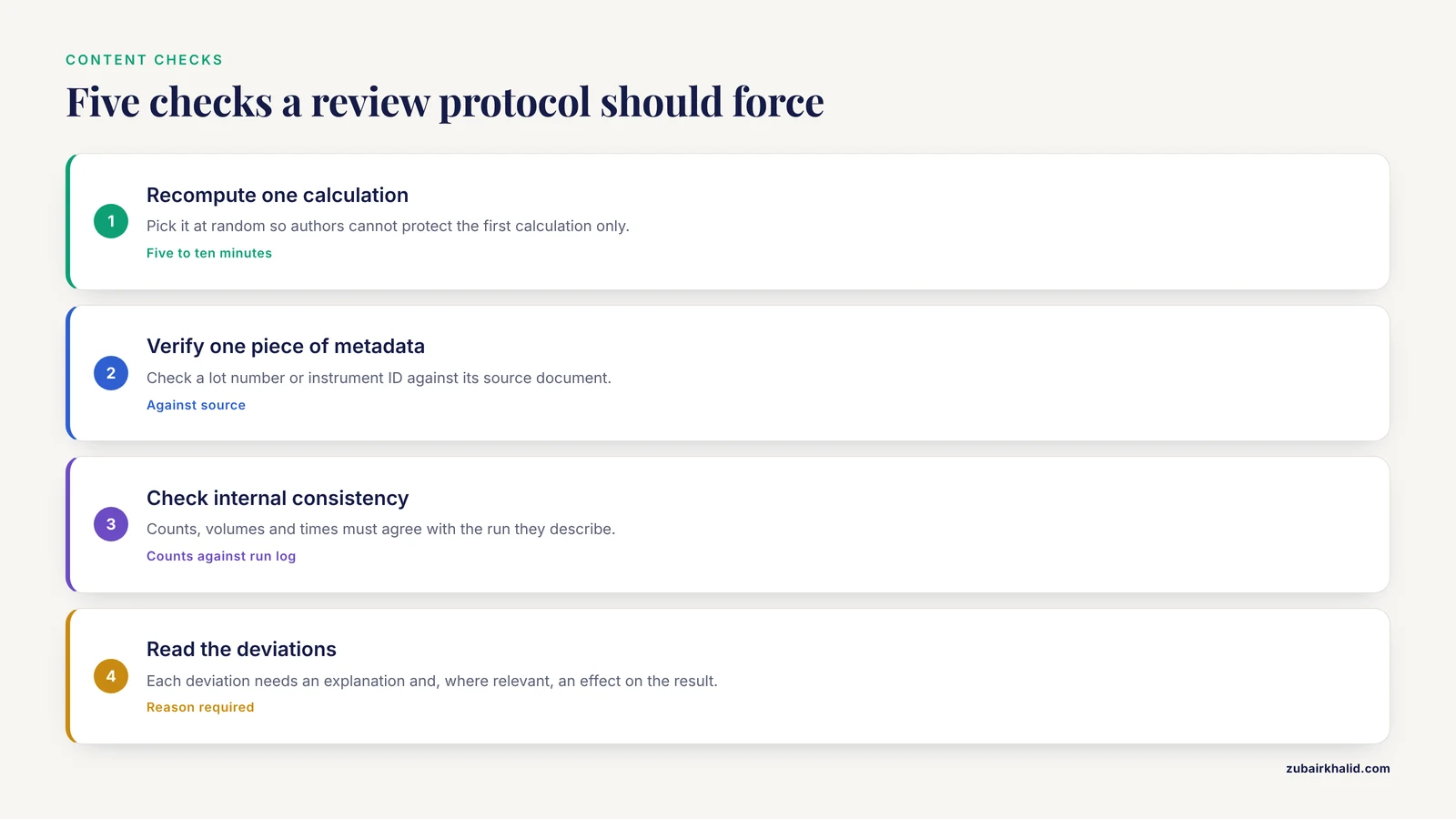
Replace the open-ended instruction "review the notebook" with a written checklist that forces content checks. A workable protocol for a single entry takes five to ten minutes and includes:
- Recompute one calculation from scratch, chosen at random by the reviewer.
- Verify one piece of metadata, such as a lot number or instrument ID, against its source document.
- Check internal consistency, meaning the counts, volumes, and times recorded in the entry must agree with the run or session they describe.
- Read the deviations section and confirm each deviation has an explanation and, where relevant, an effect on the result.
- Confirm the correction log, if any, has been applied correctly.
The random element matters. If reviewers always recompute the first calculation, authors learn to make the first calculation correct. Random selection keeps the entire entry honest.
Use Second-Person Verification Where It Matters
Full independent review of every entry is usually impractical. A tiered approach works better. The author performs a same-day self-check, which catches obvious slips. A second person performs verification of critical entries only, which in most labs means calculations, sample identity assignments, and any entry that feeds directly into a reported result. This mirrors the second-person verification that Good Laboratory Practice regulations under 21 CFR Part 58 require for critical phases of nonclinical studies, and the same logic transfers well to academic work where the result matters.
Define "critical" in writing before you need it. A reasonable starting definition is any entry that, if wrong, would change the interpretation of a result or would have to be reproduced during a replication attempt.
Shorten the Interval Between Recording and Review
Set a rule the lab can actually keep, such as review within five working days of the entry, and track compliance. A short interval does three things at once. It preserves the reviewer's ability to resolve questions from memory, it prevents the end-of-quarter signature ritual, and it distributes the attention budget evenly across the notebook instead of concentrating it in a late batch.
Fix the Template Before Fixing the Review
Many missed errors are template errors wearing a reviewer costume. If the notebook has no field for deviations, no field for equipment IDs, and no structured area for calculations, the reviewer cannot be blamed for missing information that was never recorded in a findable place. Template work comes first because it changes what can be reviewed.
Handling Corrections and Deviations
Two categories of entry deserve explicit review attention because they are where honest mistakes hide. The first is corrections. Every correction should use a single line through the original text, leaving it legible, with the corrected value, the initials of the person making the change, the date, and a brief reason. Erasures, correction fluid, and overwriting destroy the original record and create a review blind spot, because the reviewer can no longer see what changed. The second category is deviations from the written protocol. A deviation recorded with a reason is useful information. A deviation recorded without a reason, or not recorded at all, is an error waiting for its next review to miss it.
Electronic Lab Notebook Comparison: Where Digital Review Helps and Hurts
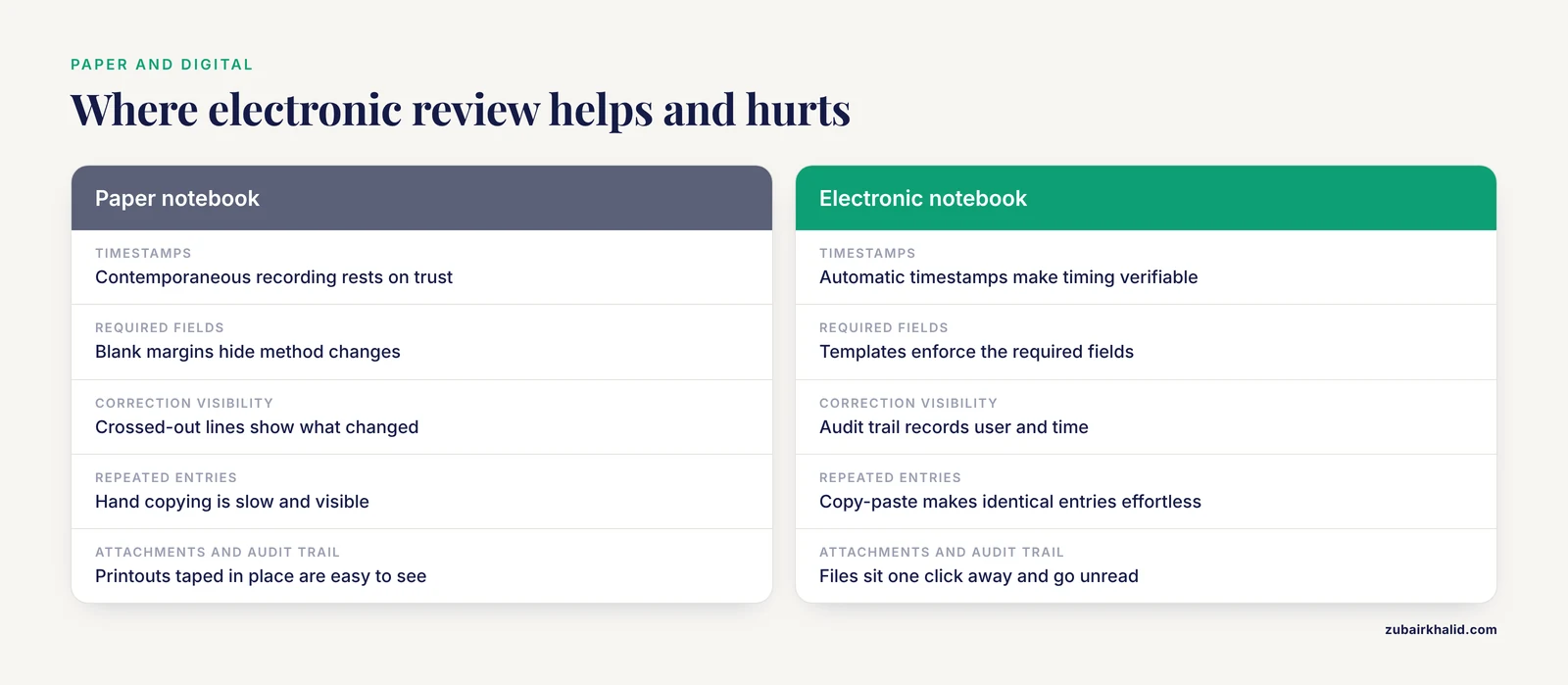
Electronic lab notebooks change the failure modes of review more than they change the frequency. Understanding both sides keeps expectations realistic during an electronic lab notebook comparison.
Digital systems help review in four specific ways. Timestamps are automatic, so contemporaneous recording becomes verifiable rather than a matter of trust. Templates enforce required fields, which eliminates the blank-margin problem of paper notebooks. Audit trails record every change with the user and the time, so corrections become visible events instead of crossed-out lines. Search makes targeted review possible, for example pulling every entry that used a particular reagent lot across a whole project.
Digital systems hurt review in four corresponding ways. Copy-paste makes identical repeated entries effortless, and identical entries are exactly the pattern reviewers stop reading closely. Attachments, instrument files, and linked datasets sit one click away, and reviewers click far less often than they should. Audit trails generate volume, and an unread audit trail provides the feeling of control without the substance. Finally, screen-based review encourages skimming, because scrolling is faster than reading and the interface gives no natural stopping point the way a page turn does.
The practical conclusion is that electronic systems shift review effort from legibility and attribution toward content and attachments. Labs that port their paper review checklist directly into an electronic workflow usually end up verifying signatures that the system already guarantees, while skipping attachment checks that the paper world never required. Rebuild the checklist around what the system does not verify for you.
Designing a Lab Notebook Template That Supports Review
A lab notebook template either feeds the review or starves it. At minimum, a template should include:
- A unique experiment or entry identifier that matches any attached files
- Date and time of the work, recorded at the time it happens
- The objective in one sentence, so a reviewer knows what the entry claims to accomplish
- The full method as performed, including any change from the standard protocol
- Reagent details, including source, lot number, and preparation date where relevant
- Structured calculation space, written out step by step rather than as a final number
- Instrument identifiers and key settings
- Raw data location, whether that is a printout taped in place, a file name, or a repository reference
- A deviations section, with a reason required for each entry
- Signature and date lines for both the author and the reviewer, kept separate
The structured calculation space deserves emphasis. When a template records only the final concentration, the reviewer has nothing to check, so they cannot check it. When the template requires the dilution equation with the actual numbers, recomputation during review takes seconds.
Safety note. Any template section covering reagents and equipment should capture the hazards associated with the work, for example by referencing the safety data sheet for each chemical used and noting any biological material handled under institutional biosafety requirements. This serves review in a direct way. A reviewer who sees a hazard notation can confirm that the recorded handling steps are consistent with the hazard, and a missing hazard notation is itself a reviewable defect. Never rely on memory for hazard information. Check the current safety data sheet from the manufacturer before recording handling instructions in a notebook, because formulations and precautionary statements change between lots and suppliers.
Common Mistakes and Limitations
Even well-intentioned labs repeat a specific set of mistakes when they overhaul their review process. Treat this section as a checklist of what not to do.
- Fixing the reviewer instead of the process. Individual diligence varies less than process design. A mediocre reviewer with a content-based checklist outperforms a careful reviewer with no checklist.
- Adding review steps without adding time. A checklist imposed on an unchanged time budget gets performed superficially, and the lab gains the appearance of rigor while losing what little attention existed before.
- Reviewing only the sample that will be inspected. If review intensity concentrates on entries likely to face an audit, the notebook develops a clean front section and an unchecked remainder.
- Treating the signature as the control. A signature records that a review happened. It does not record what the review covered, which is why the review checklist should itself be signed or logged.
- Confusing correction with concealment. Some labs respond to a found error by quietly fixing the entry. A corrected entry with a documented reason is a healthy record. An altered entry is a worse problem than the original error.
- Over-relying on the electronic system. Automatic timestamps and enforced templates remove certain error classes, and they have no effect on wrong values that were typed correctly into the wrong field.
One limitation applies throughout. Review requirements differ across institutions, funding contexts, and regulated environments, and the tiered approach described here is a starting framework rather than a substitute for your institution's own documentation policy. Where a formal requirement exists, whether from a sponsor, a regulator, or an institutional quality program, that requirement defines the minimum, and the practices in this article are additions, not replacements.
Prevention Practices
Prevention converts the fixes above into standing habits. The following set covers the failure modes described in this article.
- Review within five working days of the entry, and cap sessions at a fixed number of pages so attention never has to stretch.
- Use a written, content-based review checklist that forces at least one recomputation, one metadata check against a source document, and one internal consistency check per session.
- Separate the author sign-off from an independent review, and reserve second-person verification for critical entries.
- Rotate reviewers so no single person's blind spots define the lab's blind spots.
- Rebuild the lab notebook template with structured fields for calculations, deviations, reagent lots, and raw data locations, and revise it whenever a review finds an error the template made easy to make.
- Require single-line corrections with initials, dates, and reasons, and add corrected entries to the next review.
- In electronic systems, review attachments and audit trails as named steps, and treat suspiciously uniform repeated entries as a sampling trigger.
- Track missed errors as process data. When an error passes review, run the diagnostic sequence, name the failure mode, and adjust either the template or the checklist. A review process that never changes is a review process that has stopped learning.
Frequently Asked Questions
What is the most common lab notebook review mistake?
Reviewing whether entries exist rather than whether they are accurate. Form checks catch missing signatures and blank fields, and they consistently miss wrong numbers, swapped sample identities, and transcription errors, because confirming accuracy requires comparing the entry against source documents such as instrument logs and balance printouts.
How soon after an experiment should a lab notebook review happen?
Within a few working days, ideally under five. Short intervals let the reviewer resolve questions from memory, prevent end-of-quarter batch signing rituals, and spread review attention evenly across the notebook instead of concentrating it in a rushed late session where scanning replaces reading.
Who should review a lab notebook?
A second person who understands the science in the entry, and not the author. Administrative staff can competently verify dates and signatures, but judging a calculation or a method deviation requires technical knowledge, so match the reviewer to the content being verified.
Can a scientist review their own notebook?
Not in a way that substitutes for independent review. Self-review is useful as a same-day housekeeping check, but it cannot catch assumption errors, because the author reads their own notebook with full expectation of what it should say. Use self-checks for slip detection and independent review for verification.
What is ALCOA and why does it matter for reviews?
ALCOA stands for Attributable, Legible, Contemporaneous, Original, and Accurate, a widely used summary of data-integrity expectations. It matters for reviews because four of the five attributes can be checked from the page alone, while accuracy, the attribute most often missed, requires opening the underlying records, which is exactly the step reviews tend to skip.
Do electronic lab notebooks prevent review errors?
They prevent some and enable others. Automatic timestamps, enforced templates, and audit trails remove legibility and attribution failures, but copy-paste entry, unread attachments, and skim-heavy screen reading introduce new failure modes. An electronic system changes which review steps matter, it does not remove the need for content checks.
What should a lab notebook template include?
A unique entry identifier, date and time, a one-sentence objective, the method as performed, reagent sources and lot numbers, written-out calculations, instrument identifiers, raw data locations, a deviations section with required reasons, and separate signature lines for author and reviewer. Structured calculation space is the field most often missing and most valuable to reviewers.
How do you fix a review that already missed an error?
Run a diagnostic sequence before changing anything. Classify the error type, compare the entry date to the review date, ask the reviewer what they actually examined, check whether the template captured the missing information, and examine how the correction was handled. The diagnosis points to a specific fix, such as adding recomputation to the checklist or shortening the review interval.