The Lab Notebook Review Meeting: An Agenda
By Dr. Zubair Khalid, DVM, MS, PhD ·

By the end of this article you will be able to run a lab notebook review meeting with a written agenda, sample entries in a defensible way, record the outcome in a review log, and close each meeting with assigned follow up actions. You will need three things on hand: the notebooks or electronic lab notebook (ELN) accounts under review, a one page agenda, and a review log where you record what was checked and what needs fixing.
The lab notebook review meeting is a short, recurring meeting in which a senior scientist, lab manager, or principal investigator reads through lab notebook entries with the person who wrote them and checks that the record is complete, dated, signed, and traceable. It is not a performance review and it is not a data club. The single purpose is to confirm that the permanent record of the work would let a trained stranger repeat the experiment and find the raw data behind every number.
Why the Lab Notebook Review Meeting Matters
Notebooks are the primary record of research. The Office of Research Integrity, which sets expectations for responsible data management in US federally funded research, treats laboratory notebooks as core documentation of data ownership, retention, and reproducibility. Under Good Laboratory Practice principles published by the OECD, study records must be attributable, dated, and available for reconstruction of the work. For labs that operate under the US FDA's 21 CFR Part 11 rules for electronic records, the same expectations extend to ELNs, which must produce trustworthy, attributable, and auditable records.
A review meeting makes those abstract requirements concrete on a schedule. It catches small problems, a missing date, an unsigned correction, a figure referenced but never attached, while the person who wrote the entry still remembers the details. Wait six months and the same problem becomes a reconstruction project.
Review meetings also serve a quieter function. New students and technicians learn what a complete entry looks like by having their entries read out loud and questioned. Labs that review notebooks routinely produce far fewer incomplete entries than labs that review only before a paper submission or an audit.
The Lab Notebook Review Meeting Agenda, Step by Step
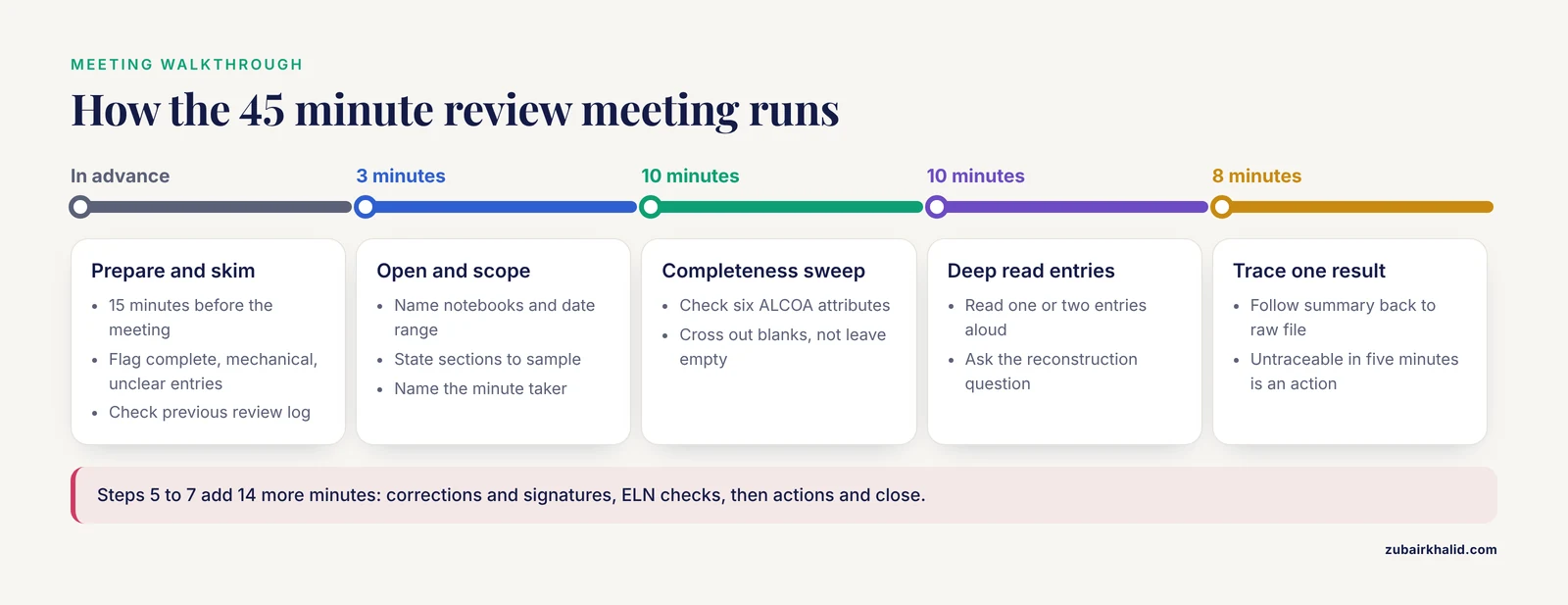
The agenda below assumes a 45 minute meeting covering one or two notebooks. Scale the time up or down with the number of notebooks. The full walkthrough follows the sequence you should run in the meeting itself, so you can use this section as your meeting script.
Step 0: Prepare Before the Meeting (15 minutes, done in advance)
The reviewer collects the notebooks or opens the ELN records for the period under review and skims them before anyone sits down. Preparation is what separates a useful review from a rambling one. During the skim, flag three categories of items on sticky notes or in a shared document:
- Entries that look complete and well written (use these as examples)
- Entries with mechanical problems (missing dates, unsigned corrections, blanks)
- Entries where the science itself is unclear (ambiguous reagent identity, units missing, an unexplained jump in a protocol)
The reviewer also checks the previous review log so that earlier action items can be verified rather than re discussed.
Step 1: Open the Meeting and Set the Scope (3 minutes)
State three things out loud and write them in the review log:
- Which notebooks and which date range are under review
- Which sections will be sampled in depth
- Who is recording the minutes
A typical opening sounds like: "Today we review the Chen and Okafor notebooks covering September 1 through October 31. We will deep read two entries per notebook and sweep the rest for completeness. I will record actions in the shared review log."
Step 2: Run the Completeness Sweep (10 minutes)
The sweep is a fast page by page or entry by entry check for mechanical completeness. For each entry you confirm six attributes, which map onto the ALCOA principles (Attributable, Legible, Contemporaneous, Original, Accurate) used across regulated and academic labs:
| Attribute | Question to ask | Typical failure |
|---|---|---|
| Attributable | Is the author identified? | Initials only, no full name anywhere |
| Dated | Is there a date on every page or entry? | A week of pages with one date at the top |
| Legible | Can someone else read it? | Pencil, overwriting, abbreviations nobody defines |
| Original | Are raw values recorded directly? | "See separate sheet" for a sheet that is gone |
| Accurate | Do units and identities match reality? | mg written where µg was meant |
| Complete | Are blanks crossed out rather than left empty? | An empty margin that looks like a skipped condition |
For an ELN, the completeness sweep is faster because timestamps and authorship are automatic. You shift attention to attachment presence and signature status, covered in Step 6.
Step 3: Deep Read Sampled Entries (10 minutes)
Pick one or two entries and read them aloud with the author. For each, ask the reconstruction question: could a trained colleague in another lab repeat this experiment from this entry alone? Work through the entry in this order:
- Objective. Does the first line state what the experiment is testing?
- Materials. Are reagents identified well enough to order them again? A lot number for an antibody, a catalog source for a cell line, a manufacturer and grade for a chemical.
- Method deviations. If the protocol differs from the standard one, is the deviation written down with a reason?
- Raw data. Are the actual observed numbers recorded, not just the calculated ones? If the notebook shows only a fold change, where is the raw fluorescence value?
- Linkage. Does every number point to a raw file, a printout, a gel image, or an instrument log? In an ELN this means an attached file or an instrument identifier. On paper it means taped in printouts with the page noted.
- Follow up. Does the entry end with the next step and the conclusion, even a one line one?
Step 4: Check Data and File Traceability (8 minutes)
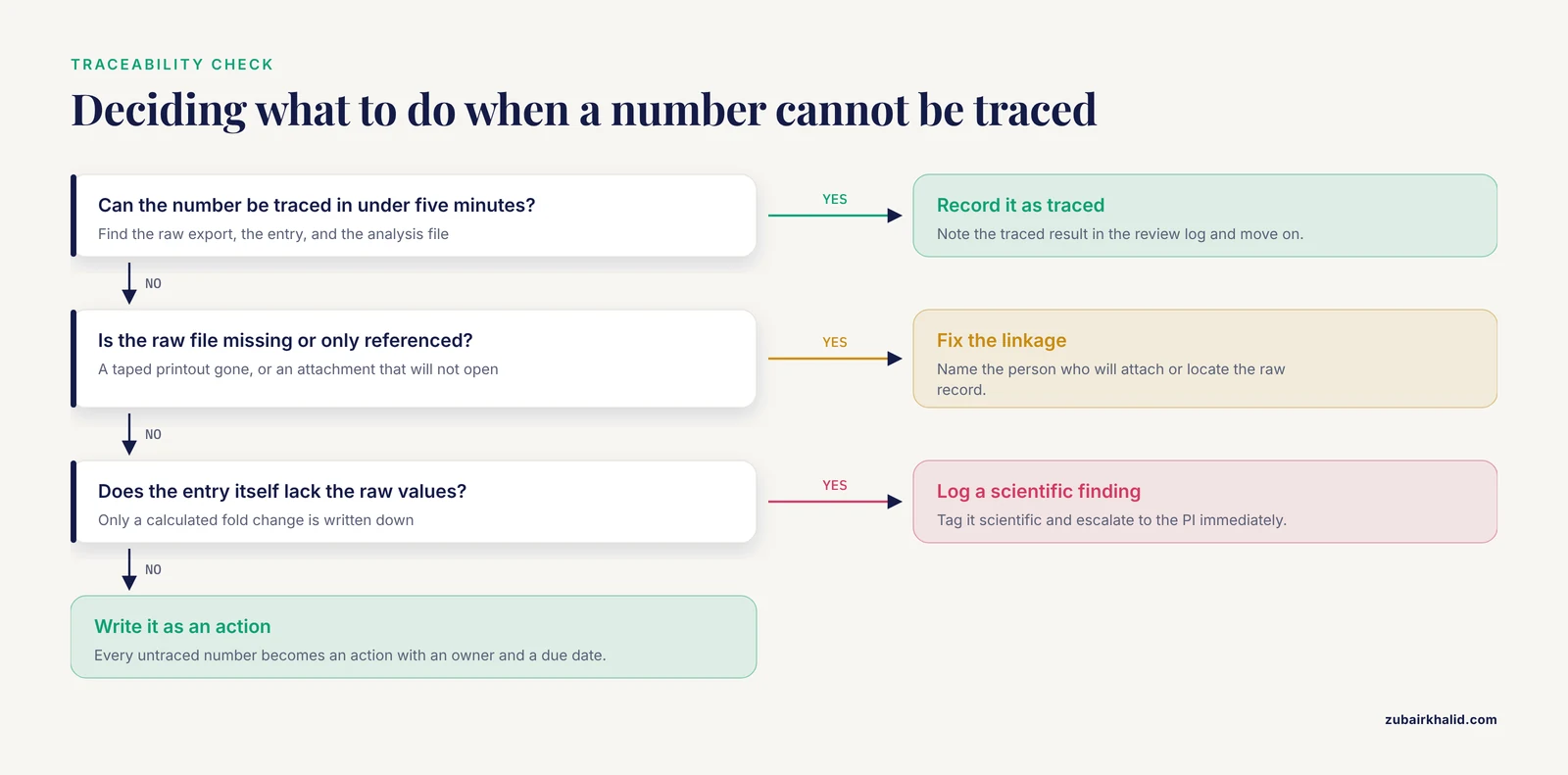
Traceability is where most notebooks fail quietly. For each figure or result the group produced in the review period, trace one path from the summary back to the raw record. For example, take the statement "the 10 µM treatment reduced viability by 40 percent" and find the plate reader export, the notebook entry that describes the assay, and the analysis file that produced the number. You do not need to trace every result every month. Trace one or two per meeting and rotate.
If a number cannot be traced in under five minutes, that is an action item. Write it down with the name of the person who will fix the linkage.
Step 5: Verify Corrections, Signatures, and Witnessing (5 minutes)
Corrections follow strict conventions, and they are the most common source of audit findings. On paper, a correction is a single line through the error so the original remains readable, followed by the correct value, the author's initials, the date, and a short reason. Erasure, white out, and overwriting are not acceptable. In the meeting, the reviewer scans the sampled pages for crossed out values and confirms each carries initials and a date.
Signatures and witnessing are separate functions. The author signs to attest the entry is their work and is accurate. A witness, where required by the lab's policy or a sponsor agreement, signs to attest they observed the work. GxP labs and many sponsored projects require dated signatures on every entry or every page. Academic labs often apply witnessing to critical steps only, such as animal procedures or the release of a reference standard. The review meeting confirms that whatever policy the lab has adopted was actually followed.
Step 6: Run ELN Specific Checks (5 minutes, if applicable)
For an electronic lab notebook, replace the page sweep with these checks:
- Every entry for the period has a completed signature or is explicitly marked draft
- Attached files open and match the version referenced in the entry
- Templates were used where the lab requires them, rather than free text
- Locked or finalized entries were not edited after signing (the audit trail will show this)
- Shared group entries name every contributor
Most ELNs export an entry log as a CSV file. A two minute scripted check finds date gaps and unsigned entries faster than scrolling. Here is a worked example you can adapt. The script reads an export, looks for gaps longer than a threshold you choose, and counts unsigned entries.
import csv
from datetime import date

THRESHOLD_DAYS = 14

rows = list(csv.DictReader(open("eln_export.csv")))
dated = sorted(date.fromisoformat(r["entry_date"]) for r in rows if r["entry_date"])

gaps = [(a, b, (b - a).days)
        for a, b in zip(dated, dated[1:])
        if (b - a).days > THRESHOLD_DAYS]

unsigned = [r["entry_id"] for r in rows if r["signature_status"] == "none"]

for a, b, d in gaps:
    print(f"GAP: {a} to {b} ({d} days, {d - THRESHOLD_DAYS} days over threshold)")
print(f"Unsigned entries: {len(unsigned)} -> {', '.join(unsigned) or 'none'}")
print(f"Entries checked: {len(dated)}")
The expected output for a healthy notebook looks like this:
Unsigned entries: 1 -> EN-0288
Entries checked: 41
And for a notebook with a gap:
GAP: 2026-09-02 to 2026-09-29 (27 days, 13 days over threshold)
Unsigned entries: 3 -> EN-0201, EN-0204, EN-0211
Entries checked: 18
A gap is not automatically a problem. A two week field trip or a rotation period with no bench work explains many gaps. The script's job is to surface them so the author can explain them in the meeting, which then goes into the review log.
Step 7: Record Actions and Close (4 minutes)
Every review meeting ends with a written record containing four items:
- Notebooks and date range reviewed
- Findings, each with a severity (fix now, fix this week, systemic issue)
- Named owners and due dates for each action
- Verification status of the previous meeting's actions
The review log itself becomes part of the lab's quality record. Keep it in the ELN or in a bound file with the notebooks.
Worked Example: Calculating Review Coverage
Review coverage is the fraction of entries examined in depth. It is the number you report to yourself when you decide whether your sampling is real or cosmetic. The calculation takes one line.
entries_in_period = 60
entries_deep_read = 15
coverage = entries_deep_read / entries_in_period * 100
print(f"Review coverage: {coverage:.0f}%")
Expected output:
Review coverage: 25%A quarterly meeting that deep reads zero entries has 0 percent coverage no matter how long it runs. Track coverage in the review log alongside the findings. If coverage stays below roughly 20 percent for months, either shorten the interval between meetings or sample more per meeting, because mechanical sweeps alone rarely catch ambiguous science.
Parameters That Matter
The agenda stays constant, but four parameters change with the lab, and each choice has consequences. This table summarizes the practical options.
| Parameter | Common options | Best suited to | Tradeoff |
|---|---|---|---|
| Frequency | Monthly, quarterly, per project milestone | Monthly for active benches, quarterly for slow moving projects | More frequent meetings keep memories fresh but cost time |
| Sampling strategy | Fixed count (2 entries), random sample, all GxP entries | Fixed count for teaching labs, full review for regulated work | Full review is thorough and slow |
| Reviewer | PI, lab manager, peer scientist | Lab manager for technical completeness, PI for scientific content | Peer review builds culture but may miss policy issues |
| Documentation | Review log in ELN, bound paper log, spreadsheet | ELN log for GxP labs, any durable log elsewhere | The log must itself be dated and attributable |
Set these once in a written lab policy, then follow them. Changing the rules every meeting destroys the value of the record, because gaps between reviews stop meaning anything.
Electronic Lab Notebook Comparison
Choosing between a paper notebook and an ELN changes which agenda steps matter. The comparison below is functional rather than vendor specific, because the features that drive review workflows are common across the major platforms, including Benchling, eLabFTW, RSpace, and LabArchives.
| Feature | Paper notebook | Typical ELN |
|---|---|---|
| Attribution | Handwritten signature, witness line | Automatic user identity, login tied |
| Timestamps | Written by hand, easily mistaken | Automatic, server recorded |
| Corrections | Single line strikeout with initials | Version history and audit trail |
| File linkage | Taped printouts, page references | Native attachments and instrument integrations |
| Search | None beyond the index page | Full text search across the lab |
| Completeness sweep | Manual page turning | Filter by signature status or template |
| Backup | Scanning program, vulnerable to loss | Server side, depends on vendor arrangement |
| Offline bench use | Always available | Depends on the platform and network |
Three conclusions follow for the review meeting. First, in an ELN the mechanical sweep shrinks to minutes, because signature status and timestamps are queryable, and you redirect that time to deep reads and traceability. Second, paper retains an advantage at the bench for fast annotations, so many labs run a hybrid and the meeting must check that paper scratch notes were transcribed before the paper is retired. Third, for labs under 21 CFR Part 11, the ELN must provide the audit trail and signature manifestations that the rule requires, so the review meeting includes a periodic look at the audit trail itself, not just the entries.
When comparing ELN platforms for your lab, evaluate against your review workflow, not against feature lists: can you export an entry log, filter by signature status, enforce templates, and view an audit trail per entry. Those four capabilities decide how much of this agenda can be automated.
A Lab Notebook Template You Can Adapt
Labs that give every member a common structure spend far less meeting time fixing entries. Here is a template that covers the attributes in the completeness sweep. Post it in the ELN as a template or print it inside the front cover of paper notebooks.
# Entry [number] - [short title]
Date: YYYY-MM-DD
Author: full name
Related project/protocol: [link or protocol ID]

## Objective
What question does this experiment answer? One or two sentences.

## Materials
- Reagent or sample, source, lot or passage number, concentration
- Instrument, including asset or serial number if tracked

## Procedure
Reference the standard protocol ID, then record ONLY deviations:
- Deviation 1: what changed, why

## Raw observations
Record values as read. Units on every number. Attach or reference
raw files by filename.

## Results and interpretation
What the data show. Mark calculations as calculated, raw values as raw.

## Next steps
The single next action, with a date.

Author signature: ______________ Date: ______
Witness signature (if required): ______________ Date: ______
The template earns its place at the review meeting because each heading maps to a question the reviewer asks. When everyone uses it, the deep read becomes a scan for empty headings.
Lab Notebook Review Meeting Agenda Tips
These tips come from the parts of the workflow that most often fall apart in practice.
- Prepare or cancel. An unprepared review meeting degenerates into a general lab chat. If the reviewer cannot skim in advance, move the meeting rather than improvising.
- Deep read the new person's notebook first. Students in their first months benefit most from entry level feedback, and their bad habits are cheapest to fix early.
- Rotate traceability targets. Trace a different figure or dataset each meeting so that over a year the whole project's data paths get exercised.
- Read the good entries aloud too. Naming one exemplary entry per meeting sets the standard faster than listing failures.
- Keep findings severity tagged. A missing date and a fabricated linkage are not the same class of problem. Tag findings as mechanical, traceability, or scientific, and escalate only the last category to the PI immediately.
- Timebox the science discussion. If a deep read turns into a genuine data discussion, take it offline and note it in the log. The meeting's product is a review record, not a decision.
- Automate the sweep in an ELN. Save the script above, run it the morning of each meeting, and bring the output. Fifteen seconds of script replaces twenty minutes of scrolling.
Common Mistakes and Limitations
These are the mistakes labs actually make when they institute the lab notebook review meeting, along with the fixes.
- Reviewing only before an audit or submission. A review conducted under deadline pressure finds nothing and fixes less. The entire value of the meeting comes from regularity while memory is fresh.
- Reviewing without the author present. The reviewer who annotates a notebook alone produces a list of complaints nobody reads. The author in the room turns each finding into an immediate fix or an explained gap.
- Treating the review as a grading exercise. If the first review of a new student results in formal criticism, the lab teaches everyone to write less. Frame findings as reconstruction questions, not judgments, and the notebook quality rises.
- Confusing review with witnessing. The reviewer checks completeness and traceability. The witness attests to observing the work. One person can do both only if the lab's policy allows it, and each function gets its own signature.
- Letting the review log go undocumented. A review that produces no written record cannot demonstrate diligence later. Write the log even when the meeting is short and the findings are few.
- Allowing blank margins to survive. Empty space on a page is an ambiguity invitation. Cross out unused space or draw a diagonal line through the remainder of the page in paper notebooks.
- Ignoring the review log's own quality. The review log is itself a record. If it has no dates or no named recorder, it fails the same standard the meeting enforces.
A limitation to state plainly: this agenda describes a general academic and industry practice pattern, not a binding regulatory procedure. Labs operating under specific sponsor terms, institutional biosafety requirements, or GxP quality systems must follow those written requirements where they differ, and individual cases involving data disputes or suspected record falsification belong with your institution's research integrity office, not with a routine meeting agenda.
Frequently Asked Questions
How often should a lab hold a notebook review meeting?
Most active research labs do well with a monthly meeting of 30 to 60 minutes, while low activity projects can move to quarterly. Choose a cadence you can sustain, because an abandoned schedule is worse than a modest one.
Who should attend the lab notebook review meeting?
The notebook author, the reviewer (usually a PI, lab manager, or senior scientist), and optionally one peer. Keep it small, three people at most, so the meeting stays a working session rather than an audience event.
Should we review paper notebooks or electronic lab notebooks?
Review whichever medium holds the primary record, and if you run a hybrid, review both. In an ELN the mechanical sweep is faster because signatures and timestamps are automatic, so spend the saved time on traceability and deep reads.
What is the difference between notebook review and witnessing?
Review checks that entries are complete, accurate, and traceable. Witnessing is a separate attestation that a second person observed the work being performed. Some labs combine the functions in one meeting, but each requires its own signature and purpose.
How much of the notebook should be reviewed each time?
A practical pattern is a full mechanical sweep of the period plus a deep read of about 20 percent of entries, rotating which entries are sampled. Regulated labs under sponsor or GxP requirements may need to review every entry.
What do we do when we find a missing entry or an error?
Record a late entry that is clearly labeled as such with the current date, an explanation, and the author's signature, and never backdate. For errors in existing entries, apply the single line correction convention with initials, date, and reason.
Do we need to document the review meeting itself?
Yes. A dated review log listing the notebooks covered, findings, action owners, and due dates is what turns the meeting into an auditable quality practice. Without the log, the meeting leaves no evidence it happened.
Can a lab notebook template replace part of the review meeting?
A shared template reduces the mechanical findings dramatically but does not replace the meeting, because only a reviewer can judge whether an entry actually lets someone reproduce the work. Use the template to make the meeting shorter, not to skip it.