Page Numbering Strategies for Lab Notebooks
By Dr. Zubair Khalid, DVM, MS, PhD ·

The core difference between lab notebook page numbering methods is who assigns the numbers and when: a factory stamps them into a bound notebook, a scientist writes them in by hand as pages fill, or an electronic lab notebook assigns entry identifiers automatically. The rule of thumb is simple. If your records must hold up in a patent dispute or a regulatory audit, use a pre-numbered bound notebook or an electronic lab notebook (ELN) with a locked audit trail. If you are documenting everyday academic research, hand numbering with a consistent format works well and costs nothing.
Page numbering sounds like a trivial detail. It is not. The page number is the address of every claim in your notebook, and when a page has a reliable address, you can cite it in a meeting, point a collaborator to it, defend it in an intellectual-property review, or find it again five years later. Researchers who study archival lab notebooks describe them as an invaluable record of research conditions, steps, and outcomes, and they note that the usefulness of those records depends on being able to segment a notebook into discrete, locatable entries [1]. Page numbering is what makes that segmentation possible in the first place.
Why page numbering matters more than it looks
A lab notebook is a legal and scientific document, not a diary. Three functions depend directly on page numbering.
Continuity. Experiments rarely fit on one page. A protocol started on page 14 continues on page 15 and maybe page 22 after an interruption. Numbering gives you the "continued on page" notation that keeps a long experiment readable.
Traceability. Every figure, sample, and reagent lot you use should trace back to a dated, locatable entry. When a reviewer or collaborator asks where a number came from, "notebook 3, page 41, entry dated March 8" is an answer. "Somewhere in the middle of the blue notebook" is not.
Tamper evidence. Sequential page numbers expose missing pages. If a bound notebook jumps from page 27 to page 30, anyone auditing the record sees the gap immediately. That property is a large part of why bound, sequentially numbered notebooks became the standard in industrial research settings.
There is a growing practical reason as well. Projects that digitize old analog lab notebooks now use automated tools to segment scanned pages into entry types and extract their contents so the data can be reused and analyzed [1]. Notebooks with clean, consistent page numbering scan, index, and segment far more reliably than notebooks with loose pages and improvised labels. The page number you write today determines how machine-readable your record is decades from now.
The main page numbering options at a glance
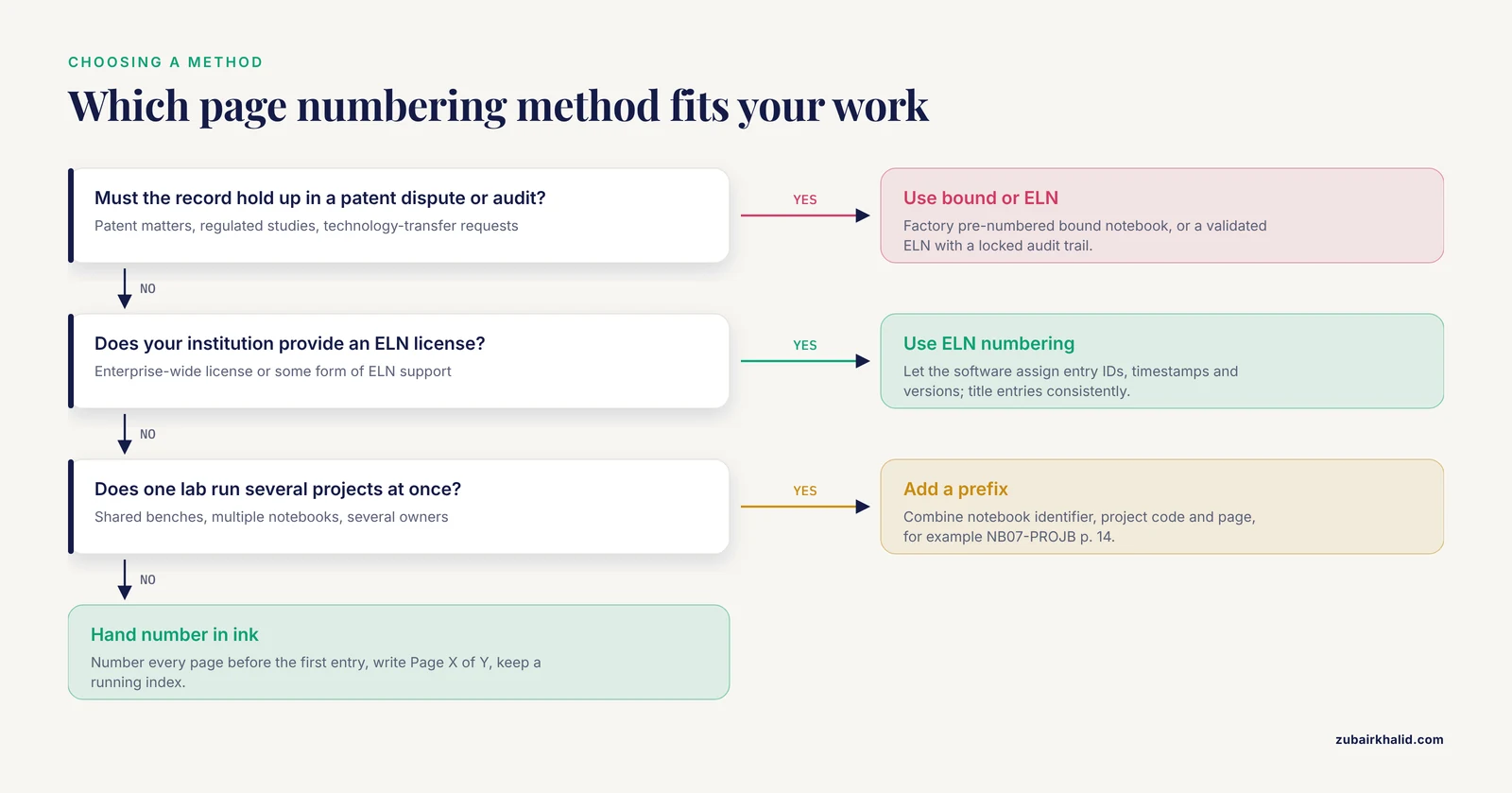
The table below compares the seven practical page numbering strategies for lab notebooks that most labs use, alone or in combination.
| Method | How it works | Pros | Cons | Best fit |
|---|---|---|---|---|
| Factory pre-numbered bound notebook | Pages are printed with sequential numbers and often "Page X of Y" before you ever write in the book | Strong tamper evidence, zero effort, audit-friendly | Cannot add pages, fixed order, no project prefixes | Industrial R&D, patent-sensitive work, regulated studies |
| Hand numbering a blank or spiral notebook | You write page numbers in ink as pages fill | Works with any cheap notebook, flexible | Easy to forget, weaker tamper evidence, spiral pages can be removed | Students, academic labs, field work |
| Numbered copy-sheet notebook | Each original page sits over a numbered carbonless duplicate sheet | Gives a second copy for a witness, supervisor, or file | Duplicates smudge, bulkier and more expensive, limited page counts | Labs requiring countersigned or filed copies |
| Date-anchored numbering | Entries are keyed by date, for example 2026-03-08 page 1, rather than by page position | Natural chronology, easy sorting, survives loose pages | Harder to locate a page physically, two entries can share a code | Field notebooks, clinical or observational records |
| Prefixed section numbering | Each notebook or project gets a prefix, for example "SN-2026-03 p. 14" | Unambiguous across many notebooks and users | Requires discipline and a naming convention | Multi-project labs, shared equipment logs |
| ELN automatic numbering | The software assigns entry IDs, versions, and timestamps | Searchable, timestamped, supports multimedia and signatures | Depends on institutional licensing and support | Industry, collaborative projects, data-heavy work |
| Hybrid paper plus scan | Number paper pages, then scan and name files by notebook and page | Combines permanence with searchability | Adds a scanning workflow and storage decisions | Labs moving toward digital records |
No single method wins on every criterion. The sections below explain each option on its own terms, then the article compares them on the criteria that actually decide the choice.
Method deep dives
Factory pre-numbered bound notebooks
This is the traditional gold standard. The notebook is stitched or glued as a bound volume, pages are stamped with sequential numbers before sale, and many commercial versions print "Page 1 of 72" style labels plus a signature and date line at the bottom of each page. Some include a table of contents block in the front.
The strengths come from physics and arithmetic. Bound pages are hard to remove without visible damage, and sequential numbering makes any removal obvious. In United States patent practice, a bound, sequentially numbered notebook with dated and signed entries has long served as corroborating evidence of conception dates and diligent work, which is why many technology-transfer offices still ask for them even as ELNs spread. The tradition extends well beyond chemistry and biology. Technical writing on electronics bench work treats the laboratory notebook as a standard companion to instruments such as oscilloscopes, with the notebook capturing setup, settings, and observations alongside the measurement hardware [2].
The weaknesses are rigidity and search. You cannot insert a page when an experiment runs long, and finding anything depends on the index you maintain by hand in the front. If you abandon a project halfway through the book, the rest of the numbered pages either sit empty or get crossed out and labeled with a diagonal line, which looks untidy but is actually correct procedure.
Hand numbering a blank or spiral notebook
Many students and academic labs use ordinary composition or spiral notebooks and number pages by hand in ink. The method is cheap and flexible, but it has the weakest integrity guarantees of any option here. Spiral bindings let pages tear out, and hand numbering invites the two classic failures: forgetting to number for weeks, then guessing, and renumbering after a mistake.
If you use this method, adopt three habits that recover most of the lost rigor. Number pages in permanent ink the day you start the notebook, before the first entry. Write "Page 5 of 100" rather than "5" so that a missing or added page is detectable. And treat a numbering error with a single-line strikethrough and initials rather than white-out, which is the same correction rule you apply to data errors.
Numbered copy-sheet (duplicate page) notebooks
These notebooks pair each original page with a carbonless duplicate that carries the same printed number. When you write on the original, pressure transfers the entry to the copy. The original stays in the book and the duplicate tears out for a supervisor, a witness, or a project file.
The page numbering itself is factory-assigned, so integrity is good. The tradeoffs are practical. Duplicates degrade over time, the books are bulkier, page counts are limited, and the per-book cost runs higher than plain bound notebooks. The method earns its keep when two parties need simultaneous possession of the same numbered record, for example a countersigning arrangement between a trainee and a supervising scientist.
Date-anchored numbering systems
Instead of relying only on page position, a date-anchored system keys every entry to an ISO-format date such as 2026-03-08, optionally with a sequence suffix for multiple entries that day. The page still carries a physical number, but the reference you cite is the date code.
This approach shines when pages might become separated from the binding, which happens in field notebooks, and when records will later be sorted chronologically. It maps naturally onto how digitization projects treat notebooks, because automated page-segmentation pipelines group scanned content into entry types and the date is the most robust human-readable key on any page. The weakness is physical lookup. A date code does not tell a colleague which shelf the notebook sits on, so date anchoring works best combined with a notebook identifier, not instead of one.
Prefixed and sectioned numbering for multi-project labs
When one lab runs several projects, plain sequential numbers collide. Page 14 of your notebook and page 14 of your benchmate's notebook are different worlds. Sectioned numbering solves this with a prefix scheme. A common pattern combines a notebook identifier with a project code and the page number, for example "NB07-PROJB p. 14". Each element is defined once in a lab-wide register that lists every active notebook identifier, its owner, and its start date.
The cost is discipline. Prefixes only work if every user follows the same convention, and that convention is part of the normal culture a lab teaches its members as they join and learn how the group keeps records. The benefit is that any page in the lab becomes uniquely addressable in one string, which makes both human cross-references and later scanning filenames unambiguous.
Automatic numbering in electronic lab notebooks
An ELN assigns each entry an identifier, a timestamp, and usually an immutable version history. There are no physical pages to number, and the "page numbering" question becomes a question about entry identifiers, versioning, and export formatting.
Adoption in academia is real but uneven. An environmental scan of 35 major United States research universities found that 8 of them, about 23 percent, held an enterprise-wide ELN license, and 10 institutions, about 28 percent, provided some form of ELN support, with the library involved at 9 of those 10 [3]. The same review identified barriers that include cost and the diversity of researcher needs, which is why many academic labs still run on paper while their industrial counterparts standardized on ELNs years ago.
Within the ELN world, there is a meaningful distinction between page-style systems and richer structured systems. Semantic lab notebook platforms go further than storing text and files. They model the experiment itself so that the record is machine-readable and queryable, which was demonstrated in a use case modeling a microwave-based quarantine experiment [4]. This matters for numbering because a structured ELN can relate entries, samples, and instruments by defined relationships rather than by page adjacency.
Computational notebooks occupy a middle ground. A Jupyter Notebook organizes descriptive text, mathematical notation, code, and results into ordered web pages, and educators report that this format improves engagement and learning in quantitative courses [5]. For numbering purposes, a Jupyter notebook has cell and version identity rather than page numbers, so treat it as a companion record to your primary notebook unless your institution formally designates it as the record of work.
Digital notebooks also solve a paper problem automatically: the index. Work on digital notebook terminals treats index and content creation as built-in functions of the notebook itself, so the table of contents that a scientist maintains by hand on paper is generated continuously in a well-designed electronic system [6].
Hybrid paper plus scan
Many labs split the difference. Scientists keep bound or hand-numbered paper notebooks, then scan pages on a schedule and file the images with names built from the numbering scheme, for example "NB07_p041_2026-03-08.pdf". The paper original preserves tamper evidence while the scan delivers searchability. This is also the entry point that digitization research uses, since automated extraction pipelines consume page scans of archival notebooks and segment them into discrete, analyzable entries [1]. The added work is a scanning routine and a storage decision, and both fail quietly if nobody owns them, so assign the task to a named person or rotate it.
Comparing the options on the criteria that decide real choices
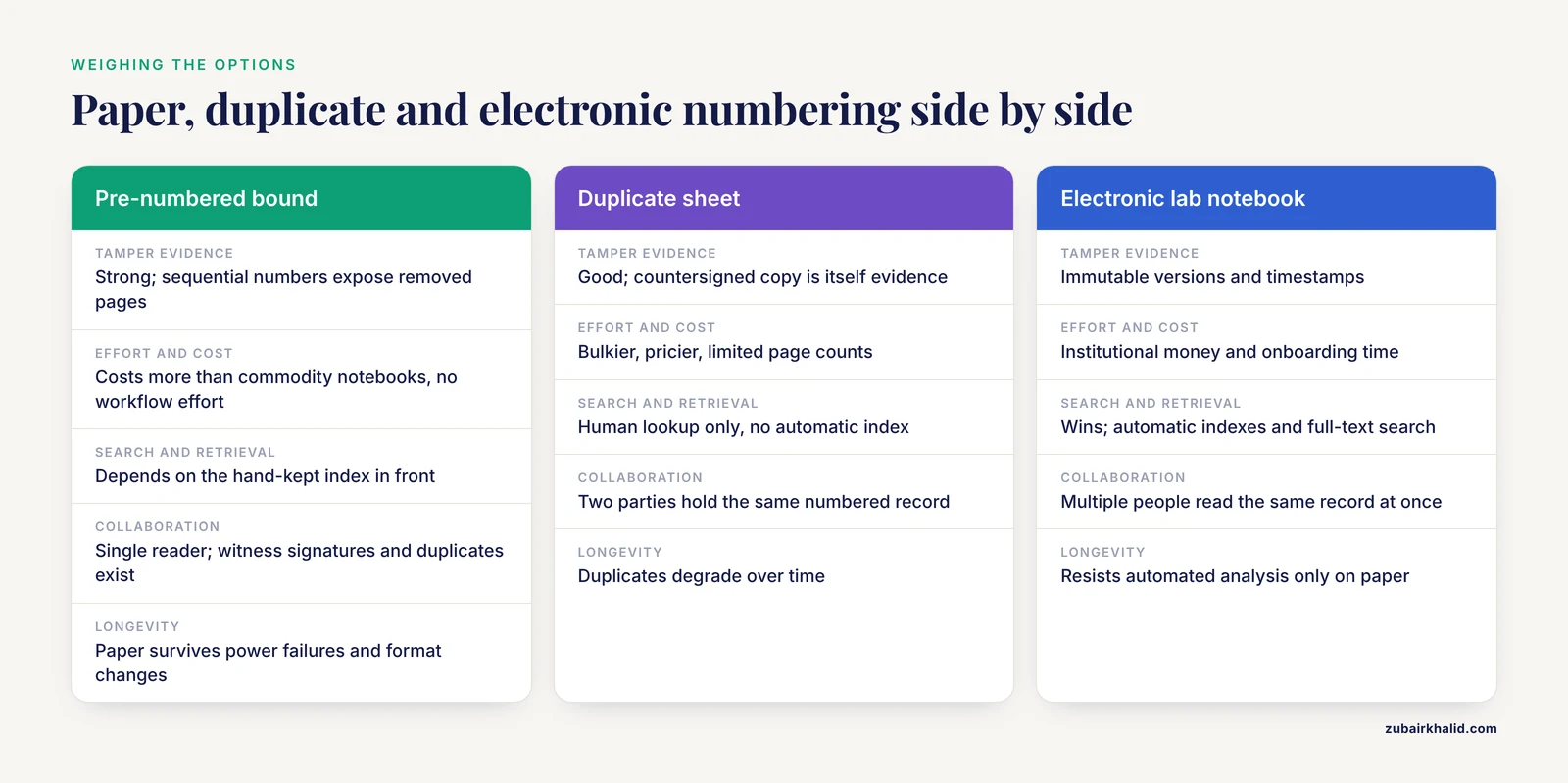
Lab notebook page numbering methods pros and cons become concrete once you weigh them against five criteria.
Legal and regulatory defensibility. Pre-numbered bound notebooks and ELNs with audit trails lead. Hand-numbered spiral notebooks trail badly, because removable pages undermine the whole point of sequential numbering. Duplicate-sheet notebooks score well because the countersigned copy is itself evidence.
Effort and cost. Hand numbering costs nothing but attention. Pre-numbered notebooks cost more than commodity notebooks but nothing in workflow. ELNs cost institutional money and onboarding time, and the licensing survey above shows why that barrier shapes adoption patterns at universities.
Search and retrieval. ELNs win decisively, with automatic indexes and full-text search as standard functions [6]. Date-anchored and prefixed paper systems improve on plain sequential numbering but still depend on human lookup. Scanned hybrids recover much of this if filenames follow the numbering scheme.
Collaboration. A shared ELN lets multiple people read the same record at once, and structured or semantic systems expose relationships between experiments rather than forcing readers to reconstruct them from page order [4]. Paper numbering is single-reader by nature, which is why witness signatures and duplicate sheets exist.
Longevity and machine-readability. Paper survives power failures and format changes but resists automated analysis until it is scanned. Current research on making archival notebook scans usable by computational and AI methods shows both the promise and the cost of converting decades of paper records after the fact [1]. Numbering your pages consistently now is the cheapest insurance available against that future conversion bill.
On balance, the best lab notebook page numbering methods for most working scientists are the two ends of the spectrum. Pre-numbered bound notebooks for anything with patent, regulatory, or long-term archival stakes. ELN automatic numbering where the institution provides one and the work is collaborative or data-heavy. Hand numbering, date anchoring, and prefixes are best understood as adaptations for situations where the two leaders are unavailable.
Worked scenarios
A first-year graduate student in an academic lab. The lab provides composition notebooks and no ELN. The student numbers every page of a new notebook in ink before starting, writes "Page X of Y" at the top of each page, keeps a running index on the first two pages, and adds a notebook identifier and project prefix to the cover and to every cross-reference. Total added time is under ten minutes for the life of the notebook, and the record is already one step above most of the lab.
An industrial R&D team working toward a patent filing. The company issues pre-numbered bound notebooks with signature and witness lines, or runs a validated ELN. Entries are dated and signed daily, a second scientist witnesses and countersigns at defined intervals, corrections use single-line strikethroughs, and no page is ever removed. The numbering scheme is factory-assigned, so the team's job is disciplined use, not page labeling.
An undergraduate teaching lab. Thirty students need a consistent, gradeable record. The instructor distributes a lab notebook template with a printed header block and numbered footer on each page of a course packet, or assigns cheap notebooks with a numbering session in week one. The template enforces the fields that matter for grading, date, experiment title, objective, observations, and signature, so page numbering and template design reinforce each other.
A lab migrating from paper to an ELN. The lab freezes old notebooks, scans them, and files images using the existing numbering as filenames. New work moves into the ELN, where entry IDs and timestamps replace page numbers. The historical record stays navigable because the old page numbers remain the addressing scheme, and the transition does not create a documentation gap between the two eras.
How to number pages correctly, step by step
Whatever method you choose, the mechanics follow the same sequence.
- Assign numbers before the first entry, in permanent ink for paper, using "Page X of Y" format.
- Do not skip pages. If you leave a page blank, draw a single diagonal line through it, write "intentionally left blank", and initial and date it.
- Start every entry with the date, the experiment title, and a continuation reference if the experiment started on an earlier page.
- End each page with "continued on page N" where relevant, so continuity survives page breaks.
- Make corrections with a single strikethrough, leaving the original legible, then initial and date the correction. Never erase or obscure.
- Sign and date the bottom of each page, and arrange witness countersignatures if your setting requires them.
- Maintain the index in the front as you go, one line per entry with page number, date, and title.
- Cross-reference related entries explicitly, for example "sample B7 prepared per page 22, analyzed page 38".
Building a lab notebook template around your numbering system
A lab notebook template is a pre-printed or pre-formatted page skeleton that standardizes what every entry contains. Numbering and templates are designed together, because the template is where the page number, date, and identifiers live.
A solid paper template header block contains these fields, each on its own line:
- Notebook identifier and page number, for example "NB07, Page 14 of 100"
- Full date in an unambiguous format, for example 2026-03-08
- Project or experiment code matching your section prefix scheme
- Experiment or entry title
- Continuation reference, "continues from page 12" where applicable
A footer block contains:
- Signature line with date
- Witness signature line with date, where required
- Optional cross-reference line for related pages
In an ELN, the template becomes a structured entry form with the same fields as metadata, which lets the system generate indexes and filters automatically. The design principle is identical in both media. Every field you standardize is a field you never have to reconstruct from memory later.
Common Mistakes and Limitations
- Numbering after the fact. Scientists who number pages "when the notebook is full" end up with guessed numbers and double-assigned pages. Number before the first entry.
- Removing pages from a bound notebook. Removing a page breaks sequential numbering and can invalidate the record for patent purposes. If a page is void, strike it through, label it, and move on.
- Using pencil or erasable ink. Erasable records are weak records. Permanent ink or a locked electronic entry, not pencil.
- White-out on errors. Obscuring an entry destroys the correction history. A single line through the error, initialed and dated, is the accepted practice.
- Ambiguous dates. "3/8" means March 8 in the United States and August 3 elsewhere. Write the year first, 2026-03-08.
- Cross-references without identifiers. "See page 14" is meaningless once two notebooks exist. Always cite notebook ID plus page.
- Treating the ELN version history as optional. An ELN's evidentiary value comes from its timestamps and immutable versions. Editing practices that defeat versioning undo the advantage of electronic numbering.
- Assuming digitization will fix a messy notebook. Automated segmentation of notebook scans performs best on consistent, locatable pages, and archival notebooks are at risk of being lost from the scientific record when they lack the structure that makes extraction reliable [1]. Fix the numbering at the source.
- Limitations. Specific requirements vary by institution, employer, and field, and patent or regulatory contexts can carry rules stricter than general scientific practice. When a policy question matters for your situation, ask your institution's research office, technology-transfer office, or quality unit, since individual cases need guidance from the responsible body rather than a general guide.
Frequently Asked Questions
Should I number lab notebook pages before or after writing?
Number them before, in permanent ink, before your first entry. Pre-numbering prevents the two most common failures, forgotten numbering and guessed numbers, and it makes the "Page X of Y" format possible, which lets anyone detect a missing page at a glance.
What is the best lab notebook page numbering method for patent protection?
A factory pre-numbered, bound notebook with dated, signed, and witnessed entries, or a validated electronic lab notebook with an immutable audit trail. Sequential factory numbering and bound construction together make page removal detectable, which is the property that gives the record its corroborating weight in patent matters.
How do you number pages in a spiral or loose-leaf notebook?
Number every page in permanent ink on the day you start, using "Page X of Y" format, and accept that this method offers the weakest tamper evidence available. For any work with legal or regulatory stakes, transfer to a bound notebook rather than reinforcing the loose-leaf one.
Do electronic lab notebooks need page numbers?
They do not use page numbers in the paper sense. An ELN assigns each entry an identifier, timestamp, and version automatically, and its search and index functions replace the hand-maintained table of contents [6]. What matters instead is consistent entry titling and linking, which serve the same purpose page numbering serves on paper.
What should go in a lab notebook template header?
At minimum, the notebook identifier and page number, the full unambiguous date, a project or experiment code, the entry title, and a continuation reference. A matching footer carries signature and date lines, plus a witness line where your setting requires one.
Can I renumber or relabel pages if I make a mistake?
No. Renumbering damages the integrity of the whole record. Strike through the erroneous number with a single line, write the correction next to it, and initial and date the change, exactly as you would correct an erroneous data value. If pages are truly blank or mislabeled at the start, void them with a diagonal line, a label, and your initials rather than relabeling later.
Sources
- AI-Ready Data: Knowledge Extraction from Archival Lab Notebooks
- Practical Oscilloscopes at Workaday Prices Laboratory Notebook-sharp Cut-off Fitters for That Awkward Ijhf Band Page 10 a Data Error Analyzer for Tracking down Problems in Data Communica- Tions
- Support for Electronic Lab Notebooks at Top American Research Universities
- A Semantic Lab Notebook - Report on a Use Case Modelling an Experiment of a Microwave-based Quarantine Method
- Application of Jupyter Notebook in Teaching Pattern Recognition
- Laptop, notebook intelligent terminal and index content creation methods