Lab Notebook Organization Systems: A Comparison
By Dr. Zubair Khalid, DVM, MS, PhD ·

A paper notebook and an electronic lab notebook differ in one fundamental way: the paper notebook is a single physical object that is hard to search and impossible to back up, while the electronic lab notebook (ELN) is a searchable database that depends on software, electricity, and disciplined backups. Every other difference in this comparison flows from that one.
The rule of thumb for choosing is short. Pick a bound paper notebook when your records must be signed, witnessed, and preserved as a fixed object, and pick an ELN when you need search, sharing, attachments, and data you can analyze later. Most working labs land on a hybrid, where the ELN is the official record and paper handles the messy minutes at the bench.
This guide compares the main lab notebook organization systems side by side, lays out the pros and cons of each option, explains the criteria that decide real choices, and closes with worked scenarios and template structures you can copy.
What a Lab Notebook System Has to Do
Before comparing systems, define the job. A lab notebook, paper or electronic, has to do four things at once.
Record. The notebook captures what you did while you did it. Scientists call this a contemporaneous record, meaning the entry is written during or immediately after the work, not reconstructed days later.
Reproduce. A stranger with your notebook, the cited protocols, and the same reagent lot numbers should be able to repeat the experiment and see the same result. This is the standard that standard treatments of laboratory documentation set, and it explains why notebooks record details that seem trivial until they are not, such as the centrifuge speed, the incubator position, or the lot number on a bottle of antibody.
Defend. The notebook establishes who did the work and when. Dates, signatures, and unbroken page sequences give the record weight in authorship questions, patent matters, and audits.
Reuse. Months later, you or someone else should be able to find the entry, pull the numbers, and feed them into a figure, a thesis chapter, or an analysis pipeline.
A few terms used throughout this comparison:
- Electronic lab notebook (ELN): software built to store experiment records in structured, searchable form, with attachments, access control, and usually an audit trail.
- Audit trail: an automatic, tamper-resistant log of who changed what and when. Paper has no equivalent, which is why paper relies on signatures and witnesses instead.
- LIMS (laboratory information management system): software organized around samples rather than experiments. It tracks each specimen through receipt, storage, testing, and disposal.
- Template: a pre-formatted skeleton for an entry, with fixed fields such as date, objective, protocol, observations, and sign-off, so every entry has the same shape.
- Witness: a second person who signs an entry to confirm the work was done as written.
Lab Notebook Organization Systems: Options, Pros and Cons
The field of lab notebook organization systems splits into seven practical options. Each is explained on its own terms first, then compared in the table that follows.
Bound Paper Notebooks
The classic. Pages are stitched or case-bound and pre-numbered, entries go in permanent ink, and pages are never removed. The working conventions are standardized enough to be considered textbook knowledge: date every entry, write only in ink, correct mistakes with a single line through the text plus initials and date, and tape in printouts with a dated signature across the flap so nothing can be swapped unnoticed.
Pros: nothing to plug in, nothing to license, accepted by every institution and journal, and fixed page numbers make references such as "see page 42" stable for years. A bound notebook on good paper stock remains readable for decades on a shelf.
Cons: there is exactly one copy, so fire, water, or misplacement destroys the record. Search means an index you build by hand in the front pages. Images and instrument files cannot be attached, only taped in or referenced. And every number you later want to analyze has to be retyped by hand.
Loose-Leaf and Binder Systems
Numbered sheets in a ring binder. You can insert protocol printouts, reorder sections, and pull pages out for scanning.
Pros: flexible and cheap, easy to combine your notes with printed protocols and course handouts, and pages scan flat.
Cons: the same flexibility destroys integrity. Pages can be removed or reordered without leaving a trace, so a binder is a poor record of experiments and a reasonable place for drafts, course notes, and working protocols. Treat anything in a loose-leaf binder as provisional until it is transcribed into the real record.
Duplicate and Carbon-Copy Notebooks
Each page carries a copy layer, so writing produces an original and a duplicate in one pass. Some designs keep the copy in the book, others let you tear the copy out and file or submit it.
Pros: you get a second copy automatically, page numbers line up between original and copy, and teaching labs use this so students keep the original while the course keeps the duplicate.
Cons: copies are only as legible as your writing pressure, duplicate sheets fade faster than originals, and the system inherits every other limitation of paper, including the absence of search.
General-Purpose Digital Documents
Word processors, spreadsheets, shared documents, wikis, and note apps. Many students start here because the tools are familiar and free.
Pros: full-text search, instant sharing, easy photos and file attachments, and no new software to learn.
Cons: nothing enforces structure. Every entry invents its own format, versions multiply, there is no audit trail by default, and nothing connects entries to instruments or reagent inventories. A shared folder of documents is better than no record and weaker than a dedicated ELN for anything that must be defended or aggregated.
Dedicated Electronic Lab Notebooks (ELNs)
Purpose-built software for experiment records. Entries are structured, templates are reusable, attachments carry metadata, and the platform writes an audit trail automatically. Both commercial products and open-source platforms exist, and institutional licenses are common at universities.
Pros: search across every entry you ever wrote, controlled sharing with specific labmates, direct upload of instrument exports and gel images, reusable templates, backups handled at the server, and structured fields that make entries machine-readable.
Cons: ELNs usually carry subscription or licensing costs, or shift the work to hosting and maintaining an open-source instance. There is a learning curve, screens are awkward in some bench settings, and records depend on the vendor staying in business and on your exports staying current.
The structured-data advantage is not cosmetic. A 2019 study in the Journal of Chemical Information and Modeling used records from an industrial ELN as a primary data source for building a machine learning model, exactly the kind of downstream analysis that unstructured prose cannot support [1].
LIMS and Where It Fits
A LIMS answers sample questions rather than experiment questions. Where did this specimen come from, where is it stored, which tests ran on it, and what happened to the aliquots. Clinical, biobanking, and environmental labs lean on LIMS for chain of custody, while research labs lean on ELNs for experimental narrative. Some commercial platforms now sell both functions in one package, but the organizational logic differs, and buying a LIMS when you need an ELN is a common and expensive mix-up.
Hybrid Paper-Electronic Systems
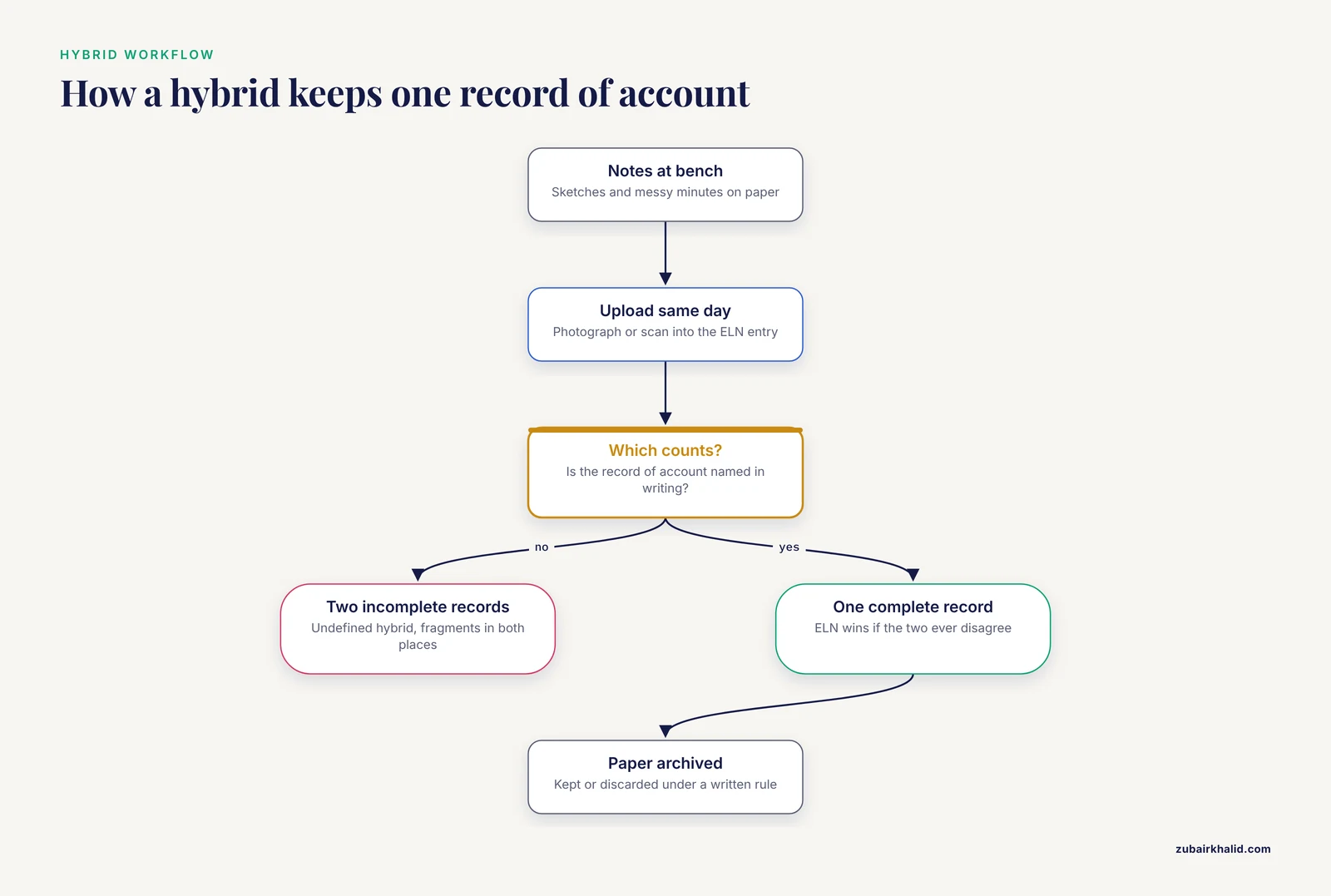
The most common real-world system is a hybrid. Notes and sketches happen on paper at the bench, then get photographed or scanned and attached to the ELN entry the same day, with the paper archived or discarded under a written rule. Hybrids work only when one system is named the record of account, meaning the system that counts if the two ever disagree. Write that rule down, because an undefined hybrid quietly becomes two incomplete records.
Side-by-Side Comparison of Lab Notebook Organization Systems
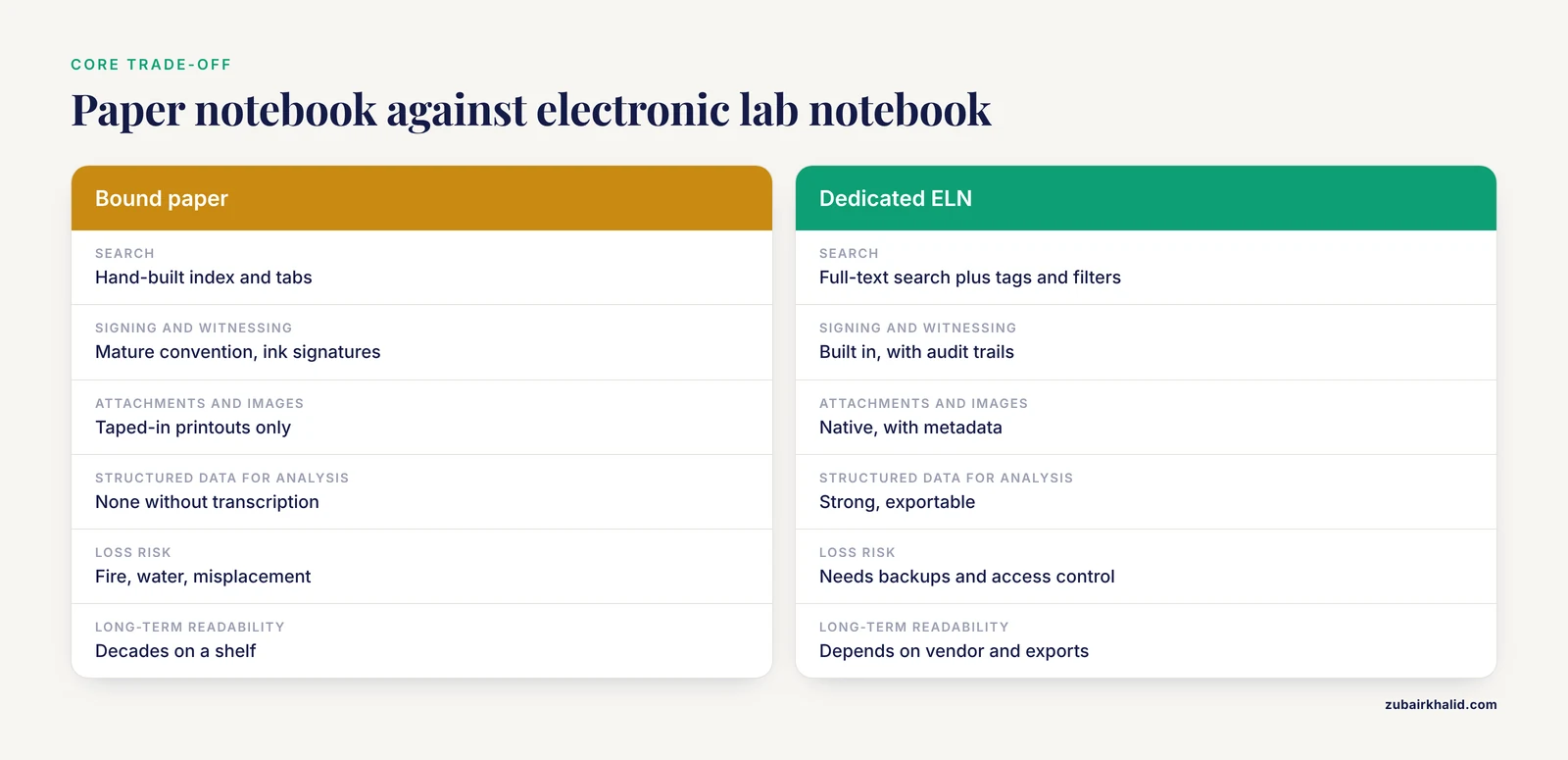
The table compares the five core systems on the criteria that decide real choices. A hybrid combines rows from two columns, with a written rule for which column wins.
| Criterion | Bound paper | Loose-leaf binder | Duplicate notebook | General digital docs | Dedicated ELN |
|---|---|---|---|---|---|
| Search | Hand-built index, tabs | Manual, pages can shift | Hand-built index | Full-text search | Full-text search plus tags and filters |
| Entry at the bench | Excellent, no power needed | Good | Good | Poor without a device | Good where a device is allowed |
| Signing and witnessing | Mature convention, ink signatures | Weak, pages movable | Good, aligned copies | Weak by default | Built in, with audit trails |
| Attachments and images | Taped-in printouts only | Hole-punched inserts | Taped-in printouts | Easy | Native, with metadata |
| Structured data for analysis | None without transcription | None | None | Partial, manual | Strong, exportable |
| Loss risk | Fire, water, misplacement | High, pages fall out | Same as paper | Device failure, weak provenance | Needs backups and access control |
| Collaboration | One reader at a time | Shared physically | Second copy only | Good | Strong, parallel access |
| Template support | Hand-copied or printed skeleton | Printed sheets | Preprinted forms | Manual copying | Reusable entry forms |
| Long-term readability | Decades on a shelf | Binder-dependent | Copies can fade | Format obsolescence risk | Depends on vendor and exports |
| Best fit | Defensible bench record | Course notes and drafts | Records needing a second copy | Informal lab notes | Searchable, collaborative lab record |
How to Choose: The Criteria That Decide Real Choices
Feature lists dominate every electronic lab notebook comparison, yet features rarely decide the choice. These five criteria do.
Search and Retrieval
Paper search is an index you maintain by hand, plus tabs and consistent entry titles. It works until the notebook count grows past a shelf. An ELN searches full text across every entry, filtered by project, tag, author, and date. A query for a reagent lot number returns every experiment that touched it in seconds, while on paper the same question means flipping through every notebook that could plausibly contain it. The gap changes behavior: a searchable notebook gets reread, and rereading prevents repeated experiments. If your project will generate hundreds of entries over several years, weight this criterion heavily.
Data Integrity and Attribution
Paper proves integrity through physics and convention: permanent ink, bound pages, dated signatures, witness lines, single-line corrections, and taped flaps over printouts. An ELN proves integrity through software: an audit trail records every change with a user and a timestamp, access controls decide who can edit, and electronic signatures attach an identity to an entry.
Neither system is automatically safer. Paper burns, soaks, and walks away. Digital records survive fires and then die from corrupted files, misconfigured permissions, expired licenses, or a vendor shutting down. Before you commit, ask your institution and your target journals what they require, because expectations differ between a thesis lab, a core facility, and a regulated contract lab.
Collaboration and Continuity
An ELN entry shared with a labmate lets them run your protocol with your troubleshooting notes visible, and it hands a graduating student's project to their successor as a searchable archive rather than a shelf of handwriting. New lab members onboard faster when they can read how similar experiments actually went, including the failed attempts that never make it into papers. Paper collaboration is physical: one reader at a time, and continuity depends on someone transcribing or scanning. If your lab has turnover and shared projects, this criterion favors ELNs strongly.
Data Reuse and Analysis
This is the criterion where ELNs pull far ahead, because structured entries become datasets. The clearest published demonstration comes from chemistry. Researchers built a machine learning model that assigns reactions to 336 classes and paired it with Conformal Prediction, a framework that attaches a statistical confidence estimate to each prediction [1]. They tested it on two reaction collections, one extracted from an industrial electronic lab notebook and one assembled from the medicinal chemistry literature [1]. Their classification scheme, SHREC (Sheffield Hierarchical REaction Classification), organized the labels into four hierarchical levels, which is only practical when reactions are recorded in consistent, structured fields [1]. The validation result shows why confidence estimates matter in practice: after thresholds filtered out less than 15 percent of the most uncertain classifications, 95 percent of the remaining predictions were correct [1].
A paper notebook could feed the same analysis only after someone retyped every reaction by hand. If your field produces data you will mine later, such as reactions, sequences, or screening results, the structure of your entries decides whether your notebook remains a record or becomes a dataset.
Longevity and Migration
Paper on good stock outlasts every file format. Digital records last as long as the format, the software, and the backups, so plan the exit before you enter. Prefer platforms that export entries in open formats, take periodic full exports regardless, and keep PDF snapshots of signed entries. Ask any vendor two questions before signing: what can I export, and what happens to my data if you shut down. For paper, the equivalent discipline is a scanning routine, because an unscanned paper notebook is a single point of failure.
Worked Scenarios
Five common situations, and the system each one points to.
Scenario 1: Undergraduate Teaching Lab
Bound or duplicate paper notebooks with a course template. Entries are short, graded weekly, and the duplicate copy solves collection. An ELN adds cost and setup for a one-semester course, unless the program specifically wants to teach ELN skills before students head to internships, in which case a free or institution-licensed ELN with a fixed entry form works well.
Scenario 2: PhD Student in Molecular Biology
Follow the lab standard, because your notebook must mesh with everyone else's. In an ELN lab, attach gel images, flow cytometry exports, and plasmid maps directly to entries, and tag entries by project so your thesis chapters assemble themselves from search results. In a paper lab, use a bound notebook with a printed template, tape in gel printouts and autoradiographs with dated flaps, and scan each completed week into a backed-up folder.
Scenario 3: Synthetic Chemistry With Reaction Data
Use an ELN with structured reaction fields: reactants, quantities, conditions, yield, and characterization. Consistent fields turn three years of reactions into a queryable dataset, which is the pattern the published ELN-based classification work relied on [1]. Paper remains useful for sketching mechanisms at the hood, transcribed into the ELN the same day.
Scenario 4: Regulated or Contract Lab
Ask the quality unit first, because the governing standard decides the system. Regulated environments generally require attributable, traceable records with controlled signatures, which points to a validated ELN with electronic signatures and audit trails, or to paper with witness signatures under a documented procedure. Instruments that print paper results get the printouts taped in or scanned and attached, with the ELN entry referencing the physical archive location.
Scenario 5: Field Biology
Power and connectivity are absent exactly when observations happen, so plan a hybrid. Weatherproof paper notebooks ride in the field bag, get photographed and transcribed into the ELN or a structured spreadsheet each evening, and GPS tracks and camera files upload against the same entry. The paper notebook is the field draft, the digital entry is the record, and the written rule says so.
Building a Lab Notebook Template That Works
A template is the cheapest upgrade available to any notebook system. The same fields in the same order make entries comparable, searchable, and fast to write. Build one template, apply it everywhere, and revise it only at project boundaries.
Fields Every Lab Notebook Template Should Have
- Date and entry title
- Objective, one sentence on why
- Linked protocol, or the full protocol with a version number
- Materials, with reagent lot numbers and concentrations
- Step-by-step observations, written during the work
- Results, tables, and images, each labeled with sample identifiers
- Analysis and interpretation
- Problems and deviations from the protocol
- Next steps
- Signature and date, plus a witness line where required
Paper Implementation
Print the template on a card and copy the skeleton by hand at the top of each entry, or use a notebook preprinted with the fields. Leave the observations section the largest, because that is where the honest details live. Tape-in items get a dated signature across the flap, and corrections get a single line with initials and the date.
Electronic Implementation
Save the fields as a reusable entry form in the ELN and make it the lab default. Keep field names short and identical across the lab, because consistent names are what let you filter, aggregate, and export later. Attach instrument files at entry time rather than in a Friday batch, since files separated from their entry context lose meaning fast.
Common Mistakes and Limitations
Choosing a system no one maintains. An abandoned ELN with three months of entries is worse than a paper notebook with three years, because the gaps look like completeness. Pick the system your lab will actually keep updated.
Backfilling entries. The value of a notebook rests on being contemporaneous, written during the work. Reconstructed entries lose detail and credibility, and reviewers and auditors can often spot them.
No exit plan for digital, no scan routine for paper. Both failure modes lose everything. Schedule exports for ELNs and weekly scans for paper, and put both on a calendar.
Templates heavier than the experiment. If filling the template takes longer than the protocol, people stop writing. Trim fields until the template fits on one screen or one page.
Undefined hybrids. When paper and digital both hold fragments and no rule says which counts, you have two incomplete records instead of one complete one. Name the record of account in the lab manual.
Treating digital as automatically safe. Servers go down, permissions get misconfigured, licenses lapse, and vendors close. Digital safety is a backup and export habit, not a property of the software.
Loose instrument printouts. A printout in a drawer is not a record. Tape it in with a dated flap or attach the file to the dated entry.
One limitation to keep in mind: requirements vary by institution, funder, journal, and quality system, so confirm the rules that govern your specific lab before committing records to any system.
Frequently Asked Questions
What is the best lab notebook organization system for a new graduate student?
Use the system your lab already runs and learn its conventions in your first week. If there is no standard, start with a bound paper notebook and a printed template, then move to an ELN if the lab adopts one.
Can I use the same lab notebook template on paper and in an ELN?
Yes. The fields are identical, and only the implementation changes, with a printed or hand-copied skeleton on paper and a saved entry form in an ELN.
Is an electronic lab notebook acceptable for signatures and witnessing?
Usually yes, but your institution, funder, or quality system sets the rule, not the software. A dedicated ELN records who made which change and when, and many support electronic signatures. Confirm the policy in writing before you rely on it.
Do I still need a paper notebook if my lab uses an ELN?
Usually no. Keep a scratch method for moments when screens are impractical, such as gloved work, hoods, or fieldwork, then photograph or transcribe those notes into the ELN the same day.
How often should I write entries in my lab notebook?
The same day you do the work, ideally during it. Entries reconstructed days later lose both evidentiary value and experimental detail.
What is the difference between an ELN and a LIMS?
An ELN is organized around experiments and protocols. A LIMS is organized around samples and tracks each specimen through receipt, testing, and storage.