Lab Notebooks as Legal Evidence: What Makes a Notebook Credible
By Dr. Zubair Khalid, DVM, MS, PhD ·

A lab notebook holds up as legal evidence when its entries are contemporaneous, meaning written at the time of the work, permanent, attributable to a specific person, and witnessed by someone who can confirm both. Every specific rule, from bound pages and permanent ink to electronic record-keeping controls, exists to protect one of those four properties.
This guide explains what lab notebook legal evidence requirements mean in practice, why courts and patent offices weigh records the way they do, and how paper and electronic notebooks compare when someone challenges your work. It is written for students, researchers, and lab managers in the United States who want records that survive a patent dispute, a trade secret case, or a research integrity investigation. The stakes are concrete. Patents, authorship credit, and large amounts of intellectual property have turned on what a notebook did and did not contain.
What Lab Notebook Legal Evidence Requirements Mean
"Lab notebook legal evidence requirements" is not the name of any statute. It is shorthand for the conditions a court, the United States Patent and Trademark Office (USPTO), or a regulator applies when deciding whether a notebook proves what happened, who did it, and when. No single document lists the conditions. They come from three overlapping bodies of rules, and reading them together gives you the clearest interpretation of what the requirements actually demand.
Evidence rules decide admissibility. Under the Federal Rules of Evidence, a party must authenticate a record, meaning it must show the record is what it claims to be. Records made at or near the time of the events they describe, by people with knowledge, and kept in the regular course of business can qualify for the business records exception to the hearsay rule, which restricts secondhand statements offered as proof. A contemporaneous notebook fits that description naturally. A notebook assembled years later does not.
Patent doctrine decides priority and ownership. For most of US history, patents went to the first person to invent, not the first to file. Congress changed that with the Leahy-Smith America Invents Act, which moved the country to a first-inventor-to-file standard for applications filed on or after March 16, 2013. Notebooks lost their central place in priority fights but kept, and in some ways grew, their other legal jobs.
Regulatory frameworks decide data integrity. For work under Food and Drug Administration (FDA) oversight, Title 21 of the Code of Federal Regulations Part 11 (21 CFR Part 11) sets the conditions under which electronic records and electronic signatures count as trustworthy equivalents of paper and ink. Good Laboratory Practice standards, which govern much industrial safety and toxicology testing, require raw data to be attributable, dated, signed, and retained.
A plain-language explanation of all three frameworks is that they ask the same four questions of every entry. Was it written at the time of the work? Can it be tied to a specific person? Can it be tied to a specific date? Has it been protected from undetected change? A notebook that answers all four is credible. A notebook that fails any one of them invites challenge.
Why Lab Notebooks Carry Legal Weight
The story of lab notebooks as legal evidence begins with American patent law. Because patents once went to the first to invent, two applicants who filed similar claims could be pulled into an interference proceeding at the USPTO, a hearing to decide who invented first. Dated, witnessed notebook entries decided those fights, because they documented both conception, the mental act of arriving at the invention, and reduction to practice, actually building and testing it.
The famous cautionary tale runs in the opposite direction. Gordon Gould, a graduate student who designed early lasers in 1957, had his notebook pages notarized, meaning a notary public verified his identity and the date on each page. Those pages fixed his dates in a form nobody could quietly revise, and they helped him win laser patent claims decades later after long litigation.
The America Invents Act did not retire the notebook. Four settings keep it central.
Derivation proceedings. If someone files a patent on your idea after seeing your work, the proceeding that corrects this depends on records showing your earlier date.
Inventorship disputes. Patents must name the true inventors. When records show that someone else contributed to the invention, companies use them to correct the inventor list.
Trade secrets. A trade secret is business information that gets its value from staying secret. Under the Defend Trade Secrets Act of 2016, a plaintiff must show it took reasonable measures to protect that information. Notebooks kept under lock and access control are part of that showing, and they also prove what the secret actually was on a given date.
Research integrity and authorship. Universities and journals resolve disputes over who did what, and whether results were fabricated, by examining original records. A notebook containing honest failures is far more persuasive than one containing only wins.
Employers treat this seriously. A 2007 industry report described how a worldwide biopharmaceutical research firm moved its records into electronic notebooks specifically to protect intellectual property while reducing paperwork [1]. When an organization with thousands of scientists rebuilds its record-keeping around evidentiary quality, that tells you how much weight these documents carry.
Why Courts Trust Contemporaneous Records
The logic behind every requirement starts with human memory. Detailed memory for technical work decays within days. After a few weeks, a scientist reconstructing an experiment from memory is unconsciously filling gaps with what they now believe happened. That reconstruction can be honest and still unreliable, which is why a record made the same day beats a better-organized account made later.
A contemporaneous record is hard to fabricate and easy to corroborate. Its physical features, such as ink, page position, and taped-in attachments, or its digital features, such as server timestamps and audit logs, provide checks that sit outside the author's control. An audit trail is a computer-generated, time-stamped log of every creation and change in a record.
Honest failure raises credibility. A notebook that records three failed runs before the successful one looks like a genuine working document. A notebook with only successes looks like it was written backward from a conclusion, and experienced examiners and attorneys notice.
The witness requirement exists because the author has a stake in the record. A witness who read and understood an entry at the time provides independent confirmation from someone without the same motive. That is the same reason affidavits, which are sworn written statements, carry less weight when they come from interested parties than from disinterested ones.
The Credibility Requirements, One by One
Seven properties separate a credible notebook from a casual one. Each answers a question a lawyer, patent examiner, or investigator will ask.
- Contemporaneous entry. Write the record the day of the work and date every page and entry. If you must reconstruct a lost entry, write the reconstruction on the current date, label it clearly as a reconstruction, explain what happened to the original, and have it witnessed.
- Permanence. Use a bound notebook with numbered pages and permanent ink. Never use pencil, erasable gel ink, or correction fluid. Never remove pages. Spiral notebooks and loose-leaf binders fail this test because pages can be added or removed without a trace.
- Attribution. Sign and date every page, with your name printed legibly beside the signature. Attributable means a record can be tied to one specific person. An unsigned page is an orphan that no one can prove authorship of.
- Witnessing. Have a witness who is not a co-inventor read the entry and sign with the words read and understood, plus a signature and date. Witness promptly, commonly weekly or at project milestones, because a signature added years later adds little.
- Completeness. Record the purpose, materials with lot numbers, instrument identifiers, the procedure as actually performed, raw data with units, failures and deviations, and the conclusion. Lot numbers are the batch identifiers printed on reagent containers, and they let anyone trace exactly which materials you used. Tape in printouts with permanent tape and sign and date across the tape edge so the attachment cannot be swapped out. Cross out blank space with a diagonal line and initial it so nothing can be added later.
- Transparent corrections. Mistakes are normal. Draw a single line through the error, write the correction nearby, and initial and date it. The original must stay readable. A correction that hides the original reads as tampering.
- Continuity of custody. Keep the notebook secure, track who holds it, and retain it for the life of the patent or trade secret it supports. Missing pages, or a notebook that sat in an uncontrolled drawer, both weaken the record.
The following table summarizes how paper and electronic notebooks meet each requirement.
| Requirement | Paper notebook practice | Electronic lab notebook practice |
|---|---|---|
| Contemporaneous entry | Handwritten and dated the same day | Timestamped automatically at creation |
| Permanence | Bound pages, permanent ink, no erasures | Entries locked after signing, indelible audit trail |
| Attribution | Signature and printed name on each page | Electronic signature with name, time, and meaning |
| Witnessing | Countersignature by a non-inventor | Entry routed to a reviewer who signs electronically |
| Corrections | Single strikethrough, initial, date | New version saved, original preserved in the audit trail |
| Completeness | Taped-in printouts signed across the edges | Data files attached and linked to the entry |
| Custody and retention | Locked storage, controlled checkout | Access-controlled server with backups |
Witnessing: The Signature That Does the Legal Work
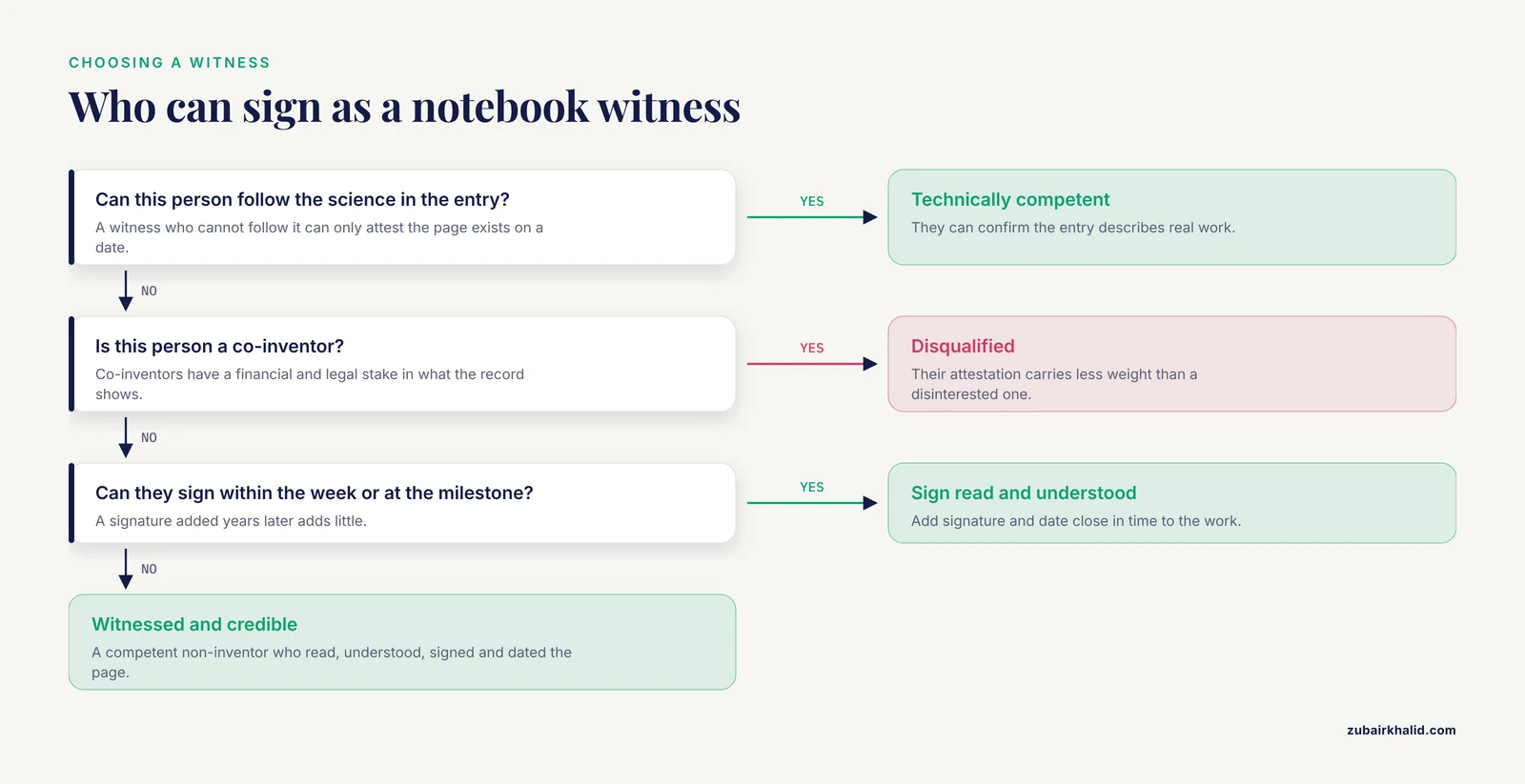
Witnessing is the requirement people get wrong most often, so it deserves its own detail.
The witness must be able to understand what they read. A witness who cannot follow the science can attest that a page exists on a date, but not that it describes real work. The witness must not be a co-inventor, because co-inventors have a financial and legal stake in what the record shows. A supervisor who contributed intellectually to the invention may also be disqualified. A technically competent colleague with no inventorship claim is the usual choice.
The signature should say something. Read and understood, plus a signature and date, tells a later reader that the witness actually engaged with the content. A bare squiggle proves little.
Frequency matters. Many research organizations require weekly witnessing, or witnessing at the close of each experiment or project milestone. The point is to place a second person's attestation close in time to the work.
Notarization dates a page but rarely witnesses its content. A notary confirms identity and date, not scientific substance, so notarization supplements witnessing rather than replacing it. For high-stakes conception records, some organizations use two witnesses. That is extra insurance, not a legal minimum.
Electronic systems reproduce this function by routing an entry to a reviewer whose electronic signature is recorded with the same timestamp discipline as the author's.
Electronic Lab Notebook Comparison: Paper Versus Digital
An electronic lab notebook (ELN) is software that replaces the bound book with structured, server-stored entries. The legal question is whether digital records can meet the same four tests of time, person, date, and protection from undetected change. They can, when the system is built for it.
Part 11 defines the controls. An electronic signature must be unique to one person and must display the printed name of the signer, the date and time, and the meaning of the signature, such as reviewed, approved, or witnessed. The system must generate a time-stamped audit trail of creation and modification that ordinary users cannot alter or disable. Accounts must be individual, so shared passwords destroy the evidentiary value of everything recorded under them.
Regulated labs often summarize the goal with the shorthand ALCOA: records must be attributable, legible, contemporaneous, original, and accurate. A well-built ELN is engineered to satisfy all five at once, which paper can only approximate.
The phrase one 2007 report chose for such a system was "signed, sealed and indelible" [1]. Signed maps to attributable electronic signatures. Sealed maps to tamper-evident integrity controls, meaning changes leave visible traces. Indelible maps to entries that cannot be silently altered once signed [1]. That six-word phrase is the electronic credibility standard in compressed form.
The comparison with paper comes down to trade-offs.
Paper wins on simplicity and independence. A bound book needs no vendor, no server, and no electricity, and its ink and page condition can be examined by anyone in any courtroom.
ELNs win on scale and searchability. A thousand-notebook archive becomes searchable in seconds, backups protect against fire and loss, and the audit trail records changes that a paper book can only hint at.
ELNs fail in ways paper does not. Shared logins erase attribution. An autosave is not a signature. A system without a true audit trail is a word processor with good marketing. Digital records also depend on export formats and vendor continuity, which is why institutions require human-readable exports as part of retention.
A persistent myth holds that electronic records are not accepted as evidence. Courts and regulators accept them when the controls above are in place, and the industry moved first where the stakes were highest, in biopharmaceutical research, where notebooks protect patent portfolios [1].
A Lab Notebook Template Built for Credibility
Whether paper or electronic, a credible entry follows the same skeleton. A lab notebook template built for evidentiary quality includes these fields.
- Header. Page number, date, project name, and your printed name.
- Purpose. One or two sentences on the question this entry answers.
- Materials. Reagents with lot numbers, instrument identifiers, and software versions where relevant.
- Procedure. What you actually did, in order, including deviations from the written protocol.
- Data. Raw values with units, exactly as observed, with instrument printouts attached and signed.
- Observations. Failures, anomalies, and surprises. These details make a record look real because they are.
- Analysis and next steps. Your interpretation, clearly separated from the raw data, and what you plan next.
- Signature block. Your signature and date, then a witness line for read and understood with the witness's signature and date.
A filled entry looks like this.
Page 112. July 14. Project: enzyme assay optimization. J. Rivera. Purpose: test whether pH 8.0 raises activity. Prepared 50 mM Tris-HCl buffer, pH 8.0, this morning. Ran three replicates of the standard assay from page 98. Results: 2.1, 2.3, and 2.2 units per milligram, versus 1.8 units per milligram at pH 7.5 on July 7. Deviation: replicate 2 sat 10 minutes at room temperature before reading. Conclusion: pH 8.0 looks better. Repeat tomorrow with fresh substrate. Signed J. Rivera, 7/14. Read and understood, M. Chen, 7/16.
Copy that structure into your ELN template fields, or write it at the top of every paper page, and each entry answers the four evidentiary questions by default.
Common Mistakes and Limitations
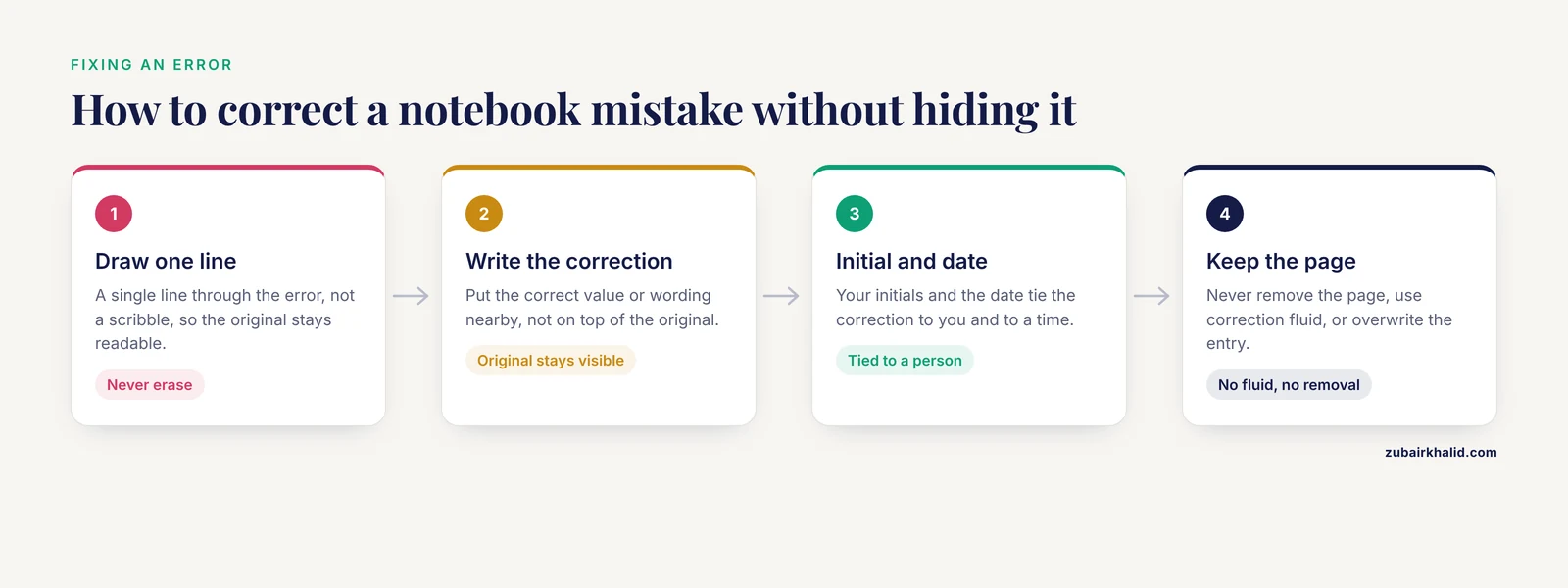
These mistakes show up again and again in real disputes.
- Writing in pencil or erasable ink.
- Erasing, overwriting, or using correction fluid.
- Backfilling entries days later and batch-signing pages at the end of the month.
- Leaving blank space where content can be added later.
- Asking a co-inventor, or someone who never read the page, to witness.
- Using loose-leaf pages or tearing pages out.
- Taping in a printout without signing across the tape edge.
- Keeping the only copy on one laptop or one storage drive.
- Sharing ELN passwords, which erases attribution for every entry under that account.
- Treating autosave or a draft status as a signature.
- Discarding notebooks when a project ends.
- Recording only successful results, which makes the whole notebook look curated.
A few limits deserve honesty. Requirements differ by jurisdiction and by proceeding, so a notebook sufficient for an internal audit may still face challenge in a specific court. A credible notebook rarely decides a case alone, it corroborates testimony and other evidence. Institutional policies on witnessing frequency, retention, and ELN configuration vary, so follow your own organization's standard operating procedure. And for any real dispute over inventorship, priority, or misconduct, individual cases need a qualified patent attorney or your technology transfer office, not a general guide.
What Remains Uncertain
Three things remain unsettled.
First, courts are still building the case law that weighs electronic metadata in specific disputes. The controls behind systems described as signed, sealed and indelible have run in production in regulated industry since at least 2007 [1], but the weight a particular judge gives a particular audit trail is fact-specific.
Second, long-term digital preservation is unresolved. Paper from the 1950s is readable today. Proprietary electronic formats from the 1990s sometimes are not. Export requirements reduce the risk of format obsolescence over patent-length timescales, but the risk does not reach zero.
Third, the treatment of notebooks in post-2013 proceedings, especially derivation and inventorship corrections, is still settling as those cases accumulate.
None of this changes the practical advice. A contemporaneous, witnessed, tamper-evident record is the strongest position under any plausible outcome.
Frequently Asked Questions
Do electronic lab notebooks count as legal evidence?
Yes, when the system captures attributable electronic signatures and a tamper-evident audit trail. Regulators accept compliant electronic records, and large research organizations rely on them to protect intellectual property.
Did the America Invents Act make lab notebooks obsolete?
No. The 2013 switch to first-inventor-to-file reduced the role of notebooks in priority fights, but they still matter in derivation proceedings, inventorship corrections, trade secret cases, and research integrity investigations.
Who can witness a lab notebook page?
A colleague who is not a co-inventor, who read and understood the entry, and who signs and dates it promptly. Weekly witnessing, or witnessing at project milestones, is the common standard.
How do I fix a mistake in a lab notebook?
Draw a single line through the error, write the correction nearby, then initial and date it. Never erase, overwrite, or use correction fluid, because the original must stay readable.
Is a notarized lab notebook stronger than a witnessed one?
No. Notarization confirms a date, but the notary usually cannot judge the science. A technically competent witness who signs read and understood does far more evidentiary work.
Can I backfill missing notebook entries?
Only as a clearly labeled reconstruction written on the current date, with an explanation of why the original is missing and a witness signature. Passing a reconstruction off as contemporaneous destroys credibility.
Is a shared document or cloud folder a valid lab notebook?
Generally no. Ordinary documents lack the audit trails, unique accounts, and signature controls that make electronic records trustworthy. Use a purpose-built electronic notebook or a bound paper book.
How long should lab notebooks be kept?
For decades, not months. Retain them at least as long as the patent or trade secret protection they support, and follow your institution's retention policy, which typically requires archival storage.