The Role of a Lab Notebook in Intellectual Property Protection
By Dr. Zubair Khalid, DVM, MS, PhD ·

A bound paper notebook and an electronic lab notebook can both protect an invention, but they earn that protection differently: paper through signed, witnessed physical originals that are hard to alter without detection, and electronics through system-generated timestamps and audit trails, the logs that record who changed what and when.
Rule of thumb: use the format your technology transfer office (the university or company office that handles invention disclosures and patenting) and your patent counsel already accept, record every entry on the day of the work, have a disinterested witness sign it, and never adopt a system you cannot export.
A lab notebook is the dated, running record of what you did, what you observed, and what you concluded at the bench. In an intellectual property dispute, that record does work no other document can. It fixes when an idea was conceived, shows whether the inventor kept working, identifies who contributed what, and corroborates testimony if a disagreement reaches a lawyer. This guide explains what it takes to turn a lab notebook into intellectual property documentation that a patent examiner, a court, or a technology transfer office will take seriously, compares the main options, and lists the mistakes that quietly weaken an otherwise strong record.
What Intellectual Property Means Inside a Lab
Intellectual property (IP) is the family of legal rights over creations of the mind. In research settings, the rights that matter most are patents, trade secrets, and copyrights in software and written materials, with plant varieties and trademarks rounding out the list in some fields. Lab notebooks matter most for patents and trade secrets, so those two get the closest look here.
Patents, Conception, and Reduction to Practice
A patent is a government-granted right to exclude others from making, using, or selling an invention for a limited period, in exchange for a public description of how the invention works. In the United States, the United States Patent and Trademark Office (USPTO) examines applications and grants those rights.
Two dates drive most disputes:
- Conception is the date an inventor formed a definite and permanent idea of the complete invention as it will later be used. A sketch of an apparatus, detailed enough that a skilled colleague could build it, usually captures conception.
- Reduction to practice is proof that the invention works. Actual reduction to practice means building it and successfully testing it. Constructive reduction to practice means filing a patent application that describes it.
A defensible notebook brackets the invention between those dates. A February entry describing the idea, followed by an April entry recording a successful test, gives a patent attorney the raw material for the application and gives a court evidence if anyone challenges the timeline. Between conception and reduction to practice, an inventor is expected to keep working with reasonable diligence, and dated entries are how diligence gets shown.
Trade Secrets
A trade secret is technical or business information that derives value from not being generally known and that its owner protects with reasonable measures. Formulas, assay conditions, cell line engineering, and prototype designs can all qualify. Trade secrets require no registration and last as long as the secrecy holds, which makes them the right tool for results you never intend to publish.
Notebooks do two jobs here. They document what was developed and when, which establishes that your lab possessed the information. They also document the protective measures, because locked storage, controlled access, and confidentiality practices are part of what makes information legally a trade secret. A notebook left open on a shared bench cuts against the reasonable-measures requirement.
Inventorship Is Not Authorship
An inventor, under US patent law, is a person who made a contribution to the conception of at least one claimed invention. Someone who only ran experiments designed and directed by others is not an inventor, however skilled the bench work was. Authorship on a scientific paper follows different and softer norms, and the two lists rarely match. Notebooks record who proposed which idea and when, which is the raw material an attorney uses to set inventorship. Naming the wrong inventors can invalidate a patent or ignite disputes among collaborators years later.
Why Notebooks Still Matter Under First-to-File
Before 2013, US law awarded a patent to the first person to invent, and notebook evidence decided many interference contests, the USPTO proceedings that resolved who invented first. The Leahy-Smith America Invents Act, signed in September 2011 and effective for applications filed on or after March 16, 2013, moved the United States to a first-inventor-to-file system that most of the world already used. The filing date now generally controls who wins.
That change did not retire the notebook. Five jobs remain:
- Derivation proceedings. If someone files an application covering an idea they took from another person, the true originator can challenge the filing in a derivation proceeding at the USPTO. Dated, witnessed entries are the core evidence.
- Corroboration. US courts have long required an inventor's own testimony about conception to be supported by independent evidence. A contemporaneous, witnessed notebook is the classic corroboration, and an unwitnessed notebook is worth far less.
- Disclosure timing. US law gives inventors a one-year grace period after their own public disclosure, such as a talk, poster, or paper. Most other countries require absolute novelty, meaning any public disclosure before filing can bar protection there. Notebook dates show exactly what became public and when, which shapes foreign filing decisions.
- Prior user rights. The America Invents Act strengthened a defense available to parties that can document commercial use of an invention before another party's effective filing date. Records of that use are the defense.
- Ownership and reporting. Employers and universities typically require inventors to assign their inventions, and under the Bayh-Dole Act of 1980, inventions made with federal funding must be reported to the funding agency, which retains certain rights in them. Notebook records support the inventorship determinations and reports those obligations require.
Trade secrets add a sixth job, and disputes over departing employees add a seventh. The notebook is the only contemporaneous record most labs have of any of it.
The Practices That Make an Entry Defensible
The conventions below come from generations of patent practice and are still what patent counsel looks for when evaluating a record.
- Use a bound notebook with numbered pages. Sewn binding, with pages numbered before use. Avoid loose-leaf and spiral formats, where pages can be removed without a trace.
- Write in permanent ink. Blue or black, non-erasable. Many labs prefer blue because an original written in blue ink is easy to distinguish from a photocopy.
- Date every entry on the day of the work. Contemporaneous recording is the entire point. If you must write something up later, say so in the entry and give the date the events actually occurred.
- Sign each page. A line such as "Performed and recorded by," followed by signature, printed name, and date.
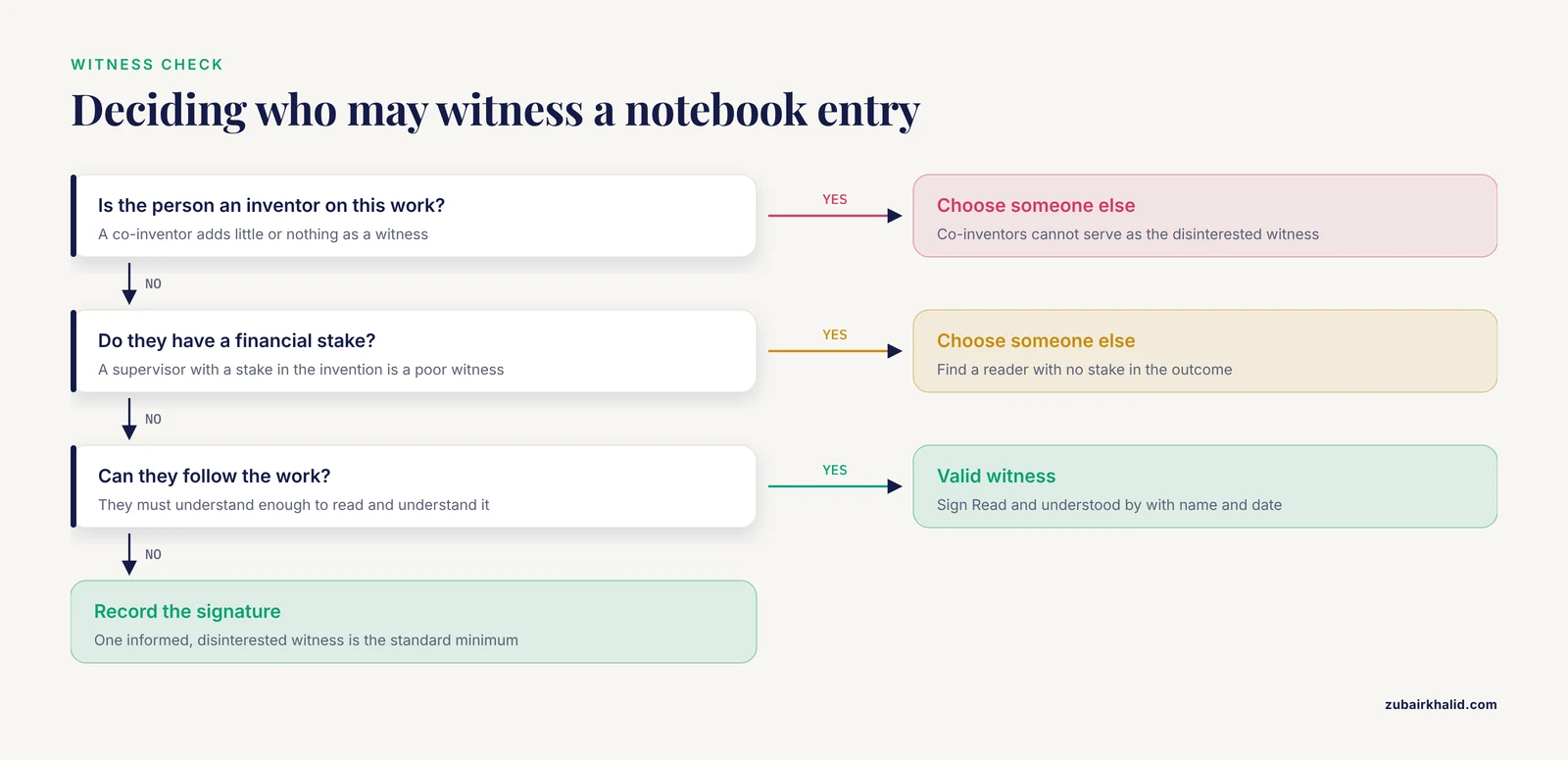
- Have a witness sign. The witness should be someone who is not an inventor, has no financial stake in the invention, and understands enough of the work to follow it. The witness attests that the entry existed and was disclosed on its date, not that the science is correct. Common wording is "Read and understood by," with a signature and date. One informed, disinterested witness is the standard minimum, and some employers require two.
- Never erase. Draw a single line through an error so it stays legible, write the correction beside it, then initial and date the change. Erasures and correction fluid invite the argument that something was hidden.
- Eliminate blank space. Draw a diagonal line through unused space or write "end of entry," so nothing can be added later.
- Never remove pages and never backdate. Either act can sink an otherwise strong record.
- Attach materials, do not stash them. Tape or glue in gel images, instrument printouts, and figures, then sign and date across the attachment so it cannot be swapped. Label each item with its date and the conditions used.
- Record failures and ideas. Negative results show the work was real and continuous. Ideas get dated entries of their own, which is how conception gets fixed on paper. Name anyone who contributed an idea, because that matters for inventorship.
- Protect the original and copy it offsite. Scan pages regularly and store the scans somewhere the original is not. In most employment and university settings the physical notebook belongs to the institution, so follow its retention policy.
Regulated laboratories often borrow a data-integrity framework known as ALCOA: records should be attributable, legible, contemporaneous, original, and accurate. Those five words are also a fair summary of what makes any notebook entry persuasive as IP evidence.
Lab Notebook Intellectual Property Documentation Options
Three realistic options exist, and most working scientists will recognize pieces of each. The pros and cons below are weighted toward evidentiary value rather than convenience alone.
Bound Paper Notebooks
A bound paper notebook is the traditional instrument: pre-numbered pages, permanent ink, wet-ink signatures, and a witness line on every page.
Its strengths are legal. Physical originals are hard to alter without detection, courts and patent practitioners have generations of familiarity with them, no software misconfiguration can silently weaken them, and they work during power and network failures. Its weaknesses are practical. Nothing is searchable, there is only one copy unless you scan it, collaboration means physically handing the book to someone, instrument output has to be printed and pasted, and transcription into a thesis or manuscript is slow. Fire, flood, or a lost bag can erase the only original, which is why offsite scanning is non-negotiable even for paper devotees.
Electronic Lab Notebooks
An electronic lab notebook (ELN) is software for recording experiments, typically with automatic timestamps, user authentication, audit trails, electronic signature workflows, structured templates, and links to raw instrument files.
Its strengths mirror paper's weaknesses. Timestamps come from the system rather than the writer's memory, full-text search makes a decade of work retrievable, teams in different buildings or time zones can work in one record, backups are automatic when configured, and data-heavy biology becomes manageable.
Its weaknesses are mostly about trust. An ELN's evidentiary value depends on configuration: whether the audit trail is on, whether entries lock after signing, whether witness steps are enforced rather than optional, and whether the vendor can produce records in a form a court will accept. A shared word-processing document or spreadsheet is not an ELN, because it has no reliable record of who changed what and when. Export matters too, since proprietary formats and vendor lock-in can strand records when a contract ends, so institutions should verify export paths before committing. Cost and validation add overhead that small labs feel most.
Regulated work raises the bar further. The Food and Drug Administration's regulation 21 CFR Part 11 governs electronic records and electronic signatures in FDA-regulated settings and expects controls such as audit trails and secure signature manifestations. Many ELNs provide tooling for this, but compliance comes from how a system is configured and used, not from a checkbox on a vendor's website.
Hybrid Workflows
A hybrid workflow uses paper where its strengths matter most and electronics everywhere else. Common versions include a bound notebook for conception moments and key milestones, with wet-ink witnessing, alongside an ELN for daily data, or an ELN as the daily record with periodic printouts that get signed and witnessed on paper.
Hybrids match how many universities and companies actually operate, and they give a dispute two independent records instead of one. The cost is reconciliation. Someone must designate which record is authoritative, entries must cross-reference each other, and divergence between the paper and digital layers is itself a credibility risk if the two ever disagree.
Side-by-Side Comparison: Paper, Electronic, and Hybrid
An electronic lab notebook comparison that stops at feature lists misses the point. The criteria that decide real IP outcomes are evidentiary, so the table below is built around them.
| Criterion | Bound paper notebook | Electronic lab notebook (ELN) | Hybrid (paper plus ELN) |
|---|---|---|---|
| How a date is proven | Handwritten, signed, and witnessed in ink on numbered pages | System timestamp backed by an audit trail | Wet-ink witness on the original, timestamped scan in the system |
| Witness workflow | In person, ink signatures, easy to verify later | E-signature tasks, only as strong as their configuration | Witness reviews the paper or printout, system records the scan |
| Corrections | Single line, initial, date, never erase | Edits preserved in version history and audit log | Paper rules govern originals, version control governs scans |
| Search and reuse | Manual, needs an index at the back | Full-text search, templates, copy-forward | Search the digital layer, originals stay archival |
| Collaboration | One book, one location | Multi-user, remote access, shared projects | Sharing happens in the digital copy, originals stay controlled |
| Attachments | Taped or glued, signed across the seam | Native uploads linked to entries | Physical outputs pasted, digital files uploaded |
| Backup and loss risk | One physical object, mitigated by scanning | Vendor backups, verify them in writing | Originals plus offsite scans |
| Export and longevity | Paper lasts decades if stored dry and dark | Depends on vendor export formats and contract terms | Open-format scans plus paper originals |
| Regulatory fit | Long acceptance, no Part 11 burden | Can support 21 CFR Part 11 controls when configured | Common pattern in regulated industry labs |
| Typical failure mode | Gaps, missing witnesses, backdating | Weak audit trails, skipped witness steps, vendor lock-in | Paper and digital copies drifting apart |
| Best fit | Solo inventors, small labs, records of conception | Large or multi-site teams, data-heavy biology | Most universities and regulated companies |
Three readings fall out of the table. Paper wins on evidentiary tradition, because a signed, witnessed physical original with numbered pages is the record patent litigators have trusted for generations and is difficult to tamper with undetectably. ELNs win on everything that makes records usable, because timestamps, search, sharing, and backups are structural rather than habits, so they survive busy weeks and personnel changes. Hybrids win on coverage, because a conception entry on witnessed paper plus a daily record in an ELN leaves few gaps a challenger can exploit.
The best lab notebook intellectual property documentation system is the one your patent counsel or technology transfer office will stand behind and that you will actually keep. A perfectly configured ELN nobody updates loses to a scrupulously witnessed paper notebook, and the reverse is equally true.
Designing a Lab Notebook Template That Holds Up
A lab notebook template turns good intentions into default behavior, because a page that already has the right fields gets filled in correctly even on a bad day. Whether the template lives on paper or in an ELN, it should include:
- Header block. Project name, notebook number, page number, and date.
- Purpose. One line stating the hypothesis or goal.
- Materials and conditions. Reagent names with lot numbers, concentrations, cell lines, instrument identifiers, and software versions.
- Procedure. What was actually done, including any deviation from the planned protocol.
- Observations. Raw numbers, times, temperatures, and references to images or files.
- Analysis and ideas. Calculations, sketches of apparatus, and invention ideas, each with a date and the name of anyone who contributed the idea.
- Conclusion and next steps. What the result means and what happens next.
- Signature block. "Performed and recorded by," with signature, printed name, and date.
- Witness block. "Read and understood by," with signature, printed name, and date.
- Attachment log. Each attached item, its date, the conditions used, and a note that the signer signed across it.
For an ELN template, build the same fields as structured entries and configure the witness step as a required task rather than an optional one. For a paper template, print the signature and witness lines at the bottom of every page so they cannot be forgotten.
One habit costs nothing and pays disproportionately: when an idea for an invention appears, write it as its own dated entry, describe it completely enough that a stranger could evaluate it, and name every contributor. That entry type is what conception evidence looks like.
Worked Scenarios
Scenario 1: The Poster That Almost Preceded the Patent
A graduate student develops an improvement to a microfluidic cell sorter. Her notebook shows a dated, witnessed entry on February 3 describing the design in enough detail to build it, followed by April entries recording successful sorting runs. Her advisor, who contributed the key design idea, appears in those entries as a contributor. In June, the technology transfer office files a provisional patent application, a lower-cost first filing that secures a priority date while the team decides on a full application. She presents a poster in July.
The notebook did four jobs. It fixed the conception date, showed continuous work between February and April, distinguished the advisor as a co-inventor from the machine-shop postdoc as a non-inventor who contributed execution, and let the office file before the poster went public. That last point matters most for the lab's future. The US grace period would have cushioned a filing after the poster, but most countries require absolute novelty, so filing first preserved the option of foreign patents.
Scenario 2: The Departing Chemist and the Trade Secret File
A specialty chemicals company suspects a departing chemist of taking a catalyst formulation to a competitor. The company's notebooks show the formulation's development across three years, the failed variants that prove the work was real, and witness signatures from colleagues who are still employed. Access logs and a locked cabinet show the reasonable measures that qualify the formulation as a trade secret under the Defend Trade Secrets Act of 2016, the federal statute that created a nationwide cause of action for trade secret misappropriation.
Two lessons follow. Notebooks establish what the company knew and when, which is the starting point for any misappropriation claim. And the way notebooks are stored is itself evidence, because a company that leaves its secrets on an open bench will struggle to argue it took reasonable measures to protect them.
Scenario 3: Two Labs, One Assay, and a Derivation Dispute
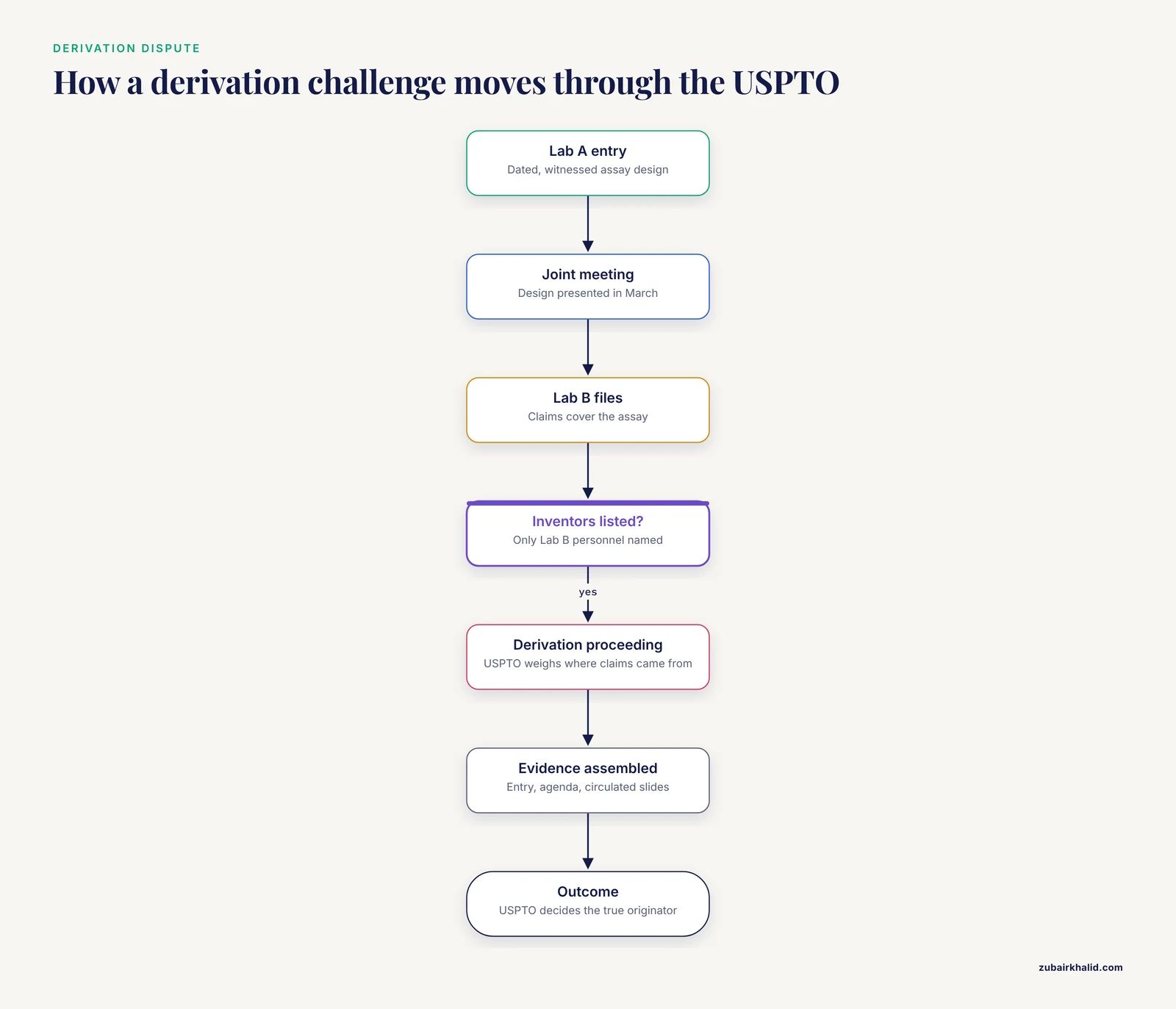
Lab A describes a new assay design in a dated, witnessed entry and presents it at a joint lab meeting in March. Lab B files a patent application the following year with claims covering the assay and lists only its own personnel as inventors. Lab A can challenge the filing in a derivation proceeding at the USPTO, where the question is whether Lab B's claims came from Lab A's conception. The March entry, the meeting agenda, and the email that circulated the slides together make the case.
The lesson is collaboration hygiene. Sharing an idea without a dated record of the share invites exactly this dispute. A one-line entry noting what was presented, to whom, and when turns a he-said, she-said argument into a document review.
Common Mistakes and Limitations
The mistakes below are the ones patent attorneys encounter most often, and each is avoidable the day you learn it.
- Writing a month of entries in one sitting. If you must reconstruct, label the entry as a reconstruction, state the dates the events occurred, and say when you prepared it. Never backdate.
- Pencil, erasable ink, erasures, or correction fluid. Any of these invites the argument that the record was altered.
- Missing dates or signatures, or signing a stack of pages in a batch at the end of the month.
- The wrong witness. A co-inventor, a supervisor with a financial stake, or someone who signs without reading adds little or nothing.
- Blank space left on pages, which leaves room for later additions.
- Loose-leaf binders, spiral notebooks, or torn-out pages.
- Recording only successes. A record with no failed experiments looks reconstructed, and negative results are often the proof of diligence.
- One copy in one location, whether that is a single paper book or a single laptop.
- Posting notebook pages in talks, on social media, or in a thesis before the technology transfer office has been consulted, which can start disclosure clocks abroad with no recovery.
- Treating a shared document folder as an ELN. Without audit trails, the record of who changed what is unverifiable.
- Confusing paper authorship with patent inventorship, then naming the wrong inventors on a filing.
- Waiting until after publication to contact the technology transfer office.
- Unlabeled attachments, such as a gel image with no date, no conditions, and no signature across it.
A well-kept notebook strengthens a position in an IP dispute, but it does not guarantee any outcome. Patentability, inventorship, and trade secret status turn on facts and law that vary by case, employer, and funding source, and this guide is general education rather than legal advice. For a specific invention, involve your technology transfer office or a registered patent attorney early, before any public disclosure.
Frequently Asked Questions
What is the best lab notebook for intellectual property documentation?
The best system is the one your institution's technology transfer office and patent counsel accept and that you keep consistently. A bound, witnessed paper notebook and a properly configured ELN with audit trails and enforced e-signatures both work. Consistency of habit matters more than format.
Do electronic lab notebooks hold up in patent disputes?
Yes, when they capture who created each entry, when, and every later change in an audit trail, and when witnesses e-sign the entries. Plain shared documents and spreadsheets generally do not, because they cannot prove who altered what.
Who can witness a lab notebook entry?
Someone who is not an inventor, has no financial stake in the invention, and understands enough of the work to follow it. The witness confirms the entry existed on its date. A co-inventor or a reader who signs without looking adds little.
What should a lab notebook template include?
A date, project and page identifiers, the purpose of the experiment, materials with lot numbers, the procedure, raw observations, analysis, conclusions, next steps, a signature line, and a witness line. Add an attachment log for gels, printouts, and photos.
Does the United States still award patents to the first to invent?
No. The US now uses a first-inventor-to-file system under the America Invents Act. Notebooks still matter for derivation claims, inventorship disputes, corroboration of conception, and trade secrets.
Can I scan my paper notebook into an electronic system?
Yes, and regular offsite scans are good practice. The scans supplement rather than replace the original, which remains the primary evidence in many disputes. Keep scans complete, dated, and access-controlled.