Why Your Lab Notebook Keeps Failing Inspection
By Dr. Zubair Khalid, DVM, MS, PhD ·

The single most common cause of lab notebook inspection failures is missing dates and missing signatures on individual entries. An inspector opens the notebook, flips to a random page, and finds an experimental result with no date, no initials, and no way to prove who recorded it or when. Everything else on the page can be perfect and the entry still fails, because an undated, unsigned record cannot be traced to a person or a point in time.
The first thing to check, before you read anything else in this article, is simple. Open your notebook (or your electronic notebook) to five random pages and ask three questions about each one. Is every entry dated? Is every entry signed or initialed by the person who did the work? Is every correction made in a way that preserves the original text? If any answer is no, you have found your most likely inspection failure, and you can fix it this week without buying anything.
This article walks through the causes of lab notebook inspection failures from the most common to the rarest, explains the mechanism behind each one, gives you a diagnostic sequence you can complete in an afternoon, and closes with prevention practices and a practical comparison of paper and electronic options.
Why Inspections Care About Notebooks at All
A lab notebook is the primary record of an experiment. Documentation of experiments is essential for best research practice and underpins scientific transparency and data integrity [1]. When an inspector, auditor, or collaborator reviews your work, the notebook is the evidence that an experiment actually happened, that the recorded results came from that experiment, and that the person listed as the scientist was the person who did it.
Modern research generates large datasets that paper notebooks were never designed to hold, which is one reason electronic lab notebooks (ELNs) have spread through industry and are slowly spreading through academia [2]. Whatever format you use, the underlying inspection questions stay the same. Who did the work, when did they do it, what did they actually observe, and can someone else follow the record and repeat the experiment? Most lab notebook inspection failures are failures to answer one of those four questions.
The Most Common Failures, From Frequent to Rare
Missing Dates and Signatures
Every entry needs a date and the initials or signature of the person who made it. This sounds trivial until you audit your own notebook and find a brilliant Friday afternoon experiment recorded with a figure, a conclusion, and no way to prove when it was done. Inspectors check this first because it is fast to check and because everything else depends on it. An entry without a date cannot be placed in a sequence, and an entry without a name cannot be defended if the result is ever questioned.
The mechanism is human. People date the first page of a day and then stop, or they batch-sign a week of pages at once, which converts a contemporaneous record into a reconstructed one. In electronic systems the same failure appears as a shared login, where several people record data under one account and the audit trail can no longer distinguish between them.
Improper Corrections
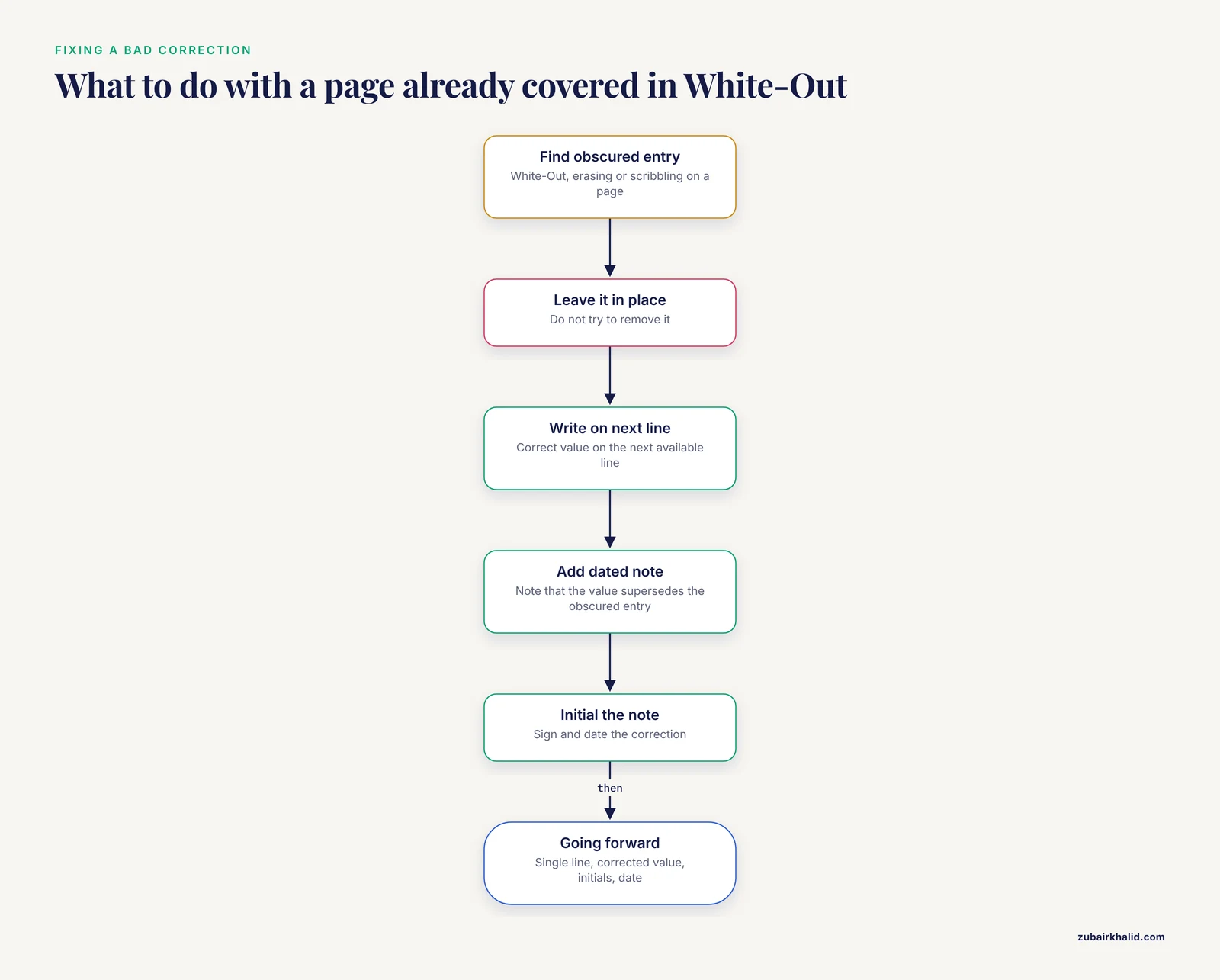
The second most common failure is the correction itself. Accepted practice is to draw a single line through the error so the original text stays readable, write the corrected value next to it, and initial and date the change. Correction fluid, erasing, overwriting, and scribbling are all treated as obliteration of a record, because they destroy the original value and make the record impossible to audit. In an electronic notebook, deleting an entry or editing it without a retained history produces the same result. The system must preserve the original data and log who changed what and when, which is why a permissions system, controlled sharing, an audit trail, and electronic signature are considered basic capabilities of a credible ELN [3].
If your paper notebook has White-Out on it, an inspector will flag every affected page, and if the pattern repeats, the credibility of the whole notebook drops.
Non-Contemporaneous Recording
Recording data hours or days after the experiment is a quieter failure that inspectors catch through internal inconsistencies. The classic signs are a notebook entry written in one pen while a date header sits in another, temperature readings that are too round, or results entered in a batch with identical timestamps. The record is supposed to be made as the work happens. A reconstructed entry might be honest, but the inspector cannot tell the difference between honest reconstruction and fabrication, so the entry fails.
The mechanism here is workflow. People write quick numbers on sticky notes or paper towels at the bench with the intention of transcribing them later. Every transcription step is a chance for error and a chance for an inspection finding.
Gaps, Loose Sheets, and Unattached Data
Blank pages in the middle of a notebook, pages removed, and loose printouts tucked between pages all raise the same question: what was on the missing material? An inspector treats a gap in a bound notebook as a potential deletion of unfavorable data. Photographs, gel images, and instrument printouts that are not permanently attached with date and signature on the attachment share the same problem, because loose paper can be swapped or lost.
Raw instrument output deserves special attention. A spreadsheet of averaged values in the notebook with no link to the raw file is a traceability failure, since the reviewer cannot check how the averages were produced.
Missing Traceability and Study Identifiers
As work scales up, individual entries stop being enough. The management of data across devices, with large amounts of metadata, is one of the biggest documentation challenges in modern research, and transparency and integrity have to be reflected directly in the record [1]. One practical fix described in the literature is the use of unique study identifiers, where every experiment in a lab carries a Study-ID that links the notebook entry to samples, instrument files, and analysis outputs [1]. Without such a system, an inspector who picks up a frozen sample tube cannot trace it back to the notebook page that describes its creation, and the failure is a broken chain of custody rather than a missing signature.
Template Inconsistency Across a Lab
When every member of a lab invents their own notebook format, inspections fail in aggregate. One person records reagent lot numbers, another does not. One uses a standard layout for each experiment, another writes prose. A consistent lab notebook template, applied by everyone and checked periodically, prevents whole categories of missing information because the template asks the questions before the experiment starts.
Retrospective Entry and Backdating
The rarest but most serious failure is the deliberate or careless creation of records after the fact, presented as contemporaneous. Backdating a page, signing for a colleague, or inserting a page into a past position converts a documentation problem into an integrity problem, and integrity findings follow people, not just notebooks. This is also the category where the difference between paper and electronic systems matters most, because a properly configured ELN records who made an entry and when, and cannot be quietly rewritten [3].
Troubleshooting Table
Use this table as your working checklist. Work down from the top, since the most frequent causes are listed first.
| Symptom | Likely cause | How to confirm | Fix |
|---|---|---|---|
| Random pages lack a date or signature | Missing dates and signatures | Sample five random pages, check each entry independently | Add a rule that no entry is complete without date and initials, review weekly |
| White-Out, erasures, or scribbled corrections | Improper correction technique | Scan for opaque patches, check whether original text is readable | Single line through the error, write correction beside it, initial and date it |
| Results written days after the experiment | Non-contemporaneous recording | Compare pen types, ink consistency, and handwriting rhythm across a week | Record at the bench, use pre-printed templates with blanks to fill in |
| Blank pages, removed pages, loose printouts | Gaps and unattached data | Fan through the notebook looking for gaps, pull gently on attachments | Never remove pages, cross out unused blocks, tape attachments on all four sides and initial across the tape |
| Averaged results with no raw data link | Broken traceability | Pick one result and try to trace it to the raw instrument file | Attach or reference raw files, adopt Study-IDs for experiments [1] |
| Two people use the same notebook account | Shared credentials in an ELN | Review the user list and audit trail for one account | One account per person, individual logins, audit trail enabled [3] |
| Entries look fine individually but the format varies by person | No enforced lab notebook template | Compare notebooks from three lab members side by side | Adopt one lab-wide template and train everyone on it [4] |
| Notebook smells of solvent, pages stained, labels unreadable | Physical record damage | Inspect the physical condition of the notebook | Keep notebooks off the wet bench, photograph wet steps immediately, use a fresh page if a spill occurs |
A Short Diagnostic Sequence
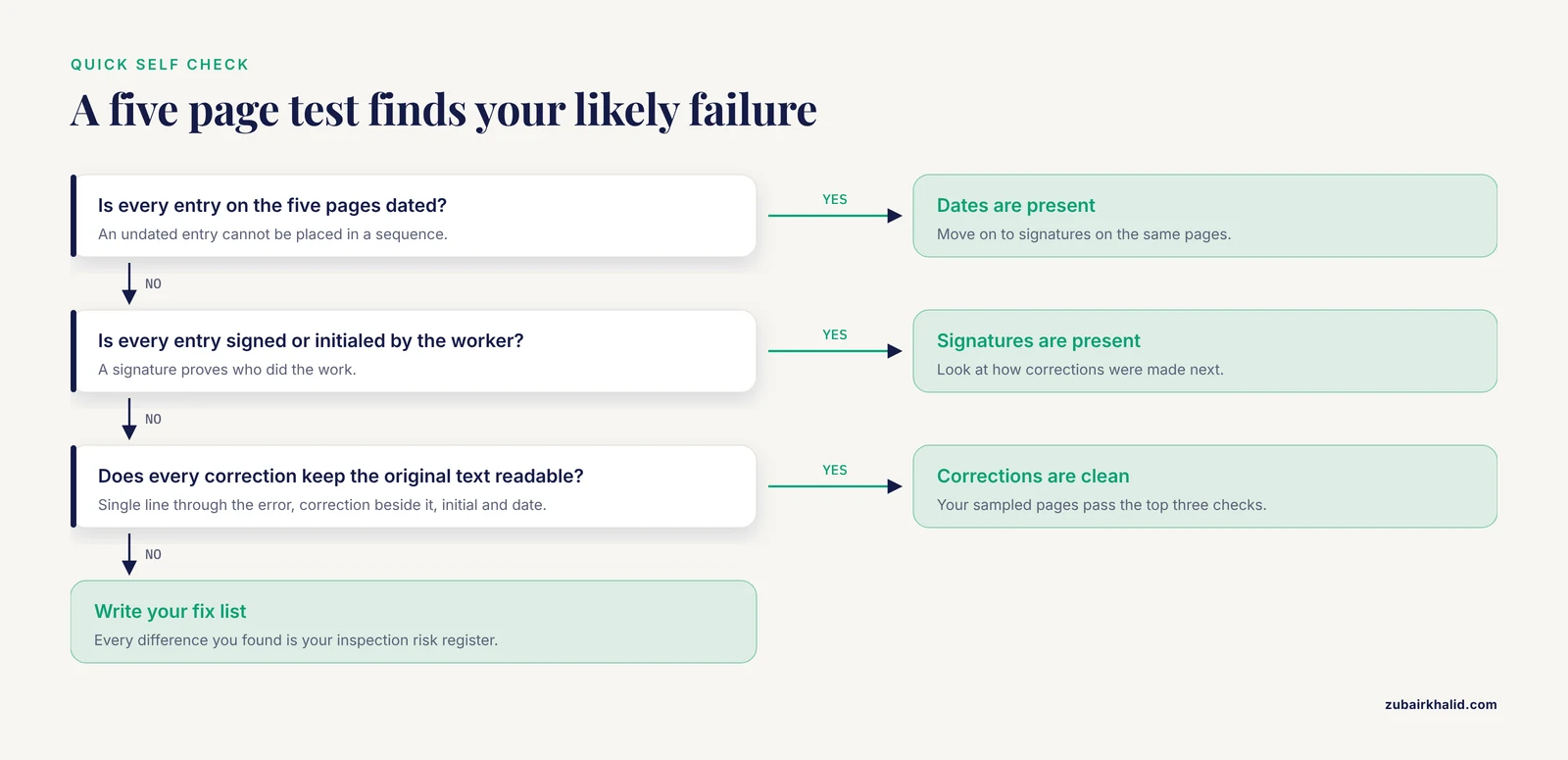
If you want to know why your lab notebook keeps failing inspection, run this sequence once. It takes about two hours for a single notebook.
- Sample five random pages and check date, initials, and correction technique on every entry.
- Check the physical state of the notebook. Look for gaps, removed pages, loose sheets, and stains.
- Pick three results and trace each one from conclusion back to raw data. If a trace breaks anywhere, mark the broken link.
- If you use an ELN, log in as an administrator and read the audit trail for one experiment. Confirm it shows who created each entry, when, and whether any entries were modified.
- Compare notebooks from at least three lab members. List the fields present in one and missing in another.
- Write down every difference you found. That list is your inspection risk register, and it doubles as your fix list.
How to Fix Lab Notebook Inspection Failures
Fix the Paper Notebook First
If you stay on paper, three changes remove most findings. First, adopt a one-page lab notebook template that every experiment starts with. A workable template includes the date, the experimenter's name, a project or study identifier, the objective in one sentence, reagent names with lot numbers and concentrations, instrument settings, the raw observations, and a short conclusion. Second, train corrections. A five-minute demonstration of the single-line-and-initial method prevents years of White-Out. Third, add a weekly two-minute peer check where a labmate samples three pages from your notebook against the template.
Training matters more than most labs expect. When a bioprocess engineering teaching laboratory implemented a cloud-based ELN, the course paired the tool with explicit training in good documentation practices (GDPs) and data integrity, and the combined approach improved both learning outcomes and compliance, with students rating the electronic system better than paper for compliance purposes [4]. The lesson generalizes to professional labs. Tools do not fix habits, training on the habits does.
Fix Traceability With Study Identifiers
Numbering experiments consistently is the cheapest high-impact fix for lab notebook inspection failures. A lab that sets up unique Study-IDs gains a single key that connects notebook pages, sample inventory, and instrument files, which directly supports transparency and integrity in the documentation [1]. A simple scheme is a lab code, the year, and a sequential number, for example LABA-2026-0147, applied identically in the notebook, on sample labels, and in the file names of raw data.
Integrate Sample Records With Experiment Records
A frequent hidden failure is the split between two record systems. In most academic and government labs, experiments live in notebooks while samples live in spreadsheets, and the two activities are managed as if they were unrelated [5]. Inspectors notice when a notebook describes an experiment using a sample that the inventory cannot account for, or when an aliquot's history stops at the freezer log. Integrated management of samples and experimental data reduces lost and mislabeled samples, clarifies the relationships between samples and experiments, reduces experimental error, and improves search and productivity [5]. If a full integrated platform is out of reach, a documented cross-reference between your notebook Study-ID and your sample sheet row number closes most of the gap.
Electronic Lab Notebook Comparison and When to Switch
What an ELN Does That Paper Cannot
An ELN timestamps entries automatically, ties them to an individual account, preserves edit history in an audit trail, and supports electronic signatures, which together eliminate the top three paper failure modes in one step [3]. ELNs also handle large datasets, image files, and remote or real-time monitoring of experiments that paper notebooks physically cannot [4].
The Comparison That Actually Matters
The useful electronic lab notebook comparison is not one brand against another in the abstract. It is three tiers against your lab's real needs, based on how the market is structured. Published reviews have classified available notebooks into pools suited to Quality environments, specialized biology or chemistry work, general research and development, and multidiscipline use, because the right notebook depends on the stringency of your environment [6]. A regulated quality lab needs a system with audit trails and signatures as core features. A free-form academic lab may be better served by a flexible general tool with a disciplined template layered on top.
General-purpose tools occupy a middle tier. A translational research laboratory at New York University School of Medicine used Evernote for all routine experimental recording over six months and found that its advantages outweighed the inability to freehand directly into the notebook, with snapshots and drawing add-ons used to cover that gap [7]. A separate survey-based analysis at a biomedical research institute found that Microsoft OneNote offered many features associated with ELN best practices and that users preferred it to a purpose-built scientific ELN, though OneNote remains a general note-taking application rather than a scientific tool [8]. Both experiences point to the same conclusion. A general tool plus a strict template and clear rules can pass inspection in many academic settings, but you must supply the discipline the software lacks.
Why ELN Projects Fail and How to Avoid That
Switching to an ELN does not automatically fix your inspection problems, because ELN adoption carries its own failure modes. User studies of ELN adoption have identified the main barriers as cost, ease of use, and accessibility across different devices and operating systems, with scientists often willing to use generic notebooking tools and spreadsheets but finding that purpose-built ELNs lack functionality researchers actually need [9]. A failed rollout leaves a lab with half its records on paper and half in the system, which is itself an inspection finding.
Two structural safeguards reduce that risk. First, plan for interoperability. The proliferation of diverse ELN platforms creates real problems for data exchange between systems, and tools such as ELNdataBridge, which synchronizes data between disparate ELN platforms through Python APIs, exist because labs change systems and collaborations span platforms [10]. Choose a system that exports your data completely, and keep exports on a schedule. Second, expect integration questions. ELN benefits increase when the notebook connects to laboratory information management systems, instrument data systems, and scientific data management tools, but there is no single well-established path for that integration, so scope it deliberately rather than assuming it will happen by itself [2].
A Middle Path for Reluctant Labs
Labs that cannot commit to a full ELN can still capture most of the compliance benefit. In the NYU translational lab example, the electronic system effectively replaced paper in an academic research setting while users kept photographing or drawing material that could not be typed [7]. In the teaching lab example, the ELN enabled streamlined workflow, quick recording and archiving, enhanced sharing, and real-time monitoring, with positive user experience measures improving across two successive years of the course [4]. Both results support a staged approach. Move your highest-risk records, such as regulated studies or long experiments with heavy data, into the electronic system first, and keep proven paper habits for the rest.
Prevention Practices That Keep You Passing
Prevention is cheaper than repair, and it consists of five habits rather than any purchase.
- One template, one lab. Everyone uses the same lab notebook template, and new members are trained on it in their first week, mirroring the way structured ELN onboarding supported good documentation practices in the teaching lab study [4].
- Contemporaneous entry, always. Record at the bench. If a number lands on a scrap, it is transcribed the same day with a note about where it came from.
- Corrections that preserve history. Single line, corrected value, initials, date, in every notebook and in every electronic system.
- Study-IDs that tie everything together. One identifier connects notebook page, sample label, and raw data file, maintaining the chain of transparency the record exists to provide [1].
- Periodic self-inspection. Once a month, someone in the lab runs the six-step diagnostic sequence above on a random notebook. Finding your own gaps costs nothing, and it removes the surprise from a real inspection.
There is a cultural dividend as well. A standard practice of releasing lab notebooks alongside publications would increase transparency and help improve honesty when reporting results, and newer electronic notebook systems make that level of sharing technically easier [11]. A notebook built to survive an inspection is also a notebook you would not mind a reviewer seeing.
Safety note. A notebook that travels to the wet bench collects hazards of its own. Pages soaked with ethidium bromide stains, phenol, or solvent become chemical waste, and smudged reagent labels on a page become unreadable records. Keep the notebook out of splash zones, photograph any step involving hazardous reagents immediately, and if a spill contaminates the notebook, treat the affected pages as chemical waste according to your institution's hazardous waste procedures, then reconstruct the entry on a fresh page with a dated note explaining the transfer.
Common Mistakes and Limitations
- Fixing only past pages. Labs often clean up the twenty pages before the audit and change nothing going forward. The next inspection samples new pages and finds the same habits.
- Signing for other people. countersigning a colleague's entry destroys the personal accountability the signature exists to prove. Each person signs only their own work.
- Treating an ELN purchase as a compliance fix. An ELN with shared logins, disabled audit trails, or no template produces the same failures in a new interface [3].
- Assuming general note apps are ELNs. OneNote and Evernote can work in academic settings with discipline, but they were not designed for scientific record-keeping, and the lab must supply the structure, as the adaptation guides for these tools make clear [8].
- Ignoring the sample side. A perfect notebook tied to a chaotic freezer spreadsheet still fails traceability checks, because samples and experiments are documented as separate activities [5].
- Individual results still need judgment. This article covers documentation practice, and the scientific validity of any specific experiment always depends on your protocol, your institution's policies, and the requirements of your funder or regulator.
Frequently Asked Questions
What is the most common reason a lab notebook fails inspection?
Missing dates and missing signatures on individual entries are the most common cause. Run the five-page test described at the top of this article and you will usually confirm or rule out this failure in ten minutes.
How do I fix a correction that I already made with White-Out?
Do not try to remove it. Write the correct information on the next available line, add a dated note that the corrected value supersedes the obscured entry on the earlier page, and initial it. Going forward, use the single-line-and-initial method so the original text always stays readable.
What should a lab notebook template include?
At minimum, a date, the experimenter's name, a study or experiment identifier, the objective, reagent names with lot numbers and concentrations, instrument settings, raw observations, and a dated conclusion. Fields stay identical for every experiment so missing information becomes obvious at a glance.
Can an electronic lab notebook satisfy an inspector?
Yes, when it provides individual accounts, an audit trail, electronic signatures, and preserved edit history, which are considered basic capabilities of a credible ELN [3]. A misconfigured ELN with shared logins fails the same way an undated paper notebook does.
Is OneNote or Evernote a real ELN?
Not by design, but both have worked as ELNs in academic labs when paired with strict templates and rules. Users at one biomedical institute preferred OneNote over a purpose-built scientific ELN [8], and an NYU translational lab used Evernote successfully for six months [7]. The lab supplies the compliance structure the software does not.
How do I compare electronic lab notebook platforms for my lab?
Sort candidates by the stringency of your environment first. Reviews of the ELN market group products into quality-focused, biology-focused, chemistry-focused, research and development, and multidiscipline pools [6]. Then check cost, ease of use, cross-device accessibility, export options, and integration with your instruments, since adoption studies identify cost, usability, and accessibility as the leading barriers [9].
How far back will an inspector look?
There is no universal lookback period in the sources reviewed here, so treat the whole retention period required by your funder, institution, or regulator as fair game. The practical implication is that you cannot outlast an inspection by waiting, and old notebooks need the same date, signature, and correction standards as current ones.
Who signs and witnesses a notebook entry?
The person who performed the work signs or initials and dates the entry. A witness or second signature is required in some regulated settings, where a second person confirms they observed the work, and where the workflow requires it both signatures should be contemporaneous rather than a batch review at the end of the week.
Sources
- Electronic Lab Notebooks and Experimental Design Assistants.
- Electronic laboratory notebooks progress and challenges in implementation.
- eCAT: Online electronic lab notebook for scientific research.
- Implementation and use of cloud-based electronic lab notebook in a bioprocess engineering teaching laboratory.
- The benefits of integrated systems for managing both samples and experimental data: An opportunity for labs in universities and government research institutions to lead the way.
- A review of electronic laboratory notebooks available in the market today.
- Using Evernote as an electronic lab notebook in a translational science laboratory.
- A quick guide for using Microsoft OneNote as an electronic laboratory notebook.
- Electronic lab notebooks: can they replace paper?
- ELNdataBridge: facilitating data exchange and collaboration by linking Electronic Lab Notebooks via API.
- Scientific honesty and publicly shared lab notebooks: Sharing lab notebooks along with publication would increase transparency and help to improve honesty when reporting results.