Data Integrity in Lab Notebooks: Best Practices
By Dr. Zubair Khalid, DVM, MS, PhD ·

Data integrity in lab notebooks means every experimental record is attributable, legible, contemporaneous, original, and accurate for as long as anyone might need it. You achieve that with disciplined habits in a paper notebook or with controlled features such as audit trails and electronic signatures in an electronic lab notebook, and regulators and funders, including the FDA and NIH, judge records against those same expectations.
What Does "Lab Notebook Data Integrity FDA NIH" Mean?
People who search for "lab notebook data integrity FDA NIH" usually want to know how these two organizations relate to the notebook sitting on the bench. The answer is different for each, and understanding the difference explains most of the advice in this article.
The FDA is a regulator. When a laboratory generates data that support a drug, biologic, device, or other product the FDA oversees, the notebook becomes part of the evidence chain. The FDA expects those records to be trustworthy, and for electronic records it applies 21 CFR Part 11, the regulation governing electronic records and electronic signatures. The FDA's data integrity expectations for regulated laboratories are built on the ALCOA framework described below. An electronic lab notebook developed with input from the FDA's Center for Biologics Evaluation and Research, for example, built its core feature set around exactly these concerns, including a permissions system, an audit trail, and electronic signature capability [1].
The NIH is a funder, not a product regulator. For NIH funded work, data integrity in lab notebooks is about scientific stewardship. NIH expects grantee institutions and investigators to keep records that allow findings to be reproduced, to support the data management and sharing plans now required for most funded projects, and to retain research records for the periods institutions and sponsors specify. A notebook that cannot answer who did what, when, and why undermines those obligations even if no regulated product is involved.
So the phrase "lab notebook data integrity FDA NIH," when interpreted plainly, asks one practical question: does my notebook hold up under outside scrutiny, whether that scrutiny comes from a regulator auditing a submission, a funder reviewing reproducibility, a journal editor, or a colleague three years from now trying to repeat the experiment?
Why Data Integrity in Lab Notebooks Matters
Documentation of experiments is essential to best research practice and to scientific transparency and data integrity [2]. The notebook is where raw observation first becomes a durable record, before analysis, before publication, and before anyone else sees it. If that first record is incomplete, backdated, or ambiguous, every downstream product inherits the problem.
There is also a honesty dimension. One proposal in the scientific literature argues that routinely releasing lab notebooks as supplementary material alongside publications would reduce biased and incomplete reporting, and that modern electronic notebook systems make this level of transparency realistic [3]. A notebook maintained for integrity is one you could actually release. A notebook patched together from memory after the fact is not.
Finally, large datasets have changed the stakes. Modern experiments generate data volumes that paper pages cannot hold or organize, which is a major reason electronic systems emerged in the first place [4]. Data integrity practices that worked for a 1980s bench notebook need updating when the experiment's real output is a 40 gigabyte imaging directory.
The Core Principles: ALCOA and ALCOA+
Regulatory and quality professionals summarize data integrity expectations with the acronym ALCOA. The terms are standard in the field and apply to any notebook, paper or electronic.
- Attributable. Every entry identifies who made it. In a paper notebook, that means signed and dated entries. In an electronic system, it means entries are tied to a unique user account rather than a shared login.
- Legible. A reader years later can understand the entry. Permanent ink in paper, sensible structure in electronic records.
- Contemporaneous. The record is made at the time of the activity, not reconstructed hours or days later.
- Original. The record is the first capture of the data, or a verified true copy of it. Raw instrument output counts. A transcription of a transcription does not.
- Accurate. The record reflects what actually happened, including failed runs and unexpected results.
Good documentation practice, often abbreviated GDP in laboratory training, extends ALCOA with four more attributes: complete, consistent, enduring, and available [5]. A record that is accurate but stored on a dead laptop is not enduring. A record that omits the failed attempt is not complete.
Paper Notebook Best Practices and a Lab Notebook Template
Paper notebooks remain common in laboratories, and much research data still lives in proprietary file formats without experimental context alongside them [6]. A paper notebook can fully satisfy data integrity expectations if the habits are right.
Follow these practices:
- Use a bound notebook with permanently numbered pages. Never remove a page.
- Write in permanent ink. Date every entry as you work.
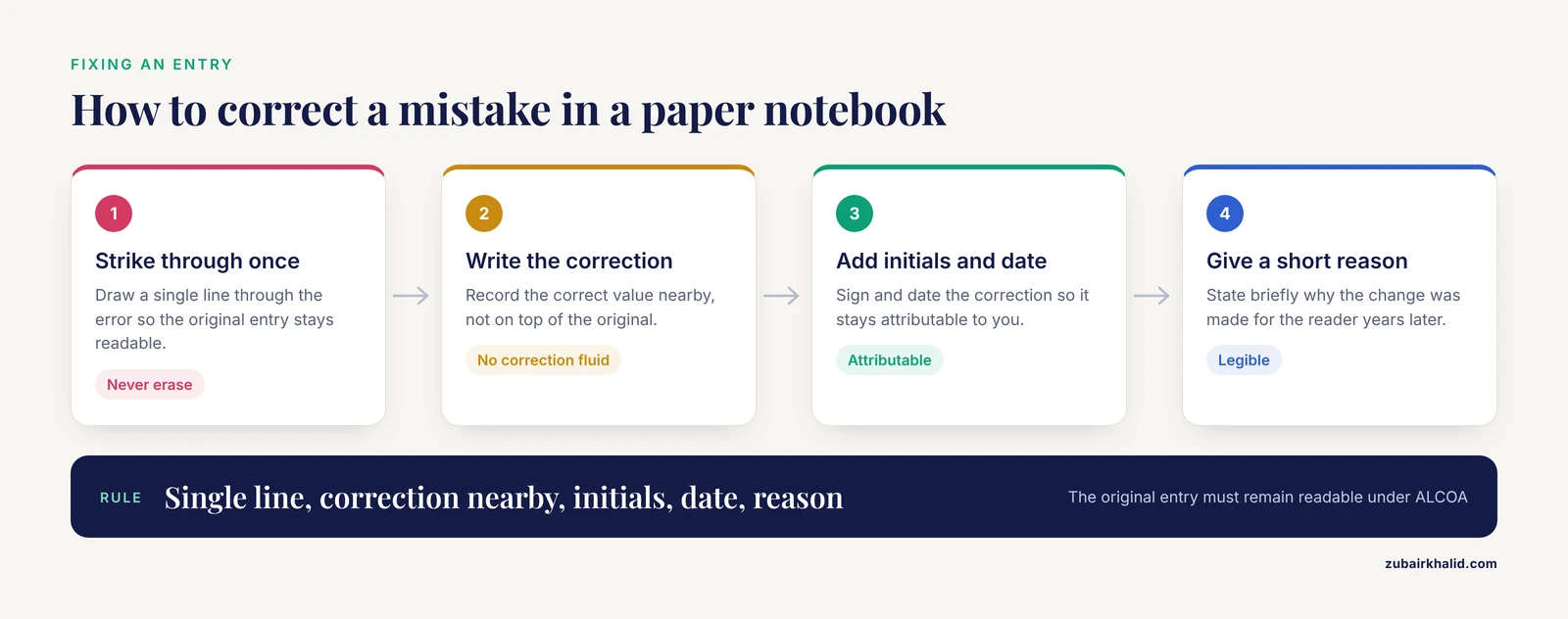
- Make corrections with a single line through the error, then write the correction nearby with your initials, the date, and a short reason. Never erase, overwrite, or use correction fluid. The original entry must stay readable.
- Attach printouts, gels, and instrument strips flat with tape, sign and date across the tape, and label each attachment with the experiment it belongs to.
- Leave no blank pages or large gaps. Draw a line through unused space.
- Have a second qualified person witness and sign critical entries periodically.
A workable lab notebook template for a paper notebook follows this structure on every experiment page:
- Header with project name, a unique experiment or study identifier, the date, and the operator's name.
- A one or two sentence statement of purpose.
- A reference to the protocol or standard operating procedure used, with version or date.
- Materials and reagents with lot numbers and expiration dates.
- The actual procedure as performed, including any deviation from the written protocol, recorded as it happens.
- Raw observations and measurements in real time.
- A short conclusions section.
- Signature and date lines for the experimenter and, where institutional policy requires, a witness.
The study identifier deserves emphasis. Guidance on adopting electronic documentation recommends setting up unique study identifiers as a concrete mechanism for maintaining best practice, because the ID links the narrative record to every associated data file, sample, and analysis [2]. The same habit works in paper notebooks and makes later reconstruction of an experiment dramatically easier.
Electronic Lab Notebooks and How They Raise the Bar
Electronic lab notebooks, usually abbreviated ELNs, were introduced to make documentation of experiments more straightforward, and their functionality has expanded steadily toward broader use [2]. ELNs are better equipped than paper notebooks to handle modern life science experiments that generate large datasets and require high levels of data integrity [5].
What an ELN adds over paper is largely enforcement. A well designed ELN captures integrity attributes automatically instead of relying on personal discipline:
- Attribution through individual accounts, so every entry, edit, and attachment is tied to a named user.
- Audit trails that record who changed what and when, without the possibility of silent deletion.
- Electronic signatures that sign entries with the same legal weight the context requires.
- Controlled sharing and permissions, so collaboration happens without losing accountability [1].
- Search, which turns a shelf of dusty notebooks into a queryable knowledge base.
These are not conveniences. They are the mechanical realization of ALCOA. The early online ELN eCAT, developed with feedback from groups including the FDA's Center for Biologics Evaluation and Research, universities, and hospital labs, defined its core capabilities exactly this way, as a permissions system, controlled sharing, an audit trail, electronic signature, and search, presented through a front end that resembled an electronic counterpart to a paper notebook [1].
Electronic Lab Notebook Comparison: Choosing a Platform
The ELN market is crowded and uneven. A review of 35 electronic notebooks available at the time grouped them into five categories by intended audience, quality assurance and quality control environments, biology specific tools, chemistry specific tools, research and development tools, and multidiscipline tools usable across that spectrum from stringent quality laboratories to free form research [7]. That structure is still a useful first filter when you compare options, because a lab working under quality system requirements needs different features than a basic research group.
| Attribute | Paper notebook | Purpose built ELN | General note taking tool (OneNote, Evernote) |
|---|---|---|---|
| Attribution | Manual signatures | Automatic, per user account | Manual, unless accounts enforced |
| Contemporaneous recording | Depends on discipline | Enforced by workflow and timestamps | Possible, depends on discipline |
| Audit trail of changes | None | Built in | Limited or absent |
| Electronic signature | Not available | Available [1] | Not designed for it |
| Large dataset handling | Poor, needs pointers to files | Strong [5] | Moderate |
| Search across records | Manual page flipping | Strong | Strong |
| Cost and setup | Low | Often subscription based [8] | Often low or free [4] |
| Fit to regulated quality environments | Accepted with controls | Designed for it [7] | Not designed for it |
The comparison shows a genuine trade off. Purpose built ELNs provide the strongest integrity controls but carry adoption barriers. User studies have identified the cost of available ELNs, their ease of use, or lack of it, and accessibility problems across different devices and operating systems as the main obstacles, and evidence suggests scientists readily use generic notebooking software, spreadsheets, and general scientific tools while finding that many current ELNs lack required functionality [8]. In a survey based implementation study at a biomedical research institute, users actually preferred Microsoft OneNote over a scientifically designed commercial ELN, although OneNote remains a general note taking application not designed for scientific purposes, so the authors published a guide for adapting it to an ELN workflow [4]. A translational research laboratory that ran all routine experimental documentation through Evernote for six months concluded that the advantages outweighed the one notable limitation both paper and electronic users reported, the inability to freehand directly into the notebook, which the lab addressed with imported snapshots and drawing add ons [9].
A practical electronic lab notebook comparison therefore starts with your requirements, not the vendor list. Ask what your data integrity obligations demand, audit trail and signature or disciplined habits, then match the tool category, quality environment, biology, chemistry, research and development, or multidiscipline, to that demand [7].
Making ELNs Work: Implementation, Training, and Integration
Buying a platform is the easy part. Getting a lab to use it correctly is where data integrity is won or lost.
Training matters most. A bioprocess engineering teaching laboratory that implemented the cloud based ELN LabArchives trained students specifically in good documentation practices and data integrity, and reported streamlined workflow, quick data recording and archiving, enhanced data sharing and collaboration, superior data integrity, and real time and remote monitoring of experiments, with student responses indicating the ELN was better than paper for compliance [5]. The lesson generalizes, labs that treat ELN adoption as a documentation training program, not a software installation, get better results.
Instrument data needs a capture plan. One of the biggest hurdles in electronic documentation is managing data from different devices with substantial metadata while ensuring transparency and integrity are reflected in the record [2]. Academic laboratories working on limited budgets have solved this with modest changes to common systems, including three data transfer approaches for moving files from instruments such as NMR, GC-MS, LC-MS, IR, Raman, and mass spectrometers to a central server where the files become visible inside the ELN [10]. The principle transfers to any lab, raw instrument data should flow into the notebook environment automatically or through a defined routine, never by ad hoc copying that skips provenance.
Integration multiplies value. ELN benefits increase when the notebook connects with laboratory information management systems, chromatography data systems, analytical instruments, and scientific data management systems, although a well established integration path has been slow to emerge [11]. Integrated management of samples and experimental data offers tangible benefits including fewer lost and mislabeled samples, clearer visualization of relationships between samples and experiments, reduced experimental error, more effective search, productivity gains, and more efficient freezer use [12]. Platforms that combine ELN and LIMS functions in one FAIR compliant environment, such as openBIS deployed for an analytical laboratory, show how a single data platform can serve both documentation and instrument workflows [13]. FAIR here refers to the principle that scientific data should be findable, accessible, interoperable, and reusable.
Standards give structure to what you record. Minimum information checklists define the elements an experiment record must contain so that others can interpret and reuse the data. The GIATE guidelines for therapy experiments provide a concrete example, a checklist covering purpose, methods, and results across molecular, cellular, animal, and clinical models, with an electronic lab notebook and a spreadsheet format offered as two ways to create the required information [14]. A related position paper on minimum information standards in chemistry argues that data must mature beyond a supplement to a research paper and that agreement on minimum information standards is needed to support structured reporting [6]. Building such checklists into your notebook template turns every experiment record into structured, reusable data.
Common Mistakes and Limitations
These are the errors that most often defeat data integrity in lab notebooks, in practice:
- Recording from memory. Writing the experiment down at the end of the day breaks the contemporaneous requirement and is the single most common integrity failure in otherwise careful labs. Record as you work, even if roughly, and clean up the narrative in a later dated addendum rather than rewriting the original.
- Cleaning up failed attempts. Omitting the run that failed makes the record incomplete and destroys the record's credibility as evidence of what happened.
- Improper corrections. Correction fluid, erasure, and overwriting in paper, or undeleted edits without audit trails in electronic systems, are the first things an auditor looks for. Use single line strikethrough with initials, date, and reason, or rely on a system whose audit trail makes every change visible [1].
- Detached data files. A notebook entry that says "results in my Dropbox" with no controlled link leaves the data without experimental context, a pattern criticized in calls for better research data management [6].
- Choosing an ELN nobody will use. Cost, poor ease of use, and cross device accessibility are documented reasons ELN adoption stalls, and no platform has become a dominant market player partly for these reasons [8]. Pilot with the actual users before committing.
- Assuming software creates integrity automatically. An ELN with audit trails still depends on users logging in under their own names, timestamping honestly, and attaching the right files. General purpose tools used as ELNs need deliberate workflow rules, as the OneNote adaptation guide demonstrates [4].
- Ignoring interoperability and migration. Data locked in one ELN platform creates a long term risk. A newly reported adapter based approach, ELNdataBridge, enables exchange of information between different ELN systems through their programming interfaces, which signals where the field is heading, but labs should still ask export questions before adoption [15].
- Skipping the template. Free form entries are hard to interpret later. Structured headers, study identifiers, and defined sections exist precisely to keep records unambiguous.
- No retention plan. Records must endure. Decide where archived notebooks live, in what format, and who is responsible before the drawer fills up or the subscription lapses.
One limitation applies across all of this, no notebook practice substitutes for sound experimental design and honest conduct, and individual institutional, sponsor, or regulatory requirements vary, so laboratories should confirm the specific rules that govern their own work.
What Is Still Uncertain
Several questions remain open. No single ELN has emerged as a key player in the market, and researchers continue to report that available products fall short of their functional needs, so the ideal platform for any given lab is still a matter of trial [8]. Interoperability between ELN platforms is only beginning to be solved, with the first reported method for direct exchange of information between different ELNs published recently [15]. Standardized minimum information requirements for recording experiments exist for some domains, such as therapy development [14] and chemistry [6], but a universal standard for laboratory notebook content has not been achieved. How widely labs will adopt practices such as publishing notebooks alongside papers, which could measurably improve reporting honesty, is not yet known [3].
Frequently Asked Questions
What does "lab notebook data integrity FDA NIH" mean?
It refers to how laboratory notebooks relate to the expectations of the FDA and NIH. The FDA, as a regulator, expects notebook records supporting products it oversees to meet data integrity standards, including 21 CFR Part 11 for electronic records. The NIH, as a funder, expects records that support reproducibility, data sharing, and retention for research it funds.
What are the ALCOA principles for lab notebooks?
ALCOA stands for attributable, legible, contemporaneous, original, and accurate. Every entry must identify its author, be readable, be made at the time of the work, capture the original data, and reflect what actually happened. Good documentation practice adds complete, consistent, enduring, and available [5].
Can an electronic lab notebook satisfy FDA expectations?
Yes, when it provides the controls the FDA expects for electronic records, including user attribution, audit trails, and electronic signatures consistent with 21 CFR Part 11. An ELN developed with feedback from the FDA's Center for Biologics Evaluation and Research built precisely those features into its core design [1]. The lab remains responsible for using them correctly.
Is a general tool like OneNote or Evernote acceptable as an ELN?
It can be, with disciplined workflow rules. Users in a biomedical research institute preferred OneNote over a scientific ELN in surveys, and the authors published a guide for adapting it to an ELN workflow [4]. A translational lab used Evernote for six months and found its advantages outweighed the lack of freehand entry, which they worked around with snapshots and drawing add ons [9]. These tools lack built in audit trails and electronic signatures, so they fit research contexts better than regulated quality environments.
What should a lab notebook template include?
A header with project name, unique study identifier, date, and operator, a purpose statement, a protocol reference with version, materials with lot numbers, the procedure as actually performed including deviations, raw observations recorded in real time, conclusions, and signature and date lines. Unique study identifiers are specifically recommended as a mechanism for maintaining and enhancing best documentation practice [2].
How do I correct a mistake in a paper lab notebook?
Draw a single line through the error so it remains readable, write the correction nearby, and add your initials, the date, and a brief reason. Never erase, overwrite, or use correction fluid, because the original entry must stay legible under the ALCOA principles.
How do I choose between a paper notebook and an ELN?
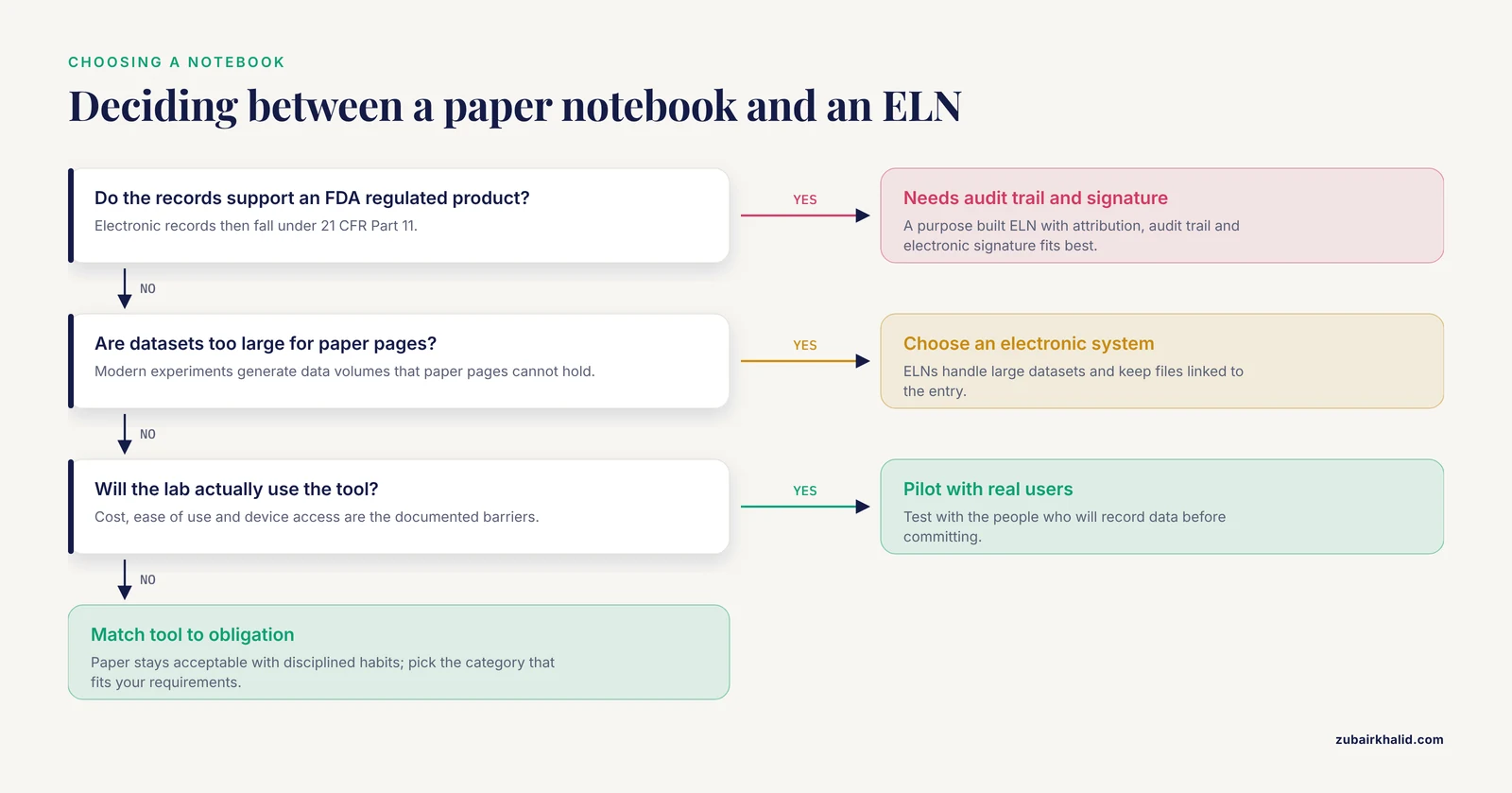
Base the choice on your integrity obligations and data volume. ELNs are better equipped for large datasets and high data integrity requirements, with automatic attribution, audit trails, and search [5], while paper notebooks remain acceptable with disciplined manual practices. Match the tool category, quality, biology, chemistry, research and development, or multidiscipline, to your requirements [7], and pilot with real users before committing, since cost and usability are the leading adoption barriers [8].
How does lab notebook data integrity support reproducibility?
Complete, contemporaneous, and attributable records let another researcher reconstruct exactly what was done, including failed attempts and deviations, which is the practical basis of reproducibility. Documentation is described as essential to best research practice and to scientific transparency and data integrity [2], and proposals to share notebooks alongside publications argue that open, well maintained records would reduce biased and incomplete reporting [3].
Sources
- eCAT: Online electronic lab notebook for scientific research.
- Electronic Lab Notebooks and Experimental Design Assistants.
- Scientific honesty and publicly shared lab notebooks: Sharing lab notebooks along with publication would increase transparency and help to improve honesty when reporting results.
- A quick guide for using Microsoft OneNote as an electronic laboratory notebook.
- Implementation and use of cloud-based electronic lab notebook in a bioprocess engineering teaching laboratory.
- Minimum Information Standards in Chemistry: A Call for Better Research Data Management Practices.
- A review of electronic laboratory notebooks available in the market today.
- Electronic lab notebooks: can they replace paper?
- Using Evernote as an electronic lab notebook in a translational science laboratory.
- Procedures for systematic capture and management of analytical data in academia.
- Electronic laboratory notebooks progress and challenges in implementation.
- The benefits of integrated systems for managing both samples and experimental data: An opportunity for labs in universities and government research institutions to lead the way.
- The openBIS Digital Platform for Instrumentation and Data Workflow in the Analytical Laboratory.
- Guidelines for information about therapy experiments: a proposal on best practice for recording experimental data on cancer therapy.
- ELNdataBridge: facilitating data exchange and collaboration by linking Electronic Lab Notebooks via API.