Lab Notebook Corrections and Intellectual Property
By Dr. Zubair Khalid, DVM, MS, PhD ·

Most intellectual property damage from lab notebooks traces back to a single habit: fixing a mistake by erasing it, painting over it, or writing so heavily on top of it that the original reading disappears. The first thing to check on any page you are worried about is whether the original entry is still legible beneath or beside the correction, and whether the correction carries its own date and initials. If both are true, the page usually keeps its value as evidence. If either is false, the repair takes more than a pen.
Lab notebook corrections and intellectual property are linked because a notebook is not primarily a memory aid. It is a contemporaneous legal record that can support a patent filing, a trade secret claim, or a data integrity review years after the experiments end. A correction done well preserves that record. A correction done badly can weaken it permanently, and some damage cannot be repaired at all, only explained.
This guide covers why notebooks carry legal weight, what causes corrections to damage that weight, how to fix a correction properly in paper and electronic notebooks, a troubleshooting table for the most common failures, a short diagnostic audit, and the prevention practices and template elements that keep the problem from coming back.
Why Lab Notebooks Carry Intellectual Property Weight
A lab notebook does three legal jobs, and every correction rule exists to protect one of them.
First, the notebook documents conception and reduction to practice. In United States patent law, conception is the point at which the invention exists as a complete idea in the inventor's mind, and reduction to practice is the point at which the idea is built and shown to work. Inventorship turns on conception, so dated entries that show an idea forming and then working are direct evidence of who invented what, and when.
Second, the notebook supports independent creation. Since the America Invents Act took effect, United States patents have generally gone to the first inventor to file, and the filing date controls priority between two competing applications. Notebooks did not lose their value when that change happened. A derivation proceeding, the formal process for resolving a claim that one party took the invention from another's confidential disclosure, still turns on contemporaneous records showing who had the idea first and where it came from.
A concrete example shows the stakes. Suppose your team designs an enzyme variant in March, and a competitor files an application on a similar variant the following January. The filing dates will usually decide priority between the applications, but if the competitor's version looks like it came from your collaborator's confidential talk at a closed meeting, your team's dated, witnessed March entries become the evidence that shows independent creation.
Third, the notebook anchors trade secrets and data integrity. A well-kept notebook shows what an organization knew and when, demonstrates that reasonable measures protected confidential information, and provides the baseline record for any later review of data quality. The stakes are high enough that protecting intellectual property is an explicit design goal for notebook systems at major research firms [1].
Reviewers and counsel look for the same features in both formats. They want entries in the author's own hand or account, dates that follow the calendar, corrections that show their own history, and a second person who can say what the page looked like when it was signed. Every rule in this guide serves one of those four expectations.
Corrections threaten all three jobs for one reason. The value of a notebook comes from its appearance of contemporaneity and integrity. A page that looks altered invites an examiner, a licensing partner, or opposing counsel to argue that the record was changed after the fact, and once that argument lands, the dates written on the page prove little. The purpose of correction rules is fidelity to what actually happened, not neatness.
Lab Notebook Corrections and Intellectual Property: The Causes That Matter
Corrections damage intellectual property through a small number of mechanisms. Listed from most common to rarest, they are:
1. The undocumented correction
A value is crossed out and rewritten with no initials, no date, and no reason. This is the most common failure by a wide margin, usually committed by someone in a hurry who assumes the cross-out speaks for itself. The mechanism is simple. Nothing ties the change to a person and a moment in time, so the page can no longer show that the correction was made the same day as the original entry, and the date at the top of the page weakens accordingly.
2. Erasure and obliteration
Pencil erasures, correction fluid, tape, scraped paper, and heavy overwriting all destroy the original reading. The mechanism is the most serious on this list. The record stops showing what was originally written, so a reviewer must take the author's word for what used to be there. In a dispute that is equivalent to having no record, and in the worst case an obliterated page looks deliberate, which turns a clerical problem into an allegation of fraud.
3. Erasable media
Pencil, erasable pens, and water-soluble inks make every entry a potential correction waiting to happen. Water-soluble ink has a second failure mode in a biology lab, since a splash from a buffer or a solvent can dissolve an entry hours after it was written. The mechanism is that the medium itself is mutable, so contemporaneity can never be verified.
4. Physical integrity failures
Loose-leaf pages, glued-in printouts that detach, and removed pages break the context around a correction. A missing page is indistinguishable from a suppressed page, which is why bound, numbered notebooks are the traditional standard for patent-relevant work.
5. Backdating and silent late entries
Writing an entry today with an earlier date, or adding material to a past page without labeling the addition, makes the record assert a falsehood about time. Done through carelessness, it weakens the notebook. Done deliberately, it is misconduct that can sink a patent case, a trade secret claim, and a career.
6. Electronic record failures
Shared logins, disabled audit trails, copy-paste overwrites of raw data, and edits made to signed records without a new amendment are the electronic equivalents of the failures above. The audit trail is the electronic ink, and gaps in it have exactly the same effect as erasures on paper.
Each mechanism has a different fix, which is why the diagnosis matters. A missing initial needs a dated note, while an obliterated entry needs escalation to counsel.
How to Fix a Correction Without Damaging Intellectual Property
Correcting a paper notebook
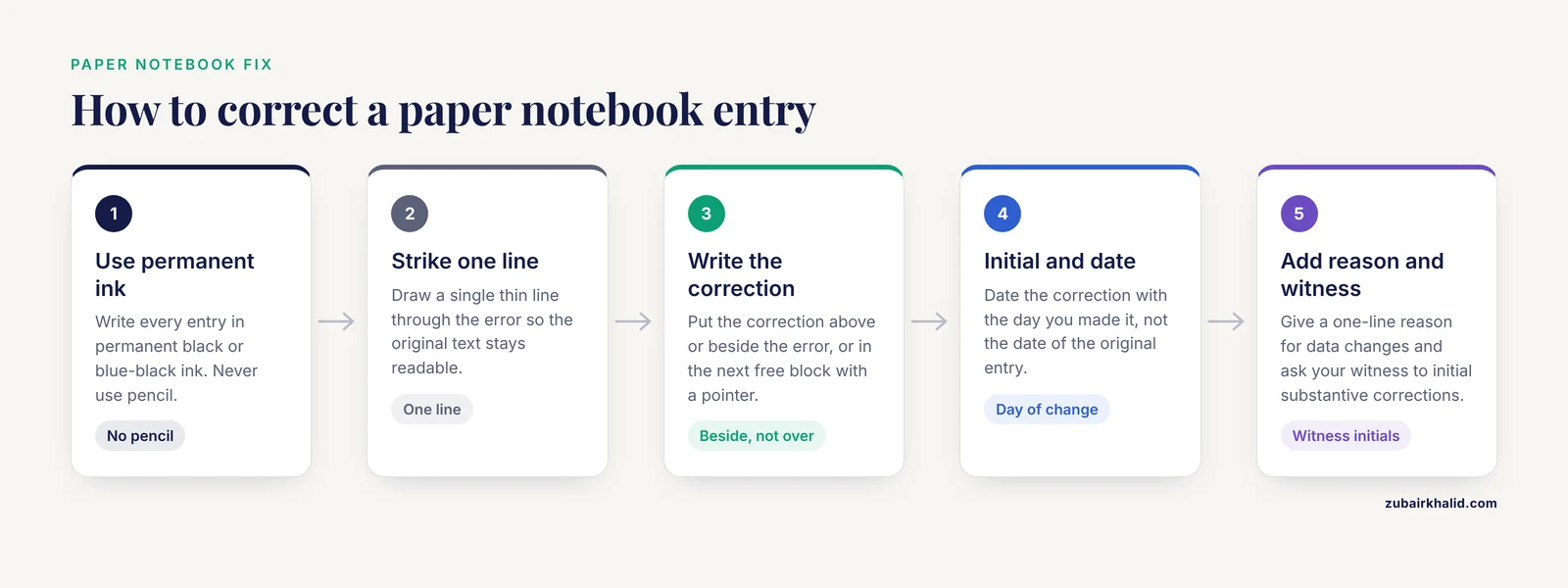
- Write everything in permanent black or blue-black ink from the first entry. Never use pencil.
- Draw a single line through the error, thin enough that the original text stays readable. One line, not a scribble.
- Write the correction directly above or beside the error, or continue in the next free block of space with a short note pointing to it. Do not squeeze text into margins or between lines in a way that could look like a later insertion.
- Initial and date the correction. The date is the day you made the correction, not the date of the original entry.
- Add a one-line reason whenever the change affects data or a conclusion, and initial and date the reason as well.
- Ask your witness to initial substantive corrections, the same way they initial entries.
- When you tape in a printout or photo, initial and date across the tape boundary so the attachment and the page are visibly joined.
- Never remove a page. If an entire page is wrong, draw a single line through it, write "void" with a brief reason, initial and date it, and start the replacement on a new page that cross-references the voided one.
- Never backdate. If you record work after the fact, write "recorded on [today's date] for work performed on [date of the work]". A labeled late entry is honest and useful. An unlabeled one is a liability.
- When a page is finished, cross out large blank areas with a diagonal line so nothing can be added later.
A worked example
| A weak correction | The same correction done properly |
|---|---|
| "Yield: 12 21 mg", with the second number written over the first in different ink and no initials | "Yield: 12 mg struck through with one line, corrected to 21 mg. J.D. 14 Mar 2026. Transcription error, the balance display read 21.0 mg, printout taped to page 44." Witness initials added on the correction line |
The weak version leaves three questions open. Who changed the number, when, and which value did the instrument actually display? The proper version answers all three and points to independent raw data that confirms it.
Correcting an electronic lab notebook
The electronic rule is the mirror of the paper rule: add, never overwrite.
- Make the change as a new version or a signed amendment so the system retains the original entry.
- Sign the amendment from your own account.
- Open the audit trail and confirm the system logged who made the change, what changed, and when.
- If the system permits silent edits, shared accounts, or edits to signed records without re-approval, treat that as a configuration failure and escalate it. For work governed by the United States regulation 21 CFR Part 11, which covers electronic records and electronic signatures, computer-generated, time-stamped audit trails are a baseline expectation.
Audit trail mechanics are simple once you have seen them. Every create, edit, and signature event is logged with the user account, a system clock timestamp, and typically the previous and new values. Ordinary users cannot edit the log. When you correct an entry, the system stores the change as a new layer over the original, so a reviewer can reconstruct the full history. That reconstruction ability is what makes an electronic record indelible in the practical sense, even though the storage is magnetic rather than ink.
Troubleshooting Table: Symptoms, Causes, and Fixes
The table covers the failures that most often surface when a notebook is reviewed for a filing, a technology transfer evaluation, or a dispute. Every row is a place where corrections and IP collide. Find the symptom you have, confirm the cause, and apply the fix. Two fixes recur throughout, so they are worth memorizing: keep the original legible, and attach a dated, initialed note to every change.
| Symptom | Likely cause | How to confirm | Fix |
|---|---|---|---|
| Correction fluid or tape covers an entry | Obliteration | Tilt the page under raking light, feel for raised texture, and check any photocopies or scans made before the correction | Leave the covering in place. Enter the correct information beside it with the date, your initials, and a note that the original is obscured. Notify your technology transfer office or patent counsel before any filing |
| Faint ghost of erased pencil text | Erasure | Shine light at a low angle across the page and look for graphite smears under magnification | Do not write over the ghost. Re-enter the information as a new dated, initialed entry that states it reconstructs the earlier one, and cite the supporting raw data |
| Corrected value with no initials or date | Undocumented correction | Compare the entry against instrument printouts, raw data files, and the witness's memory | Add a dated, initialed marginal note identifying the change and pointing to the supporting raw data |
| Glued-in gel photo or printout lifting off the page | Detached attachment | Look for adhesive residue and offset marks on the facing page | Do not reglue over the entry. Photograph the item in place, note the detachment, initial and date, then secure the item with tape along one edge outside the text or store it in a labeled sleeve referenced from the page |
| Entry written in different ink from the rest of the page | Suspected backdating or later insertion | Compare the entry's content against surrounding dates and ask the author when it was written | If the entry is honest, add a dated, initialed note explaining when it was actually written. If it was backdated deliberately, escalate to the technology transfer office and patent counsel immediately, because the remedy is legal, not clerical |
| Page missing or page numbers out of sequence | Removed page | Check duplicate copies, carbon sets, or the scanned archive | Document the gap with a dated, initialed note on the following page describing what the page contained and where a copy may exist |
| Electronic record changed but the audit trail shows no editor | Shared or borrowed login | Review system access logs with your IT group | Stop account sharing, re-attribute the record to its true author with a signed amendment, retrain the group, and disclose the ambiguity to counsel |
| Signed electronic entry edited after signature | Post-signature amendment without re-approval | Check the version history for an edit event after the signature timestamp | Add a new signed amendment explaining the change and keep both versions visible so the record stays signed, sealed, and indelible [1] |
Electronic Lab Notebook Comparison: Paper Versus Digital
A 2007 report in Health Management Technology described how a worldwide biopharmaceutical research firm adopted electronic lab notebooks to protect intellectual property while reducing paperwork, with records characterized as signed, sealed and indelible [1]. The report captures the core trade-off between the two formats. Paper notebooks carry legal weight through physical properties, ink, glue, page numbering, and handwriting. Electronic notebooks carry it through system properties, timestamps, signatures, and audit trails.
| Feature | Paper notebook | Electronic lab notebook |
|---|---|---|
| Correction method | Single-line strikethrough plus an initialed, dated correction | New version or signed amendment, original retained |
| Tamper evidence | Physical, ink, glue, page sequence | The audit trail, a system log of every change |
| Timestamps | Handwritten dates | System-generated, machine-readable timestamps |
| Witnessing | Handwritten signature on the page | Electronic signature tied to a unique account |
| Search and review | Manual, page by page | Full-text search across every record |
| Backup | Scanning or photocopying, done by hand | Automatic central backup |
| Typical failure mode | Erasure, obliteration, detached pages | Shared accounts, disabled audit trails, silent edits |
Indelibility is the intellectual property advantage. In a well-configured electronic system, the original entry survives every correction, which is the property paper cannot guarantee [1]. The efficiency gain is real as well, since review and copying that once consumed days become a search query.
Many labs run a hybrid for years, electronic records for data-heavy work and a paper book for quick sketches. If you scan paper pages into an electronic system, treat the scan as a copy, not the original, and keep the paper book until counsel says otherwise. If you print electronic records into a paper binder, print the audit trail with them, because a printed record without its log loses the timestamps that give it weight.
An electronic notebook is only as strong as its configuration, though. The data integrity principles summarized as ALCOA, attributable, legible, contemporaneous, original, and accurate, apply to both formats, and a correction that erases the original breaks the original and accurate requirements at the same time. Before trusting any electronic system with patent-relevant work, confirm that audit trails cannot be disabled, that every user has a unique account, and that signed records cannot be edited without a new signed amendment.
A Short Diagnostic Sequence for a Notebook Audit
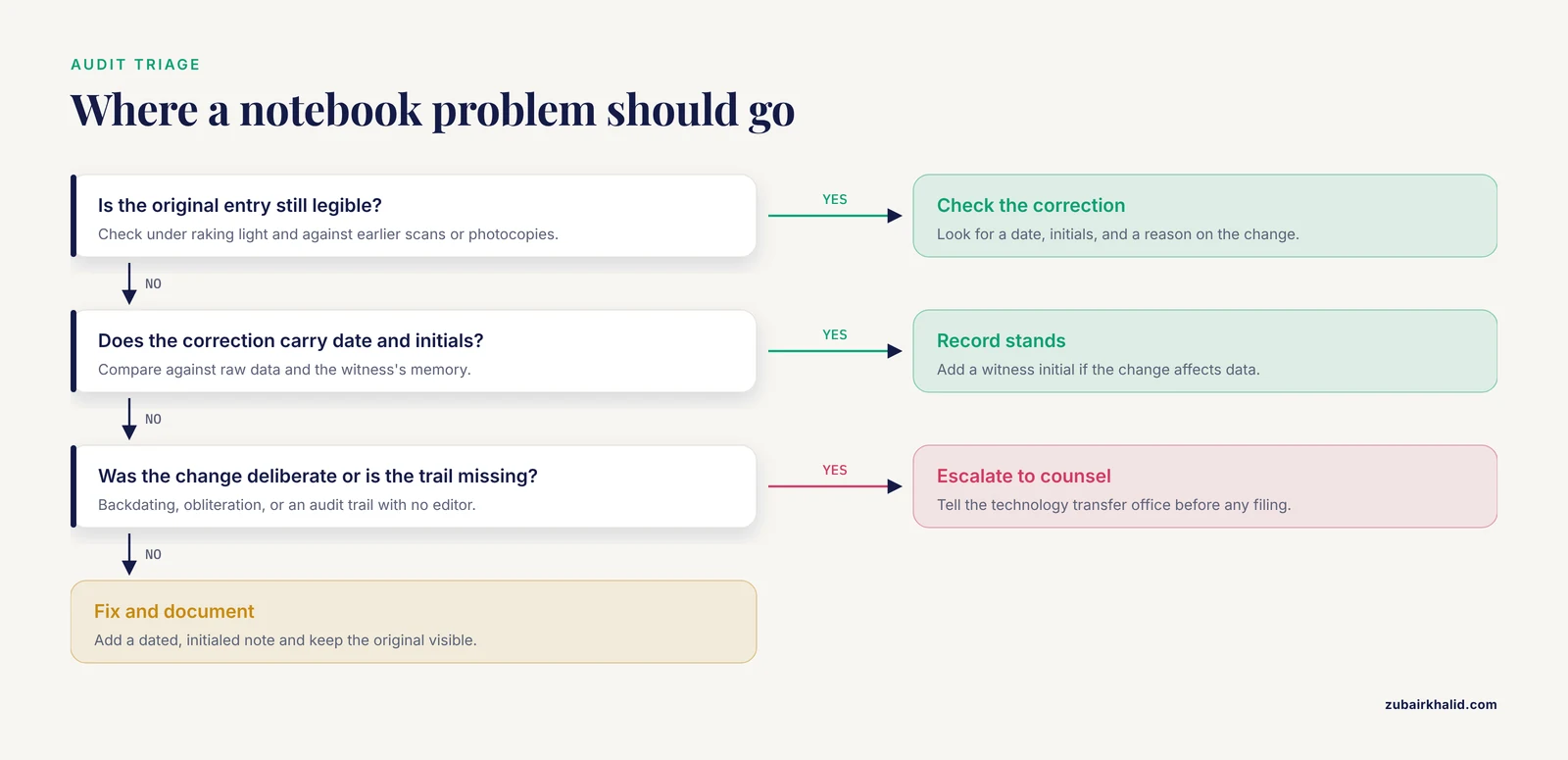
Run this sequence before any filing, technology transfer review, or collaboration handoff. Start by defining scope. List the notebook numbers, page ranges, and electronic record identifiers that touch the invention or result, so the audit has a boundary and a finish line. For a typical project notebook the whole sequence takes about an hour and surfaces most problems while they are still correctable.
- Pull every page relevant to the invention or result, including voided pages and attachments.
- Check each correction. Is the original still legible? Does the correction carry a date and initials? Does a substantive change carry a reason?
- Check page integrity. Are page numbers in sequence, are all attachments secured, is anything loose or missing?
- Check witnessing. Does a witness signature appear on each page and on substantive corrections?
- Check dates. Do entries run in order, and are any late entries labeled as late?
- For electronic records, export the audit trail for the relevant entries and confirm every edit has a named author and a timestamp.
- Route anything questionable to the technology transfer office or patent counsel before filing, not after. Explaining a documented weakness is far easier than explaining a discovered one.
Solutions: Prevention Practices and a Lab Notebook Template
Prevention is cheaper than repair, and most of it is template design plus a few enforced rules.
What a strong lab notebook template contains
- Bound, numbered pages, or an electronic system with enforced version control
- Front matter listing the owner's name, contact information, notebook number, and start date
- A date and title line for every entry
- A project or account code on each page
- Signature and witness lines at the bottom of every page, in the traditional format "witnessed and understood by", followed by a signature and date
- A table of contents or index maintained as the notebook fills
- A standard correction format printed inside the cover, for example "correction, reason, initials, date"
- A tape strip or sleeve system for attachments
Rules that protect the record
- No correction fluid, no erasers, and no pencil anywhere in the lab
- No page removal, ever
- No shared accounts on the electronic system
- A ten-minute correction demonstration for every new researcher at onboarding, using a real page from an old notebook
- A self-audit twice a year using the diagnostic sequence above
- Technology transfer review before anything heads toward a filing
Make the onboarding demonstration concrete. Show a page with a proper single-line correction next to a page with white-out, and let the new researcher practice both. Ten minutes of practice prevents the habit that causes most of the damage in the first place. Large research organizations treat notebook systems as intellectual property infrastructure rather than clerical overhead, and that reasoning is what drove the shift to electronic records at major biopharmaceutical firms [1].
Safety notes
Correction fluids and some solvent-based inks are flammable and release vapors. Use them in a ventilated area away from open flames, cap them when not in use, and keep them off skin.
If a notebook becomes contaminated with a hazardous chemical, biological material, or radioactive material, do not clean it at the bench with solvents, which destroys entries and can spread contamination. Follow your institution's chemical hygiene plan for decontamination or disposal, and preserve the record first by photographing the pages or transcribing the entries into a new notebook with a dated note explaining what happened.
Common Mistakes and Limitations
- Chasing neatness. A page with no cross-outs at all can look rewritten. Honest notebooks show honest corrections.
- Rewriting a page cleanly instead of correcting in place. The clean copy is a new record, not a repair, and the original page still exists with its problems intact.
- Treating a witness signature as a cure-all. A witness who signs an obliterated entry has witnessed a problem, not fixed one.
- Assuming digital means safe. An electronic system with shared logins or optional audit trails is weaker than a well-kept paper book.
- Assuming the notebook alone wins the patent. Under first-inventor-to-file, the filing date controls priority between applications. Notebooks support derivation, inventorship, trade secrets, and data integrity, which is reason enough to keep them well, but they are one piece of a legal strategy.
- Waiting until filing time to deal with historical problems. Some damage can only be explained, never repaired, and explanations carry more weight when the person who made the mistake documents them promptly.
- Copying a lab notebook template from the internet without adapting the signature and witness lines to your institution's policy. The template is a starting point, and the institutional policy is the authority.
- Treating these rules as legal advice. They are record-keeping practice. Any specific situation involving a filing, a dispute, or a suspected integrity problem needs the institution's technology transfer office or a qualified patent attorney.
Frequently Asked Questions
Can a corrected lab notebook still support a patent?
Yes. A correction preserves the record when the original entry stays legible and the correction is dated, initialed, and explained wherever the change affects data or conclusions.
Is white-out ever acceptable in a lab notebook?
No. Correction fluid destroys the original entry and makes the page look tampered with, which is the opposite of what an evidentiary record needs.
Do I have to witness every correction?
Initial and date every correction yourself, and have your witness initial corrections that change data, results, or conclusions. Pure spelling fixes generally do not need a witness.
How do corrections work in an electronic lab notebook?
You make the change as a new version or signed amendment, the system keeps the original, and the audit trail logs who changed what and when.
Does the first-to-file rule make lab notebooks pointless?
No. The filing date decides priority between competing applications, but notebooks still prove derivation, inventorship, conception dates, and trade secret possession.
What should I do if I already used white-out on an important page?
Leave it in place, reconstruct the obscured entry from raw data or earlier copies in a new dated, initialed entry, and tell your technology transfer office or patent counsel before any filing.
What makes a good lab notebook template for intellectual property?
Bound numbered pages, dated entries in permanent ink, signature and witness lines, a standard correction format, secured attachments, and no loose pages.
Are electronic lab notebooks accepted as legal records?
Yes, when the system captures authorship, system-generated timestamps, and a complete audit trail, which is why large biopharmaceutical research firms use them to protect intellectual property [1].