Lab Notebook Correction Signature Requirements Explained
By Dr. Zubair Khalid, DVM, MS, PhD ·

To correct an entry in a laboratory notebook, draw a single line through the mistake, write the correct information next to it, and add your initials and the date directly beside the change. The original entry must stay readable, and the correction must be signed by the person who made it at the time the change was made.
That short rule carries most of the weight in regulated and academic laboratories alike, yet it is one of the most common sources of inspection findings, grade deductions, and disputed data. This article gives a full interpretation of lab notebook correction signature requirements, explains where the rule comes from, walks through the standard correction procedure, covers what happens in electronic systems, and clears up the myths that cause people to overcorrect or hide their mistakes.
What Do Lab Notebook Correction Signature Requirements Mean?
The phrase describes two linked obligations that apply whenever you change something you have already written in a lab notebook:
- The correction itself must be made in a way that leaves the original entry legible.
- The person making the correction must mark the change with a signature or initials and the date, placed at or near the change.
A signature on a correction does three jobs at once. First, it identifies who changed the record, which matters if the data is ever questioned. Second, it dates the change, which establishes the sequence of events. Third, it signals that the change was intentional and reviewed, not an accident of smudged ink or a lost page.
The requirements apply to any change to recorded data: crossing out a transcription error, replacing a wrong reagent lot number, adjusting a calculation, or reclassifying an observation. They also apply to additions. When you realize you left a value out of a table hours after the experiment, the added value is treated like a correction, with initials and a date showing when the addition was made.
Different organizations enforce the rule with different strictness. The Food and Drug Administration expects it of regulated studies under Good Laboratory Practice (GLP), the quality system covering nonclinical safety studies. Under FDA regulation 21 CFR Part 58, raw data entries must be dated and signed or initialed by the person who entered the data, and any change to raw data must be made so the original entry is not obscured, must be dated, and must be signed or initialed by the person making the change. The Organization for Economic Cooperation and Development (OECD), whose Principles of Good Laboratory Practice are adopted widely across national testing frameworks, states matching expectations for data recorded during GLP studies. University teaching labs borrow the same conventions even where no regulator is watching, because the habits transfer directly into industry and clinical settings.
Interpretation of the Two Signature Elements
The identifier. A full signature is the most unambiguous identifier. Initials are widely accepted, especially for routine corrections made many times per day, because the notebook already links the initials to the person on the signature page or in a personnel file. Some institutions require a full signature on the first entry of each page and accept initials for individual corrections. The specific requirement is set by the laboratory's standard operating procedure (SOP), a written document that defines how a routine activity is performed. If your SOP says full signature and date, initials alone will fail an audit.
The date. The date you write next to a correction is the date you actually made the change, not the date of the original experiment. This distinction confuses many students. A correction dated after the fact is normal and expected. What is never acceptable is backdating, which means writing an earlier date to make a change appear contemporaneous. Backdating destroys the credibility of the entire record.
The Standard Correction Procedure, Step by Step
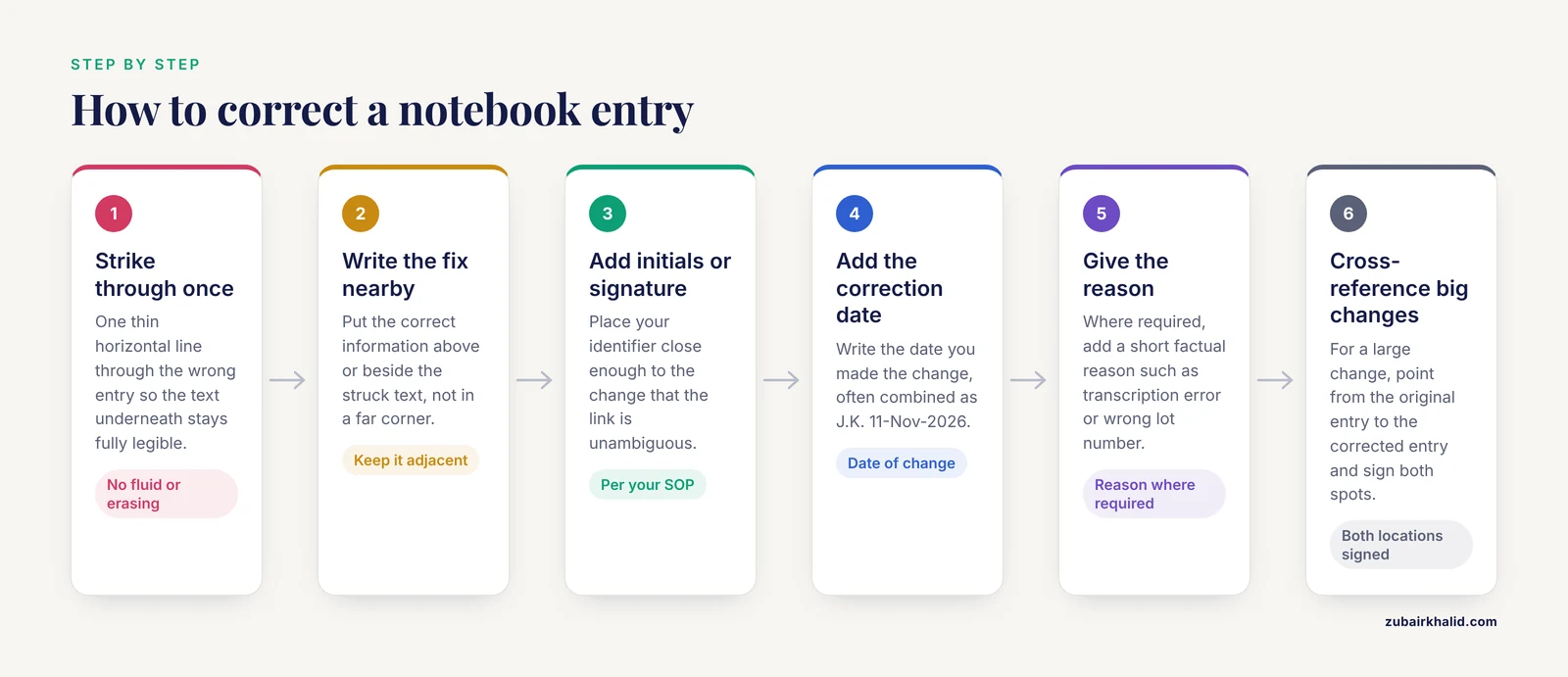
The procedure below reflects the consensus of GLP training materials, industry SOPs, and standard research methods textbooks.
- Draw a single line through the incorrect entry. One horizontal strike-through, thin enough that the text underneath remains fully legible. Never scribble, never erase, never use correction fluid or tape.
- Write the correct information immediately adjacent to the error. Above or beside the struck-through text works well. Do not write the correction in a far corner of the page or on another page, because a reviewer must be able to connect the change to the original entry at a glance.
- Add your initials (or signature, per your SOP) next to the correction. Place the identifier close enough to the corrected text that its association is unambiguous. If a page contains many corrections, each one gets its own initials.
- Add the date of the correction. Many labs combine the identifier and date, for example "J.K. 11-Nov-2026," written beside each change. A separate correction log at the bottom of the page can also collect initials and dates, but only if the SOP allows that format.
- Record the reason for the change where required. GLP requires the reason for a change to be indicated when the regulation or the study protocol demands it. Typical short reasons include "transcription error" or "incorrect lot number recorded." Even where not strictly required, a brief reason strengthens the record considerably.
- Cross-reference if the correction is substantial. For a large change, some labs write a short note near the original entry pointing to the corrected entry elsewhere on the page, with both locations initialed and dated.
A worked example makes this concrete. Suppose you wrote "N=12" for a treatment group, and the true count was 13. You strike through the 12 with one line, write "13" above it, and beside the change write your initials and the date, plus "count error" if your SOP asks for reasons. The struck 12 is still readable, so any reviewer can see what was originally recorded and how the record evolved.
Who Signs What: A Summary of Signature Obligations
The table below summarizes the four signature events most laboratory records involve.
| Record event | Who signs | What they write | Timing |
|---|---|---|---|
| Original data entry | Person who performed or observed the work | Signature or initials, plus date of the entry | Same day as the work |
| Correction to an entry | Person making the correction | Initials or signature, date of correction, and reason where required | Same day as the correction |
| Witness or verification of critical data | Second qualified person, where the SOP requires | Initials and date beside the verified entry or correction | At the time of verification |
| Electronic record change | Logged-in user | The system captures user identity, timestamp, and often a reason code in the audit trail | Automatic, at the moment of the change |
The witness line deserves a note. In many GLP and manufacturing settings, critical events such as weighing a reference standard or performing a data check require a second person to verify and sign. A witnessed correction means the second signer confirms both that the change is correct and that the original entry was as recorded. Not every lab requires witnesses for routine corrections, so treat the requirement as SOP-specific.
Why the Rule Exists: The Logic Behind Data Integrity
The signature requirement is not bureaucratic ceremony. It rests on how scientific records function as evidence.
A laboratory notebook is the raw data record for an experiment, and raw data is defined as the original, first-captured record of an observation. Under FDA GLP, raw data includes laboratory worksheets, recorded raw data, and memoranda, and the regulation treats it as the foundation for reconstructing a study. A reconstruction test is common during inspections: a reviewer should be able to read the notebook and repeat the experiment, understand what happened, and see every change and who made it.
The core data-integrity expectations are often summarized with the acronym ALCOA, a framework used widely in regulated laboratories. Data should be attributable (you can tell who created it), legible, contemporaneous (recorded at the time of the activity), original, and accurate. Signature and date requirements on corrections are the mechanism that keeps corrected data attributable and contemporaneous. If a change is unsigned, the record silently loses its attribution. If the original entry is obscured, the record loses its originality. Both failures can invalidate the data for regulatory use.
The single-line rule also protects the integrity of the scientific narrative itself. Seeing what was originally written and what was changed later can reveal real findings. A value corrected from 4.2 to 2.4 units three days after the original entry might reflect a unit conversion error, but it might also reflect a deliberate adjustment, and the dated signature trail is what lets a reviewer tell the difference. In patent disputes and trade secret cases, contemporaneous dated records have historically been treated as persuasive evidence of when an invention or result existed, which is one reason companies train employees heavily on notebook discipline even outside regulated research.
Finally, the requirement distributes accountability correctly. Data belongs to the person who generated it, and only that person (or someone explicitly authorized under the SOP) should change it. Signature requirements make that ownership visible on every page.
Common Myths About Correcting Lab Notebooks
Myths around corrections cluster into two groups: practices that hide the original entry, and practices that treat corrections as evidence of wrongdoing.
Myth: Correction fluid or erasing is fine as long as the data is right. Obliterating the original entry is the single most serious notebook offense in a regulated setting. The original entry is raw data, and raw data must remain retrievable. A whited-out page can cause an entire study to be rejected during an FDA inspection, because reviewers can no longer confirm what was originally recorded.
Myth: A page with corrections must be rewritten or discarded. Some students, on noticing several errors, tear out the page and start fresh. Removing pages is a worse violation than the errors themselves. Bound notebooks exist precisely so pages cannot be removed without detection. Correct the errors in place with the standard procedure. A messy page with clean, signed corrections is a compliant page.
Myth: Corrections suggest the data is unreliable. The opposite is true. Every real experiment generates small errors in transcription, labeling, and arithmetic, and an honest record shows those errors being caught and fixed, with signatures proving who fixed them and when. Records that look flawless often raise more suspicion during an audit than records with a reasonable, well-documented trail of corrections.
Myth: You can sign a correction on behalf of a colleague. Identity matters. If someone else notices your error, the accepted practice is for them to flag it to you, and for you to make and sign the correction yourself. Signing another person's name or initials is falsification. Where a lab allows a reviewer to annotate a correction, the reviewer signs with their own identity, clearly separate from the data originator's marks.
Myth: The date on a correction should match the date of the experiment. As covered above, the correction date records when the change was made. Writing the original experiment's date on a correction made later is backdating, and it is treated as a data-integrity violation even when the underlying correction is accurate.
Myth: Pencil is fine. Erasable medium undermines the permanence of the record. Standard practice across academic and industry laboratories is permanent ink, typically blue or black ballpoint or gel ink, chosen because it survives photocopying and does not smear. If a pencil entry exists in an older notebook, the correction procedure still applies, and many institutions re-record the affected entry in ink with a cross-reference.
Paper and Electronic Notebooks: An Electronic Lab Notebook Comparison
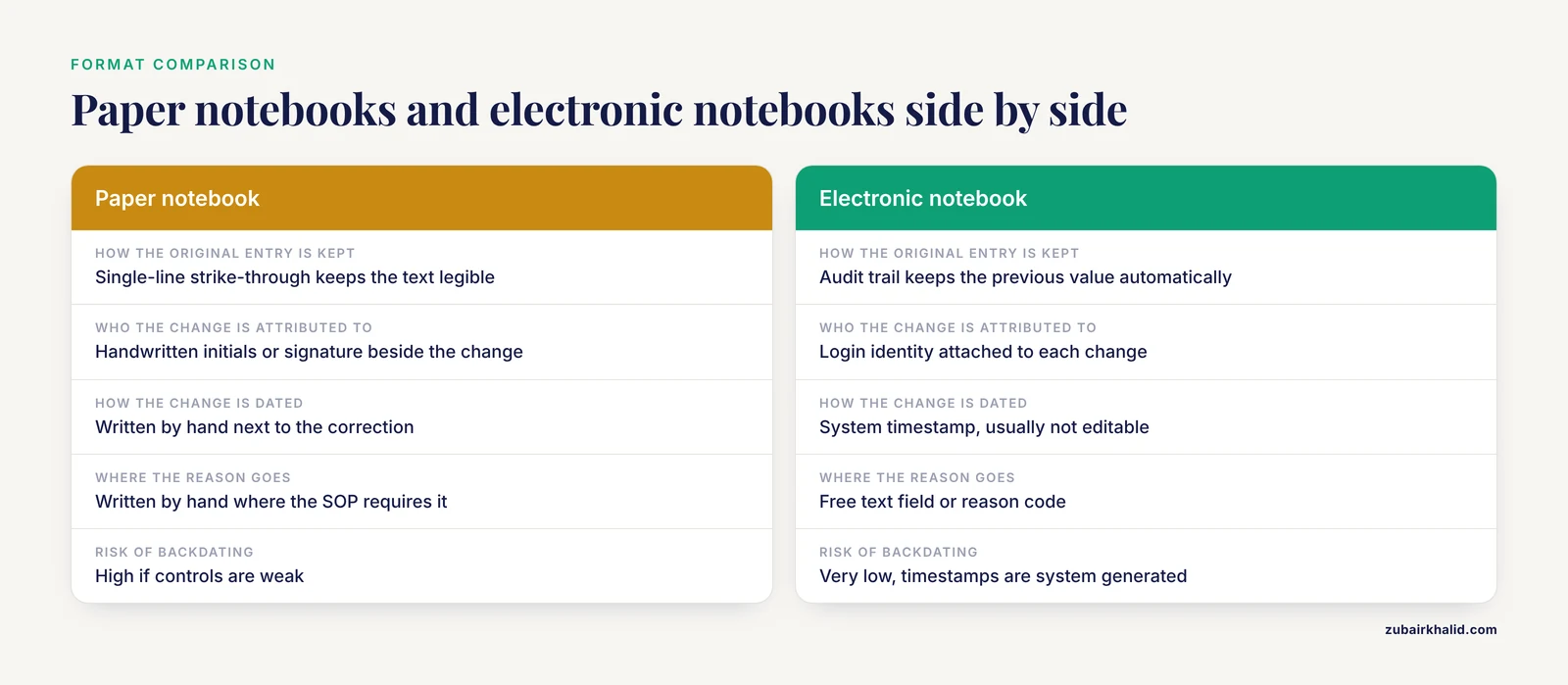
Electronic lab notebooks (ELNs) handle correction signature requirements differently from paper, and understanding the difference matters for anyone choosing a platform or preparing for an audit.
In a paper notebook, the signature is a physical act. You write it, and the page carries your handwriting. In an electronic system, the signature is an attribute attached to the record by software. When you edit an entry, the system logs your user identity, the timestamp, and often the previous value, in an audit trail, which is a secure, computer-generated, time-stamped record of every change.
The FDA's regulation on electronic records and signatures, 21 CFR Part 11, sets the expectations for this environment. Electronic signatures must include the printed name of the signer, the date and time, and the meaning of the signature, such as "reviewed" or "entered by." The audit trail must not obscure previous values, which is the electronic equivalent of the single-line rule. A well-implemented ELN therefore makes the old entry permanently visible alongside the new one, with attribution automatic.
Key points of comparison:
| Aspect | Paper notebook | Electronic lab notebook |
|---|---|---|
| How the original entry is preserved | Single-line strike-through keeps text legible | Audit trail retains the previous value automatically |
| Attribution | Handwritten initials or signature | Login identity attached to each change |
| Date of change | Handwritten beside the correction | System timestamp, usually not editable by users |
| Reason for change | Written by hand where required | Free text field or reason code, depending on platform |
| Backdating risk | High if controls are weak | Very low, timestamps are system generated |
| Signature meaning | Implied by context | Explicitly recorded per Part 11 expectations |
The comparison shows why many regulated laboratories have moved to ELNs. The paper method depends entirely on the writer's discipline, while the electronic method enforces the requirements structurally. The tradeoff is dependency on the platform's validation status, access controls, and data migration practices, all of which become audit topics in their own right.
For individual researchers, the practical advice is consistent across formats. Check your institution's SOP for whether electronic records are approved, whether electronic signatures are accepted, and how a record moves between paper and electronic systems. Mixed records, where part of the experiment is on paper and part is in software, need clear cross-references in both directions.
Building the Requirements Into a Lab Notebook Template
A lab notebook template, whether a printed page layout or a structure you follow in an ELN, can prevent most correction problems before they happen. Effective templates share several features.
A signature and date line on every entry and every page. Each page should end with the author's signature and the date, so every page stands on its own as an attributed record. Entries made on different days on the same page each get their own date.
A signature block identifying the writer. Somewhere in the front matter, the notebook should map initials to full names and signatures. This makes initials-based corrections unambiguous months or years later, including to people who never met the writer.
Space for a reason-for-change notation. Templates used in GLP environments often reserve a narrow margin where short reasons such as "transcription error" are written beside corrections, keeping the main data area clean.
A witness line for critical entries. Where the SOP requires verification, the template provides a dedicated line for the witness's initials and date, rather than leaving the witness to squeeze a mark into the margin.
Page numbering and a table of contents. Numbered pages and an index are not signature requirements, but they support the attribution chain, because a reviewer can locate the page on which a correction appeared and confirm the page has not been removed.
Groups adopting a shared template should distribute it with a one-page SOP covering the correction procedure, so new members learn both at the same time. The American Society for Microbiology and similar professional bodies have long promoted disciplined record keeping in the context of publication and reproducibility, and many university research offices publish their own notebook guidelines modeled on GLP conventions.
Common Mistakes and Limitations
These are the errors that most often surface in audits, lab-course grading, and manuscript reviews.
- Squeezing corrections into tiny spaces without identifiers. A strike-through with corrected text crammed above it, with no initials and no date, is incomplete under any standard.
- Batch signing. Making five corrections during the morning and signing them all at once with one initials-and-date mark covering the page is not compliant. Each correction needs its own identifier and date, unless the SOP explicitly defines an approved batch format.
- Rewriting instead of correcting. Copying a corrected table onto the next page and leaving the original untouched obscures the change history unless you cross-reference both locations and sign both.
- Losing the reason. Where a reason is required, writing "oops" or leaving the field blank fails the expectation. Short factual reasons such as "unit conversion error" are sufficient.
- Correcting data you did not generate. Unless your role authorizes it, a colleague's entries should be corrected by that colleague.
- Sticky notes as the correction record. Attaching a note over an error instead of correcting it on the page leaves the underlying entry unresolved and the note easily lost.
- Assuming the rules are identical everywhere. Requirements vary by institution, by study type, and by country. GLP studies, clinical research, and academic projects set their own SOPs. When your situation involves regulated work, intellectual property, or clinical data, the individual case needs review by your supervisor or your institution's quality assurance unit, who can confirm the exact SOP language that applies.
A broader limitation applies to everything in this article: the conventions described here reflect mainstream GLP, FDA, and academic practice, but no single universal rulebook exists. Your own institution's written procedures always take precedence over general guidance.
Frequently Asked Questions
Can I use white-out or an eraser on a lab notebook entry?
No. Correction fluid, correction tape, and erasing all obscure the original entry, which must remain legible under GLP-style record keeping. Draw a single line through the error, write the correction nearby, and initial and date the change.
Do I need a witness to sign my corrections?
Only if your SOP requires it. Witness signatures are common for critical data in GLP studies and manufacturing, but many academic and exploratory labs do not require a second signer for routine corrections. Check your lab's written procedure.
Are initials enough, or do I need my full signature?
Initials are widely accepted for routine corrections as long as your identity is established in the notebook, usually through a signature page or personnel record. Some institutions require a full signature on page entries and accept initials for individual changes. Your SOP decides.
I found a mistake from two weeks ago. What date do I write?
Write the date you are making the correction, not the date of the original experiment. Corrections made after the fact are normal and expected. Writing the older date would be backdating, which is a data-integrity violation.
Can I tear out or replace a bad page?
No. Removing pages from a bound notebook is treated as a serious records violation, worse than the errors themselves. Correct the entries in place using the single-line, initial, and date procedure, even if the page ends up messy.
How do corrections work in an electronic lab notebook?
The system records your user identity, a timestamp, and the previous value in an audit trail when you edit an entry. You typically enter a reason in a designated field. You cannot obscure the old value, which mirrors the paper rule that the original entry stays readable.
Do the signature rules apply to instrument printouts and loose data?
Yes. Printouts, worksheets, and other raw data are treated as part of the record. If a printout contains an error, correct it on the printout itself with the strike-through, initials, and date, then tape or bind it into the notebook with an attribution note. Do not retype a printout, because the retyped copy is not the original record.
Does a correction need the reason for the change written down?
Under FDA GLP, the reason for a change must be indicated when the regulation or the study protocol requires it, and many SOPs ask for a reason on every correction. A brief factual note such as "transcription error" or "wrong lot number recorded" is sufficient and makes the record stronger even where optional.