Maintaining Continuity in Lab Notebooks
By Dr. Zubair Khalid, DVM, MS, PhD ·

By the end of this article you will be able to keep a lab notebook that reads as an unbroken, dated, signed record of your work. You will know how to structure every page, how to record an experiment the same day you perform it, how to correct mistakes without destroying the original record, how to handle skipped pages and gaps in time, and how to judge whether an electronic lab notebook (ELN, a software system that captures experiment data with timestamps and user accounts) preserves the same evidentiary weight as a paper book.
To follow the walkthrough, have one of the following on hand:
- A bound paper notebook with preprinted page numbers, plus a permanent archival ink pen (pigment ink such as those sold for archival writing)
- Or an account in your institution's electronic lab notebook, with a sample experiment open
- A pen with black or blue permanent ink if you use paper
- Your institution's notebook policy or standard operating procedure (SOP, a written internal instruction that defines required practice), if one exists
Nothing else is required. Every example below uses plain text you can copy into a paper page or an ELN entry.
What Continuity of Evidence Means in a Lab Notebook
Continuity of evidence is the property of a record that lets a later reader trace every entry back to a specific person, date, and unbroken sequence of pages. In practice it answers four questions about any line in your notebook:
- Who wrote it (attribution)
- When it was written (chronology)
- Whether the record is complete, with no missing pages, gaps, or unexplained alterations (integrity)
- Whether the record has been verified by a second person where required (attestation)
The phrase comes from legal and forensic practice, where "chain of custody" describes the documented handling of physical evidence from collection to presentation. A lab notebook serves the same function for experimental data. Three audiences depend on it:
- Patent examiners and attorneys. In inventors' disputes, a properly witnessed, dated, and contemporaneous notebook can support priority of invention. The record must show that the entry was made at the time of the work, not reconstructed later.
- Regulators and quality units. In regulated research, data must be attributable, legible, contemporaneous, original, and accurate. These five expectations are commonly summarized as ALCOA, a data integrity framework taught in standard industry training.
- Your future self and your colleagues. Most notebook failures hurt science long before they hurt a patent case. An experiment that cannot be reproduced because a concentration, an instrument setting, or a reagent lot number was never written down is a lost experiment, regardless of any legal question.
Continuity fails in small, cumulative ways. A page left half blank, an entry written three days late, a correction made with correction fluid, a sample labeled only "sample 4". None of these is dramatic. Together they turn a defensible record into a collection of loose notes.
Paper, Hybrid, and Electronic Notebooks Compared
For most of the twentieth century, the bound paper notebook was the only accepted record. That has changed. A 2007 case study of a worldwide biopharmaceutical research firm described the company's move to electronic lab notebooks as a way to protect intellectual property while reducing paperwork, with electronic records that are signed, sealed, and indelible [1]. The driving logic is the same continuity of evidence that paper provides, achieved through different mechanisms.
The table below summarizes the main options you will encounter as a student or early-career researcher.
| Feature | Bound paper notebook | Paper plus scanned copies | Electronic lab notebook (ELN) |
|---|---|---|---|
| , - | , - | , - | , - |
| Attribution | Handwritten signature per page | Signature plus scan metadata | Login identity on every entry |
| Timestamp | Handwritten date, vulnerable to backdating | Scan file date, editable | System-generated, tamper-resistant |
| Corrections | Single strike-through, initial, date | Same as paper, plus scan of original | Audit trail records every change |
| Search | None, manual index required | Limited to scanned text | Full text search |
| Backup | None unless photocopied | Scan stored on institutional server | Automatic, per vendor configuration |
| Witnessing | Physical counter-signature | Counter-signature on scan | Electronic signature workflows |
| Risk profile | Loss, fire, single copy | Scan quality gaps | Depends on vendor controls and validation |
None of the three options is automatically superior. A paper notebook with disciplined entries beats a badly used ELN, and a well-run ELN beats a paper notebook stored in a drawer that floods. The 2007 biopharmaceutical case is instructive because the firm did not adopt ELNs for convenience alone. The stated goals were protection of intellectual property and reduction of paperwork, which is to say continuity of evidence and efficiency together [1].
If your institution gives you a choice, the decision usually reduces to two questions. First, does your data need to be exported, searched, or shared with collaborators on a regular basis. Second, does your institution's intellectual property policy specify witnessing practices that one format supports better than the other. Ask your technology transfer office or principal investigator before you commit months of work to one format.
A Lab Notebook Template That Preserves Continuity
Every page of a paper notebook, and every entry in an ELN, should carry the same core fields. Here is a plain-text template you can copy at the top of each page or each new entry. This is a lab notebook template you can adapt to your group's conventions.
Date: 2026-11-11
Experiment: EXP-2026-041
Project: Plasmid pABC construction
Operator: J. Rivera
Purpose: Amplify 1.2 kb insert from template pXYZ-9
Related pages: p. 38 (primer design), p. 40 (reagent prep)
Materials/lot numbers: Phusion HF polymerase, lot 0041-A
Instrument: Thermocycler T-100, serial 88213
Each field exists to preserve one link in the chain of evidence:
- Date. Written at the time of the work, never reconstructed. If you write the entry a day later, write the actual date of writing and note the date of the work inside the text.
- Experiment identifier. A unique label such as EXP-2026-041 lets you cross-reference between the notebook, sample labels, and instrument output files. Use the same identifier everywhere.
- Operator. The person who actually performed the work. If two people worked together, list both and note who did which step.
- Purpose. One sentence. This is what makes the notebook readable a year later.
- Related pages. Cross-references keep continuity across pages. Without them, a record split over twelve pages becomes twelve fragments.
- Materials and lot numbers. Reagent lot numbers matter because a failed experiment traced to a bad reagent lot can only be diagnosed if the lot was recorded.
- Instrument identifiers. Institutions often run multiple identical instruments. A serial number or asset tag removes ambiguity.
The identifier convention deserves one more note. Choose a format and keep it for the life of the project. A workable pattern is a project prefix, the year, and a sequence number, for example EXP-2026-041 meaning the forty-first experiment logged in 2026 for that project code. Write the pattern down on the inside cover of the notebook so a successor can decode it.
Lab Notebook Continuity of Evidence Step by Step
The following walkthrough covers a complete cycle of maintaining continuity in lab notebooks, from opening a new book to closing out an experiment. The examples show a paper notebook, and a later section shows the same steps in an ELN.
Step 1. Establish the notebook's identity before writing in it
On the inside cover, write in permanent ink:
Notebook 7 of J. Rivera
Start date: 2026-11-11
Projects: pABC construction, enzyme assay pilot
Convention: EXP-YYYY-NNN for experiment IDs
If found, return to Lab 412, Science Hall
Expected result: anyone who finds the book knows whose it is, when it started, and how to read its identifiers. If your institution requires a bar code or asset tag on notebooks, apply it now.
Step 2. Verify the pagination
Check that pages are prenumbered. If they are not, number every page by hand before you write anything else, in the top outer corner, using the same pen you will write with. Prenumbered and hand-numbered pages both serve the same purpose. A reader must be able to detect a removed page. If page 47 is missing between 46 and 48, continuity of evidence has a visible hole. Never remove a page from a bound notebook, and never use a notebook with perforated or removable pages for record-keeping.
Step 3. Write entries on the same day as the work
Open the entry the moment you start the experiment, before the first measurement. Record as you go. If a value must be noted away from the notebook, write it on a dated, initialed scrap that you then tape or transcribe into the notebook the same day, keeping the original scrap if your policy allows pasted-in records. Transcribing "from memory the next morning" is the single most common way a contemporaneous record becomes a reconstructed one.
A same-day entry looks like this:
2026-11-11  EXP-2026-041  p. 41

09:15 Set up 25 uL PCR reactions per lab protocol PCR-03 rev 4.
      Template pXYZ-9 miniprep from 2026-11-08, p. 37.
      Primer pair F2/R3 (sequences on p. 38).
      Rxn 1: 30 s annealing gradient start 58 C.
      Rxn 2: 62 C annealing.
10:05 Loaded 5 uL of each rxn + 6x loading dye on 1% agarose,
      120 V, 35 min. Gel image saved as G2026-1111-JR.tif
      on instrument PC, folder EXP-2026-041.
Result: Rxn 2 shows single band at expected ~1.2 kb.
      Rxn 1 shows band plus faint lower band.
Decision: carry Rxn 2 product to cleanup, next page.
Expected output when a colleague reads it later: they know what was done, when, with which reagents and settings, where the raw image lives, and what you decided. Nothing requires memory.
Step 4. Never leave blank space, and close every page
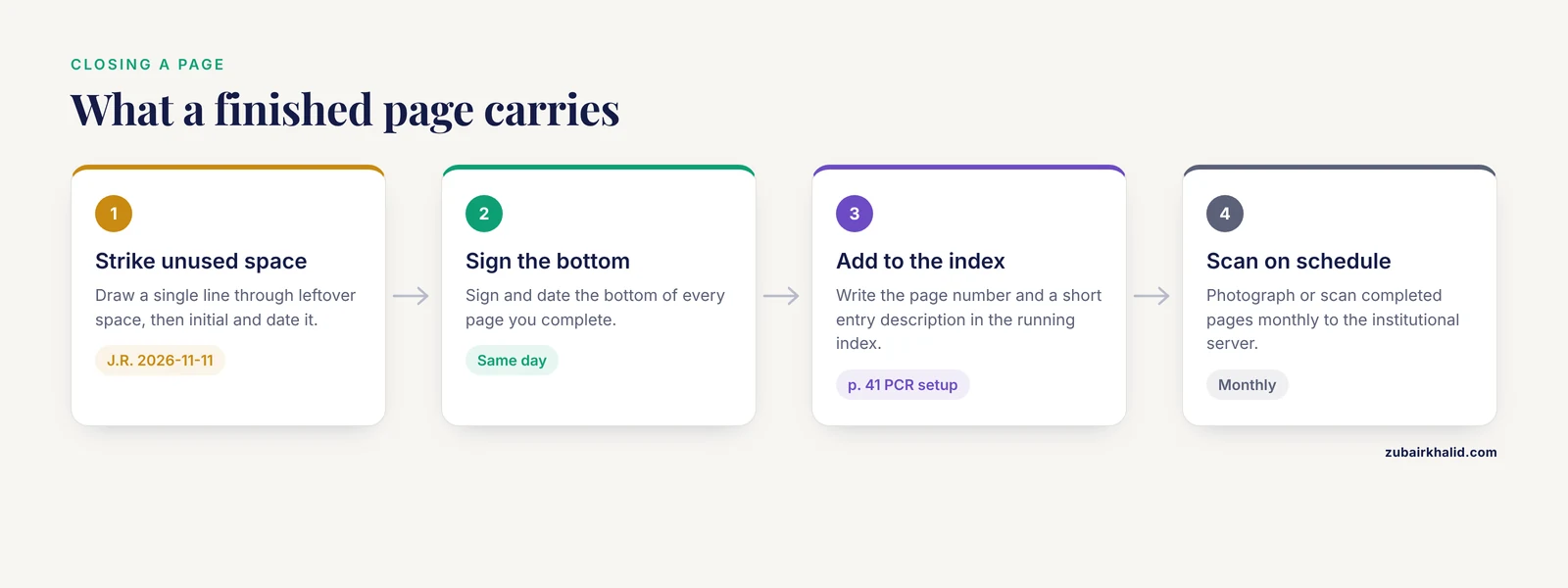
Fill pages sequentially. If an entry ends mid-page and the next entry starts a new topic, draw a single diagonal or horizontal line through the unused space, then initial and date it. If you are stopping work and will continue tomorrow on the next page, close the current page the same way.
[unused space struck through with a single line]
J.R.  2026-11-11
Continued on p. 42.
This practice prevents later insertion of text into apparent blank space, which is the classic attack on notebook credibility in patent disputes.
Step 5. Correct mistakes without erasing them
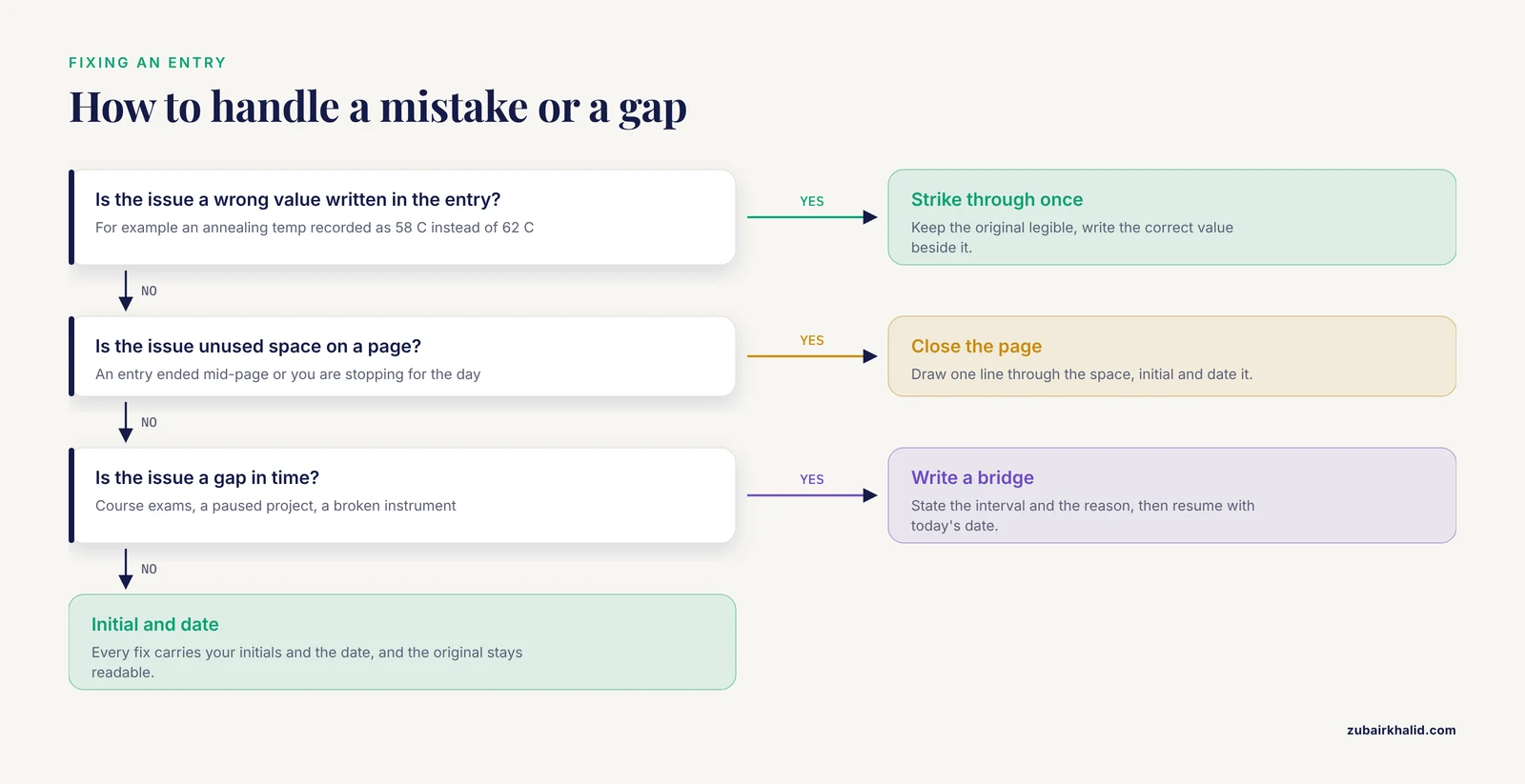
Draw a single line through the error so it remains legible, write the correction beside it, and initial and date the change. The original must stay readable. This applies to paper and to ELNs alike. In an ELN you do not delete a value, you amend it, and the system records both values with timestamps and your identity in the audit trail.
Correct example on paper:
Annealing temp: ~~58~~ 62 C J.R. 2026-11-11A struck value is evidence. It tells a later reader what you thought at the bench and what you concluded after checking. An erased or painted-over value tells a later reader only that something was hidden.
Step 6. Attach and cross-reference raw data
Tape or glue in instrument printouts, gel photographs, and small data tables flat and fully within the page margins, then write across the edge of the attachment so part of the writing is on the page and part on the item. This technique, sometimes called a tab fusion, makes it immediately obvious if the attachment is removed. Large items such as full-page autoradiographs get reduced photocopies taped in, with the original stored in a labeled folder referenced in the notebook.
Every attachment gets a caption with date, experiment ID, and content:
Fig. 1. Gel, EXP-2026-041, 2026-11-11, lanes 1-2 as rxn 1, 2.
Original stored in folder EXP-2026-041, cabinet 3.
Step 7. Handle gaps in time honestly
Gaps are normal. Courses end, projects pause, instruments break. Continuity of evidence does not require daily writing. It requires that every gap be legible as a gap. When you resume after a pause, write a short bridging entry:
2026-12-02
No bench work 2026-11-12 to 2026-12-01. Course exams.
Resuming EXP-2026-041 cleanup today, p. 42.
This one sentence converts a silent two-week hole, which looks like concealment, into an explained interval, which preserves continuity.
Step 8. Arrange witnessing where required
A witness, sometimes called a counter-signer, is a colleague who reads the entry and signs and dates it to attest that they understood the work as described. Witnessing is most consequential for potentially patentable work. Ask your institution's intellectual property office which entries require witnessing and how often. When someone witnesses a page, they sign:
Read and understood. M. Chen 2026-11-12Do not have a witness sign pages they have not read, and do not backdate witness signatures. Both practices damage the credibility of the whole notebook, not just the page.
Step 9. Sign and index as you go
Sign and date the bottom of every page you complete. Maintain a running index on the inside back cover or a dedicated page:
Index
p. 38  Primer sequences, EXP-2026-041
p. 40  Reagent prep, buffers B1-B4
p. 41  PCR setup and gel, EXP-2026-041
p. 42  Cleanup and ligation, EXP-2026-041
The index is what turns a notebook from a diary into a retrievable record. Ten minutes of indexing per week saves hours later.
Step 10. Back up and archive on a schedule
Paper notebooks are single-copy records. Scan or photograph completed pages on a fixed schedule, monthly is a common cadence, and store the images on an institutional server, not a personal drive. On the archived folder, apply the same naming convention as the experiments inside it. When a notebook is full, write the closure date on the cover, state the last page number, and store it according to your institution's retention schedule. Institutional retention periods vary by field and funding source, so confirm your own requirement rather than assuming a number.
The same steps in an electronic lab notebook
In an ELN, the mechanics change but the objectives do not. A minimal structured entry might look like this in the entry's metadata view:
Experiment ID: EXP-2026-041
Date performed: 2026-11-11
Author: J. Rivera (auto-recorded from login)
Protocol version: PCR-03 rev 4
Attached files: G2026-1111-JR.tif, thermocycler log CSV
Amendments: 1 (annealing temp corrected, audit trail)
Signatures: J. Rivera (author), M. Chen (reviewer)
The system supplies attribution and timestamps automatically, records amendments in an audit trail, and applies electronic signatures when required. This is what the biopharmaceutical case study meant by records that are signed, sealed, and indelible, meaning each entry carries an authenticated identity and cannot be silently altered after the fact [1]. Reducing paperwork was the second benefit the firm reported, since structured fields replace repetitive handwriting and make entries searchable across the whole organization [1].
Two ELN habits deserve special attention. First, never share credentials. Shared logins destroy attribution, which is the foundation of continuity of evidence in a digital system. Second, export and archive closed experiments in a vendor-neutral format on your institution's schedule, because a record trapped in a discontinued platform is at risk of becoming unreadable.
Practical Tips for Continuity
These are the habits that separate notebooks that hold up from notebooks that do not.
- Write in the notebook, not around it. If you catch yourself drafting data on sticky notes to copy later, stop. The sticky note phase is where continuity dies.
- Use permanent pigment ink in black or blue. Some inks fade or wash off. Pencil is never acceptable for a record.
- Date as the full year, month, day in a fixed order. The format 2026-11-11 removes the ambiguity between month-first and day-first conventions that causes real confusion in international collaborations.
- Record negatives and failures. A failed reaction with its conditions is evidence about what does not work. It belongs in the record with the same care as a success.
- Photograph setup states. A quick photo of an instrument screen or an assembled apparatus, taped in and captioned, preserves details that prose misses.
- Sign the same day you write. An unsigned page is an unfinished record.
- Keep one notebook per project line where practical. interleaved projects on the same pages weaken the cross-reference structure.
- Review weekly. Five minutes each Friday checking for unsigned pages, unindexed entries, and missing attachments keeps small lapses from compounding.
Common Mistakes and Limitations
These are the specific failures seen most often in student and early-career notebooks, each with its consequence and its fix.
- Backdating. Writing an earlier date on an entry made today. This is the most serious error because it attacks chronology directly. If you are recording work from a previous day, write today's date and state the date of the work inside the entry.
- Using pencil or erasable ink. Both invite alteration. Fix by using permanent ink from the first page.
- Leaving blank space for later notes. Blank space invites insertion. Fix by striking through unused space with your initials and date, as shown in Step 4.
- Removing pages. Tearing out pages, even "messy" ones, breaks the visible sequence. Fix by correcting in place instead.
- White-out and erasures. These destroy the original value. Fix by using single-line strike-throughs everywhere.
- Recording from memory the next day. Reconstructed entries lack contemporaneity. Fix by writing at the bench, even if roughly, and refining immediately.
- Missing lot numbers and instrument IDs. Without them, troubleshooting and audits stall. Fix by keeping a lot-number log page at the front of the notebook and referencing it.
- Unindexed notebooks. A notebook nobody can search is functionally lost. Fix with the running index in Step 9.
- Unattached or loose inserts. Loose printouts fall out and lose their connection to the entry. Fix by taping flat with a tab fusion signature across the edge.
- Shared ELN credentials. Attribution collapses when two people use one login. Fix by using individual accounts and listing collaborators in the entry text.
Two limitations frame all of the above. Institutional policies differ on witnessing frequency, retention periods, and acceptable formats, so your organization's SOP always takes precedence over general practice. And for questions about patent strategy or the legal weight of a specific record, consult your institution's technology transfer or legal office, since those judgments depend on facts this article cannot know.
How to Check Your Own Notebook
A quarterly self-audit catches drift early. Run through this checklist against any completed week of pages:
- Every page carries a date, an experiment identifier, and a signature.
- No page has unstruck blank space.
- Every correction is a struck-through original plus an initialed replacement.
- Every attachment is taped in, captioned, and signed across.
- Every cross-referenced page number resolves to an actual page.
- The index covers every entry.
- In an ELN, every entry has a complete metadata header and no shared-account activity appears in the audit trail.
If any item fails, fix it the same day using the correction and gap procedures above, and note the audit itself in the notebook. The fact that you audit is itself part of continuity.
Frequently Asked Questions
What does continuity of evidence mean in a lab notebook?
It means the record shows an unbroken, dated, attributable sequence of entries, so any line can be traced to a person, a time, and a place in the page order with no gaps or silent alterations. A notebook with continuity of evidence can support reproducibility, intellectual property claims, and regulatory review.
Can I write in pencil or use white-out in a lab notebook?
No. Pencil can be erased and white-out conceals the original value, and both destroy the permanence that continuity of evidence requires. Use permanent ink and correct errors with a single-line strike-through, initial, and date.
What should I do if I skipped a page or left a big gap in my notebook?
Never go back and fill a skipped page with an earlier date. Draw a line through the unused space, initial and date it, and start the new entry on the next page with today's date. For a gap in time, write a short bridging entry stating the interval and the reason.
How do I correct a mistake the right way?
Draw one line through the error so it stays legible, write the corrected value next to it, and add your initials and the date. The original value remains part of the evidence. Never erase, overwrite, or paint over it.
Do electronic lab notebooks hold up as legal and scientific records?
Yes, when they are implemented with authenticated user accounts, tamper-resistant timestamps, audit trails, and electronic signatures. A biopharmaceutical case study described ELN records as signed, sealed, and indelible and adopted them specifically to protect intellectual property while reducing paperwork [1]. Your institution's policy on ELN use and validation determines the details.
Who can witness my lab notebook entries?
A colleague who understands the work and did not perform it, following whatever witnessing rules your institution or technology transfer office specifies. The witness reads the entry, then signs and dates it. Do not backdate witness signatures or sign pages you have not read.
How often should I make notebook entries?
At the time you do the work, which in practice means starting the entry before the experiment begins and completing it the same day. Gaps are acceptable when they are explained, but entries written days later from memory weaken the record.
What belongs in a lab notebook and what does not?
Contemporaneous experimental detail belongs in the notebook, including dates, purposes, protocols and their versions, reagent lot numbers, instrument settings, raw observations, calculations, decisions, and attached printouts. Leave out personal notes unrelated to the work, and never paste in items you are not authorized to include, such as unpublished data from colleagues without their knowledge or materials under confidentiality restrictions.