Lab Notebooks for Patent Filing: What to Record First
By Dr. Zubair Khalid, DVM, MS, PhD ·

By the end of this guide you will know which notebook entries carry the most weight in a patent filing, how to structure each entry so it survives legal scrutiny, how to get entries witnessed correctly, and how paper notebooks compare with electronic lab notebooks (ELNs) for intellectual property work. To follow along you need a bound notebook with numbered pages, or access to your institution's ELN system, plus your raw data files and instrument printouts.
The core idea is simple. A patent application is judged against evidence of when and how an invention was conceived and demonstrated. The most credible evidence is a contemporaneous, dated, signed record made at the bench. Reviews of the patent process consistently stress that securing protection begins well before the application itself is drafted [1]. Your notebook is where that early stage lives.
Why Your Lab Notebook Matters Before Filing a Patent
The United States operates a first-inventor-to-file system. Under this system, patent rights go to the first party to file an application, not simply the first party to build the invention [2]. That shift makes filing speed matter, but it does not make the notebook obsolete. The notebook still does three jobs that no other document can do.
First, it fixes the date of conception. Conception is the legal term for the moment you formed a definite and permanent idea of the complete invention. Reduction to practice is the moment you actually built and tested it. Examiners, courts, and your own patent attorney all rely on dated records to place these events on a timeline.
Second, it supports inventorship decisions. Inventorship is a legal determination based on who contributed to the conception of the claimed invention. Disputes over who invented what, and when, can end up in formal interference or derivation proceedings. The CRISPR-Cas9 dispute between the University of California and the Broad Institute went before the Patent Trial and Appeal Board and was decided in February 2017, years after the original work [3]. Clean contemporaneous records are the cheapest insurance against that kind of fight.
Third, it documents novelty against prior art. Prior art is any public disclosure, patent, or publication that existed before your filing date. Careful documentation of existing knowledge protects against invalid patent claims, because it shows what was known and when [2]. Your notebook also records what you did that was new, which is what the novelty assessment actually turns on.
One more reason to write carefully. Patent eligibility in biotechnology has narrowed under US case law. The Supreme Court's decisions in Mayo, Myriad, and Alice, and the Federal Circuit's Sequenom decision, restricted claims directed to natural phenomena and abstract ideas, even for groundbreaking diagnostic methods [4]. What survives examination is usually the practical application: the specific method, conditions, and technical steps. A notebook that records only "we observed the phenomenon" supports little. A notebook that records the exact protocol, controls, thresholds, and applied use supports the claims your attorney will draft.
Lab Notebook Before Filing Patent: Step by Step
This walkthrough covers the full sequence from setting up a notebook to the pre-filing review. Each step produces a concrete artifact you can show a patent attorney.
Step 1. Set up the notebook before the first entry
If you use paper, choose a bound notebook with preprinted page numbers. Never remove pages. If you use an ELN, choose one with tamper-evident audit trails, version history, and electronic signing. Biopharmaceutical companies adopted ELNs specifically to protect intellectual property while reducing paperwork, with records described as signed, sealed, and indelible [5]. Whatever format you use, decide it before day one. A project split between a lost paper notebook and an unstructured folder of files is hard to defend.
Step 2. Open every entry with the standard header
Teaching laboratories that have trained hundreds of students use a consistent entry structure: title, date, author, purpose, methods, results, and conclusions [6]. That structure works just as well for invention-focused records because it forces you to separate what you intended from what you observed.
Use this lab notebook template as the skeleton of every entry:
## Entry [number]: [Short descriptive title]

Date: 2026-11-11
Author: A. Researcher (employee ID, dept.)
Related entries: Entry 14, Entry 22
Project: [internal project code]
Purpose: What question does this entry answer? If the work relates
  to a potential invention, say so in one sentence.

Method / procedure:
- Reagent, source, catalog or lot number, concentration
- Instrument, model, settings
- Exact conditions (times, temperatures, volumes, buffer recipes)

Results (raw, recorded as observed):
- Primary numbers, readings, images as collected
- Unexpected observations, even if they look like errors

Conclusions / next steps:
- What does this result mean for the invention?
- What will be tried next, and why?

Signatures:
- Recorded by: ______  Date: ______
- Witnessed by (non-inventor): ______  Date: ______
Attachments: [list each attached item and its reference number]
The attachment line matters more than most people expect. Tape or permanently affix gels, printouts, and graphs to the page, sign or initial across the edge so removal is obvious, and list every attachment by number.
Step 3. Record the moment of conception immediately
When you first think of the inventive idea, write a dated entry that states three things: the problem, the proposed solution, and why you believe the solution works. Use plain language. An attorney can polish wording later, but no attorney can resurrect a date that was never written down.
A conception entry can be three sentences long. It does not need data. It does need a date, your signature, and enough detail that a reader can tell what the invention is. If you conceived the idea in a meeting, write the entry the same day and reference the meeting.
Step 4. Record reduction to practice with working parameters
Reduction to practice means you built the invention and it worked. This is where the detail earns its keep. Record every parameter someone else would need to repeat the work. The methods editorial literature makes the case plainly: experiments fail when small but important details go unnoticed, and researchers regularly waste months reinventing protocols because an inherited notebook lacked those details. For patent purposes the same omissions are worse, because a claim that cannot be supported by an enabling description is vulnerable.
Record:
- Full reagent identities with suppliers and lot numbers
- Exact concentrations, for example "PCR primer at 0.5 µM final"
- Instrument make, model, and setting values
- Timings, temperatures, and sequence of operations
- Raw readings as collected, before any processing or rounding
Step 5. Preserve the record, gaps and all
Use permanent ink. Correct errors with a single-line strikethrough, initial and date the correction, and write the corrected value next to it. Never erase, never use correction fluid, never remove a page. If you miss a day, leave the page blank with a diagonal line through the unused space and a dated note explaining why. A record with visible, explained gaps is far more credible than a suspiciously perfect one.
Step 6. Get entries witnessed by a non-inventor, contemporaneously
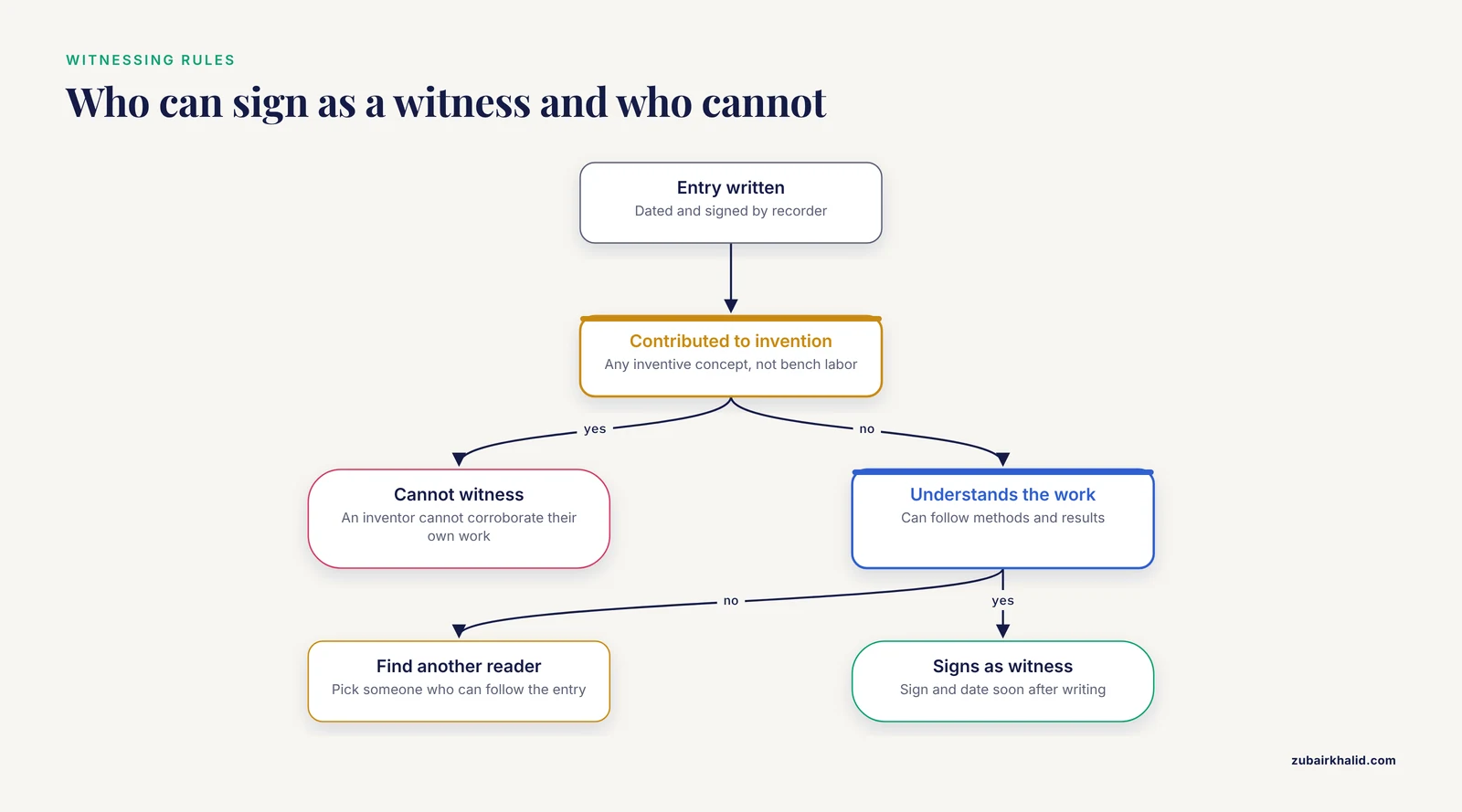
Have someone who understands the work but did not contribute to the invention read the entry and sign and date it soon after you write it. The witness's value is that they can later corroborate, from independent memory, that the entry existed on the date shown. Have them sign as a witness, not as a collaborator, and never ask a co-inventor to serve as a witness, because an inventor cannot corroborate their own work.
In electronic systems the equivalent is an electronic signature or approval workflow with a locked audit trail, which is precisely the capability ELNs were adopted to provide in IP-sensitive industrial settings.
Step 7. Track the inventorship trail as you go
Whenever someone contributes an inventive concept, not just bench labor, note who proposed what and when. Keep a running record of idea contributions in the notebook. If the project ever turns commercial, your tech transfer office will reconstruct inventorship from these entries. Getting it wrong can jeopardize a patent, so the running record is worth the two minutes it takes per entry.
Step 8. Run the pre-filing review
Before an application is drafted, do a structured pass:
- Assemble the conception entries, reduction-to-practice entries, and witnessed pages in chronological order.
- Run a prior art search and record the search terms, databases, and dates in the notebook. Structured documentation at the pre-filing stage is treated in the patent literature as a quality indicator for the eventual application [7].
- Map each potential claim category to supporting entries. Commercial analysis of top-selling drugs shows that product protection typically spans multiple claim types, including chemical composition, method of use, process or synthesis, formulation, and delivery device, with patents filed both during development and after regulatory approval [8]. In that cross-sectional study, the ten top-selling prescription drugs in the US for 2021 were linked to 1,429 patents and applications [8]. Your notebook should support every claim type your attorney may want.
- Write an invention disclosure and keep a copy, referenced to specific notebook entries.
What a completed entry looks like
Here is a worked example showing the expected output of Steps 2 through 6 for a hypothetical formulation experiment. The numbers are illustrative, not real data.
## Entry 37: Stability of buffer formulation B at 37 C

Date: 2026-11-11
Author: A. Researcher (ID 4471, Protein Sciences)
Related entries: Entry 35 (conception of formulation B), Entry 36
Project: P-2214
Purpose: Test whether replacing citrate with 20 mM HEPES
  extends storage stability of enzyme conjugate E1. This tests
  the formulation concept first written down in Entry 35.

Method / procedure:
- Enzyme conjugate E1, in-house lot 2026-10-04, 1.0 mg/mL
- Buffer B: 20 mM HEPES, 150 mM NaCl, 0.02% Tween 20, pH 7.4
  (adjusted at 22 C with 1 M NaOH)
- Buffer A (control): 20 mM citrate, same salts, pH 6.0
- Aliquots of 100 µL in amber glass vials, n = 3 per condition
- Incubator, model X200, 37 C, samples pulled at 0, 3, and 7 days

Results (raw, as observed):
- Day 0 activity, Buffer A: 100, 99, 101 relative units
- Day 7 activity, Buffer A: 41, 44, 39 relative units
- Day 7 activity, Buffer B: 92, 95, 90 relative units
- Note: Buffer B vials showed no visible precipitation,
  Buffer A vials showed fine white sediment.

Conclusions / next steps:
- HEPES formulation B retains ~90% activity at 7 days at 37 C
  versus ~40% for citrate control. This supports the
  formulation claim sketched in Entry 35.
- Next: repeat with a second enzyme lot and add a 25 C arm.

Signatures:
- Recorded by: A. Researcher   Date: 2026-11-11
- Witnessed by: B. Colleague (non-inventor)   Date: 2026-11-12
Attachments: A-1 (raw plate reader export, 3 pages),
  A-2 (photo of vials, signed across flap)
An attorney reading this entry can identify the invention (the HEPES formulation), the supporting data, the control, the unexpected stability difference, and the date. That is exactly what a pre-filing review needs.
What to Record First: Priority Order
When time is short, record in this order. Earlier items are harder to reconstruct later, so they come first.
| Priority | What to record | When | Why it matters for the patent |
|---|---|---|---|
| 1 | Conception statement (problem, solution, rationale) | Same day the idea forms | Fixes the earliest date and the inventive concept |
| 2 | Date, author, and witness fields | With every entry | Establishes who, when, and corroboration |
| 3 | Working parameters (reagents, lots, settings, conditions) | As performed | Provides the enablement behind the claims |
| 4 | Raw data, attached and cross-referenced | At collection | Primary evidence that reduction to practice occurred |
| 5 | Negative and unexpected results | Same day | Supports unexpected-results arguments and honest best-mode records |
| 6 | Prior art search terms, databases, and dates | Before drafting | Documents the novelty assessment done in good faith [7] |
| 7 | Inventorship contributions | As they occur | Prevents inventorship defects and disputes [3] |
| 8 | Disclosure and confidentiality decisions | Before any talk or poster | Protects novelty under the filing timeline [2] |
Electronic Lab Notebook Comparison
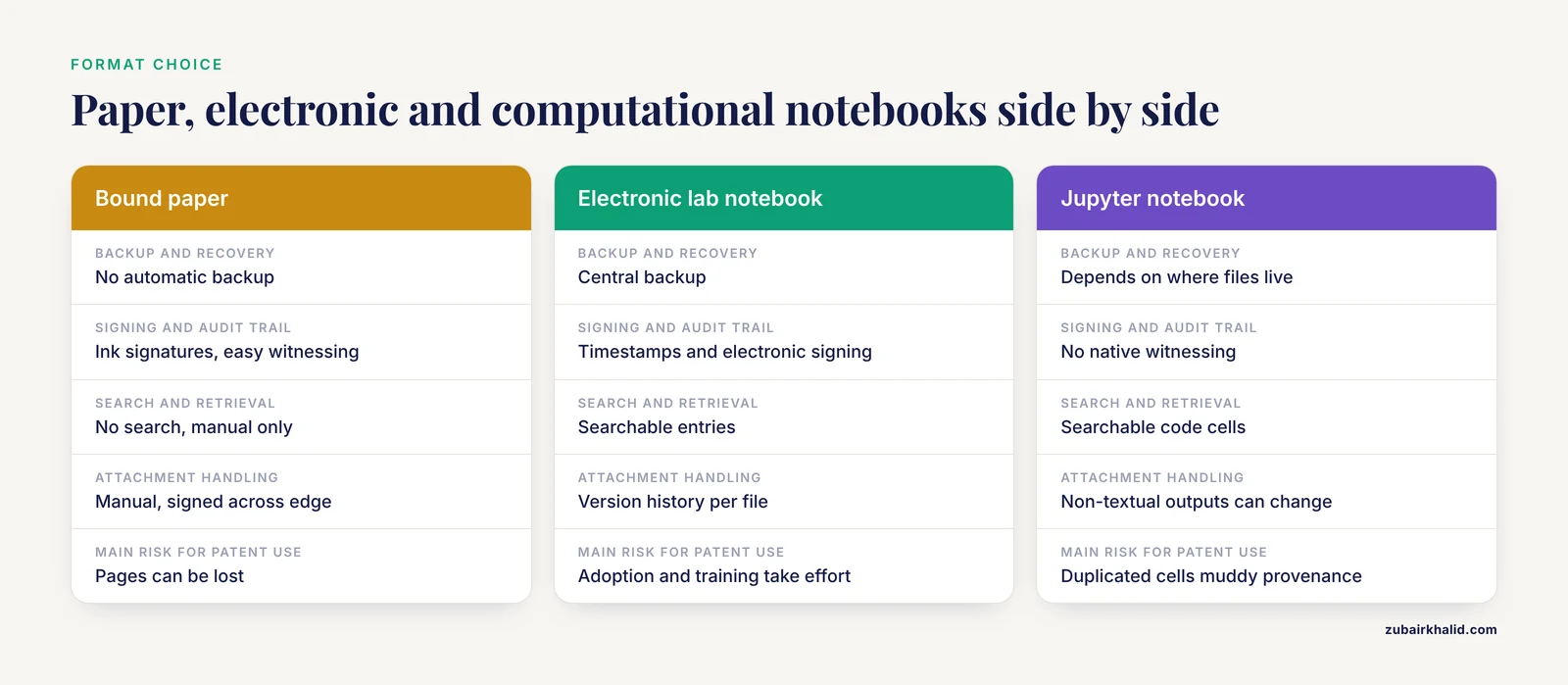
Choosing a format is a real decision, and the trade-offs are documented rather than hypothetical. Large biopharmaceutical firms moved to ELNs to make IP records signed, sealed, and indelible while cutting paperwork [5]. University deployments, however, show that adoption is not automatic. An implementation study of ELN software among STEM users at an American university in the UAE reported the practical challenges of rolling ELNs out to researchers [9]. A third format, the computational notebook such as Jupyter, is now common in data-heavy life science work, and research on those tools shows both strengths and specific weaknesses: users frequently duplicate code cells to test ideas quickly, and non-textual outputs such as images are fragile when comparing runs [10]. Newer research directions include semantic lab notebooks that link entries to shared annotations and structured data [11].
| Format | Strengths for patent support | Watch-outs |
|---|---|---|
| Bound paper notebook | Universally understood by attorneys, easy witnessing with ink signatures, cheap to start | No automatic backup, no search, pages can be lost, attachment handling is manual |
| Electronic lab notebook (ELN) | Audit trails, timestamps, electronic signing, central backup, enterprise IP use is established [5] | Adoption and training take effort [9], export formats vary between vendors, choose one with tamper-evident history |
| Computational notebook (Jupyter and similar) | Captures the exact code and parameters used, ideal for analysis pipelines | Frequent code duplication muddies provenance, non-textual outputs can change between executions [10], pair it with an ELN entry rather than replacing one |
The practical answer for most research groups is hybrid. Keep the ELN as the system of record where your institution provides one with proper audit controls, and reference computational notebooks and raw data files from ELN entries by immutable identifiers. That pattern also matches where the field is heading, toward notebooks that tie narrative entries to structured, machine-readable data [11].
Lab Notebook Tips That Carry the Most Weight
These tips reflect what attorneys and tech transfer officers look for when they review lab notebooks for patent filing.
- Write why, not just what. The purpose line in each entry [6] is what turns a data log into evidence of inventive intent.
- Date contemporaneously. A same-day date is evidence. A reconstructed date is a liability.
- Record failures with the same care as successes. A failed run with full parameters is still reduction-to-practice evidence and often the most persuasive data you have.
- Never backfill. If you find a gap, add a new dated entry explaining the gap rather than inventing a past entry.
- Keep the invention confidential until filing. Public disclosure can create prior art against your own application. Documentation of what was known and when is also the mechanism communities use to defend against invalid patent claims [2], and the same logic protects you.
- Bring the notebook to your first tech transfer meeting. The patent process rewards applicants who understand the procedural and timing requirements early, and professional assistance should be sought when drafting the application [1]. Early review of your notebook makes that assistance far more effective.
- Record the applied use, not just the observation. Given the narrowed eligibility for natural phenomena and diagnostic methods in US case law [4], entries that document a concrete method, condition, or application are far more valuable than entries that document a discovery alone.
Common Mistakes and Limitations
These are the errors seen most often when a notebook reaches a patent attorney too late.
- Gaps and backfilled entries. Missing dates, blank stretches, and entries written weeks after the fact are the single most common weakness. The fix is the discipline in Step 5.
- Erasable ink and loose data. Pencil, correction fluid, and stapled printouts that can be swapped out all undermine credibility. Permanent ink and signed-over attachments only.
- The wrong witness. A witness who is a co-inventor cannot independently corroborate. A witness who signs months later is nearly as weak as no witness.
- ELNs without audit trails. An electronic record that a user can silently edit is not indelible. The enterprise standard is tamper-evident version history with electronic signatures. A shared word processor document does not qualify.
- Unreferenced data files. Raw files sitting on a laptop with no entry pointing to them, or pointing to them by a filename that will change, break the chain from entry to evidence.
- Treating the notebook as the patent itself. A strong notebook does not replace a well-drafted application, which must withstand examination and potential third-party opposition and generally requires professional help to write [1].
- Assuming the first notebook wins. Under first-inventor-to-file rules the filing date decides priority. A perfect notebook cannot substitute for filing promptly.
- Not knowing what is eligible. Biotech claims face subject-matter exclusions for natural phenomena and abstract ideas. Record applications and methods, and let counsel assess eligibility, rather than assuming any discovery is patentable.
One general limitation applies to everything above. Specific patentability questions, inventorship calls, and filing strategy for your project require a patent attorney or your institution's technology transfer office. Use this guide to make their job possible, not to make legal decisions alone.
Frequently Asked Questions
Do I need a lab notebook to file a patent?
No, a patent application can be filed without one, but the notebook is your best contemporaneous evidence of conception, reduction to practice, and inventorship, and the patent process is considered to begin well before the application is filed [1].
What should I record first in a lab notebook for patent purposes?
Record a dated conception statement first, meaning the problem, your proposed solution, and your rationale, followed immediately by the working parameters and raw data of the experiments that test it.
Do electronic lab notebooks count as evidence for patents?
Yes, when they provide tamper-evident audit trails and electronic signing, which is why biopharmaceutical firms adopted ELNs described as signed, sealed, and indelible for intellectual property protection [5].
Who can witness my lab notebook entries?
Someone who understands the work but did not contribute to the invention should witness, signing and dating entries contemporaneously, because an inventor or co-inventor cannot independently corroborate your record.
How does my notebook relate to the first-inventor-to-file system?
The filing date controls who gets the patent, but your notebook establishes conception, inventorship, and what the prior art was, all of which remain decisive in validity and ownership disputes [2].
Can I use a Jupyter notebook instead of a lab notebook?
Jupyter notebooks capture code and parameters well, but users often duplicate cells to test ideas and non-textual outputs can differ between executions [10], so treat them as supporting records referenced from a dated, witnessed ELN or paper entry.
Does my notebook establish who the inventors are?
The notebook does not determine inventorship by itself, but a running record of who contributed which inventive concept, and when, is the primary evidence used to make that legal determination, and inventorship disputes can take years to resolve.
When should I stop recording and talk to a patent attorney?
Talk to a patent attorney or tech transfer office as soon as you have a conception entry and at least one supporting result, because early professional review shapes what you record and protects your filing timeline [1].
Sources
- Effective Strategies to Patent Plastic Surgery Ideas and Intellectual Property
- The Role of Novelty and Prior Art in the First to File System to Protect Traditional Knowledge from Invalid Patent Claims
- Interference proceedings and innovation goals of the CRISPR-Cas9 patent
- Separating sheep from goats: a European view on the patent eligibility of biomedical diagnostic methods
- Signed, sealed and indelible. Electronic lab notebooks help a worldwide biopharmaceutical research firm protect intellectual property while reducing paperwork.
- Lab Notebook POGIL (process-oriented guided-inquiry learning) activity
- Exploring patent quality indicators in pre-filing stage: Development of propositions and suggestion of research method
- Patent Portfolios Protecting 10 Top-Selling Prescription Drugs.
- Is it worth it? Implementation of electronic lab notebook software among the STEM community at an American University in the uae
- Comparing Execution Traces of Jupyter Notebook for Checking Correctness of Refactoring
- Programme Committee Building Executable Biological Pathway Models Automatically from Biopax Exploiting Semantics from Ontologies and Shared Annotations to Find Patterns in Annotated Linked Open Data a Checklist-based Approach for Quality Assessment of Scientific Information a Semantic Lab Notebook -