Attribution and Authorship in Shared Lab Notebooks
By Dr. Zubair Khalid, DVM, MS, PhD ·

Attribution in a shared lab notebook means recording, for every entry, who performed the work, who wrote the record, and when it was made. Authorship is a separate matter. It is the formal credit that a publication or patent grants, and a line in a shared notebook does not by itself create it. Understanding the difference protects your data, your intellectual property, and your career.
What Lab Notebook Authorship Attribution Means
Lab notebook authorship attribution has two parts that people often blur together.
Attribution is the record-keeping practice of tying every observation, measurement, protocol, and raw data file to a specific person and a specific date. In a shared notebook, attribution answers the question "who did this?" for each entry, not for the notebook as a whole. A well-attributed entry states the name of the experimenter, the date and time, the notebook page or electronic entry identifier, and any collaborator who touched the experiment.
Authorship is a credit decision. Most journals expect authors to have made a substantial intellectual contribution, participated in drafting or critically revising the manuscript, approved the final version, and agreed to be accountable for the work. Those criteria come from long-standing publication norms rather than from lab notebooks themselves. A notebook is evidence of who did what. It is not a contract that converts labor into a byline.
So what does lab notebook authorship attribution mean in practice? It means your notebook is designed so that, months or years later, anyone auditing the record can determine exactly which human being stands behind each piece of data. A complete lab notebook authorship attribution interpretation looks like this: the attribution field identifies the responsible person, the timestamp establishes priority, the signature or login establishes accountability, and the entry content establishes what that person actually did. Together those elements make the record trustworthy.
The distinction matters because conflating the two causes real harm. A technician who runs 200 gels may be attributed on every entry yet not qualify for authorship under journal criteria. A principal investigator who never opened the notebook may still be an author because of intellectual direction. Attribution and authorship overlap, but they answer different questions.
Why Attribution Matters in a Shared Notebook
A personal notebook used by one person has a simple attribution model. The owner signs every page and the story is coherent. A shared notebook breaks that model, and the failure modes are concrete.
Reproducibility depends on it. When a result cannot be repeated, the first diagnostic question is who performed the original experiment and under what conditions. If three postdocs wrote in the same notebook without clear attribution, that question may be unanswerable. Good documentation practices, which include unambiguous records of who performed each step, are the foundation of data integrity in modern life science research [1].
Inventorship and intellectual property depend on it. Patent law in the United States assigns inventorship to the people who made the inventive contribution, not to supervisors, funders, or notebook owners. If a dispute ever reaches a patent attorney, dated, signed, attributed entries are the documentary evidence that establishes who conceived an idea and when. Undated or ambiguous entries weaken everyone's position, including the institution's.
Error tracing depends on it. When a control fails or a reagent turns out to be contaminated, you need to find every experiment that touched the problem. Attribution plus dates lets you trace the blast radius. Without attribution, you may have to discard results unnecessarily because you cannot prove which runs were affected.
Credit disputes depend on it. Authorship disagreements are among the most common conflicts in research laboratories. Notebooks rarely settle them alone, but a clear record of who conceived, performed, and analyzed each experiment gives a fair arbitration process something to work with. A notebook where every entry carries a name gives you a factual basis for a contribution statement when a manuscript is drafted.
The Core Rule: Every Entry Has One Named Owner
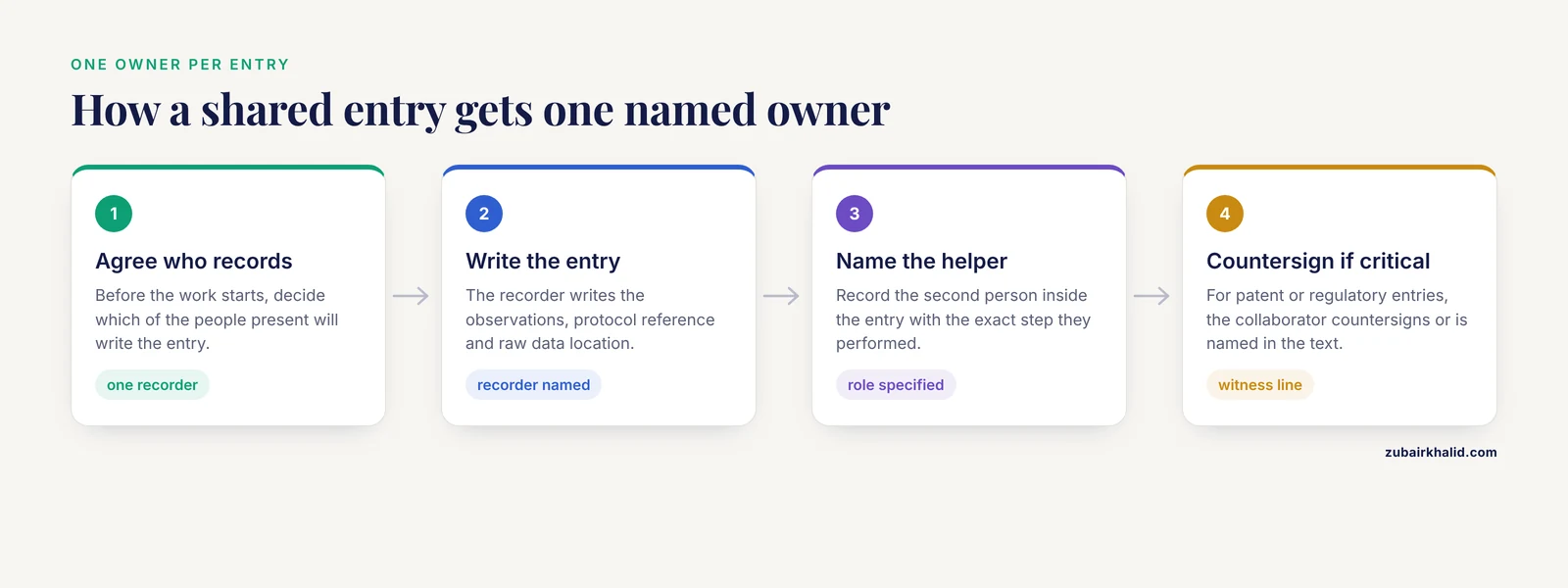
The single most useful convention for attribution and authorship in shared lab notebooks is this: each entry belongs to one named person, even when the experiment involved many.
If two people performed an experiment together, one of them writes the entry and is listed as the recorder. The second person's role is recorded inside the entry, for example "performed the cell plating step," and that collaborator countersigns or is identified by name in the text. If a trainee performed the work under supervision, the trainee is the entry owner and the supervisor's role is described, not substituted. Writing "performed by the Smith lab" attributes the work to nobody.
On paper, the traditional mechanics are straightforward and still worth knowing because they carry over conceptually to electronic systems:
- Write in permanent ink. Never use pencil or erasable pen.
- Date every page and every entry. Do not backdate, ever. If you record something late, write the entry date and note when the work occurred.
- Sign or initial each page you wrote.
- Have a second person who understands the work witness and sign critical entries, especially those likely to matter for patents or regulatory filings. The witness confirms that the entry existed and reflects the work, not that the witness performed it.
- Never leave blank gaps. Draw a single line through unused space so nothing can be added later.
- Correct mistakes with a single strikethrough, initial the correction, and add the correct information. Never erase or obscure an error.
In shared paper notebooks, the usual practice is to divide the notebook by project or by date block and assign each block to one person, or to have each person use consecutively numbered pages within their assigned section. Passing a single open notebook around a lab with no ownership convention is the arrangement that generates disputes.
How Electronic Lab Notebooks Handle Attribution
Electronic lab notebooks (ELNs) change the attribution problem from a behavioral discipline into a system design problem. An ELN is software that records experiments in a structured digital environment, typically with user accounts, timestamps, and access controls.
The capabilities that matter for attribution are well established in the ELN literature. eCAT, developed as one of the first online ELNs targeted at academic researchers, was built around a permissions system, controlled sharing, an audit trail, electronic signature, and search [2]. Each of those features maps directly onto an attribution need:
- User accounts mean every entry is created under a login, so the recorder is unambiguous by default.
- Timestamps are applied by the system, not typed by the user, which eliminates backdating.
- Audit trails preserve a permanent history of who created, modified, or viewed each entry and when. Edits do not erase the original record.
- Permissions and controlled sharing let a lab define who may read, edit, or sign a notebook or notebook section, which is how a shared notebook keeps individual accountability while remaining collaborative.
- Electronic signatures allow a person to sign an entry in a way that is bound to their identity and the entry content.
A study of a cloud-based ELN implementation in a bioprocess engineering teaching laboratory, using LabArchives, reported that the ELN improved data integrity, streamlined workflow, and enabled real-time and remote monitoring of experiments, with students rating the ELN better than paper notebooks for compliance [1]. The same study noted that limited training and a shortage of personnel familiar with ELNs had restricted adoption, which is worth knowing if you are introducing one into your lab. Attribution features only work when everyone actually uses their own account.
Electronic Lab Notebook Comparison
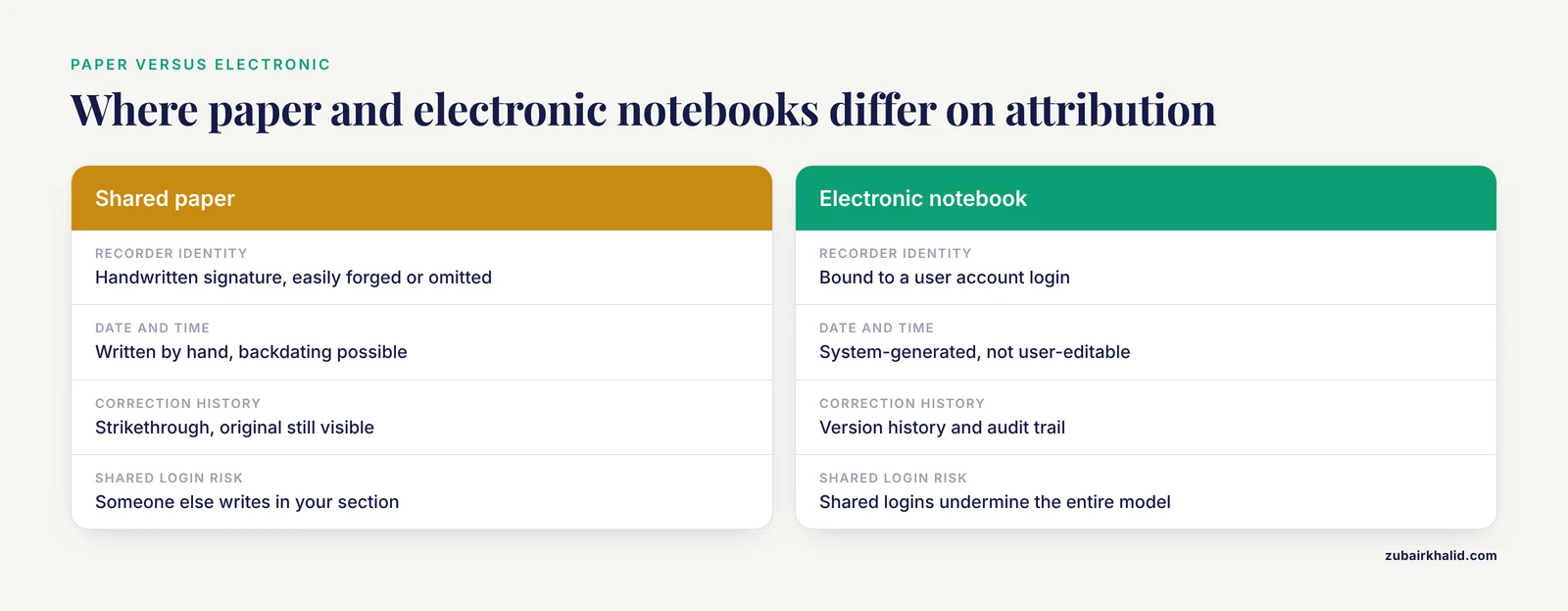
An electronic lab notebook comparison against a shared paper notebook makes the attribution differences concrete.
| Attribution feature | Shared paper notebook | Electronic lab notebook |
|---|---|---|
| , - | , - | , - |
| Identity of the recorder | Handwritten signature or initials, forged or omitted easily | Bound to a user account login |
| Date and time | Written by hand, backdating possible | System-generated timestamp, not user-editable |
| Correction history | Single strikethrough, original still visible | Version history and audit trail of every edit |
| Witnessing | Manual countersignature on the page | Electronic signature tied to the entry content |
| Search for all entries by one person | Page-by-page manual review | Search and filter by author |
| Access control | Physical possession of the notebook | Permissions system with controlled sharing |
| Risk of a shared identity | Someone else writes in your section | Shared logins undermine the entire model |
The comparison has a caveat. An ELN with a shared departmental login is worse than a disciplined paper notebook, because every action is attributed to one fake user. The technology enforces attribution only when each person uses their own credentials.
Building Attribution Into a Lab Notebook Template
A consistent lab notebook template is the cheapest attribution system available, whether the notebook is paper or electronic. The template turns attribution from a memory task into a fill-in task, which matters because people under time pressure skip optional fields.
A template designed for shared use should include these fields for every entry:
- Entry number and date, including time for time-critical work such as cell culture passages or enzyme kinetics runs.
- Experimenter name, the person who performed the work.
- Recorder name, if different from the experimenter, for example when a student dictates results to a lab mate at the bench.
- Collaborators, with each person's specific role in the experiment.
- Project or study identifier, so entries can be grouped later.
- Purpose of the experiment, one or two sentences.
- Protocol reference, including version or modification notes.
- Raw data location, file names or instrument run numbers, so the entry links to primary data rather than summarizing it.
- Observations and deviations, including anything that went wrong, because negative and anomalous results belong to the person who generated them.
- Signature line, and a witness line for entries that may support patent or regulatory claims.
- Attribution note for external content, such as an adapted protocol or an image supplied by a collaborator, credited by name in the entry.
A short worked example shows how this looks in practice:
Entry 041, 2026-03-14, 09:30. Experimenter: J. Okafor. Recorder: J. Okafor. Collaborators: M. Chen prepared the lysis buffer (step 2 only). Project: pET-28a expression screen, study PL-3. Purpose: test induction temperature for target protein solubility. Protocol: SOP-17 rev 3, modified per entry 038. Raw data: SDS-PAGE gels IMG_2214 to IMG_2219, instrument run BR-88. Observations: pellet largely insoluble at 37 °C, retry at 18 °C planned. Deviation: incubator drifted to 39 °C for 20 minutes during induction. Signature: J.O. Witness: R.V.
Every field in that example serves attribution. Years later, a reader knows who did the work, who helped, what was changed, where the raw data lives, and who confirmed the record.
One further consideration comes from the open science movement. Open lab notebooks publish experiment records as micropublications released shortly after each experiment concludes, and researchers have argued that such records should be written in unambiguous, machine-readable formats so that algorithms, not just human readers, can consume them [3]. That argument applies to structure generally. When your template uses consistent, labeled fields rather than free prose, software can search, aggregate, and analyze entries across the whole lab, and attribution fields become machine-queryable. You can then answer questions such as "list every experiment M. Chen contributed to this quarter" without reading every page.
Attribution Is Not Authorship, But It Feeds It
Because the two words travel together, a common misconception is that notebook attribution settles authorship. It does not, and treating it that way damages both record-keeping and lab culture.
Authorship on a scientific paper rests on contribution to the intellectual work: conceiving or designing the study, acquiring, analyzing, or interpreting data, and drafting or substantively revising the manuscript, with final approval and accountability. Journal guidelines, and the policies of most research institutions, converge on that general standard even where the details differ. Notebook attribution is documentary evidence that a person performed specific experimental work on specific dates. It supports an honest contribution statement. It does not automatically confer a byline, and no amount of notebook writing substitutes for the intellectual contribution journals require.
The converse also holds. A supervisor whose ideas and funding shaped the project may be an author even if their name appears in the notebook only in occasional entries. Students sometimes interpret an empty notebook as exclusion from authorship. The better reading is that the notebook records bench-level contribution, and authorship conversations should happen early, explicitly, and in writing, using the notebook as one input among several.
Attribution does, however, matter enormously in one authorship-adjacent area: determining who contributed what when a collaboration ends badly. If a former lab member claims work they did not perform, or if a departing member's contributions need to be documented for a thesis committee or a patent application, attributed entries are the primary evidence. Labs that maintain disciplined attribution rarely have these disputes escalate, because the facts are not in question.
There is also a hierarchy worth teaching to new lab members. On a single entry, the experimenter named in the attribution field is accountable for the accuracy of the record. On a dataset built from many entries, the contributing experimenters are accountable for their own entries. On a publication, authorship follows the journal's criteria applied to the whole project. At each level, the attribution record is the input, not the decision.
Common Mistakes and Limitations
These are the errors that most often undermine attribution in shared notebooks.
- Sharing logins or passwords in an ELN. This destroys the attribution system entirely. Every entry becomes attributable to the shared account, timestamps lose meaning, and the audit trail becomes unusable for disputes. If a lab member cannot access the ELN, fix the access problem, do not work around it.
- Attributing work to the principal investigator. Writing "PI instructed" or naming the lab instead of the person who pipetted the sample satisfies nobody. Name the person who performed the step.
- Backdating paper entries. A dated entry that was actually written later is the fastest way to lose patent protection and credibility. Record late, and state both dates honestly.
- Recording in pencil or erasable ink. Alterable records are treated as unreliable in disputes and audits. Use permanent ink on paper.
- Leaving collaborators unnamed. "With help" is not attribution. A collaborator who contributed a recorded step is named and their step is specified, so their contribution is documentable later.
- Treating the notebook as the authorship agreement. Authorship should be discussed and recorded when a project starts and revisited as contributions evolve. Waiting until manuscript submission to negotiate credit, with the notebook as your only evidence, invites conflict.
- Skipping negative results. Failed experiments attributed to nobody tend to be rerun wastefully, and omitted failures distort what a future reader believes was tried.
- Assuming an ELN solves attribution automatically. The software provides accounts, timestamps, and audit trails [2], but training and consistent use determine whether the features actually function [1].
On limitations. Attribution conventions vary across institutions, fields, and jurisdictions, particularly for patent evidence and regulatory work governed by formal documentation standards. This article describes widely used good documentation practices and published ELN experience, not a legal opinion. For a specific dispute, an invention disclosure, or a question about your obligations under an institutional or sponsor policy, consult your institution's research integrity office or technology transfer office. Individual situations need that kind of qualified review.
Frequently Asked Questions
What does lab notebook authorship attribution mean?
It means recording, for each entry in a shared notebook, who performed the work, who wrote the record, and when, so that every piece of data traces to a specific accountable person. Authorship in the publication sense is a separate credit decision that uses attribution as evidence but is not created by it.
Does writing entries in a shared lab notebook make you an author?
No. Notebook entries document bench-level contribution, while authorship requires a substantial intellectual contribution, manuscript involvement, final approval, and accountability under standard journal criteria. Consistent attributed entries strengthen your case during authorship discussions, but they do not guarantee a byline.
Who owns data recorded in a shared lab notebook?
Ownership of research data typically belongs to the institution or sponsor under most research agreements, not to the individual who wrote the entry. Attribution is about responsibility and credit for the work, which is distinct from legal ownership of the data.
Can two people use the same lab notebook?
Yes, and shared notebooks are common, but each entry must have one named owner who signs or logs it. Assign sections or date blocks to individuals, name collaborators inside entries, and never share ELN login credentials, because shared accounts erase individual attribution.
How do I credit a collaborator inside my own notebook entry?
Name them and specify exactly what they did, for example "M. Chen prepared the lysis buffer for step 2." If the collaboration is significant, have the collaborator countersign the entry. This keeps one accountable recorder while making every contribution visible and verifiable.
Do electronic lab notebooks record who made each entry?
Yes. ELNs bind entries to user accounts, apply system-generated timestamps, and maintain audit trails and electronic signatures that capture who created, edited, or signed each record [2]. These features only work when every lab member uses their own credentials.
What should a lab notebook template include for attribution?
Include the entry number, date and time, experimenter name, recorder name if different, named collaborators with roles, project identifier, purpose, protocol reference, raw data location, observations and deviations, and signature and witness lines. Consistent labeled fields also make entries searchable and machine-readable across a lab [3].
Can notebook entries be used as evidence in authorship disputes or patent cases?
Yes. Dated, signed, and attributed entries are primary documentary evidence of who performed and conceived work, which is why witnessing, permanent ink, and honest correction practices matter. Ambiguous or undated records weaken the position of everyone involved, including the institution holding the patent rights.