How to Keep a Lab Notebook That Stands Up to Audit
By Dr. Zubair Khalid, DVM, MS, PhD ·

By the end of this article you will be able to build a lab notebook template that satisfies an auditor, correct mistakes without destroying the record, attach raw data so it can be verified later, run a monthly self-audit, and decide whether paper or an electronic lab notebook (ELN) fits your lab. You need your current notebook, your institution's data-retention policy, a text editor or spreadsheet for templates, and optionally a trial account on an ELN platform.
Documentation of experiments is the foundation of scientific transparency and data integrity [1]. An auditor, whether a regulatory inspector, a sponsor's quality unit, a technology-transfer officer, or a collaborator reproducing your work, asks one core question: can you prove what you did, when you did it, and why? A notebook that answers that question on demand is what "stands up to audit" means.
What "Stands Up to Audit" Means
Auditors evaluate records against the ALCOA principles that govern good documentation practice in regulated and quality-conscious laboratories: records must be Attributable, Legible, Contemporaneous, Original, and Accurate. These are established data-integrity expectations, not optional style preferences. In practice, they translate into five habits.
- Every entry traces to a named person, with a date.
- Writing is readable by someone who did not write it, including six months later.
- Entries are recorded at the time of the work, not reconstructed at the end of the week.
- The first recording of a result is preserved, never overwritten or discarded.
- Numbers, units, reagent lots, and instrument IDs are correct and traceable to their source.
Electronic lab notebooks were introduced specifically to make this kind of documentation more straightforward and to support transparency and data quality across the many devices and metadata types modern experiments generate [1]. The payoff is real. When a bioprocess engineering teaching lab moved to a cloud-based ELN and trained students in good documentation practices, the platform enabled stronger data integrity, streamlined workflows, and better compliance outcomes than the paper notebooks it replaced [2]. Training matters as much as the tool. Students who receive explicit instruction and feedback on notebook practices show measurable growth in how they document their work [3].
Lab Notebook Audit Best Practices Step by Step
This walkthrough covers the full cycle, from setup to archive. Work through it once to establish your system, then repeat steps 3 through 7 on a weekly or monthly rhythm.
Step 1: Establish identity, dates, and a table of contents
On the first page of a paper notebook, or the profile page of an ELN, record your full name, your role, the lab or group, and the date the notebook opens. Number every page. Reserve the first two pages for a table of contents and fill it in as you go, not at the end.
In an ELN, identity is handled by your login, and timestamps are applied automatically by the server. That automation is one of the structural advantages of electronic records over paper, because attributability and contemporaneity are enforced by the system rather than by your discipline [2][4].
Step 2: Apply a Study-ID scheme before the first experiment
A unique Study-ID links every entry, file, and instrument output back to one experiment. One published approach recommends labs define unique Study-IDs to maintain and enhance best practices [1]. Use a fixed format and never deviate.
Format:  LABCODE-YEAR-SEQUENCE[.sub-experiment]

Example: KHL-2026-047        (the 47th study registered in 2026)
         KHL-2026-047.02     (second sub-experiment under that study)
Write the Study-ID on every page or entry it touches, embed it in every raw data filename, and paste it into the sample sheet of every instrument run. When an auditor asks you to produce all records for one experiment, the Study-ID is the thread that pulls the whole bundle out of your archive in seconds.
Step 3: Record experiments contemporaneously, in pen or in real time
In a paper notebook, write in permanent ink while you work. Plan the experiment on the left or first half of the page and record observations as they happen. If you pre-write a protocol, leave space and record what actually happened, including deviations, in real time.
Never reconstruct a day's work from memory at the end of the week. Reconstructed records fail the contemporaneous test, and auditors detect them easily when all entries in a week carry the same handwriting pace, the same pen, and identical timestamps.
Step 4: Attach raw data and verify it with checksums
Raw instrument output belongs in the record, not in a folder on a laptop that may not exist in two years. For paper notebooks, tape or staple printouts flatly inside the page, sign and date across the tape so the attachment cannot be swapped, and label each attachment with the Study-ID.
For electronic records, compute a cryptographic checksum when you attach a file. A checksum is a fixed-length fingerprint of a file's contents. If the file changes by even one byte, the fingerprint changes, which lets an auditor verify years later that the data was not altered.
On Linux or macOS:
sha256sum raw_data_plate_047.csvExpected output (fingerprint abbreviated here for readability):
3f2a9c1b7e...a41d raw_data_plate_047.csvRecord that fingerprint string in the notebook entry itself, next to the filename. On Windows, the certutil -hashfile <filename> SHA256 command produces the same fingerprint. Later, anyone can rerun the command and confirm the archived file still matches the fingerprint you wrote down.
Step 5: Correct errors the auditable way
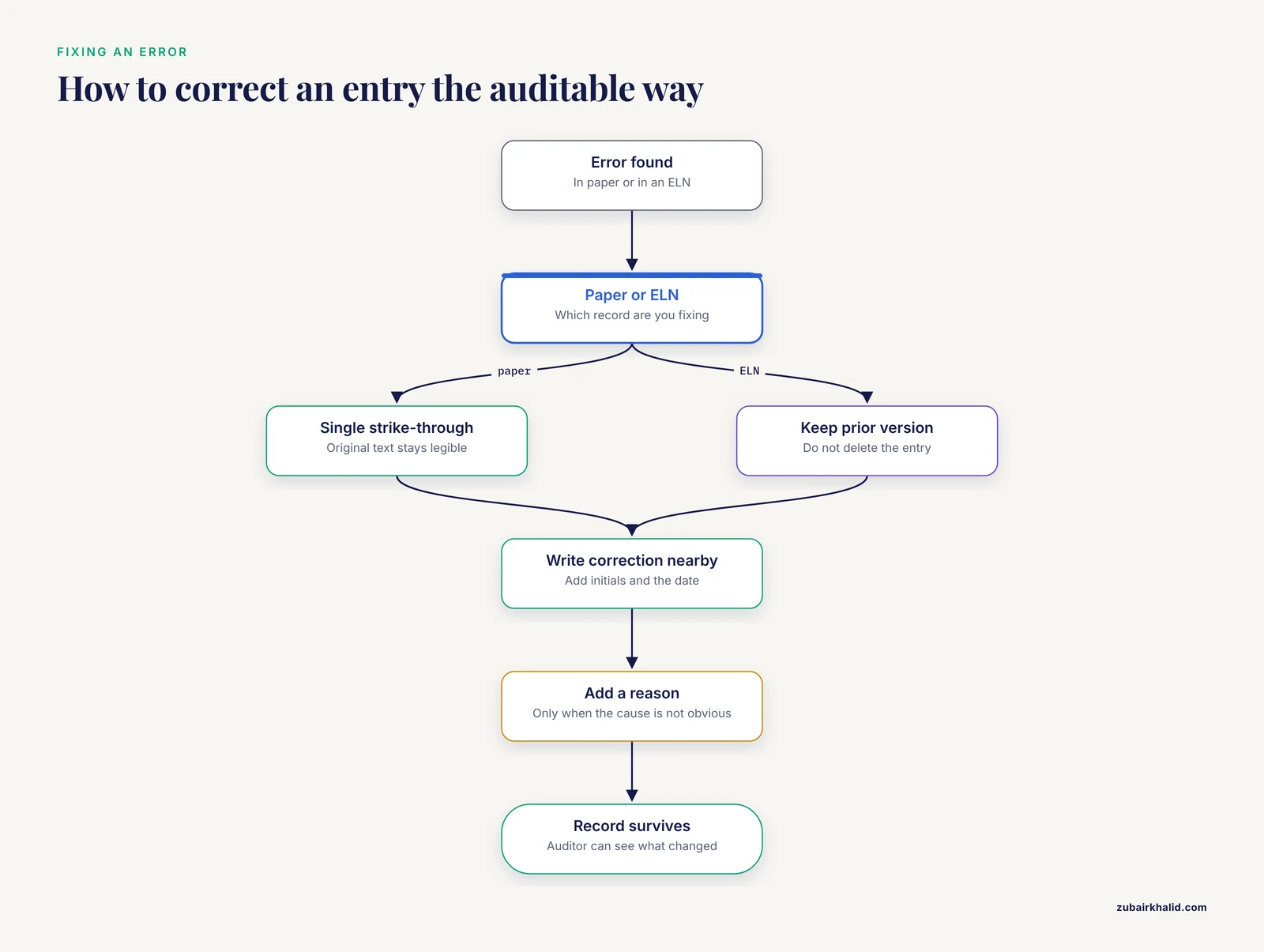
Cross out the error with a single line so the original text stays legible. Write the correction nearby, then add your initials and the date. Add a one-line reason when the cause is not obvious, for example "transcription error" or "wrong dilution factor used". Never erase, never use correction fluid, never write over the entry, and never remove a page.
In an ELN, do not delete an entry. Most platforms keep prior versions automatically, and that version history is the electronic equivalent of the single-line strike-through. If your platform allows hard deletion, that is a property to check before you commit to it, because auditors expect the original record to survive a correction.
Step 6: Sign and date every completed entry, with a witness where required
Sign and date the bottom of each entry when the work is complete. In quality-regulated work, a second person witnesses and countersigns critical steps. Purpose-built ELNs support this directly. One of the earliest web-based ELNs, developed with feedback from groups that included the FDA's Center for Biologics Evaluation and Research, was built around a permissions system, controlled sharing, an audit trail, electronic signature, and search [4]. If you evaluate platforms, those five capabilities are the baseline feature list for audit readiness.
Step 7: Run a monthly self-audit
Once a month, audit your own notebook against a short checklist before anyone else does.
- Are all entries dated and signed, with no gaps longer than your normal working rhythm?
- Does every experiment carry its Study-ID on every page or entry?
- Is every correction a single-line strike-through with initials and date?
- Are all raw data attachments present, labeled, and checksum-verified where applicable?
- Is the table of contents current?
- Could a trained stranger repeat the experiment using only what is written?
Fix anything you find with a dated corrective note. A self-audit that finds and fixes gaps is a normal quality activity. An external audit that finds the same gaps is a finding.
Step 8: Export, back up, and archive on a schedule
Paper notebooks go to the lab archive according to your institution's retention policy. Electronic records need an export routine. Export a full, readable copy of the notebook, including metadata and attachments, at the end of each project, and store the export where the institution directs.
Interoperability is the emerging weak point here. Because many different ELN platforms are now in use, researchers increasingly need to move records between systems, and tools such as ELNdataBridge have been built specifically to synchronize and exchange data between disparate ELN platforms through their Python APIs [5]. When you leave a lab or a platform is retired, your archive must not be trapped in a format nobody can open. Ask any prospective ELN vendor two questions: can I export everything in an open format, and what happens to my data when my account closes?
Building a Lab Notebook Template That Auditors Accept
A template turns good intentions into fill-in-the-blank discipline. Whether on paper or screen, every experiment entry should carry these fields.
| Field | What to record | Why an auditor cares |
|---|---|---|
| Header | Study-ID, experiment number, date, your name | Attributability and traceability |
| Objective | One or two sentences on the goal and hypothesis | Shows intent, supports accuracy |
| Materials | Reagent names, concentrations, lot numbers, expiration dates | Reproducibility and traceability |
| Equipment | Instrument IDs, settings, calibration status | Traceability of measurements |
| Protocol | What you actually did, including deviations, in order | Contemporaneous truth, not the planned version |
| Raw data | Readings as observed, with units, plus attachments | Original record preservation |
| Analysis | Calculations shown step by step, software and version named | Verifiability of derived numbers |
| Outcome | Result, interpretation, and next step | Demonstrates scientific reasoning |
| Sign-off | Signature and date, witness signature if applicable | Attributability |
Keep the template identical for every experiment. Consistency is what makes a notebook searchable, reviewable, and machine-readable later. That last point is not hypothetical. Research on converting handwritten lab notebooks into structured digital archives found that automated extraction of table records from analog notebooks can achieve error rates under 5 percent per cell, and the authors emphasize that structured, consistent analog documentation is what makes such transformation possible [6]. A disciplined template today is the difference between an archive an algorithm can read and a shoebox nobody can mine.
Electronic Lab Notebook Comparison: Paper, Generic Tools, and Purpose-Built ELNs
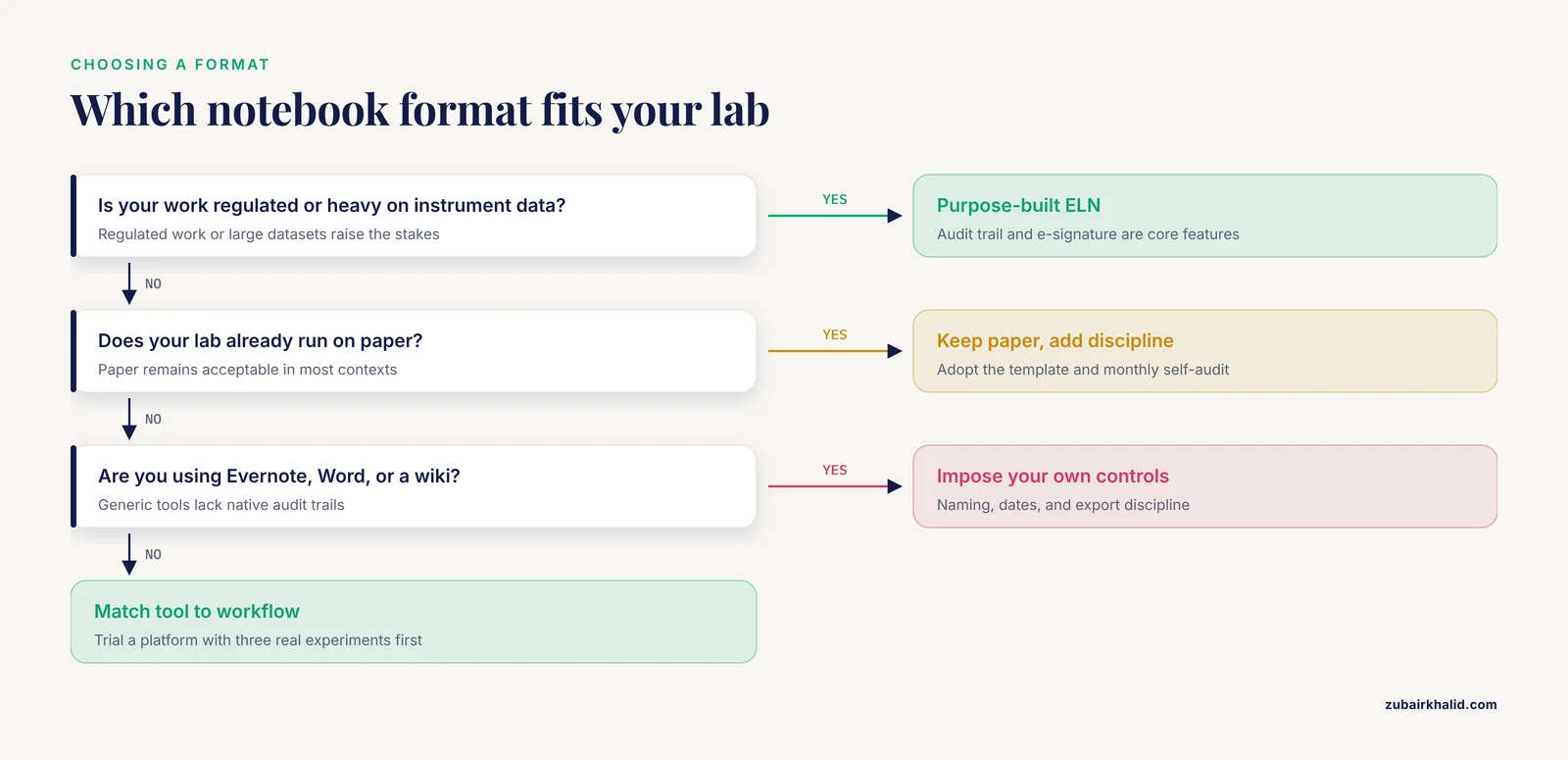
Choosing a format is the highest-leverage decision in audit readiness. There is no single solution that satisfies every scientific discipline, and institutions that studied this question consistently recommend matching the platform to the lab's actual workflows [7]. The comparison below reflects what the research literature reports.
| Criterion | Paper notebook | Generic tools (Evernote, wikis, spreadsheets) | Purpose-built ELN |
|---|---|---|---|
| Automatic timestamps and identity | No, manual only | Partial | Yes, server-enforced |
| Built-in audit trail and e-signature | No | No | Yes, core features [4] |
| Search across years of records | Manual, slow | Yes | Yes [4] |
| Freehand sketching | Natural | Weak point, needs snapshots or add-ons [8] | Varies by platform |
| Handling large datasets | Poor, attachments only | Good | Good [2] |
| Cost and administrative burden | Low | Low to moderate | Documented adoption barrier [9] |
| Ease of use and cross-device access | Not applicable | Good | A documented weakness in many products [9] |
| Integration with instruments and LIMS | None | None | Improves value but no well-established universal path [10] |
Research on why ELNs struggled to displace paper identified the main barriers as cost, ease of use, and accessibility across devices and operating systems [9]. That same study observed that scientists happily use general office and scientific tools alongside their notebooks, which explains why hybrid habits persist. Meanwhile, the ELN market is crowded and fragmented. An early review cataloged 35 electronic notebooks and grouped them into five pools by audience: Quality Assurance and Quality Control environments, Biology, Chemistry, Research and Development, and Multidiscipline products spanning stringent quality labs through free-form research [11]. That fragmentation has consequences. Different labs in the same institution often end up on different platforms, which is exactly the problem interoperability tools such as ELNdataBridge were designed to address [5].
Three practical recommendations follow from this comparison.
- If your work is regulated or generates large instrument datasets, a purpose-built ELN with an audit trail and electronic signatures is the safer choice. In the LabArchives teaching deployment, students themselves rated the ELN as better than paper for compliance [2].
- If your lab runs on paper, keep paper but adopt the template and self-audit discipline above. A rigorous paper notebook outperforms a sloppy ELN in every audit scenario.
- If you use a generic tool such as Evernote, understand its limits. A translational science lab at NYU School of Medicine ran Evernote as its full ELN for six months and concluded that its advantages outweighed the inability to write freehand, which they worked around with imported snapshots and drawing add-ons [8]. Generic tools lack native audit trails, so you must compensate with disciplined naming, dates, and exports.
Newer platforms are pushing auditability further. A proposed framework called IntegriLAB integrates repositories such as DataLad, Overleaf, and GitHub into one web-based system and certifies research activities through cryptographically signed, immutable blockchain records to guarantee data integrity and verifiable authorship [12]. That points to where audit expectations are heading: not just "who wrote this" but cryptographic proof of it.
Preparing for the Actual Audit Day
When an audit is scheduled, auditors typically work from a records request: produce the notebook entries, raw data, and attachments for named experiments or date ranges. In regulated bioanalysis, for example, electronic laboratory notebooks and regulatory audit experiences are now standard topics of discussion among quality professionals [13]. Preparation is mechanical if your system is sound.
- Pull every record by Study-ID. If step 2 was done properly, this takes minutes.
- Verify checksums on every electronic attachment in front of the auditor if asked.
- Have corrections ready to explain. Point to the strike-through, the initials, and the reason. A corrected entry with a documented reason is good practice. An unexplained correction is a finding.
- Know your retention policy and state it plainly.
- Be ready to describe your sign-off and witness procedures without hesitation.
One deeper lesson comes from research on auditing complex technical work. Post-hoc, top-down audits miss the day-to-day practices that actually shaped the outcome, which is why researchers studying AI development proposed ethnographic audit trails that document practices as they happen rather than reconstructing them afterward [14]. Your lab notebook is your own ethnographic audit trail. Written contemporaneously, it captures the decisions, deviations, and reasoning that no retrospective summary can recover. That is also why shared notebooks increase transparency in science more broadly. Releasing lab notebooks alongside publications has been proposed as a standard practice to reduce biased and incomplete reporting [15].
Common Mistakes and Limitations
These are the failures auditors encounter most often, and each one is avoidable.
- Batch-dating entries. Writing a week of experiments in one sitting, all with the same date, destroys contemporaneity. Record as you work, or record the same day.
- Backfilling data without labeling it as a transcription. Copying instrument readings into the notebook hours later is acceptable only if you note the source, the original file, and the transcription date.
- Missing reagent lot numbers. Lot numbers are the entire chain from your result back to the physical reagent. Omitting them breaks traceability for every downstream conclusion.
- Correction fluid and erasure. Both suggest concealment, even when the intent was innocent. Single-line strike-through only.
- Loose attachments. Unstapled printouts and unlabelled USB sticks are not part of the record. Attach, sign across the attachment, and checksum electronic files.
- Pages torn out or notebooks abandoned halfway. Never remove pages. If a notebook is abandoned, close it with a dated note explaining why, and start the next one.
- Choosing an ELN for features you will never use, then fighting its workflow. Adoption research shows that poor fit on cost, usability, or device access kills ELN projects [9]. Trial a platform with three real experiments before committing your lab.
- Assuming the ELN audit trail covers everything. Audit trails record what happened inside the platform. If half your data lives in instrument software that was never integrated, the trail has holes. Integration with instruments and laboratory systems improves ELN value, but there is no single established path, so the gaps must be documented deliberately [10].
- No export plan. Records locked in a retired platform are a compliance liability. Export on a schedule and confirm the exports actually open.
- Treating notebook discipline as individual taste. It works only as a lab-wide standard. Instruction and feedback measurably improve documentation behavior, so build training into onboarding.
One limitation applies to everything above. Audit expectations vary with your context. Academic grant audits, institutional data reviews, sponsor audits, and regulated manufacturing each apply different standards, so confirm your institution's or sponsor's specific documentation requirements rather than assuming a universal rulebook.
Frequently Asked Questions
What do auditors look for first in a lab notebook?
Auditors typically start with attribution and dating. They check that entries are signed, dated, contemporaneous, and traceable to a named person, then test whether raw data supports the recorded results. Gaps in dates, unsigned pages, and unexplained corrections are the fastest ways to generate findings.
Is a paper notebook still acceptable, or do I need an ELN?
A disciplined paper notebook remains acceptable in most academic and many regulated contexts. Purpose-built ELNs offer structural advantages, including server-enforced timestamps, audit trails, and electronic signatures, and users in one published deployment rated the ELN as better than paper for compliance. Match the format to your regulatory exposure and data volume rather than to fashion.
What should a basic lab notebook template include?
At minimum, include a header with Study-ID, date, and name, then objective, materials with lot numbers, equipment and settings, the protocol as actually performed, raw data with units, shown calculations, an outcome and interpretation, and a dated signature line. Keep the field order identical for every entry.
How do I correct a mistake without failing an audit?
Draw a single line through the error so it stays legible, write the correction next to it, and add your initials, the date, and a brief reason. Never erase, use correction fluid, overwrite, or remove pages. In an ELN, keep the prior version rather than deleting the entry.
Can I use Evernote, Word, or a wiki as my lab notebook?
You can, and one translational research lab did so successfully for six months, concluding the advantages outweighed the inability to write freehand. The tradeoff is that generic tools lack native audit trails and electronic signatures, so you must impose your own naming conventions, timestamps, and export discipline.
What is an audit trail in an electronic lab notebook?
An audit trail is an automatic, server-generated record of who changed what and when, including entries, edits, and signatures. It is one of the core capabilities purpose-built ELNs were designed around, alongside permissions, controlled sharing, electronic signatures, and search. It cannot cover activity that never enters the platform, such as data left in unintegrated instrument software.
How do I prepare my notebook for a scheduled regulatory audit?
Pull every record for the requested experiments by Study-ID, verify checksums on electronic attachments, have corrections and their documented reasons ready to explain, know your retention policy, and be able to describe your sign-off and witness procedures from memory. Rehearse the self-audit checklist in the month before the audit date.
How far back should lab notebook records be kept?
Follow your institution's or sponsor's retention policy, because requirements differ across sectors and no single universal period applies. The practical rule is that the archive must remain complete, readable, and retrievable for the entire mandated period, which makes scheduled exports and open formats essential for electronic records.
Sources
- Electronic Lab Notebooks and Experimental Design Assistants.
- Implementation and use of cloud-based electronic lab notebook in a bioprocess engineering teaching laboratory
- Examining student growth in laboratory notebook practices in introductory physics courses
- eCAT: Online electronic lab notebook for scientific research.
- ELNdataBridge: facilitating data exchange and collaboration by linking Electronic Lab Notebooks via API.
- From Analog Records to Computational Research Data: Building the AI-Ready Lab Notebook
- Exploring electronic lab notebooks (ELNs) at a R1 institution in the Southeast USA
- Using Evernote as an electronic lab notebook in a translational science laboratory.
- Electronic lab notebooks: can they replace paper?
- Electronic laboratory notebooks progress and challenges in implementation.
- A review of electronic laboratory notebooks available in the market today.
- IntegriLAB: a blockchain-enabled electronic lab notebook for reproducible neuroimaging research.
- 9th GCC closed forum: CAPA in regulated bioanalysis; method robustness, biosimilars, preclinical method validation, endogenous biomarkers, whole blood stability, regulatory audit experiences and electronic laboratory notebooks.
- Capturing the unobservable in AI development: proposal to account for AI developer practices with ethnographic audit trails (EATs)
- Scientific honesty and publicly shared lab notebooks: Sharing lab notebooks along with publication would increase transparency and help to improve honesty when reporting results.