Lab Notebook Amendment vs Correction: How to Choose
By Dr. Zubair Khalid, DVM, MS, PhD ·

A lab notebook amendment adds information the record does not yet contain. A lab notebook correction fixes an error that is already in the record. That sentence is the entire difference between the two, and the rest of this guide turns it into a decision you can make at the bench in seconds.
The rule of thumb: if the original entry is wrong, correct it where it sits, with a single line through the error, the right value nearby, your initials, the date, and a short reason. If the original entry is right but incomplete, write an amendment as a dated, signed addition that leaves the original untouched. When a change needs both jobs done, correct the error first, then amend the record with the consequences.
The choice matters because a notebook is evidence. Collaborators, reviewers, patent attorneys, and auditors read it to reconstruct what happened, when it happened, and why. In patent proceedings, dated and witnessed entries have long been used to support who did what and when. Many quality systems compress the goal into the ALCOA mnemonic, which asks that records be attributable, legible, contemporaneous, original, and accurate. Amendments and corrections exist so that a record can change and still meet that standard.
The Decision Rule, Operationalized
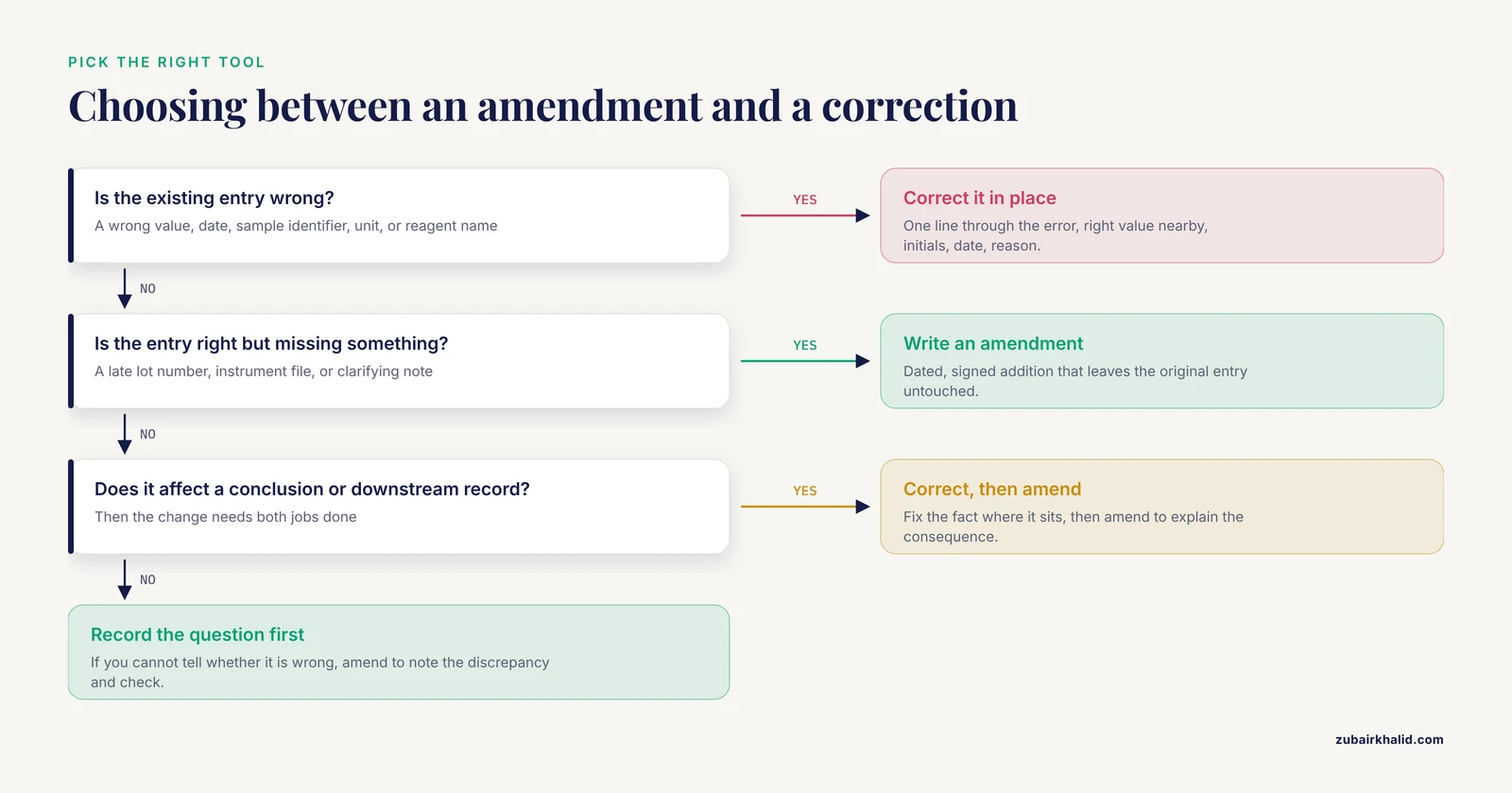
Three questions settle almost every case.
- Is the existing entry wrong? A wrong value, date, sample identifier, unit, or reagent name calls for a correction.
- Is the existing entry right but missing something? A missing lot number, an instrument file that arrived later, or a clarifying note calls for an amendment.
- Does the change affect a conclusion or a downstream record? Then do both. Correct the error where it sits, and add an amendment explaining what the correction changes.
Choosing between a lab notebook amendment or correction gets easier once you stop thinking about wording and start thinking about what happened to the facts. An error occurred, or new information arrived. Those are the only two triggers.
A fourth case deserves its own handling. If you cannot tell whether an entry is wrong, record the question. Write an amendment noting the discrepancy and the check you are doing, then make the correction once the check resolves it. That way the record never contains a silent change, and it never contains a correction made on a guess.
A quick example of question 3 in action. You recorded an incubation start time of 9:15 a.m., and the plate reader's export file shows the first read at 9:50 a.m. You correct the 9:15 with a single line, write 9:50, initial and date the change, and note "transcription error, reader export file." If your kinetic analysis treated 9:15 as time zero, you then add a dated amendment to the analysis entry explaining the recalculation. The correction repairs the fact. The amendment carries the consequence.
Lab Notebook Amendment vs Correction: Side-by-Side
The difference between a lab notebook amendment and a correction, criterion by criterion:
| Criterion | Amendment | Correction |
|---|---|---|
| Trigger | New or clarifying information | An error in an existing entry |
| The original entry | Untouched and fully legible | Struck through with one line, still legible |
| Placement | Separate dated note, addendum page, or linked entry | In line, at the site of the error |
| What you write | The added information, the date, your signature | The correct value, your initials, the date, a short reason |
| Reason statement | Optional, though helpful when information arrives late | Expected in most settings |
| Timing | Whenever the information arrives, even weeks later | As soon as the error is found |
| Effect on the record | The record grows | The record stays in place with the error visible |
| In an electronic lab notebook (ELN) | An appended entry, attachment, or linked child record | A tracked change with the prior version preserved in the change history |
| Publishing parallel | A linked addendum that updates an article | A formal Correction or Author Correction notice |
Read the table by column when you are deciding what to do, and by row when you are training a new student. Two rows do most of the work. The trigger row separates the tools, because an error produces a correction while new information produces an amendment. The effect row separates the outcomes, because an amendment grows the record while a correction marks it without shrinking it. Every other row follows from those two facts.
What an Amendment Is and When to Use One
What counts as an amendment
An amendment is a dated, signed addition to the record that supplies information the original entry lacks. The original entry stays exactly as written. The amendment sits beside it, below it, on a continuation page, or as a linked entry in an ELN, always carrying its own date and signature.
Other fields use the word the same way. In clinical research, a protocol amendment is a formal, dated change to a study protocol, approved before it takes effect. In publishing, an amendment to an article is a linked addendum that updates the paper without replacing it, a mechanism shown in action shortly.
When to use a lab notebook amendment
Six situations account for nearly every amendment:
- Information that arrives after the entry. Sequencing results, plate reader exports, chromatography files, or a collaborator's confirmation that a shipment arrived.
- Missing detail. A lot number (the manufacturer's identifier for one production batch), a catalog number, a calibration date, or an expiration date that was not at hand when the entry was written.
- Clarification. Which of two similar bottles was actually used, the units behind a bare number, or the identity of a lane in a gel image.
- A late entry. Work you did but did not record the same day. Write it as an amendment labeled "late entry," with the date you are writing it. The gap between the work date and the writing date is normal, and recording it honestly is the point.
- The aftermath of a deviation. A deviation is a departure from the planned procedure. The event itself belongs in the record of the day it happened. Its investigation, root cause, and final disposition usually arrive later, and they belong in an amendment.
- A cross-reference. Where a sample went, where a calculation lives, or which page continues the experiment.
How to write a clean amendment
Label it as an amendment or addendum, or use the amendments box in your template. Date it with the date you are writing it, not the date of the original entry. Sign it. State what you are adding and, when it helps a reader, why it is arriving late. Cross-reference the original entry by page or entry number so both can be read together. If an entry accumulates several amendments, number them in order so their sequence stays unambiguous. If you attach a printout or a photo, tape it in fully, sign and date across the tape edge so the attachment cannot be swapped later, and caption it with what it shows.
What a Correction Is and How to Make One
What counts as a correction
A correction is a change made to an existing entry because that entry is wrong. One constraint defines the whole procedure: the original content must stay legible permanently. A correction is a visible, attributed edit, never a rewrite.
The single-line method
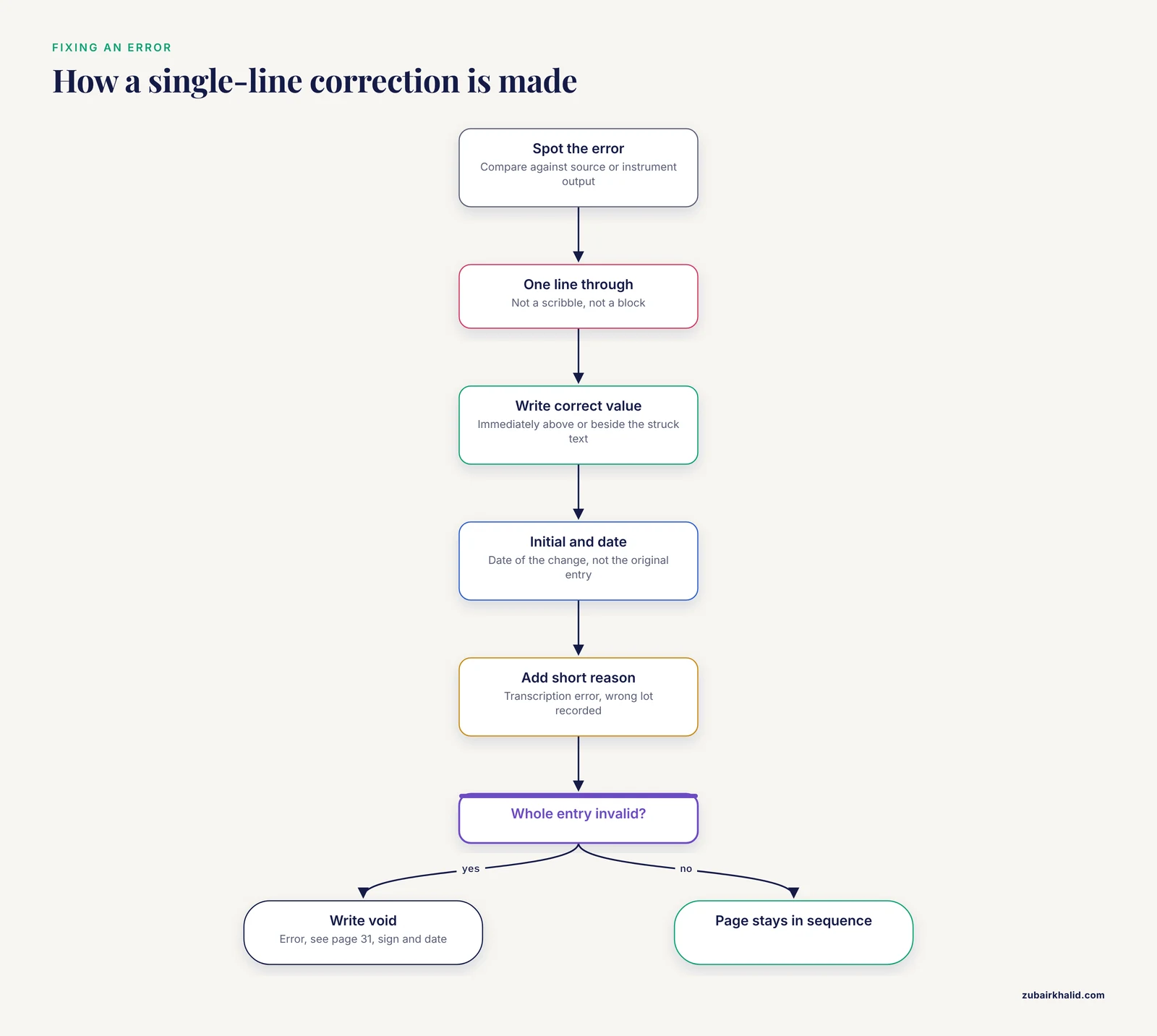
The standard method, taught in nearly every notebook procedure:
- Draw one horizontal line through the error. Not a scribble and not a solid block. One line, so the original value remains readable.
- Write the correct value or word immediately above or beside the struck text.
- Add your initials and the date at the change.
- Add a short reason. "Transcription error," "wrong lot recorded," or "units clarified" is enough. The reason is what separates a correction from an unexplained alteration.
Never erase, never use correction fluid or tape, never write over a number, and never remove a page. If an entire entry is invalid, write "void" or "error, see page 31," give a one-line explanation, sign and date it, and leave the page in sequence. A voided page that stays in the notebook is a controlled record. A missing page is a gap nobody can explain.
Situations that call for a correction
Typical triggers:
- A transcribed value that does not match the instrument output or the source record.
- A wrong date, wrong sample identifier, or wrong page reference.
- A wrong reagent, strain, or cell line name.
- A wrong unit, or a decimal point in the wrong place.
- A checkbox or circle marked against the wrong option.
- A lot number that contradicts the bottle or the inventory log.
Make the correction as soon as the error is found, and write the date of the change, never the date of the original entry. Where practical, the person who made the error makes the correction. If a reviewer or supervisor makes or requests it, their initials and date go at the change, and many procedures ask the original author to countersign (add a confirming signature). In regulated work, some procedures also require a witness for corrections. Your lab's written procedure settles that question.
How the Published Record Handles the Same Problem
Scientific publishing runs into the same problem at larger scale. An article is published, and later an error surfaces or new material needs to travel with it. Publishers do not silently rewrite the paper. They attach dated, linked notices, and they use the same two instruments you use at the bench.
A Correction is a short notice that flags and fixes an error while the original article stays in place. The Journal of Soil Science and Plant Nutrition issued a Correction in 2025 for a lab-scale study of turnip (Brassica rapa var. rapa) cultivation under sewage sludge amendment [1]. That title also carries a warning about words. There, "amendment" refers to sewage sludge worked into the growing substrate, an agronomy usage with nothing to do with record-keeping. Same word, different trade, and context decides.
An Author Correction can carry an amendment with it. The Author Correction for a Scientific Reports study on consolidated bioprocessing for bacterial alkaline phosphatase production from Bacillus paralicheniformis states that an amendment to the paper has been published and is accessible through a link at the top of the article [2]. The same construction appears in a 2020 Author Correction for a paper on an intelligent lab-on-fiber approach to identifying human cancer single-cell types [3]. The pairing is the instructive part. Correction and amendment are not rivals. The notice corrects the record, the linked amendment delivers updated material, and both stay attached to the original paper.
Nature issued an Author Correction in 2020 for the report of Bose-Einstein condensates observed in an Earth-orbiting research lab [4]. Even a landmark result gets a dated, linked notice rather than a quiet edit. Journals label these notices variously as Correction, Author Correction, Erratum, or Corrigendum, but the mechanism is constant.
The lesson for a bench notebook is direct. Never silently rewrite. Flag errors where they sit, append additions as dated, signed material, and keep every version of the record reachable.
Electronic Lab Notebook Comparison: How Digital Records Handle Each
Paper and digital records enforce the same principles with different mechanics.
On paper, you are the audit trail (the secure record of who changed what, when, and why). The single-line strikethrough, the initials, the date, and the reason are the version history. The system works because ink cannot be quietly undone, and it fails the moment someone erases, paints over, or pulls a page.
In an electronic lab notebook, the software keeps the history. A typical ELN versions every save, records the user, the timestamp, the previous content, and the new content, and prompts for a reason when an entry changes after the fact. Signed entries are often locked, and changing them runs through a signature revocation or amendment workflow that preserves the signed version. A correction becomes a tracked change with the original value retrievable indefinitely. An amendment becomes an appended entry, an attached file, or a linked child record tied to the original.
When you compare electronic lab notebooks, judge them on the features that protect this workflow:
- Audit trail detail. Does the system capture the old value, the new value, the author, the timestamp, and the reason for every change?
- Signed-entry behavior. Can a signed entry be altered, and does the workflow preserve the signed version while recording who approved the change?
- Visible changes. Do corrections display as a readable diff (a line-by-line view of what changed) or strikethrough, rather than a silent overwrite?
- Linking. Can an amendment be attached to the entry it amends, so a reviewer sees both together?
- Export. Can you export the complete record, audit trail included, in a format a reviewer can open without the vendor's software?
- Templates. Can you build a lab notebook template with required fields for units, lot numbers, and instrument identifiers, which prevents the omissions that later demand amendments?
Computational biology is converging on the same standard from another direction. Cedalion, a Python-based open-source framework for analyzing functional near-infrared spectroscopy (fNIRS) and diffuse optical tomography (DOT) data, was built to unify analysis in a reproducible, extensible, community-driven environment [5]. It adheres to shared data standards, SNIRF (the Shared Near Infrared Spectroscopy Format) and BIDS (the Brain Imaging Data Structure), supports cloud-executable Jupyter notebooks, and provides containerized workflows so analysis pipelines can be provided alongside the publications they support [5]. Translated to bench practice, the requirement is identical. A record earns trust when it is standardized, versioned, and reconstructable by someone else, with every entry attributable, every version preserved, and every change explained.
Worked Scenarios: Choosing Between an Amendment and a Correction
Scenario 1: A transcription slip in a number
You record an incubation temperature of 37.0 °C. During review a week later, a colleague compares your entry with the incubator's printed log, which reads 36.0 °C for that day. The notebook value is wrong, so you make a correction. One line through 37.0, write 36.0 beside it, add your initials and today's date, and note "transcription error, incubator log p. 42." No amendment is needed, because nothing new is being added. The fact was already in the record, recorded incorrectly.
Scenario 2: Information that arrives late
On Monday you transform competent cells and plate them, and the entry is accurate as far as it goes. On Thursday the sequencing facility returns results confirming the two plasmid sequences. The Monday entry is accurate but incomplete, so you amend it. On the next line, or in the amendments box of your template, you write "Amendment, 14 May: sequencing confirmations received for plasmids A and B, facility report taped to p. 19," then sign and date it. The Monday entry stays as written. The amendment carries its own, later date, and the gap between the two dates is the honest timeline of the work.
Scenario 3: The wrong reagent, with conclusions downstream
Your entry says the blocking step used Tween 20. The bottle inventory shows the bottle on that bench was Tween 80. That is a correction at the site of the error. One line through Tween 20, write Tween 80, initial, date, reason "wrong reagent recorded, bottle log checked." Then ask the second question. Does the assay interpretation change? If no, the correction is the whole job. If yes, add a dated amendment under the results section naming the affected conclusions. The correction repairs the fact. The amendment carries the consequence.
Scenario 4: A signed electronic entry with a wrong dilution factor
In your ELN you record a 1:10 dilution, sign the entry, and later realize the series was actually 1:100. Because the entry is signed, you do not edit it quietly. You open the correction workflow, which asks for a reason, and enter "dilution factor misread from worksheet." The system stores the prior version in the audit trail with your name and the timestamp, and the corrected value takes effect from that point. Because every downstream concentration calculation depended on that factor, you then add an amendment linking the recalculated results to the original entry. The audit trail now shows the error, the fix, and the impact, which is exactly what a reviewer or auditor wants to see.
Building the Rules Into a Lab Notebook Template
Most amendments and corrections trace back to a field the template never asked for, which makes a good lab notebook template the cheapest prevention available. Build these elements in.
- Header block. Experiment title, project or study code, date, operator name, and notebook and page number. Page numbers are what make cross-references in amendments and corrections possible.
- Reagent and material table. One row per item, with name, supplier, catalog number, lot number, and expiration date. Missing lot numbers are among the most common reasons for amendments, and a required field prevents them.
- Instrument block. Instrument name or identifier, calibration or verification status, and the run file name or storage location. This gives late-arriving instrument files an obvious home as an amendment with an attachment.
- Data fields with units printed beside them. A bare number with no unit is a correction waiting to happen.
- An amendments box. A small ruled block on every page labeled "Amendments," with lines for date, description, and signature. When the box exists, people use it.
- A correction legend on the inside cover. One sentence: "To correct an entry, draw a single line through it, write the correction nearby, add your initials, the date, and a short reason." New rotation students then learn the rule from the notebook itself.
- A footer. Signature and date lines for the author, plus a reviewer or witness line where your lab uses one. Many labs also sign and date every page on the day of the work, which makes any later change easy to spot.
- A blank-space rule. Cross out unused space at the end of an entry with a diagonal line, so nothing can be added into the gap later without the addition being obvious.
Common Mistakes and Limitations
These mistakes account for most of the findings auditors raise against notebook records.
- Erasing, overwriting, or using correction fluid. The most damaging habit, because it destroys the original value and, with it, the record's credibility.
- Writing in pencil. Pencil invites erasure, which is why permanent ink is the default requirement for a permanent record.
- Correcting without a reason. An initial and date without a reason tells a reviewer that something changed but not why, which invites doubt about the change itself.
- Backdating. The date on a correction or amendment is the date the change was made. Writing an earlier date turns an honest record into a falsified one.
- Correcting someone else's entry without attribution. If you must correct an entry you did not write, your initials and date go at the change, and many procedures ask the original author to countersign.
- Using an amendment to fix an error. A note saying the value should be 36.0, next to an unmarked 37.0, leaves two live values in the record with no marked error. Correct the value in place, then amend if consequences need explaining.
- Using a correction to add information. Striking through accurate content to squeeze in new material implies the content was wrong. Add an amendment instead.
- Loose attachments without control. A printout taped in without a dated signature across the tape edge can be swapped. A loose sheet tucked between pages can be lost.
- Silent edits in an ELN. Changing an entry without using the reason field, or pasting new data over old, defeats the audit trail the software exists to provide.
Two limitations bound all of this. Institutional procedure outranks general practice. Regulated studies run under good laboratory practice (GLP) style quality systems, the framework used for regulated nonclinical studies, with prescribed forms, defined correction codes, and quality assurance review, and your lab's written standard operating procedure (SOP) settles any conflict between house rules and general advice. Individual cases also vary. When a situation is genuinely ambiguous, such as a page that needs voiding or a signed record that must change, ask your documentation lead or quality unit before acting, because the right handling depends on the study and its review arrangements, not on a general rule of thumb.
Frequently Asked Questions
What is the difference between a lab notebook amendment and a correction?
A correction fixes an error that is already in the record, using a single line through the mistake, the correct value nearby, initials, date, and a short reason. An amendment adds new or clarifying information as a dated, signed addition while the original entry stays untouched.
When should I use a lab notebook amendment?
Use an amendment whenever the original entry is accurate but incomplete. Typical cases are information that arrives later, such as sequencing results or instrument files, missing lot numbers, clarifying notes, and late entries written after the day of the work.
Can I erase or white out an entry if I made a mistake?
No. Erasing, correction fluid, and overwriting destroy the original record. Draw one line through the error so it stays legible, write the correct value nearby, and add your initials, the date, and a brief reason.
How do electronic lab notebooks handle amendments and corrections?
An electronic lab notebook stores every version in an audit trail and records who changed what, when, and usually why. Corrections appear as tracked changes with a reason field, and amendments appear as appended entries, attachments, or linked records. Compare ELNs on audit trail detail, signed-entry workflows, and export options.
Do I need to give a reason for every change I make?
Corrections need a short reason, such as transcription error or wrong lot recorded. Amendments should state what is being added, and why it arrives late when that helps a reader. The reason is what makes a change auditable.
What should I do if I find an error weeks after the original entry?
Correct it as soon as you find it, and date the change with the actual date of the change, never the date of the original entry. If the error affects a conclusion or a downstream record, add an amendment explaining the impact.
Sources
- Correction: Cultivation of Turnip Plant (Brassica Rapa Var. Rapa L.) Under Sewage Sludge Amendment: A Lab-Scale Experimental Study
- Author Correction: Dynamic consolidated bioprocessing for innovative lab-scale production of bacterial alkaline phosphatase from Bacillus paralicheniformis strain APSO
- Author Correction: iLoF: An intelligent Lab on Fiber Approach for Human Cancer Single-Cell Type Identification
- Author Correction: Observation of Bose-Einstein condensates in an Earth-orbiting research lab
- Cedalion tutorial: a Python-based framework for comprehensive analysis of multimodal fNIRS and DOT from the lab to the everyday world