Lab Meeting Agenda Template: How to Run a Productive Meeting
By Dr. Zubair Khalid, DVM, MS, PhD ·
By the end of this article you will be able to build a lab meeting agenda template from scratch, fill it in for a real 60-minute meeting, assign roles so no single person dominates the room, and close every meeting with named action items. You need nothing installed. A shared document, a calendar invite, and the plain-text template in this article are enough to start this week.
Lab meetings are where a research team thinks out loud together. An ethnographic study that followed an optical physics group for more than a year found that regular lab meetings do three things for a team. They keep the group focused on a shared research agenda, they let members check the quality of ongoing work, and they generate new research ideas through continuous discussion [1]. A meeting with a clear agenda protects all three functions. A meeting without one usually becomes a string of announcements.
Why a Lab Meeting Agenda Template Works
The evidence on research meetings points to a consistent pattern. Structured meetings with a shared plan outperform unstructured ones, and the structure matters more than the setting, whether the team meets in person or online [2] [3].
Regular internal meetings are what researchers themselves use to do science by talking. In the observed physics lab, meetings were compulsory for all members and served as a protected space to comment on conducted research, amend experimental setups, test argumentation, and outline new research directions [1]. That space only stays protected when the conversation has a shape. An agenda is that shape.
The costs of skipping structure are well documented in adjacent academic settings. A multi-institution perspective on faculty meetings in biomedical engineering found that most faculty members never receive formal training in running meetings, that meetings are often poorly organized, and that an inequitable distribution of voices drives disengagement and poor attendance [4]. Those problems appear in graduate and postdoctoral lab meetings too, often in amplified form, because junior members feel the least permission to interrupt a rambling senior speaker.
A written agenda solves several of these problems at once:
- It makes the meeting predictable, so members know what they are walking into.
- It gives quieter members a known slot to speak, which counters unequal airtime.
- It converts vague discussion into named action items with owners and dates.
- It creates a written record that absent members can read in five minutes.
The Core Lab Meeting Agenda Template Format
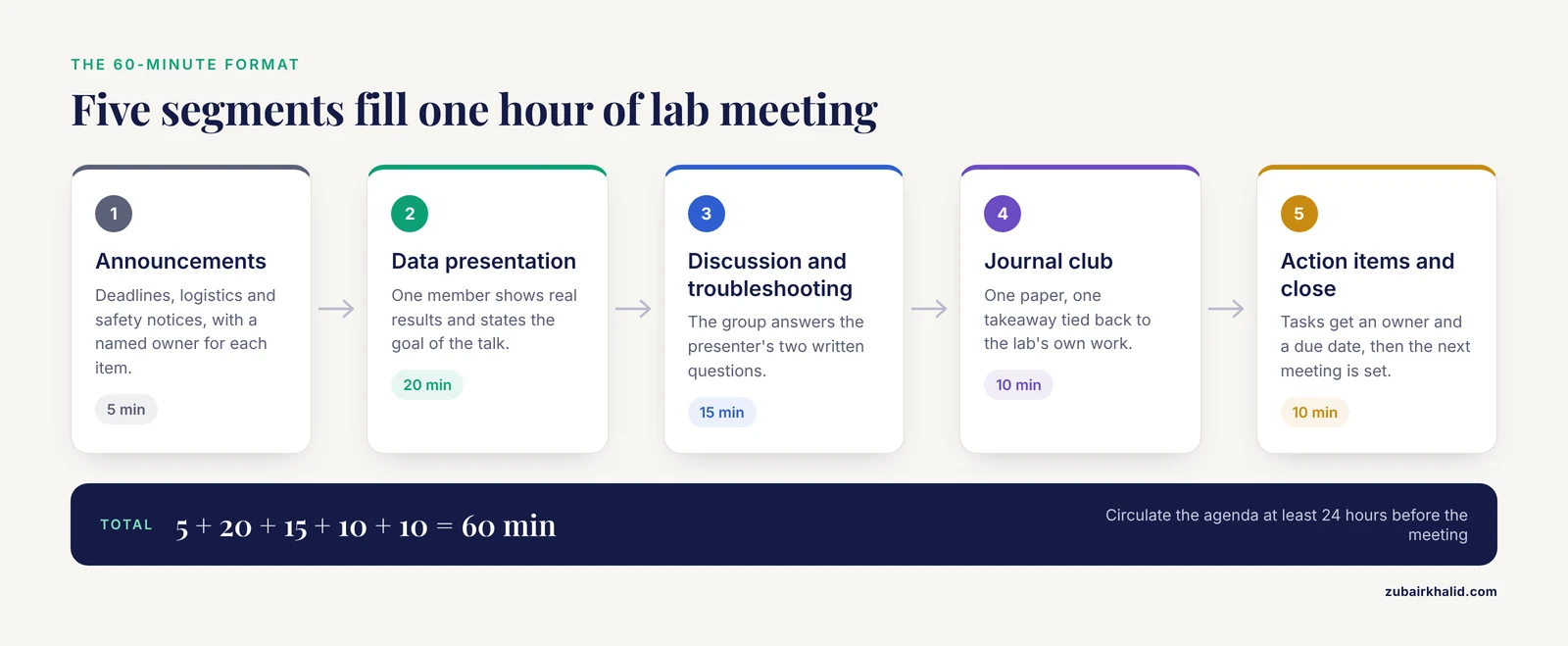
The format below is a free lab meeting agenda template you can paste into any shared document. It follows a simple lab meeting agenda template format with five segments. Copy it, fill the brackets, and circulate it at least 24 hours before the meeting.
# Lab Meeting Agenda

Date: [YYYY-MM-DD]
Time: [HH:MM to HH:MM, time zone]
Location or video link: [room name or URL]
Chair: [name]
Timekeeper: [name]
Note taker: [name]

## 1. Announcements (5 min)
- [Deadline, funding call, visitor, safety notice]
- Owner: [name]

## 2. Data Presentation (20 min)
- Presenter: [name]
- Project or title: [short title]
- Goal of this talk: [feedback wanted / decision needed / update only]
- Outline: background, methods, results, next steps

## 3. Discussion and Troubleshooting (15 min)
- Question 1 for the group: [specific question]
- Question 2 for the group: [specific question]

## 4. Journal Club or Paper Highlight (10 min)
- Presenter: [name]
- Paper: [citation or DOI]
- One takeaway for our project: [sentence]

## 5. Action Items and Close (10 min)
- [Task] - Owner: [name] - Due: [date]
- [Task] - Owner: [name] - Due: [date]
- Next presenter: [name]
- Next meeting: [date and time]
Each segment has a defined purpose:
| Segment | Purpose | Time in a 60-min meeting | Written output |
|---|---|---|---|
| Announcements | Share deadlines, logistics, and safety notices | 5 min | Dated note in minutes |
| Data presentation | One member shows real results or a problem | 20 min | Presenter's slides attached to agenda |
| Discussion | Group responds to the presenter's stated questions | 15 min | Recommendations recorded by note taker |
| Journal club | One paper, one takeaway, tied to lab work | 10 min | Citation plus takeaway in minutes |
| Action items | Convert talk into tasks with owners and due dates | 10 min | Task list with names and dates |
The single most valuable line in this template is the "Goal of this talk" field. It forces the presenter to declare whether they want feedback, a decision, or only to transmit information. That one sentence changes the behavior of the whole room.
How to Run a Productive Lab Meeting: Step-by-Step
Step 1. Fix the cadence and the calendar slot
Choose a weekly or biweekly slot and defend it. In the optical physics group studied over a year, regular meetings were compulsory for all members, and that consistency is what turned them into a place where members became acquainted with the scope, problems, and limits of the ongoing research [1]. An agenda cannot rescue a meeting that half the team skips.
Send a recurring calendar invite that includes the link to the agenda document. Put the link in the invite body, not just in chat, so the agenda travels with the invitation.
Step 2. Open the agenda document and rotate the owning roles
Three roles rotate weekly: chair, timekeeper, and note taker. Rotation matters for inclusion. The faculty meeting study found that inequitable distribution of voices is a defining failure of academic meetings, and that productive departments deliberately design meetings to be inclusive and engaging [4]. Rotating the chair gives every member, including first-year students, structured authority over the room at least once per cycle.
Assign the roles in the agenda itself, in the header block, so the information survives when the document is copied forward to next week.
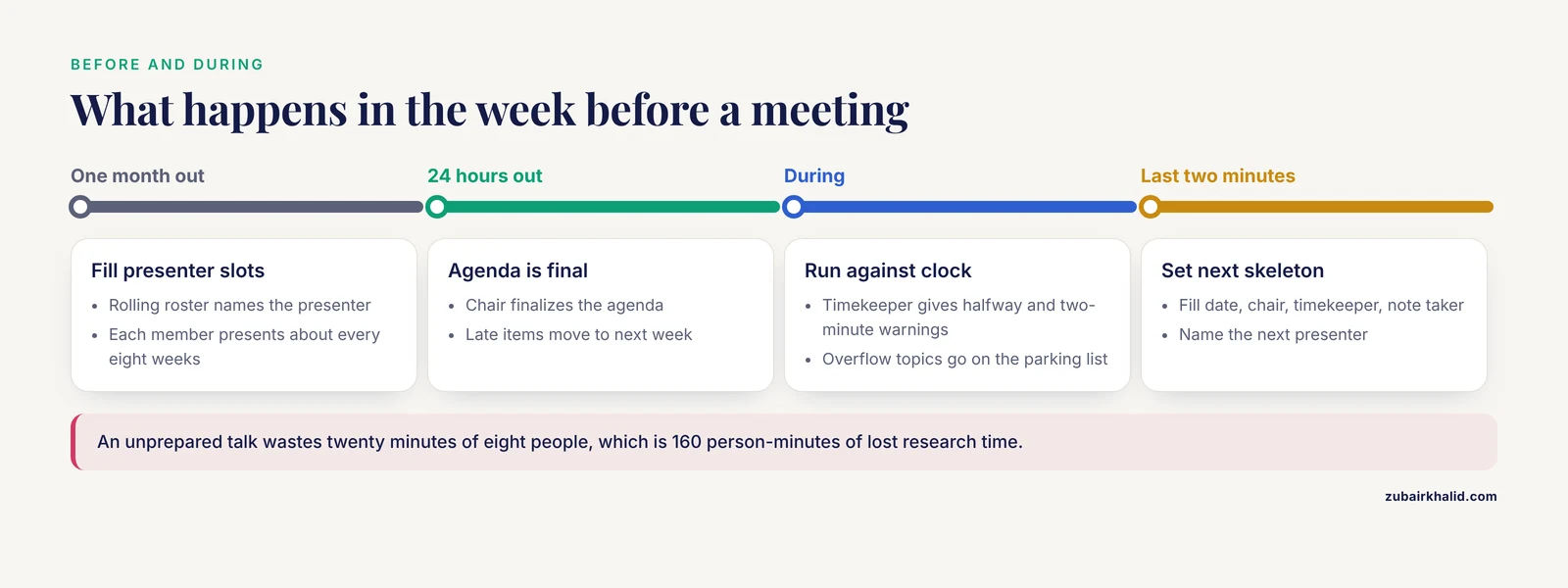
Step 3. Pre-fill the presenter slots one month ahead
Keep a rolling presenter roster. If your lab has eight members and one data talk per weekly meeting, each member presents roughly every eight weeks, which works out to about six or seven presentations per person per year. Writing this rotation into the template removes the weekly scramble of asking for volunteers and lets presenters prepare properly.
Step 4. Set the agenda by a fixed deadline
The chair finalizes the agenda 24 hours before the meeting. Anything arriving after the deadline moves to next week. This rule sounds strict and works because it protects the presenters. A talk scheduled at the deadline gets no preparation, and an unprepared talk wastes twenty minutes of eight people, which is 160 person-minutes of lost research time.
For labs that collaborate with external partners or community members, agree in advance on how meeting topics are proposed. Research on meaningful research partnerships identifies communication and meetings as a distinct operational domain, with formal communication plans and agreed practices cited as what makes co-produced work function [5]. A one-line rule, such as "add items to the agenda doc by Thursday noon," is a workable version of that plan.
Step 5. Run the meeting against the clock
The timekeeper announces remaining time at the halfway point of each segment and again at two minutes before the cut. This is not hostility toward discussion. It is what keeps the discussion segment, the most valuable part, from being eaten by announcements.
When a discussion runs hot, the chair writes the topic on a visible parking list and schedules it as the main item for the next meeting. This mirrors what structured improvement programs do. In the Cystic Fibrosis Learning Network telehealth innovation lab, teams met weekly, shared learnings from plan-do-study-act cycles, and exchanged tools through a maintained shared platform, a loop that helped both of their improvement targets get met ahead of the expected date [2]. The mechanism is simple. Short, regular, documented cycles beat long, rare, undocumented ones.
Step 6. Record decisions and action items live
The note taker types directly into the agenda document during the meeting, under each heading. Minutes kept in a separate file drift out of sync. Minutes kept in the agenda stay attached to the topic that produced them.
Every action item gets three fields: task, owner, and due date. A task without an owner is a wish. A task with an owner but no date is a wish with a name on it.
Step 7. Close with the next meeting's skeleton
Spend the last two minutes filling in the header of the next agenda. Date, time, chair, timekeeper, note taker, and next presenter. This takes two minutes and eliminates the most common failure mode of rotating systems, which is that nobody knows whose turn it is until Monday morning.
Step 8. Archive and review the format once per semester
Keep one document per meeting, all in a single folder named by year. At the end of each semester, the lab spends one meeting reviewing the format itself. Ask three questions. Are action items from the last month actually done. Is the discussion segment doing real scientific work. Does anyone consistently leave without having spoken.
A Filled-In Lab Meeting Agenda Template Example
Here is a lab meeting agenda template example with realistic content, so you can see what a finished agenda looks like before a meeting.
# Lab Meeting Agenda

Date: 2026-11-11
Time: 10:00 to 11:00 ET
Location or video link: Room 214, and https://zoom.us/j/xxxxxxx
Chair: Priya
Timekeeper: Marcus
Note taker: Elena

## 1. Announcements (5 min)
- Grant progress report due December 1, draft sections assigned
- Departmental seminar Thursday, speaker on single-cell sequencing
- Equipment: the new centrifuge rotor arrived, training required before use

## 2. Data Presentation (20 min)
- Presenter: Marcus
- Project or title: Pilot flow cytometry panel for T-cell exhaustion markers
- Goal of this talk: feedback wanted on gating strategy before scaling up
- Outline: background, antibody panel, preliminary gates, controls problem

## 3. Discussion and Troubleshooting (15 min)
- Question 1: Is the viability dye compensating correctly, or is spillover driving the dim population?
- Question 2: Should we add a fluorescence-minus-one control for marker CD39?

## 4. Journal Club or Paper Highlight (10 min)
- Presenter: Elena
- Paper: recent review on reward processing measures in translational research
- One takeaway for our project: construct-level measures matter more than instrument choice

## 5. Action Items and Close (10 min)
- Draft gating plan revision - Owner: Marcus - Due: 2026-11-18
- Order FMO control reagents - Owner: Priya - Due: 2026-11-13
- Circulate seminar abstract to group - Owner: Elena - Due: 2026-11-12
- Next presenter: Priya
- Next meeting: 2026-11-18, 10:00 ET
The expected output of this system is a folder of dated agenda documents where each one contains its own minutes and action items. Six months in, any member can trace a decision back to the meeting and the discussion that produced it, which is exactly the quality-assurance function researchers report lab meetings serving [1].
Roles, Inclusion, and Voice
An agenda distributes speaking opportunity, but distribution needs deliberate design. The BME UNITE perspective, written by academics across career stages and diverse backgrounds, recommends treating meetings as spaces for effective communication, connection, and shared work, and identifies concrete strategies for making them inclusive and engaging [4]. Four strategies translate directly to lab meetings.
First, use round-robin openers. The chair asks each member for a one-sentence update before the main talk. This guarantees everyone speaks in the first five minutes, which measurably raises the likelihood they speak later.
Second, protect question time for juniors. The chair calls on graduate students before faculty for the first two questions after a data talk. Senior members can wait.
Third, write before you speak. For decisions, give the group two minutes of silent writing on the specific question before open discussion. Written-first rounds prevent the loudest voice from anchoring the room.
Fourth, when meetings include partners outside the lab, such as clinicians, community members, or patient partners, the host carries extra responsibility for context. Interviews with patients and clinicians about transplant selection committee meetings found that process understanding is itself empowering for outsiders to a deliberation [6]. A one-line explanation of why an item is on the agenda serves the same function for a visitor to your lab meeting.
Teams running participatory research report similar lessons. In a cancer center patient and public involvement group, five patients and five citizens contributed across nine monthly meetings, and tangible outcomes such as revisions to a prevention study followed from a coordinated framework of mission, charter, and plan developed in the first two meetings [7]. Structure at the start pays off for the whole cycle.
Adapting the Template for Special Meetings
The core template handles routine weekly meetings. Three common variants need small changes.
Data-only meetings. For labs that alternate between data talks and journal clubs, delete segment 4 and give the presentation 30 minutes. Keep the discussion segment proportional. The observed physics lab showed that commenting on conducted research and amending experimental setups is central meeting work, not an optional extra [1].
Journal club meetings. Swap segment 2 for a structured paper walk-through. Limit each presenter to one figure from the paper, one methodological criticism, and one implication for lab work. This format trains argumentation, which lab meeting discussion is known to support [1].
Agenda-setting or planning meetings. Once or twice a year, a lab should hold a meeting whose output is a research agenda rather than a weekly task list. Large-scale agenda-setting efforts model this well. A Catalan participatory process used a systems approach with 687 participants, including 660 students and 27 professionals across 20 focus groups, to co-define research and innovation priorities for HIV and STI prevention [8]. Expert panels use a compressed version, such as a one-day consensus meeting that identified 70 barriers, 64 facilitators, and a prioritized research agenda for healthy ageing across five domains [9], or a two-day meeting of 130 global experts that produced a priority research agenda for Zika virus vaccines and monoclonal antibodies [10]. A lab-scale version asks each member to bring one proposed project, clusters them on a whiteboard, and votes for the top three directions for the coming year.
Multidisciplinary expert groups follow the same logic. An expert meeting on anhedonia research was convened specifically to review the literature and define priorities for future work, with a central priority being a shared translational nomenclature that resolves mismatches between constructs, paradigms, and measures [11]. The lesson for a lab meeting is that naming your constructs precisely during discussion prevents months of members talking past each other.
Meetings with stakeholders and community partners. When a meeting includes stakeholders, implementation research on engagement in pilot studies identifies a practical pattern. Investigators who seek alignment between stakeholder priorities and study goals, communicate clearly as principal investigators, and build collaborative teams sustain engagement, and they note that conducting effective team meetings with larger groups is itself a challenge worth optimizing [3]. Multi-stakeholder working groups that met virtually to develop a national research blueprint in hematology found that investing in relationships, trust, and transparency was key to working across the engagement continuum [12]. For a lab, this means budgeting the first ten minutes of a joint meeting for relationship maintenance, not just content.
Cross-disciplinary clinical teams reach the same conclusion from the other direction. A qualitative study across four Canadian pediatric oncology centers found that structured collaboration, including joint meetings, shared care planning, and proactive information exchange, supported effective integration of specialist palliative care, while unclear roles among team members created fragmented care [13]. Clear roles in the agenda header are the lab meeting equivalent.
Research Collaboration Tools for Sharing the Agenda
The agenda document is your first research collaboration tool, and the choice of platform matters less than three properties: simultaneous editing, a permanent link, and a comment system. Any shared document platform with those three features works.
A small toolkit covers most labs:
- Shared documents for the agenda, minutes, and action items, one file per meeting in a dated folder.
- A reference manager with a shared group library, so journal club citations in the agenda link to full-text records rather than broken URLs.
- A messaging channel for the link to each week's agenda and for reminders, kept separate from substantive discussion, which belongs in the documented meeting.
- A project tracker where action items from the agenda get copied as tasks with owners and due dates.
Communication research in intensive care settings categorizes meeting and communication supports into technology-based and non-technology-based interventions and finds that utilization varies widely even when tools exist [14]. The practical translation for a lab is that tool adoption follows habit, not procurement. Pick the simplest platform your whole team already uses, and use the agenda document itself as the single source of truth.
For teams whose members span institutions, governance research on science-policy interfaces identifies six principles behind effective collaborative bodies: inclusiveness, accountability, transparency, communication, sustainability, and equity [15]. Those six words make a reasonable checklist for any standing collaboration meeting between labs.
Common Mistakes and Limitations
- No agenda at all. The most common failure. Without a written agenda, announcements expand to fill the hour and the discussion segment, the part that actually generates ideas [1], never happens.
- Status theater. Members recite what they did without stating what they need. Fix it with the "Goal of this talk" field, which forces a request.
- One person speaks for 45 minutes. Inequitable airtime is a documented driver of disengagement in academic meetings [4]. Timekeeping and round-robin openers correct it.
- Vague action items. "Look into the antibody issue" satisfies no one. Require task, owner, and date, and read the list aloud at close.
- No written record. Meetings that leave no trace force absent members to ask neighbors what happened and let decisions get re-litigated weeks later. Minutes in the agenda document solve both.
- Agenda circulated minutes before the meeting. Presenters cannot prepare and discussion degrades into first reactions. The 24-hour deadline exists for this reason.
- Template rigidity. A template is a starting point. A lab of three people may not need a rotating chair, and a lab of fifteen may need two parallel meetings. Review the format each semester.
- Assuming one format fits every meeting type. Weekly science meetings, agenda-setting retreats, and stakeholder meetings have different outputs and need different segments, as described above.
A final limitation belongs to the reader rather than the template. Meeting structure supports scientific discussion, but it does not substitute for mentoring, project planning, or the actual experiments, and individual labs differ enough that every team should expect to revise this format after the first month of use.
Frequently Asked Questions
How long should a lab meeting agenda be?
One page. If the agenda needs more than five segments for a 60-minute meeting, split the meeting into two shorter ones rather than shrinking every segment to meaninglessness.
Where can I find a free lab meeting agenda template?
The plain-text template in this article is free to copy, and it works in any shared document platform because it is just markdown headings and bullet lists. Paste it into a new document, fill in the brackets, and circulate it.
What does a good lab meeting agenda template example look like?
It names the chair, timekeeper, and note taker, lists each segment with a time allocation, states the presenter's goal, and ends with action items that have owners and due dates. The filled-in example in this article shows all of these fields with realistic content.
How do I run a productive lab meeting when discussions always run over?
Assign a timekeeper who announces the two-minute warning for every segment, and park overflow topics on a visible list for the next meeting. Short, regular, documented meeting cycles consistently outperform long unstructured ones in research settings [2].
Should every lab member present data at every meeting?
No. One prepared data talk per weekly meeting is the standard rotation, which for an eight-member lab means each person presents roughly every eight weeks. Additional members give one-sentence updates in the round-robin opener.
How do we make lab meetings inclusive for quieter members?
Rotate the chair role, call on junior members first for questions, and use two minutes of silent written responses before open discussion. Deliberate design for equitable voice distribution is a central recommendation from research on academic meetings [4].
What belongs in the agenda versus what belongs in email?
Anything that needs group discussion, a decision, or a shared record goes in the agenda. Pure logistics, such as a room change, belong in the messaging channel. If an email thread runs longer than three replies, it belongs in the next agenda instead.
Can we use this lab meeting agenda template format with external collaborators or patient partners?
Yes, with two adjustments. Add a brief context line under each agenda item so outsiders can follow the deliberation, and budget the first ten minutes for relationship building rather than content. Partnership research identifies agreed communication and meeting practices as a distinct domain that determines whether collaborations work [5].
Sources
- Inside regular lab meetings: The social construction of a research team and ideas in optical physics.
- Cystic fibrosis learning network telehealth innovation lab during the COVID-19 pandemic: a success QI story for interdisciplinary care and agenda setting.
- Implementation Strategies for Strengthening Community and Stakeholder Engagement in Clinical and Translational Pilot Studies.
- How to Make Faculty Meetings More Productive, Values-Driven, and Meaningful.
- Identifying practices for meaningful health research partnerships: series of rapid environmental scans.
- Patient Participation in Organ Transplant Selection Meetings: A Qualitative Study.
- Patient and public involvement in a cancer prevention research department: lessons learned from the DIADEME group.
- A systemic, multistakeholder participatory approach to research, innovation and action agenda setting for more integrated and effective prevention of HIV and other STIs: the case of Catalonia, Spain.
- A narrative review and expert consensus on barriers, facilitators, and research gaps to healthy and positive ageing - Position of the Multidisciplinary International Positive Ageing Group (MIPAG).
- Zika virus vaccines and monoclonal antibodies: a priority agenda for research and development.
- Research agenda to advance anhedonia assessment, understanding and treatment: an ECNP-GALENOS expert meeting report.
- Lived Experience Expert, community engagement, policy, and health equity, diversity, and inclusion elements of the Bleeding Disorders Research Collaborative.
- Communication Barriers and Facilitators to Specialist Pediatric Palliative Care Involvement in Pediatric Oncology Settings Across Canada.
- Patient- and Family-Centered Care, Communication, and Relationship Development Along a Technological Continuum in the ICU: A Scoping Review.
- What can the Independent Panel on Evidence for Action against Antimicrobial Resistance learn from science policy-interfaces in global environmental governance? A scoping review and conceptual framework.