Journal Selection Tools Compared
By Dr. Zubair Khalid, DVM, MS, PhD ·

Journal selection tools come in two families. Recommendation tools, often called a journal finder, read your title or abstract and return a ranked list of candidate journals. Evaluation tools then judge each candidate on visibility, indexing, fees, and trustworthiness. The rule of thumb is simple: use a matcher to build a shortlist of five, then use evaluation resources to cut that list to one. Researchers who run the two steps in the opposite order, or who rely on a single tool for both jobs, routinely end up either in a journal with no audience for their topic or in one they later regret.
Choosing among information resources is an old, well-studied problem. Librarians formalized it decades ago, back when the choice was which dial-up database to search, and their core insight still holds: the terms you search with and the criteria you apply determine the options you ever see. The same logic applies to a journal finder. Its output is only as good as the text you feed it and the criteria you use to judge the results.
This article compares the main journal selection options side by side, explains what each one actually does, weighs the pros and cons on the criteria that decide real submissions, walks through worked scenarios, and lists the mistakes that cost researchers the most time.
How to Choose a Journal: What the Tools Actually Do
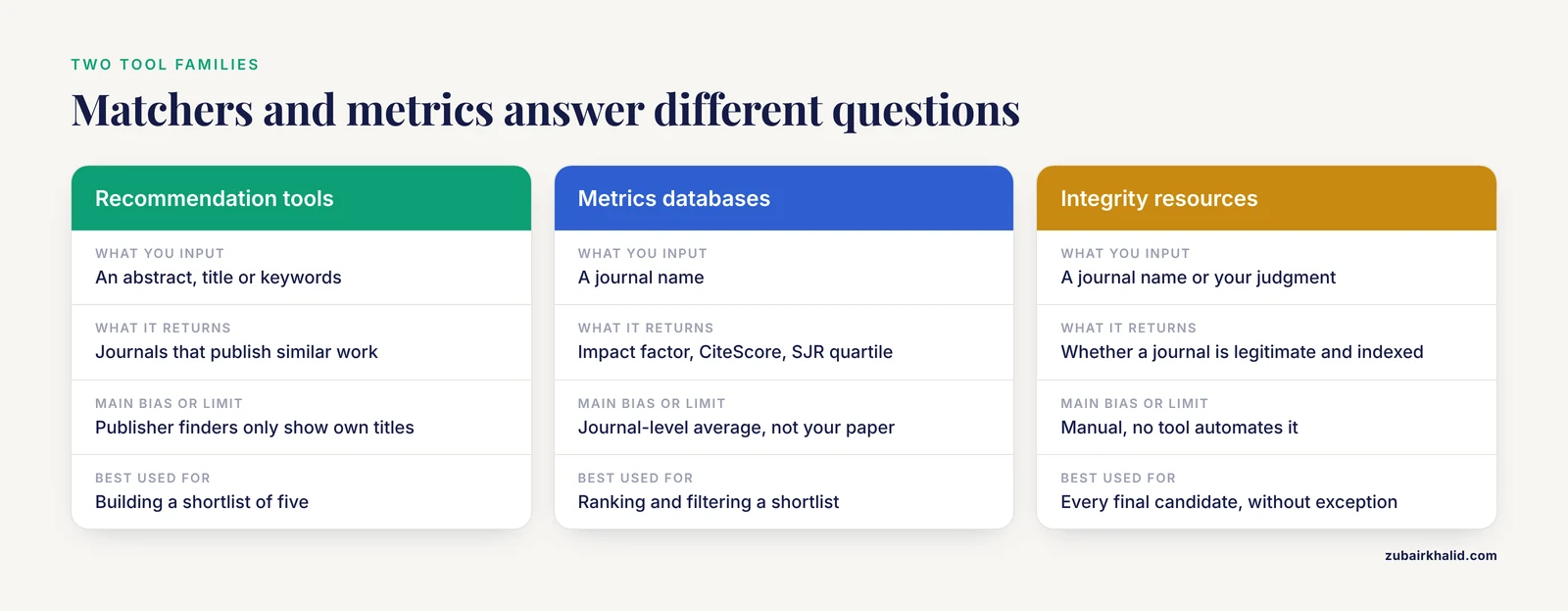
Before comparing brands, sort the tools by function. There are three functional categories, and most named products fall cleanly into one of them.
- Recommendation tools (journal finders and manuscript matchers). You paste in an abstract, a title, or keywords. The tool compares your text against a bibliographic database and returns journals that publish similar work. Examples include the Elsevier Journal Finder, the Springer Nature Journal Suggester, the Wiley Journal Finder, JANE, the Web of Science Manuscript Matcher, JournalGuide, and the Edanz Journal Selector.
- Metrics and ranking databases. You enter a journal name and get citation-based standing: impact factor, CiteScore, SJR rank, or quartile placement. Examples include Clarivate's Journal Citation Reports, Scopus source records with CiteScore, and the free SCImago portal.
- Integrity and vetting resources. These tell you whether a candidate journal is legitimate and indexed where you expect. The Directory of Open Access Journals (DOAJ), the Think. Check. Submit. checklist, the Retraction Watch database, and plain searches of PubMed or Scopus coverage serve this role.
A fourth, older option deserves mention: doing it by hand. You look at the reference lists of the twenty papers your own work depends on and count where those authors publish. This is slower than any tool, but it directly measures where your actual community sends its papers, and no database fully replicates it.
Journal Selection Tools Comparison at a Glance
The table below is the core of this journal selection tools comparison. Costs are described qualitatively because they change, and free access tiers differ by institution.
| Tool | Type | What you input | What it returns | Key strength | Main limitation |
|---|---|---|---|---|---|
| Elsevier Journal Finder | Publisher matcher | Abstract | Ranked Elsevier journals | Fast, matches against Scopus-indexed articles | Suggests only Elsevier titles |
| Springer Nature Journal Suggester | Publisher matcher | Abstract and manuscript text | Springer Nature and BMC journals | Simple, shows metrics alongside suggestions | Suggests only that publisher's portfolio |
| Wiley Journal Finder | Publisher matcher | Title and abstract | Wiley journals | Quick first pass | Suggests only Wiley titles |
| JANE | Independent matcher | Abstract, title, or keywords | Journals, plus matching articles and authors | Free, literature-based, shows the evidence for each match | Draws on MEDLINE, so biomedical only |
| Web of Science Manuscript Matcher | Subscription matcher | Manuscript text | Journals from the Web of Science corpus | Uses curated citation data | Requires institutional access |
| JournalGuide | Independent matcher plus profiles | Title, abstract, or journal name | Candidate journals with profile data | Combines matching with journal details such as indexing | Profile depth varies by journal |
| Edanz Journal Selector | Independent matcher | Abstract or text | Broad multi-publisher list | Wide coverage | Data provenance is less visible |
| Journal Citation Reports (JCR) | Metrics database | Journal name | Journal Impact Factor and quartiles | The standard citation metric | Subscription, one dimension of quality |
| Scopus source records | Metrics database | Journal name | CiteScore and related data | Free preview access | Citation metrics only |
| SCImago portal | Metrics database | Journal name or subject area | SJR indicator, quartiles by subject | Free, transparent methodology | Reflects Scopus coverage only |
| DOAJ | Directory and vetting | Journal name | Whether an open access journal meets listed criteria | Strong screen for open access legitimacy | Covers open access journals only |
| Think. Check. Submit. | Checklist | Your own judgment | A structured vetting process | Free, catches predatory traps | Manual, no data input |
| Retraction Watch database | Integrity check | Journal, author, or article | Records of retractions | Surfaces problems metrics hide | Must be checked deliberately |
Recommendation Tools on Their Own Terms
Publisher Journal Finders
The Elsevier Journal Finder, Springer Nature Journal Suggester, and Wiley Journal Finder work the same way. You paste an abstract, the tool searches its own indexed corpus for similar papers, and it returns journals from that publisher's list, often ranked by similarity.
Their shared strength is speed and integration. Each suggestion usually comes with scope notes, and the Springer Nature tool displays metrics next to candidates where available. Their shared weakness is structural: they only suggest journals they publish. A perfect match hosted by a competitor will never appear. Treat these finders as one voice in a chorus, not as an oracle. If you run your abstract through three publisher finders and one independent tool, you get a far more honest picture of the market for your paper.
JANE and Literature-Based Matching
JANE (Journal/Author Name Estimator) takes a different approach. It searches your abstract against MEDLINE, the biomedical literature database maintained by the National Library of Medicine, and returns the journals that have published the most articles similar to yours. It also returns the most similar individual articles and the most prolific authors in that space, which is genuinely useful: those author names are your candidate reviewers and your future readers.
JANE is free and shows its work, since each suggestion links to the underlying similar articles. Its limits are coverage and scope. It reflects MEDLINE, so it serves biomedical and life science authors far better than physicists or economists, and it reports no citation metrics or fees. You use JANE to find the neighborhood, then use other tools to pick the house.
JournalGuide and Other Independent Matchers
JournalGuide, from Research Solutions, and the Edanz Journal Selector sit between the two camps. They match across publishers and add journal profile information, including indexing status and publisher details. JournalGuide in particular lets you check where a journal is abstracted and indexed, which doubles as an integrity screen. The trade-off is that independent tools vary in how current and complete their profiles are, so treat profile pages as a starting point and verify anything decision-critical on the journal's own site.
Web of Science Manuscript Matcher
The Manuscript Matcher, available through Clarivate's Web of Science platform and via EndNote, matches your manuscript against the Web of Science Core Collection. Its advantage is curated citation data. Its disadvantage is access, since most researchers can use it only through an institutional subscription. If your library provides it, it is one of the strongest matchers available, and pairing its output with the SCImago portal gives you both fit and standing.
Metrics Databases on Their Own Terms
Matchers answer "who publishes work like mine." Metrics databases answer "how visible and established is this journal." You need both.
Journal Impact Factor (JIF). Defined as the average number of citations in a given year to items a journal published in the two preceding years, the JIF is published annually in Clarivate's Journal Citation Reports and remains the most cited single number in publishing decisions. It requires a subscription. Its limitations are as famous as its popularity: it measures the journal, not your paper, it favors review-heavy journals, and it varies enormously across disciplines, so a value that is strong in ecology is mediocre in cell biology.
CiteScore. Scopus's answer to the JIF, calculated over a longer citation window and displayed on the journal's Scopus source page. It is free to check and covers a wider journal universe than the JCR, but it is still a journal-level citation average with the same discipline-matching caveats.
SCImago and SJR quartiles. The SCImago portal is free and ranks journals using the SJR indicator, which weights citations by the prestige of the citing journal. Its most practical output is the quartile: within each subject category, journals are divided into four groups, Q1 through Q4, by rank. A journal in Q1 of a narrow subfield may have a modest raw citation count, which is exactly why quartiles are often more informative than raw metrics for a specialist paper.
One caution applies to all three. A single metric is a searchlight, not a verdict. Reviewers of decision tools in other fields have reached the same conclusion about complex versus simple evaluation methods: multi-criteria approaches capture more dimensions but demand more data and effort, while simple comparisons are accessible but narrow [1]. Choose a small, explicit set of metrics and move on.
Directories and Integrity Checks on Their Own Terms
This is the category most researchers skip, and the category where skipping costs the most.
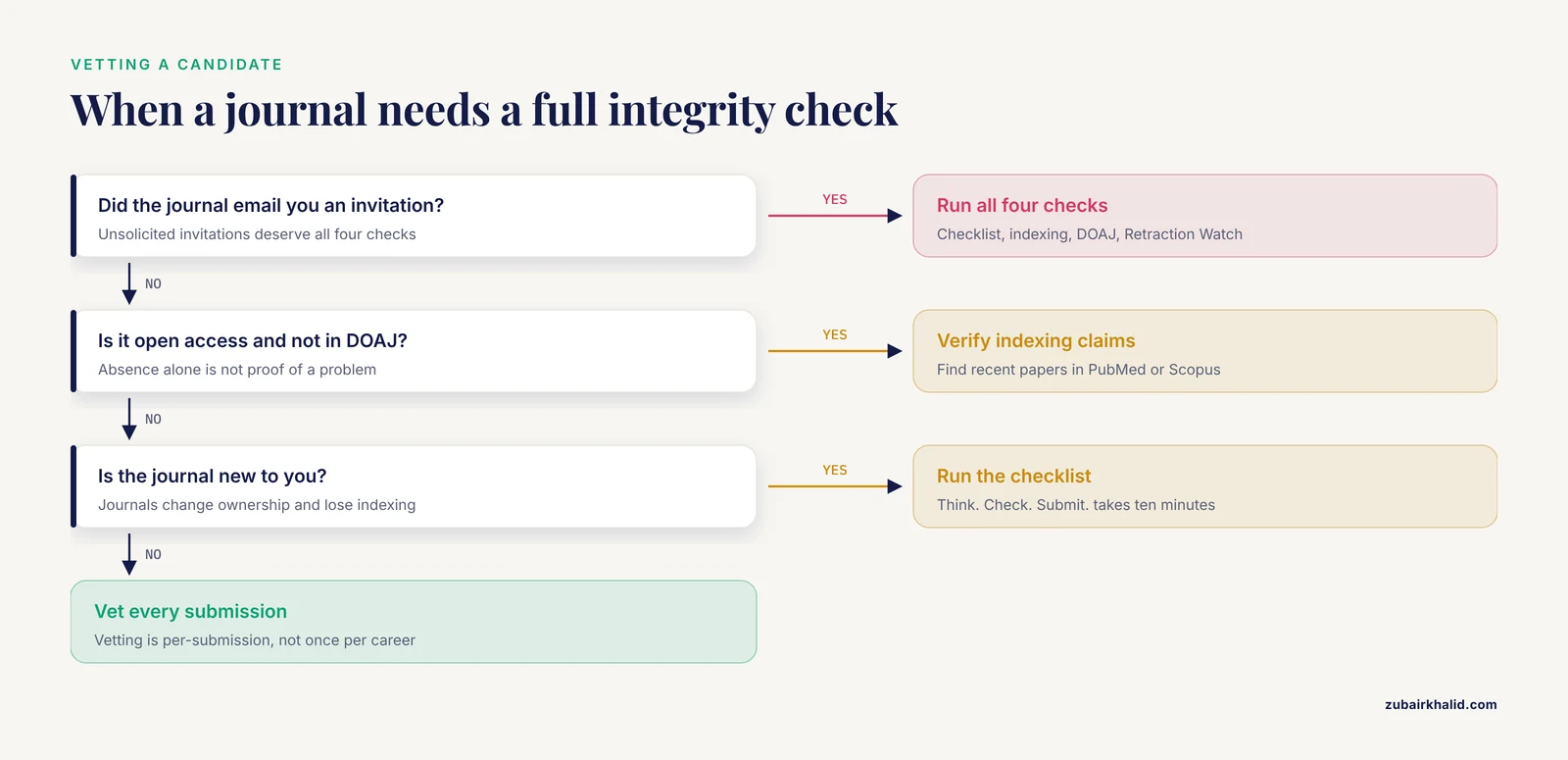
DOAJ. The Directory of Open Access Journals lists open access journals that meet stated inclusion criteria covering editorial practice and transparency. For any open access candidate, DOAJ membership is a meaningful positive signal, though absence alone is not proof of a problem, since strong society journals sometimes simply are not open access.
Think. Check. Submit. This is a checklist maintained by a coalition of scholarly publishing organizations. It walks you through questions about the publisher's identity, the editorial board, the peer review process, and fees. It requires no account and takes ten minutes. Run it for any journal you have never heard of, especially any that solicited you directly by email.
Retraction Watch database. Retractions happen, and they are recorded on the article page itself. A 2024 article in the Journal of Food Quality, for example, carries a retraction notice directly at its DOI, visible to any visitor [2]. Searchable databases aggregate these events, and a quick search for the journal or its editor can reveal patterns that no impact factor will show you.
Coverage checks. Finally, verify what the journal itself claims. If a journal's site says it is indexed in PubMed or Scopus, search those databases for a handful of the journal's recent papers. Fake indexing claims are among the most common markers of predatory journals, a term for publications that collect fees while providing little or no genuine peer review.
Comparing Tools on the Criteria That Decide Real Choices
Most journal selection tools comparison exercises fail because they compare features instead of decisions. The criteria below are the ones that actually change where you submit.
Coverage and neutrality. Publisher finders have built-in bias toward their own portfolios. Independent tools such as JANE and JournalGuide cover multiple publishers but each rests on a particular data backbone, MEDLINE for JANE and broader bibliographic sources for the others. Match the backbone to your field. A plant science paper fed to a MEDLINE-only matcher will get thin results. The point generalizes: any atlas of scholarly resources is only as good as the corpus behind it, which is why projects that aggregate publication and tool metadata, such as the DaTo atlas of biological databases and tools, matter and why their maintainers must curate continuously as resources change.
Transparency of evidence. The best matchers show why they suggested a journal, usually as links to the similar articles that drove the match. JANE does this well. When a tool hides its reasoning, you cannot tell whether it matched your methods section or one keyword in your title.
Scope fit versus prestige. Matchers optimize for topical similarity, metrics databases optimize for visibility, and these objectives conflict more often than researchers expect. A well-matched specialist journal may sit in Q2 while a poorly matched general journal sits in Q1. Papers published slightly out of scope get read less, cited less, and reviewed by referees who care less. For most authors, especially early-career authors building a coherent research identity, scope fit should outrank a modest metric difference.
Cost signals. Tool comparison work in other applied fields consistently shows that cost must be evaluated alongside performance, because a tool that scores well but cannot be used in practice delivers nothing [3]. For journal selection, the analogous fee is the article processing charge (APC), the fee some open access journals charge accepted authors. Many matchers do not surface APCs, so you must check the journal's author guidelines before committing. For a society journal, page charges and open access license fees follow different rules, and both belong in your decision before submission, not after acceptance.
Workflow fit. A tool you will actually use beats a better tool you will not. Systematic reviews of tool adoption in clinical settings found that even validated, effective tools face barriers to utilization in real workflows [3]. Pick a combination that fits your habits: one matcher you trust, two metrics pages you can open in tabs, and one checklist you run without thinking.
Pros and Cons of Each Approach
Publisher journal finders
- Pros: fastest path from abstract to shortlist, metrics and scope notes appear alongside suggestions, free.
- Cons: portfolio bias, no cross-publisher view, some bury fee information.
- Best used: to seed a shortlist when you already have a candidate publisher in mind.
Literature-based matchers such as JANE
- Pros: free, transparent, returns authors and articles along with journals, grounded in real publication patterns.
- Cons: field coverage limited to the underlying database, no metrics or fee data.
- Best used: in biomedicine and the life sciences, as the first step of any shortlist.
Subscription matchers such as the Web of Science Manuscript Matcher
- Pros: curated citation corpus, strong precision.
- Cons: institutional access required.
- Best used: when available, in combination with a free metrics portal.
Independent matchers such as JournalGuide and the Edanz Journal Selector
- Pros: cross-publisher coverage, useful journal profile data including indexing.
- Cons: variable profile currency, less standardized methodology.
- Best used: as the bridge between matching and vetting.
Metrics databases
- Pros: objective, comparable, fast to check, quartiles handle discipline differences reasonably well.
- Cons: journal-level averages say nothing about your specific paper, single-metric thinking distorts decisions, JCR access requires a subscription.
- Best used: to rank and filter a shortlist, never to generate one.
Integrity resources
- Pros: cheap insurance against the worst outcome, publishing in a journal that later disappears or is delisted.
- Cons: manual effort, no tool automates the full vetting process.
- Best used: on every final candidate, without exception.
Formal decision frameworks acknowledge this exact pattern. Reviews of tool selection methods across applied fields distinguish traditional judgment-based approaches from structured multi-criteria decision-making, and note that the strongest frameworks tie each candidate tool to specific desired outcomes rather than to habit [4]. Translated to journals: tie your choice to outcomes such as who will read the paper, how fast you need a decision, and what your CV requires, rather than to the journal your lab always uses. Even outside publishing, scholars treat choosing among candidate systems as a formal multi-attribute problem with weighted criteria [5], and the same discipline pays off here.
Worked Scenarios
Scenario 1: A first-time corresponding author with a methods paper. You have a manuscript on a new image-analysis pipeline for microscopy data. Paste your abstract into JANE, which returns several informatics and methods journals along with the authors who publish most heavily in that space. Run the same abstract through the Elsevier and Springer Nature finders to catch titles JANE missed. You now have roughly eight candidates. Check each on SCImago for quartile and on the DOAJ if open access. Two candidates are society journals your community actually reads, one is an expensive megajournal, and one lists an editor whose other projects look questionable on the Think. Check. Submit. checklist. You cut to three, check APCs on each journal's author guidelines, and submit to the society journal that matched your scope best. Total tool time: about two hours.
Scenario 2: The rejected manuscript. Your paper comes back from a Q1 general journal with two hostile reviews and a transfer offer to a lower-tier journal in the same publisher's portfolio. Do not accept the transfer reflexively. Re-run your abstract through an independent matcher with the reviewers' scope complaints in mind. Often the right move is a more specialized journal outside that publisher entirely, which a publisher finder cannot suggest. The transfer offer is worth considering only if the matcher independently supports that journal's scope.
Scenario 3: The flattering email invitation. You receive an email inviting you to submit to a journal whose name closely resembles a well-known title. You have never used it. Before anything else, run the Think. Check. Submit. checklist, search the journal's recent articles in PubMed or Scopus, and check the Retraction Watch database. If the journal claims indexing it cannot demonstrate, or the invitation promises an unusually fast review for a fee, you have your answer. No matcher belongs in this scenario, because matching tools do not vet.
Scenario 4: The interdisciplinary paper. Your work sits between ecology and epidemiology, and different matchers return disjoint lists. This is the situation where the manual method earns its keep. Pull the reference lists from your ten most important citations, tabulate where those authors publish, and merge that list with the matcher output. Interdisciplinary work is precisely where single-corpus tools underperform, and the hybrid approach compensates.
Common Mistakes and Limitations
Feeding a title instead of an abstract. Matchers compare text. A ten-word title contains almost nothing for the algorithm to match, so the results are close to random. Paste the full abstract, or for tools that accept it, several paragraphs of the manuscript.
Treating the matcher's ranking as the decision. Matchers rank topical similarity, which is one input among several. A first-place suggestion can carry a fee you cannot pay, a scope drift toward a subfield you do not belong in, or a poor integrity record.
Single-metric thinking. Choosing by impact factor alone pushes papers out of scope and rewards journals that publish citable reviews over journals that publish your kind of article. Choose a small metric set: one citation metric, one quartile, and acceptance-to-publication speed if you can find it.
Ignoring discipline baselines. Metrics only mean something relative to the field. Never compare a neuroscience journal's numbers to an education journal's numbers.
Skipping the vetting step for familiar-seeming journals. Journals change ownership, lose indexing, and accumulate retraction records. Vetting is per-submission, not once per career.
Assuming tool outputs are current. Bibliographic resources drift. The DaTo project documented exactly this, tracking how bioinformatics tools and databases, including where they were published and whether their links still worked, changed over twenty years. Recheck your saved shortlists each time you have a new manuscript.
Letting a tool choose before you define the audience. The question "who needs to read this paper" should come first. A matcher cannot answer it, and tools applied without explicit objectives tend to optimize for whatever metric is in front of you rather than for the outcome you need [4].
A note on limits. Tools narrow and vet. They do not replace the two human judgments that decide most outcomes: whether the science is ready, and whether the match between your contribution and the journal's readership is genuine. When a submission involves unusual circumstances, such as disputed data or an ethical question, your institution's research office or a senior colleague belongs in the loop before any tool does.
Frequently Asked Questions
What is a journal finder and how does it work?
A journal finder is a recommendation tool that reads your title or abstract, searches a bibliographic corpus for similar published articles, and returns journals that publish that kind of work. Publisher finders search their own portfolios, while independent tools such as JANE search broad literature databases and show the similar articles behind each suggestion.
Are publisher journal suggesters biased?
Yes, structurally. The Elsevier, Springer Nature, and Wiley tools can only return journals from their own portfolios, so a better-fitting journal elsewhere will never appear. This does not make them useless, but it means you should run your abstract through at least one independent matcher to see the full field.
Can one tool alone tell me where to submit?
No. Match tools answer who publishes similar work, and evaluation tools answer whether a candidate is trustworthy and visible. Every sound submission combines at least one of each, plus a fee check and an integrity screen. A single tool, however good, leaves at least one of those questions unanswered.
How do I check whether a journal is legitimate?
Run the Think. Check. Submit. checklist, confirm the journal's claimed indexing by finding its recent articles in PubMed or Scopus, look for membership in DOAJ if it is open access, and search the Retraction Watch database for the journal and its editors. Unsolicited email invitations deserve all four checks before anything else.
Do journal finders predict acceptance?
No. Matchers estimate topical similarity between your manuscript and a journal's published corpus. They know nothing about your results' quality, the current editor's priorities, or the volume of submissions the journal is handling. Treat the output as a shortlist generator, not an acceptance forecast.
When should I ignore the metrics and choose a journal for readership?
Whenever your paper targets a specific subfield where the specialists who will build on it read a particular society journal. A modest metric in the right venue beats a strong metric in the wrong one, because out-of-scope papers get weaker reviews, fewer reads, and fewer citations. Define the audience first, then let the metrics rank the venues that share it.
Sources
- A systematic review of decision tools for process selection and performance improvement in manufacturing
- Retracted: Forecasting the Applied Deep Learning Tools in Enhancing Food Quality for Heart Related Diseases Effectively: A Study Using Structural Equation Model Analysis
- Psychiatric screening tools in asthma and their barriers to clinical utilization: a systematic review
- Selection methods of lean management tools: a review
- Selection of Database Management System by Using Multi-Attribute Decision-Making Approach Based on Probability Complex Fuzzy Aggregation Operators