How to Tailor Your Grant Proposal for International Funders
By Dr. Zubair Khalid, DVM, MS, PhD ·
By the end of this guide you will be able to identify funders whose priorities match your project, reshape an existing proposal so it reads as a natural fit for a specific international call, build a defensible budget and management plan, and run a pre-submission review that catches the errors that get most applications rejected. You will need your draft proposal or project outline, the target funder's call documents and evaluation criteria, a spreadsheet for the budget, and access to colleagues or mentors who can review your draft before you submit.
International research grant proposal writing is a skill you build deliberately, not a talent you are born with. Most early career researchers first encounter it during their doctorate, yet the foundations, choosing a fundable question, matching a funder, writing for reviewers, are best laid during undergraduate training [1]. This guide walks through the whole process for a life scientist aiming at funders outside their own institution and often outside their own country.
Why International Funders Evaluate Proposals Differently
A funding body issues a competitive call. Your aim is not to prove that you deserve money. Your aim is to show that your study is the one most deserving of the limited funds available [2]. That framing changes everything about how you write.
International funders add layers that local funders do not. They evaluate against published criteria, they compare applicants from many countries and career stages, and they scrutinize whether the applicant team can actually deliver the work. A study of 243 researchers found that the strongest predictor of success in research funding competitions was the principal investigator's past performance, specifically the quality of previous publications and international visibility [3]. That means your track record, and how clearly you present it, is part of the proposal, not background material.
International funders also tend to be dedicated to a specific disease, process, or region [2]. A global health funder cares about implementability in low-resource settings. A basic science council cares about mechanistic depth. Sending the same generic proposal to both is the single fastest route to rejection.
Grant Proposal Planning: Start Months Before the Call
Grant proposal planning begins long before you open the application template. Two activities dominate the pre-writing phase, selecting the right research environment and identifying the right funding opportunity. The environment matters because reviewers judge feasibility. If you propose clinical sampling but your institution lacks the ethics approvals, the lab capacity, or the collaborator who can recruit patients, experienced reviewers will see the gap immediately.
Work backward from the funder's deadline. A practical planning schedule for a major international call looks like this:
- Four to six months before the deadline, shortlist funders whose published priorities match your topic.
- Three to four months out, read the last two years of funded projects if the funder publishes them, and draft your research question and hypothesis.
- Two to three months out, write the full draft, assemble the team letters, and build the budget.
- Six to eight weeks out, circulate the draft to experienced grant writers and your institution's research office.
- Two weeks out, freeze the science and spend remaining time on compliance, formatting, and the checklist.
The core of the plan is a clear, well-founded research question and hypothesis. Your methodology section must specify the measurement methods and experimental setup, and your schedule must be realistic, with milestones and anticipated barriers.
Step-by-Step: Tailoring a Proposal for a Specific International Funder
Step 1. Build a funder-fit scorecard
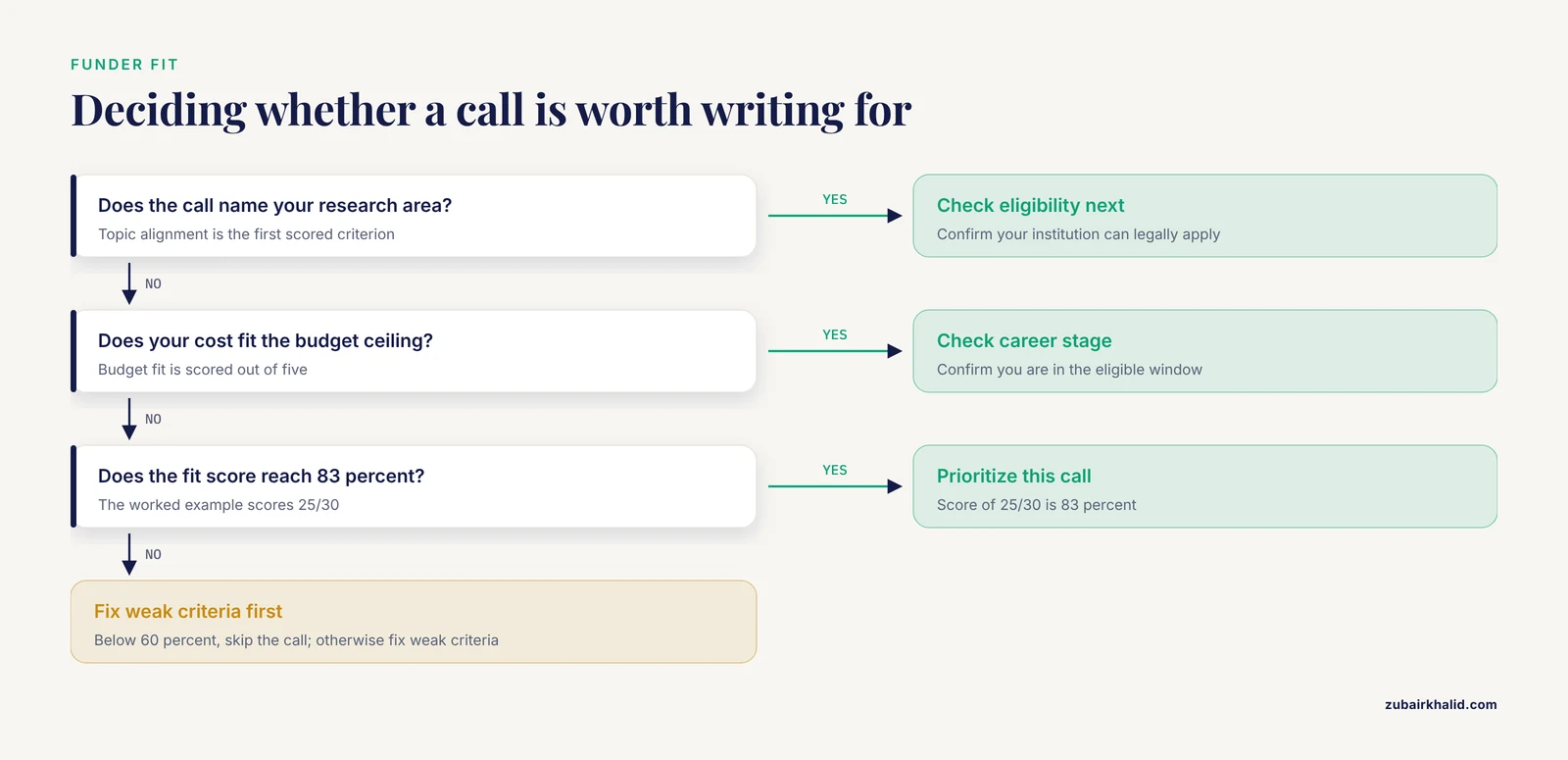
Before writing, quantify how well each candidate call matches your project. List the funder's stated priorities, eligible topics, budget ceiling, and required deliverables, then score your project against each. You can do this in a spreadsheet, or with a short script if you track calls in plain text files. Here is a simple Python scoring scaffold you can adapt:
# funder_fit.py - score how well a call matches your project
criteria = {
    "topic_alignment": 5,        # 1-5: does the call name your area?
    "geographic_eligibility": 5, # 1-5: can your institution legally apply?
    "budget_fit": 4,             # 1-5: does your cost fit the ceiling?
    "career_stage_fit": 3,       # 1-5: are you in the eligible window?
    "deliverables_capacity": 4,  # 1-5: can you meet required outputs?
    "team_track_record": 4,      # 1-5: publications and visibility
}

total = sum(criteria.values())
max_score = len(criteria) * 5
print(f"Fit score: {total}/{max_score} ({total/max_score:.0%})")

if total / max_score >= 0.8:
    print("Recommendation: prioritize this call")
elif total / max_score >= 0.6:
    print("Recommendation: apply only after fixing weak criteria")
else:
    print("Recommendation: skip this call")
Running the script produces expected output like this:
Fit score: 25/30 (83%)
Recommendation: prioritize this call
A call scoring below roughly 60 percent is usually not worth three months of your life, no matter how prestigious the funder. This kind of structured filtering is exactly what algorithmic grant-matching tools do, and institutions that use them have reported grant-award hit rates rising from 12 percent to 19 percent [4].
Step 2. Rewrite the opening around the funder's own priorities
Open your proposal with the funder's language, not yours. If the call prioritizes antimicrobial resistance in food-producing animals, your first paragraph should state plainly how your project reduces that burden. If it prioritizes capacity building, your first paragraph should describe the training and infrastructure your project leaves behind. The rule is simple. Identify the appropriate funding opportunity according to the funding body's priorities and guidelines, and then formulate the grant accordingly [2].
A practical drafting exercise. Take the funder's call text, copy the three or four sentences that describe what they want to fund, and paste them at the top of your working document. Every time you revise a section, check that it visibly advances one of those sentences. Delete anything that does not.
Step 3. State the research question and hypothesis in one sentence each
The core component of any proposal is a clear, well-founded research question and hypothesis. Reviewers on international panels read dozens of applications in a short window. If they cannot restate your question after reading the first page, the proposal fails. Test yourself by writing both sentences and showing them to a colleague outside your subfield. If they can repeat them back accurately, you have succeeded.
Step 4. Specify methods a reviewer in another country can evaluate
International review panels often include experts adjacent to, rather than inside, your specialty. Describe the experimental setup, measurement methods, sample size logic, and analysis plan in enough detail that a competent scientist outside your lab could judge whether the design answers the question. Define every abbreviation at first use, because the reviewer may not share your field's shorthand.
Step 5. Build the budget from the sample size upward
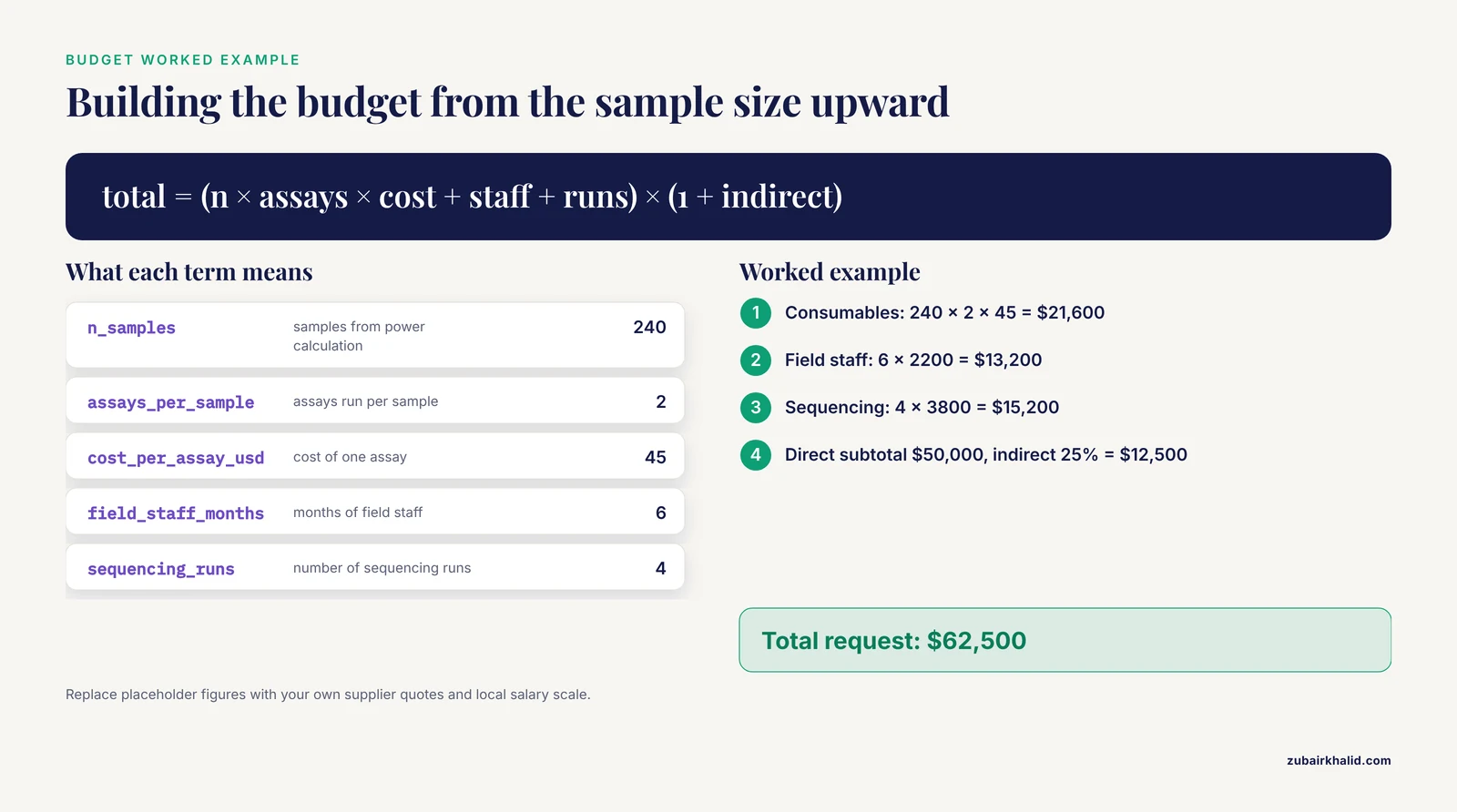
The financial section of a proposal is a detailed cost breakdown that must align with your sample size calculation and methodology. Work the numbers from the bottom up. Here is a worked illustration for a hypothetical field study, with placeholder figures you would replace with your own quotes:
# budget_sketch.py - build costs from the experimental design
n_samples = 240          # from your power calculation
assays_per_sample = 2
cost_per_assay_usd = 45  # replace with supplier quotation

consumables = n_samples * assays_per_sample * cost_per_assay_usd
field_staff_months = 6
field_staff_cost = field_staff_months * 2200  # replace with local salary scale
sequencing_runs = 4
sequencing_cost = sequencing_runs * 3800

direct_costs = consumables + field_staff_cost + sequencing_cost
indirect_rate = 0.25
total = direct_costs * (1 + indirect_rate)

print(f"Consumables:        ${consumables:,.0f}")
print(f"Field staff:        ${field_staff_cost:,.0f}")
print(f"Sequencing:         ${sequencing_cost:,.0f}")
print(f"Direct subtotal:    ${direct_costs:,.0f}")
print(f"Indirect (25%):     ${direct_costs * indirect_rate:,.0f}")
print(f"Total request:      ${total:,.0f}")
Expected output:
Consumables:        $21,600
Field staff:        $13,200
Sequencing:         $15,200
Direct subtotal:    $50,000
Indirect (25%):     $12,500
Total request:      $62,500
Once you have these predicted values, both tangible and non-tangible costs can be calculated and justified line by line [2]. Every figure a reviewer cannot trace back to the design is a figure they will question.
Step 6. Show the management plan and timeline
A strong organisational structure showing how funds will be managed, with realistic deliverables and a research timeline, convinces assessment boards that the team can handle the project [5]. Summarize the schedule in a table the reviewer can absorb in ten seconds. For the hypothetical project above:
| Period | Months 1-6 | Months 7-12 | Months 13-18 | Months 19-24 |
|---|---|---|---|---|
| Milestone | Ethics approval and piloting | Enrollment and sampling | Laboratory analysis | Analysis and manuscripts |
| Deliverable | Approved protocol | 240 samples collected | Dataset locked | Two manuscripts drafted |
| Risk watchpoint | Recruitment slower than planned | Sample loss in cold chain | Assay batch failure | Staff turnover |
Anticipating potential barriers and challenges, and stating how you will respond, is itself a scored element of many calls.
Step 7. Assemble the team the call demands
Provision of preliminary data helps, and collaboration with well-known, published colleagues and top centers helps further. For some kinds of application, such collaboration is a prerequisite [5]. Read the call text to find out whether it requires partners in specific countries, specific sectors, or specific career stages, then recruit those partners early enough that they contribute real input rather than a letter attached at the last minute.
Step 8. Run a pre-submission review and compliance check
Before submission, a more experienced grant writer should review the proposal, and you should use a checklist to assess adherence to the funding body's guidelines [5]. A minimal compliance checklist looks like this:
# submission_checklist.yaml
call_version:
  template_used: "2026 call guidelines, v2.1"
  page_limits_respected: true
  font_and_margin_rules_followed: true
budget:
  matches_guidelines: true
  currency_and_exchange_rate_stated: true
  justification_per_line_item: true
team:
  cv_format_matches_funder_template: true
  support_letters_current_and_signed: true
  conflict_of_interest_declarations: true
administration:
  institutional_signature_obtained: true
  submitted_before_internal_deadline: true
  pdf_bookmarks_and_file_names_correct: true
Many institutions that invested in internal grant review processes saw meaningful improvement in competitiveness, a lesson documented in a mixed-methods study of grant-writing practices at Ukrainian universities, which identified internal review, language support, and awareness of funding opportunities as central themes [6].
International Research Grant Proposal Writing Tips
The tips below come from workshops and structured training programs that have tested what moves the needle.
Get formal training if you can. A one-day proposal-writing workshop for health care professionals in Nepal, run with international and national resource persons, covered why proposals are rejected, plagiarism, and grant writing, and 90 percent of participants agreed it achieved its objectives [7]. A research grant writing course compresses years of trial and error into days, and many universities and clinical translational institutes now run them. The Indiana CTSI Postdoc Challenge, for example, trains postdocs to write proposals and review peers' applications using NIH-style criteria, and has funded 54 postdoctoral researchers since 2014 [8]. Serving as a reviewer yourself is one of the fastest ways to learn what reviewers reward.
Use AI tools carefully and disclose them. A systematic review of AI use in African higher education found that AI tools shortened supervisor feedback cycles by an estimated 45 percent in institutional case studies, but introduced plagiarism, data-provenance, and authorship-blur risks where policy was weak [4]. Use AI to find calls, tighten prose you have already written, and simulate reviewer questions. Never let it generate your scientific claims or your record of contributions. Check your funder's AI disclosure policy before you submit.
Write for the reviewer's workload. Reviewers skim first, read second. Use informative section headings, put the hypothesis in the first page, and make every figure self-explanatory. The quality and originality of the science is the main selling point, together with convincing the board that your consortium is the best placed group to do the job [5].
Engage the communities your research touches. Co-production, defined by the National Institute for Health and Care Research as researchers, practitioners, and members of the public working together and sharing power and responsibility, can reshape a proposal for the better. In one UK project on maternity care for underserved migrant women, workshops with 26 migrant mothers led the team to shift the entire focus of the proposal from documenting problems to co-designing solutions, and to build an expert-by-experience subgroup into the study governance [9]. If your international call values patient and community involvement, budget for it and describe it concretely.
Invest in language support where needed. Among the themes identified for improving grant-writing capacity at Ukrainian universities was implementing language support policies, alongside leveraging international collaborations and emphasizing evaluation and learning [6]. If English is not your first language, budget for professional editing of the final draft, and ask a colleague who has won funding from the same funder to read the narrative. Clarity failures are read as science failures.
Study funded examples. Training programs that walk participants through case studies of proposals that passed funding measurably improve understanding and readiness to submit [10]. If the funder publishes abstracts of awarded projects, read the last cycle. You will learn the vocabulary, the scope, and the level of preliminary detail that succeed.
The Two Selling Points That Decide Every International Application
Every funding application rests on two selling points, the strengths of the researcher or research group and the relevance of the project itself [2]. Tailoring means making both visible early and often.
For the researcher side, list your publications that are most relevant to this call, not your full bibliography. State your international visibility explicitly, because the quality of the project director's previous publications and international visibility are the key drivers of successful applications [3]. Name your collaborators, their roles, and what preliminary data each brings.
For the project side, connect each specific aim to a stated funder priority. If the call asks for capacity building, name the students you will train and the equipment your institution will retain. If it asks for translational potential, name the pathway from your result to a clinical or policy use.
Common Mistakes and Limitations
Submitting the same proposal to every funder. The proposal has to be targeted to the funding source being approached, and generic applications are easy for panels to spot [5]. Retitle, reorder, and rewrite the framing for each call.
Ignoring formal requirements. Attention to formatting and application guidelines is mandatory, not optional. Wrong fonts, missing annexes, and budgets in the wrong currency are administrative rejects that never reach a reviewer.
Budgeting from the ceiling downward. Starting from the maximum award and back-filling costs produces numbers that cannot be justified against the sample size and methods. Build upward from the design.
Unrealistic timelines. Overly optimistic deliverables signal inexperience. Reviewers want realistic targeted deliverables and a timeline that accounts for ethics approval, recruitment, and equipment lead times [5].
Skipping the experienced review. Proposals that skip review by a seasoned grant writer carry fixable flaws into the panel [5]. Arrange at least one external read, ideally from someone funded by the same body.
Assuming the reviewer knows your context. International panels may know little about your institution, your region's disease burden, or your regulatory environment. State those facts plainly and cite official sources.
Treating co-production as decoration. Community engagement that appears only in a sentence of the methods, with no budget line and no governance role, reads as box-ticking. If the call values it, integrate it structurally.
One limitation to keep in mind. Success rates at major international funders are low, and even excellent proposals are rejected for fit or budget-cycle reasons. A rejection with reviewer comments is data for the next submission, not a verdict on the science. This guide describes general practice, and each funder's own call documents always take precedence over any general advice.
Frequently Asked Questions
How early should I start grant proposal planning for an international call?
Start at least four to six months before the deadline. Shortlist funders, draft the research question, write the full proposal, and reserve the final two weeks for compliance checks and institutional signatures,.
What does tailoring a proposal actually involve?
It means reformulating the framing, aims, team, and budget around the specific funder's priorities and guidelines, rather than sending the same document everywhere [2].
Do I need collaborators in other countries to win international funding?
Often yes, and for some calls it is a prerequisite. Collaboration with well-known, published colleagues and strong centers strengthens the application and is required by certain schemes [5].
How do I find international funders that match my research?
Read the published priorities of dedicated funders in your disease or process area, use institutional grant-discovery tools, and score each call against your project before committing writing time [2], [4].
Can I use AI tools when writing my proposal?
Yes, for grant discovery and editing, with disclosure. Evidence shows efficiency gains but also real risks of plagiarism and blurred authorship, so follow your funder's AI policy [4].
Why do reviewers care so much about my publication record?
Because past performance predicts future success. The quality of the principal investigator's previous publications and their international visibility were the key drivers of successful applications in a large survey of researchers [3].
What budget errors are most common in international applications?
Costs that do not trace back to the sample size calculation and methodology, missing currency and exchange-rate clarity, and unjustified line items.
Is a research grant writing course worth the time?
Yes. Structured training and peer-review programs demonstrably strengthen proposal quality and reviewer skills, and workshop participants overwhelmingly report the training helped their readiness to apply [7], [8], [10].
Sources
- Research Grant Proposal Writing Course for Students in Higher Institutions
- WASP (Write a Scientific Paper): Writing a Research Grant - 1, Applying for Funding.
- Competing for research funding: Key elements impacting the evaluation of grant proposal
- Ethical AI Integration in African Higher Education: Enhancing Research Supervision, Grant Discovery, and Proposal Writing Without Compromising Academic Integrity
- WASP (Write a Scientific Paper): Writing a Research Grant - 2, Drafting the Proposal.
- Building Research Capacity and Promoting Collaboration Through Grant Writing: Lessons From Ukrainian Universities
- Workshop on proposal writing on research for health care professionals: a brief report
- 177 The Indiana CTSI Postdoc Challenge: Catalyzing early-career success using experiential training in grant proposal writing and peer review
- Co-production in public health research grant writing: engaging underserved migrant mothers in the UK
- Strengthening Proposal Writing Skills through Research Grants and PKM Bima Workshop