How to Handle Intellectual Property in Multi-Institutional Research
By Dr. Zubair Khalid, DVM, MS, PhD ·

In multi-institutional research, intellectual property is either settled before work begins in a written agreement among the partners or settled after the fact by the collision of each institution's default policies, and the first route produces far fewer disputes. The rule of thumb is simple. Get a short signed IP understanding in place before the first sample, dataset, or protocol crosses an institutional boundary. Choose open licensing when the goal is wide dissemination, and choose filed protection when a partner must invest money to turn a result into a product.
Intellectual property (IP) is any creation that the law treats as ownable. In life science work that usually means patents on inventions, copyright on software and written materials, and trade secrets such as unpublished formulations or assay conditions. Multi-institutional research, meaning scientific collaboration across universities, hospitals, companies, and government laboratories, multiplies the number of policies that touch every result. This guide lays out the main options for intellectual property in multi-institutional research, compares them on the criteria that decide real choices, and gives a workflow you can adapt to your own consortium.
Why Multi-Institutional IP Is Different
Within a single institution, IP follows one path. One employer policy assigns rights, one technology transfer office (TTO), the office that handles patenting and licensing for an institution, manages filings, and one set of funder rules applies. Across institutions, every one of those layers is duplicated, and the copies rarely match.
Scholarship on industry-university intellectual property dynamics treats the subject as a multi-level phenomenon, shaped at the same time by the individual researcher, the laboratory, the institution, and the wider research system. A decision that looks personal, such as which results to present at a conference, can bind an entire consortium.
Three structural problems drive most disputes.
First, joint invention. When researchers at two institutions each contribute to the conception of an invention, patent law treats the invention as jointly owned. In the United States, each co-owner of a patent can generally use the invention and license others without sharing the income, unless an agreement says otherwise. Partners who assume shared income by default are often wrong.
Second, conflicting defaults. Every university and most companies have an IP policy, and those policies disagree about who owns what. One university may claim rights to inventions made by anyone using its facilities, while a partner company may claim everything its employees touch. A jointly made invention can fall between the two.
Third, divergent practice. National IP systems differ in how written law combines with enforcement, a distinction drawn in analyses of post-TRIPS IP systems, so two partners can operate under rules that look similar on paper but behave differently in practice [1].
Practice also lags behind theory in many fields. A bibliometric review of intellectual property protection research on intangible cultural heritage in China found little robust collaboration between authors and institutions in that literature [2]. Weak institutional collaboration is a pattern, not an exception, which is why deliberate IP governance matters.
Your Options for Intellectual Property in Multi-Institutional Research
Four workable options exist. Mature consortia usually combine them.
Option 1, Negotiated Inter-Institutional Agreements
A consortium agreement is a single contract among all partners that sets the rules for the project. It defines background IP, meaning IP each partner owns before the project starts, and foreground IP, meaning IP created during the project. It then assigns ownership of the foreground, sets licensing rights, fixes a publication procedure, and names a dispute process. Two companion instruments do the day-to-day work. A material transfer agreement (MTA) governs each transfer of research materials such as cell lines, plasmids, antibodies, or animal models. A confidential disclosure agreement (CDA), sometimes called a nondisclosure agreement, protects exchanges of nonpublic information before a full contract exists.
Research on inter-institutional collaborative networking in plant molecular biology in India examines how research partnerships operate within an intellectual property rights regime, a reminder that IP terms shape how institutional networks form and hold together [3]. Evidence from China points the same direction from the policy side, showing that stronger regional IP protection policy increased deep integration of enterprise-led industry-university-research cooperation, partly by raising enterprise innovation investment and regional IP enforcement [4].
Agreements cost time up front. In exchange, they remove ambiguity exactly where ambiguity is most expensive, which is after results exist.
Option 2, Institutional Default Policies
The default route applies each partner's existing IP policy and funder rules with no new paperwork. In the United States, the Bayh-Dole Act of 1980 lets universities take title to inventions made with federal funding, in exchange for duties such as reporting inventions to the funding agency and working toward practical use. Defaults work reasonably well for exploratory projects, low-value outputs, and partners whose policies already align.
They fail predictably in three situations. Defaults conflict over jointly made inventions. Defaults say nothing about publication timing across partners. And defaults rarely address materials, so reagents move without terms. If you choose the default route, choose it deliberately, after confirming that the partners' policies do not collide.
Option 3, Open Licensing and Open Science
Open science is the practice of sharing publications, data, software, and methods under terms that let others access and reuse them. A consortium can pick a license once, for example a recognized open data license for datasets and written protocols or a permissive open source license for code, and every partner and outsider gets defined reuse rights without case-by-case negotiation.
The combination of openness and IP is workable but poorly practiced. A cross-sectional survey of 177 researchers and research managers, mostly at European research-performing organizations, found general optimism about combining IP and open science, yet concrete examples of successful synergy were rare. The reported barriers were unclear institutional guidance, limited awareness of open licensing mechanisms, uncertainty about running IP protection and open science at the same time, differing objectives across partners in collaborative projects, and national differences in legal frameworks, with knowledge transfer offices and open science ambassadors named as the supports that help most [5].
Empirical work on international high-tech companies shows why openness is not the opposite of protection, since firms increasingly combine open and closed innovation into hybrid strategies in both form and content [6].
Option 4, Hybrid Staged Models
A hybrid model keeps early results open and protects late-stage value. A typical design publishes methods and datasets immediately, holds exact commercial know-how as trade secrets, and files a patent only when a partner commits resources to development. Two tools make this precise. An option agreement gives a company a time-limited right to negotiate a license on defined terms, which lets a collaboration start before any license is signed. A field-of-use license limits rights to one application, for example granting a company exclusive diagnostic rights while the university retains therapeutic uses.
Timing is the binding constraint. In most countries a patent application must be filed before public disclosure, because disclosure destroys novelty. The United States allows a limited grace period after a disclosure, but no other major system is that forgiving, so every talk, poster, preprint, and thesis needs a check against the filing calendar.
Side-by-Side Comparison of the Main Approaches
The table summarizes the four approaches and the trade-offs that decide most choices.
| Approach | Who sets the rules | Best fit | Publication and sharing | Main trade-off |
|---|---|---|---|---|
| Negotiated consortium agreement | The partners, in one signed contract before work starts | Multi-university grants, public-private partnerships, projects with a product goal | Publication procedure fixed up front, usually a short review window for patent filings | Slowest to set up, needs legal support |
| Institutional default policies | Each partner's IP policy plus funder rules | Exploratory work, low-stakes outputs, partners with aligned policies | Fast but uncoordinated, with gaps around joint inventions | Conflicts surface after results exist |
| Open licensing | The consortium, through one license chosen for all outputs | Datasets, software, protocols, public health and basic science results | Immediate sharing within license terms | Weaker pull for partners who must commercialize |
| Hybrid staged model | The partners, with staged decision points in the agreement | Translational pipelines, tool-plus-product projects | Open early layers, protected late layers | Needs active management and clear triggers |
Pros and Cons of Each Approach
Speed and setup cost. Defaults are fastest, open licensing is fast after one licensing decision, and negotiated agreements are slowest, often taking weeks to months. Pay the setup cost once, up front, or pay it repeatedly in disputes later.
Ownership clarity. Agreements rank first because they name owners, shares, and a managing institution. Defaults rank last for joint work, because conflicting policies are the definition of the problem. Open licensing sidesteps ownership by converting it into license terms everyone can read.
Publication freedom. A good consortium agreement protects publication with a fixed review window that exists to give partners time to file patent applications before disclosure. Defaults vary by institution. Open licensing maximizes freedom by design.
Commercialization path. Agreements and hybrid models give a company a defined path, usually through options and field-of-use licenses, and a defined path is what convinces a partner to invest. Open licensing is weakest here, and defaults are unpredictable. Partners fund what they can eventually license.
Cross-border robustness. Aligning IP rules across jurisdictions is possible but slow. Analyses of legal harmonization across African regional economic communities describe harmonization of business and IP law as a key integration tool that still faces obstacles from colonial legacies, diverse legal traditions, and uneven economic development [7]. Even within trade blocs, comparative analysis of CPTPP, USMCA, and RCEP found a gradient of IP enforcement intensity, with USMCA at the strong end and RCEP at the weaker end [8]. The practical lesson is to name a governing law and a dispute forum in every multi-country agreement rather than assume convergence.
What protection actually buys. A meta-regression synthesis of 91 primary studies reporting 1,626 effect size estimates found the average effect of IP protection on innovation, technology diffusion, productivity, and economic growth to be statistically or practically insignificant [9]. Protection is a tool for enabling a specific transaction, such as an exclusive license that funds development, not a goal in itself. Protect what a defined use requires.
Worked Scenarios
Scenario 1, Three Universities and a Diagnostics Company
A consortium of three universities and a diagnostics company is developing an assay for early detection of a pathogen. Before the first experiment, the partners sign a consortium agreement. Each partner files a background IP schedule listing its existing cell lines, antibodies, and software. The agreement makes foreground IP jointly owned, managed by the lead university, and gives the company a time-limited option for an exclusive diagnostic field-of-use license. Publication follows a 30-day review window so partners can file patents. Every material shipment travels under an MTA. When the assay works, the company exercises its option, licensing income flows into the agreed sharing formula, and the universities publish without delay. The agreement, not goodwill, kept both the paper and the product on schedule.
Scenario 2, A Cross-Border Data Consortium
Five universities on three continents pool genomic and clinical data to study disease resistance. The partners sign a data sharing agreement that classifies each contributing dataset as background, defines derived datasets as foreground, and sets access tiers for internal, partner, and public use. Data-based IP, such as copyright in database structure and trade secret protection for compiled nonpublic data, is named explicitly. The research field around data-based intellectual property has grown rapidly since 2013, with regional collaboration led by the United States, China, and the United Kingdom, while institutional collaboration in the area remains underdeveloped [10], so the consortium does not assume that shared practice norms exist. Each site names a data steward, and every transfer is logged. When a partner later wants to commercialize a derived model, the agreement already says who negotiates and on what terms.
Scenario 3, An Open Methods Consortium
Twelve laboratories build an open protocol and analysis software for imaging. The consortium picks a permissive open source license for the code and an open license for the protocol at the start, and contributor terms require every contributor to grant that same license. Exact proprietary parameters, such as an unpublished reagent formulation held by one partner, stay outside the public repository as trade secrets. The project spreads quickly because adoption is frictionless, and the partner with commercial interests still holds protectable know-how. This is the hybrid logic in miniature, open where spread helps, closed where a specific asset needs protection.
How to Handle Intellectual Property in Multi-Institutional Research: A Practical Workflow
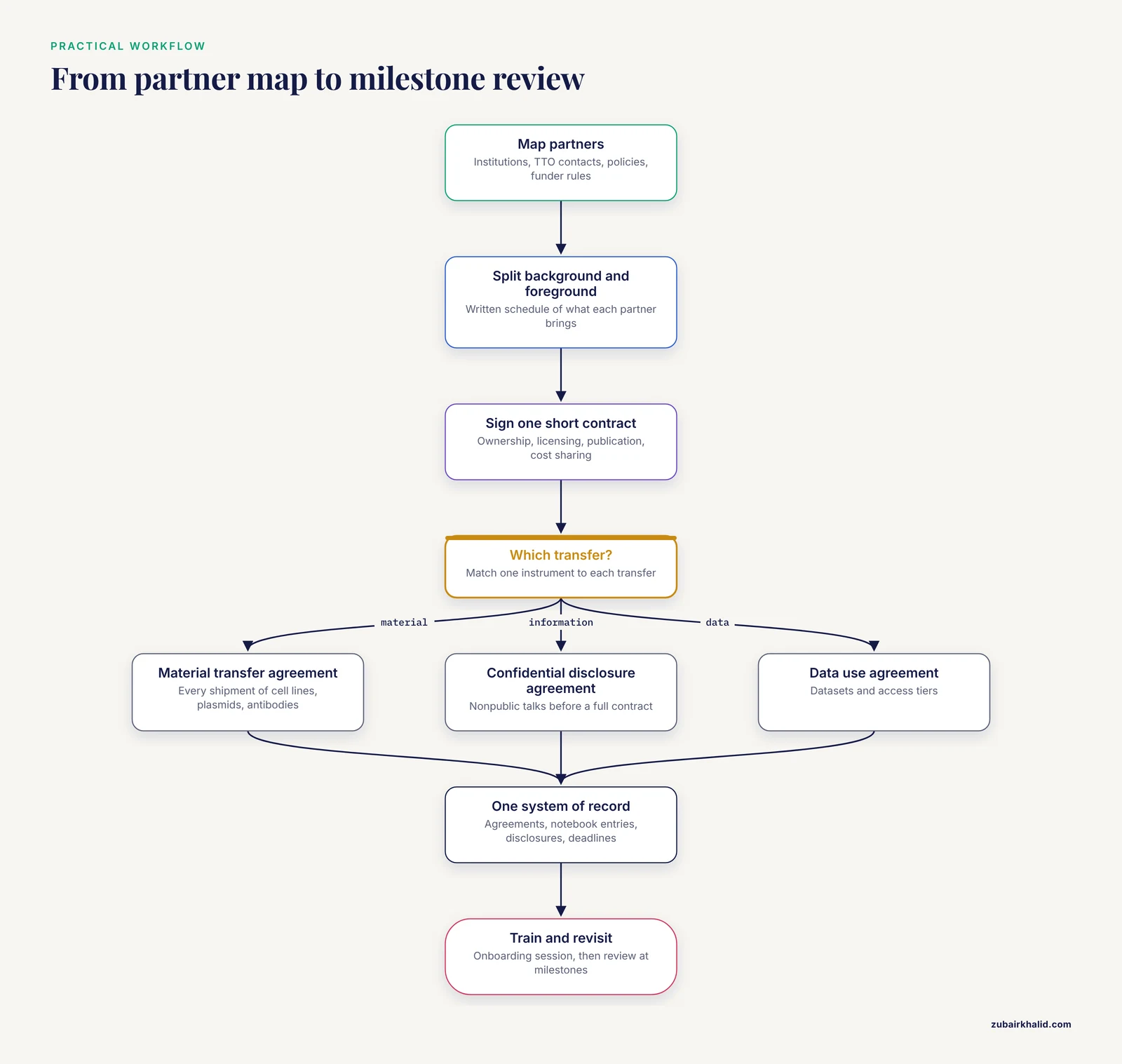
Seven steps turn the options above into an operating routine.
- Map every partner and its policies. List each institution, its TTO contact, its IP policy location, and its funder rules. Large partnerships show why this discipline matters. The systematic approach used to survey actors in the Global Polio Eradication Initiative first defined the universe of all relevant actors, then enumerated specific individuals within it, which allowed comprehensive sampling across countries [11]. Your consortium version is smaller, but the order is the same, universe first, individuals second.
- Separate background and foreground IP in a written schedule. Worked example, Partner A contributes an existing cell line, Partner B contributes an antibody, and the project creates an engineered detection assay. The schedule lists the cell line and antibody as background and the assay as foreground. Ambiguity here is the root of most later disputes.
- Put ownership, licensing, and publication terms in one short contract. Terms worth negotiating include joint foreground ownership managed by one lead institution, a fixed review window before public disclosure so partners can file, a cost-sharing formula for filings, and field-of-use options for commercial partners.
- Match the instrument to each transfer. Use an MTA for every material shipment, a CDA for confidential discussions, a data use agreement for datasets, and IP clauses in every subaward. One instrument per transfer, no exceptions, including transfers between academic labs.
- Keep one system of record. Archive failures are a measurable source of IP loss. In a survey of 17 consumer brands managing overseas IP assets, 64.7 percent stored records in fragmented forms, 58.8 percent reported problems such as missing official documents and no renewal warnings, only 17.6 percent had built multi-jurisdictional digital archive systems, and archive management defects were linked to 34.2 percent of IP-related losses [12]. The laboratory equivalent is a single, access-controlled location holding executed agreements, timestamped notebook entries, invention disclosures, and filing deadlines.
- Train everyone who touches the project. A case study at a Mozambican higher education institution found limited understanding of the legal implications of IP infringement among faculty, researchers, and students, and concluded that stronger institutional policies and ongoing awareness actions are needed [13]. Work on IP legal education in universities makes the same argument from the curriculum side, treating IP literacy as a foundation for innovation and for moving research results into practice [14]. A one-hour onboarding session covering disclosure rules, MTA basics, and who to call prevents most avoidable errors.
- Revisit at milestones. Trigger a review when a partner joins or leaves, when the project pivots toward commercialization, or when funding changes. Agreements that are never revised drift away from the work they govern.
Research Collaboration Tools That Keep IP Tidy
Four tool categories carry most of the load. Electronic lab notebooks create timestamped, tamper-evident records of conception and development. Version-controlled repositories hold code and protocols while contributor terms keep licensing consistent. A shared disclosure and deadline tracker prevents missed filing and renewal dates. An e-signature workflow for MTAs and CDAs ensures executed copies land in the system of record instead of an inbox. None of these research collaboration tools replaces the agreement, they preserve the evidence the agreement relies on.
Common Mistakes and Limitations
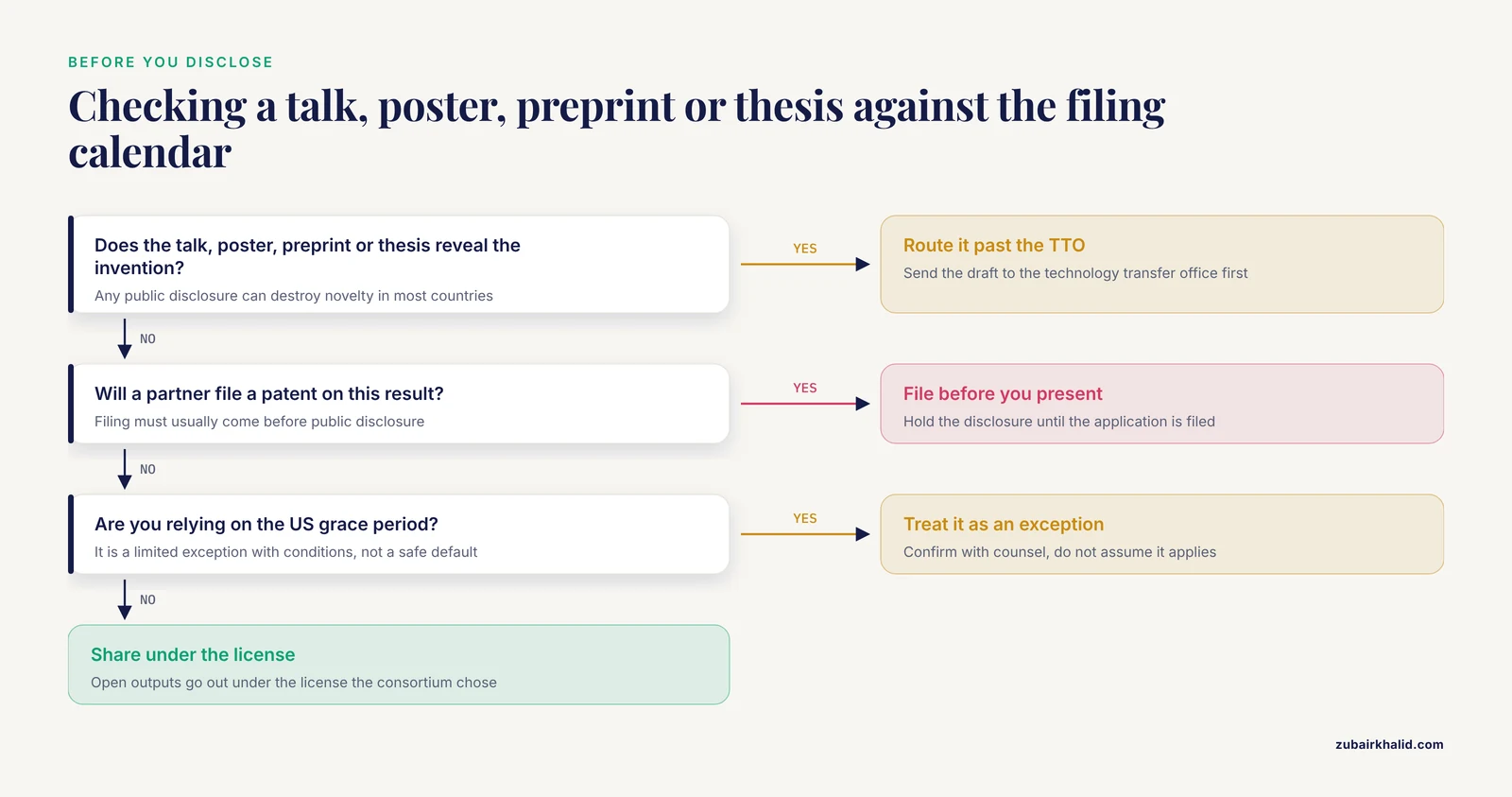
Treating authorship and inventorship as the same thing. Authorship is scholarly credit on a paper, decided by contributorship norms. Inventorship is a legal status on a patent, decided by who contributed to the claimed invention. Listing the wrong inventors can damage a patent's validity, and the two lists often differ.
Disclosing first and asking later. A conference talk, poster, preprint, or thesis can count as a public disclosure that destroys novelty in most countries. The US grace period is an exception with conditions, not a safe default. Route every disclosure past the TTO first.
Assuming identical words mean identical rights. A clause that reads the same in two countries can behave differently in practice, because written law and enforcement diverge. Cross-border agreements should always name a governing law and a dispute forum.
Relying on email threads as the agreement. An email chain records intent, it does not bind institutions. Only signatures from people with actual authority to bind each institution create enforceable terms.
Letting materials move before paperwork does. Reagents travel faster than contracts. Every physical transfer needs an MTA, and undocumented transfers create ownership questions that surface years later.
Over-protecting. Filing, maintaining, and enforcing rights costs money and slows sharing. Protect only what a defined transaction needs, and let open licenses carry everything else.
Skipping onboarding for new staff and students. Rotating students and new hires are the most common source of accidental disclosures and undocumented transfers. A short induction closes most of that gap.
One limitation governs all of the above. IP law varies by country, changes over time, and turns on facts that no guide can anticipate. Treat this article as orientation, and have each partner's TTO or IP counsel review real agreements, especially before any disclosure or commercial negotiation.
Frequently Asked Questions
Who owns an invention made by researchers at two different universities?
Ownership follows the written agreement between the institutions, and absent an agreement the patent is typically jointly owned. Joint ownership limits what any single owner can do, so consortia usually assign management of jointly owned patents to one lead institution in the agreement.
What is the difference between inventorship and authorship?
Inventorship is a legal determination based on who contributed to the claims of a patent, while authorship is scholarly credit for a published paper. The two lists frequently differ, and incorrect inventor naming can undermine a patent.
Do I need a material transfer agreement to share a cell line with another institution?
Yes. An MTA records who owns the material, what the recipient may do with it, and who owns derivatives and any inventions built on it. Send nothing across an institutional boundary without one.
Can we present results at a conference before filing a patent?
Only after checking with your technology transfer office. A public presentation counts as a disclosure that can destroy patent novelty in most countries, and the US grace period is a limited exception rather than a safe default.
How should a consortium handle ownership of shared datasets?
Through a written data sharing agreement that classifies contributed datasets as background, defines derived datasets as foreground, and sets access, reuse, and publication terms. Name a data steward at each site and log every transfer.
Can a project be both open science and carry intellectual property?
Yes, if the partners choose licenses and protection points deliberately. Open licenses carry the outputs meant to spread, while filed rights or trade secrets protect specific assets that fund development, and institutional guidance helps teams hold the two together.
Sources
- Defining and Measuring the Institutional Context of National Intellectual Property Systems in a post-TRIPS world
- Intangible cultural heritage research in China from the perspective of intellectual property rights based on bibliometrics and knowledge mapping
- Inter-institutional collaborative networking in the intellectual property rights regime: research in plant molecular biology in India
- The role of intellectual property on Enterprise-led Industry-University-Research Institution cooperation: case of innovation awards in China
- Stakeholders’ perceptions of the synergy between intellectual property and open science: A cross-sectional survey
- ‘Open’ Innovation and Institutional Protection of Intellectual Property
- Legal harmonization as an integration tool: an analysis of institutional efforts to harmonize business law, intellectual property law, and commercial law on the African continent
- The Differentiation and Coordination Pathways of Intellectual Property Enforcement Provisions in Regional Trade Agreements-A Comparative Study Based on CPTPP, USMCA, and RCEP
- Does intellectual property protection deliver economic benefits? A multi-outcome meta-regression analysis of the evidence
- Exploring Intellectual Property in the Digital Realm: A Bibliometric Study on Research on the Management and Protection of Data-Based Intellectual Property
- Sampling method for surveying complex and multi-institutional partnerships: lessons from the Global Polio Eradication Initiative.
- Research on Digital Construction, Operation and Maintenance of Overseas Intellectual Property Archives for Consumer Brands
- Legal Risks of Intellectual Property and Digital Plagiarism in Mozambique: Case Study of the Higher Institute of Training, Research and Science (2022 - 2024)
- Research on Intellectual Property Law Education in Higher Education Institutions under the Background of Optimizing the Business Environment