Assessing Participant Comprehension in Informed Consent
By Dr. Zubair Khalid, DVM, MS, PhD ·

By the end of this guide, you will be able to build a comprehension assessment for your own study, choose an appropriate instrument from validated options, score participant responses against a defensible threshold, decide when to re-teach and re-test, and avoid the measurement errors that make many consent assessments look better than they are. This is a core skill in research ethics and responsible conduct of research, because a signature on a consent form proves nothing by itself.
Here is what you need on hand before you start:
- Your study's informed consent form (ICF), the document participants actually read or hear
- A list of the key consent elements your protocol and review board require (voluntary participation, study purpose, procedures, risks, benefits, alternatives, confidentiality, right to withdraw, contacts)
- A blank question bank template and a scoring sheet, on paper or in a spreadsheet
- A quiet place to administer the assessment and, for low-literacy settings, a plan for oral or audio delivery
- A written plan for what you will do when a participant fails the assessment
Why Comprehension Assessment Belongs in Research Ethics
Informed consent is the ethical foundation of research with human participants. The consent process has three parts: disclosure of information, comprehension of that information, and a voluntary decision. Most research teams invest heavily in the first part, drafting and translating the form, and the third part, obtaining the signature. The middle part, comprehension, is where the process most often breaks down, and it is the part that assessment exists to check.
A signature documents that the form was signed. It does not document that the participant understood what they signed. Studies that actually measure understanding keep finding gaps. In a pain clinic study of 201 patients undergoing lumbar epidural steroid injections, older age and identifying as Black or as another race predicted poorer understanding of the consent they had given, even though the researchers found no difference by assigned sex at birth, education level, or profession [1]. In a cross-sectional study in Romania, the correlation between what participants objectively knew and what they believed they understood was only moderate, a Spearman correlation of 0.35, meaning many confident participants had real knowledge gaps [2]. In the classic Deaconess validation study, 70 percent of subjects rated their understanding of consent information as thorough, yet their actual test scores told a more complicated story [3].
Assessment closes that gap. It converts consent from a paperwork event into a verified conversation, which is what responsible conduct of research demands.
What a Comprehension Assessment Actually Measures
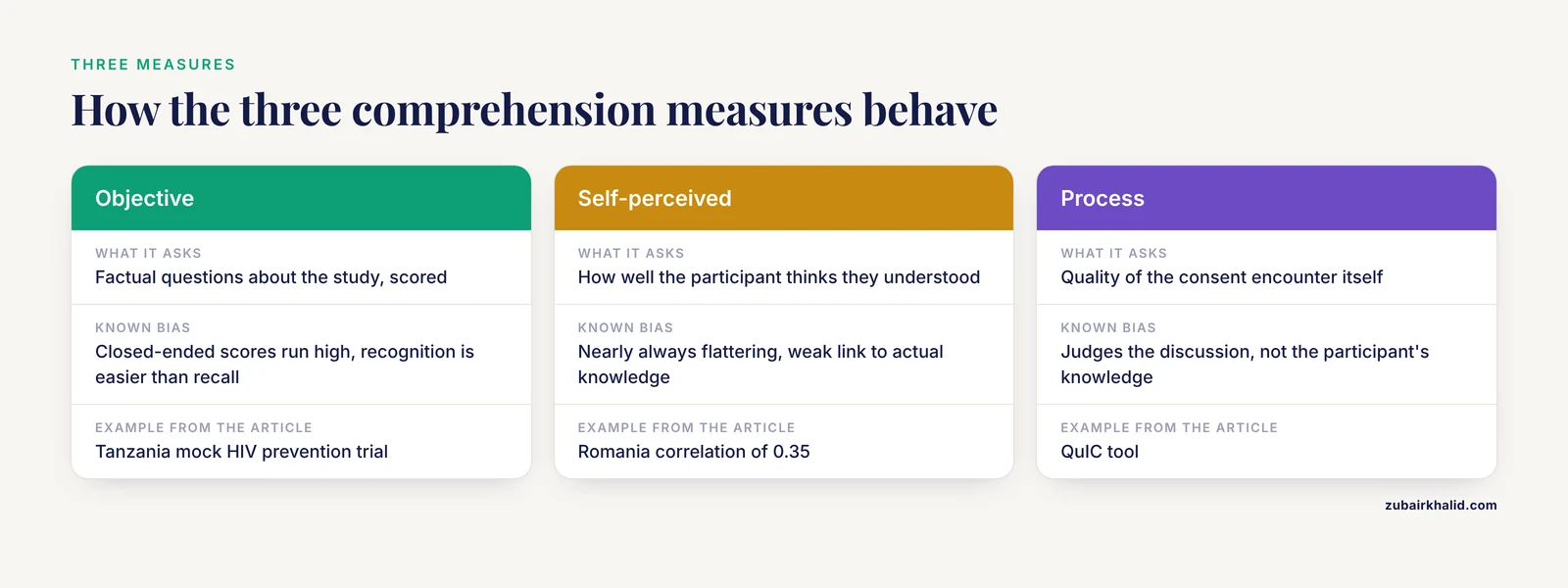
Before building anything, be clear about the three kinds of measures, because they behave differently and each has a known bias.
Objective measures ask factual questions about the study and score the answers. A closed-ended version offers multiple choice or true and false items. An open-ended version asks the participant to explain in their own words, for example "What is this study trying to find out?"
Self-perceived measures ask participants how well they think they understood. These are easy to collect and nearly always flattering. In the Tanzania mock HIV prevention trial, women reported higher perceived ease of understanding than either objective format could justify, and perceived scores did not track with actual performance [4]. The Romania study reached the same conclusion with a moderate correlation of 0.35 between self-perceived and objective comprehension [2].
Process measures evaluate the quality of the consent encounter itself, for example whether the discussion covered the required elements and whether questions were invited. The Quality of Informed Consent (QuIC) tool is a standard example of this category [5].
The format bias matters and has been measured directly. In the Tanzania study, women randomized to the closed-ended assessment scored significantly higher overall than women given open-ended questions, because recognition is easier than recall [4]. Practical consequence: if you use closed-ended questions, your scores will run high. If you need a conservative estimate of understanding, use open-ended items or mix both.
Step by Step: Building and Running a Comprehension Assessment
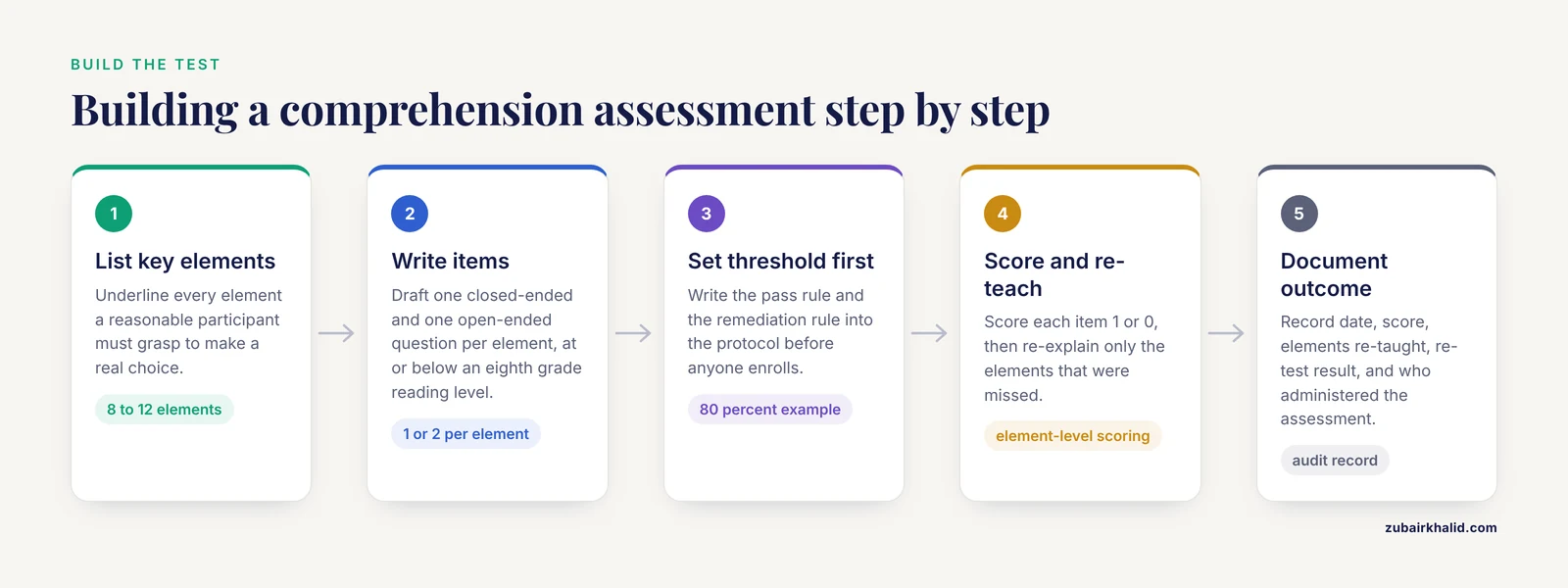
This walkthrough takes you from a bare consent form to a scored, documented decision. It works for a clinical trial, a survey study, or a procedures clinic.
Step 1. List the key elements your participants must understand
Read your consent form and underline every element a reasonable participant must grasp to make a real choice. A typical list for a clinical study:
- The study involves research, not routine care
- The purpose of the research, in one sentence
- What will happen to the participant, procedures and duration
- The main risks
- The expected benefits, if any
- Reasonable alternatives, including not participating
- Participation is voluntary and can stop at any time without penalty
- How confidentiality will be protected
- Who to contact with questions or injury
Aim for 8 to 12 elements. More than that and your test gets long. The Gambian audio tool used 34 items to cover the full element set for clinical trials, which is thorough but requires careful administration time [6]. Short protocol-specific tests of 10 to 21 items are more common in practice,.
Step 2. Write one or two questions per element
For each element, draft a closed-ended item and an open-ended item. Worked examples for a fictional hypertension trial:
Element 4 (risks)

Closed-ended item:
Which of the following is a known risk of the study drug?
  a) Dizziness
  b) Improved sleep
  c) Weight gain
  d) No risks are known
Correct answer: a

Open-ended item:
In your own words, what could go wrong if you join this study?
Scored correct if the participant names at least one listed risk.
Language rules that raise validity:
- Write at or below an eighth grade reading level. Consent documents routinely exceed what their readers can handle. In a review of 97 consent documents plus institutional review board websites serving American Indian and Alaska Native communities, the documents were readable only at inappropriately high levels and were unsuitable for actually teaching participants about the research [9]. At the National Institute of Cancerology in Mexico, more than half of internal consent forms were somewhat or very difficult to read, some requiring nearly ten years of education to understand [10].
- One idea per question.
- Avoid medical jargon. Say "high blood sugar," not "hyperglycemia."
- Test the questions on a colleague before piloting.
Step 3. Set your pass threshold and remediation rule before you enroll
Decide in advance what counts as adequate understanding and what you will do when a participant falls short. Two defensible models from the literature:
- A percent-correct threshold. In the Kenyan adolescent study, the benchmark was answering at least 80 percent of the 21 items correctly, and only a small minority of participants cleared that bar after standard consent, which is exactly the kind of finding a threshold lets you see [8].
- A judgment band. In the Mozambican pediatric bacteremia study, participants who did not show good or reasonable understanding at enrollment received the information again as a refresher before proceeding [7].
Write the rule into your protocol so it is applied consistently to everyone.
Step 4. Deliver the consent, then administer the assessment
Administer the assessment immediately after the consent discussion, before the participant signs if your design allows, or right after signature. Two delivery styles work well:
Teach-back. After explaining the study, ask the participant to explain it back to you in their own words. This is functionally an open-ended, element-by-element check and doubles as the remediation conversation.
Structured questionnaire. Read the items aloud or let the participant answer on paper or a tablet. For low-literacy populations, audio delivery is validated. The Gambian team developed a 34-item questionnaire, audio-recorded it in three local languages (Mandinka, Wolof, and Fula), and deployed it as an audio computer-assisted interview to 250 trial participants, then re-administered it one week later to a random half to test reliability [6].
Technology can also carry the consent itself. In an emergency department study of HIV testing consent, participants completed a simulated consent on a tablet kiosk and then answered comprehension questions. Most understood that testing was voluntary (93 percent) and that refusal would not affect their care (98.5 percent), and nearly 90 percent found the kiosk easy or very easy to use [11].
Step 5. Score the assessment
Score each item as 1 for correct and 0 for incorrect, then compute the percentage. Here is a worked scoring script you can drop into any spreadsheet or Python environment:
# Scoring a 10-item comprehension assessment
# responses: 1 = correct, 0 = incorrect
responses = [1, 1, 0, 1, 1, 1, 0, 1, 1, 1]

score = sum(responses)
percent = score / len(responses) * 100

print(f"Score: {score}/10 ({percent:.0f}%)")

if percent >= 80:
    print("Decision: comprehension adequate, proceed")
else:
    print("Decision: re-teach failed elements, then reassess")
Expected output:
Score: 8/10 (80%)
Decision: comprehension adequate, proceed
A useful refinement is element-level scoring, which tells you what to re-teach rather than only whether to proceed:
# Element-level scoring: map each item to a consent element
elements = {
    "voluntary_participation": [1, 1],   # items 1-2
    "purpose":                 [1, 0],   # items 3-4
    "risks":                   [0, 1],   # items 5-6
    "procedures":              [1, 1],   # items 7-8
    "confidentiality":         [1, 0],   # items 9-10
}

for element, answers in elements.items():
    pct = sum(answers) / len(answers) * 100
    flag = "PASS" if pct >= 80 else "RE-TEACH"
    print(f"{element:26s} {sum(answers)}/{len(answers)} ({pct:.0f}%)  {flag}")
Expected output:
voluntary_participation    2/2 (100%)  PASS
purpose                    1/2 (50%)   RE-TEACH
risks                      1/2 (50%)   RE-TEACH
procedures                 2/2 (100%)  PASS
confidentiality            1/2 (50%)   RE-TEACH
This participant understands voluntariness and procedures but has gaps on purpose, risks, and confidentiality. Those three elements get a second explanation and a re-test of the missed items.
Step 6. Re-teach and reassess when needed
A failed assessment is not a rejection. It is a cue to explain again, using different words, then re-test the missed items. The Mozambican study shows this working in practice: parents and guardians were read the consent document, tested with a 10-question instrument, given a refresher when their understanding fell short, and retested the next day to check recall. The authors concluded that attention to the consent process can produce genuinely informed, voluntary participation even in a challenging setting [7].
Step 7. Document the outcome
Record for each participant: the assessment date, the score, any elements re-taught, the re-test result, and who administered the assessment. This record is what an auditor or review board will ask for, and it is the evidence that your consent process, not just your consent form, works.
Step 8. Reassess over time when participation is ongoing
Comprehension decays. For longitudinal studies, plan a re-assessment at a defined interval, for example at the first follow-up visit, using a shortened version of the instrument. Continued participation should rest on continued comprehension, which presumes a meaningful degree of recall [7].
Choosing a Measurement Instrument
You do not have to invent your own test. Several validated options exist, and the right choice depends on your population, language situation, and how much administrative burden you can absorb.
| Instrument or approach | Format | Best suited for | Key evidence |
|---|---|---|---|
| Deaconess Informed Consent Comprehension Test (DICCT) | Standardized questionnaire, scored by blinded raters | Ambulatory clinical trials with adult volunteers | Interrater agreement 0.84 in 275 enrolled adults, with preliminary validity supported by correlations with vocabulary and reading scores [3] |
| Modular Informed Consent Comprehension Assessment (MICCA) and QuIC | Structured comprehension and process tools | Cluster studies and settings where both knowledge and consent quality must be measured | Used to detect a large comprehension gain after consent redesign in Ethiopia [5] |
| Audio digitized questionnaire | 34 items, audio computer-assisted interview | Low-literacy participants, languages without standardized written formats | Validated in three Gambian languages with 250 trial participants, including one-week re-administration [6] |
| Short protocol-specific test | 10 oral questions derived from the consent document | Studies with guardian consent and rapid follow-up | Used at enrollment and again the next day to check recall in Mozambique [7] |
| Youth and parent comprehension instrument | 21 items, quasi-experimental design | Adolescent research and parent permission processes | Detects improvement from enhanced consent procedures in Kenyan youth and parents [8] |
| Ten-item post-reading test | Written comprehension test after form review | Randomized comparisons of rewritten or AI-assisted consent forms | Used to compare ChatGPT-generated forms against standard forms in interventional radiology [12] |
| Kiosk-based consent with survey | Tablet-delivered consent plus comprehension survey | Emergency departments, high-volume screening, opt-in testing | Demonstrated strong comprehension of voluntariness and no effect on care [11] |
If you are building a novel instrument, borrow the validation playbook. Pilot the items, check that two blinded scorers agree, and correlate scores with an independent measure such as a reading test, following the pattern the DICCT developers used [3].
Tips That Improve Real Comprehension
These informed consent comprehension assessment tips come directly from studies that tested interventions, not from speculation.
- Adapt the consent process to the local context before you enroll. Rapid Ethical Assessment (REA) is a method where researchers quickly characterize the community's literacy, language, and social norms, then redesign the consent process around those findings. In a cluster randomized trial in northern Ethiopia with 300 participants in an HPV seroprevalence study, the REA-adapted consent process raised mean comprehension scores from 45.2 percent in the control arm to 73.1 percent in the intervention arm, a difference of 27.9 percentage points [5].
- Add extended discussion plus test and feedback. The Kenyan quasi-experimental study gave adolescents, young adults, and parents an enhanced procedure consisting of an extended discussion followed by testing with feedback. Mean scores rose from 11.36 to 15.87 among adolescents, from 13.64 to 17.81 among young adults, and from 13.43 to 16.77 among parents, and the share answering at least 80 percent of items correctly rose sharply in every group [8]. The mechanism is simple: testing identifies what was missed, and feedback fixes it in the same session.
- Match the delivery mode to your population. Audio computer-assisted delivery works when written language is a barrier [6]. Tablet kiosks work in busy clinical settings and produce strong comprehension of core elements at high patient acceptability [11].
- Shorten and simplify the form itself. Readability is a prerequisite for comprehension. Audit your ICF with a readability index and a structured tool such as the Patient Education Materials Assessment Tool (PEMAT), the approach used in the interventional radiology randomized evaluation [12]. If most external-trial forms in one review needed more than 60 minutes of reading time, your form probably needs cutting too [10].
- Expect and plan for population differences. Older patients and, in one surgical cohort, patients identified as Black or as other races were more likely to show poor understanding of consent [1]. Knowing which subgroups in your population are at risk lets you direct extra teaching time where it does the most good.
- Use the assessment result, not just the score. The point of element-level scoring is targeted re-teaching [7]. A number in a file changes nothing. A second explanation delivered five minutes after the first failed check changes understanding.
- Consider AI-assisted form rewriting, with review. In a 2025 randomized controlled study of 122 participants facing two interventional radiology procedures, consent forms generated by ChatGPT-4o produced higher comprehension scores than standard forms, 82.9 percent versus 77.3 percent, with the largest relative gains among participants with lower educational attainment [12]. This is a tool for drafting plain-language forms, not a replacement for ethics committee review, which remains essential.
Common Mistakes and Limitations
These are the informed consent comprehension assessment common mistakes that most often distort results or, worse, create false confidence.
Mistake 1. Trusting self-reported understanding. Participants consistently overrate how well they understood. In the Deaconess validation study, 70 percent rated their understanding as thorough while their objective test results told a different story [3]. The Romania study quantified the gap with a correlation of only 0.35 between perceived and actual comprehension [2]. Self-report is useful for satisfaction surveys, never as your only comprehension check.
Mistake 2. Using only closed-ended questions. Recognition inflates scores. In the Tanzanian mock trial, closed-ended scores were significantly higher than open-ended scores in the same population with the same consent process [4]. If your review board or your own conscience wants a conservative picture, include open-ended items.
Mistake 3. Assuming a readable-looking form is a comprehensible form. Documents that pass a quick glance can still demand years of education. Reviews of consent materials have repeatedly found reading levels inappropriate for the target audiences and content unsuitable for actually educating participants about the research [9], and a hospital ethics committee audit found more than half of internal forms somewhat or very difficult to read [10]. Run a readability index before approval.
Mistake 4. Testing once and never again. A participant who passes at enrollment may not retain the information a week later. One-day recall checks in Mozambique demonstrated the value of re-testing shortly after enrollment, and the study team built refreshers into the process accordingly [7]. For longitudinal research, schedule reassessment.
Mistake 5. Ignoring who is at risk of poor understanding. Comprehension is not distributed evenly. Older age and certain demographic factors predicted poorer consent understanding in the interventional pain cohort [1]. A one-size-fits-all script will underserve the participants who most need the extra time.
Mistake 6. Treating a failed assessment as a recruitment loss. The Ethiopian trial shows the opposite can be true. The REA-adapted consent process not only raised comprehension, it also produced higher recruitment rates (88.7 percent versus 80.7 percent) and better retention (85.7 percent versus 70.3 percent) [5]. Spending more time on understanding can strengthen, not weaken, enrollment.
Limitation. Most validation data come from specific settings, languages, and study types, so absolute thresholds do not transfer automatically between populations. Individual cases, especially those involving vulnerable participants or complex protocols, need judgment from your review board and study team rather than a single pass or fail number.
Frequently Asked Questions
What is an informed consent comprehension assessment?
It is a structured check of whether a research participant actually understood the key elements of a consent form, using objective questions, teach-back, or a validated instrument, rather than relying on a signature or the participant's own confidence.
When should comprehension be assessed?
Immediately after the consent discussion and before or right after the participant signs, with additional checks at follow-up visits for longitudinal studies, since recall of consent details fades over time.
What score counts as adequate comprehension?
There is no universal standard. Common approaches include a percent-correct benchmark, such as answering at least 80 percent of items correctly, or a judgment band of good or reasonable understanding, either of which should be set in your protocol before enrollment.
What is teach-back and how do I use it?
Teach-back means asking participants to explain the study in their own words after you describe it. If their explanation misses an element, you re-explain that element and ask again. It functions as an open-ended assessment and a remediation conversation at the same time.
Should I use open-ended or closed-ended questions?
Use both if you can. Closed-ended items are faster and score higher because recognition is easier than recall, while open-ended items give a more conservative and diagnostically useful picture of what the participant actually retained.
How do I assess comprehension in participants with low literacy?
Use oral or audio delivery. Validated approaches include audio computer-assisted questionnaires recorded in local languages and read-aloud structured tests, both of which were developed specifically because written consent documents fail low-literacy audiences.
Does improving consent comprehension hurt recruitment?
No, the best evidence points the other way. A cluster randomized trial in Ethiopia found that a consent process redesigned through Rapid Ethical Assessment raised comprehension scores substantially while also improving both recruitment and retention rates.
Can I use my own questionnaire instead of a validated instrument?
Yes, and short protocol-specific tests of around 10 items are common, but follow sound development practice. Derive items directly from your consent document, pilot them, check that different scorers agree, and document the instrument in your protocol so the method is transparent.
Sources
- Assessment of the Factors Influencing the Patient's Comprehension of the Informed Consent to Interventional Pain Procedures
- Understanding Informed Consent: A Cross-Sectional Study of Objective and Self-Perceived Comprehension in Romania
- The Deaconess Informed Consent Comprehension Test: An Assessment Tool for Clinical Research Subjects
- Comparison of Closed-Ended, Open-Ended, and Perceived Informed Consent Comprehension Measures for a Mock HIV Prevention Trial among Women in Tanzania
- Cluster randomized trial assessing the effects of rapid ethical assessment on informed consent comprehension in a low-resource setting
- Digitised audio questionnaire for assessment of informed consent comprehension in a low-literacy African research population: development and psychometric evaluation
- Assessment of Parents’/Guardians’ Initial Comprehension and One-Day Recall of Elements of Informed Consent within a Mozambican Study of Pediatric Bacteremia
- Assessment of Consent Comprehension among Kenyan Adolescents, Young Adults, and Parents: Comparison of Enhanced and Standard Consenting Procedures
- Health Literacy and Informed Consent Materials: Designed for Documentation, Not Comprehension of Health Research
- Towards objectivity in ethical assessment: legibility as part of informed consent form comprehension.
- Informed consent for HIV testing via tablet kiosk: An assessment of patient acceptability and comprehension
- ChatGPT-generated informed consent forms in interventional radiology: A randomized controlled evaluation of comprehension, attitudinal responses, and readability.