How to Incorporate Committee Feedback in Your Dissertation
By Dr. Zubair Khalid, DVM, MS, PhD ·

By the end of this guide, you will be able to take a full round of committee comments, whether from a proposal defense, a chapter review, or a pre-defense review, and turn it into a tracked, dated revision plan. You will build a single feedback log, triage every comment by type, write a point-by-point response memo, and revise your manuscript so that no comment is silently dropped. You will also learn how to slot this process into a realistic dissertation plan so that feedback rounds move you toward finishing rather than stalling you.
Before you start, have these on hand:
- A word processor with a track changes or compare-documents feature, such as Microsoft Word, LibreOffice Writer, or Google Docs with suggesting mode
- A spreadsheet program such as Excel, Google Sheets, or LibreOffice Calc
- Optionally, Python 3 installed on your computer if you want to automate your log summaries
- Every written comment you have received, in whatever form it arrived, including marked-up PDFs, email messages, and notes from meetings
- A backup location, such as a cloud folder or an external drive, where each version of your dissertation is dated and stored
Feedback is where most dissertations are actually finished. The draft gets you to the table. The revision cycles get you to the degree.
What Committee Feedback Actually Is
Committee feedback is not a single thing. It arrives in at least four distinct forms, and each form demands a different response.
Substantive feedback questions your ideas, arguments, or interpretations. Examples include "your claim in Section 2.3 is stronger than your evidence" or "you have not considered the alternative explanation your own data support." This is the most valuable and the most expensive kind of feedback to address, because it usually requires new thinking, new analysis, or new text.
Methodological feedback questions how you produced your results. It includes comments on sampling, measures, statistical choices, instrument validity, or the logic connecting your research questions to your analysis plan. In quantitative work this often means rerunning analyses. In qualitative work it often means clarifying coding decisions, audit trails, or trustworthiness procedures.
Editorial feedback covers clarity, organization, grammar, formatting, citation style, and figure quality. A comment like "this paragraph buries its point" or "tables must follow the style guide" is editorial. These comments are individually cheap to fix but often arrive in large numbers.
Logistical feedback covers process requirements from your graduate program or university. Deadlines, formatting checks, required sections, and signature procedures fall here. Your graduate school's official handbook and formatting checklist, not your committee, are the authority for most of these.
The single biggest error doctoral candidates make is treating all four types the same way, usually by diving into the document and fixing whatever they happen to read first. A structured system prevents that.
Read and Triage Before You Touch the Manuscript
When feedback arrives, your first instinct will be to start editing immediately. Resist it. A first emotional reaction to criticism is normal, and editing while defensive or discouraged produces sloppy decisions.
Follow this sequence instead:
- Read everything once, without editing. Read the full set of comments straight through. Do not open your manuscript. Do not fix typos. The goal is a complete map of what every reader said.
- Sleep on it, or at least take a few hours. Reactions to criticism are strongest in the first day. Decisions made after that reaction fades are better decisions.
- Read a second time with a highlighter or annotation tool. Mark every discrete comment. A single page of marginalia may contain five separate comments. Number them.
- Classify each comment as substantive, methodological, editorial, or logistical, using the definitions above.
- Flag anything unclear or alarming. Comments you do not understand, and comments that would force you to change your research question or redesign a study, go on a separate short list for a conversation with your advisor or committee chair.
A useful rule during triage: a comment that begins with "why" is usually a request for justification, not a demand for change. "Why did you exclude the 2008 cases?" may be answerable in two sentences in your response memo, with no revision to the manuscript at all beyond adding that justification.
Build a Feedback Response System
The heart of incorporating committee feedback dissertation by dissertation is a single tracking document. Everything, from every reviewer, on every chapter, in every round, lives in one place. Here is how to build it.
Step 1: Create a comment log
Open your spreadsheet and set up these columns:
| Column | Content | Example |
|---|---|---|
| A: ID | Sequential number | 14 |
| B: Chapter | Chapter or section number | 2 |
| C: Page or location | Page, section, or paragraph | p. 34, para 2 |
| D: Reviewer | Who made the comment | Dr. Ramirez |
| E: Comment | The comment, quoted or closely paraphrased | "Clarify why the 2008 dataset was excluded" |
| F: Type | Substantive, methodological, editorial, or logistical | Substantive |
| G: Planned action | What you will actually do | Add a justification paragraph citing the data quality memo |
| H: Status | Open, in progress, done, or declined with rationale | Open |
| I: Due date | The date you will finish it | 2026-11-18 |
| J: Response text | What you wrote back to the committee | (filled later) |
The Type and Status columns are what turn a pile of comments into a manageable project. The table below summarizes the four comment types and how to handle each.
| Comment type | What it questions | Typical action | Typical effort per comment |
|---|---|---|---|
| Substantive | Your argument or interpretation | Rethink, rewrite sections, sometimes collect or reanalyze | Hours to days |
| Methodological | How you produced results | Rerun analyses, revise methods chapter, consult a statistician or methods expert | Days, sometimes weeks |
| Editorial | Clarity, style, formatting | Fix text, reformat, run a final style pass | Minutes |
| Logistical | Program and university requirements | Check the graduate handbook, complete forms, adjust structure | Minutes to hours |
Step 2: Enter every comment
Transcribe each numbered comment into one row. Quote the comment directly where possible, because your memory of the exact wording will fade and your response memo will need to quote it. If feedback arrived in multiple formats, such as an annotated PDF from one member and an email from another, consolidate them all here. One log, one source of truth.
Step 3: Estimate effort and set due dates
Assign each comment a due date based on its type. A workable pattern is to batch all editorial fixes into one or two dedicated sessions, give methodological comments their own analysis blocks on your calendar, and schedule substantive rewrites as the largest blocks. Set dates that fit into your broader dissertation planning calendar, which is covered later in this article.
Step 4: Summarize your log with formulas
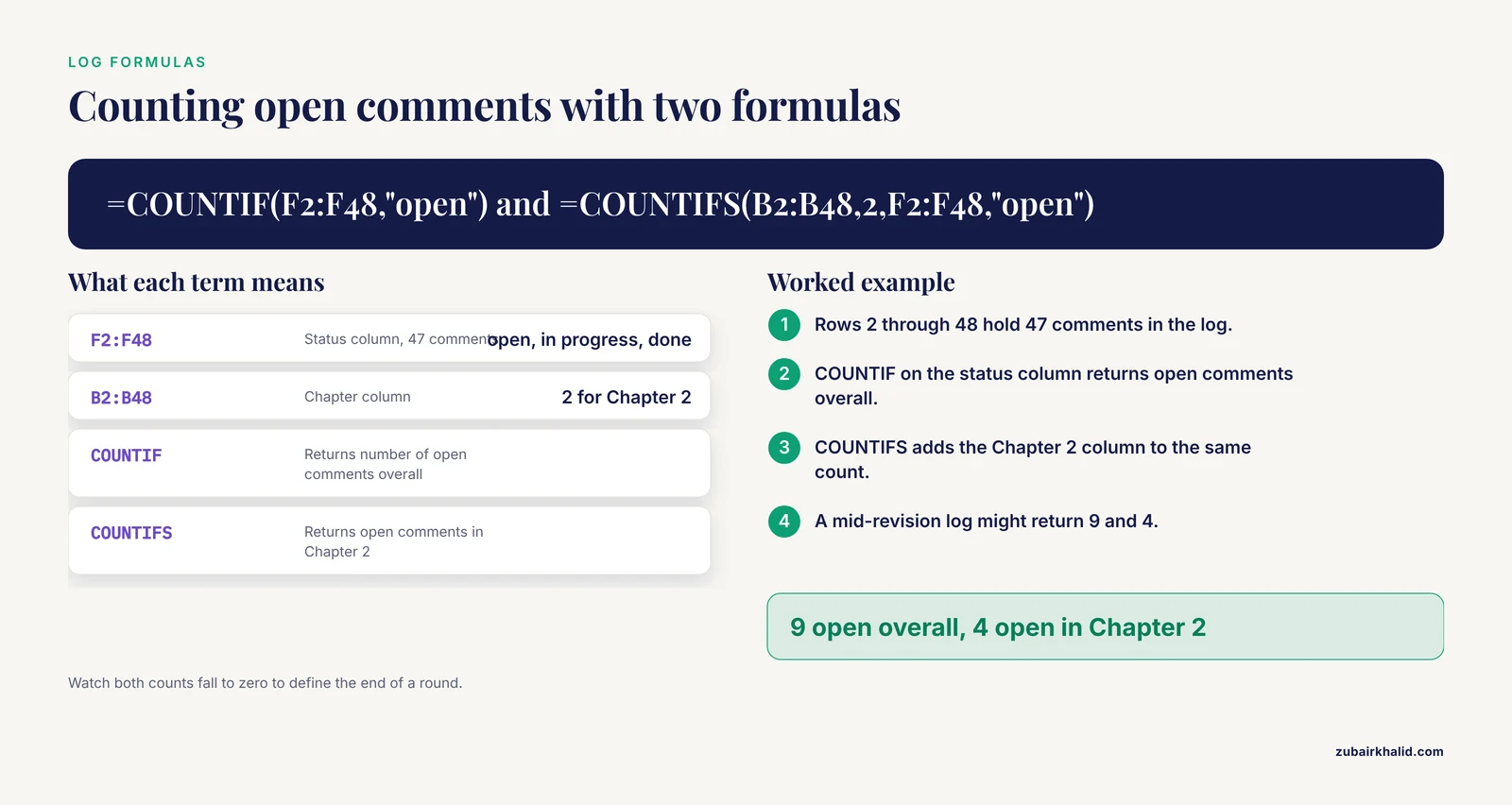
Two simple formulas tell you where you stand at any moment. In Google Sheets or Excel, with 47 comments in rows 2 through 48:
=COUNTIF(F2:F48,"open")
=COUNTIFS(B2:B48,2,F2:F48,"open")
The first formula returns the number of open comments overall. The second returns the number of open comments in Chapter 2. Expected output for a mid-revision log might be 9 and 4. Watching these counts fall to zero is a concrete, measurable definition of "finished with this round," which is far better than a vague feeling that you have probably addressed everything.
Step 5 (optional): Automate the summary with Python
If you prefer working in Python, save your log as a CSV file named committee_feedback.csv and run this script:
import csv
from collections import Counter

with open("committee_feedback.csv", newline="") as f:
    rows = list(csv.DictReader(f))

open_items = [r for r in rows if r["status"] == "open"]
by_chapter = Counter(r["chapter"] for r in rows)
by_type = Counter(r["type"] for r in rows)

print(f"Total comments: {len(rows)}")
print(f"Open: {len(open_items)}")
print(f"By chapter: {dict(sorted(by_chapter.items()))}")
print(f"By type: {dict(by_type)}")

print("--- Open items, by due date ---")
for r in sorted(open_items, key=lambda r: r["due"]):
    print(f'{r["id"]} | Ch {r["chapter"]} p.{r["page"]} | {r["type"]} | due {r["due"]}')
    print(f'   {r["comment"][:70]}')
Expected output looks like this:
Total comments: 47
Open: 12
By chapter: {'1': 9, '2': 18, '3': 14, '4': 6}
By type: {'substantive': 15, 'methodological': 9, 'editorial': 20, 'logistical': 3}
--- Open items, by due date ---
7 | Ch 2 p.34 | substantive | due 2026-11-18
   Clarify why the 2008 dataset was excluded from the primary analysis
3 | Ch 1 p.9  | substantive | due 2026-11-19
   State the contribution of the study more explicitly in the introduction
This printed list becomes your daily work queue. When the script reports Open: 0, the round is complete.
Step 6: Decide what to do with each comment
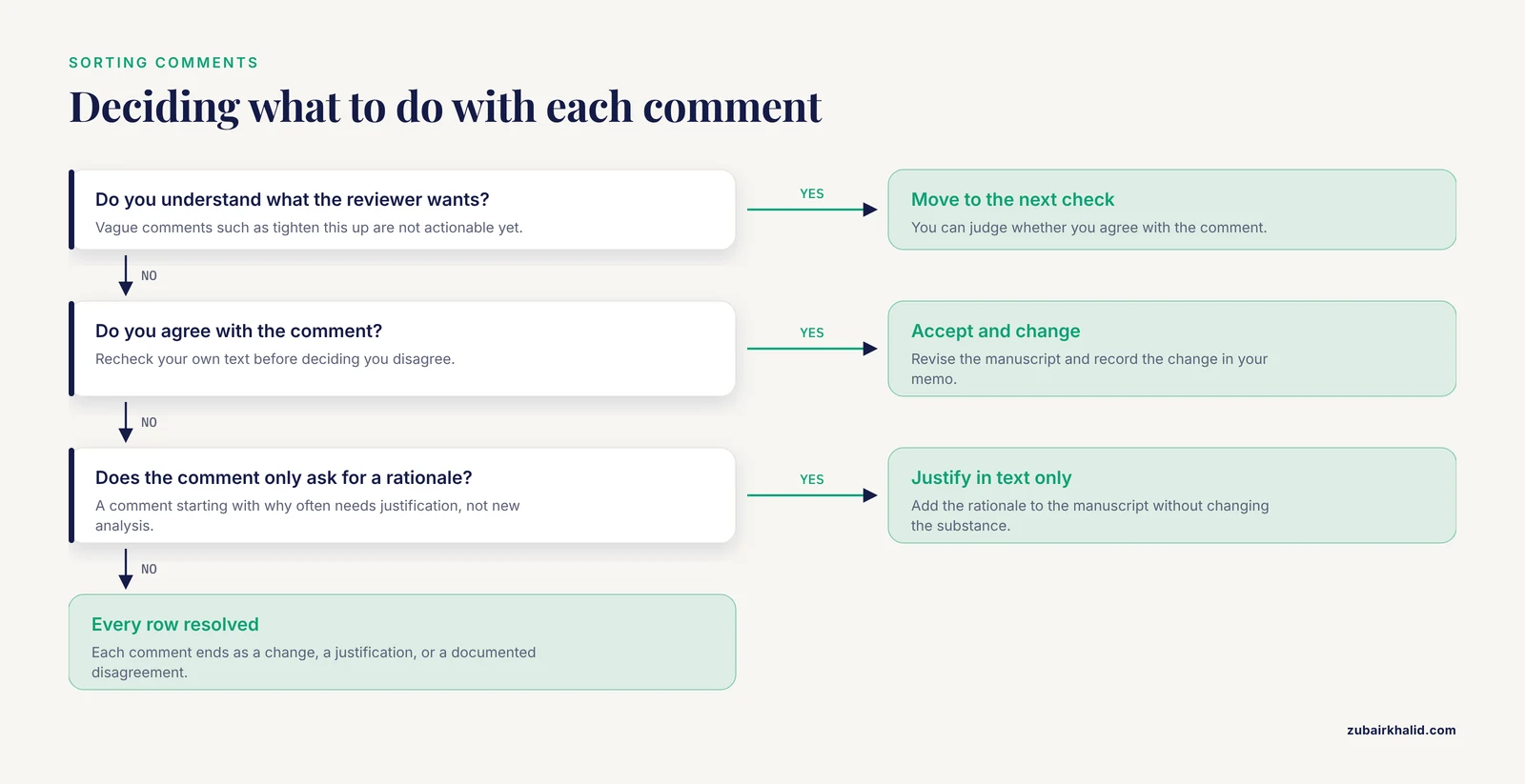
For every row, choose one of four actions:
- Accept and change. You agree, and you will revise the manuscript.
- Accept and justify in text only. The comment asks for a rationale you can add without changing substance.
- Push back with rationale. You disagree, and you will explain why, respectfully and with evidence, in your response memo.
- Clarify first. You do not yet understand what the reviewer wants, so you schedule a conversation before acting.
Pushing back is legitimate and expected at the doctoral level. Committees respect a well-reasoned disagreement far more than silent compliance with advice that weakens the work. What committees do not forgive is silence, where a comment simply vanishes with no change and no explanation.
Incorporating Committee Feedback Dissertation Step by Step
With your log built, the actual revision cycle follows a fixed routine. This is the step-by-step core of the process.
Step 1: Write the response memo before revising
Open a new document and, for every comment, write a block in this format:
Comment 14 (Dr. Ramirez, Ch. 2, p. 34):
"Clarify why the 2008 dataset was excluded from the primary analysis."

Response:
We agree this needs justification. Page 34 now includes a paragraph
explaining that the 2008 dataset used a different depression measure
(the PHQ-9 rather than the CES-D), making raw score comparison invalid.
The exclusion is also flagged in Table 2.1 with a footnote.

Change made: Ch. 2, p. 34, new paragraph 3, and Table 2.1 footnote b.
Status: Done.
Write all the memos before you edit the manuscript. This forces you to think through every response in advance, surfaces conflicts between comments while they are still cheap to resolve, and gives you a document you can send to your committee alongside the revised chapters.
Three formatting rules make memos effective:
- Quote each comment verbatim so reviewers can match responses to their own words without hunting.
- State exactly what changed and where, down to the page and paragraph. Vague responses such as "we strengthened this section throughout" read as evasion.
- Keep the tone neutral and specific. You are documenting decisions, not defending your dignity.
Step 2: Revise with tracked changes
Turn on track changes before you touch a sentence. In Microsoft Word, select Review, then Track Changes. In Google Docs, switch to suggesting mode with the pencil icon in the upper right. Revised text should be visible as changes, not silently merged.
Two exceptions apply. First, if a comment requires deleting and rewriting an entire section, make the deletion and describe it in the memo rather than leaving a wall of strikethrough text. Second, purely mechanical formatting fixes can be accepted in bulk once you have verified they are correct.
Save a new dated version of the manuscript before you begin: a filename pattern such as dissertation_2026-11-11_pre-feedback-round-2.docx prevents the classic disaster of revising over the only copy your committee has seen.
Step 3: Check consistency across the whole document
Any substantive change ripples outward. If you add a variable, rerun an analysis, or reframe an argument in Chapter 3, you must update the abstract, the introduction's statement of contributions, the literature review where that argument appears, the results tables, and the discussion. Experienced committees check exactly these seams. After completing your comment-specific edits, do one full-document pass asking a single question: does everything I changed appear consistently everywhere it should?
A practical check is to search the revised document for the old phrasing or old numbers. In Word, press Ctrl+F and search for terms related to each substantive change. If a deleted variable name still appears in a table footnote on page 112, you have found a seam.
Step 4: Pilot your revision process on one chapter
If this is your first full revision cycle, run the entire system on one chapter before committing to it across the dissertation. Test whether your log columns are useful, whether your memo format feels natural, and whether your effort estimates were realistic. Intervention researchers distinguish sharply between whether a procedure works in principle and whether it is feasible and acceptable for the people who have to carry it out, and they often pilot procedures in a feasibility study before full deployment [1]. Your revision system is an intervention on your own workflow, and it deserves the same treatment. If the log feels burdensome after one chapter, simplify the columns before round two rather than abandoning tracking altogether.
Step 5: Circulate and document
Send your committee the revised manuscript, the response memo, and, where your program expects it, a clean copy alongside the tracked-changes copy. Confirm your program's convention with your advisor, since some committees want to see every keystroke and others want only the clean version plus the memo. Log the date you sent everything and the date each member acknowledged receipt. Follow your program's official rules for circulation timelines, which are set by your graduate school, not by you.
Step 6: Close the loop
When responses arrive, they feed the next cycle. New comments enter the same log with new IDs. Comments that generated a memo response but no manuscript change get their status set to done because they are resolved, even though nothing was edited. Your definition of done is always: every row in the log has a status of done or a documented rationale, and the memo has been sent.
Feedback on Different Stages of the Dissertation
The same system applies throughout, but the center of gravity shifts by stage.
Proposal or prospectus stage. Feedback concentrates on the research questions, the literature framing, and the methods plan. Substantive and methodological comments dominate. Address these fully now, because a flaw in the design left uncorrected at this stage multiplies into months of rework later.
Data chapters. Methodological comments peak here. Expect questions about analytic choices, missing data handling, robustness checks, and whether your tables report what your text claims. Keep your analysis scripts or coding memos organized, because a request to rerun an analysis with one different decision is routine and should take hours, not weeks, if your work is reproducible.
Discussion and conclusion. Substantive comments about overclaiming, alternative interpretations, and the boundaries of your contribution cluster here. A useful discipline: for every claim, ask whether the specific results in your own chapters support it at the strength you state. Reviewers reliably flag the gap.
Pre-defense and final submission. Editorial and logistical comments dominate. At this stage, run the formatting checklist from your graduate school yourself before your committee does, verify every citation resolves to a real reference, and confirm that every figure and table is numbered, titled, and called out in the text.
Interpreting Feedback: Read the Concern, Not Just the Words
Committee members, like all reviewers, write comments that hint at deeper concerns. A marginal note reading "see Bruner (1966)" usually means "this section ignores a relevant theoretical tradition," and the fix is a substantive engagement with that literature, not a citation bolted onto the reference list. A comment reading "this is interesting" attached to a minor aside sometimes signals that the member wishes that aside were the real focus of the chapter.
The underlying skill here has a name in the behavioral sciences: reflective functioning, the capacity to treat observable behavior as an expression of underlying mental states rather than taking it purely at face value. Work on parental reflective functioning defines it as the ability to understand another person's behavior as an expression of internal emotional states and to respond in a way that helps regulate the situation [1]. Applied to a committee, the observable behavior is the written comment, and the internal state is the concern behind it. Reading only the surface words leads to literal, minimal fixes that leave the reviewer's actual worry unaddressed, which is why some students report fixing "everything" and still getting the same comment back twice.
Two habits build this skill. First, for each comment, write one sentence in your log completing the phrase "the reviewer is worried that..." before you write your response. Second, when a comment is ambiguous, ask the reviewer directly what concern prompted it, either by email or in a scheduled meeting. Most faculty answer such questions gladly and briefly.
Handling Conflicting and Vague Feedback
Three situations recur in every dissertation.
Two committee members disagree. When one member wants a mixed-methods design expanded and another wants the project tightened, you cannot satisfy both with edits. Bring the conflict to your committee chair or advisor and ask for a decision. Frame it neutrally: "Dr. Lee suggested X and Dr. Patel suggested Y. They point in different directions for Chapter 3. Which should govern?" The chair's job includes adjudicating exactly this. Do not try to secretly implement a compromise that neither member asked for, because both will notice.
The comment is vague. "Tighten this up" or "this needs more" is not actionable. Reply with a specific proposed action and ask for confirmation: "My plan is to cut the historical background in Section 4.2 from six pages to two and move the detail to an appendix. Does that match what you had in mind?" This converts a vague comment into a confirmable plan, and it creates a written record.
The comment seems wrong. Sometimes a reviewer misreads a passage, or suggests something that conflicts with your data. First recheck your own text, because misreading on your side of the desk is more common than anyone likes to admit. If the comment still seems mistaken, respond in the memo with evidence: quote the passage, explain the intended meaning, and either revise the passage for clarity or respectfully decline the change with your reasoning. Declining with a clear rationale is a complete, professional response. Declining silently is not.
Dissertation Planning: Making Feedback Rounds Fit Your Timeline
Feedback rounds are the invisible variable in most dissertation timelines. Students estimate writing time accurately and revision time poorly, then discover in their final year that two more rounds of committee review will not fit before graduation. Build rounds into your plan deliberately.
A practical planning method:
- Count the rounds, not the tasks. Most programs require at least two to three full review cycles after the proposal: one or more per-chapter or full-draft rounds and a final pre-defense round. Ask your advisor early how many rounds are typical in your program.
- Estimate turnaround on both sides. For each round, estimate two intervals: your time to revise (often two to six weeks depending on comment volume) and the committee's time to respond (commonly several weeks per member, since faculty juggle many obligations). Ask your program what its expected review turnaround is and use that, not optimism.
- Put the round dates on the calendar backward from your defense date. If you intend to defend in April and each round takes two months end to end, your final full draft must be in committee hands by roughly December, and earlier rounds must close well before that. Work backward and write the dates down.
- Protect revision blocks on your calendar. Schedule specific sessions for specific comment groups, such as "Tuesday and Thursday mornings, Chapter 2 substantive comments," the same way you would schedule data collection.
- Build a buffer. Add one unplanned round's worth of time to your plan. A committee member going on leave, a methods question requiring new analyses, or an IRB amendment can each consume weeks.
This is the core of how to finish dissertation work on schedule. Completion is not primarily a function of writing speed. It is a function of estimating review cycles honestly, keeping a single accurate log of what remains, and refusing to let untracked comments pile up in email threads. Candidates who track their open comment count and drive it to zero, round after round, are the candidates who walk across the stage on time.
A note on scope: committee conventions differ by institution and by discipline. Your graduate school handbook, your program's graduate director, and your committee chair define the rules that govern you, and this guide cannot substitute for them. Verify circulation timelines, formatting requirements, and committee composition rules against the official documents for your own program.
Common Mistakes and Limitations
These are the errors that most often derail a feedback round. Each one is avoidable with the system above.
- Editing before triaging. Opening the manuscript and fixing whatever you read first means the hardest comments get addressed last and rushed, or never. Triage first, always.
- Responding in prose only. Writing a long narrative email about "all the changes" instead of a point-by-point memo guarantees that some comments go unaddressed and that reviewers must hunt to find your responses. Numbered, quoted, page-referenced memos prevent this.
- Silently dropping comments. Every comment needs a visible outcome: a change, a justification added, or a documented disagreement. A comment with no visible outcome reads as disrespect for the reviewer's time and invites a harsher round next cycle.
- Treating all editorial comments as trivial. Formatting, citation consistency, and figure quality are exactly what final reviewers check most carefully, and fixing them in one exhausted pass the week before submission produces errors. Batch them early in dedicated sessions.
- Revising over the submitted version. Never edit the only copy your committee has seen. Date and duplicate every version before revising.
- Ignoring the emotional reaction. Making accept-or-decline decisions on comments the same day they arrive leads to defensiveness. Wait, then decide.
- Not updating downstream sections. A change in the methods chapter that never reaches the abstract, tables, and discussion is one of the most common reasons a committee returns a draft unchanged-but-unapproved. Search the whole document for every substantive change.
- Fighting the process instead of using it. Some students experience every comment as an indictment. Committee feedback at the proposal and chapter stages is the mechanism by which a draft becomes a defensible dissertation, not a verdict on your ability. The candidates who treat comments as free expert consultation finish faster and defend more calmly.
Two limitations of any general guide apply here. First, committee norms vary widely, and the expectations of your specific chair override any generic advice, including the advice above. Second, a small number of feedback situations, such as a committee that has stopped responding or a chair who has left the institution, are structural problems rather than workflow problems. Those call for your program's graduate director or your university's ombuds office, not for a better spreadsheet.
Frequently Asked Questions
How long should a full round of committee feedback take to incorporate?
It depends on comment volume and type, but a realistic planning unit is two to six weeks of your work per round for a typical chapter draft, plus committee review time. Count editorial comments in batches and substantive comments individually, and let your log's open-item count, not your mood, tell you when the round is done.
What should I do when two committee members give conflicting advice?
Bring the conflict to your committee chair and ask for a decision, quoting both comments neutrally. Do not implement a private compromise and do not quietly follow one member while ignoring the other, because both will notice in the next round.
Do I have to make every change my committee suggests?
No. You must respond to every comment, which can mean accepting it, adding a justification to the text, or declining with a clear written rationale. Silent omission is the only unacceptable response.
How do I respond to feedback I disagree with?
Quote the comment in your memo, state your reasoning concisely, and cite the evidence, such as your own data or the methodological literature, that supports your position. If the disagreement is fundamental, ask your chair to help resolve it before the next round.
How detailed should my response memo be?
Detailed enough that a reviewer can match every one of their comments to a specific response and a specific location, down to page and paragraph, without searching the manuscript. Quote each comment and state exactly what changed.
Should I meet with my committee or respond in writing?
Do both in the right order: written memo first, meeting second. The memo creates a record and forces you to think, and the meeting then focuses on the few comments that genuinely need discussion. Use meetings to clarify vague or conflicting feedback, not to replace documentation.
How does feedback fit into overall dissertation planning?
Treat each round as a scheduled project phase with a start date, an end date, and committee turnaround time built in, then work backward from your intended defense date. Add a buffer for at least one unplanned round, because revision cycles are the most commonly underestimated part of the timeline.
How do I know when the dissertation is ready to defend?
It is ready when every comment in your log has a documented resolution, the full document is internally consistent across chapters, your graduate school's formatting checklist is complete, and your chair confirms the draft is defensible. Your chair's explicit go-ahead, not your own anxiety level, is the signal.