How to Identify Funding Priorities in a Grant Announcement
By Dr. Zubair Khalid, DVM, MS, PhD ·

Every funding announcement tells you what the funder actually wants to buy with its money. The problem is that the answer is spread across a dozen sections, written in bureaucratic prose, and mixed in with rules that matter but do not express priority. By the end of this article you will be able to take any grant announcement, whether it is a federal Funding Opportunity Announcement (NOFO), a foundation program guideline, or an internal institutional call, and extract its real priorities in a structured way. You will also be able to score your own project against those priorities and decide, before you write a single page, whether the opportunity is worth your time.
To follow the walkthrough you need three things on hand:
- One complete grant announcement, downloaded as a PDF or open in a browser. Use the full document, not the summary page on a search portal.
- A way to annotate. A PDF highlighter, a printed copy with a pen, or a plain text file all work.
- A spreadsheet or text file where you will build the priority worksheet shown in the walkthrough.
A funder's own applicant guide or Frequently Asked Questions document, if one exists, is also useful. Many funders publish these alongside the announcement.
What a Funding Priority Actually Is
A funding priority is a statement about what the funder wants to accomplish with a specific pool of money in a specific cycle. Priorities answer questions like these:
- What problem area does the funder care about right now?
- Which populations, regions, disease areas, or scientific questions must the work address?
- What methods or approaches does the funder prefer, require, or exclude?
- What kind of team, institution, or career stage does the funder want to support?
- What deliverables or outcomes will the funder count as success?
Priorities are different from three other things in the same document. Eligibility rules tell you who may apply. Administrative rules tell you how and when to submit. Review criteria tell you how a submitted application will be scored. Priorities sit upstream of all three. They describe the fit between your project and the funder's goals. A proposal can pass every eligibility check and still lose because it does not address the priorities, and a proposal that nails the priorities can overcome a mediocre score in some programs because the program officer wants it funded.
Most announcements state priorities in three places: a purpose or background section near the front, an explicit section often titled Program Description, Priorities, or Scope, and the review criteria near the end. A few state them only implicitly, which is why you need a systematic method rather than a quick skim.
Where Priorities Hide Inside an Announcement
Different funders organize documents differently, but the underlying signal types are consistent. The table below maps each signal to the section where it usually appears and to the weight you should give it.
| Signal type | Where it usually appears | How much weight to give it |
|---|---|---|
| Purpose and background statements | Opening pages, Section I | High. This is the funder's own framing of the problem |
| Explicit priority language | Section titled Priorities, Program Description, or Scope | Highest. Quote it verbatim in your worksheet |
| Review criteria and subcriteria | Merit review or evaluation section | High. These are the priorities expressed as scoring questions |
| Required elements | Application contents checklist | High. Anything mandatory reveals what the funder considers non-negotiable |
| Allowed and unallowed costs | Budget and allowability sections | Medium. Shows what activities the funder will actually pay for |
| Set-asides and special emphasis notes | Eligibility, award information, or program description | Medium to high. Often marks a real internal commitment |
| Award size and project period | Award information section | Medium. Caps and floors imply scope expectations |
| FAQ documents and webinars | Funder website, supplemental files | Medium. Clarifications here often reveal unstated priorities |
| Funded project abstracts from prior cycles | Funder website, annual reports | Medium. The most direct evidence of what gets funded |
Read the announcement with this table in mind. Every time you encounter one of these signals, stop and extract the specific commitment it represents.
Identify Funding Priorities in Grant Announcements Step by Step
This walkthrough takes 60 to 90 minutes for a first pass on a major federal announcement, and less for a short foundation guideline. Work through the steps in order. Each step produces material you will use in the next one.
Step 1. Assemble the full application package
Download the announcement itself plus every linked document: the applicant guide, budget instructions, forms package, and any FAQ file. Bookmark the funder's program page. Announcements are sometimes corrected or reissued, so note the version date and the opportunity number printed on the document. If the funder hosts an applicant webinar, register for it or find the recording, because program staff often use webinars to say plainly what they are looking for.
Step 2. Read the purpose section and mark the verbs
Read the opening purpose, background, and authorization sections before anything else. Highlight every verb and verb phrase that describes what the funder wants to fund. Typical verbs include advance, address, develop, evaluate, establish, improve, prevent, reduce, and train. Also highlight the nouns attached to those verbs, because the noun phrases are the funder's own vocabulary for the problem.
Here is an illustrative example paragraph, written for this exercise, in the style of a hypothetical health research announcement:
EXAMPLE (hypothetical announcement, not a real solicitation)

"This program supports research to develop and evaluate
community-based interventions that reduce delays in cancer
screening among rural populations. Applications must propose
projects that partner with local health systems and that
include a plan for sustaining interventions beyond the award
period."
The verbs are develop, evaluate, reduce, propose, partner, and include a plan. The noun phrases are community-based interventions, delays in cancer screening, rural populations, local health systems, and sustaining interventions. Each of those phrases is a priority signal.
Step 3. Build the priority worksheet and extract priority statements verbatim
Open your text file or spreadsheet and create a worksheet with one row per priority signal. Copy priority language word for word. Paraphrasing at this stage loses information, because exact phrases often reappear in the review criteria, and reusing the funder's exact language in your application is one of the highest-value grant proposal planning habits.
A worksheet for the hypothetical example above might look like this:
PRIORITY WORKSHEET
Announcement: Example Cancer Screening Disparities Program (illustrative)
Version date: found on document cover
Deadline: from announcement cover page

Priority 1
  Verbatim text: "community-based interventions"
  Where found: Purpose section, paragraph 1
  Type: preferred approach
  My project addresses this: yes / partially / no

Priority 2
  Verbatim text: "reduce delays in cancer screening"
  Where found: Purpose section, paragraph 1
  Type: target outcome
  My project addresses this: yes / partially / no

Priority 3
  Verbatim text: "rural populations"
  Where found: Purpose section, paragraph 1
  Type: required population focus
  My project addresses this: yes / partially / no

Priority 4
  Verbatim text: "must propose projects that partner with
  local health systems"
  Where found: Purpose section, paragraph 1
  Type: hard requirement (uses "must")
  My project addresses this: yes / partially / no

Priority 5
  Verbatim text: "plan for sustaining interventions beyond
  the award period"
  Where found: Purpose section, paragraph 1
  Type: required plan element
  My project addresses this: yes / partially / no
Continue through the whole document in later steps and add rows as you find more signals. Number the priorities so you can refer to them later.
Step 4. Mine the review criteria
Turn to the merit review or evaluation section. Review criteria are the priorities converted into scoring questions. For each criterion, write it into your worksheet and, underneath it, note the specific evidence the funder asks reviewers to look for. Many federal announcements list subquestions under each criterion. Those subquestions are the single most useful text in the document for a grant writer, because they tell you exactly what reviewers will be instructed to check.
Do this conversion yourself. For each criterion, write a one-line question such as, "What must my application contain so a reviewer can answer this criterion with the highest rating?" That question list becomes the outline for your eventual proposal.
Step 5. Mine the budget, allowable activities, and award information
Three quiet sections carry heavy priority information.
The allowable costs and unallowable costs lists tell you what the funder will pay for. If equipment is listed as allowable and travel is restricted, the funder cares about equipment-heavy work. If a category of activity is listed as unallowable, proposing it is a wasted paragraph.
The award size and project period tell you the intended scope. If the announcement describes awards up to a modest total over a short period, the funder wants a pilot or a focused study, not a five-aim program. Matching your proposed scope to the intended award size is a priority in itself, and mismatched scope is a common reason otherwise strong applications fail.
The allowable activity descriptions, sometimes written as examples ("examples of responsive projects include..."), are direct invitations. Treat every listed example as a stated priority and copy it into your worksheet.
Step 6. Look for set-asides, emphasis notes, and implicit priorities
Scan for phrases such as priority will be given to, special consideration, encouraged, of particular interest, and set-aside. A set-aside means the funder has reserved part of the available money for a specific type of application, which makes that type materially easier to fund. Also read the eligibility section closely even if your eligibility is obvious, because eligible applicant categories often reveal who the funder expects to do the work.
Then check the funder's context outside the document. Look at the abstracts of projects the funder funded in recent cycles, which most public funders publish. A pattern in those abstracts, such as every funded project involving a community partner, tells you what the funder rewards in practice, not just in print.
Step 7. Score your project's fit
Now test your own project against the worksheet. Use a two-layer score that separates hard requirements from soft preferences. Define a simple system like this:
- Hard requirement: the announcement uses must, required, or shall. Score 1 if your project fully satisfies it, 0 if not.
- Soft priority: the announcement uses should, encouraged, priority will be given to, or of particular interest. Score 2 for fully addressed, 1 for partially addressed, 0 for not addressed.
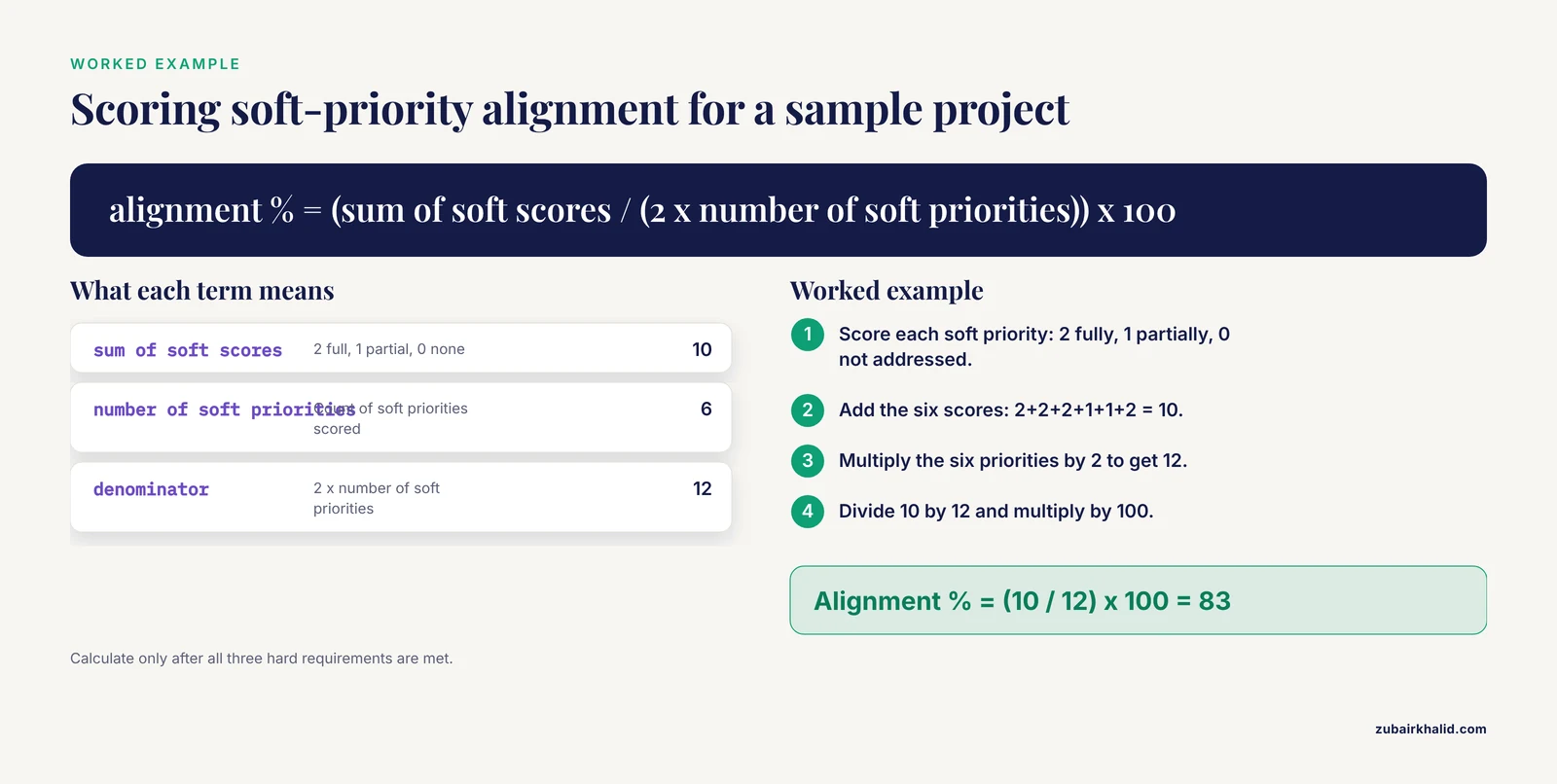
The formula for a soft-priority alignment percentage, which you calculate only after every hard requirement is satisfied, is:
alignment % = (sum of soft priority scores / (2 x number of
soft priorities)) x 100
Here is a worked example for a project with three hard requirements and six soft priorities:
HARD REQUIREMENTS
  R1 Nonprofit applicant organization ....... 1 (met)
  R2 Must serve a defined rural area ........ 1 (met)
  R3 Preliminary data required .............. 1 (met)
  Hard check: 3 of 3 met -> proceed

SOFT PRIORITIES (2 = fully, 1 = partial, 0 = no)
  P1 Community-based intervention ........... 2
  P2 Reduce screening delays ................ 2
  P3 Rural population focus ................. 2
  P4 Local health system partnership ........ 1 (planned, not yet signed)
  P5 Sustainability plan .................... 1 (draft outline only)
  P6 Dissemination to practice community .... 2

Sum = 10
Denominator = 2 x 6 = 12
Alignment % = (10 / 12) x 100 = 83
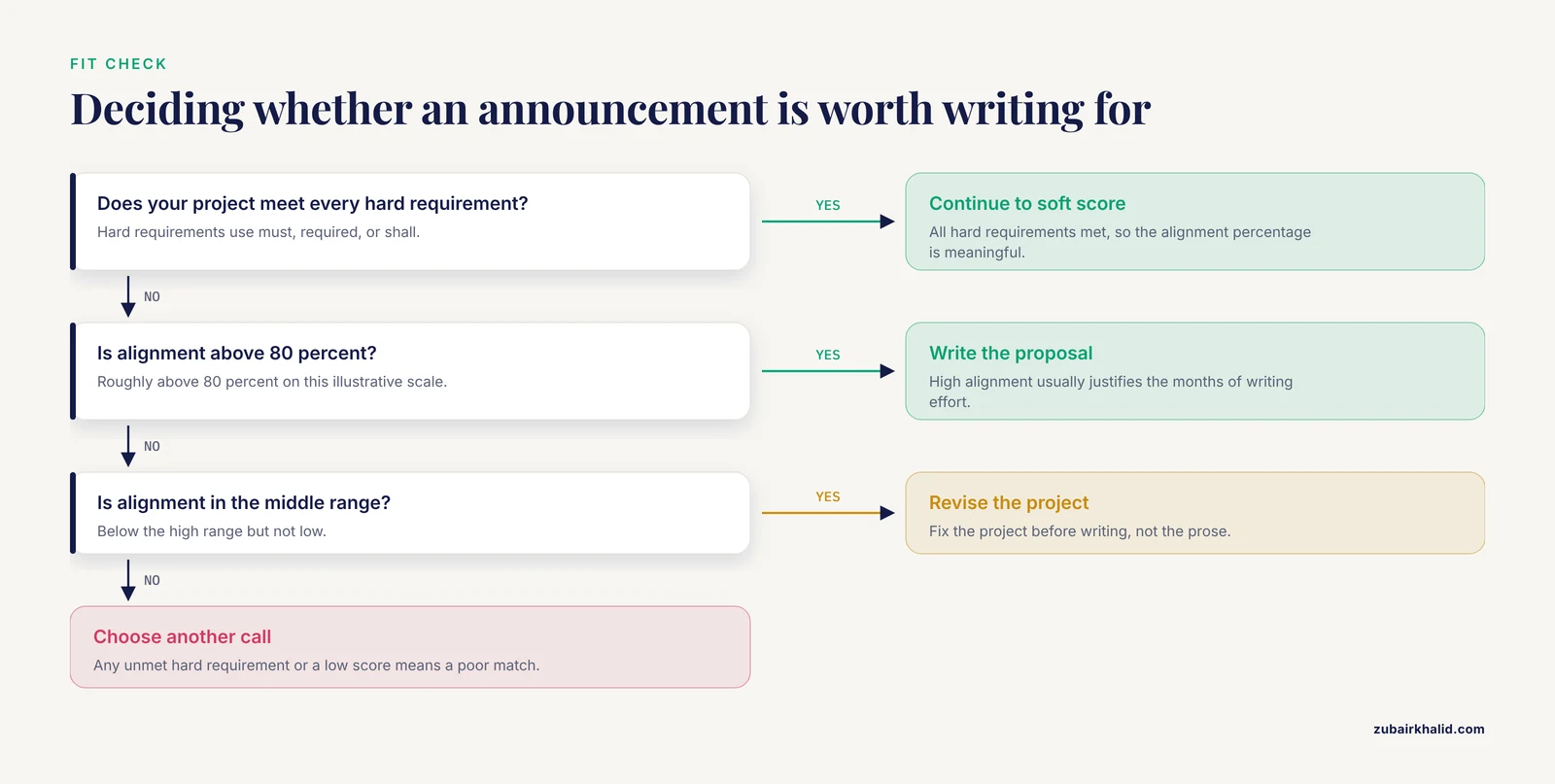
An alignment percentage in the high range, roughly above 80 percent by this illustrative scale, usually justifies writing. A score in the middle range means you should revise the project, not the writing, before you commit months of effort. A score in the low range, or any unmet hard requirement, means the opportunity is a poor match regardless of how well you write. These thresholds are a personal decision rule for planning, not an official standard. Any consistent scale you apply honestly will serve the same purpose.
Step 8. Write the one-page alignment summary
Convert your worksheet into a single page that you will keep in front of you while writing. For each numbered priority, write one sentence describing where in your proposal the priority is addressed and which specific aim, section, or budget line covers it. The expected output looks like this:
ALIGNMENT SUMMARY (expected output of Step 8)

P1 Community-based intervention -> addressed in Specific
   Aims 1 and 2, intervention described in Research Design B.1
P2 Reduce screening delays -> primary outcome, Section C.3,
   measure named and time points specified
P3 Rural population focus -> recruitment plan, Section D.2,
   two partner clinics named
P4 Health system partnership -> letters of support attached,
   budget line for partner compensation in Category B
P5 Sustainability plan -> dedicated subsection E.4 and
   budgeted sustainability planning meeting in Year 2
P6 Dissemination -> plan in Section F, conference and
   community report budgeted

Gaps to fix before submission: none (all priorities addressed)
If you cannot write one of these sentences, you have found a real gap. Either add the missing element to the project or, if you cannot, decide honestly whether to apply.
How to Read the Strength of Priority Language
Not every sentence in an announcement carries the same force. Grant announcements use a loose but recognizable hierarchy of obligation, and learning to grade the language is one of the most practical of all tips for identifying funding priorities.
Strongest are imperative forms: must, shall, required, will not be accepted. These are rules. Violating one usually ends the application at administrative review, before anyone scores the science.
Next are committed preferences: priority will be given to, of particular interest, special emphasis on, set-aside for. These are not rules, but the funder has told you where the money leans. In a competitive cycle, an application in the favored category competes against a smaller, friendlier pool.
Then come invitations: encouraged, welcomes, may include, examples include. These signals are real but optional. Addressing them improves fit but failing to address them is rarely fatal by itself.
Weakest is background prose. Historical and contextual paragraphs explain why the program exists, and they help you frame your significance section, but they are not commitments.
When two statements conflict, the more specific and more recent one usually wins, and a plain statement in the review criteria or allowable-activities list outranks an aspirational sentence in the background. When the conflict is genuinely confusing, that is a question for the program officer, which leads to the next section.
Using Identified Priorities in Grant Proposal Planning
Once your worksheet and alignment summary exist, priorities should shape every major element of the proposal. Grant proposal planning works best when the priority list, not the draft you already have, drives the structure.
Start with the title and abstract. Reviewers, and in many programs the first-line staff who triage applications, form their responsiveness judgment from the title and abstract before they read anything else. Use the funder's own vocabulary from your verbatim extracts in both. If the announcement says community-based interventions and your draft says community-engaged programs, adopt the announcement's phrase.
Next, map priorities to specific aims. For the strongest priorities, there should be a named aim whose success would directly satisfy that priority. For weaker priorities, a subsection or a measured outcome is usually enough. If a hard requirement cannot be mapped to any aim, restructure the project.
Then align the budget. Every priority that requires an activity should have a visible budget line covering that activity. A sustainability plan with no budgeted sustainability work reads as an empty promise to a reviewer who has the announcement open.
Finally, align the team and letters. If the priorities imply partnership, career-stage diversity, or community involvement, the biographical sketches and letters of support should make those characteristics impossible to miss.
This mapping also tells you when to stop. If you find yourself contorting a legitimate research project to resemble a priority you cannot genuinely address, the honest conclusion is that this is the wrong announcement. The same effort spent on a well-matched call has a far higher expected return.
Common Mistakes and Limitations
The most frequent errors in this task are predictable, and each has a direct fix.
Reading only the summary webpage. Portal summaries truncate the announcement and routinely omit the priority language and review criteria. Always work from the full document.
Treating review criteria as separate from priorities. Criteria are priorities written as scoring questions. Applicants who extract the purpose statements but ignore the criteria write proposals that reviewers cannot map onto the scoring sheet.
Copying an old proposal onto a new announcement. Funders revise priorities between cycles, sometimes in small-sounding ways, such as a changed population focus or a new required data-sharing plan. Re-read the current document from scratch even for a program you have applied to before.
Ignoring award size and scope signals. Proposing a large multi-aim project into a small-award mechanism reads as a failure to understand the program, and reviewers notice.
Stretching the project to fit. Claiming relevance the project cannot deliver produces a proposal that weakens at exactly the points reviewers probe hardest. Partial honesty about fit costs less than confident overreach.
Writing to the priorities but not to the required elements. A beautifully aligned proposal missing a mandatory attachment can be rejected without review. Run the application contents checklist as its own pass.
Relying on someone else's summary of the announcement. Colleagues and listserv digests are useful alerts, but paraphrases drop qualifiers such as must and only. Verify every claim in the primary document.
One limitation belongs in its own sentence. Announcements are legal documents that can be corrected or withdrawn, and informal advice, including anything in this article, never overrides the text of the current official announcement and any updates the funder posts. Verify against the funder's official version before you commit.
Working With the Program Officer
Program officers are the funders' own interpreters of the announcement, and most funders expect and encourage prospective applicants to contact them. Contact them after you have completed your worksheet, because an informed question gets an informed answer.
Ask questions that only the funder can answer. Good examples include whether your project concept falls within the program's scope, whether a specific design feature is acceptable, how the funder weighs a particular priority, and whether an announced set-aside still applies in the current cycle. Send a short written summary of your idea with the question. Program staff generally cannot review your draft proposal or promise an outcome, so frame questions around scope and fit rather than around your chances of success. Write down the answer, because verbal guidance is most useful when it is recorded and dated.
Going Further With Training
The method in this article is a skill, and skills improve with structured practice. A research grant writing course is worth considering if you are preparing a first federal application, switching fields, or mentoring a group of trainees, because a course adds critique of actual drafts, practice decoding announcements under time pressure, and feedback from people who have served on review panels. Your institution's office of research or sponsored programs may also run internal workshops, and many professional societies offer grant-writing sessions at their annual meetings. Whether you learn through a course, a writing group, or repeated practice on real announcements, the core discipline stays the same: extract the funder's stated commitments, score your fit honestly, and write to the priorities you found rather than the project you happen to have.
Frequently Asked Questions
What is a funding priority in a grant announcement?
A funding priority is a statement of what the funder wants to accomplish with a specific pool of money, such as a target problem, population, method, or outcome. Priorities guide both which applications are considered responsive and how they are scored.
Where in the announcement do I find the priorities?
Priorities usually appear in three places: the purpose or background section, an explicit section titled Priorities or Program Description, and the review criteria. If no section is labeled with the word priorities, the purpose section and review criteria together carry the same information.
What is the difference between funding priorities and review criteria?
Priorities describe what the funder wants to support, while review criteria describe how reviewers will score what you submit. They overlap heavily, because criteria are usually priorities converted into scoring questions, so extract both into the same worksheet.
How do I know whether my project actually fits an announcement?
List every hard requirement from the announcement and check that your project meets all of them, then score each soft priority as fully, partially, or not addressed. If any hard requirement fails or your soft-priority score is low, revise the project or choose a different opportunity before writing.
Should I contact the program officer before applying?
Yes, once you have read the full announcement and prepared specific questions. Program officers can confirm whether your concept is in scope and clarify ambiguous priority language, although they cannot pre-review your proposal or predict funding outcomes.
What does set-aside mean in a grant announcement?
A set-aside is money the funder has reserved for a defined category of applications, such as first-time investigators or a specific topic area. Competing inside a set-aside means competing against a smaller pool of similar applications.
Can I still apply if I cannot address every priority?
Yes, as long as you meet every hard requirement stated with must or required. For soft priorities you cannot address, acknowledge the gap and strengthen the priorities you can address fully, but recognize that heavily unaligned applications rarely win in a competitive cycle.
How early should I start analyzing a grant announcement?
Start as soon as the announcement is published, ideally months before the deadline. The analysis determines whether the project needs restructuring, partnership agreements, or preliminary data, and those take far longer to arrange than the writing itself.