How to Write Observations in a Lab Notebook
By Dr. Zubair Khalid, DVM, MS, PhD ·

By the end of this guide you will be able to write a complete, dated, signable observation entry in a lab notebook, separate what you saw from what you think it means, attach data and images so they can be found again, and avoid the record-keeping mistakes that make notebooks useless in a lab meeting, a manuscript draft, or an audit. You will also be able to compare paper notebooks, electronic lab notebooks, and computational notebooks so you can pick the right format for your work.
You do not need special software to follow this guide. Have on hand a bound notebook with numbered pages (or your institution's approved electronic notebook), a permanent pen if you use paper, and a copy of your course or laboratory standard operating procedure, usually called an SOP, which is the written document that defines how your lab expects records to be kept.
What Counts as an Observation, and Why the Notebook Is the Record
An observation is a description of something you directly perceived or measured during the experiment: a color change, a temperature reading, a smell, a mass, an absorbance value, a behavior. An interpretation is your explanation of what the observation means. A good entry contains both, clearly separated, because six months later the interpretation is only as credible as the observation behind it.
The notebook is not a diary. It is the permanent record of what happened, in what order, and with what materials. In structured teaching exercises, students learn to write entries that include a title, date, author, purpose, methods, results, and conclusions, and they learn why each part exists through guided discussion rather than by memorizing a form [1]. Those same elements are what a research lab expects, which is why it pays to learn them early.
Writing in the notebook is also how you learn. Writing faculty who collaborate with science departments make a point that applies here: writing is a means of learning in science, not just a way of reporting results afterward [2]. When you force yourself to describe a result in a sentence, you often notice the flaw in the experiment while you can still fix it.
There is a second reason to write carefully. Human observation is biased in predictable ways. In behavioral research, manual coding of observations is known to be costly and prone to bias from the limits of the coding scheme and the subjectivity of the human rater, which is why modern pipelines push toward predefined, reproducible measurement schemes [3]. You get the same benefit at notebook scale. If you define your terms before you observe, and you record in a fixed structure, your notes become reproducible instead of impressionistic.
The Anatomy of a Notebook Entry
A complete entry has a fixed skeleton. Once the skeleton is habit, writing an entry takes minutes, not an hour. The parts below follow the structure taught in guided notebook exercises used with large laboratory classes [1].
Title and date. A short, specific name for the experiment and the calendar date you performed it. "Enzyme kinetics trial 3, pH 9.0" beats "Experiment 2".
Author. Your name and, where relevant, the names of collaborators who touched the experiment. If two people share a notebook, the person making the entry signs it.
Purpose. One or two sentences stating the question the experiment answers. If you cannot write the purpose in one sentence, you do not yet know what you are testing, and that is worth discovering before you pipette anything.
Methods. What you actually did, written as it happened, not as the protocol predicted. This is where deviations live: the reagent that was a different lot number, the incubation that ran 40 minutes instead of 30 because the centrifuge was busy.
Results and observations. The core of this guide. Raw numbers, direct descriptions, and attached data, all with units and timestamps.
Conclusions. What the results show, stated cautiously, plus the next step. A conclusion that says "the reaction plateaued after 2 minutes, so the next trial will use double substrate" is more useful than one that says "it worked".
Some labs also require a witness signature, meaning a second qualified person who signs that they saw the work performed. Check your SOP to see whether yours does.
How to Write Observations in a Lab Notebook Step by Step
This is the walkthrough. Follow it in order for every experiment, and the structure becomes automatic.
Step 1. Prepare the notebook before the experiment
If you use a bound notebook, number every page if the pages are not prenumbered, reserve the first two or three pages for a table of contents, and update that index as you go. Never tear out a page. If you use an electronic lab notebook, create the entry for the experiment before you start work so it is ready to receive timestamps.
A reusable lab notebook template looks like this. Copy it into the first page of each experiment, or load it as a template in your electronic system:
Date:            YYYY-MM-DD
Project:         <project or course code>
Experiment:      <short title>
Author:          <your name, collaborator names>
Purpose:         <one sentence, the question being tested>

METHOD (as performed)
  1. <step, with reagent, lot, concentration, instrument settings>
  2. ...

OBSERVATIONS (timestamped, units always)
  HH:MM  <what you saw or measured>

DATA ATTACHED
  <chart, photo, instrument file name, page cross-reference>

RESULTS
  <calculated values, with units>

CONCLUSIONS / NEXT STEPS
  <what the data show, what to do next>

Signed: ____________  Date: ______   Witness (if required): ____________
Step 2. Write the purpose before you touch the equipment
Open the notebook and write the purpose first. This one sentence is your checkpoint. If writing it is hard, the experimental logic is fuzzy, and the cheapest moment to fix that is now.
Step 3. Record methods as you actually perform them
Write down what happened, not what was supposed to happen. Use enough detail that a competent colleague could repeat the work without asking you a question. Standard details include reagent identities and concentrations, instrument settings, incubation times and temperatures, and lot numbers where traceability matters. If the protocol said 30 minutes and it ran 40, write 40, and write why.
Step 4. Write observations in real time, and separate seeing from concluding
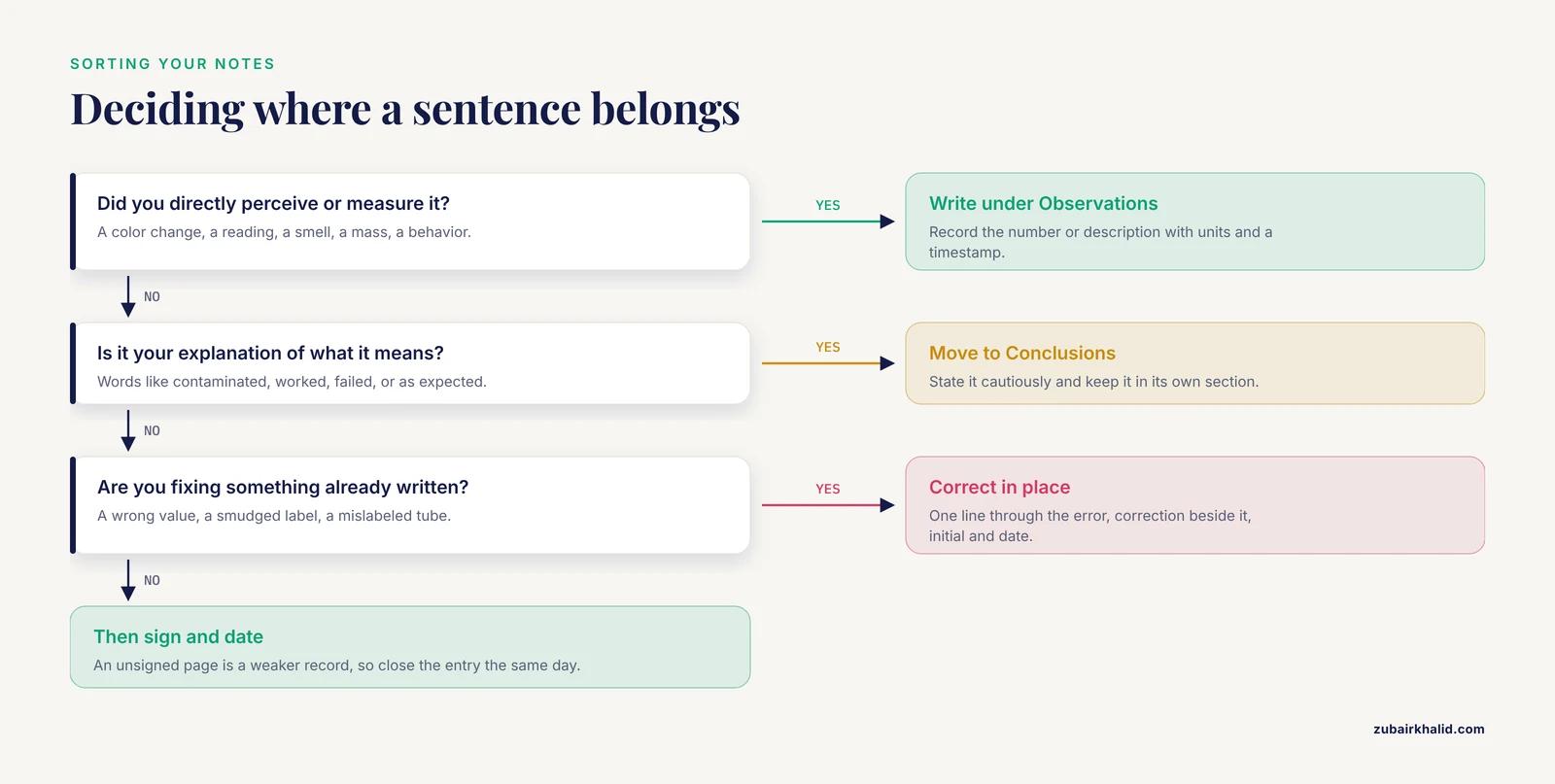
Record at the bench, not from memory at the end of the day. Memory degrades within hours, and reconstruction is where errors creep in. For each observation, ask two questions. What did I perceive? What do I think it means? Write the first under Observations and the second under Conclusions.
Compare these two lines from the same moment:
Weak:    "The reaction worked well."
Strong:  "14:05 - solution changed from clear to pale yellow within 30 s
          of adding 10 uL enzyme. No precipitate visible at 14:10.
          (Interpretation: product accumulating as expected, moved to
          Conclusions section.)"
The weak line is an interpretation dressed as an observation. The strong line records the color change, the timing, the absence of a precipitate, and moves the judgment where it belongs. Behavioral scientists formalize this same discipline by defining categories before observation and coding against them, precisely because undefined terms invite rater subjectivity [3]. Your operational definition can be as simple as "pale yellow means the color of the 10 µM p-nitrophenol standard in the rack".
Step 5. Quantify everything you can, with units
Numbers beat adjectives. "Warm" is not data. "Water bath displayed 37.2 C at 13:58" is data. For anything you can count, measure, or read off an instrument, record the number, the unit, and the instrument or method. For anything you cannot quantify, use a defined scale rather than a vague word: "no growth, trace growth, moderate growth, confluent" beats "some growth".
Step 6. Attach or cross-reference every piece of data
Instrument files, gel photographs, and scanned charts do not live in the notebook. They live beside it. For each one, record in the notebook where it is and how to verify it. A line like this is enough:
DATA ATTACHED
  - Gel photo 2026-11-11_pcr3.jpg, saved to project folder
    /kinetics/2026-11-11/, MD5 checksum recorded on page 47
  - Raw absorbance trace: plate reader export CSV, file
    trial3_405nm.csv, same folder
An MD5 checksum is a short alphanumeric fingerprint computed from a file's contents. If even one byte of the file changes later, the checksum changes, which lets you prove the data were not altered. Most systems generate one with a single command:
md5sum trial3_405nm.csvExpected output looks like:
9f86d081884c7d659a2feaa0c55ad015a3bf4f1b2b0b822cd15d6c15b0f00a08 trial3_405nm.csvCopy that string into the notebook next to the file name. When you or a reviewer later want to confirm the file is unchanged, run the command again and compare.
Step 7. Convert raw numbers into results, and show the arithmetic
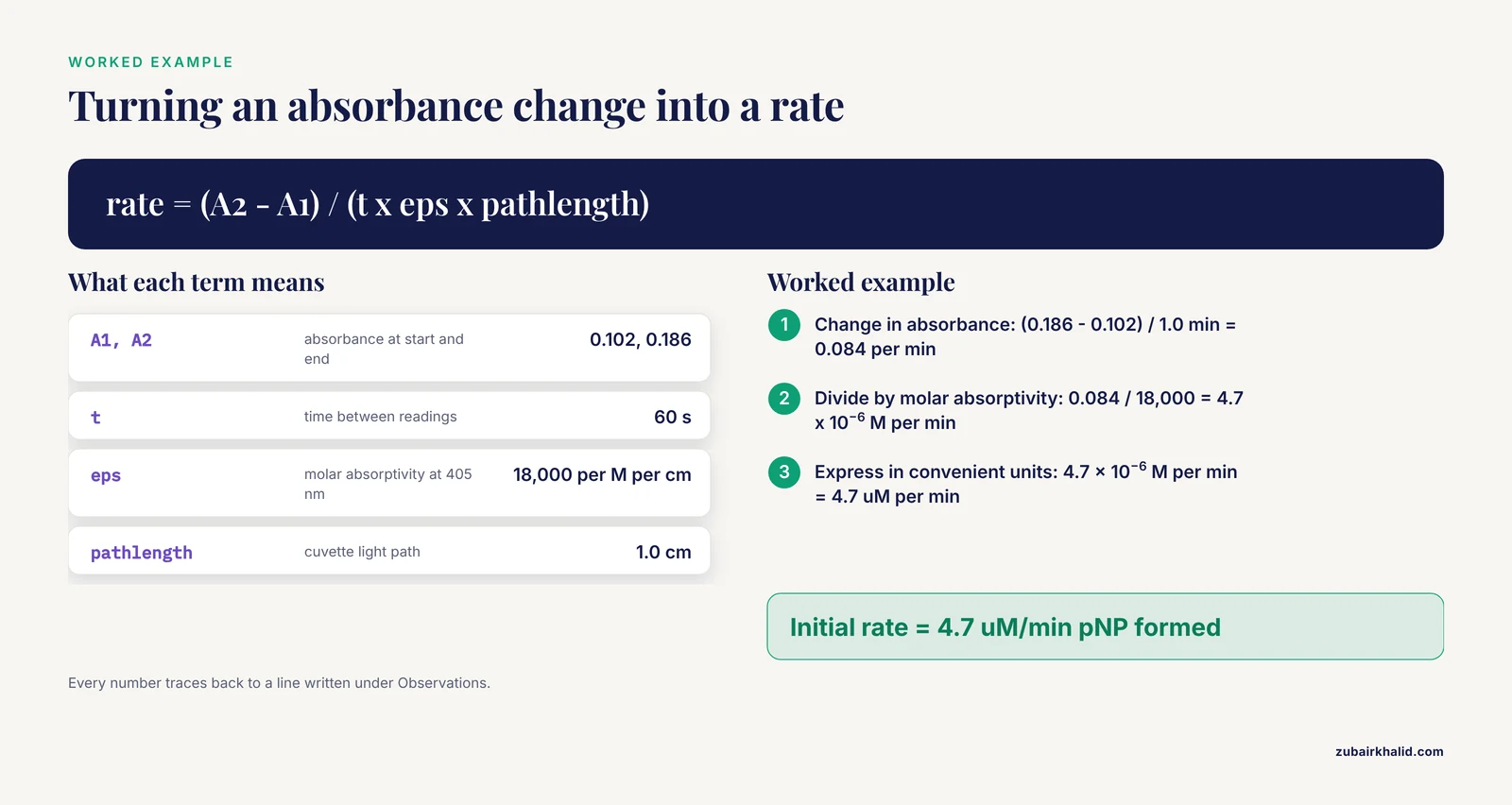
Results are the calculated values derived from your observations. Show the calculation in the notebook so you or anyone else can check it later. Here is a worked example for an enzyme assay using p-nitrophenol, a standard chromogenic substrate whose yellow product is read at 405 nm. Absorbance is the logarithmic measure of light absorbed by a sample, and molar absorptivity, symbolized by the Greek letter epsilon, converts absorbance into concentration through the Beer-Lambert relationship.
Recorded observation: A405 rose from 0.102 to 0.186 over 60 s
                      in a 1.0 cm pathlength cuvette.

Step 1: change in absorbance per minute
        (0.186 - 0.102) / 1.0 min = 0.084 per min

Step 2: convert to a concentration rate with the molar absorptivity
        of p-nitrophenolate at 405 nm, about 18,000 per M per cm
        rate = 0.084 / 18,000 = 4.7 x 10^-6 M per min

Step 3: express in convenient units
        4.7 x 10^-6 M per min = 4.7 uM per min

Expected notebook line:
"Initial rate = 4.7 uM/min pNP formed (A405 slope 0.084/min,
 1 cm path, eps 18,000, 60 s linear range)."
Every number in that final line traces back to something written under Observations. That traceability is the whole point.
Step 8. Conclude, sign, and date
Write your conclusions and next steps while the experiment is fresh, then sign and date the entry. If your SOP requires a witness, get the signature the same day. An unsigned page is a weaker record. When you fill the notebook, write "continued on page X", and when you skip space, draw a single diagonal line through the blank region so no one can add content later.
Practical Tips for Writing Observations
These are the habits that separate a useful notebook from a stack of pages.
- Timestamp within the day. Hours and minutes cost nothing and let you reconstruct order, which matters when you later wonder whether the control was read before or after the samples.
- Record failures in full. The failed run with the bubbled cuvette is often more informative than the successful one. Write failed experiments with the same completeness as successful ones.
- Write the deviation next to the step. If step 4 of the protocol did not go as planned, note it inline rather than in a separate "problems" list a reader will never connect to the step.
- Cross-reference instead of duplicating. If the data appear on page 47, write "see page 47" rather than copying the numbers, because duplicated numbers drift out of sync.
- Index photographs. A photo taped or pasted into a paper notebook should have the date, subject, and your initials written on it directly, in pen, because photos peel and migrate.
- Leave blanks blank. Never backdate, never fill in a value you cannot remember, never write a number you did not actually record. Estimate nothing silently.
- Read your own entry the next morning. If you cannot reconstruct the experiment from your entry alone, the entry needs more detail, and the fix belongs in your template.
- Schedule a weekly review. People who generate observations for a living often lack protected time to reflect on them, a barrier documented among teaching faculty who observe classrooms but struggle to write up what they see [4]. Thirty minutes at the end of the week to reread entries and write a one-paragraph summary pays for itself the first time you design the follow-up experiment.
Electronic Lab Notebook Comparison: Paper, ELN, and Computational Notebooks
There are three common formats, and each fits a different kind of work. The right answer depends on your lab's policy, the kind of data you generate, and what your institution requires for signatures and retention. The table compares them on the features that matter for observations.
| Feature | Bound paper notebook | Electronic lab notebook (ELN) | Computational notebook (Jupyter-style) |
|---|---|---|---|
| Timestamping | Manual, by hand | Automatic, per entry and edit | Automatic, per saved execution |
| Search | Page-by-page, index only | Full text across all entries | Text plus code and output search |
| Embedding images and data files | Tape, paste, staple, cross-reference | Direct upload and preview | Data loaded and displayed in line |
| Correction handling | Single line through error, initial and date | Version history preserves edits | Version control or saved revisions |
| Witness and signatures | Physical signature on the page | Configurable electronic approval | Usually manual, policy dependent |
| Backup and retention | Scan or photocopy per lab policy | Handled by the platform | Handled by repository or version control |
| Best suited for | Wet bench work, regulated records, teaching labs | Labs needing search, sharing, and templates | Analyses where code, output, and narrative belong together |
An electronic lab notebook, usually abbreviated ELN, is a software platform designed to replace or supplement the paper record, with features such as templates, full-text search, and edit histories. A computational notebook, such as a Jupyter notebook, mixes runnable code, its live output, and explanatory text in one document. In physics teaching, a Jupyter notebook has been used as an interactive companion that serves simultaneously as an instruction sheet and a data analysis tool, with students reporting high engagement with the combined format [5]. The same paper describes students using the notebook to collect real smartphone accelerometer data and process it in place, which shows how the observation, the computation, and the interpretation can live in one artifact [6]. For bench science where most observations are physical, the paper notebook remains hard to beat for tamper evidence, but the ELN wins when your observations are mostly digital, or when several people must search shared records.
Whatever the format, one principle survives the transition: the record must be contemporaneous, attributable, and unaltered. A digital entry with a clean edit history satisfies that. A digital entry silently rewritten three days later does not, and neither does a paper page with correction fluid on it.
Common Mistakes and Limitations
These are the mistakes seen most often in student and early-career notebooks, each with its fix.
- Recording conclusions instead of observations. "The reaction was contaminated" is a conclusion. Fix it by writing what you saw, "the overnight culture smelled of ethanol and the tube label was smudged", and putting the contamination conclusion in its own section.
- Writing entries hours later. reconstructed-from-memory entries are the leading source of irreproducible details. Fix it by writing at the bench, in real time, even if the first draft is ugly.
- Missing units. A recorded "5" is meaningless if no one knows whether it was 5 mL, 5 minutes, or 5 degrees. Fix it by making units part of every number, every time.
- Vague quantifiers. "A lot of growth", "slightly cloudy", "pretty fast" cannot be compared across days. Fix it with defined scales written into your template before the experiment starts.
- Erasing, scratching out, or using correction fluid. In a bound notebook, a correction is made by drawing one line through the error, writing the correct value beside it, and initialing and dating the change. The original must stay readable, because the record's value is in showing what was known at the time.
- Recording only successful experiments. A notebook full of wins is suspicious and scientifically useless. Failures, controls that did not behave, and reagent batches that went bad are all observations.
- No cross-reference to files. An instrument file whose location nobody recorded is effectively lost. Fix it with the filename, folder, and checksum habit from Step 6.
- Assuming the instrument log is enough. Instrument logs capture the numbers but not the context: which vial was which, the bubble on the cuvette wall, the power flicker at 14:10. The notebook is where context lives.
- Skipping signature and date. Unsigned entries create disputes about when work happened and who did it. Sign every page you write.
A limitation to keep in view: conventions differ between institutions, courses, and regulated environments, and your own laboratory's SOP always takes precedence over general advice. If your work falls under quality or regulatory oversight, follow your institution's documented procedure and ask your supervisor when a case is unclear.
From Notebook to Write-Up: Observation Writing Is a Learnable Genre
Everything above treats the notebook entry as a genre with rules, and that framing is deliberate. Collaborations between writing specialists and science faculty have argued that scientific writing genres can be taught by scientists, and that attention to the writing process improves student writing, because writing is a way of learning the discipline rather than a cosmetic step after the science is done [2]. Your notebook is the lowest-stakes place to practice that genre, which makes it the right place to build the habit.
The habit also compounds. Scientists at every career level describe formative moments that shaped how they work, and projects that collect those stories exist precisely because the human record of doing science matters alongside the data. Your notebook, read years later, is a version of that record for your own career: it shows not only what you found but how you learned to see.
Frequently Asked Questions
Should I write observations in pen or pencil?
Use permanent ink in a paper notebook. Pencil can be erased, which undermines the record's integrity, and most institutional policies require ink for exactly that reason.
What is the difference between an observation and a conclusion?
An observation is what you directly perceived or measured, such as a color change or an absorbance reading. A conclusion is your interpretation of that observation, and it belongs in a separate section so a reader can evaluate the evidence behind it.
How do I write observations for a failed experiment?
Write them exactly as you would for a successful one, including the purpose, what you did, what you saw, and your best hypothesis for the failure. Failed experiments with complete records are often the most valuable pages in the notebook.
Do I need to record observations if the instrument logs the data automatically?
Yes. The instrument log captures numbers, but your notebook captures context, such as which tube was which, visible anomalies, deviations from the protocol, and the order of events. Reference the instrument file in the notebook so the two records connect.
Can I use abbreviations and shorthand in a lab notebook?
Yes, as long as each abbreviation is defined once, either in the entry or in a standing list at the front of the notebook. Shorthand that only you can decode today is worthless to your successor, or to you, in two years.
How do I correct a mistake in a bound notebook?
Draw a single line through the error so it stays readable, write the correction next to it, and initial and date the change. Never erase, overwrite, or use correction fluid, because the original entry is part of the record.
Is a lab notebook template acceptable, or does it count as pre-filled data?
A blank template with labeled sections is standard practice and saves time. What is not acceptable is filling in expected values before you observe them. A template structures the entry, and your real observations fill it.
Should lab notebooks be signed and witnessed?
You should always sign and date your own entries. Whether a second person must witness them depends on your institution's policy, particularly in regulated or patent-sensitive work, so check your SOP and follow it.
Sources
- Lab Notebook POGIL (process-oriented guided-inquiry learning) activity
- Collaborating between Writing and STEM: Teaching Disciplinary Genres, Researching Disciplinary Interventions, and Engaging Science Audiences
- An open-source standardized pipeline for equitable observations of interactive behavioral dynamics: Theory-driven measurement, analysis, and masking.
- Creating a Supportive Space for Teaching-Focused Faculty to Write About their Teaching
- Exploring digital signal processing using an interactive Jupyter notebook and smartphone accelerometer data
- Learning digital signal processing using an interactive Jupyter notebook and smartphone accelerometer data