How to Write a Data Paper: A Step-by-Step Guide with Template
By Dr. Zubair Khalid, DVM, MS, PhD ·

By the end of this guide, you will have done three things. You will have deposited a real dataset in a public repository with a citable identifier. You will have written a complete data paper manuscript from a fill-in template. And you will know how to check that your deposited files are exactly the ones you intended to share, so a stranger can reuse them without emailing you.
A data paper is a peer-reviewed article whose main contribution is the dataset itself, not a new hypothesis test. The article describes what the data measure, how they were collected, how they were validated, and how someone else can use them. This matters because the traditional journal article summarizes data rather than delivering them. Reviews of biomedical publishing argue that peer-reviewed papers present narratives about data, while the underlying individual records often stay locked away, a problem researchers call dark data [1]. Structural biology groups face the same issue, since high-throughput laboratories generate years of raw measurements that get compressed into a few summary figures in the final paper [2].
To follow this walkthrough you need the raw files for one finished dataset, a spreadsheet program or a Python installation, a plain-text editor, an account at a research data repository, and your funder or target journal's data policy. No specialized software is required. Every command in this article runs in a standard terminal or a plain Python script.
What a Data Paper Is and How It Differs From a Research Article
A conventional research article asks a question, analyzes data, and reports an answer. A data paper asks no new question. Its product is a documented, validated, publicly accessible dataset that other researchers can analyze however they wish. The peer review in a data paper evaluates whether the data are complete, well described, and reusable, not whether the authors' interpretation is correct.
The distinction matters for your planning. In a research article, you might summarize two years of field measurements into four figures. In a data paper, those raw measurements, the metadata, and the collection protocol are the publication. The journal's reviewers will examine your file structure, your missing-data handling, and your validation checks with the same care a traditional journal gives to statistics.
Most journals that publish data papers follow a similar structure, with sections such as Background and Summary, Methods, Data Records, Technical Validation, and Usage Notes. The template later in this guide maps directly onto that structure, so you can adapt it to journals that publish this article type.
Why Data Papers and Research Data Sharing Matter
Data sharing has a long and uneven history. In 1996, the leaders of one of the first large-scale human genome sequencing projects argued publicly against automatic release of raw DNA sequence data before assembly and quality control, which sparked a debate about when raw data should become public [3]. Two decades later, funding agencies and journals increasingly require open access to both results and the raw data generated with their support, although real gaps remain in agreed policies for privacy, consent, and ownership, particularly for clinical trial data [4].
The pressure to share comes partly from evidence that researchers do not hand over data on request. In a prospective study of corresponding authors who had published in the BMJ, most researchers were reluctant to release their data, and only one author out of twenty-nine contacted released it. Researchers who received specific requests for files were less likely, and slower, to respond than those who received general requests [5]. A formal data paper removes that friction in advance by making the release deliberate, documented, and citable.
The payoff shows up in fields that have built sharing infrastructure. The Functional Magnetic Resonance Imaging Data Center was created so neuroscientists could pool raw imaging data from peer-reviewed studies, enabling secondary meta-analyses and mega-analyses that no single study could support [6]. In chemistry, making original nuclear magnetic resonance spectra, called free induction decays, available alongside publications improves structural verification and reproducibility, yet these files are still rarely accessible with the published results [7]. When you write a data paper, you join that pattern of reuse rather than leaving your dataset to decay on a lab hard drive.
What You Need on Hand
Gather these before you start, because each step depends on them:
- The final dataset files, in an open format such as CSV for tables or plain text for sequences, not only the proprietary file from your instrument.
- A short description of how the data were generated, written for a reader who was not in your lab.
- Any ethics approvals or consent forms that govern sharing, especially for human-subject data [4].
- The names, roles, and ORCID identifiers of everyone who contributed.
- The data policy of your funder and your target journal, which tells you whether open deposit is required and what metadata standard applies.
How to Write a Data Paper Step by Step
Step 1: Choose the Dataset and Check What You Can Legally Share
Start with one dataset that is finished, quality controlled, and free of unresolved claims from collaborators. Confirm three things before you deposit anything.
First, confirm you have the right to release the data. Check your funder agreement, your institutional policy, and any material transfer or collaboration agreements. Second, confirm that sharing complies with your ethics approval. For clinical research, patient privacy is a central barrier to raw data publication, and explicit consent for publication is often required unless you use a restricted-access route [4]. Third, confirm the dataset has no pending claims, such as a student's thesis chapter or a collaborator's planned analysis, that a public release would undermine.
If full open release is not possible, restricted access is a legitimate alternative. Journals and funders working on raw clinical trial data publishing have outlined restricted-access repositories as an accepted option, where qualified researchers apply for access and a data access committee approves requests [4]. Note the access model clearly in your manuscript so readers know what they are requesting.
Step 2: Pick a Repository and Check Its Rules
A repository is a long-term hosting service that assigns your dataset a persistent identifier, usually a DOI, and keeps the files and metadata available even if your lab moves or a grant ends. Use a repository, not a personal website or a link in the manuscript, because journal policies and the FAIR principles, which stand for findable, accessible, interoperable, and reusable, expect a stable, machine-readable home for data [1].
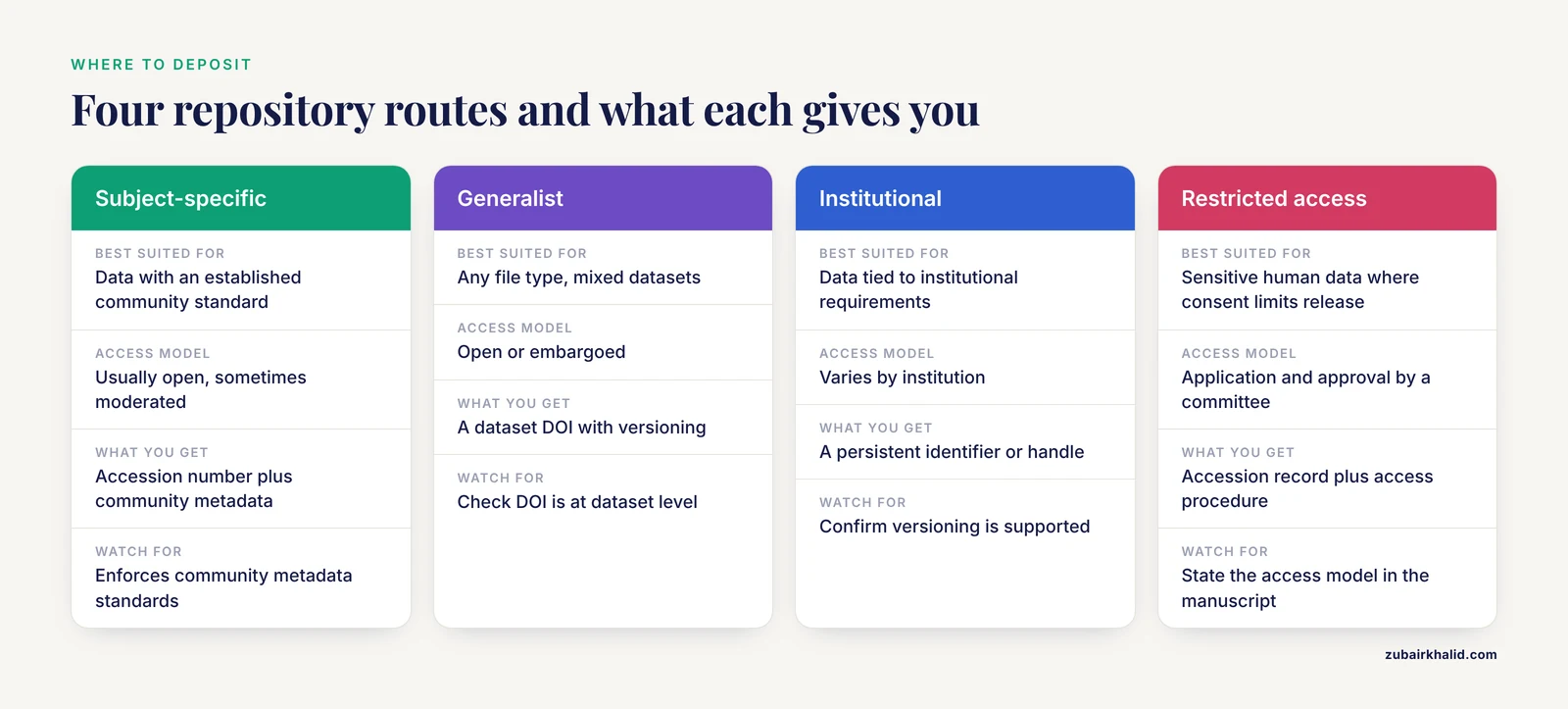
The best repository is usually one built for your data type, because subject repositories enforce community metadata standards. The comparison below summarizes your main options.
| Repository type | Examples | Best suited for | Access model | What you get |
|---|---|---|---|---|
| , - | , - | , - | , - | , - |
| Subject-specific | NCBI GEO or GenBank for sequence data, general pattern also seen in neuroimaging archives | Data with an established community standard | Usually open, sometimes moderated | An accession number plus community-standard metadata [3][6][8] |
| Generalist | Zenodo, Dryad, figshare | Any file type, mixed datasets | Open or embargoed | A dataset DOI with versioning |
| Institutional | Your university's research data service | Data tied to institutional requirements | Varies by institution | A persistent identifier or handle |
| Restricted access | Controlled-access clinical data archives | Sensitive human data where consent limits open release [4] | Application and approval by a data access committee | An accession record plus a documented access procedure |
Two practical checks before you commit. Check whether the repository assigns a DOI at the dataset level, because that DOI is what you will cite in your manuscript. And check whether it supports versioning, so you can publish a corrected version later without breaking the original citation.
Step 3: Organize and Validate Your Files
Reviewers of data papers reject submissions where the files are ambiguous. Build a folder structure that separates data, metadata, code, and documentation:
project/
  data/
    measurements_2024.csv
  metadata/
    dataset_metadata.yaml
  code/
    validate_data.py
  README.md
Fix a checksum for every file before upload. A checksum is a unique fingerprint computed from a file's contents, and it proves the uploaded copy is byte-for-byte identical to your local copy:
sha256sum data/measurements_2024.csvExpected output looks like this:
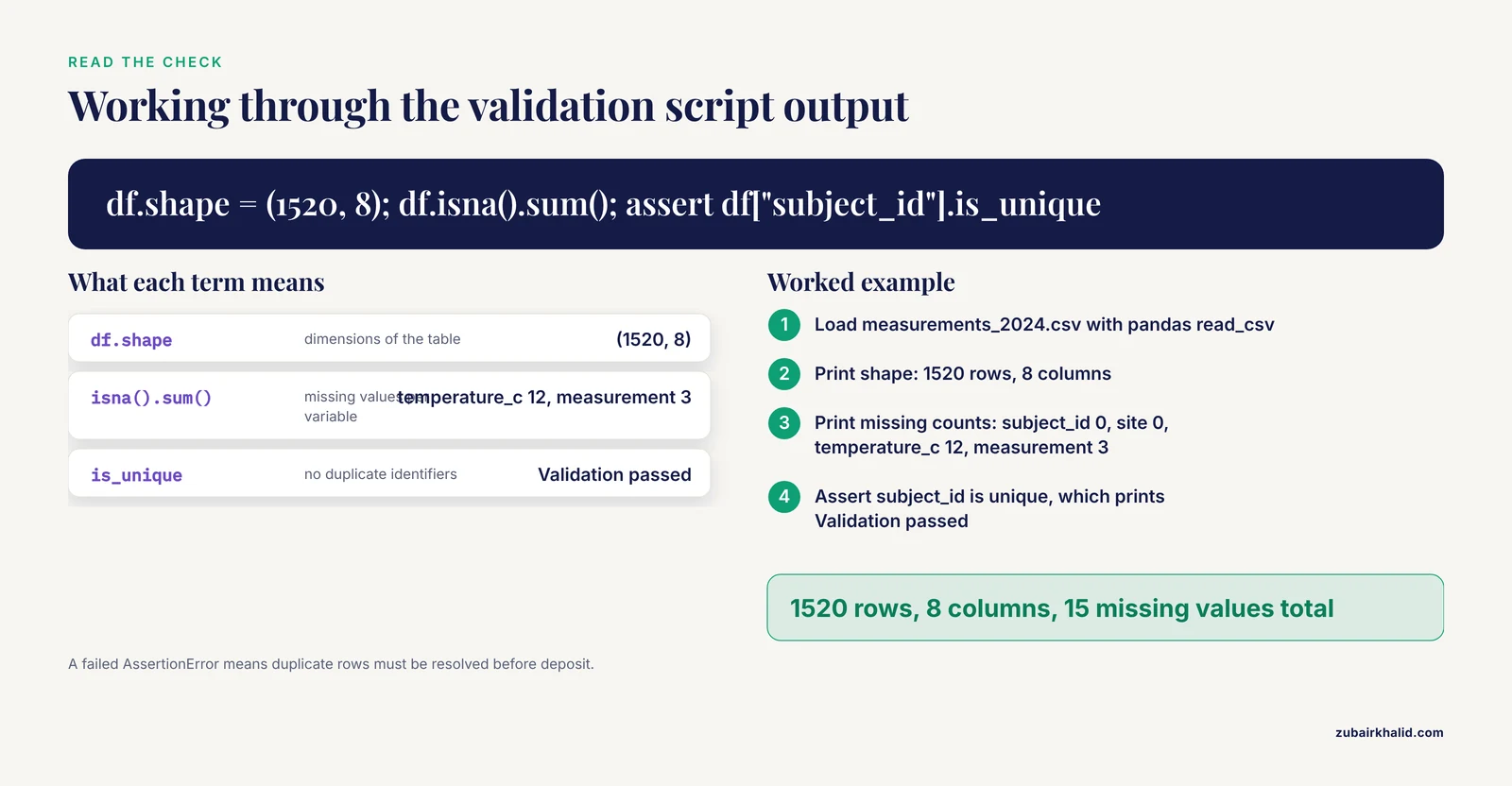
9f2c4e1a8b3d7f605a1c9e2b4d8f7a6c3e5b1d9f8a7c6e4b3d2f1a0c9e8b7d6f data/measurements_2024.csvThen run a short validation script. This example, using the pandas library in Python, loads a table, reports its dimensions and missing values, and fails loudly if the identifier column contains duplicates:
import pandas as pd

df = pd.read_csv("data/measurements_2024.csv")
print(df.shape)
print(df.isna().sum())
assert df["subject_id"].is_unique
print("Validation passed")
Expected output for a clean file:
(1520, 8)
subject_id        0
site              0
temperature_c    12
measurement       3
dtype: int64
Validation passed
If anything goes wrong at this stage, you will usually hit one of three errors. FileNotFoundError: No such file or directory: 'data/measurements_2024.csv' means you ran the script from the wrong directory or misspelled the path, so run it from the project root. UnicodeDecodeError: 'utf-8' codec can't decode byte 0xff means the file was saved in a different text encoding, so re-export the CSV as UTF-8 from your spreadsheet program. A failed AssertionError means the identifier column contains duplicate rows, and you must resolve those duplicates before deposit, because a reuser cannot tell which row is correct.
Check your result by downloading the file after upload and re-running the checksum. If the fingerprint matches, the transfer was clean.
Step 4: Write Metadata to a Standard
Metadata are the structured facts about your dataset, such as who created it, when, where, with what instruments, and under what license. Most journals now require deposit in public repositories aligned with the FAIR principles, yet metadata frequently lacks standardization, which blocks effective reuse [8]. Poor metadata is also what turns deposited data into dark data, files that exist but cannot be found or interpreted.
Write your metadata in a machine-readable format. YAML, a plain-text format that pairs field names with values, is increasingly used for FAIR metadata management in the life sciences, and toolkits such as FRED use it to generate standardized metadata and export it directly to repository submission formats like the NCBI GEO submission format [8]. A minimal but complete YAML block for a tabular dataset looks like this:
title: "Soil respiration measurements at three US tallgrass prairie sites, 2023-2024"
creators:
  - family_name: "Alvarez"
    given_name: "Maria"
    orcid: "0000-0002-0000-0000"
date: "2025-06-15"
description: >-
  Hourly soil respiration measured with a closed-chamber infrared
  gas analyzer at three sites, April 2023 through October 2024.
keywords: [soil respiration, carbon flux, tallgrass prairie]
license: "CC-BY-4.0"
methods: "Closed-chamber method, one chamber per plot, calibrated monthly."
related_identifiers:
  - identifier: "10.xxxx/xxxxx"
    relation: "isSupplementTo"
    resource_type: "dataset-paper"
Fill in every field. The title should name the subject, the location, and the time range. The description should state what one row of the data table represents, because that single sentence prevents most reuser confusion. The license field tells the world what others may legally do with your files.
Step 5: Deposit the Dataset and Get a DOI
Deposit in this order, and do not skip the order, because later steps depend on the identifier:
- Upload the data, metadata, code, and README from your validated folder structure.
- Choose a license. A permissive license such as CC BY 4.0, which allows reuse with attribution, is the default recommendation for data unless your institution requires otherwise. Avoid custom licenses, which reusers and repositories cannot process automatically.
- Set an embargo only if your journal or funder requires one, for example until the associated research article is published.
- Complete every required metadata field in the repository's submission form, pasting in your YAML values so the two match.
- Publish the deposit and record the DOI it returns.
Check the result by visiting the DOI in a private browser window and confirming that the files download and the metadata display correctly. Then compare checksums on one downloaded file against your local record from Step 3.
Step 6: Write the Manuscript From the Template
Now write the paper itself. Copy this template into a plain-text file and fill each bracketed section. The structure follows the format used by journals that publish data papers, so it adapts directly:
# [Descriptive dataset name, including subject, location, and years covered]

## Background & Summary
[Three to five sentences. What the data measure, why they were collected,
how many records and subjects they cover, and what research questions
they can answer that the original analysis did not.]

## Methods
[How the data were generated. Sampling design, instruments and their
calibration, collection protocol, and quality control during collection.
Cite any protocol papers or instrument manuals by DOI or report number.]

## Data Records
[Where the data live. One or two sentences per file or accession,
giving the repository name, the DOI or accession number, and the file
format. List every file in the deposit, including the metadata file.]

## Technical Validation
[How you verified the data. Report missing-value rates per variable,
calibration checks, duplicate detection, and any comparison against a
reference measurement or published benchmark. State the software and
versions used for these checks.]

## Usage Notes
[How to load the files, what each column means, the units for every
measured quantity, and known quirks such as sensor downtime or
site-specific gaps.]

## Code Availability
[Where the validation and processing scripts live, with the versioned
repository or deposit link.]


## Data Paper Tips That Save Time

 **Write the README and metadata while the data are fresh.** Metadata written during collection captures decisions you will have forgotten by submission time, and it feeds directly into the YAML block in Step 4.
 **Validate before you deposit, not during review.** The Python checks in Step 3 take minutes to run and prevent the most common revision requests.
 **Keep one canonical dataset version.** Freeze the files before writing the manuscript, record checksums, and never edit the deposited copy in place.
 **Deposit code with the data.** A validation script is the strongest evidence your Technical Validation section can offer, and reviewers read it.
[10] **Prepare the authorship list early.** Authorship in science publishing has become contested territory, with named high-status authors sometimes serving as figureheads for work done by others [11]. Agree in writing, before submission, who contributed what.

## Common Mistakes and Limitations

- **Reporting the wrong measure of spread.** Using the standard error of the mean instead of the standard deviation makes data look more precise than they are, and editors flag it as a common statistical problem in submitted manuscripts [9]. Given how persistent the practice is even after explicit editorial guidance [12], have a colleague check your summary statistics.
- **Soft-pedaling ambiguous results.** In the same cross-sectional analysis, more than half of papers reporting P values between 0.05 and 0.1 interpreted them as trends or as statistically significant [12]. Describe your validation findings with their actual numbers.
- **Publishing identifiable human data without the right consent.** For clinical and human-subject data, privacy and consent are genuine obstacles, and the appropriate response is restricted access or anonymization, not an open deposit and a hopeful assumption [4].
- **Over-harmonizing pooled data.** When combining individual participant data from multiple studies, forcing everything into one common format trades away detail. The harmonization-information trade-off states that the level of granularity you impose determines the amount of information you lose, so harmonize only as far as your reuse goal requires [1].
- **Assuming the data speak for themselves.** A deposit with thin documentation gets ignored, because publications are compressed summaries and the surrounding context is what makes raw records interpretable [2]. The Usage Notes section exists for this reason.
- **Submitting data of uncertain authenticity.** Journals now scrutinize raw data images closely, because fabricated manuscripts produced by paper mills often rely on template-generated raw data that fail close inspection [13]. Keep genuine instrument outputs and processing logs, since they are your proof of provenance.
- **Underestimating the writing effort.** Nonpublication rates for research presented at meetings are estimated at 25 to 60 percent, and researchers report barriers to manuscript preparation that go well beyond lack of time [14]. Budget calendar time for the manuscript, not just for the deposit.
- **Expecting the data paper to do a research paper's job.** A data paper documents and validates a dataset. It does not test a hypothesis or establish a biological mechanism, and some evaluation committees weight it differently from a hypothesis-driven article. Plan your publication record accordingly.

One general limitation applies throughout. The requirements of specific repositories, licenses, and journals change, so read your target journal's current data policy and the repository's current submission guide before you deposit.

## Frequently Asked Questions

### What exactly is a data paper?

A data paper is a peer-reviewed article whose primary contribution is a documented, validated, publicly deposited dataset. It describes what the data are, how they were collected and checked, and how to reuse them, without requiring a new hypothesis test.

### Do I still need a traditional research article?

Often yes. Many researchers publish the hypothesis-driven analysis separately and the dataset description as a data paper, with each citing the other. Some journals allow both in one submission package.

### Which repository should I choose for my data?

Choose a subject-specific repository when your data type has one, because it enforces community standards, and a generalist repository when it does not. The comparison table above summarizes the main options by data type and access model.

### Can I share human clinical or patient data openly?

Only when your consent and ethics documentation supports it. Patient privacy is a central obstacle to raw data publication, and restricted-access repositories are an accepted alternative when open release is not permitted [4].

### How do I cite a dataset in my reference list?

Cite the creators, year, dataset title, the words "Data set", the repository name, and the dataset DOI, following the worked example in Step 7. Cite the dataset itself, not only the paper describing it.

### How big or complete must a dataset be to justify a data paper?

There is no universal size threshold. The dataset should be complete for its scope, quality controlled, and useful to other researchers, whether that is one instrument's multi-year record or a compiled collection of published measurements.

### Which license should I choose for my dataset?

A permissive standard license such as CC BY 4.0 is the usual default, because it allows reuse with attribution and is processed automatically by repositories. Avoid custom licenses and check any funder requirement first.

### Do data papers count for career advancement?

They count as peer-reviewed publications, but evaluation committees weight article types differently. Check your institution's or funder's criteria and treat the data paper as one component of a publication record rather than a replacement for hypothesis-driven work.

<script type="application/ld+json">
{
  "@context": "https://schema.org",
  "@type": "FAQPage",
  "mainEntity": [
    {
      "@type": "Question",
      "name": "What exactly is a data paper?",
      "acceptedAnswer": {
        "@type": "Answer",
        "text": "A data paper is a peer-reviewed article whose primary contribution is a documented, validated, publicly deposited dataset. It describes what the data are, how they were collected and checked, and how to reuse them, without requiring a new hypothesis test."
      }
    },
    {
      "@type": "Question",
      "name": "Do I still need a traditional research article?",
      "acceptedAnswer": {
        "@type": "Answer",
        "text": "Often yes. Many researchers publish the hypothesis-driven analysis separately and the dataset description as a data paper, with each citing the other. Some journals allow both in one submission package."
      }
    },
    {
      "@type": "Question",
      "name": "Which repository should I choose for my data?",
      "acceptedAnswer": {
        "@type": "Answer",
        "text": "Choose a subject-specific repository when your data type has one, because it enforces community standards, and a generalist repository when it does not. Consider the access model, whether a dataset DOI is assigned, and whether versioning is supported."
      }
    },
    {
      "@type": "Question",
      "name": "Can I share human clinical or patient data openly?",
      "acceptedAnswer": {
        "@type": "Answer",
        "text": "Only when your consent and ethics documentation supports it. Patient privacy is a central obstacle to raw data publication, and restricted-access repositories are an accepted alternative when open release is not permitted."
      }
    },
    {
      "@type": "Question",
      "name": "How do I cite a dataset in my reference list?",
      "acceptedAnswer": {
        "@type": "Answer",
        "text": "Cite the creators, year, dataset title, the words Data set, the repository name, and the dataset DOI. Cite the dataset itself, not only the paper describing it."
      }
    },
    {
      "@type": "Question",
      "name": "How big or complete must a dataset be to justify a data paper?",
      "acceptedAnswer": {
        "@type": "Answer",
        "text": "There is no universal size threshold. The dataset should be complete for its scope, quality controlled, and useful to other researchers, whether that is one instrument's multi-year record or a compiled collection of published measurements."
      }
    },
    {
      "@type": "Question",
      "name": "Which license should I choose for my dataset?",
      "acceptedAnswer": {
        "@type": "Answer",
        "text": "A permissive standard license such as CC BY 4.0 is the usual default, because it allows reuse with attribution and is processed automatically by repositories. Avoid custom licenses and check any funder requirement first."
      }
    },
    {
      "@type": "Question",
      "name": "Do data papers count for career advancement?",
      "acceptedAnswer": {
        "@type": "Answer",
        "text": "They count as peer-reviewed publications, but evaluation committees weight article types differently. Check your institution's or funder's criteria and treat the data paper as one component of a publication record rather than a replacement for hypothesis-driven work."
      }
    }
  ]
}
</script>

## Sources

1. [Harmonization-Information Trade-Offs for Sharing Individual Participant Data in Biomedicine.](https://pubmed.ncbi.nlm.nih.gov/36420049/)
2. [Data management in the modern structural biology and biomedical research environment.](https://pubmed.ncbi.nlm.nih.gov/24590705/)
3. [Should non-peer-reviewed raw DNA sequence data release be forced on the scientific community?](https://pubmed.ncbi.nlm.nih.gov/8928007/)
4. [Towards agreement on best practice for publishing raw clinical trial data.](https://pubmed.ncbi.nlm.nih.gov/19296844/)
5. [Data sharing in medical research: an empirical investigation.](https://pubmed.ncbi.nlm.nih.gov/11697377/)
6. [The Functional Magnetic Resonance Imaging Data Center (fMRIDC): the challenges and rewards of large-scale databasing of neuroimaging studies.](https://pubmed.ncbi.nlm.nih.gov/11545705/)
7. [Dissemination of original NMR data enhances reproducibility and integrity in chemical research.](https://pubmed.ncbi.nlm.nih.gov/27197893/)
8. [FRED enables standardized FAIR metadata generation and management for omics research.](https://pubmed.ncbi.nlm.nih.gov/42498726/)
9. [Statistical Data Editing in Scientific Articles.](https://pubmed.ncbi.nlm.nih.gov/28581261/)
10. [Prevalence of Listeria monocytogenes, Salmonella spp., Shiga toxin-producing Escherichia coli, and Campylobacter spp. in raw milk in the United States between 2000 and 2019: A systematic review and meta-analysis.](https://pubmed.ncbi.nlm.nih.gov/36916568/)
11. [Figureheads, ghost-writers and pseudonymous quant bloggers: the recent evolution of authorship in science publishing.](https://pubmed.ncbi.nlm.nih.gov/18755552/)
12. [Poor statistical reporting, inadequate data presentation and spin persist despite editorial advice.](https://pubmed.ncbi.nlm.nih.gov/30110371/)
13. [The raw truth about paper mills.](https://pubmed.ncbi.nlm.nih.gov/34180058/)
14. [Going Beyond "Not Enough Time": Barriers to Preparing Manuscripts for Academic Medical Journals.](https://pubmed.ncbi.nlm.nih.gov/31530189/)