How to Use a Lab Report Rubric and Assignment Prompt Together
By Dr. Zubair Khalid, DVM, MS, PhD ·

The assignment prompt tells you what to produce, and the rubric tells you how that product will be judged. The rule of thumb for choosing how to use them is simple: read the prompt first to define the task, then convert the rubric into a drafting checklist, and finish by grading your own draft against the rubric before you submit. Students who treat these two documents as a matched pair, rather than as separate paperwork, write better lab reports in less time and recover far more points from sections they would otherwise rush.
This guide walks through the lab report rubric vs. assignment prompt question in detail. It covers what each document contains, how to combine them into a single workflow, several concrete options with their pros and cons, worked scenarios, and the mistakes that cost students the most points.
Lab Report Rubric vs. Assignment Prompt: The Core Difference
An assignment prompt is the instructions your instructor writes to define the task. It answers questions such as which experiment you are reporting, which sections are required, how long the report should be, what data you must use, and when it is due. A rubric is the scoring tool your instructor uses to grade the finished report. It breaks the report into criteria, such as "hypothesis is testable" or "figures are labeled with units," and describes what performance looks like at each level, often from excellent to poor.
A useful analogy from clinical research: when evaluators assessed AI-generated medical summaries, they used a structured rubric with named domains such as accuracy, completeness, clear communication, referencing, and following instructions, because a single global impression is unreliable [1]. Your instructor faces the same problem with your lab report. The rubric is how grading becomes consistent, and the prompt is how the task stays well-defined.
The two documents overlap but are not interchangeable. The side-by-side table below shows where they differ.
| Dimension | Assignment Prompt | Lab Report Rubric |
|---|---|---|
| Core question it answers | What am I supposed to do? | How will this be judged? |
| Typical contents | Task description, required sections, length, data sets, formatting rules, deadline | List of criteria, performance levels, point values or weights per criterion |
| Level of detail | Coarse. It defines the whole product | Fine. It defines qualities inside each section |
| Written for | The student, to specify the task | Both student and grader, to standardize judgment |
| When you read it | Before you start planning | Before, during, and after drafting |
| Consequence of ignoring it | You may write the wrong assignment entirely | You lose points on specific, named criteria |
| Structure | Prose paragraphs and bullet lists | Grid of criteria rows and performance-level columns |
The granularity gap in that table is the whole reason the two documents work together. The prompt might say "write a results section." The rubric might award points for whether your results section reports descriptive statistics, states whether the data support the hypothesis without interpreting causes, and contains figures with labeled axes. The prompt gets you to the right room. The rubric shows you where the light switches are.
What the Assignment Prompt Actually Tells You
Before you write anything, extract five things from the prompt.
- The task verb and scope. "Analyze the enzyme kinetics data" and "design an experiment to test the enzyme kinetics hypothesis" demand different reports. The prompt fixes the boundaries of the work.
- The required lab report format. Most undergraduate prompts require a version of the standard scientific structure: title, abstract, introduction, materials and methods, results, discussion, and references. Some prompts compress this into a worksheet or expand it into a full journal-style manuscript. The prompt is the authoritative statement of the expected lab report format.
- The data you must use. Class data, your bench partner's data, pooled section data, or simulation output. Using the wrong data set invalidates every downstream section.
- The audience. A report written for a lay audience uses different language than one written for a scientific audience, and rubrics that assess science writing treat audience awareness as a distinct scoring dimension [2].
- Logistics. Page limits, citation style, file format, and the deadline.
Decisions about how students report their data, and how much guidance they receive in interpreting it, are deliberate instructional choices made when a lab course is designed [3]. That means the prompt is not filler. If the prompt asks you to interpret pooled class data rather than your own bench data, that choice is part of what you are being graded on.
What the Rubric Actually Tells You
A rubric is a scoring grid. Each row is a criterion. Each column is a performance level, such as "exemplary," "proficient," "developing," and "beginning," often with point values attached. Analytic rubrics of this kind score each criterion separately rather than assigning one holistic grade.
Rubrics do three jobs at once, and each job tells you something about how to use the rubric as a student.
They standardize judgment. When four faculty raters used an analytic rubric to grade the same resident projects, interrater reliability correlations ranged from 0.63 to 0.81, and the four rubric categories showed high internal consistency, with Cronbach alpha values between 0.91 and 0.96 [4]. In plain language, well-built rubrics make different graders agree with each other. That matters to you because it means the rubric, not the grader's mood, drives most of your score.
They make expectations public in advance. In a laboratory animals technologist program, the evaluation rubric covered criteria such as daily report and record-keeping, fulfillment of standard operating procedures, animal procedures and organization of materials, and teamwork, and the aspects and criteria to be examined were known to students and teachers beforehand [5]. When criteria are disclosed in advance, the rubric is effectively the answer key for process skills, not just the final document.
They separate substance from polish. The Universal Science Writing Rubric, developed to assess science writing across genres including lab reports, review articles, and grant proposals, deliberately focuses on science content and interpretation rather than surface features like grammar [2]. If your rubric follows this pattern, most of the points live in whether you interpret your data correctly, not in spelling.
Rubrics also serve the grader, not just the graded. Lab course designers explicitly use rubrics to ensure fair and efficient grading, particularly for skills-based learning goals where traditional exams measure the wrong thing [3]. A fair and efficient grading process means your grade reflects named, visible criteria, which is exactly why you should be reading those criteria before you write.
How to Use a Lab Report Rubric and Prompt Together: A Five-Step Workflow
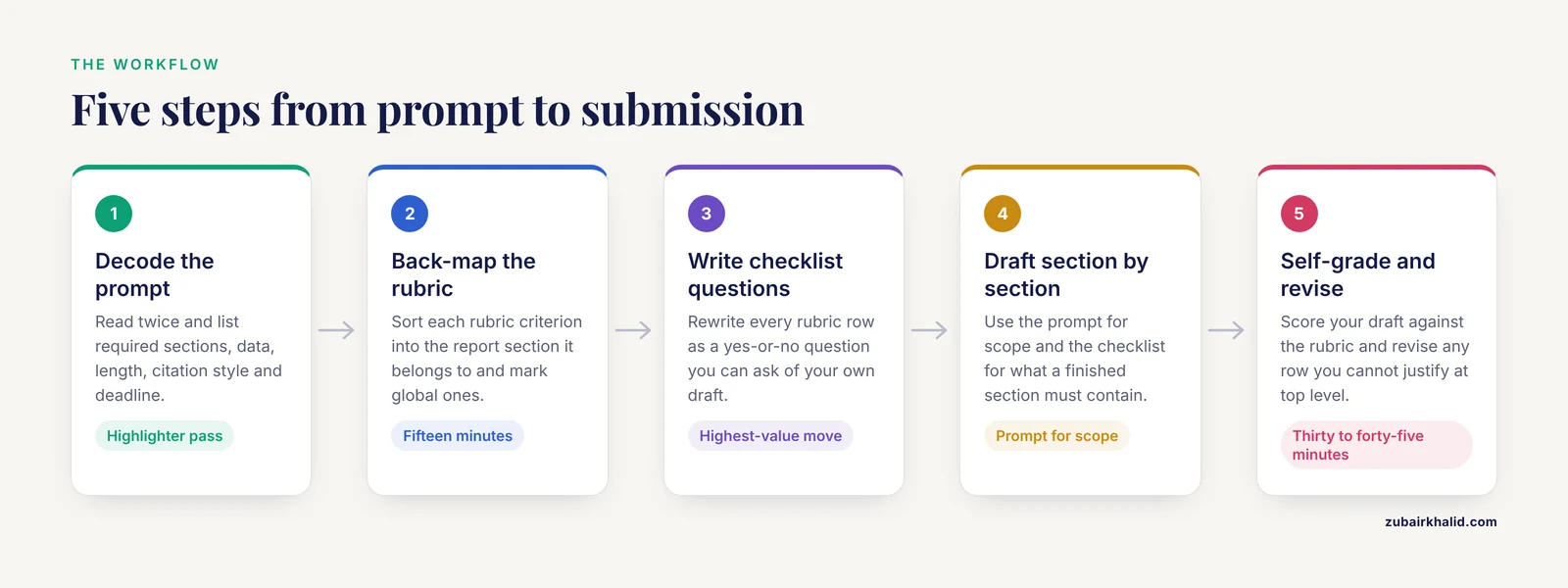
Here is the workflow that answers the primary question of this article, from the night you get the assignment to the moment you submit.
Step 1. Decode the prompt and list the deliverables
Read the prompt once for the big picture and once with a highlighter. Produce a short list: required sections, required data, length, citation style, deadline. If the prompt names the standard sections of a scientific report, write them down in order, because that order becomes the skeleton of your document and the skeleton of a standard lab report format.
Step 2. Back-map the rubric onto the report sections
Take the rubric's criteria rows and sort them into buckets by section. A criterion like "states a testable hypothesis" belongs to the introduction. "Presents figures with labeled axes and units" belongs to results. "Distinguishes results from interpretation" belongs to results versus discussion, and this distinction trips up more students than any other. Criteria about citations and reference formatting belong to the reference list. Some criteria, such as "writing is clear and concise," apply everywhere, so mark them global.
This step takes fifteen minutes and pays for itself many times over, because it turns two disconnected documents into one integrated map of the assignment.
Step 3. Convert each rubric row into a drafting checklist question
Rewrite every criterion as a yes-or-no question you can ask of your own draft. "Hypothesis is testable" becomes "Does my hypothesis predict a measurable outcome under stated conditions?" "Discussion interprets results" becomes "Does my discussion explain the results rather than repeat them?" This transformation is the single highest-value move in the entire workflow, because a rubric written as performance descriptions becomes actionable only when rephrased as checks.
Step 4. Draft the report using the prompt for scope and the checklist for content
Write section by section. Consult the prompt whenever you are unsure how far to go, and consult the checklist whenever you are unsure what a finished section must contain. When you draft your methods, for example, the prompt tells you whether to include the supplier and catalog details for reagents, and the checklist reminds you that reproducibility, meaning a reader could repeat the procedure, is usually a scored criterion.
Step 5. Self-grade, revise, and only then submit
Score your own completed draft against the rubric, honestly, criterion by criterion. Assign yourself the level you believe each row earns and write a one-line justification. Any row where you cannot justify a top level is a revision target. This self-grading pass typically takes thirty to forty-five minutes for a full lab report and routinely recovers points in the discussion and figure sections, which students chronically underweight.
One caution for this step applies to every tool you use along the way, including generative AI assistants. A multidisciplinary expert panel built the OMNI rubric for evaluating AI outputs in health contexts with ten domains, including accuracy, safety, recognizing uncertainty, completeness, clear communication, context awareness, referencing, and following instructions, precisely because raw AI output cannot be trusted without structured checking against criteria [1]. Apply the same logic to your own draft. Checklist items exist to be verified, not assumed.
Options for Combining Rubric and Prompt, With Pros and Cons
There is more than one way to answer how to use a lab report rubric and prompt together. The best approach depends on your timeline, your confidence, and how your course is structured. These are the main options, with their pros and cons.
Option 1. Rubric as a pre-writing planning tool
Read both documents on day one, build the combined checklist, and plan the report around it before drafting anything.
Pros. Prevents structural rework. Front-loads the criteria into your memory while you are still at the bench, so you record the right data and take the right notes. Cheapest option in total time.
Cons. Requires the rubric to be released early, which some instructors do. A checklist built before you understand the experiment can mislead if the rubric's criteria are ambiguous and you guess their meaning wrong.
Option 2. Rubric as a post-draft self-grading tool
Write the full draft guided by the prompt alone, then score yourself against the rubric and revise.
Pros. Fits any timeline and any course. Produces at least one genuine revision cycle, which measurably improves discussion sections. Lowest risk of misreading the rubric, because you judge it against real text.
Cons. You may discover late that you collected the wrong data or omitted a required figure, and late fixes are expensive. Two full passes over the report cost more total time than Option 1.
Option 3. Rubric-based peer review
Exchange drafts with a classmate and grade each other against the rubric before submission.
Pros. Peers catch problems you are blind to, especially unclear writing and missing logic between results and discussion. Explaining the rubric to someone else forces you to understand it.
Cons. Peer graders vary in accuracy, and a partner who grades generously can create false confidence. Scheduling a swap before the deadline requires discipline.
Option 4. Feed-forward and co-created rubrics
Some courses go further and involve students in building or rehearsing the rubric itself. In a large first-year biochemistry course of roughly 270 students, student lecturers co-created the marking rubric and "unexemplars," which are deliberately flawed sample reports, and students engaged in a formative assessment with peer marking and feed-in feedback before the graded submission. Students in that flipped, feed-in design earned significantly higher summative marks, 56.7 percent versus 50.9 percent, with a 97 percent pass rate and 88 percent satisfaction [6].
Pros. The strongest evidence-backed option for learning. Rehearsing judgment on flawed samples teaches you to see errors in your own work. Works even when the instructor supplies the rubric, because you can practice on unexemplars on your own by writing an intentionally weak paragraph and critiquing it.
Cons. Depends on course design you do not control. If your course offers no such session, you can approximate it by grading a published or instructor-provided sample report against the rubric yourself.
Option 5. Rubric-driven revision of AI-assisted drafts
If you use an AI tool to help draft or rephrase sections, the rubric becomes your audit instrument rather than your planning tool.
Pros. Turns a risky shortcut into a controlled process. The structured domains used in professional AI evaluation, such as accuracy, referencing, and following instructions, map cleanly onto the criteria in most lab report rubrics [1].
Cons. Highest risk option if skipped. An AI draft can satisfy surface features while fabricating a citation or misstating your own data, and only criterion-by-criterion checking against the actual data catches that. Many courses prohibit undisclosed AI drafting, so check your prompt before choosing this option.
Which option is best?
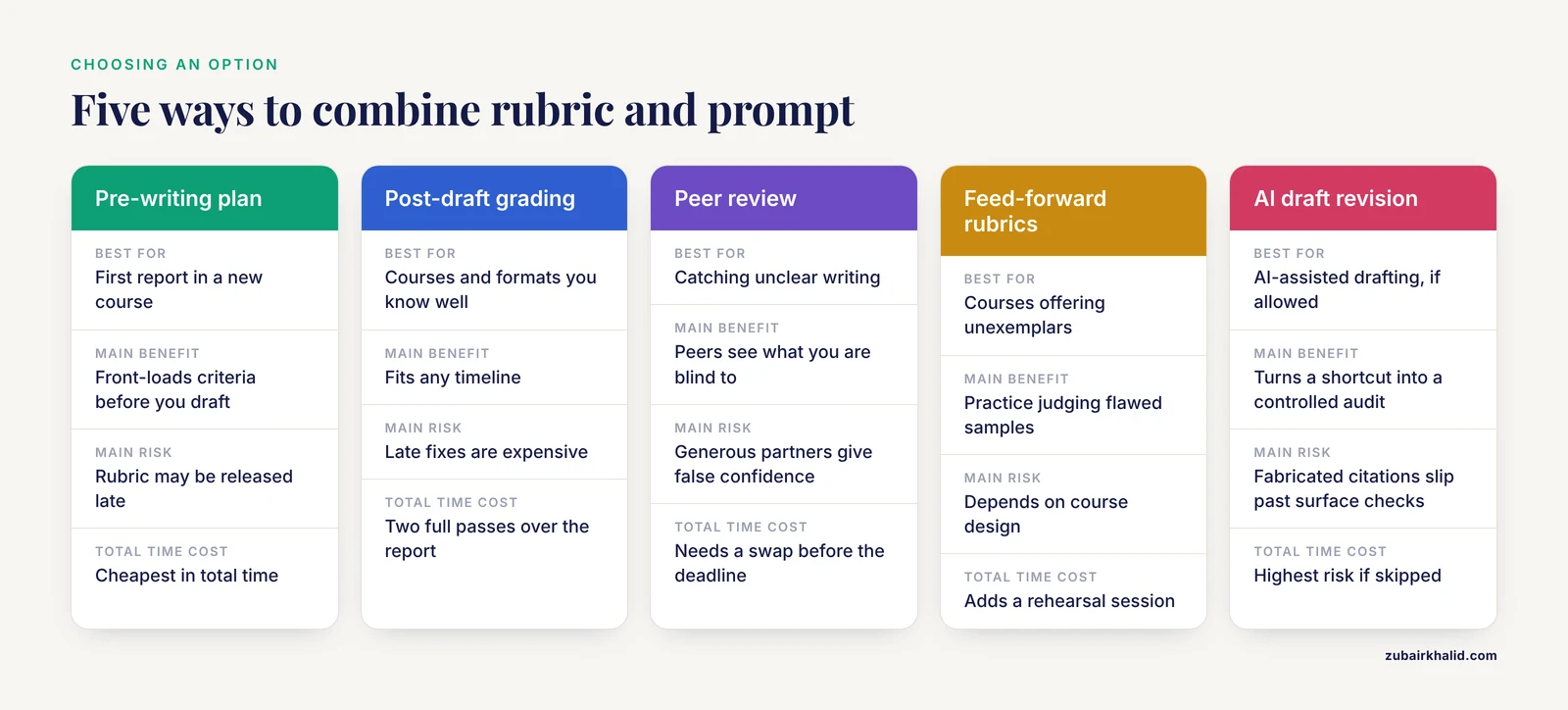
For a first lab report in a new course, the best approach is Option 1 combined with Option 3. For a course you know well and a report format you have written before, Option 2 alone is efficient. For a course that offers sample reports or unexemplars, add Option 4 regardless of which other option you choose, because practice in judging quality transfers across every future report.
Worked Scenarios
Scenario A. First-year biology student, enzyme activity lab
Priya receives a prompt requiring a full report in standard lab report format, two pages of results from pooled class data, and APA citations. The rubric has twelve criteria worth five points each, including "hypothesis is falsifiable," "methods allow replication," and "discussion proposes one alternative explanation."
On Sunday, she decodes the prompt and learns the report uses pooled data, so she records her raw bench values plus the class spreadsheet. She back-maps the rubric and notices two criteria she would have missed entirely, one on figure captions stating sample size and one requiring an alternative explanation in the discussion. She converts all twelve rows into checklist questions. While drafting the discussion on Thursday, she writes her interpretation, then adds a short paragraph proposing a plausible alternative explanation, which she would have skipped without the checklist. On Friday she self-grades, finds her methods section lacks the incubation temperature and duration, fixes it, and submits. The two criteria she would have missed are worth ten points, roughly a full letter grade on the assignment.
Scenario B. Graduate student, methods course report
Marcus writes a lab report for a graduate instrumentation course. The prompt requires a journal-style manuscript with a structured abstract. The rubric emphasizes data treatment, including error propagation and whether uncertainty is reported with the correct number of significant figures.
He chooses Option 2, drafting first because he knows the format. At the self-grading stage, he discovers the rubric scores uncertainty separately from the central value, and his draft reports "3.42 ± 0.15" in some places and rounded values in others. He standardizes the treatment across the results, adds a sentence on how the uncertainty was propagated, and resubmits the affected tables. The late catch costs him an hour but saves the largest single criterion on the rubric.
Scenario C. Teaching assistant grading a stack of forty reports
Elena is a TA grading her first stack. The course gives her the rubric and the prompt. Because the rubric is analytic, with separate criteria and level descriptions, she grades criterion by criterion across all reports rather than report by report. This keeps her standard consistent from the first paper to the fortieth, which is exactly the consistency that analytic rubrics were built to produce [4]. Where a criterion is ambiguous, she checks how the instructor's prompt phrases the task, because the prompt defines the task the rubric is measuring. Her graded comments cite rubric language, which makes her feedback actionable for students revising future reports.
Mapping Rubric Criteria to Lab Report Sections
For a standard lab report format, this mapping covers where most rubric criteria land. Use it as a starting template for Step 2 of the workflow, then adjust to your actual rubric.
| Report section | Typical rubric criteria | Typical prompt requirements |
|---|---|---|
| Title and abstract | Title states the specific system and question, abstract summarizes purpose, methods, key result, and conclusion | Word limit, structured versus unstructured abstract |
| Introduction | States testable hypothesis, provides sufficient background, cites primary literature correctly | Number of sources required, citation style |
| Materials and methods | Written so the procedure could be repeated, reports quantities, units, and conditions, correct past passive voice | Required detail level, whether supplier information is needed |
| Results | Presents data in logical order, figures and tables labeled with units and captions, reports statistics correctly, no interpretation | Which data set to use, required figure types |
| Discussion | Interprets results against the hypothesis, addresses alternative explanations, states limitations, connects to background literature | Required length, required connections to course concepts |
| References | Correct citation format, every claim sourced, sources are primary literature | Citation style, minimum source count, prohibition on certain source types |
| Global criteria | Clarity, concision, correct grammar, logical flow | Page limit, file format, deadline |
The rows where students lose the most points, in the experience of most instructors, are Results and Discussion, and the specific failure is blending them. If your rubric scores "results reported without interpretation" as a distinct criterion, treat that row as a hard boundary. Numbers, figures, and statistical outcomes live in Results. Meaning, mechanism, and comparison with published findings live in Discussion.
Common Mistakes and Limitations
These are the errors that most often cost points, plus the honest limits of this workflow.
Reading the rubric after drafting. The most common mistake in the entire genre. Students skim the prompt, write what they assume a lab report should be, and meet the rubric for the first time at the grade return. Every point the rubric names is a point you could have targeted.
Treating the rubric as decoration rather than contract. Some students read the rubric, agree it is reasonable, and then write exactly as they would have anyway. The rubric only changes your grade if it changes your drafting and revision decisions.
Chasing surface features instead of scored substance. If your rubric follows the pattern of modern science writing assessment, content and interpretation dominate while grammar is a minor criterion [2]. Polishing prose for hours while leaving the discussion's reasoning thin is a misallocation of effort.
Assuming the prompt and rubric always agree. Occasionally they conflict, for example a prompt that requests an interpretation in the results section while the rubric penalizes it. When that happens, the rubric is normally the more reliable predictor of your grade, because it is the grading instrument, but flag the conflict to your instructor in writing before the deadline.
Self-grading generously. The purpose of self-assessment is to find weaknesses before the grader does. If every row earns a top level in your own scoring, you are either an excellent writer or grading with wishful thinking. Have a peer spot-check one section.
Ignoring process criteria. Some rubrics score how you worked, not just what you wrote. The laboratory animals technologist rubric cited above includes daily record-keeping, timeliness, and teamwork among its criteria [5]. If your course grades notebook entries or bench conduct, those points accumulate on every lab day and cannot be recovered in a final writing push.
Leaning on AI without structured checking. AI-drafted text can be fluent and wrong. Structured, criterion-by-criterion evaluation is the professional standard for judging such output, and expert bodies have built dedicated rubrics for exactly this reason [1]. Apply the same standard to anything a tool drafted on your behalf.
A limitation of the workflow itself. Rubrics describe minimums and targets, not ceilings. A report can satisfy every row and still be unremarkable, because rubrics are built for reliable grading across hundreds of students, not for rewarding exceptional insight. If you aim beyond the rubric, do it after the rubric's requirements are secured, not instead of them. And individual grading situations vary by instructor and institution, so when a specific dispute arises, your instructor's clarification is the final word.
Frequently Asked Questions
Should I read the rubric or the assignment prompt first?
Read the prompt first. The prompt defines the task, the audience, and the required lab report format, and you need that frame before the rubric's criteria make sense. Then read the rubric immediately afterward, while the prompt is fresh, so you can back-map each criterion onto a section.
Can a rubric replace the assignment prompt?
No. A rubric scores qualities inside the work, but it rarely states the full task, such as which data set to use, what the experiment was, or the deadline. The prompt and rubric serve different functions, and treating the rubric as a substitute for the prompt is how students end up writing a well-executed report on the wrong assignment.
What should I do if the prompt and the rubric seem to disagree?
Follow the rubric for grading decisions and raise the conflict with your instructor in writing before the deadline. Discrepancies are usually unintentional, and instructors often resolve them for the whole class. Asking early costs nothing and asking late, after the grade, costs everything.
How do I self-grade a draft when the rubric has no point values?
Assign yourself a performance level for each row and write a one-sentence justification quoting the level description. The justification matters more than the label, because any row where you cannot justify the top level with specific evidence from your own text is a revision target, whether or not points are attached.
How many revisions should I do with a rubric?
One thorough rubric-guided revision pass is enough for most course lab reports. More passes add value only if each pass targets a specific criterion group, such as one pass on figures and statistics and one on discussion logic. Endless shallow rereading of the same draft returns almost nothing.
Can I use a rubric designed for one course on a lab report in another course?
Partially. General science writing rubrics are built to apply across genres and audiences, so criteria on hypothesis quality, data interpretation, and clarity transfer well between courses [2]. Course-specific criteria, such as particular statistical tests, formatting rules, or required sections, do not transfer. Use a general rubric for drafting habits and your course's rubric for the actual grade.
Sources
- Development and Pilot Evaluation of a Standardized and Accessible Rubric (OMNI) for Assessing Generative AI in Health Care Contexts: Four-Stage Mixed Methods Study.
- Development and Validation of a Universal Science Writing Rubric That is Applicable to Diverse Genres of Science Writing.
- Setting Up an Undergraduate Immunology Lab: Resources and Examples.
- Development and initial validation of a project-based rubric to assess the systems-based practice competency of residents in the clinical chemistry rotation of a pathology residency.
- A rubric as a tool for summative and formative evaluation in Laboratory Animals Technologist degree at the University of Buenos Aires (Argentina).
- Case study: Co-creating a flipped feed-in approach to a virtual biochemistry lab assessment: increasing student achievement and engagement in a large, diverse cohort.