How to Structure Reviewer Responses: One Comment Per Paragraph
By Dr. Zubair Khalid, DVM, MS, PhD ·

By the end of this article you will be able to take a decision letter from an editor, break it into its individual reviewer comments, and build a reviewer response letter in which every comment gets exactly one clearly labeled block containing the comment, your answer, and the change you made in the manuscript. You will also know how to verify that you answered everything before you submit.
To follow along you need three things on hand: the editor's decision letter with the reviewer reports, your current manuscript file with line numbers turned on, and a word processor or text editor where you can keep the response letter as a separate document. Nothing else is required. No special software is needed, although many authors use a simple two-column table or colored text to keep the two voices (reviewer and author) visually separate.
Why the Reviewer Response Letter Deserves Its Own Structure
A reviewer response letter is the document you send back with your revised manuscript, in which you answer each point the reviewers and editor raised. Editors and reviewers read dozens of these. When the answers are scattered, merged, or buried inside long paragraphs, reviewers cannot easily confirm that their concerns were addressed, and the revision goes back for another round. When each comment maps to one visible block of response, the reviewer can check off concerns one at a time, which shortens the path to acceptance.
This is not a niche habit. Nearly every published rebuttal in the Copernicus journal family, which includes journals such as Hydrology and Earth System Sciences, Atmospheric Chemistry and Physics, Biogeosciences, Geoscientific Model Development, and The Cryosphere, is built as a point-by-point response in which each reviewer comment is quoted and answered in turn [1][2][3]. The authors of one glaciology revision describe their own letter exactly this way: they made major revisions, addressed all comments as described in the rebuttal document, and detailed the changes "in a point-by-point response to each comment below," with reviewer comments in italicized blue text and author responses in normal black text [2]. That physical layout, one comment followed by one response, is the whole system this article teaches.
The payoff is visible on the other side of the process too. A second-round review from a hydrology manuscript records the reviewer confirming that the authors "substantially improved the manuscript by addressing my main comment," that the new structure addressed the paper's objective more logically, and that the authors "also addressed my other comments appropriately" [4]. That kind of confirming second report starts with a response letter a reviewer can actually navigate.
The One-Comment-Per-Paragraph Rule
The one-comment-per-paragraph rule states that every individual comment or question from a reviewer receives its own dedicated response block, and that no block answers two unrelated comments at once. The rule has three parts:
- One comment means one discrete point. If a reviewer's numbered point 4 contains two separate questions about sample size and about a figure, those are two logical comments even though they arrived inside one numbered item.
- One paragraph (or block) means one quoted comment, one response, and one statement of what changed in the manuscript, kept together and labeled.
- No mixing means you never fold an answer about statistics into a paragraph that is mainly about figure design, and you never answer two points in a single unbroken block unless they genuinely require one joint action.
The rule works because of how reviewers read. A reviewer skims the letter looking for their own comments. Quoting the comment, in italics or a color, gives them an anchor. Answering immediately below it, in plain text, lets them verify the answer without flipping between documents. Stating the change with a line number closes the loop, because the reviewer can jump straight to the revised manuscript and see the edit. Published interactive comments in Copernicus journals follow exactly this loop, quoting the reviewer's question and then answering it, often ending with a statement such as "We have added these points to the Abstract of the revised manuscript".
Anatomy of a Single Response Block
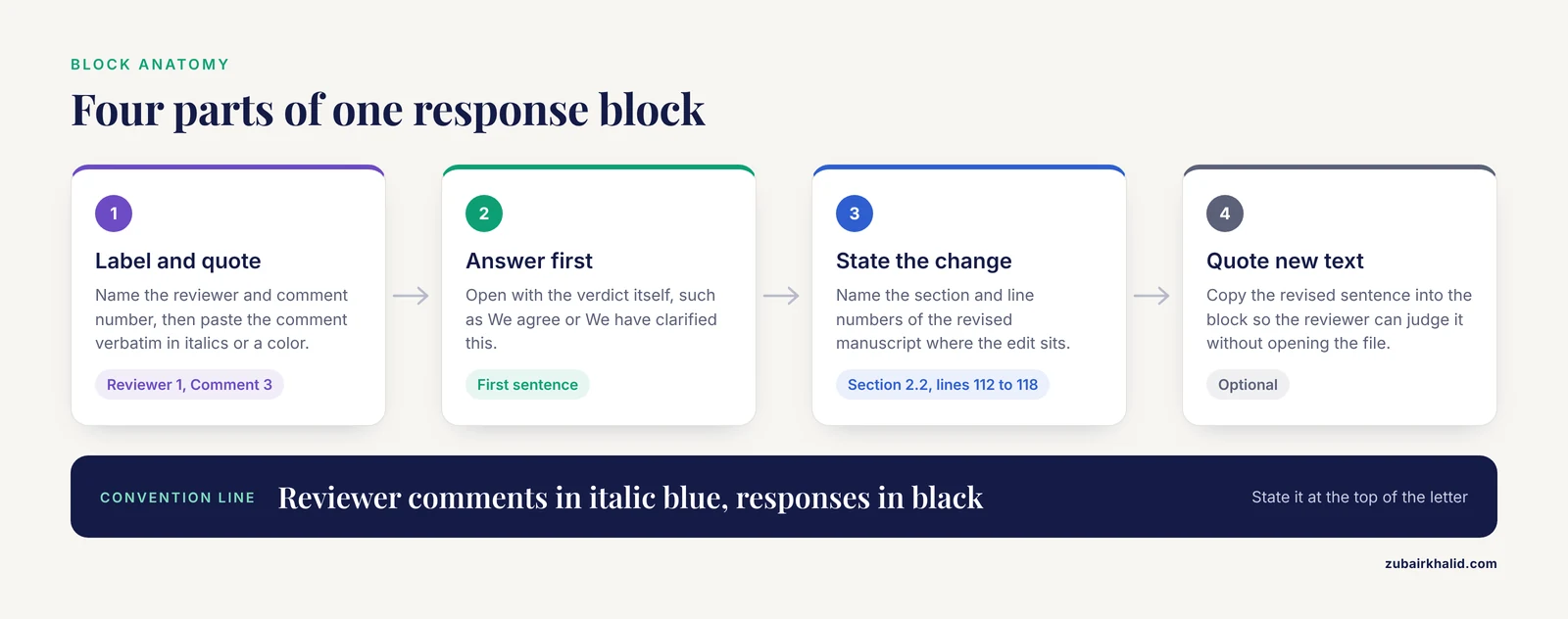
Before the walkthrough, learn the anatomy. A well-formed block for one comment contains four elements in this order:
- Label and quote. A short label (for example, "Reviewer 1, Comment 3") followed by the reviewer's original wording, reproduced verbatim, usually in italics, a distinct color, or a quoted style.
- Response. Your answer, starting with a direct reply such as "We agree" or "We have clarified this" or, where you disagree, a respectful statement of why.
- Change made. What you edited in the manuscript, with the section and line numbers of the revised version, for example "Section 2.3, lines 145 to 152, revised text now states...".
- Quoted new text, when useful. The actual revised sentence or paragraph copied from the manuscript, so the reviewer can judge it without opening the file.
Published response letters use this exact anatomy with different visual conventions. One hydrogeology rebuttal states its convention up front in the opening line of the document: the original reviewer's comment appears in italics and the author's response in orange [6]. Another uses italicized blue text for the reviewer and black text for the authors. A response to an atmospheric modeling reviewer quotes the reviewer's recommendation about moving the paper to a different journal and answers it directly in a single block [1]. The visual skin varies. The underlying one-comment-one-block skeleton does not.
How to Structure Response to Each Reviewer Comment Step by Step
This section gives you a complete, reusable procedure for building the letter. Follow the steps in order for each reviewer.
Step 1. Decompose the decision letter into labeled comments
Copy every reviewer's report into your response document. Under each reviewer's heading, insert a numbered label for each comment. Where a numbered paragraph from the reviewer contains more than one question, split it into sub-labels such as "Comment 4a" and "Comment 4b." Numbered response documents are the norm, and even letters that group by theme keep per-comment numbering, as in a model-comparison paper whose rebuttal is organized as numbered responses to each reviewer comment [7], and in rebuttals labeled explicitly "Response to Reviewer Comment 1" and "Response to Reviewer Comment 3" as separate documents [8][9].
Step 2. Triage the comments
Read through all comments once before answering anything. Mark each one with a category: agree and fixed, agree and partial fix, disagree with justification, or needs discussion with the editor. Triage prevents the most common structural failure, which is spending pages on minor points while the major concern gets two sentences. Reviewers notice the allocation. When a major comment about the presentation of results receives a genuine reorganization, the reviewer says so in the second round [4]. When a reviewer's central recommendation, such as a suggestion to reframe or rehouse a paper, is met with a real reply rather than silence, the exchange stays productive.
Step 3. Quote each comment verbatim
Paste the reviewer's exact words into the block. Do not paraphrase, shorten, or tidy up their grammar. Verbatim quotation serves two purposes. First, it proves you did not distort the request. Second, it makes the letter self-contained, so the editor and the reviewer can each read it without a second window open. Rebuttals that quote the comment in full, as the Copernicus interactive comments do, are easy for anyone to audit years later [10].
Step 4. Answer the comment in the first sentence of your response
Start the response with the answer itself, not with pleasantries. "Yes, we agree that the sample size limits the power of this comparison" gives the reviewer their verdict immediately. Save the explanation for the sentences that follow. A response that opens with three sentences of context before reaching the point forces the reviewer to hunt for the answer, which is precisely what the one-comment-per-paragraph rule exists to prevent.
Step 5. State what changed, with line numbers
After the answer, state the concrete edit: which section, which line numbers in the revised manuscript, and what the new text says. Many authors then quote the new manuscript text inside the response block. This is the element that converts your promise into something verifiable. Response letters in the Copernicus system, where the exchange is published alongside the paper, rely on this element so that readers of the final article can trace how each concern was resolved.
Step 6. Format the block so the two voices cannot be confused
Pick one convention and apply it to every block in the document. The most common conventions are color and italics. One published rebuttal uses italicized blue text for reviewer comments and normal black text for author responses [2]. Another uses italics for the comment and orange for the response [6]. Whatever you choose, state the convention at the top of the letter, exactly as those authors do, so nobody has to guess.
Step 7. Repeat for every comment, then count
When all blocks are written, count the reviewer's original comments and count your response blocks. The numbers must match. This simple check catches dropped comments, which are the single most damaging structural error in a rebuttal, because a reviewer whose point went unanswered often assumes the omission was deliberate.
A Worked Example of a Complete Block
Here is how one fully formed block looks in plain text form, using the conventions described above. You can type this in any word processor or write it in markdown and convert it later.
Reviewer 1, Comment 3
*In italic blue: "The description of the sampling protocol in
Section 2.2 is too brief for reproducibility. Please state how
samples were stored and for how long before analysis."*

Response: We agree, and we have expanded the sampling description.
Change made: Section 2.2, lines 112 to 118 of the revised
manuscript. We now report storage temperature (4 C), maximum
holding time before analysis (14 days), and the container type
(high-density polyethylene bottles).

New manuscript text: "Samples were collected in pre-rinsed
high-density polyethylene bottles, stored at 4 C in the dark, and
analyzed within 14 days of collection."
The expected output of the whole letter is a document with this shape, repeated for every comment:
Response to Reviewers
Manuscript ID: XXXX-2024-0187

Convention: Reviewer comments in italic blue. Author responses
in normal black text. Line numbers refer to the revised manuscript
with tracked changes.

Reviewer 1
  Comment 1 ... [block]
  Comment 2 ... [block]
  Comment 3 ... [block]

Reviewer 2
  Comment 1 ... [block]
  Comment 2 ... [block]

Response to the Editor
  Editor point 1 ... [block]
Note the final section. Editors frequently attach their own points, separate from the reviewer reports, and those points deserve the same one-comment-per-block treatment. Rebuttals published under titles such as "Response to editor and reviewer comments" make this two-part structure explicit in the title itself [3].
Formatting Systems Compared
You have several practical ways to implement the rule. The table below summarizes the options and when each works best.
| Format | How it looks | Best for | Watch out for |
|---|---|---|---|
| Colored text, reviewer and author in different colors | Reviewer comment in blue italics, response in black or orange [2][6] | Most journals, both single- and double-column submissions | Some journals want plain black text only, so check author guidelines |
| Quotation style | Reviewer text in block quotes or quotation marks, response below in plain text | Plain-text submission systems and markdown workflows | Weaker visual separation than color |
| Two-column table | Left column reviewer comment, right column response | Reviewers who ask many short points | Long quoted comments and long new manuscript text cramp the right column |
| Numbered list, no styling | "Comment 1. [text] Response 1. [text]" | Systems that strip formatting, and quick minor revisions | Easiest format in which voices blur if responses run long |
| One document per comment | Separate files labeled "Response to Reviewer Comment 1" [8][9] | Open interactive review platforms that log each exchange separately | Not practical for a single consolidated rebuttal at most journals |
The color convention deserves one extra note. Because rebuttal letters in some journals are eventually published as part of the interactive discussion record [11][12], the colors you choose become part of the permanent, publicly readable exchange. Pick colors that remain readable when printed in grayscale, in case the published version loses the color channels.
How to Respond to Peer Reviewers When You Disagree
Agreement is easy to structure. Disagreement needs the same block, with a different opening. Open with the disagreement stated plainly and respectfully, for example "We respectfully disagree, for the following reason." Then give the reasoning, ideally with evidence such as a citation, a calculation, or an additional analysis. Then, if you still changed nothing in the manuscript, say so explicitly and explain why no change is needed. Never leave a disagreement implicit, because the reviewer will assume you missed the point.
A published response to a post-publication comment on a methods review illustrates the tone well. The author responds to a methodological critique in a dedicated comment-by-comment exchange, addressing the criticism on its substance rather than deflecting it [13]. That exchange became part of the scientific record of the paper, which is another argument for keeping each disagreement contained in its own well-formed block. Future readers judge you by what you wrote in response, not by what you thought.
When the disagreement is with a recommendation rather than a factual claim, the same structure applies. In one atmospheric chemistry exchange, the reviewer recommended that the manuscript would fit a different journal better. The authors answered that specific recommendation in its own block rather than scattering their reasoning across the letter. The comment received a clear verdict, and the editor could act on it.
Handling Compound Comments Within the Rule
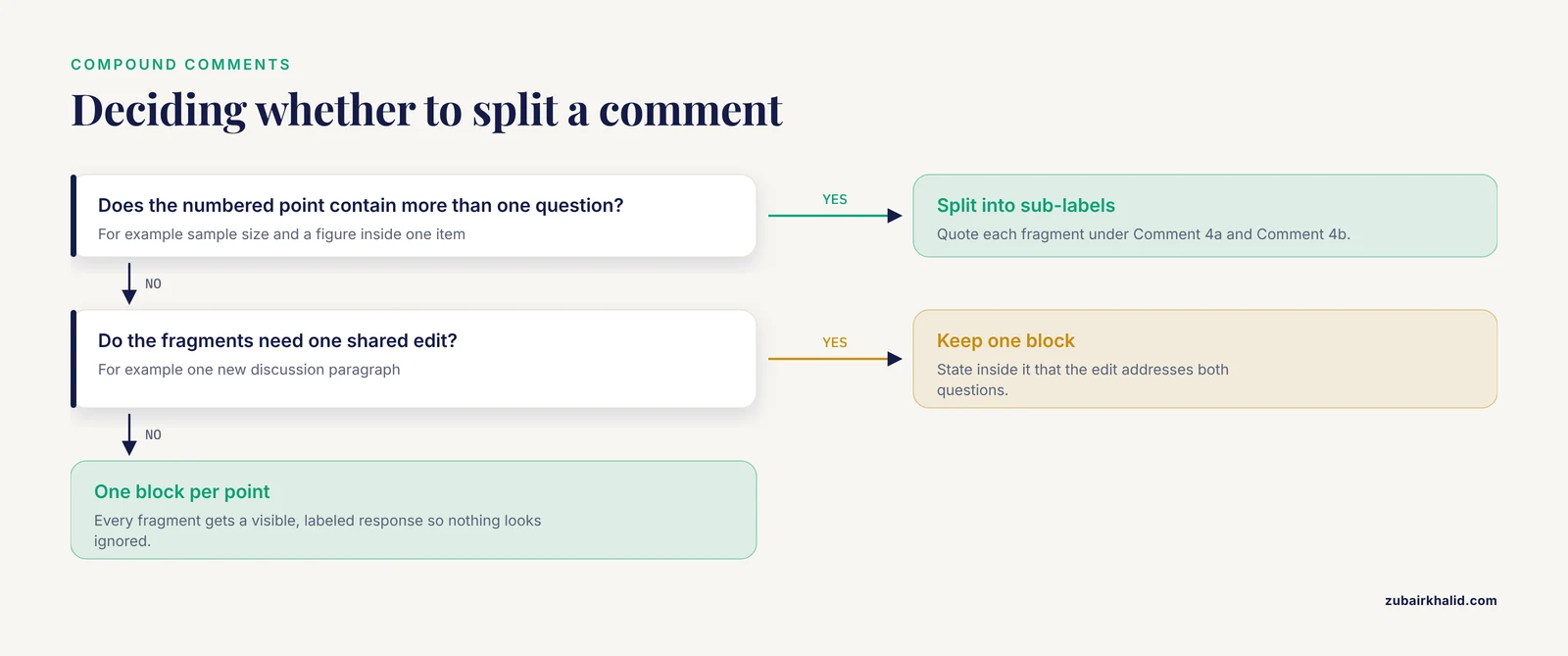
Real reviewer reports often bundle several questions into one numbered paragraph. The rule scales to this with a simple adaptation: split the compound comment into sub-comments, quote only the relevant fragment under each sub-label, and give each fragment its own block. So a single reviewer point that asks (a) whether the isotope data were flow-weighted and (b) whether the correlation between weighted and unweighted estimates changes the conclusions becomes two blocks, "Comment 5a" and "Comment 5b," each quoting its fragment and each answering one question. This mirrors how published rebuttals in catchment hydrology handle multi-part points, where the response letter walks through the reviewer's individual questions one at a time, quoting each and answering it with the corresponding manuscript change.
The exception to splitting is when two fragments genuinely demand one shared edit. If a reviewer's comment requires one new paragraph in the discussion that answers both a statistical point and an interpretation point, you may keep one block, but say so inside the block: "This edit addresses both questions in Comment 6." Transparency about the mapping is what the rule is really after.
How to Structure Response to Each Reviewer Comment: Tips
These tips come from the conventions visible in published rebuttals and from the practical experience of authors who revise under the Copernicus interactive format, where the exchange is public [14][11][15][16].
- State your formatting convention in the first lines of the letter, as the authors who wrote "original Reviewer's comment in italics, Author's response in orange" did [6]. Nobody should have to reverse-engineer your code.
- Thank the reviewers once, briefly, at the top of the letter, not under every comment. A published glaciology rebuttal thanks the editor for the opportunity and thanks the reviewers for detailed suggestions in a short opening paragraph before the point-by-point section begins.
- Quote new manuscript text for every substantive change. Reviewers checking a major revision want to see the new wording without opening the file.
- Keep each response block as short as the point allows. A response that runs half a page for a minor comment suggests evasion, not thoroughness.
- When a comment led to a big change, say "major change" in the block. Reviewers track whether their major concerns got major responses. The second-round review praising a reorganized results section shows what that tracking looks like from the reviewer's side.
- Where the reviewer's question asks for clarification of purpose or framing, answer the question and then note where the answer now lives in the manuscript, as one reanalysis intercomparison rebuttal did by answering the purpose question and adding the answer to the Abstract of the revised manuscript [5].
- If your journal uses interactive public review, remember the response will be citable. Write every block so it makes sense to a stranger reading it five years later [11][12].
Common Mistakes and Limitations
The following mistakes account for most structural failures in reviewer response letters. Each one is avoidable with the rule and the checklist above.
- Bundling several comments into one response. The reviewer reads the merged block and cannot tell whether each sub-point was answered. Split compound comments into labeled sub-blocks as described above.
- Dropping a comment entirely. With no mapping between comments and blocks, omissions are easy to miss. The count check in Step 7 exists for this reason.
- Paraphrasing the reviewer instead of quoting. A paraphrase can change the request, and the reviewer will notice. Quote verbatim.
- Answering before restating what changed. A response that says "we agree" but never names a section or line number forces the reviewer to diff two manuscripts by memory. Always include the change and its location.
- Burying disagreement. If you disagree and the reader has to infer it, the reviewer assumes consent and expects a change that never arrives. State disagreement in the first sentence of the block.
- Answering the editor's points inside a reviewer's section. Keep an "Editor" section with its own blocks, as published "Response to editor and reviewer comments" documents do [3].
- Inconsistent formatting. If comment 4 is quoted and comment 5 is summarized, the letter looks unfinished. One convention, applied everywhere.
- Pleasantries inside every block. Thanking the reviewer in all thirty response blocks pads the letter and delays the answers. One thanks at the top is enough.
Two limitations of the method deserve honest statement. First, the rule produces clear letters, not automatically persuasive ones. A well-formed block containing a weak argument still loses the point. Second, conventions differ by journal. Some journals require response letters in a specific template, and some cap the length of rebuttals. Check your target journal's author guidelines before adopting any format, including the ones in this article. And because every peer review situation differs, use the structure as scaffolding rather than as a script, adapting the blocks to what your reviewers actually asked.
How to Check Your Letter Before Submission
Run this verification pass on the finished document:
- Count reviewer comments against response blocks. The numbers must be equal.
- Search the letter for each quoted comment. Every comment should appear in italics, color, or a quote style exactly once, in its own block.
- Search for line numbers. Every block claiming a manuscript change should contain at least one line number or section reference from the revised file.
- Open the revised manuscript at three randomly chosen cited locations and confirm the quoted new text actually appears there. This catches the classic copy-paste drift where the letter quotes an older draft.
- Read only the first sentences of every response block, in order. If that skim alone tells you the verdict on each comment, your letter is structurally sound. If any first sentence does not contain the answer, rewrite that block so it does.
This checking routine takes about fifteen minutes on a typical major revision and prevents the round-trip delay caused by unanswered or unverifiable points.
Frequently Asked Questions
What is the one-comment-per-paragraph rule?
It is the convention that every single reviewer comment gets its own dedicated block containing the quoted comment, your answer, and the change you made in the manuscript. No block answers two unrelated points at once, and no comment goes without a visible, labeled response.
How do I handle a reviewer comment that contains several questions?
Split the compound comment into labeled sub-comments, such as Comment 4a and Comment 4b, quote the relevant fragment under each label, and give each fragment its own response block. If two fragments require one shared edit, keep one block and state inside it that the edit addresses both questions.
Should I quote the reviewer's comment in my response letter?
Yes, quote it verbatim. Quoting makes the letter self-contained, proves you read the request accurately, and lets the reviewer find their own points at a glance. Published rebuttals quote reviewer text in italics, colors, or block quotes precisely for this reason [6].
How do I respond to a comment I disagree with?
Open the block with the disagreement stated plainly, then give your reasoning with evidence, then state explicitly whether you changed the manuscript and why or why not. Dedicated comment-by-comment exchanges, including published post-publication responses, resolve disagreement on substance rather than by omission [13].
How do I structure responses when the editor also asked questions?
Give the editor a separate section at the end of the letter with the same block structure you used for the reviewers. Rebuttals titled "Response to editor and reviewer comments" make this two-section layout explicit [3].
What colors or fonts should I use for the response letter?
Pick one convention, such as italic blue for reviewer comments and black for responses, or italic comments with orange responses, state it at the top of the letter, and apply it consistently [2][6]. Choose colors that survive grayscale printing.
How long should each response be?
As short as the point allows. Minor comments usually need two to four sentences, while major concerns may need a paragraph plus quoted new manuscript text. A very long response to a minor point reads as evasion.
Do I have to respond to every minor comment individually?
Yes, in the sense that every comment needs a visible block. For a run of truly repetitive minor comments, you may answer several in one short block if they share a single fix, but say so in the block, and make sure each individual point is quoted or listed so nothing appears to be ignored. The count check against the original comment list is what protects you here.
Sources
- Response to Comment 2 by Anonymous Reviewer 2
- Response to reviewer's comments
- Response to editor and reviewer comments
- Response to reviewer comments
- Interactive comment on “ Global temperature response to the major volcanic eruptions in multiple reanalysis datasets ”
- Response to comments Original Reviewer’s comment in italics. Author’s response in orange. Reviewer #1 “Hydrogeological controls on spatial patterns of groundwater discharge in peatlands” by Hare et al. describes a multifaceted approach to understanding two primary mechanisms for groundwater discharg
- Manuscript NPG-2019-62 Simulation-based comparison of multivariate ensemble post-processing methods Response to Reviewer Comments
- Response to Reviewer Comment 3 for Convection-permitting climate model representation of severe convective wind gusts and future changes in southeastern Australia
- Response to Reviewer Comment 1 for Convection-permitting climate model representation of severe convective wind gusts and future changes in southeastern Australia
- Interactive comment on “ Rapid response of habitat structure and aboveground carbon storage to altered fire regimes in tropical savanna ”
- Response to anonymous reviewer comment RC1
- Response to the reviewer 1 Manuscript: “A comparative study of plant water extraction methods for isotopic analyses: Scholander-type pressure chamber vs. cryogenic vacuum distillation”, by Zuecco et al
- Response to Comment on “Methods to account for spatial autocorrelation in the analysis of species distributional data: a review”
- Authors’ response to interactive comment by Reviewer #1
- Authors’ response to interactive comment by Anonymous Reviewer #2
- ’ response to interactive comment by Reviewer # 1 Juraj Parajka