Jargon-Free Science Writing for Posters: A Plain-Language Checklist
By Dr. Zubair Khalid, DVM, MS, PhD ·

By the end of this guide you will be able to take a jargon-heavy poster draft and turn it into clear, readable text that a first-year student, a reviewer from another field, and a specialist can all follow. You will build a jargon inventory for your own draft, apply a repeatable swap process, run an objective readability check on your text, and rebuild each poster section around plain-language findings. You will also know the most common mistakes people make when they simplify scientific jargon for posters, and how to avoid them.
Here is what to have on hand before you start:
- Your current poster text in a single document (title, headings, body text, figure captions)
- A word processor with a word count and find-and-replace function
- Python 3 installed if you want to run the readability checks in this guide (optional but recommended)
- A colleague outside your subfield for a two-minute read-aloud test
- The poster guidelines from your specific conference, because size, orientation, and format rules vary between meetings
Why Posters Need Simpler Language Than Papers
A research poster is not a paper mounted on foam board. Conference attendees walk past dozens of posters in a single session, and most give a poster a minute or two before deciding whether to stop. During that window they read the title, one heading or two, and maybe the largest figure. If the text reads like a journal abstract, most of your audience moves on.
Jargon is the specialized vocabulary of a field. It includes acronyms (short forms built from the first letters of a name, such as PCR for polymerase chain reaction), technical nouns (apoptosis, chirality, mycorrhiza), and inflated verbs that papers use out of habit (utilize, elucidate, demonstrate). Jargon is efficient for experts and opaque to everyone else, including reviewers from adjacent fields, students, funders, and journalists who attend the same sessions.
Jargon-free science writing for posters does not mean avoiding all technical terms. It means keeping the technical terms your audience genuinely needs, defining them once, and cutting the ones that add length without adding meaning. Plain language is a precision tool. A sentence like "We measured how temperature changed bacterial growth rate" is shorter, clearer, and more accurate to what you did than "Temperature-dependent growth kinetics were investigated."
How to Simplify Scientific Jargon for Posters, Step by Step
This section is a complete walkthrough. Each step produces something concrete you can check before moving to the next one.
Step 1: Collect all poster text into one document
Open a new document and paste in every word currently planned for the poster: title, all headings, all body text, figure captions, and the acknowledgments line. Do not edit anything yet. At the top, write down your intended primary audience in one sentence, for example "undergraduate biology students and researchers from other life science fields."
Then count the words. In most word processors the count appears in the status bar. A common target for a full research poster is roughly 300 to 800 words of body text, and many conference guidelines suggest staying under about 800 words total. If your draft is well over that, simplification and cutting will happen together, which is fine.
Run this in a terminal to get a quick count if you prefer the command line:
text = open("poster_text.txt").read()
words = len(text.split())
print(f"Total words: {words}")
Expected output:
Total words: 1147That number is your baseline. Every later step should push it down.
Step 2: Flag candidate jargon with a repeatable scan
Rather than hunting for jargon by feel, scan the draft three times with three specific questions:
- Acronym pass. List every acronym and abbreviation. For each one, ask whether the full term appears nearby on the poster. If not, either spell it out at first use or cut it.
- Noun pass. Underline every word you would not use in a conversation with a smart non-specialist. Examples from life science drafts: upregulate, bioavailability, tensile strength, genotype-by-environment interaction.
- Verb and filler pass. Highlight inflated verbs and filler phrases. Common offenders: utilize, utilize, perform (as in "perform an analysis"), conduct, elucidate, in order to, prior to, subsequent to, a majority of, a number of.
You can automate a first sweep with a short Python script that searches your draft against a starter list of filler phrases:
import re

jargon_list = [
    "utilize", "elucidate", "paradigm", "methodology",
    "in order to", "prior to", "subsequent to",
    "a number of", "a majority of", "it should be noted",
    "demonstrate", "commence", "terminate",
]

text = open("poster_text.txt").read().lower()
hits = 0
for term in jargon_list:
    count = len(re.findall(r"\b" + re.escape(term) + r"\b", text))
    if count:
        print(f"{term}: {count}")
        hits += count
print(f"Total flagged phrases: {hits}")
Expected output for a typical unedited draft:
utilize: 3
in order to: 4
prior to: 2
demonstrate: 2
a number of: 1
Total flagged phrases: 12
The script does not catch field-specific nouns, because those differ by discipline. That is what the noun pass in your own reading is for. The script catches the mechanical filler that almost every draft contains.
Step 3: Apply the swap table
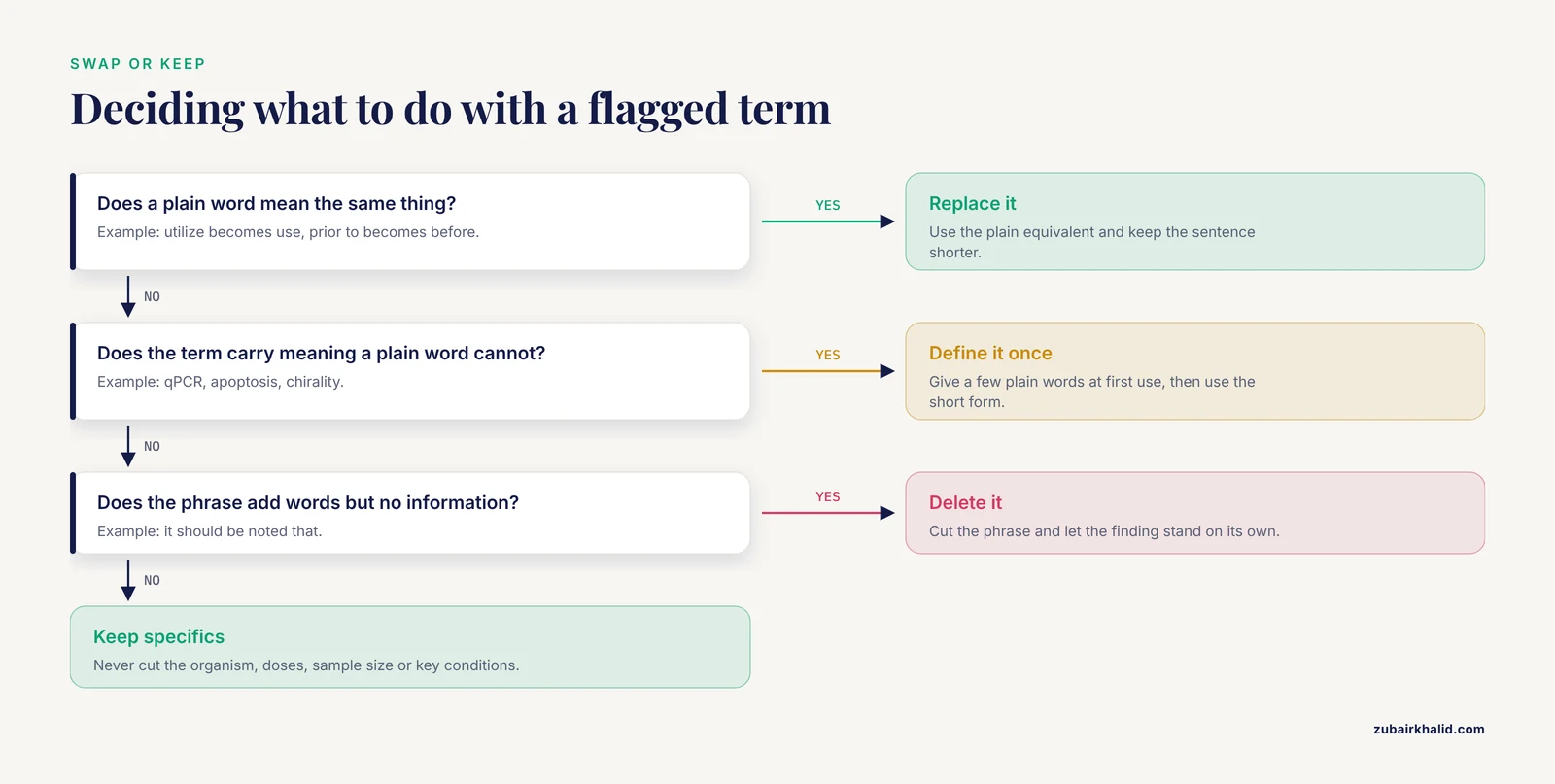
For each flagged item, choose one of three actions: replace with a plain equivalent, define it in a few words, or delete it. The table below summarizes the three options and shows worked examples you can adapt.
| Option | Use when | Before | After |
|---|---|---|---|
| Replace | A plain word means the same thing | "We utilized confocal microscopy to visualize…" | "We used confocal microscopy to see…" |
| Define | The term carries meaning a plain word cannot | "qPCR" with no explanation | "qPCR, a lab method that counts DNA copies" |
| Delete | The phrase adds words but no information | "It should be noted that results were significant" | "Results were significant" |
A quick reference of swaps that work across most life science posters:
- utilize → use
- in order to → to
- prior to → before
- subsequent to → after
- demonstrate → show
- a majority of → most
- exhibited an increase → increased
- was associated with → went with, or matched (choose the one you actually mean)
- methodology → method, or the specific technique name
- elucidate → explain, or show
- perform an analysis of → analyze
- individuals diagnosed with X → people with X (for human subjects work)
Notice a pattern: plain swaps are almost always shorter. Simplification is also compression, which is exactly what an overcrowded poster needs.
Step 4: Shorten sentences and prefer active voice
Active voice means the subject of the sentence performs the action ("We measured growth"). Passive voice means the subject receives it ("Growth was measured"). Posters tolerate some passive voice, but active sentences are shorter and easier to scan from a meter away.
Aim for an average sentence length near 15 to 20 words, with almost no sentence over about 25. Worked example, before:
"Investigation of the dose-dependent effects of the compound on inflammatory marker expression was undertaken utilizing an in vitro model system in which peripheral blood mononuclear cells were stimulated prior to compound administration."
After applying Steps 2 through 4:
"We exposed human immune cells to the compound at three doses and measured two inflammation markers after 24 hours."
The revision cut 44 words to 21, converted passive to active, replaced "inflammatory marker expression" with "inflammation markers," and stated the time point, which the original hid. Notice it kept the necessary specifics: doses, cell type, time point, measurement. Plain does not mean vague.
Step 5: Run an objective readability check
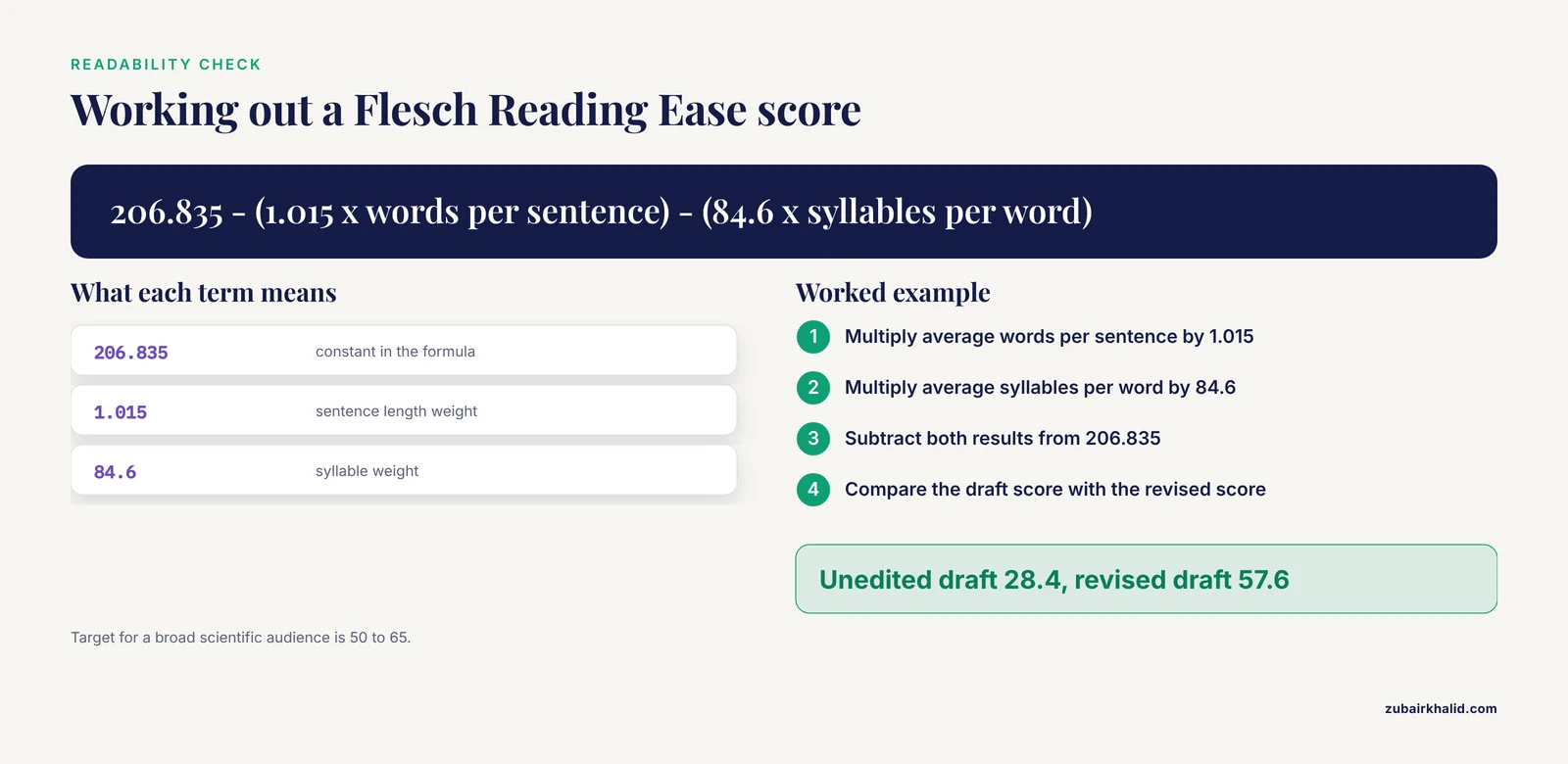
Subjective judgment is useful, but numbers give you a target and a way to confirm improvement. The standard tool is the Flesch Reading Ease score, a readability formula developed in the 1940s and still built into Microsoft Word and most writing tools. The formula is:
206.835 - (1.015 x average words per sentence) - (84.6 x average syllables per word)Scores run from 0 (very hard) to 100 (very easy). For a poster aimed at a broad scientific audience, a score in the 50 to 65 range is a realistic target. Academic prose typically scores in the 30s, which is exactly the problem you are fixing. The related Flesch-Kincaid grade level converts the same inputs into a US school grade estimate, and a grade 9 to 11 target works well for cross-disciplinary scientific audiences.
The Python textstat package computes both:
import textstat

poster_text = open("poster_text.txt").read()

ease = textstat.flesch_reading_ease(poster_text)
grade = textstat.flesch_kincaid_grade(poster_text)

print(f"Flesch Reading Ease: {ease:.1f}")
print(f"Flesch-Kincaid Grade Level: {grade:.1f}")
Expected output for the unedited draft from earlier steps:
Flesch Reading Ease: 28.4
Flesch-Kincaid Grade Level: 14.2
After working through Steps 2 to 4, a realistic improved output looks like this:
Flesch Reading Ease: 57.6
Flesch-Kincaid Grade Level: 9.8
If the installation fails, the exact message is usually ModuleNotFoundError: No module named 'textstat'. Fix it by running pip install textstat in the same environment you are using to run Python. If you get a FileNotFoundError, the file name in your script does not match the file on disk, so check the name and the working directory.
One caution on interpretation: readability scores reward short words and short sentences, and a text can score well while still being unclear. Treat the numbers as a smoke detector, not a certificate. A good score with confusing logic still needs a human edit pass.
Step 6: Rebuild each poster section around a finding
Now reassemble the poster with plain language built into its structure rather than patched on top. Work through the sections in this order:
- Title. State the finding, not the topic. "Temperature shifts alter bacterial growth rate" beats "Effects of temperature on bacterial physiology." Keep it under roughly 12 words.
- The one-sentence takeaway. Write the single sentence you want a reader to remember. If you cannot write it, the poster is not ready. Many presenters place this sentence at the top of the poster in large type or in a highlighted box.
- Headings. Replace topic headings with finding headings. "Results" becomes "Compound X cut inflammation markers in half at the highest dose." Headings are the only text many readers see, so they carry the most information per word on the whole poster.
- Methods. Keep this section short and specific. Name the organism or system, the key measurement, and the sample size, in two or three sentences. Detail that experts will ask about belongs in your spoken explanation or a handout, not in dense poster prose.
- Figure captions. Write captions that stand alone. A reader who sees only the figure and its caption should learn the main point of that figure. "Figure 2: Growth rate fell by half between 30 and 37 degrees Celsius" works without the rest of the poster.
- References and acknowledgments. Keep these small and complete, but do not spend plain-language effort here. Few readers study them at the poster wall.
Step 7: Run the hallway test
Print the revised text at reading size, hand it to a colleague outside your subfield, and give them 90 seconds. Then ask three questions: What did we find? How did we find it? Why does it matter? If they cannot answer all three, note which section failed and revise that section only. One round of this test catches more problems than another hour of solo editing.
A second useful check is reading your text aloud. Sentences you stumble over are sentences readers stumble over. Rewrite each one where you stumble.
How to Make a Scientific Poster: Design That Supports Plain Language
Simplified text only works if the research poster design lets people read it. Three design decisions matter most for plain-language goals.
Font size. Text at a conference poster is read from about one to two meters away. Common conference guidance is body text of at least 24 point, section headings of 40 point or larger, and a title readable from across the aisle, often 72 point or more. If your simplified text still does not fit at those sizes, the fix is cutting words, not shrinking fonts.
One message per panel. Arrange content so each region of the poster carries one idea, in a reading order that runs left to right and top to bottom. Numbered section labels (1, 2, 3) help readers who arrive mid-poster, which at a busy session is nearly everyone.
Figures carry the story. A jargon-free poster leans on visuals. Every figure should have a short plain-language title above it and a self-contained caption below it. Strip chart junk: remove gridlines a reader does not need, label axes with units, and enlarge axis fonts to match body text. A bar chart with a title like "The compound cut inflammation markers in half at the highest dose" communicates more in two seconds than a paragraph beside it.
Common Mistakes and Limitations
Even careful presenters repeat the same errors when simplifying. These are the ones to watch for, followed by an honest note on limits.
Replacing one jargon term with a longer phrase. Swapping "qPCR" for "quantitative real-time polymerase chain reaction performed on the platform described below" is not simplification. Define the term once in a few words, then use the short form.
Cutting the methods until they are unverifiable. Plain language never justifies hiding the organism, sample size, or key conditions. A poster that says "we tested the treatment" without naming doses or sample numbers invites justified skepticism. Keep the specifics, state them in short sentences.
Leaving acronyms undefined. Assume your acronym is unknown to at least half the people who stop at your poster, even in your own field, because acronyms are often lab-specific or cohort-specific. Spell out each acronym at first use, then abbreviate.
Trusting the readability score alone. As noted above, a high Flesch score can mask muddled logic. Use the score to catch sentence-level problems, and use the hallway test to catch structure problems.
Simplifying only the body text. The title and headings are read far more often than body paragraphs. If those stay jargon-heavy, the simplification effort is wasted. Revise them first, not last.
Ignoring conference-specific rules. Poster dimensions, orientation, and required sections differ between meetings, and some meetings require specific headers such as a structured background-methods-results format. Read your conference's instructions before finalizing the layout, and treat them as constraints your plain-language edit must fit inside.
Assuming the poster does the explaining. The poster is a visual anchor for a conversation. Its job is to start the conversation and support your two-minute explanation, not to replace it. If a detail will not fit, prepare to say it instead of printing it.
One limitation applies to the process itself: readability targets and word budgets in this guide are widely used conventions, not rules enforced by any scientific body. Your own conference guidelines, and your own judgment about your audience, take precedence. And if your poster reports human or animal research, remember that individual studies carry ethical and regulatory requirements that no writing style choice changes.
Frequently Asked Questions
How do I know which words count as jargon?
A word is jargon for your poster if a smart reader from outside your subfield would not know it. Test each candidate against this question while doing the noun pass in Step 2. Acronyms, discipline-specific nouns, and inflated verbs are the three categories to check.
How much text should a scientific poster have?
A common target is 300 to 800 words of body text, with many conference guidelines suggesting a ceiling near 800. Treat these as upper limits. If your simplified text still exceeds them, cut sections rather than shrinking fonts.
What readability score should I aim for?
Aim for a Flesch Reading Ease score of roughly 50 to 65, or a Flesch-Kincaid grade level of 9 to 11, for a cross-disciplinary scientific audience. Use the textstat check in Step 5, then confirm with a human reader.
Will simplifying my language make my poster look less rigorous?
No. Plain language and rigor are separate. Keep your methods specific, your numbers exact, and your claims matched to your data, and clarity will make the work look more credible, not less.
How do I simplify the methods section without losing essential detail?
Keep the system, the intervention, the key measurement, and the sample size, each in its own short sentence. Move exhaustive parameters to a handout or a QR-code link to your preprint, and be ready to answer method questions verbally.
What font sizes should I use on a research poster?
Common guidance is body text of at least 24 point, headings of 40 point or larger, and a title of 72 point or more so it reads from across the aisle. Always check your specific conference's guidelines first.
How do I handle abbreviations on a poster?
Spell out each abbreviation at its first appearance, followed by the abbreviation in parentheses, then use the abbreviation alone afterward. If an abbreviation appears only once on the poster, spell it out and drop the abbreviation entirely.
How long does it take to simplify a poster draft?
Plan on two to three focused hours for a typical draft, including the jargon scan, the rewrite, the readability check, and one hallway test. Drafts with heavy jargon or a weak takeaway sentence can take longer, and the hallway test usually adds one more short revision round.