How to Use Advisor Feedback to Refine Your Thesis Scope
By Dr. Zubair Khalid, DVM, MS, PhD ·

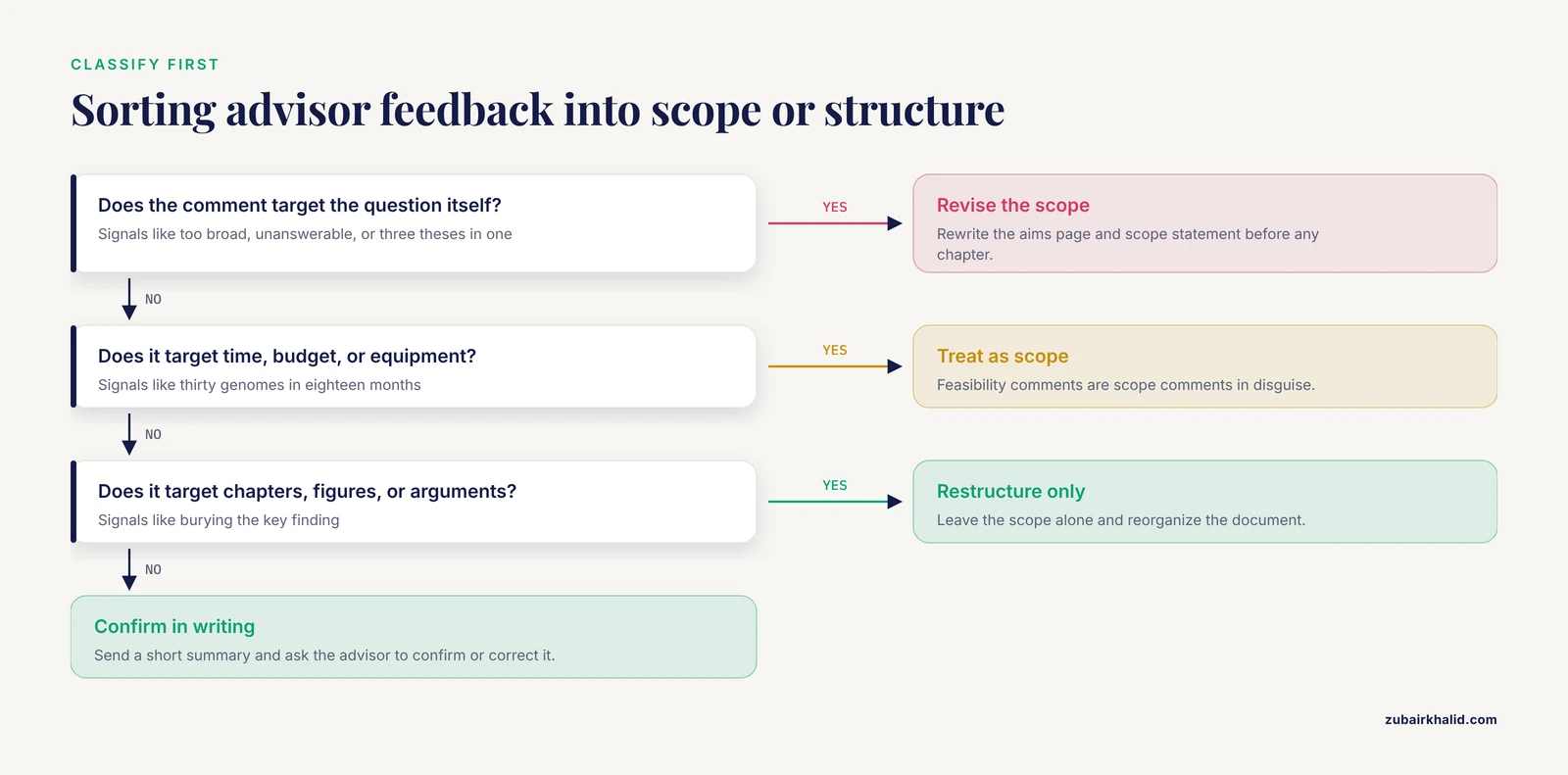
Advisor feedback does one of two things: it questions what you are asking (your research question and its scope) or it questions how you are answering it (your methods, structure, and writing). The fastest way to decide how to respond is this rule of thumb: if your advisor comments on the question itself, revise the scope before touching a single chapter, and if your advisor comments on chapters, figures, or arguments, revise the structure while leaving the scope alone.
Most graduate students get this backwards. They respond to scope-level comments with cosmetic edits, adding a sentence here and reordering a paragraph there, while the underlying question remains too broad, too vague, or unanswerable with the available data. This article walks through the five practical options for responding to advisor feedback, compares them side by side, works through realistic biology scenarios, and shows how to fold the revised scope back into your thesis plan and biology thesis structure.
What Advisor Feedback Is Actually Telling You
A well-formulated research question is the foundation stone of any research project. It determines the scope and direction of the investigation, keeps the study focused, prevents needless diversions, and drives the choice of methods for gathering and analyzing data. When your advisor reads your proposal or draft chapters, they are checking your work against this chain: question, then methods, then results, then interpretation. Feedback at any point in the chain is often really feedback about the first link.
Before you respond to any comment, classify it. Most advisor feedback falls into one of four categories.
Feedback about the question itself
Comments such as "this is really three theses," "what is your actual dependent variable," or "who cares about this answer" target your research question. The stepwise approach to formulating a research question starts with identifying a subject of interest, doing preliminary research, defining what still needs to be known, and then narrowing the focus and scope before framing and evaluating the question [1]. If your advisor's comments suggest you skipped one of those steps, the fix belongs at the scope level.
Feedback about feasibility
Comments such as "you cannot sequence thirty genomes in eighteen months" or "that assay requires equipment you do not have" target whether the question can be answered with your time, budget, and skills. Feasibility is the first criterion in the FINERMAPS framework, which holds that a good research question is feasible, interesting, novel, ethical, relevant, manageable, appropriate, has potential value and publishability, and is systematic [1]. Feasibility comments are scope comments in disguise.
Feedback about evidence and literature
Comments such as "you have missed the last five years of literature" or "this claim needs a citation" target the evidentiary base under your scope. Comprehensive literature reviews define what has been done, what remains open, and where your study sits. A systematic review of forty-one articles on a single operations-research problem, for example, classified every prior study by objective functions, decision models, constraints, solution methods, problem size, and data type, and used that classification to identify the themes future studies needed [2]. That is the discipline your literature chapter should show, and advisors comment when it is missing.
Feedback about structure and writing
Comments such as "your results chapter buries the key finding" or "move the methods summary earlier" target presentation. These rarely require scope changes. They require a plan for how to plan a thesis document that serves the reader.
The Five Options for Incorporating Advisor Feedback
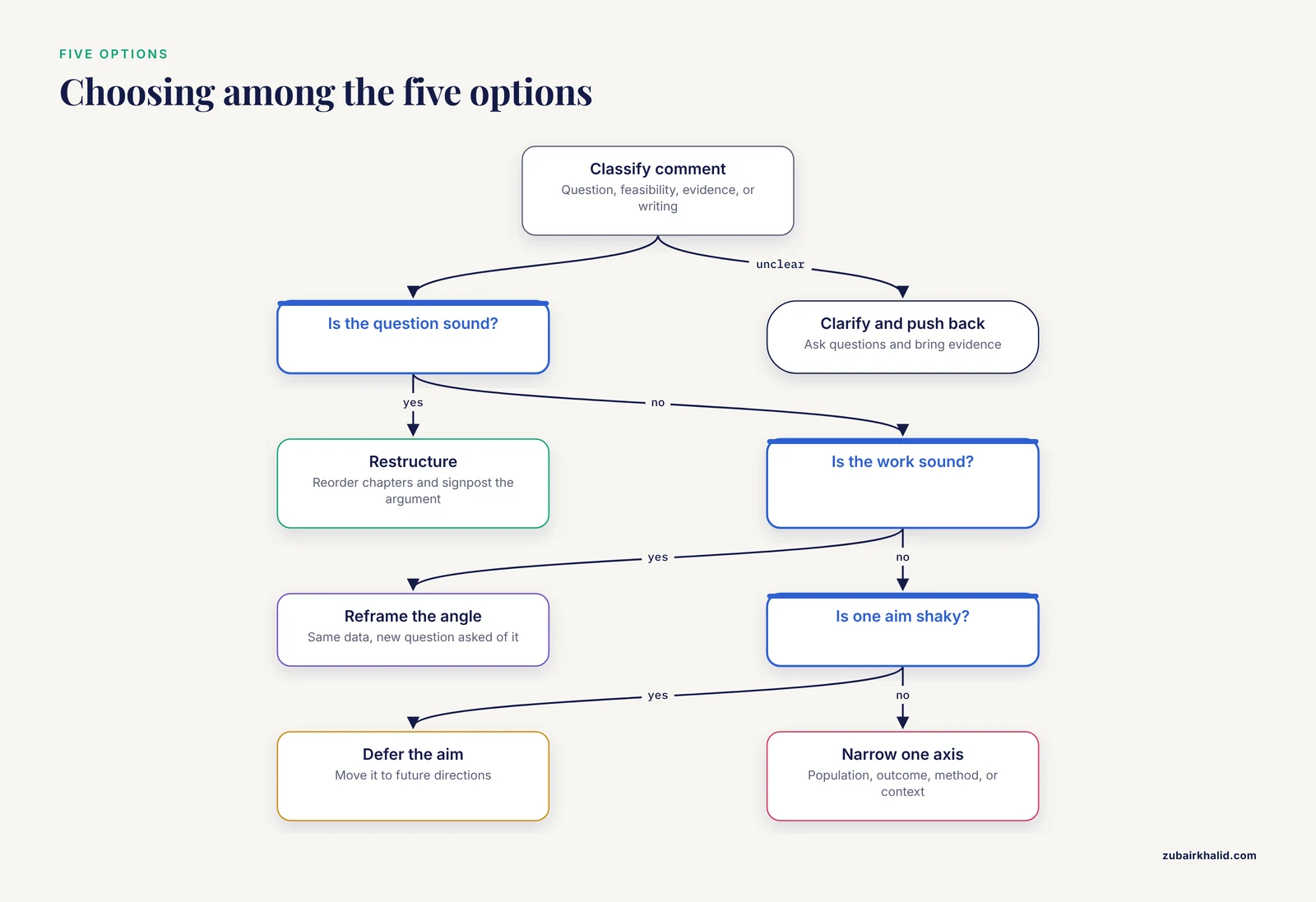
There are five realistic ways to act on a scope-level comment. Choosing among them is the core of knowing how to incorporate advisor feedback into thesis scope decisions.
| Option | What it means | Advisor signal that triggers it | Best used when | Main trade-off |
|---|---|---|---|---|
| 1. Narrow the question | Cut one variable, one population, or one aim from the study plan | "Too broad," "unanswerable," "three theses in one" | Feasibility or manageability problems [1] | Less data, less impressive-sounding title, faster completion |
| 2. Reframe the angle | Keep your materials and data, change the question asked of them | "So what," "this does not fit the field," "why these organisms" | The work is sound but the motivation or positioning is weak [3] | Requires rewriting the introduction and discussion, no new data |
| 3. Defer an aim | Move part of the scope to a future-directions section | "Save that for the follow-up paper" | One sub-aim is underdeveloped or risky | Smaller contribution, possible disappointment |
| 4. Restructure, do not rescope | Reorganize chapters, reorder arguments, clarify methods | "Unclear," "burying the point," chapter-level comments | The question is fine, the document is not | None, if you diagnose correctly |
| 5. Clarify and push back | Ask questions, present evidence, negotiate | Feedback that seems to contradict itself or rests on a misunderstanding | The advisor misread your aims or lacks recent knowledge of a subfield | Requires tact and preparation |
How to Incorporate Advisor Feedback into Thesis Scope: Options in Detail
Option 1: Narrow the question
Narrowing is the most common scope revision and usually the most correct one. When an advisor says a topic is too broad, they are applying the manageability criterion from FINERMAPS. The formulation literature is explicit that narrowing the focus and scope of the research subject is a required step before a question can be framed and evaluated [1]. A research question determines the scope and direction of the investigation, so a question that points in three directions produces a thesis that finishes in none.
Narrowing works on four axes, and you should narrow on one axis at a time so you and your advisor can see exactly what changed.
- Population. Drop from "freshwater invertebrates" to a single genus, or from "children" to a defined age band, the way a scoping review protocol restricts itself to infancy and childhood and explicitly excludes adolescents and adults [4].
- Outcome. Measure one or two endpoints well instead of five poorly. A study that set out to define the scope of clinically actionable mutations in pediatric cancer chose a specific, bounded set of variant categories, diagnostic, prognostic, therapeutically relevant, and predisposing, rather than attempting to characterize every molecular feature of every tumor [5].
- Method. Use one well-characterized technique rather than three platforms of partial coverage. In the same pediatric cancer study, a three-platform sequencing approach was justified because each platform caught variants the others missed [5], which is the exception that proves the rule: multi-method designs need explicit justification, and an advisor will ask for it if you do not volunteer it.
- Context. Restrict the setting, time frame, or disciplinary frame. Focused ethnography, for instance, is characterized partly by a more limited study timeframe and scope, a limited subpopulation sample, and more concentrated research questions than traditional ethnography [6].
A concrete example. A student proposes "the effects of microplastics on freshwater ecosystems." Narrowed once: "the effects of polyethylene microplastics on feeding rate in Daphnia magna." Narrowed twice, if the advisor still hesitates: "the dose-response effect of polyethylene microsphere concentration on filtration rate in Daphnia magna over 96-hour exposures." Each narrowing removes an axis the student would otherwise have to defend.
The main trade-off is emotional. Students resist narrowing because a broad topic feels more impressive. In practice, examining committees reward depth on a bounded question and punish shallow coverage of an unbounded one.
Option 2: Reframe the angle without discarding your work
Sometimes the advisor's complaint is not that the study is too big but that it answers a question nobody in the field is asking. Reframing keeps your materials, organisms, datasets, or models and changes the question posed of them. This is where a conceptual framework for the scope of interdisciplinary research becomes useful, because reframing often means relocating your question from one disciplinary frame to another and justifying that relocation [3].
A concrete example. A student has spent a year collecting gene-expression data on drought-stressed seedlings. The advisor comments that the descriptive results do not advance the field. Reframing options include asking which genes form a coherent response module, asking whether expression patterns predict survival under a second stress, or asking whether the response differs between two ecotypes. Same data, three different theses. The advisor's feedback told the student the data were fine and the question was not.
Reframing trades rewriting effort for salvaged effort. You will rewrite the introduction and discussion heavily, but your results chapters survive.
Option 3: Defer an aim to future work
When a thesis plan contains one strong aim and one shaky aim, the pragmatic move is to cut the shaky aim and describe it in a future-directions section. Large research communities use the same logic. A national research agenda for layperson hemorrhage control used a structured consensus process to rank a long list of candidate questions down to a small set of high-priority items for immediate work [7]. Your thesis committee performs an informal version of the same ranking every time they meet with you.
Deferral is not failure. Doctoral research regularly generates more questions than one document can answer, and the future-work section of a thesis is read seriously by examiners and by researchers who build on your work.
Option 4: Restructure rather than rescope
A large share of advisor comments that feel like scope comments are actually presentation comments. Before you cut an aim or change a question, check whether the problem is the document. The standard biology thesis structure follows the IMRaD pattern, introduction, methods, results, and discussion, often expanded into introduction, literature review, materials and methods, results, discussion, and conclusions, with a figure and table list, abbreviations list, and appendices. If your results chapter reports experiments in the order you performed them rather than the order that builds your argument, an advisor will read the thesis as unfocused even when the scope is sound.
Restructuring tasks that respond to feedback include the following.
- Reorder results chapters so each one answers part of the central question in sequence.
- Move secondary findings to a later chapter or an appendix.
- Write a signposting paragraph at the end of the introduction that states the question, the approach, and the chapter plan in three sentences.
- Trim the literature review to studies that bear directly on the question. Analyses of thesis topics in a field, which used a thesis database to map how topics distribute across research areas and identify the most active avenues [8], show that fields have identifiable centers of gravity, and your review should sit your question inside one of them rather than surveying everything.
The trade-off here is only time, and it is the cheapest time you will ever spend.
Option 5: Clarify and push back
Advisor feedback is not infallible, and blind compliance is not the same as incorporation. The supervisor-candidate relationship is one of the defining features of doctoral work, and the literature on doctoral writing treats that relationship, including its tensions and negotiations, as central to how the thesis develops [9]. When feedback seems wrong, respond with questions rather than defenses: "when you say the scope is too broad, do you mean the population, the endpoints, or the methods?" Then confirm the agreed revision in a short follow-up email so both of you share a record of the new scope.
Pushing back productively also means bringing evidence. If your advisor questions a method you have good reason to keep, bring the primary literature and the practical constraints, and ask what outcome would satisfy their concern.
Pros and Cons of Each Option
Students searching for how to incorporate advisor feedback thesis scope pros and cons are usually weighing speed against completeness. The honest comparison follows.
Narrowing the question. Pros: fastest route to a feasible, defensible project, aligns with the manageability criterion in standard question-formulation frameworks [1], and reduces committee risk. Cons: shrinks the contribution, can strand data you already collected, and can feel like a demotion.
Reframing. Pros: preserves your investment in materials and data, can raise the significance of the work by repositioning it, and suits interdisciplinary topics where the contribution depends on choosing the right frame. Cons: heavy rewriting, risk of choosing a frame your committee does not share, and no reduction in workload.
Deferring an aim. Pros: protects the core thesis timeline, keeps a risky subproject from delaying graduation, and produces an honest future-work roadmap in the tradition of consensus research agendas [7]. Cons: a smaller thesis, and the deferred aim may nag at you during your defense.
Restructuring. Pros: no scientific cost, immediate readability gains, and it often dissolves complaints that looked like scope complaints. Cons: it wastes weeks if the advisor's real objection was the question itself, which is why the diagnostic step comes first.
Clarifying and pushing back. Pros: prevents overcorrection, builds the supervisory relationship through honest negotiation [9], and documents the reasoning behind scope decisions. Cons: slow, socially uncomfortable, and unproductive if the advisor's concern rests on hard constraints such as funding or equipment.
The best option is often a sequence. Diagnose, clarify, then restructure if the problem is presentation, narrow or defer if the problem is feasibility, and reframe if the problem is significance.
Worked Scenarios
Scenario A: The too-broad ecology thesis
A student proposes studying how urbanization affects amphibian communities across three habitat types. The advisor writes, "this is a five-year project." The student classifies the comment as a feasibility comment and chooses Option 1. Within two weeks, the scope becomes how road proximity affects species richness and calling activity in one wetland complex over one breeding season, measured with automated acoustic recorders. The student keeps the three-habitat comparison as a stated future direction and drafts the revised one-paragraph scope statement for the advisor to approve. Total cost, one meeting and one rewrite of the aims page.
Scenario B: The methods objection
A student plans to identify bacterial isolates by phenotype alone. The advisor says the thesis will not hold up without molecular identification. The student initially panics and considers abandoning the collection work. Instead, the student classifies the comment as a methods-feasibility comment and responds with Option 5 plus Option 3. In the meeting, the student asks whether 16S rRNA gene sequencing of a representative subset would satisfy the concern. The advisor agrees that sequencing the twenty most abundant isolates, rather than all two hundred, balances rigor and budget. The scope narrows the identification claim to the sequenced subset, and the full phenotypic dataset moves to a descriptive chapter.
Scenario C: The significance objection
A student has compiled a dataset on enzyme activity across soil depths. The advisor comments that the descriptive results do not connect to any mechanistic question. The student chooses Option 2, reframing. Rather than "how does enzyme activity vary with depth," the revised question asks whether depth-related variation in enzyme activity predicts carbon mineralization rates, which connects the same measurements to a question soil biogeochemists actively debate. The data, assays, and sampling design all survive. The introduction and discussion get rewritten around the new framing.
Common Mistakes and Limitations
- Responding to scope comments with edits. Adding a sentence to your introduction does not narrow a question. If the comment targets the question, revise the aims page and the scope statement first, then let the chapters follow.
- Collecting feedback passively. Students who wait for annual meetings accumulate a year of drift. Send short written summaries after every meeting and ask the advisor to confirm or correct them.
- Changing scope after data collection without checking the fallout. Narrowing a question can strand collected data and void approved protocols. If your work involves animal subjects or human participants, scope changes may require new or amended approvals from your institutional review board or animal care committee before you collect another data point.
- Treating the first draft of feedback as final. Advisors revise their own advice as your project matures. Confirm the current version in writing before you rebuild a chapter.
- Narrowing so far that the thesis loses a contribution. The question formulation literature balances manageability against novelty, relevance, and potential value [1]. A question that is trivially manageable but answers nothing anyone wants to know fails the same test from the other side.
- Assuming all advisors give the same kind of feedback. Supervisory styles differ widely, and the supervisor-candidate relationship itself shapes how much direction a candidate receives and how much negotiation the scope undergoes [9]. A hands-off advisor's silence is not approval, and a hands-on advisor's detailed notes are not a mandate to follow every one.
- Expecting feedback to substitute for your own judgment. Advisors identify problems, but the candidate owns the scope statement. When you leave a meeting, you should be able to write the revised scope in three sentences without asking anyone.
One general limitation applies. Every program, committee, and advising relationship differs, and the right response in your situation depends on your program's milestones, your funding timeline, and your advisor's expectations, which no general article can decide for you.
Using Feedback to Rebuild Your Thesis Plan and Structure
Once the scope is settled, feedback becomes the raw material for a concrete plan. Knowing how to plan a thesis after a scope revision means three tasks.
First, rewrite the scope statement. One paragraph, placed at the top of your working document, that states the revised question, the population and context, the primary outcome, and the methods. Every later decision should check against it. This mirrors the way a scoping review protocol fixes inclusion criteria in advance so the study boundaries stay stable while the work proceeds [4].
Second, rebuild the timeline. Map the revised aims onto months, and attach a deliverable to each, for example, "finish pilot extractions by March," "complete all behavioral assays by June," "draft results chapter one by August." Scope changes almost always change the timeline, and stating the new timeline in writing prevents a second round of feasibility objections.
Third, align the document skeleton with the new scope. In the standard biology thesis structure, each results chapter should correspond to one aim, the discussion should return to each aim in order, and the conclusion should state what each aim contributed. If your revised scope has two aims, the thesis needs two results chapters plus whatever methods chapters the aims require. A thesis whose structure mirrors its scope statement is far easier for a committee to follow, and chapter-level advisor feedback shrinks accordingly.
Finally, mine the feedback for the future. A comment that led you to defer an aim is the seed of your first postdoctoral or manuscript project. Researchers who mapped a field's thesis topics over fifteen years did exactly this, using the accumulated record of completed theses to identify the most active areas and the top-priority avenues for future work [8]. Your advisor's rejected and deferred suggestions are a private version of that map.
A note on information gathering as you replan. Doctoral candidates increasingly lean on freely available online sources during thesis writing, and a study of doctoral students found that search engines and open web resources occupy a substantial place in the information practices surrounding thesis work [10]. Open sources are excellent for scoping a revised topic quickly, but your final scope statement should rest on the peer-reviewed literature your committee will expect you to know.
Frequently Asked Questions
How do I know if advisor feedback means my scope is too broad or just unclear?
Ask your advisor directly which axis to narrow on. If the concern is manageability, feasibility, or time, the scope is too broad and needs cutting [1]. If the advisor can restate your question in a way you agree with, the scope may be fine and the writing is unclear, which calls for restructuring rather than rescoping.
Should I always do what my advisor says about my thesis scope?
No, but you should always engage with it. Present your reasoning, ask clarifying questions, and negotiate when feedback conflicts with your data or constraints, since the supervisory relationship is built to accommodate this exchange [9]. Then confirm whatever you agree on in writing.
How do I incorporate advisor feedback without starting my thesis over?
Classify the feedback first. Most comments require either restructuring, which costs days, or narrowing on a single axis, which costs weeks. Reframing and deferral let you keep your data while changing only the question or the project boundaries. Full restarts are rare and usually follow failed experiments, not feedback.
When is it too late to change my thesis scope?
The practical deadline is when the data needed under the old scope can no longer be collected within your timeline, and the administrative deadline is when your protocol approvals or committee sign-offs would need revision. Up to those points, a scope change costs rewriting and a revised plan. Past them, defer the new direction to future work instead.
What is the best way to track and organize advisor feedback?
Keep a single running document with one entry per comment, the meeting date, the option you chose from the five options, and the action taken. Summarize agreed changes in a follow-up email after each meeting. This record becomes your defense prep document and prevents the same comment from arriving twice.
What should I do if my advisor and my committee disagree about my scope?
Bring the disagreement back to both parties explicitly, ideally in writing, and ask which constraint each side is protecting, usually feasibility on one side and significance on the other. Most disagreements resolve by narrowing to a core aim both accept and deferring the contested part to future directions, the same ranking move used in formal consensus research agendas [7].
Sources
- Formulation of Research Question - Stepwise Approach
- Developments in the Literature and New Study Recommendations Within the Scope of the Assembly Line Worker Assignment and Balancing Problem (ALWABP)
- A conceptual framework for defining scope and opportunities of interdisciplinary research in management
- Defining and measuring multiple long-term conditions in research during infancy and childhood. A scoping review protocol.
- Abstract 642: Genomes for Kids: Comprehensive DNA and RNA sequencing defining the scope of actionable mutations in pediatric cancer
- Defining focused ethnography: Disciplinary boundary-work and the imagined divisions between 'focused' and 'traditional' ethnography in health research - A critical review.
- Defining a Research Agenda for Layperson Prehospital Hemorrhage Control: A Consensus Statement.
- Scope of Thesis Research in the Area of Physical Science Education
- Writing a doctoral thesis in the field of theatre - a voluntary, necessary or “imposed” act
- 'Just Google it' - the scope of freely available information sources for doctoral thesis writing