What to Do When You Suspect a Predatory Journal
By Dr. Zubair Khalid, DVM, MS, PhD ·
Suspicion usually begins in one of two ways. Either an unsolicited email arrives promising fast publication for a fee, or you are already weeks into a submission and something about the journal feels wrong. The single fastest first check is the same in both cases: verify the journal's claimed indexing directly at the source. Search the journal title in the NLM Catalog to confirm MEDLINE or PubMed status, in the DOAJ (Directory of Open Access Journals) for open access claims, and in the Scopus source list if indexing in Scopus is claimed. Predatory journals frequently assert indexing and impact factors they do not actually have [1].
A predatory journal is a publication that prioritizes profit over scholarship. It charges fees without providing genuine peer review or editorial oversight, and it disregards the ethical standards that make scientific literature trustworthy [1]. Knowing how to identify predatory journals before you submit protects your data, your reputation, and the readers who might act on your findings. Knowing what to do after you have submitted or published protects your record when the check comes too late.
This article walks through the red flags, a diagnostic sequence you can follow step by step, and concrete fixes at every stage, from an unopened email to an already published paper.
Why This Matters for Research Ethics
Publication is no longer just a way to share results. It is a currency for hiring, promotion, and institutional rankings, and this metric-driven pressure has created fertile ground for journals that exploit researchers [2]. The "publish or perish" environment, combined with pay-to-publish open access models, has produced a documented propensity for ethical violations in biomedical publishing, from undeserved authorship to duplicate submission [3].
The harm does not stop with the individual author. Research published without real peer review can end up cited in public health policy documents, where the evidence behind decisions is often evaluated with variable rigor [4]. In one survey of educational partners at a chiropractic college, 57 percent of respondents were unsure or unfamiliar with predatory journals and 51 percent lacked confidence in recognizing them [5]. In a Tunisian survey of dental university hospital doctors, more than half reported no prior training on the topic, and only 16.9 percent checked blacklists before submitting [6]. The gap between how often people publish and how often they vet journals is the core problem this article addresses.
How to Identify Predatory Journals: The Red Flags
Practical guides converge on a consistent set of warning signs [1]. Group them into four categories: presentation, content, business practices, and claims.
Presentation red flags. Unprofessional websites, grammatical errors, generic stock photos, and journal names that closely mimic reputable titles [1].
Content red flags. Published articles that fall far outside the journal's stated scope, formatting that changes from paper to paper, and volumes of output inconsistent with a genuine editorial pipeline [1][8].
Business practice red flags. Aggressive email solicitations promising rapid or guaranteed acceptance, vague or hidden article processing charges (APCs, the fees some journals charge authors to publish), and pressure to accept revisions or pay invoices quickly [1][9].
Claim red flags. False assertions of indexing in databases such as Scopus or PubMed, fabricated impact factors, and editorial boards listing researchers who have no actual relationship with the journal [1].
Here is a troubleshooting table you can use as a working checklist. Read a row, confirm the finding yourself, and only then act.
| Symptom | Likely cause | How to confirm | Fix |
|---|---|---|---|
| Unsolicited email offering rapid or guaranteed acceptance | Mass solicitation campaign by a predatory publisher [1][9] | Check whether you ever contacted the journal, verify the sender's domain matches the journal's real website, search the journal in DOAJ | Do not reply, do not click embedded links, do not submit. If the journal impersonates a real one, notify the impersonated publisher |
| Journal name nearly identical to an established journal | Name mimicry designed to capture mistaken submissions [1] | Compare the ISSNs (International Standard Serial Numbers) of both titles, check the publisher's registered address | Submit only to the journal you verified independently through its official site or a database |
| Claimed indexing in PubMed, MEDLINE, or Scopus that you cannot verify | False or inflated indexing claims [1] | Search the journal directly in the NLM Catalog, the DOAJ, and the Scopus source list rather than trusting the journal's own page | Treat the unverifiable claim as disqualifying and choose a different journal |
| An impact factor or "citescore" displayed prominently but found nowhere in official records | Fabricated metric [1] | Look the journal up in the databases that actually compute metrics rather than accepting a badge on the journal's website | Disregard the displayed metric and re-evaluate the journal without it |
| Fees are unclear, vague, or revealed only after acceptance | Hidden APCs used to trap authors [1][9] | Look for a complete public fee schedule before submission, covering submission fees, page charges, and color charges | Request the fee schedule in writing. If the journal refuses or changes its answer, withdraw |
| Acceptance within days, with no reviewer comments | Missing or nominal peer review [8][5] | Compare the stated turnaround with realistic timelines for your field, and check whether the journal publishes review reports or reviewer policies | Withdraw the manuscript before signing any agreement |
| Listed editorial board members who appear to have no connection to the journal | Fabricated or stolen editorial credentials [1] | Cross-check names against the listed editors' institutional profiles, or contact one directly | Stop the submission and report the journal to your library or research office |
| Retractions appearing in the journal with little explanation | Weak post-publication oversight [10] | Search the journal's articles in the Retraction Watch Database | Reassess whether the journal exercises any quality control before you cite or submit |
No single row convicts a journal by itself. The pattern matters, and the sections below explain how to weigh each one.
A Diagnostic Sequence, From Most Common to Rarest
Work through these checks in order. The first ones catch most cases, and the later ones handle the borderline situations that lists alone cannot resolve.
Step 1: Examine the solicitation itself
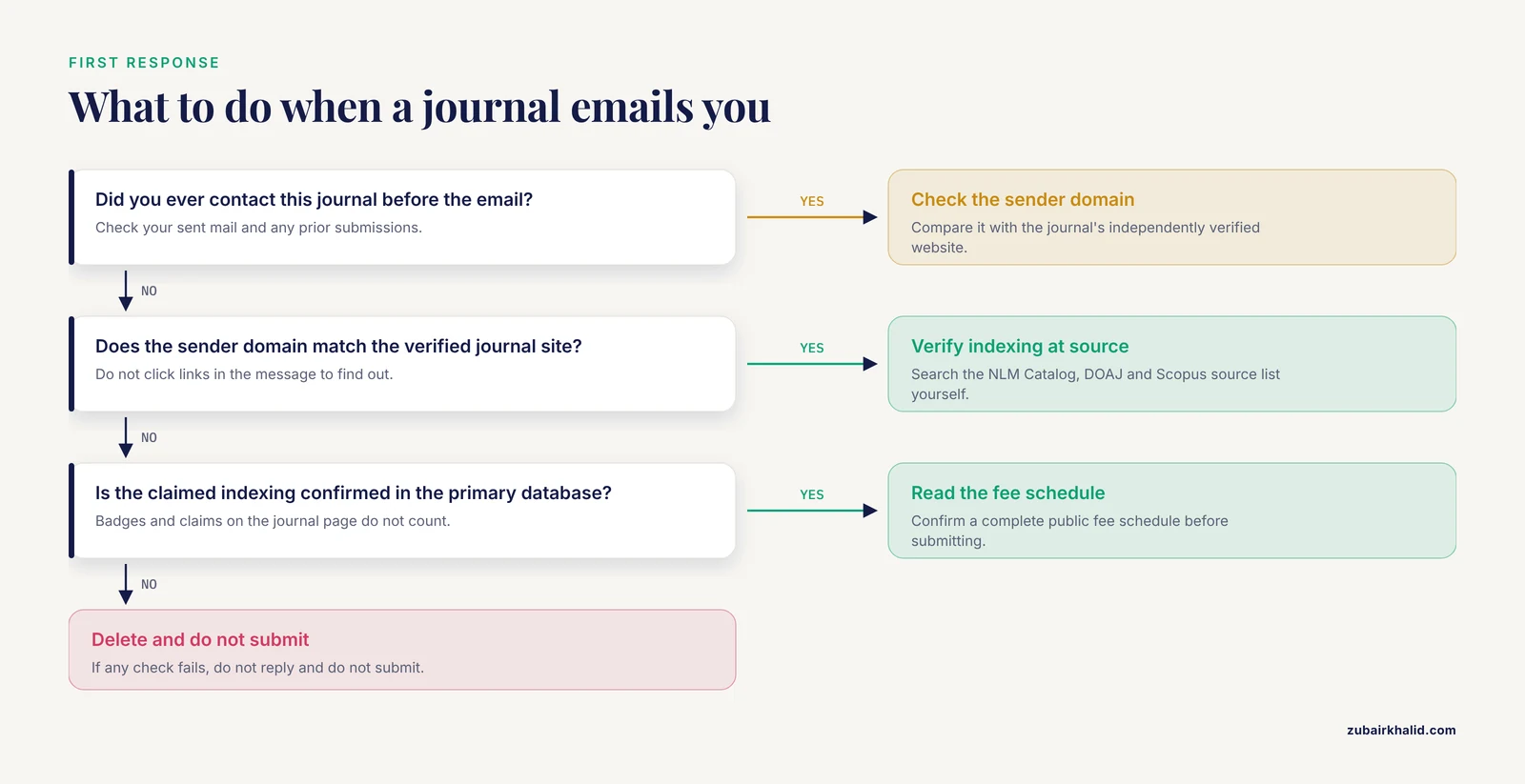
The most common trigger for suspicion is the unsolicited email. In one analysis, an academic urologist received 422 solicitations in roughly six weeks, from which 214 potentially predatory journals were identified, representing 75 different publishers, with only 7.35 percent of the solicitations actually related to urology [9]. The mechanism is volume. Predatory publishers send broad, discipline-blind invitations because their business model depends on submission volume, not scholarly fit. A legitimate editor rarely emails a stranger promising guaranteed acceptance in a journal outside that stranger's field.
Confirm the origin before anything else. Check whether you ever contacted the journal. Compare the sender's domain against the journal's independently verified website. Do not click links in the message, since some campaigns route you to lookalike submission portals that harvest your manuscript and contacts.
Step 2: Verify the journal's identity
Look up the journal by its ISSN in the databases it claims to belong to. Confirm the publisher's name and address. Name mimicry is a deliberate tactic, where a predatory title differs from a reputable one by a single word or a changed preposition [1]. The fix is procedural, not intuitive: always reach the journal by typing its verified URL or going through DOAJ, PubMed, or your library's discovery system, never by following a link in an email.
Step 3: Test the indexing and metric claims
Predatory journals make false claims about indexing in databases like Scopus or PubMed and display fabricated impact factors [1]. Confirm each claim at the primary database, not on the journal's own pages. If a journal displays an impact factor but has no record in the service that computes impact factors, the displayed number is fabricated. This single verification step resolves more suspicion than any other, because predatory publishers rely on authors trusting the journal's self-description.
Step 4: Read the fee structure critically
Fee opacity is a business-practice warning sign, but fee size alone is not diagnostic. In the urology comparison above, potentially predatory journals had a mean APC of about 2,272.50 USD (median 2,000 USD, range 150 to 3,690 USD), while legitimate journals had a higher mean APC of about 3,244.51 USD (median 3,490 USD, range 635 to 6,950 USD) [9]. Among the potentially predatory journals, 21.5 percent lacked fee transparency and 3.7 percent claimed to have no APCs at all [9]. The mechanism here is that predatory publishers profit from volume at low prices, while some legitimate journals charge more but deliver real editing, indexing, and archiving. So the question is not "is the fee high?" but "is the fee schedule complete, public, and stated before submission?"
Step 5: Assess the peer review process
Lack of peer review is the defining deviation of predatory publishing [8]. Ask three questions. What is the journal's stated review turnaround, and is it plausible for the field? Does the journal describe its review model in enough detail to hold it accountable? Did the decision letter you received contain substantive comments, or only an invoice? Acceptance without review within a few days is not a fast journal. It is a journal with no gatekeeping function.
Step 6: Cross-check against lists, with their limits in mind
Multiple warning lists and blacklists exist, and a 2026 systematic review of ten such lists found that 90 percent were publicly accessible, most relied on manual review processes, but 80 percent had unclear criteria for removing a journal from the list [11]. A 2026 study of nursing journals using the Predation Index, a behavior-based instrument scoring observable publishing practices from 1 to 10, found that journals drawn from exclusionary lists were distributed across all score categories, from low to high predatory indicators, of the 166 journals with sufficient information for assessment [12]. The practical conclusion is that lists function as risk screens, not verdicts. A journal on a list deserves heightened scrutiny, and a journal absent from every list is not automatically safe.
Step 7: Apply judgment at the boundary
Some scholars have argued that qualitative warning signs, applied mechanically, have blurred the line between mainstream and non-mainstream journals and caused useful innovations at legitimate smaller journals, such as efficient peer review processes, to be overlooked [13]. If a journal fails one soft criterion, for example a plain website, but passes every verification test in steps 2 through 5, that is a different situation from a journal that fails all of the hard tests. This is where a trusted mentor, your institution's librarian, or a disciplinary society adds real value, since experienced colleagues can often place an unfamiliar journal in context quickly [7].
What to Do When You Suspect a Predatory Journal: The Fixes
The right action depends on your stage in the publishing cycle. Work through the stage that matches your situation.
If you have received a solicitation but not submitted
The fix is simple and complete. Do not reply. Do not submit. Delete the email or, if the journal impersonated a legitimate publication, forward the message to the impersonated publisher's editor so they can alert others. Add the sender to your filters. Nothing in the solicitation obligates you, and no deadline in a spam email is real.
If you have submitted but not signed or paid
You can usually withdraw a manuscript at this stage with no cost and no consequence. Send a short written withdrawal to the editorial office, state that you are withdrawing the manuscript from consideration, and keep the confirmation. Do not sign a copyright transfer or publishing agreement in the meantime, because the agreement, not the submission, is what binds you.
If your manuscript is under review and the journal looks predatory
Withdraw in writing before acceptance. If the journal has already sent an acceptance, withdrawal becomes harder, but acting quickly still gives you the best chance of stopping the paper from entering the public record. If the journal refuses to withdraw your manuscript and proceeds to publish it, document every exchange. This record matters for the next step.
If you have already published in a predatory journal
This is the situation researchers fear most, and it has a documented, if imperfect, remedy path. Publication is not necessarily permanent. A study of 717 retractions in potential predatory journals, drawing on the revived Beall's List and the Retraction Watch Database, found 16 direct and three indirect reasons for retraction, and a single author-driven reason, retracting in order to publish elsewhere, accounted for 60.1 percent of all cases [10]. In practice, researchers do sometimes remove work from predatory venues and republish it legitimately.
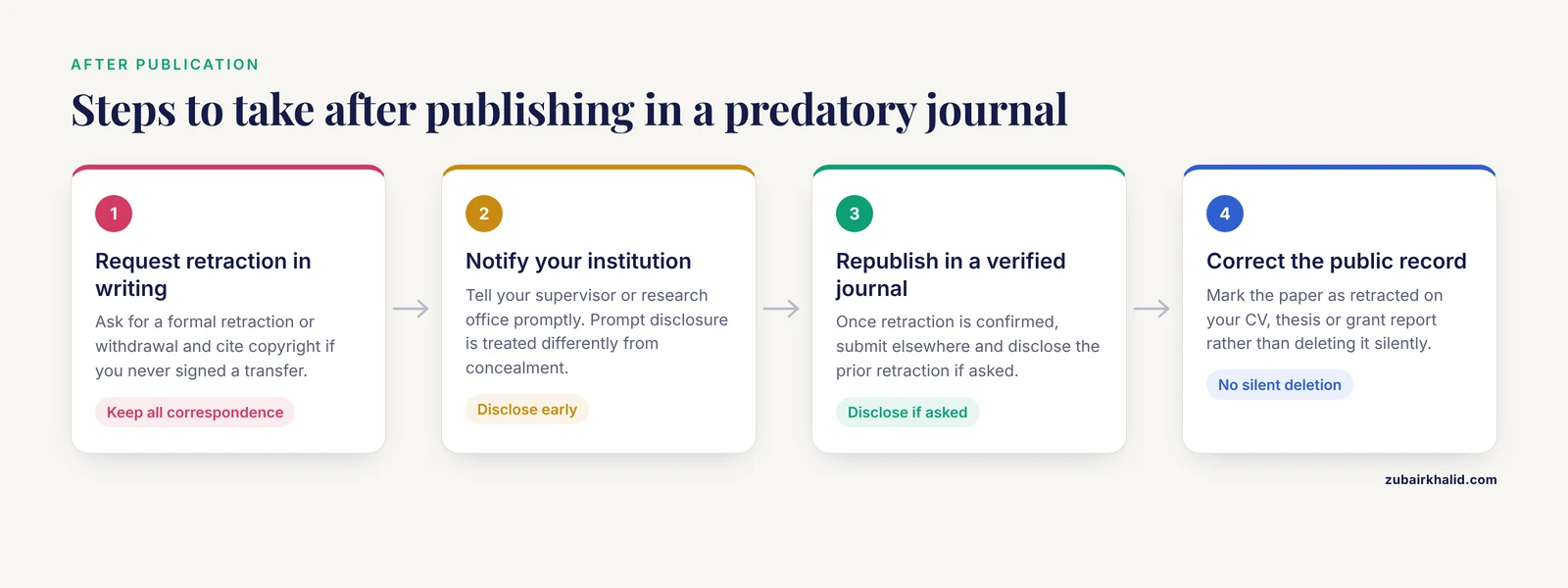
Your action sequence should be:
- Request a formal retraction or withdrawal in writing. Cite copyright as your grounds if you never signed a transfer agreement. Keep all correspondence.
- Notify your institution or supervisor. Disclosure protects you far more than discovery later. Many institutions treat honest, prompt disclosure very differently from concealment.
- Republish the work in a verified journal. Once retraction is confirmed, you can submit the work elsewhere. Disclose the prior retraction if the new journal asks, since transparent disclosure is part of responsible conduct of research.
- Correct the public record where your work is cited. If the paper is on your CV, in a thesis, or in a grant report, note its retracted status rather than silently deleting it. Silent deletion reads as concealment if anyone checks.
A practical caution at this stage: describe your evidence carefully in any public statement. Say what you verified and what you did not, and route formal complaints through your institution or the journal's publisher rather than posting accusations before your documentation is complete.
If you cited predatory journal work in your own paper or a policy document
Audit your reference list. If a citation turns out to come from a journal without functioning peer review, replace it with a verified source, or remove the claim if no verified source supports it. In public health policy, interviews with policy document authors have shown that cited information is often sourced and evaluated with variable rigor, which is exactly how untrustworthy research enters the evidence base [4]. Fixing your own reference list is a small act with a real payoff, because every corrected citation removes one pathway by which unreviewed claims travel.
Why Researchers Fall for Predatory Journals: The Causes
Understanding the causes turns a personal embarrassment into a systems problem you can defend against.
Career pressure. Publications function as mandatory metrics for faculty selection and promotion, and institutional rankings increasingly depend on research output [2]. When output counts more than venue quality, journals that promise speed and certainty gain customers.
Broken incentives within authorship. The publish or perish environment has been linked to ethical violations including honorary authorship, salami slicing (dividing one body of work into many thin papers), and duplicate submission of the same paper to multiple journals [3]. Researchers already cutting ethical corners on authorship and submission are closer, behaviorally, to cutting corners on venue choice.
Inexperience and isolation. Participation in faculty-mentored research was strongly associated with awareness of predatory journals among medical students (P less than .001), meaning that mentorship, not seniority alone, builds the skill of vetting a journal [14]. Residents and early-career researchers consistently score lower on predatory journal knowledge than academic staff [6].
Sophistication of the predators. Experienced faculty members can be caught because predatory publishers now use increasingly polished strategies, including credible-looking websites and targeted solicitations [2]. The field has also begun asking whether artificial intelligence could be applied to flag predatory publishing patterns, a question raised in a 2026 commentary on automating the identification process [15].
The absence of a certification standard. There is no universally recognized body that certifies journals as legitimate, and commentators have argued that organizations such as ICMJE (the International Committee of Medical Journal Editors) should create a certification system to identify predatory journals [16]. Until such a standard exists, individual vigilance carries the load, which is why the prevention practices below matter.
Prevention: Building Responsible Conduct of Research Habits
Prevention is a set of repeatable behaviors, not a one-time lecture.
Vet before you submit, every time. A pragmatic vetting routine takes under an hour: check the journal in DOAJ and the NLM Catalog, read its peer review policy, read its full fee schedule, and cross-check a sample of its published articles against your field's standards [7]. Only 16.9 percent of surveyed dental researchers checked blacklists before submission [6], which means the cheapest intervention is simply making this check a habit.
Verify indexing claims at the database, not the journal. Any claim about Scopus, PubMed, or impact factors should be confirmed in the primary record [1].
Use mentors and disciplinary societies. Trusted mentors and professional societies can identify reputable outlets for your specific subfield and warn you away from lookalikes [7]. If you lack access to a mentor, structured training exists. A Delphi-validated educational video for young researchers, refined through three rounds of expert consensus and audience testing, offers a compact 10-minute introduction to recognizing and avoiding predatory journals [17].
Fix the upstream pressures in your own conduct. Follow authorship criteria honestly, avoid duplicate submission, and resist salami slicing your work into least publishable units. These behaviors are linked in the literature with the same pressure that pushes researchers toward predatory venues, and cleaning them up strengthens both your record and the record of your field.
Keep your own journal vetting record. Save the fee schedule, the peer review policy, and the indexing confirmations for every journal you submit to. If a dispute arises later, this file is your evidence.
Common Mistakes and Limitations
Treating lists as final judgments. Blacklists and warning lists are risk screens. The Predation Index study showed that journals appearing on exclusionary lists spanned the full range of behavioral scores, and 99 of 265 nursing journals examined could no longer be assessed at all because they had disappeared [12]. Use lists to decide where to look closely, never to close a case.
Relying on a single warning sign. Poor website design is a weak signal on its own. Some small legitimate journals have plain sites and lean processes, and critics have documented how mechanical application of warning signs can unfairly condemn non-mainstream journals [13]. Weight the hard checks, indexing, fees, and peer review, above cosmetic ones.
Assuming expensive means legitimate. Legitimate journals in the urology comparison charged more on average than the potentially predatory ones [9]. Price tells you about the business model, not the integrity.
Assuming legitimate journals are immune. Retraction, weak review, and metric gaming exist across the publishing spectrum. The point of vigilance is not paranoia, it is verification.
Conflating open access with predation. Open access is a business model, not a synonym for fraud. The defining features of predatory publishing are absent peer review, deceptive claims, and profit-first conduct [1][8], which can technically occur under any access model.
Staying silent after a mistake. Concealment converts an error into a misconduct question. Prompt disclosure to your institution is the responsible path under any responsible conduct of research framework.
One limitation applies to every recommendation here: individual cases vary, and when a situation involves your career, your institution's policies, or a dispute with a publisher, consult your research office, your institution's legal counsel, or a senior colleague before acting on general guidance alone.
Frequently Asked Questions
What is a predatory journal in simple terms?
It is a journal that exists to collect publication fees rather than to vet and disseminate science. It typically provides little or no real peer review, makes misleading claims about indexing and metrics, and hides or obscures its charges [1].
How do I check if a journal is indexed in PubMed or Scopus?
Search the journal title directly in the NLM Catalog for PubMed and MEDLINE status, and in the Scopus source list for Scopus status. Never rely on badges or claims displayed on the journal's own website, since false indexing claims are a known red flag [1].
Can a journal be removed from a predatory blacklist?
Sometimes, but the process is often unclear. A systematic review of ten warning lists found that 80 percent had unclear delisting criteria [11], so treat removal from a list as possible but not guaranteed, and re-verify any journal on its current merits.
What should I do if I already published in a predatory journal?
Request a formal retraction or withdrawal in writing, notify your institution promptly, and then republish the work in a verified journal. Retraction data from potential predatory journals show that retracting to publish elsewhere is the most common documented reason for these retractions, at 60.1 percent of cases [10].
Are all open access journals predatory?
No. Open access is a funding model in which article processing charges may replace subscriptions. Predatory publishing is defined by missing peer review, deceptive claims, and profit-first conduct [1][8], behaviors that are assessed independently of whether a journal is open access.
Is publishing in a predatory journal research misconduct?
It depends on intent and circumstances, and determinations are made by institutions, not by general rules. Honest mistakes handled with prompt disclosure are treated differently from deliberate venue shopping. The safest position is to vet before submitting and disclose fully if you discover a problem afterward.
Do predatory journals really have impact factors?
Some display numbers that look like impact factors, but many of these are fabricated. Predatory journals commonly display fabricated impact factors alongside false indexing claims [1]. Confirm any metric in the record of the organization that actually computes it.
What is the fastest way to screen a journal before submitting?
Run five checks in under an hour: confirm the journal exists and matches its ISSN, verify claimed indexing in the primary database, read the complete public fee schedule, read the peer review policy, and cross-check the editorial board against institutional profiles [1][2][7]. If any of the five fails, walk away.
Sources
- Identifying Predatory Journals: A Practical Guide for Researchers.
- Twelve tips for identifying and avoiding predatory journals.
- Troubling Trends in Biomedical Research Publication: "Publish or Perish" Results in a Propensity for Ethical Violations.
- Investigating the trustworthiness of research evidence used to inform public health policy: a qualitative interview study on the use of predatory journal citations in policy documents.
- Scholarly publishing literacy and perceptions of predatory publishing among educational partners at a chiropractic college: a case report.
- Knowledge, practices, and perception of predatory journals among North-African Dental University Hospital Doctors.
- Navigating the academic waters: Strategies to avoid predatory journals and publish in indexed journals.
- [[Predatory Journals - Authors and Readers, Beware!].](https://pubmed.ncbi.nlm.nih.gov/41195849/)
- Financial barriers in urology publishing: an analysis of legitimate and predatory journals.
- Reasons for retractions in potential predatory journals.
- Predatory publishing lists: a systematic review.
- Predatory Publishing in Nursing Journals: A Systems-Based Analysis Using the Predation Index.
- Can aspects of predatory publishing be applied to some mainstream and grey journals?
- Awareness, knowledge, and perceptions of predatory journals among medical students in the western region of Saudi Arabia: A cross-sectional survey.
- Identifying predatory journals made easy: is it justifiable to apply artificial intelligence for peer review?
- ICMJE Should Create a Certification System to Identify Predatory Journals.
- Enhancing Awareness and Understanding of Predatory Journals: A Delphi-Validated Educational Video.