How to Handle Unexpected Questions in Your Dissertation Defense
By Dr. Zubair Khalid, DVM, MS, PhD ·

The most common cause of a stalled dissertation defense is not a hostile examiner or a flaw in your data. It is time decay. You wrote Chapter 2 eleven months ago, you have re-read your results chapter three times this week, and a committee member asks about a modeling assumption from the early chapters that you have not thought about since the semester you wrote it. The question is not unfair. Your memory of your own dissertation is simply uneven.
The first thing to check, before anything else, is whether you actually understand the question as asked. Most panic in a defense comes from answering a question the candidate only half heard. When you learn how to handle unexpected dissertation defense questions, the first skill is a controlled pause and a restatement. Everything else in this article builds on that step.
The oral examination is the oldest part of the degree. In October 1674, the Transylvanian physician Ferenc Pápai Páriz defended his inauguration thesis at the University of Basel, summarizing three gynecological cases before examiners who probed his reasoning in person [1]. The format has changed far less than the technology around it. A committee still sits across from a candidate, still asks what the candidate did not write, and still expects an answer that shows judgment rather than memorization. What follows is a practical system for the modern version of that moment: the causes of surprise questions, a triage table, a diagnostic sequence you can run in real time, and the dissertation planning habits that make surprises rare.
Why Defense Questions Catch You Off Guard (The Causes)
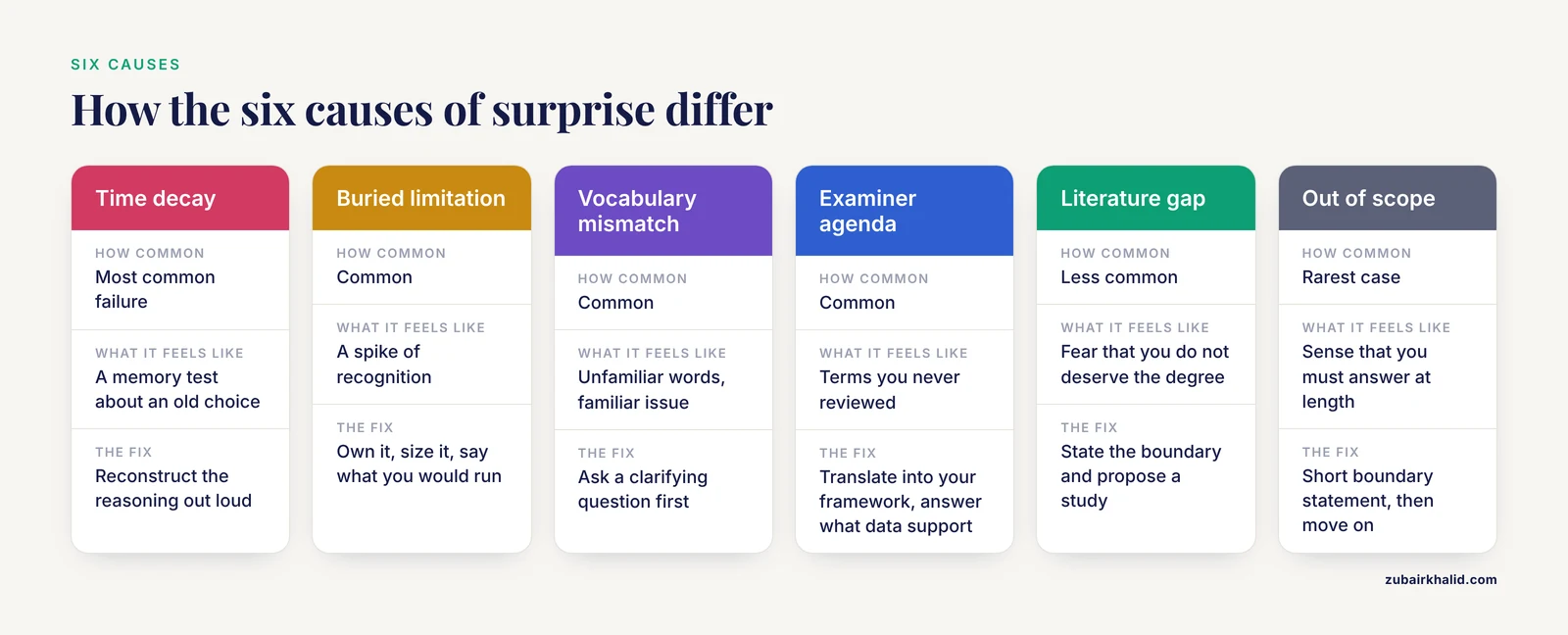
Understanding how to handle unexpected dissertation defense questions causes and fixes starts with a mechanical explanation. Questions do not surprise you at random. They surprise you through six repeatable mechanisms, listed here from most common to rarest.
1. Time decay. A dissertation is written over years, chapter by chapter, and each chapter is finished and abandoned. The committee reads the whole document in a few weeks. Their memory is fresh and uniform. Yours is fresh only where you last worked. This asymmetry alone produces most of the awkward pauses in a defense.
2. The buried limitation. You knew about a weakness in your sampling, your instrument, or your model. You mentioned it once, in a parenthetical sentence on page 87, and moved on. A committee member finds that sentence. The question is unexpected to you because you spent months successfully not thinking about it.
3. Vocabulary mismatch. You call it "reactor throughput." The committee member, trained in a neighboring subfield, calls it "processing capacity." You hear an unfamiliar question when a familiar one was asked. This mechanism is especially punishing for international candidates who defend in a second language. Pápai Páriz faced the same layered language problem at Basel in 1674, defending in Latin, a scholarly language that was not the everyday tongue of his home in Transylvania, and his thesis still had to make its case clearly to examiners reading it in translation centuries later [1].
4. The examiner's own agenda. Every committee member brings a research identity. Some ask about your work in their vocabulary, at the intersection of their interests and yours. Those questions feel unanswerable because the literature you reviewed did not use their framing, even though your data speak to it.
5. A genuine gap in the literature. Sometimes the honest answer is that nobody has studied the thing being asked, including you. Candidates often treat this as failure when it is actually the boundary of the field, which is exactly where a dissertation is supposed to sit.
6. A question outside your scope entirely. Rare, but it happens. A member asks about a policy implication, a commercial application, or a neighboring technique that your dissertation never touches. This is the rarest cause and the one with the cleanest solution, which is to say so and move on.
The mechanism behind every one of these is the same at the psychological level. An unexpected question triggers a threat response, the threat response narrows your working memory, and working memory is what you need to retrieve the answer. The fix is not more knowledge. It is a procedure that keeps your working memory on the question instead of on your fear.
Question-Triage Table
The table below is the core of how to fix how to handle unexpected dissertation defense questions in practice. Find the symptom in the left column, confirm the cause, apply the fix.
| Symptom | Likely cause | How to confirm | Fix |
|---|---|---|---|
| You freeze and cannot form a sentence | Panic competing with working memory | Your mind went blank rather than empty, you know the material but cannot reach it | Pause, breathe once, restate the question aloud in your own words |
| You answer quickly but the questioner follows up with "that is not what I asked" | Vocabulary mismatch or a misheard question | Your answer used different terms than the question did | Ask a clarifying question, "Do you mean X or Y?", before answering again |
| The question targets a weakness you mentioned only briefly in the document | A buried limitation | You feel a spike of recognition, you knew about this | Name it as a known limitation, state what you did about it, and what you would do differently |
| The question uses concepts from a field adjacent to yours | The examiner's own agenda | You recognize the terms but they never appeared in your literature review | Translate the question back into your framework, answer what your data can support, acknowledge the other framing |
| The question asks about something nobody has studied | A genuine literature gap | A rapid mental search of your bibliography finds nothing | Say the gap exists, propose how you would study it, treat it as future work |
| The question is about an application, population, or technique far outside the dissertation | Out-of-scope question | Nothing in your chapters connects to it | State the boundary plainly, offer the nearest relevant result, move on |
| You answered this question in Chapter 4 but the examiner seems not to have seen it | Committee reading asymmetry | You remember writing the answer with a citation | Say "I addressed this in Section 4.3, let me walk through it here," without sounding defensive |
| Two committee members ask opposite questions and you are caught between them | Contradictory examiner priorities | Each question points in a different direction | Address both, name the tradeoff explicitly, refuse to pretend both can be fully satisfied |
| The question concerns a method decision from your second year | Time decay | The question feels like a memory test about a choice you barely remember making | Reconstruct the reasoning out loud, reasons first, conclusion last |
| The questioner interrupts, raises their voice, or stacks three questions at once | Hostile or compressed questioning style | The tone is aggressive, not the content | Stay calm, answer the last question first or ask which one to take, keep your voice level |
Working Through the Most Common Cause to the Rarest
Cause 1: Time Decay, the Most Common Failure
The mechanism is simple. Encoding a fact into durable memory requires retrieval, and chapters you have not reopened since writing them have had no retrievals. The committee, meanwhile, has just done a fresh, complete read. When their question lands on a chapter you finished a year ago, the retrieval fails, and the failure feels like incompetence even though it is ordinary memory behavior.
The fix has two halves. In the room, reconstruct rather than recall. Say, "The reasoning at that stage was based on X, so my decision followed from that," and rebuild the logic from principles you do remember. Reconstructed answers sound thoughtful. Recited answers sound brittle, and committees can tell the difference. Before the room, fix the cause with targeted rereading. In your last two weeks of preparation, re-read the abstract, introduction, and conclusion of every chapter, not the full text. Those four short passages restore the spine of the argument, and most time-decay questions attach to the spine.
Cause 2: The Buried Limitation
Every dissertation has limitations the candidate underweighted. Committees read for them deliberately, because identifying limitations is a core examiner competence. The question surprises you because avoidance was the whole strategy.
The mechanism behind a strong answer is ownership followed by analysis. Candidates who defend weakly either deny the limitation or collapse under it. Candidates who defend well do neither. They say, "Yes, that is a limitation, and here is its size, here is why it did not undermine the main result, and here is the study I would run to remove it." If the limitation genuinely threatens a conclusion, say that too. Conceding a real problem costs far less credibility than defending an indefensible one in front of people who have already seen it.
Cause 3: Vocabulary Mismatch
The mechanism is a translation failure on the listening side. You hear unfamiliar words, conclude the question is unfamiliar, and your retrieval fails even though the underlying issue is one you know well. This cause disproportionately affects candidates who present in a second language, a situation with a long history in academia. Pápai Páriz wrote and defended his 1674 thesis in Latin, and one reason scholars still value the document is that its observations survived the language barrier well enough to be translated and studied 350 years later [1]. His case shows the durable half of the solution: the underlying scientific content carries the defense when the vocabulary wobbles.
The in-room fix is a clarifying question. "When you say X, do you mean the measurement or the interpretation?" This is not a stall. Examiners consistently read a good clarifying question as evidence of precision, and it converts an unanswerable question into an answerable one in about ten seconds.
Cause 4: The Examiner's Own Agenda
A committee member whose research sits near yours will ask questions at that intersection, using their field's framing and their field's key references. The mechanism is not malice. It is the ordinary habit of every researcher, which is to read new work through the lens of their own questions.
Your fix is translation plus honesty. Restate their question in your framework, answer with what your data support, and say plainly that your dissertation did not test their framing directly. If their framing suggests an obvious follow-up experiment, offering it turns an awkward moment into a discussion of future work, which examiners generally enjoy.
Cause 5: A Genuine Gap in the Literature
Dissertations exist precisely at the edge of what is known, so some questions will land past that edge. The mechanism of failure here is emotional rather than cognitive. The candidate interprets "I do not know" as "I do not deserve the degree," and panic does the rest.
The correct answer has three parts. First, state the boundary: "To my knowledge, that has not been established." Second, show the reasoning: what an answer would require, what data would discriminate between the possibilities. Third, connect it to future work if it is connected. An examiner who asks a literature-gap question usually wants to see whether you can tell the difference between what is known and what is not, which is a defining skill of an independent researcher.
Cause 6: The Out-of-Scope Question, the Rarest Case
Occasionally a question has no connection to the dissertation at all, because a member is curious, is testing your breadth, or is applying the dissertation to a context you never considered. The mechanism of failure is the candidate's sense that every question must be answered at full length.
It must not. The solution is a short, honest boundary statement. "That goes beyond what this dissertation addresses. My work speaks to it only through this one result, which suggests, but does not establish, that..." Thirty seconds, delivered calmly, resolves the rarest cause completely.
A Diagnostic Sequence You Can Run in Real Time
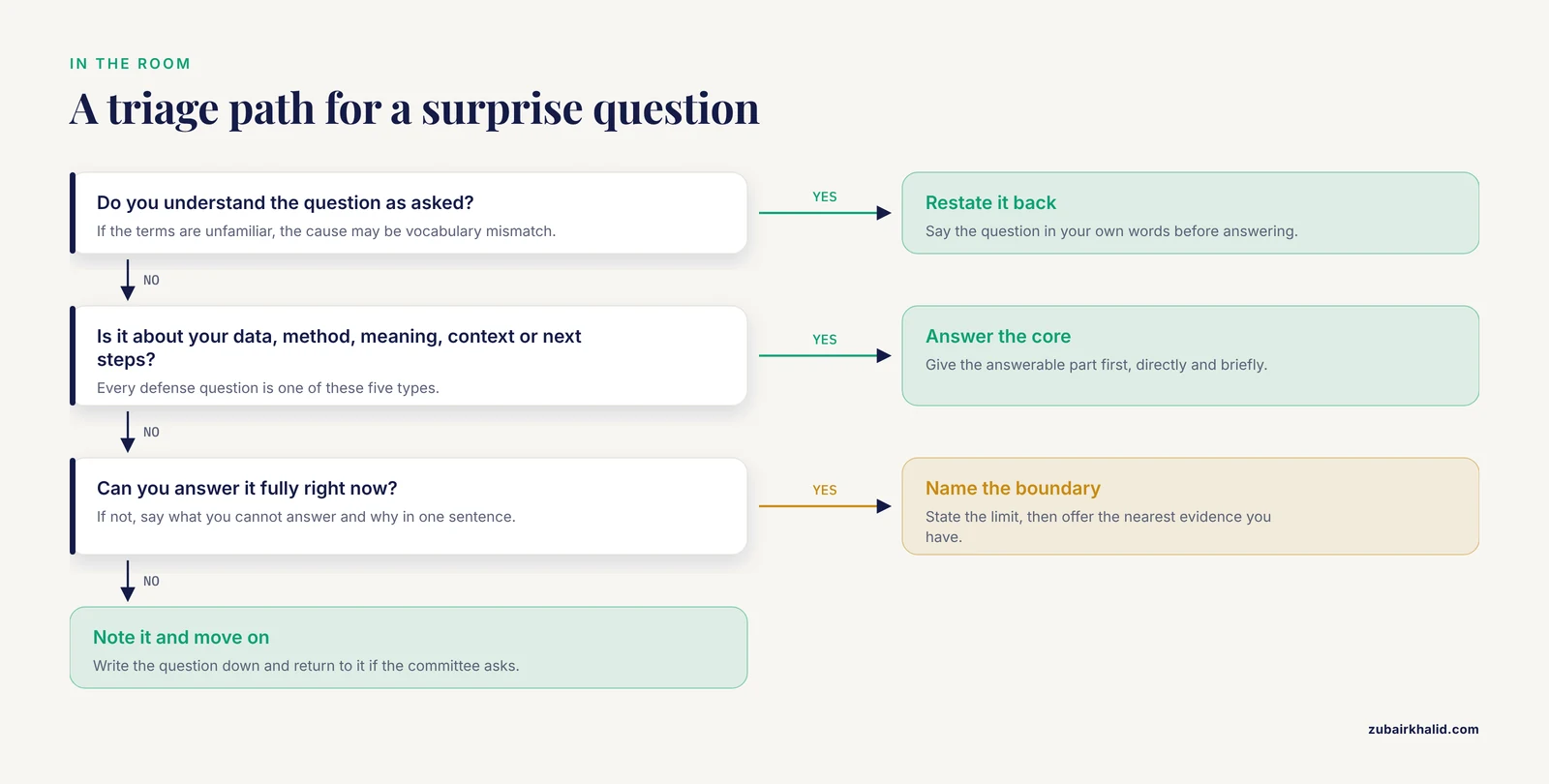
When an unexpected question arrives, run this sequence. It takes fifteen to thirty seconds and it prevents nearly every bad answer.
- Pause and breathe. Two seconds of silence is a shorter eternity in your head than in the room. No examiner scores a two-second pause against you.
- Restate the question. "So you are asking whether the effect holds when the sample is restricted to the older cohort." This buys time, confirms understanding, and exposes vocabulary mismatches immediately.
- Classify the question. Every defense question is one of five types: factual (about your data), methodological (about how you got the data), interpretive (about what the data mean), contextual (about how your work relates to other work), and speculative (about what comes next). Each type has a different correct posture, and classification alone dissolves much of the panic.
- Answer the part you can. Nearly every hard question contains an answerable core. Give that core first, directly.
- Name the boundary. Then say what you cannot answer and why, in one sentence.
- Park it if needed. "I would want to check that against the raw output before answering in detail. Can I note it and return after the presentation?" Most committees grant this, and most candidates never need to return because the discussion moves on.
- Take a note. Writing the question down signals seriousness, keeps it from circling in your head, and gives you material for revisions.
Run this sequence the same way every time. The predictability is the point. When the procedure is automatic, working memory stays on the question.
Solutions That Work in the Room
These are the how to handle unexpected dissertation defense questions solutions that graduate-level examiners themselves tend to recommend, and each maps to one of the causes above.
The Controlled Pause
Silence of two to five seconds, with a thoughtful expression, reads as competence. Filling the silence with "good question" and an immediate ramble reads as nerves. Practice pausing in your mock defense so it feels normal rather than dangerous.
The Restatement
Restating is the single highest-value move because it addresses three causes at once. It catches vocabulary mismatch before you answer the wrong question, it gives your memory two more seconds of retrieval time, and it shows the examiner that you listened.
The Bridge
When you cannot answer the question as asked, bridge from what you know to what is asked. "I cannot speak to that directly, but the closest evidence I have is X, and it suggests Y." This is honest, it demonstrates reasoning, and it gives the examiner something to work with. The historical record supports the value of this kind of honest framing. The modern reevaluation of Pápai Páriz's thesis notes that dissertations of that era preserved observations that later readers found genuinely useful, precisely because the candidates recorded what they saw rather than what a perfect theory would have predicted [1].
The Honest "I Do Not Know"
Said correctly, this sentence strengthens a defense. "I do not know, and here is how I would find out" is a researcher's answer. Said with a follow-up plan, it demonstrates exactly the judgment the degree certifies. Said alone, with a shrug, it does not. The plan is what carries it.
Handling a Hostile Questioner
Hostility is usually style, not substance. The mechanism is that some examiners test composure deliberately, and some are simply abrupt with everyone. Your countermeasures are the same in both cases. Slow your speech slightly. Answer the content, never the tone. If three questions arrived at once, ask which to take first. If an exchange turns into an argument, close it gracefully: "I think we see this differently, and I would like to look at the data you are describing." Committees routinely intervene with a colleague who is rough on a candidate, but only if you stay composed enough to let them.
Handling Contradictory Questions
When one member wants a broader sample and another wants a tighter one, do not pick a side. Name the tradeoff. "Those two goals pull in opposite directions, and my design chose the tighter sample because the primary claim required precision over coverage." Naming the tension shows design reasoning, which is exactly what examiners grade.
Prevention: Dissertation Planning That Shrinks Surprise
Handling questions in the room is a recovery skill. Prevention is cheaper, and it lives in two habits: how you plan the dissertation and how you finish it.
Build a Question Map During Dissertation Planning
Good dissertation planning treats anticipated questions as a deliverable, not a hope. While writing each chapter, keep a running list of the questions a sharp reader would ask, and answer each one in a file. By the end you will have thirty to fifty anticipated questions with prepared answers. Committees draw from a predictable well: limitations, alternative interpretations, method justifications, generalizability, and next steps. Preparing those five categories removes most of the surprise before the meeting is ever scheduled.
Run a Mock Defense
A mock defense with colleagues who have not read your chapters closely is the closest safe simulation of the real event. Their questions will cluster around your unclear passages, which is exactly where real committee questions cluster too. Every question that surprises you in the mock is one that cannot surprise you in the defense.
Prepare One-Page Chapter Summaries
The direct countermeasure to time decay. One page per chapter: the question the chapter answers, the method, the main finding, the key limitation. Review these in the final week. They restore the whole dissertation to working memory in under an hour.
Finish Cleanly, Because Endings Generate Questions
A large share of unexpected questions trace back to a rushed finish. Loose threads in the final chapters, an incomplete limitations section, a discussion that promises more than the results deliver, and unreconciled numbers between chapters are all question magnets. This is one more reason the discipline of how to finish dissertation work matters beyond the writing itself. The final two chapters are the most examined pages of the document. When your schedule slips, protect the conclusion chapter before any other. A dissertation that ends with every thread either resolved or openly named as a limitation gives an examiner far less to probe.
Know Your Committee's Work
Read the recent publications of each committee member. You are not trying to anticipate their exact questions. You are learning their vocabulary so that their questions arrive in a language you recognize, which converts cause four from a hazard into a conversation.
Common Mistakes and Limitations
- Bluffing. The single most damaging move. Examiners detect a fabricated answer quickly, and one detected bluff colors their reading of every other answer you gave.
- Answering for five minutes when thirty seconds would do. Long answers create more surface area for follow-up questions. Answer the question, stop, and let the silence invite the next move.
- Treating every hard question as an attack. Most probing questions are the examiner doing their job. Reading hostility into ordinary rigor makes you defensive, and defensiveness degrades your answers.
- Answering a question that was not asked. The restatement step exists because this mistake is extremely common and completely preventable.
- Arguing with data in your own document. If a committee member quotes a sentence from page 87 that contradicts your oral answer, the document wins. Reconcile the two out loud rather than insisting the document is wrong.
- Rehearsing scripted answers. Memorized answers collapse under follow-up. Prepare positions and evidence, not paragraphs.
- Reading too much into a hard exchange. A difficult question is not a verdict. Committees fail candidates for structural reasons that surface in deliberation, and a single rough exchange almost never decides anything.
One limitation applies to all the guidance here. Committees differ by field, institution, and culture in how formal the questioning is and how long it runs, and no general procedure covers every individual panel. The techniques above are broadly effective norms, but your specific committee's style, which you can often learn from your advisor and from recent graduates of the same program, always takes precedence.
Frequently Asked Questions
What should I do first if a question completely surprises me?
Pause, breathe once, and restate the question in your own words. The restatement confirms you understood it, buys several seconds of retrieval time, and prevents the most common error, which is answering a question the examiner did not ask.
Is it acceptable to say "I don't know" in a dissertation defense?
Yes, when it is followed by a plan. "I do not know, and here is how I would investigate it" demonstrates the judgment the degree is meant to certify. A bare "I don't know" without follow-up is the weak version and should be avoided.
How long is an appropriate pause before answering?
Two to five seconds. That span feels long to you and reads as thoughtful to the committee. Longer than that, bridge with a restatement or a clarifying question rather than letting the silence grow.
What do I do when two committee members ask contradictory questions?
Name the contradiction out loud and describe the tradeoff your design made. Do not pick a favorite. Showing that you understand the tension is worth more than a one-sided answer.
Can a single unexpected question change the outcome of my defense?
Almost never on its own. Committees deliberate over the whole performance and the whole document. What a rough exchange can do is shape the required revisions, so answer every question seriously regardless of how it is going.
How do I handle a committee member who seems hostile?
Answer the content, not the tone. Slow your speech, keep your voice level, and if questions stack up, ask which one to address first. If the pressure becomes excessive, your chair or another member will usually intervene, but only if you stay composed.
How many questions should I prepare before the defense?
Prepare answers in five predictable categories: limitations, alternative interpretations, method justifications, generalizability, and future work. Thirty to fifty anticipated questions with short prepared positions covers most of what committees ask.
What if I am asked about something I wrote years ago and barely remember?
Reconstruct the reasoning rather than trying to recall the detail. Walk through why you made the decision from the constraints you faced at the time. A reconstructed answer sounds considered, which is what examiners want to hear, and it avoids the brittleness of a half-remembered recital.
Sources
- [[Translation from Latin to Hungarian of the thesis of Ferenc Pápai Páriz at the 350th anniversary of his defense and medical inauguration at the University of Basel].](https://pubmed.ncbi.nlm.nih.gov/39550727/)