How to Handle Critical Dissertation Feedback
By Dr. Zubair Khalid, DVM, MS, PhD ·

By the end of this guide you will be able to take a heavily annotated draft or a blunt committee email and convert it into a dated, itemized revision plan. You will sort every comment into a category, decide for each one whether to revise, respond, or discuss, write a point-by-point response memo, and fold the whole cycle into your dissertation plan so the project still finishes on schedule.
Work through the steps with these on hand: the annotated file or the email thread, a spreadsheet program such as Excel, Google Sheets, or LibreOffice Calc, your program's thesis and dissertation handbook, a calendar, and Python 3 if your comment list runs past a hundred items. Word, Google Docs, or LibreOffice with change tracking enabled covers the revision passes.
This guide treats how to handle critical dissertation feedback as a repeatable system rather than a test of character. Critical feedback is the normal operating condition of a dissertation, not a sign that you failed. A committee reads your work precisely to find the weaknesses an external examiner would find later, when fixes cost more. What separates students who finish from students who stall is a system that turns comments into closed, dated tasks.
What Critical Feedback Is
Feedback is written or spoken evaluation of your draft from your advisor, committee members, or other readers your program routes your work through. Two distinctions organize everything that follows.
Formative feedback arrives while you can still change the work, such as comments on a chapter draft. Summative feedback decides approval, such as the oral defense or the final sign-off. This guide deals with formative feedback, because the way you handle it determines how mild or brutal the summative round becomes.
Major comments ask for changes to argument, analysis, or structure, for example a claim that your core method cannot answer your research question. Minor comments cover wording, typos, captions, and formatting. Critical does not mean cruel. It means the reader is judging the draft against the standard of a defensible dissertation and reporting every gap they find. Your job is to extract the task inside each comment, not to grade the tone.
How to Handle Critical Dissertation Feedback Step by Step
The workflow below handles a ten-comment chapter review and a two-hundred-comment full draft with the same seven steps. The only thing that changes is whether you count rows by hand or with the script later in this guide.
Step 1. Read the Whole Document Once Before Changing Anything
If the comments sting, close the file and come back the next day. Then read the entire document straight through without editing anything. The goal of this pass is the overall message, not the individual fixes.
Write that message as one sentence at the top of a fresh page. Examples: the committee thinks Chapter 4's analysis does not support its central claim, or the introduction promises more than the methods deliver. Most rounds carry one or two messages of this size plus a pile of local fixes. Knowing the big message first keeps you from spending a day on commas while missing the point.
Step 2. Capture Every Comment Verbatim in One Place
Do not work from memory, scattered margin notes, and four separate email threads. Open a spreadsheet and give every comment one row. Use these columns:
id,date,source,page_or_section,verbatim_comment,category,decision,action,statusEach column has a job:
- id: a sequential number you can cite in memos and meetings.
- date: the day you logged the comment.
- source: who wrote it, such as chair, member2, or external reader.
- page_or_section: where the comment attaches in the draft.
- verbatim_comment: the exact words, copied and pasted. Paraphrase from memory loses the specifics you need to answer precisely.
- category: one word from a fixed list, defined in the next step.
- decision: revise, respond, or discuss.
- action: what you will actually do, in your own words.
- status: open, in progress, or closed.
The verbatim rule matters most. A comment stored exactly can be answered line by line. A comment stored as "they want more statistics" cannot. Here are three rows of a working log:
id,date,source,page_or_section,verbatim_comment,category,decision,action,status
1,2026-11-03,chair,p. 88 ch4,"The causal claim on this page is too strong for the design.",accuracy,revise,"Weaken to predictive language and add a confound paragraph.",open
2,2026-11-04,member2,p. 91 ch4,"Why 30 minutes and not 60?",missing,discuss,"Add to meeting agenda, propose both timepoints.",open
3,2026-11-04,external,fig 4.2,"Figure captions are inconsistent across chapters.",format,revise,"Run one caption pass over every figure.",open
Expected result: a sheet where every comment from every reader appears exactly once, with a category and a decision. Nothing lives only in a margin anymore.
Step 3. Triage Every Comment Into a Category
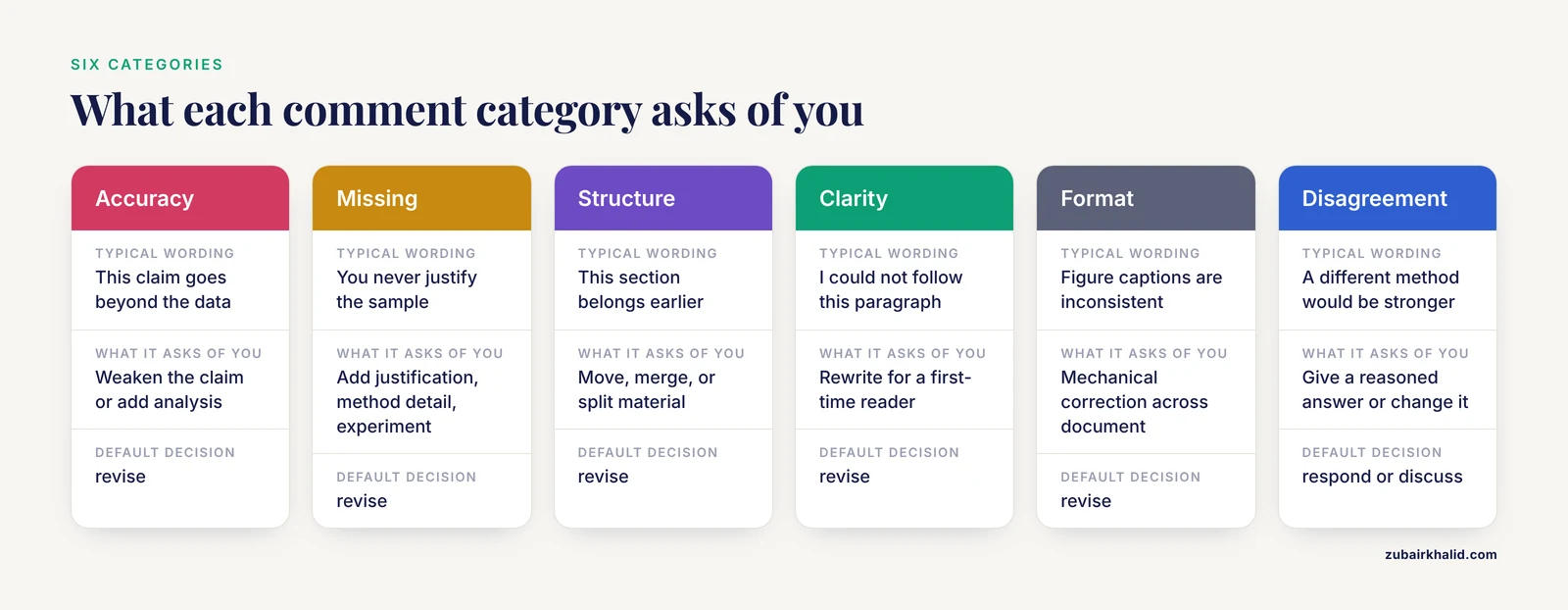
Triage means sorting items by type so you can act on similar items together. Assign exactly one category per row from a fixed list. The triage table defines the six categories, the wording you will typically see, and the default decision for each.
| Category | Typical wording | What it asks of you | Default decision |
|---|---|---|---|
| accuracy | "This claim goes beyond the data." | Weaken the claim or add the analysis that supports it | revise |
| missing | "You never justify the sample." | Add the missing justification, method detail, or experiment | revise |
| structure | "This section belongs two chapters earlier." | Move, merge, or split material | revise |
| clarity | "I could not follow this paragraph." | Rewrite for a first-time reader | revise |
| format | "Figure captions are inconsistent." | Mechanical correction across the document | revise |
| disagreement | "A different method would be stronger." | Provide a reasoned answer or make the change | respond or discuss |
Two weighting rules sit on top of the categories. First, source weight: a comment from your chair or from a required reader outranks a casual note, and a comment made by two readers counts double. Second, repetition: when two people trip on the same paragraph, the paragraph is the problem. Repetition moves a row to the top of the queue.
Step 4. Decide: Revise, Respond, or Discuss
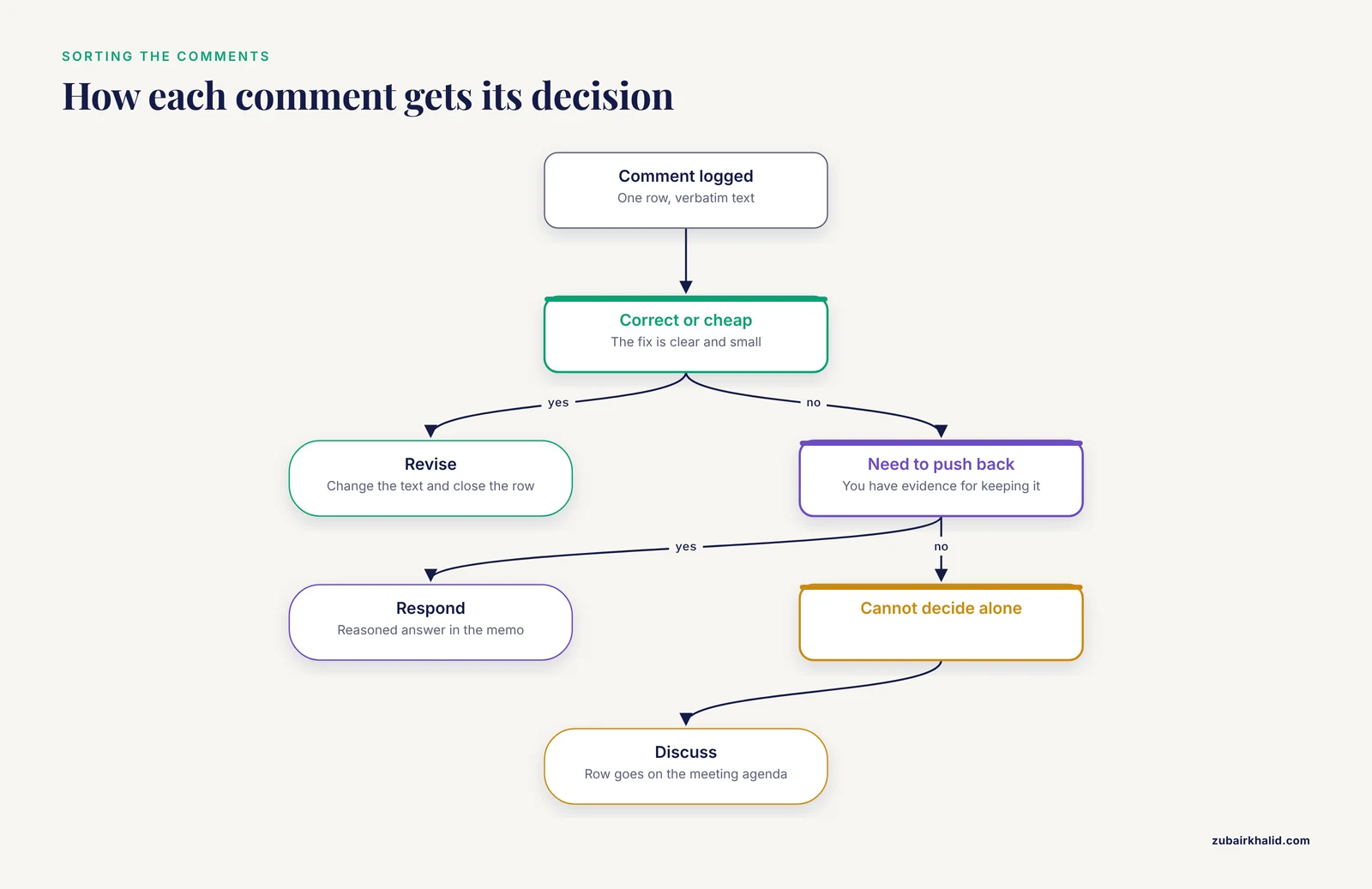
Every row gets exactly one of three decisions.
Revise means the comment is correct or cheap to satisfy, so you change the text. Respond means you will not change the text but you owe a reasoned, evidence-backed answer in the memo. Discuss means you cannot decide alone, so the row goes on the meeting agenda.
The rule that holds the system together: no row ends the day without a decision. Rows with no decision are how comments get silently dropped and then resurface at the defense, in front of an audience, with no memo to protect you.
Step 5. Write the Point-by-Point Response Memo
A response memo is a numbered document that quotes each comment and states exactly what changed and where. Journal authors use this format for peer review, and it transfers directly to a dissertation. Your chair should be able to verify an entire revision round from the memo alone, without hunting through the manuscript.
Response to Committee Comments, Chapter 4 draft, 3 November 2026

Comment 1 (chair, p. 88): "The causal claim on this page is too strong
for the design."
Response: Revised. Page 88, paragraph 2 now reads "X predicts Y in this
sample," and the discussion on page 102 lists the confounds that limit
a causal reading.

Comment 2 (member2, p. 91): "Why 30 minutes and not 60?"
Response: Discussed at the 6 November meeting. Agreed to run both
timepoints for the three affected samples. Added to the analysis plan.
Status open, target 20 November.
Three conventions make memos work. Quote the comment verbatim next to its id from your sheet. State the location of every change by page and paragraph, not by section name alone. Mark deferred items as deferred, with the reason and the date you will resolve them. A memo that hides a disagreement reads as evasion. A memo that states the disagreement with evidence reads as a scientist.
Step 6. Revise in Passes, Not Comment by Comment
Work through the manuscript one category at a time. Do the format pass first, then the clarity pass, then the accuracy and missing-work passes, which need real thinking. Switching between a caption fix and a structural rewrite is slow and error-prone, and batching identical work is faster.
Save a new, date-stamped version before each pass, for example chapter4_v3_2026-11-12.docx, and keep change tracking on. Never revise over your only copy of the previous version.
Batching also shows you real progress. If a 60-comment round contains 24 format comments, one afternoon of mechanical work closes 40 percent of the sheet, which is momentum you can spend on the hard rows.
Step 7. Close the Loop and Log What You Learned
Send the memo and the revised file together, update every status, and confirm the chair received them. Then write three lines in a running feedback log: the big message from step 1, what you will do earlier next time, and what you will ask for earlier next time.
Recurring comments are the highest-value data you own. The same criticism in two consecutive rounds signals a habit to fix at the outline stage, before the next chapter exists. Closing the loop this way is what turns a painful round into permanent changes in how you plan and draft.
Common Errors and Their Exact Messages
These errors appear once your log grows and you automate the counting. Each fix takes under a minute.
FileNotFoundError: [Errno 2] No such file or directory: 'feedback_log.csv'. The script ran from a folder that does not contain the file. Run it from the folder holding the CSV, check the working directory withos.getcwd(), or pass the full path insideopen().KeyError: 'category'. The header row does not match the name the script reads, usually a capital letter or a stray space. Print the header withprint(rows.keys())and make the script match it exactly.UnicodeDecodeError: 'charmap' codec can't decode byte 0x9d in position 214. The CSV was saved in a Windows legacy encoding, common when curly quotes ride along from Word. Re-export the CSV as UTF-8, or open it withencoding="utf-8"as the script below already does.csv.Error: field larger than field limit (131072). One pasted comment exceeds the default field size. Callcsv.field_size_limit(1000000)before reading.
How to Check the Triage Is Complete
Four checks, in order. The category counts from the script must sum to the total row count. Every row must carry a decision and a status. Every comment visible in the annotated file must appear in the sheet, which you confirm by comparing the comment count in your word processor's review panel against your row count. Finally, open three random rows and confirm the verbatim text matches the original comment character for character.
When all four pass, send the memo, book the follow-up meeting, and update the revision window in your plan. Those are the next steps, and they are scheduled work, not reactions.
A Small Script for Large Comment Lists
When a full draft returns with a hundred or more comments, counting rows by hand burns a day you do not have. This script reads your log and prints counts by category plus the number of open items.
import csv
from collections import Counter

with open("feedback_log.csv", newline="", encoding="utf-8") as f:
    rows = list(csv.DictReader(f))

counts = Counter(r["category"].strip().lower() for r in rows)
print("Comments by category")
for category, n in counts.most_common():
    print(f"  {category}: {n}")

open_items = [r for r in rows if r["status"].strip().lower() == "open"]
print(f"Open items: {len(open_items)} of {len(rows)}")
The parameters that matter:
- The file name inside
open()must point at your log. Change it or run the script from the log's folder. - The column names
categoryandstatusmust match your header row exactly, including case. - The status vocabulary is open, in progress, and closed. The script counts a row as open only when the status reads open after trimming spaces and lowercasing.
For a 22-row log like the example above, the expected output is:
Comments by category
  accuracy: 9
  structure: 6
  missing: 4
  format: 3
Open items: 22 of 22
Read the output as a work order, not a scorecard. Accuracy dominates this round, so the first deep pass is claims against data, not formatting. Rerun the script after each pass. The open-item count falling toward zero is the progress meter for the entire revision, and it is the number you report to your chair.
Tips That Make Critical Feedback Easier
These tips cover the parts of the job that the spreadsheet cannot do for you.
- Separate the schedule from the sting. Read for content on day one and start written work after the emotion fades, usually the next day. Nothing in the document gets worse overnight.
- Translate tone into tasks. "This section is muddled" means "rewrite the paragraph for a reader outside your subfield." Write the task version into the action column.
- Start with the most useful comment, not the harshest or the easiest. One substantive fix in motion makes the rest of the list feel like work instead of judgment.
- Ask for the underlying concern when a comment is vague. Send one short email with two or three specific questions, such as whether the concern is the sample, the measure, or the interpretation. Guessing for a week costs more than asking costs.
- Never argue inside the document margins. Disagreements belong in the memo, where they are numbered, quoted, and answerable. Margin arguments read as spats.
- Batch your questions and ask once. A single numbered list respects your committee's time and gets faster answers than a drip of emails.
- Bring the sheet to every meeting. Agreements made out loud become new rows with the meeting date as the source, so nothing depends on anyone's memory.
- Keep the defense in view. Every closed row is one fewer surprise in the oral exam, and a complete memo is the cheapest defense preparation you will ever do.
Common Mistakes and Limitations
These are the mistakes that turn one rough round into a lost semester.
- Editing during the first read. You rewrite sentence two while the document's overall message goes unread, then discover on page 40 that the whole chapter needs restructuring. Read once with the editor closed.
- Working from paraphrased comments. "They want more statistics" is not answerable. The verbatim text usually contains the actual request, often narrower than you feared.
- Treating every comment as the same size. A caption typo and a claim that your core method cannot answer your question are different universes of work. The category column exists to keep them apart.
- Disagreeing silently. Skipping a comment you dislike, without a written response, guarantees it returns at the defense with an audience. Write the reasoned answer now, in private, where it can be discussed.
- Over-complying. Rebuilding a working design because one reader prefers another approach can add months. If a requested change threatens your timeline, that is a discuss row, not an automatic revise.
- Revising without versions. chapter4_final_v2_REALLY_final.docx is not a version. Date-stamped names and a saved pre-revision copy are the difference between a bad afternoon and a lost week.
- Answering only the comfortable comments. The memo must number every comment, including the ones that hurt. Unnumbered silence reads as evasion and invites a harsher second round.
- Opening the next chapter before closing the current round. Unclosed feedback compounds. Close the round, then draft.
One limitation governs everything above. Program rules vary, and they outrank any general workflow. Your graduate school's thesis and dissertation handbook sets the binding requirements for formatting, committee process, and the defense, and your chair arbitrates conflicting advice from readers. Treat this system as standard practice for handling comments, not as policy for your degree. If a comment touches research ethics or data integrity, take it to your advisor and your institution's research integrity office rather than resolving it inside a memo.
Building Feedback Into Your Dissertation Plan
Handled well, feedback becomes a scheduled activity inside your dissertation planning rather than an interruption of it. Five planning moves do most of the work.
First, plan a revision window after every submission. Ask your advisor how long they typically need with a chapter, add your own triage and revision time on top, and write both dates into your calendar. If you cannot name the turnaround, ask. A revision window you never scheduled is how a three-week chapter becomes a three-month chapter.
Second, submit chapters at agreed milestones instead of saving everything for one full draft. Early chapters teach your committee your conventions and your voice, which tends to shrink the comment volume on later chapters. Milestones also give you regular, dated evidence of progress, which matters on the days the work feels infinite.
Third, define done per chapter. A chapter is done when every row in its sheet is closed, the memo is sent, and the chair confirms. With that definition, a chapter stays finished even if a later reader finds a typo. Without it, no chapter is ever finished.
Fourth, use feedback as a finish signal. When two consecutive rounds come back with only format and clarity comments, your content is stable. That is the moment to stop adding new data and new literature and to shift effort to final formatting and the defense package. A bounded feedback loop is the practical answer to how to finish a dissertation. Unlimited revision is how dissertations stall.
Fifth, schedule the full-draft round early enough that it can be minor. Work backward from your defense date, reserve a window for the complete draft, and protect it from new experiments. A last round that returns only polish is the sign your planning worked.
Keep the feedback log open while you draft new chapters. Reread the recurring comments before you start, then write so those comments cannot apply. That habit, more than any single revision, is what your committee will notice by chapter five.
Frequently Asked Questions
How long should I wait before responding to critical dissertation feedback?
Read the full document once on the day it arrives so you know the overall message, then start written work 24 to 48 hours later if the comments stung. Responses written while angry tend to be defensive and create extra rounds.
Should I push back on my committee's feedback?
Yes, when you have a specific reason. Push back in the response memo by quoting the comment, giving your evidence, and marking the row as respond rather than revise. Your chair makes the final call on anything unresolved.
What should I do when two committee members contradict each other?
Log both comments verbatim and put them on the agenda for a committee meeting so the members can resolve the conflict directly. Do not choose between them privately, because you must satisfy both readers at the defense.
How do I handle a comment that is rude or dismissive?
Extract the task underneath the tone and log that task in your tracking sheet. The memo answers substance, never tone. If dismissiveness becomes a pattern that blocks progress, raise it with your chair or graduate program director.
Do I have to make every change my committee suggests?
No. You have to address every comment, which means either making the change or giving a reasoned written answer for why you did not. Committees expect evidence-backed disagreement.
How do I keep track of hundreds of dissertation comments?
Use one spreadsheet with one row per verbatim comment, sorted by category and status, and run the counting script in this guide to watch open items fall. Work in passes by category rather than comment by comment.
What does a good dissertation response memo look like?
A numbered list that quotes each comment verbatim, names the reader and page, states exactly what changed and where, and marks anything deferred with a reason. Your chair should be able to verify the round from the memo alone.
When should I stop revising and move toward finishing the dissertation?
When a round comes back with only format and clarity comments, the content is stable, and that is your cutoff. Close the remaining rows and shift effort to final formatting and the defense package.