How to Delegate Tasks in a Research Team
By Dr. Zubair Khalid, DVM, MS, PhD ·

By the end of this article you will be able to build a task inventory for a research project, match each task to a team member with the right skills and capacity, write an assignment that a trainee can execute without follow-up questions, set up shared tracking in standard research collaboration tools, and run check-ins that catch problems before they cost you a week of bench time. You will also know the mistakes that most often break delegation in academic labs and field teams, and how to correct each one.
You need nothing installed to read this article. To apply it, have on hand one shared task board (GitHub Projects, Trello, Notion, Asana, or a plain shared spreadsheet all work), a place to write procedures such as a Google Doc or an electronic lab notebook, and an hour with your team calendar open. The examples below use GitHub and a small Python script, but every idea transfers to any board or notebook your team already uses.
Why Delegation Fails in Research Teams
Most scientists never receive formal training in delegation. A lab gives you a pipette and a protocol on day one, but nobody hands you a framework for handing work to other people. The result is a familiar pattern. The lab head keeps the analysis on their own laptop. A graduate student waits three days for a decision only the supervisor can make. Two postdocs redo the same western blot because neither knew the other had started.
The science of task delegation explains why this happens. Work on team performance and goal setting, built on decades of organizational psychology including the goal-setting research of Locke and Latham, supports a consistent set of findings that apply directly to scientific collaboration.
First, performance improves when goals are specific and difficult rather than vague. "Improve the purification" produces less progress than "reach 80 percent purity by the Friday chromatogram, measured on the A280 trace." Second, people commit to work they helped plan and understand the purpose of. Third, unclear ownership destroys coordination. When more than one person believes they own a task, or when nobody does, the task stalls. Fourth, feedback loops that are too slow cause small errors to compound. A protein that folded badly on Monday should be known by Tuesday, not discovered at the group meeting.
These findings map onto four requirements for delegation in a research setting.
- Every task has exactly one owner.
- Every owner knows the acceptance criteria, meaning the observable conditions under which the task is done.
- Every owner has the authority to make the routine decisions the task requires.
- Progress is visible to the whole team without anyone having to ask.
Academic delegation adds two complications that general management advice usually skips. The first is authorship. Delegated work is not just labor, it is contribution that determines who appears on the paper and in what position. The second is training. In most labs a large share of tasks exist partly to develop the person doing them, so the fastest person is often the wrong person to assign. Both complications have well-established institutional answers, covered below.
Credit and Authority: The Frameworks You Should Know
Before assigning anything, know what your field already standardizes. Three frameworks matter.
The CRediT (Contributor Roles Taxonomy) defines 14 contribution types that most major publishers now ask journals to record, including conceptualization, methodology, investigation, data curation, formal analysis, writing, and supervision. When you delegate, you are implicitly allocating CRediT roles. A first-year student running sample preparation is accruing an investigation role. A postdoc who redesigns the assay is accruing methodology. Naming these roles out loud when you assign work prevents the most common authorship disputes before they start.
The ICMJE (International Committee of Medical Journal Editors) recommends that authorship require four things: substantial contribution to the work, drafting or critical revision of the manuscript, approval of the final version, and accountability for all aspects of the work. In practice this means a task you delegate must still leave its owner enough understanding to satisfy that accountability. If someone cannot explain the method they ran, they cannot ethically approve the manuscript that describes it, and you delegated too much without accompanying training.
The NIH requires an individual development plan (myIDPA), which is a mentored career-planning process for its trainees, and NIH training grants expect documented mentoring. Delegation is the operational core of mentoring. Assignments that stretch a trainee one skill level past their comfort zone, with support, satisfy both the science and the mentoring mandate.
You do not need to memorize policy documents. You need to make three things explicit for every delegated task: who does it, what done looks like, and what credit it carries.
How to Delegate Tasks in a Research Team Step by Step
This walkthrough uses a realistic running example. Your team is a six-person academic lab studying an enzyme, and the current project is a structure-function paper. The steps assume you are the principal investigator or a senior member coordinating the project, but the same steps work when a postdoc delegates to undergraduates.
Step 1: Break the project into a task inventory
List every task between where you are now and submission. Do not filter by who could do it. Write tasks at the size of one to five working days. A task expected to take three weeks is not a task, it is a project that needs to be broken up.
For the enzyme project, the inventory might look like this.
1. Clone constructs E1 through E12 into pET-28a        (est. 10 days)
2. Express and purify all 12 constructs                 (est. 15 days)
3. Establish [activity assay](/knowledge/diagnostics/molecular/enzyme-activity-assay) with wild-type control      (est. 5 days)
4. Screen all constructs in activity assay              (est. 6 days)
5. Analyze kinetic parameters, fit Michaelis-Menten     (est. 4 days)
6. Prepare figures 1-4                                  (est. 4 days)
7. Draft results section                                (est. 5 days)
8. Submit crystallography dataset to PDB                (est. 1 day)
Record the estimate in units of a single person's focused days. Estimates will be wrong. That is fine, because wrong estimates get corrected at check-ins, while no estimates cannot be corrected at all.
Step 2: Build a skill and capacity matrix
For each person, record two things: which tasks they are already competent to do, and how many hours per week they actually have. Capacity is where delegation plans usually fail, because senior people say yes to everything and then deliver nothing.
A matrix in a shared spreadsheet looks like this.
person,role,capacity_hrs_wk,cloning,purification,assay,analysis,writing
Alex,PhD year 3,12,expert,expert,expert,competent,competent
Priya,PhD year 1,18,learning,learning,competent,learning,learning
Sam,MSc student,8,learning,none,none,none,none
Dr. Osei,postdoc,10,expert,expert,expert,expert,expert
Jun,rotation student,6,none,none,learning,none,none
Two rules for reading the matrix. First, never assign a critical-path task, meaning a task whose delay pushes back every downstream task, to someone learning that skill unless a competent person is paired with them. Second, schedule no more than 60 to 70 percent of each person's stated capacity, because every real week includes meetings, maintenance, and interruptions.
Step 3: Assign owners using a RACI table
RACI stands for responsible, accountable, consulted, informed. Responsible means the person who does the work. Accountable means the one person answerable for the outcome. Consulted means people whose input is needed. Informed means people who need the result. Every task gets exactly one accountable person, which is the rule that prevents duplicate blots.
| Task | Responsible | Accountable | Consulted | Informed |
|---|---|---|---|---|
| Clone constructs E1-E12 | Priya | Dr. Osei | Alex | Whole lab |
| Express and purify constructs | Alex | Dr. Osei | Priya | Whole lab |
| Establish activity assay | Dr. Osei | Dr. Osei | Alex, PI | Whole lab |
| Screen constructs | Priya | Dr. Osei | Alex | Whole lab |
| Kinetic analysis | Alex | PI | Dr. Osei | Whole lab |
| Figures | Sam | PI | Alex | Whole lab |
| Results draft | Dr. Osei | PI | Alex, Priya | Whole lab |
Notice the pattern. The PI is accountable for the analysis and the manuscript but responsible for almost nothing. That is the point of delegation. If you find yourself responsible and accountable on the same row every time, you have made a work plan, not a delegation plan.
Step 4: Write the task specification
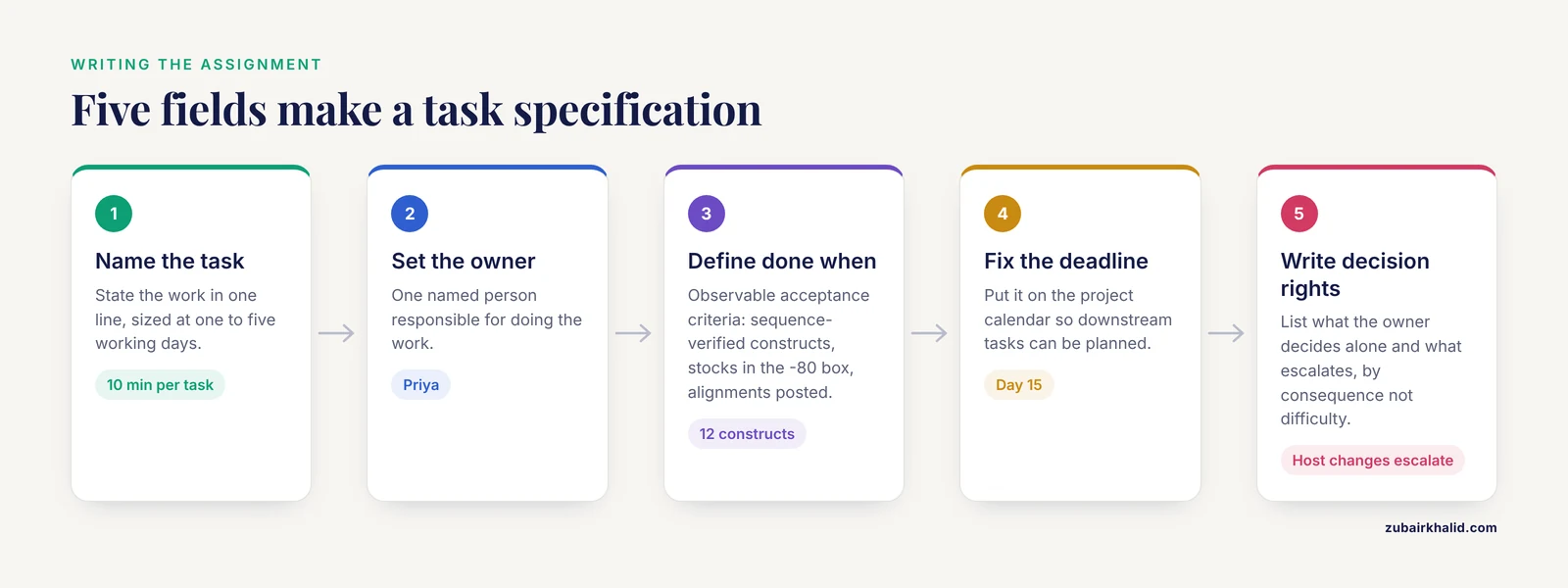
For each assignment, write a short specification with five fields. This is the single highest-value habit in delegation, and it takes ten minutes per task. Here is a real example written for Priya.
Task:      Clone constructs E1-E12 into pET-28a
Owner:     Priya
Done when: All 12 constructs sequence-verified across the full
           insert (two Sanger reads each, forward and reverse),
           plasmid stocks in the -80 box labeled LAB-PL-041,
           sequence alignments posted to the shared Drive folder
           /cloning/E-series/verification.
Deadline:  Day 15 of the project calendar (Friday, Feb 27).
Decisions: Priya chooses primers, vectors of the stated series,
           and antibiotic markers without asking. Any change of
           expression host goes to Dr. Osei first.
The "decisions" field is the one most people omit, and its omission causes the classic failure where a trainee asks you whether to use kanamycin at every step. State the decisions the owner makes alone and the decisions that escalate. Escalation criteria should be about consequences, not difficulty. Priya escalates host changes because they affect a shared cell-line schedule, not because primer design is hard.
Step 5: Put assignments where the team can see them
Create issues or cards on a shared board, one per task, with the owner, the specification, and the deadline. If your team uses GitHub, the gh command-line interface makes this fast.
gh issue create \
  --title "Clone E1-E12 constructs into pET-28a" \
  --assignee priya-lab \
  --label "cloning" --label "priority-high" \
  --body "Specification: see /protocols/cloning-E-series.md.
Done when: 12 sequence-verified constructs, stocks in LAB-PL-041,
alignments in Drive /cloning/E-series/verification.
Deadline: 2027-02-27. Decisions: primer choice and antibiotic
markers are Priya's. Host changes escalate to Dr. Osei."
Expected output:
https://github.com/yourlab/enzyme-structure-function/issues/17That URL is now the single source of truth for the task. Questions, failed clones, and protocol changes get posted there, which means six months later anyone can reconstruct what happened without excavating an email thread. For teams that do not use code hosting, the identical structure works in Trello, Notion, or Asana. What matters is not the tool, it is that the assignment, the acceptance criteria, and the discussion live in one shared place instead of in one person's inbox.
Step 6: Balance the load with a script, not with vibes
When you have more tasks than intuition can juggle, a tiny script surfaces the mismatch immediately. This one assigns tasks greedily to the person with the most remaining capacity, respecting a skill match.
tasks = [
    {"id": "clone_E1_E12",  "hours": 60, "skill": "cloning"},
    {"id": "purify_all",    "hours": 90, "skill": "purification"},
    {"id": "assay_setup",   "hours": 30, "skill": "assay"},
    {"id": "kinetics",      "hours": 24, "skill": "analysis"},
    {"id": "figures",       "hours": 24, "skill": "writing"},
]

# capacity in hours for a 6-week window
members = {
    "Alex":      {"capacity": 72, "skills": {"cloning", "purification", "assay", "analysis"}},
    "Priya":     {"capacity": 54, "skills": {"cloning", "assay"}},
    "Dr. Osei":  {"capacity": 60, "skills": {"cloning", "purification", "assay", "analysis", "writing"}},
    "Sam":       {"capacity": 24, "skills": {"writing"}},
}

for task in sorted(tasks, key=lambda t: -t["hours"]):
    fit = [(m, d["capacity"]) for m, d in members.items()
           if task["skill"] in d["skills"] and d["capacity"] >= task["hours"]]
    if fit:
        owner, _ = max(fit, key=lambda x: x[1])
        members[owner]["capacity"] -= task["hours"]
        print(f"{task['id']:15s} -> {owner}  (remaining {members[owner]['capacity']} h)")
    else:
        print(f"{task['id']:15s} -> NO QUALIFIED CAPACITY")
Expected output:
purify_all      -> Dr. Osei  (remaining -30 h)
assay_setup     -> Dr. Osei  (remaining -30 h)
clone_E1_E12    -> Priya     (remaining -6 h)
kinetics        -> Alex      (remaining 48 h)
figures         -> Sam       (remaining 0 h)
The negative numbers are the entire value of the script. They tell you in ten seconds that the plan does not fit the window, and specifically that Dr. Osei is over-committed by roughly 30 hours. Without this check, you discover the same fact on the deadline. The fix is not to work Dr. Osei harder. It is to extend the purification window, split the construct set, or move assay setup into weeks where Priya has finished cloning. Re-run the script after each change. The final numbers should all be zero or positive.
Step 7: Run check-ins with a fixed agenda
Delegation fails silently, so build in a rhythm that surfaces failure early. For most lab projects, a weekly 15-minute standing check-in per project plus an asynchronous written update works well. The written update answers four questions and nothing else.
1. What did I complete this week?
2. What am I doing next week?
3. What is blocked, and what do I need to unblock it?
4. Did anything change the estimates?
Write these in the project channel or as comments on the issue cards. Asynchronous updates matter more than meetings, because they create a written record and let the supervisor prepare questions instead of interrupting bench work to ask them.
Calibrate the first check-in for a new skill assignment to two or three days, not a week. An early check-in on a first-time assignment is not surveillance. It is the mechanism by which a wrong protocol gets caught on day 3 instead of day 10.
Step 8: Close the loop on credit
When the paper is drafted, walk each team member through their CRediT roles and confirm the list before submission. State the mapping explicitly during assignment, at the start. "Running the screen puts you in investigation and data curation" is a sentence that takes five seconds and changes how a trainee thinks about their work. Teams that discuss credit openly have fewer disputes than teams that treat it as a mystery resolved at submission time, and the contributors statement now required by most journals gives you the format for that conversation.
Choosing Among Research Collaboration Tools
You do not need every tool. You need one shared place for tasks, one shared place for procedures, one shared place for data, and one channel for conversation. The table below summarizes the common options and what each is good at.
| Need | Typical options | Best fit |
|---|---|---|
| Task tracking | GitHub Projects, Trello, Asana, Notion, Jira | Any team that will actually update it. Pick the one your team already opens daily. |
| Procedures and SOPs | Google Docs, Notion, electronic lab notebook (e.g. eLabFTW, Benchling) | Anything with regulatory or reproducibility value belongs in an ELN or version-controlled document, not chat history. |
| Code and analysis | GitHub, GitLab with version control | Anything scripted. Issues double as task tracking for computational work. |
| Data sharing | Institutional cloud drives, OSF | Datasets tied to papers, with the OSF (Open Science Framework) useful for public archiving at publication. |
| Identification | ORCID iDs for every member | Disambiguating contributions across the team's careers, required by many funders and publishers. |
| Real-time chat | Slack, Microsoft Teams, Mattermost | Questions, alerts from instruments, and rapid coordination. Never the record of a protocol. |
One integration rule saves the most time. When a task produces a file or a dataset, link it from the task card, not from chat. A card titled "Kinetic analysis, done" that links the fitted parameters and the script is a scientific record. The same information posted in a Slack thread is a rumor that will be deleted by retention policy.
Common Mistakes and Limitations
These are the failure modes that show up repeatedly in research teams, each with the practical fix.
Delegating tasks without delegating decisions. If Priya must ask you about every primer, you have not delegated cloning, you have hired an expensive pair of hands. Fix this by writing the decision-rights field in every specification, as in Step 4.
Assigning to the strongest person by default. Alex does everything fastest, so Alex gets everything, then burns out or becomes a bottleneck. Fix this by assigning training value explicitly. Critical-path work goes to the competent, everything else is a chance to move someone up the matrix.
Estimating in FTE instead of focused hours. "Priya will handle cloning" hides the fact that Priya has 18 hours a week, two courses, and a rotation student shadowing her. Fix this by estimating in focused hours and comparing them against the capacity column.
Skipping the acceptance criteria. "Purify the protein" is not done until someone defines what purity is acceptable and how it is measured. Vague completion definitions produce the argument at review time instead of the clarification at assignment time.
Check-ins that turn into status theater. A one-hour group meeting where everyone recites activity is not a check-in. Fix this with the four-question written update and short, targeted conversations when question 3 reveals a block.
Delegating a task and also hovering over it. Micromanagement trains your team to stop making decisions, which guarantees more micromanagement. The fix is to review outcomes against the acceptance criteria, not methods, unless the method is unsafe.
Ignoring the learning curve in estimates. A task that takes Dr. Osei two hours takes a first-year student a day and a half. That is normal and should be budgeted. An assignment that feels like a failure because it took four times the senior estimate was planned with the wrong number.
Leaving authorship ambiguous until submission. The single most damaging conflict in a research team is the surprise authorship list. Fix it with the explicit CRediT conversation at assignment and again before submission, and with the ICMJE criteria as your shared reference for what authorship requires.
One honest limitation applies to everything above. Labs differ in size, funding pressure, personnel turnover, and local mentorship expectations, and no delegation framework substitutes for the judgment of a supervisor who knows their trainees. The steps here are a structure for exercising that judgment, not a replacement for it. Early-career scientists should also read their institution's responsible-conduct-of-research requirements, since mentoring and authorship obligations vary by institution and funder.
Frequently Asked Questions
How many tasks should I delegate at once to one person?
Give each person at most two active tasks on the critical path and one background task, and match the total focused hours to about 60 to 70 percent of their weekly capacity. More parallel work than that reduces throughput for everyone, because context switching between experiments has a real cost in both time and errors.
How do I delegate to an undergraduate with no lab experience?
Delegate a bounded, low-risk task pair: one routine task with a detailed written protocol and one slightly stretching task where they observe and then repeat under supervision. Write the acceptance criteria explicitly, check in after two to three days, and expect to budget two to four times the senior time estimate for the first cycle.
What do I do when a delegated task fails?
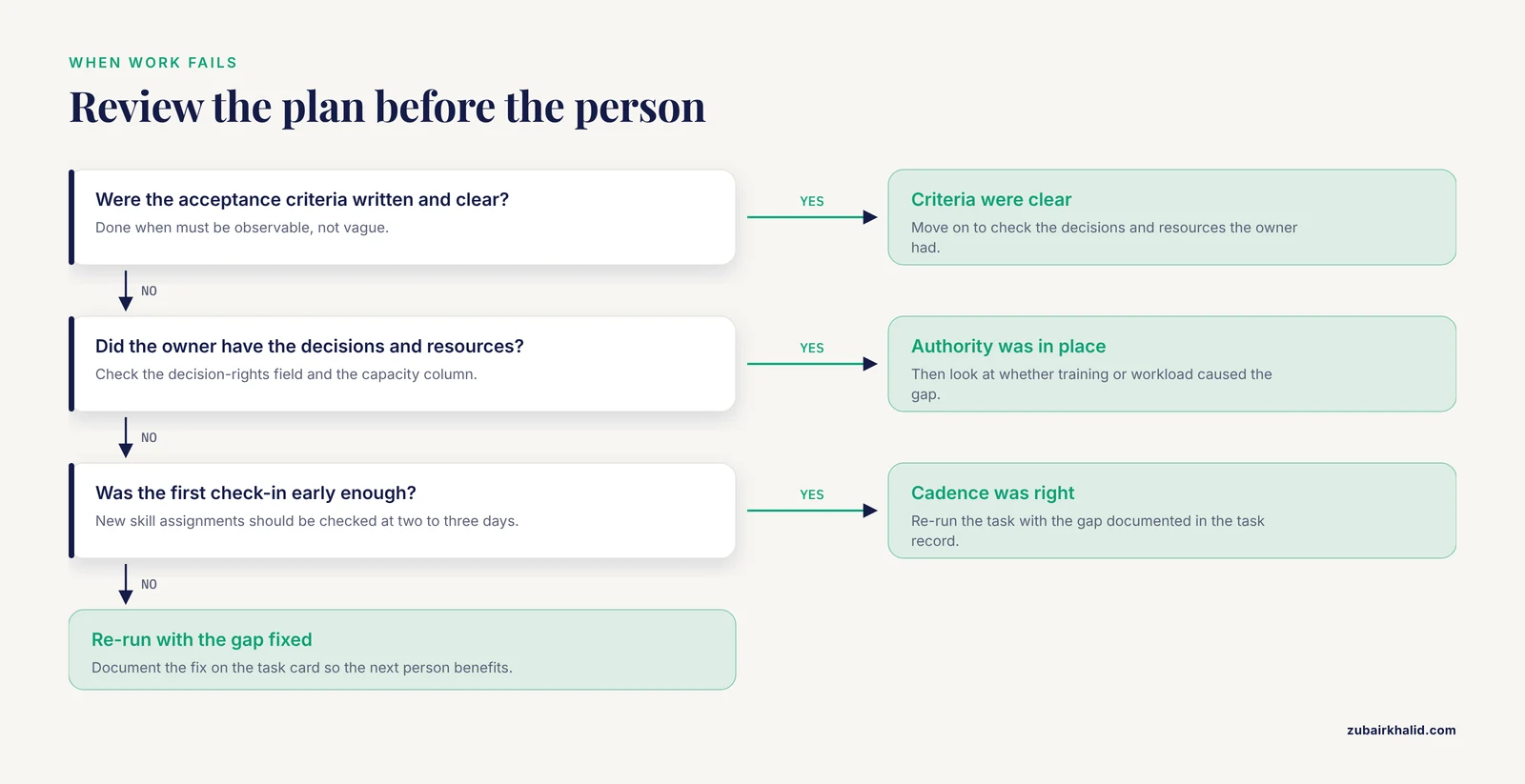
Treat the failure as information about the specification, the training, or the workload before treating it as information about the person. Review what the acceptance criteria said, whether the owner had the decisions and resources they needed, and whether the check-in cadence was early enough. Then re-run the task with the gap fixed, documented in the task record so the next person benefits.
Can a postdoc delegate when the PI is not involved in the day-to-day?
Yes, as long as the postdoc holds explicit authority for the decisions they delegate downward and accountability for the outcome is not blurred. The postdoc should be accountable on the RACI row, the trainee responsible, and the PI informed, with any decision that changes scope or cost escalating to the PI.
How is authorship decided for delegated work?
Authorship follows substantive contribution under the ICMJE criteria, and journals record the specifics using the CRediT taxonomy. Discuss the expected contribution roles at assignment time and confirm the full list with every contributor before submission, so the published record matches what each person actually did.
Which research collaboration tools should a small team start with?
Start with three: one task board everyone sees daily, one shared document system for protocols and specifications, and one version-controlled repository if any part of the work is computational. Add a channel tool and a structured data repository only when the team feels the gap. Tools do not create scientific collaboration, visible shared records do.
How do I track progress without micromanaging?
Track outcomes against written acceptance criteria at a fixed cadence, and never track presence or method. If a task's status is visible on a shared board with an asynchronous weekly update, you do not need to ask, and your team does not need to be asked. The visibility itself does the supervision.
What if two team members both think they own the same task?
Resolve it in the RACI table before work starts, because the rule is simple: one accountable person per task, always. If the conflict surfaces mid-task, decide who owns it in one conversation that day, record the decision on the task card, and treat the ambiguity as a sign your next planning cycle needs the RACI step done in writing rather than in a hallway.