How to Decline an Authorship Request: Scripts and Strategies
By Dr. Zubair Khalid, DVM, MS, PhD ·

The most common authorship request you will want to decline is the courtesy offer, sometimes called gift, guest, or honorary authorship. A colleague, a senior clinician, or a department head asks to be added to a manuscript even though they did not design the study, analyze the data, draft the paper, or approve the final version. The request usually arrives as a friendly email, a hallway conversation, or a note attached to a shared document, which makes it socially awkward and ethically loaded at the same time.
The first thing to check is not your relationship with the person asking. It is the authorship standard your target journal expects. Most biomedical journals follow the International Committee of Medical Journal Editors (ICMJE) recommendations, which define an author as someone who made a substantial contribution to the work, drafted or critically revised the manuscript, approved the final version, and accepts accountability for all aspects of the study. A request that fails this test is one you can decline on principle rather than on personality, and that distinction changes the entire conversation.
This guide walks through the causes of unwanted authorship requests from most common to rarest, gives you a troubleshooting table, and provides word-for-word scripts for the situations early-career researchers run into most often. It also covers the mirror-image problem, which is how to respond to an unfair authorship request made on your behalf, such as a collaborator adding your name to a paper you did not meaningfully work on.
Why Authorship Requests Go Wrong
Authorship is both an academic currency and a formal ethical responsibility. A 2026 narrative review on publishing clinical trials lists authorship integrity among the core requirements for ethical and successful publication, alongside trial registration, reporting guideline adherence, and transparent statistical reporting [1]. In other words, journals treat who appears on the byline as part of the scientific record, not as a social courtesy.
Because a byline carries career value, it also carries pressure. Authorship disputes remain one of the most frequent ethical problems in collaborative research, and the responsible conduct of research literature consistently identifies three root drivers:
- Unclear contribution criteria. Teams never agree, in writing, on what earns authorship before the work begins.
- Power asymmetry. Junior researchers, students, and staff feel unable to say no to a senior colleague.
- Contribution ambiguity. Roles blur. A person who provided a reagent, enrolled a few patients, or funded part of the work believes they crossed the authorship threshold, while the writing team disagrees.
A fourth driver is newer. Artificial intelligence tools now draft text, summarize literature, and analyze data, and surveys suggest that more than half of researchers use AI chatbots for tasks such as language refinement and administrative coordination. This creates genuine confusion about whether substantial AI-assisted work earns a byline, and it complicates accountability because no AI system can approve a manuscript or answer for its accuracy [2]. Journals and bodies such as the ICMJE have responded by stating that AI tools cannot meet authorship criteria and that AI use must be disclosed, a point covered in detail later in this article.
The Standard to Measure Against
Before you decline anything, anchor the conversation to a written standard. The ICMJE criteria are the default in medicine and life sciences, and they appear in journal instructions to authors. A person qualifies as an author only if they meet all four conditions:
- Substantial contributions to the conception or design of the work, or the acquisition, analysis, or interpretation of data.
- Drafting the work or revising it critically for important intellectual content.
- Final approval of the version to be published.
- Agreement to be accountable for all aspects of the work, including ensuring that questions about the accuracy or integrity of any part of it are appropriately investigated and resolved.
Contributions that fall short of authorship, such as providing funding, general supervision of a research group, technical support, data collection alone, or language editing, belong in the acknowledgments section, with the person's written permission. Many journals also require a formal author contributions statement at submission, which is exactly where a declined request can be routed gracefully [1].
When you decline with these criteria in hand, you are not rejecting a person. You are applying a standard that the journal itself will enforce at submission and, in some cases, at review.
Troubleshooting Table: Symptoms, Causes, and Fixes
| Symptom | Likely cause | How to confirm | Fix |
|---|---|---|---|
| A senior colleague emails asking to be "added to the author list" after the draft exists | Gift or honorary authorship | Compare their actual tasks against the four ICMJE criteria, and check the contributions statement | Send the decline script in the next section, offer an acknowledgment with permission, and document the exchange |
| A collaborator who supplied reagents or a small dataset expects authorship | Conflating material contribution with authorship contribution | Ask directly what role they played in conception, analysis, drafting, or revision | Thank them specifically, cite their resource in the methods, place them in acknowledgments |
| Your name appears on a submitted or published manuscript without your consent | Unrequested or coercive authorship, possibly fabricated authorship | Check the submission record, cover letter, and any correspondence you can access | Request removal in writing, contact the journal's editorial office, and escalate to a research integrity officer if needed |
| A colleague asks you to add a third person as a favor | Reciprocal or traded authorship | Ask what the third person actually contributed, and request it in writing | Decline citing journal criteria, or if the contribution is real, ask the person to perform a genuine author task |
| Pressure to credit an AI tool or to claim AI-assisted work as personal authorship | AI contribution ambiguity and accountability gaps | Determine which text or analyses were AI-generated and which journal disclosure policy applies | List AI use in a disclosure or methods note per journal policy, keep humans on the byline, since AI cannot satisfy authorship criteria [2] |
| The author list is renegotiated after submission, outside your control | Post-submission list manipulation without all authors' consent | Compare the submitted author list with the revised version in the journal system | Raise it with the corresponding author, notify the journal editorial office, and involve your institution's research integrity officer if unresolved |
| A named author refuses to approve the final version or cannot describe the study | Nominal authorship, meaning someone agreed to be listed but does not meet the accountability criterion | Ask each author to confirm the final version and state their contribution | Pause submission, resolve contributions, and have every author approve the final manuscript before resubmission [1] |
How to Decline an Authorship Request: Causes in Detail
Understanding the mechanism behind each type of request helps you choose the right response. Working from most common to rarest:
Cause 1: Courtesy and Gift Authorship
Someone with seniority or a personal relationship to the team asks to be included despite meeting none of the criteria. The mechanism is social reciprocity. The requester believes a byline is a favor you can grant, and declining feels like a personal insult. The fix is to reframe authorship as a responsibility rather than a reward. When the requester learns they would be accountable for the study's accuracy and integrity, many quietly withdraw the request. Accountability is the criterion people forget, and it is the one that does the most work in these conversations.
Cause 2: Contribution Inflation
A genuine contributor overestimates the weight of their role. A technician who ran assays, a clinician who referred patients, or a statistician who ran a pre-programmed analysis may all believe they qualify. The mechanism is a mismatch between effort and the ICMJE definition, which values intellectual contribution to conception, interpretation, drafting, and revision. This person is often not behaving unethically. They are applying a different, looser definition. The fix is a specific, respectful conversation that offers acknowledgment and names exactly what their contribution was worth.
Cause 3: Supervisor and Hierarchy Pressure
A senior investigator instructs you to add someone, or a department head expects a byline on every paper from the unit. The mechanism is power asymmetry. Junior researchers fear retaliation, funding consequences, or damage to their training relationship. This is the situation where documenting your decline matters most, because if the paper is later investigated for authorship integrity, you want a written record showing you raised the concern. Guidance on responsible conduct of research is explicit that researchers are not obligated to participate in gift authorship, and that institutions provide channels for these disputes.
Cause 4: Unrequested Authorship
The mirror-image problem. Someone adds your name without asking, often to add weight to the paper or to reciprocate a past favor. This is an unfair authorship request aimed at you rather than by you, and it is arguably more serious, because you would carry accountability for work you did not do. The mechanism is convenience. Adding a known name is faster than obtaining genuine consent and a genuine contribution. The fix is a written removal request to the corresponding author, and if the paper is already submitted or published, direct contact with the journal editorial office, which handles unauthorized authors as a publishing ethics matter.
Cause 5: AI-Related Authorship Confusion
The newest cause. A team uses a chatbot to draft substantial sections, then debates whether the tool deserves a byline, or whether a researcher who merely prompted the tool qualifies as an author. The ethical problem runs deeper than labels. Researchers have flagged concerns about cognitive dependency, accountability gaps, and undisclosed AI use undermining trust in peer review [2]. The settled position among major editorial bodies is that AI tools and their outputs do not satisfy authorship criteria, because an AI system cannot approve the final version or take responsibility for its accuracy. AI use belongs in a disclosure statement, and the humans who substantively designed the study, interpreted the results, and revised the manuscript are the authors.
Cause 6: Coercive and Retaliatory Requests
The rarest and most serious form. A person conditions data access, funding, a reference letter, or a collaboration on inclusion as an author. Coercive authorship crosses from an etiquette problem into a research integrity problem. The mechanism is leverage, and the fix is not a polite script but a formal report to a research integrity officer, an ombudsperson, or the journal's ethics editor.
Scripts for Declining an Authorship Request
The following scripts are starting points. Adjust the tone to your relationship with the person, but keep three elements in every message, a clear decline, the reason, and a concrete alternative.
Script 1: Declining When You Did Not Contribute Enough
Use this when someone offers you authorship but you know your contribution falls short. Accepting would make you accountable for work you cannot defend.
Thank you for thinking of me for the author list. Since I did not contribute to the study design or data interpretation, and I have not drafted or revised the manuscript, I do not meet the authorship criteria the journal applies, and I would not be able to approve the final version in good conscience. I am glad to be listed in the acknowledgments for my help with the sample collection, if you would like, and I am happy to review and give feedback on the draft as a colleague.
Script 2: Declining a Gift Authorship Offer
Use this when a senior colleague asks to be included without meeting the criteria. Lead with respect, then invoke the standard.
Thank you for your interest in the manuscript. Before finalizing the author list, we are confirming that every author meets the journal's criteria, which require substantial contribution to the work, drafting or critical revision, approval of the final version, and accountability for the study. Based on the current contributions statement, the byline includes those who performed these roles. Your guidance on the project has been valuable, and we would like to recognize it in the acknowledgments, with your permission. If you have contributed in a way we have missed, please tell me and we will reassess.
That last sentence matters. It keeps the door open for a genuine contribution you may not know about, and it converts a refusal into a verification step.
Script 3: Removing Your Own Name
Use this when you were added without consent.
I noticed my name on the manuscript submitted to [journal]. I did not contribute to the conception, analysis, writing, or revision of this work, and I did not consent to authorship. Because authorship carries responsibility for the accuracy and integrity of the paper, I need to ask that my name be removed before the manuscript moves forward. Please confirm once this is done, and let me know if you need anything in writing for the journal.
If the paper is already published, send a version of this message directly to the journal's editorial office and copy the corresponding author. Journals have established procedures for correcting authorship, and unauthorized authors are treated as a correction, not a favor.
Script 4: Declining to Add Someone Else
Use this when asked to include a person who does not qualify.
I appreciate you raising this. Our journal requires an author contributions statement, and each author must meet the criteria for substantial contribution, drafting or revision, final approval, and accountability. If [name] contributed to the study in a way that meets those criteria, we would be glad to include them, and I can send the criteria so we can confirm together. If their role was [providing reagents, recruiting a few participants, administrative support], the appropriate recognition is the acknowledgments section, and I will draft that language for your review.
Script 5: Responding to Pressure from a Supervisor
Use this when hierarchy makes a plain refusal risky. Anchor the refusal to the journal and the record, not to your own preference.
I want to make sure our submission goes smoothly. The journal requires a signed statement that all authors meet the authorship criteria and have approved the final manuscript. If we include [name], we will need to document their specific contributions and have them approve the final version. Given the timeline, I suggest we either invite them to take on a genuine authorship task, such as revising the discussion section, or recognize their contribution in the acknowledgments. Which would you prefer?
This script works because it moves the burden. You are not refusing your supervisor, you are reporting what the journal will require, and you are offering two legitimate paths forward.
Script 6: Resolving AI-Related Confusion
Use this when a co-author proposes crediting an AI tool or when AI use muddies who actually wrote the paper.
On the authorship question, the journal's policy follows the position that AI tools cannot be listed as authors, because a tool cannot approve the final manuscript or take responsibility for its content. We should instead disclose the AI assistance in the methods or acknowledgments, describing which tasks the tool performed. The author list will include the people who designed the analysis, interpreted the results, and revised the manuscript. I can draft the disclosure language today.
A Short Diagnostic Sequence
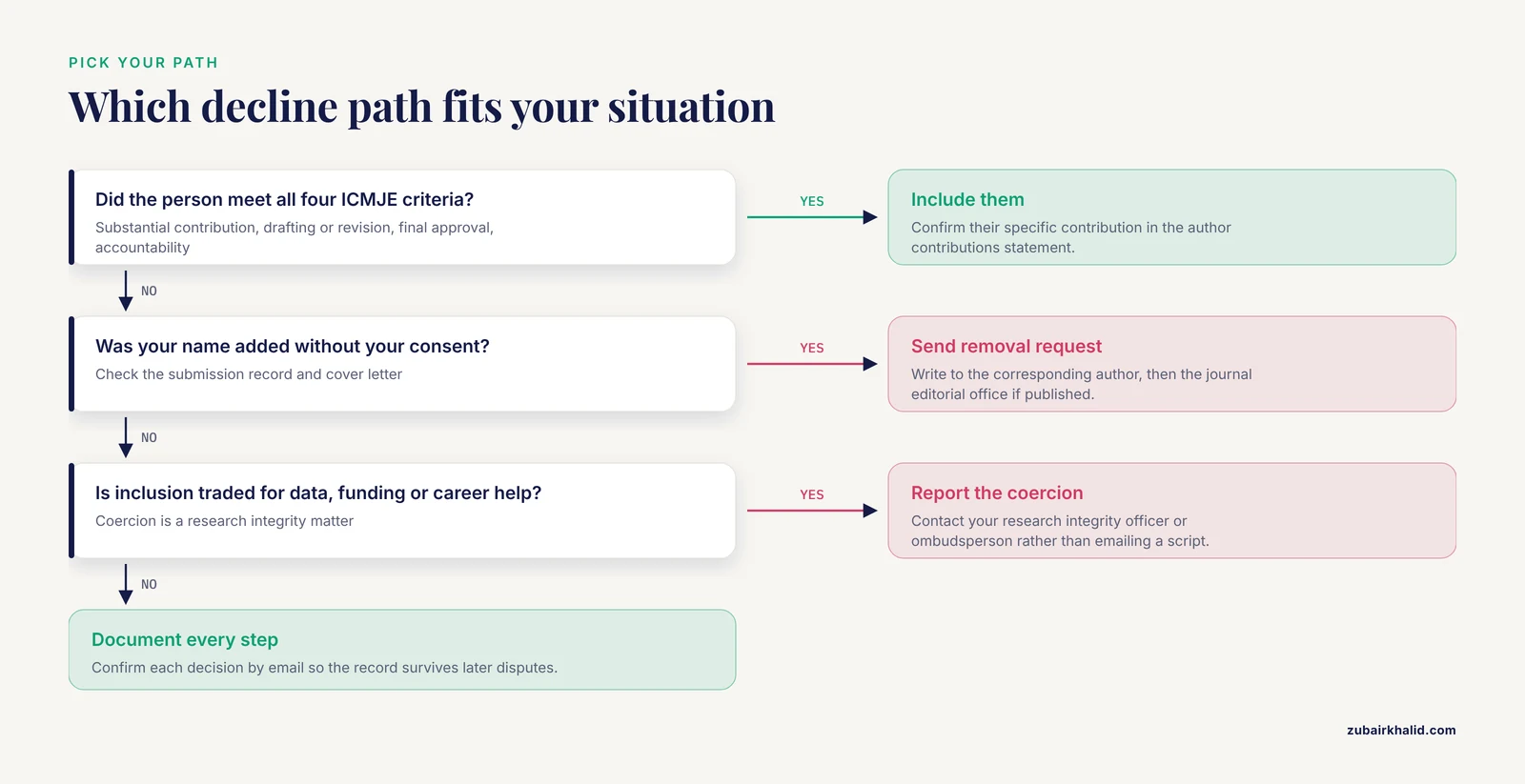
If you are unsure which situation you are in, run these five checks in order:
- Read the journal's authorship policy. Most journals state the ICMJE criteria or a close variant in their instructions to authors. This is your authority document.
- List each proposed author's actual contributions. Conception, data acquisition, analysis, interpretation, drafting, revision, final approval. Anything else is acknowledgment material.
- Check the accountability test. Ask each proposed author directly, "Are you prepared to approve the final version and answer questions about the study's integrity if they arise?" Reluctance here is diagnostic.
- Check consent and timing. Did every listed author agree, in writing, before submission? Author lists should be settled before submission, and journals expect all authors to approve the version submitted [1].
- Check for coercion. If inclusion or exclusion was traded for money, data, or career advancement, stop the informal process and contact your institution's research integrity office. Coercive authorship is a formal misconduct concern, not a negotiation.
Prevention Practices
Most authorship requests never need to be declined if expectations are set early. These practices come directly from how well-run groups manage manuscripts:
- Agree on the author list at project start, not at submission. Write down who will be an author, in what order, and what each person must contribute. Revise the list as the work evolves, and tell people when their status changes.
- Use a contributions statement from the first draft. Many journals require one anyway, and having it visible prevents contribution inflation [1].
- Circulate the final manuscript to every author and collect explicit approval. This satisfies the final-approval criterion and protects the corresponding author.
- Keep an authorship decision record. A short email trail documenting who was offered what, and on what basis, resolves disputes months later.
- State your AI use. Disclose which tasks, if any, were assisted by AI tools, consistent with journal policies that require transparency because undisclosed use can compromise trust in the published record [2].
- Teach trainees the criteria early. Students and postdocs who know the four ICMJE criteria decline bad offers faster and with less anxiety, because the refusal rests on an external standard rather than on personal nerve.
Safety Note
Declining authorship is usually a professional etiquette problem, but two situations carry real risk and deserve a formal channel rather than an email script. First, if a person conditions resources, funding, or your career progression on authorship inclusion, report the coercion to your institution's research integrity officer or ombudsperson. Second, if your name appears on a manuscript you never agreed to, and the corresponding author refuses to remove it, contact the journal's editorial office in writing and copy your institution. Both routes exist precisely for situations where polite negotiation fails, and using them is part of responsible conduct of research, not an escalation to avoid.
Common Mistakes and Limitations
- Declining by silence. Ignoring the request leaves the author list ambiguous until submission, which is when disputes become expensive. Respond in writing, even briefly.
- Declining on personal grounds. Saying "we are not close anymore" invites negotiation. Saying "this does not meet the journal's authorship criteria" does not.
- Offering acknowledgment without permission. Acknowledgment itself requires the named person's written consent under most journal policies. Ask first.
- Accepting a gift byline "just this once." A byline you cannot defend follows you permanently, is indexed with your name in bibliographic databases, and makes you accountable for the paper's integrity. Early-career researchers are especially vulnerable to this trade, because publication pressure can reward quantity over rigor [2].
- Deleting someone from the author list unilaterally. Authorship changes require the agreement of all current authors and notification of the journal. Removal without consent triggers formal investigation.
- Assuming seniority implies authorship. General supervision of a lab or department does not meet the criteria by itself. The ICMJE guidance is explicit that supervision alone earns acknowledgment, not authorship.
- Conflating AI assistance with authorship. Prompting a chatbot does not substitute for intellectual contribution, and the tool itself cannot be an author. The humans responsible for the science hold the byline.
- Skipping the written record. Verbal agreements about authorship dissolve under stress. Confirm every decision by email.
One limitation to keep in mind, individual authorship disputes vary enormously in their politics, contracts, and institutional policies. The scripts here reflect widely adopted editorial standards, but your university's authorship policy, your funder's requirements, and the specific journal's rules always take precedence. When a dispute involves allegations of misconduct, your institution's research integrity office is the right channel, not an informal email exchange.
Frequently Asked Questions
What is the politest way to decline an authorship request?
Thank the person, explain that you or they do not meet the journal's authorship criteria, and offer an alternative such as an acknowledgment or a specific contributor role. Keep the message short, written, and anchored to the published standard rather than to personal feelings.
Can I be listed as an author without my consent?
No, and it happens often enough that journals have formal correction procedures for it. Request removal in writing from the corresponding author, and if the paper is submitted or published, contact the journal editorial office directly, since unauthorized authorship is treated as an ethical issue for the record.
What if my supervisor insists I include someone who did not contribute?
Point to the journal's authorship policy and its required contributions statement, and offer acknowledgment as the alternative. If your supervisor continues to pressure you, or if the inclusion was traded for something of value, take the matter to your institution's research integrity officer.
Does an acknowledgment replace authorship?
Acknowledgment recognizes contributions that fall short of the authorship criteria, such as funding, technical help, materials, or general supervision, and it requires the person's written consent. It is not a demotion, it is the correct placement for those roles under standard editorial criteria.
Can an AI tool be listed as an author?
No. AI tools cannot approve a final manuscript or take responsibility for its accuracy, which are core authorship criteria. Disclose the AI assistance in a statement per the journal's policy, and keep the byline limited to humans who meet all four criteria.
Can I decline after the manuscript has already been submitted?
Yes, though it is more complicated. Contact the corresponding author first, then the journal's editorial office, which can process authorship corrections. The earlier you act, the simpler the correction, so never wait for publication.
Will declining an authorship request damage my career?
A well-documented decline based on journal criteria rarely does, and it protects you from accountability for work you cannot defend. The greater career risk is accepting a byline you cannot justify, which can surface later in integrity reviews or when a reader questions the paper.
Who do I contact if declining does not resolve the problem?
Start with the corresponding author, then the journal's editorial office, then your institution's research integrity officer or ombudsperson. If coercion or misconduct is involved, go straight to the research integrity office, since that escalates the matter into a formal process with protections for you.