How to Correct the Scientific Record
By Dr. Zubair Khalid, DVM, MS, PhD ·

By the end of this guide, you will be able to classify the problem with a published paper, assemble the documentation an editor needs, write a correction request that actually gets answered, and verify that the published notice is properly linked to the original article. If you are not an author but you have spotted a problem, you will also know the correct channels for raising the concern.
Before you start, put these things within reach:
- The DOI of the article in question
- The final published PDF and, if you have it, the accepted manuscript version
- The original data, code, and laboratory or field notebooks behind the claim
- A dated record of any relevant email correspondence with co-authors
- The journal's contact details for its editorial office and its ethics or research integrity contact, usually listed on the journal website under "editorial policies"
What "the Scientific Record" Means, and Why It Cannot Be Quietly Edited
A published paper is a permanent, citable claim. Other researchers build on it, cite it, and reuse its data. This permanence is deliberate. The record exists so that anyone, at any later date, can see exactly what was claimed, on what evidence, and by whom.
That permanence has a corollary. You cannot fix a published paper by republishing it, quietly changing the PDF, or hoping nobody notices the error. Fixes happen through formal notices issued by the journal: corrections, expressions of concern, and retractions. The Committee on Publication Ethics (COPE), the body whose guidance most major publishers follow, publishes retraction guidelines that describe this system, and editors generally expect authors to use it rather than to handle errors privately.
The system exists because science corrects itself in two ways. The first is through new evidence that revises old conclusions. Paleobotany offers a clean worked example. A flower specimen collected more than a century ago from the Dakota Sandstone of central Kansas sat in a museum collection until researchers examined it with micro-CT scanning, which produces virtual cross-sections and a three-dimensional rendering without destroying the fossil. That reanalysis identified the first monocot flower ever reported from the Dakota Formation, dated to roughly 100 million years ago, and named a new genus and species, Tomlinsoniella pedicellata, with implications for the fossil record of palms [1]. The earlier record was not wrong so much as incomplete, and transparent methods plus preserved specimens made the revision possible.
The second way the record corrects itself is through error reporting, which is the process this article walks through. Both routes depend on the same habit: documenting exactly what was done so that someone else can check it later.
Before you ever need a correction, you can reduce the odds you will need one. Two practices help. First, follow a recognized reporting standard for your study type, the way a cardiovascular digital twin scoping review followed the Arksey and O'Malley framework and reported itself according to the PRISMA-ScR guidelines, searching seven named databases over a defined window of years [2]. A structured checklist catches omissions before publication. Second, use standardized data capture so that terms mean the same thing across sites and years, the way the D-SERPENT project for snakebite envenoming built a geography-specific coding system modeled on the International Classification of Diseases and SNOMED Clinical Terms, refined by Delphi consensus among clinicians and public health specialists and fed into a central surveillance dashboard [3]. Coding that is defined up front leaves less room for the ambiguity that later forces corrections.
The Correction Toolbox at a Glance
Journals use a small vocabulary of formal notices. The exact naming varies by publisher, but the functions below are standard.
| Notice type | Use it when | Who decides | Effect on the original article |
|---|---|---|---|
| Correction, erratum, or corrigendum | An error affects the accuracy of part of the paper but the main conclusions stand | The journal editor | Article stays in place, changes described in a linked notice |
| Addendum | New information adds context without changing conclusions | The journal editor | Article stays in place, new material appended |
| Expression of concern | Credible doubt exists but an investigation is unfinished | The journal editor, often with the institution | Readers warned while facts are established |
| Retraction | Findings are unreliable, were published in error, or involve misconduct such as fabrication, falsification, or plagiarism | The journal editor, often with the institution | Article marked as retracted, PDF watermarked, but the record of the retraction itself stays public |
| Editorial note | Minor administrative issue, such as a misspelled author name with no effect on content | The journal editor | Small notice, article otherwise unchanged |
One point about retraction trips up many early-career researchers. Retraction does not automatically mean misconduct. Papers get retracted for honest errors that undermine the main conclusion, for duplicate publication, and for paper-mill contamination, among other reasons. The retraction notice itself states the reason, and that reason matters for how the event is read.
How to Correct the Scientific Record, Step by Step
This is the core walkthrough for a corresponding author who has found a problem in their own published paper.
Step 1. Classify the problem honestly
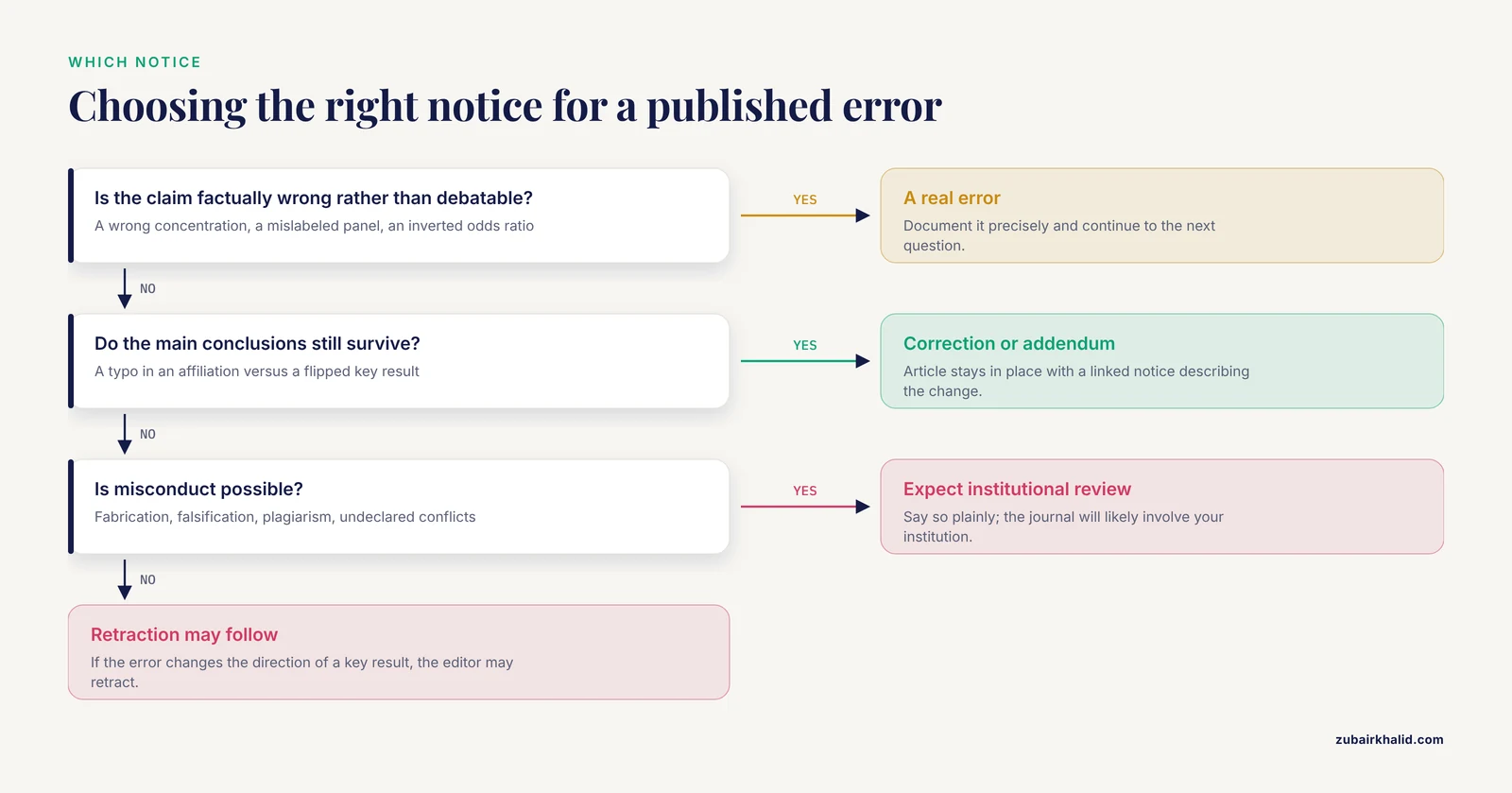
Ask three questions in order.
- Is the claim factually wrong, or merely debatable? A wrong concentration in the methods, a mislabeled figure panel, or an inverted odds ratio is an error. A competing interpretation of the same data is scientific disagreement, which belongs in correspondence to the editor or a follow-up paper, not a correction.
- Do the main conclusions survive? If a typo in an author affiliation is the whole problem, a simple correction notice suffices. If the error changes the direction of a key result, the editor may need to consider a retraction.
- Is misconduct possible? If the problem involves fabricated data, undeclared conflicts of interest, or plagiarism, the journal will likely involve your institution. Say so plainly rather than discovering it mid-process.
Write your answers down before contacting anyone. This one-paragraph self-assessment anchors every later step.
Step 2. Preserve and organize the evidence
Gather a dossier in a single dated folder. The editor's ability to act depends on being able to trace exactly what happened.
- The final published PDF, with the DOI and the version of record date
- The accepted manuscript and, if available, the peer-review correspondence
- The original data files, raw instrument outputs, and the analysis code with its version history
- Laboratory or field notebooks covering the affected experiments
- A list of every sentence, figure, table, and supplementary file that is wrong, quoted precisely
For key data files, record a cryptographic checksum so that the exact version you worked from can be proven later:
sha256sum original_data.csvExpected output looks like this:
3f7a1c9e5b2d8f4a6c0e1d7b9f3a2c5e8d1b4f7a9c2e5d8b1f4a7c0e3d6b9f2a original_data.csvSave that string with the date and the filename. If anyone later disputes which file version the analysis used, the checksum settles it. The same logic underlies publication-level provenance: a fossil study can rederive its conclusions from a preserved specimen because the specimen itself, not a description of it, is the evidence [1].
Step 3. Write to the journal's editorial office
Contact the editorial office listed on the journal site, and copy the editor who handled the paper if you know who that was. Do not route the request through a salesperson, a social media account, or the publisher's general customer service.
Use a structure like this, adapted to your case:
Subject: Correction request for [article title], DOI: 10.xxxx/xxxxx

Dear Editorial Office,

I am the corresponding author of the article above, published on
[publication date]. I am writing to request a correction.

What is wrong:
In Table 2, the values in the "pH 7.4" column were shifted by one
row during figure production. The reported value for condition C
should be 6.82, not 8.62.

Effect on conclusions:
The error affects one value in Table 2. Figure 3 and all main
conclusions are unaffected. I have attached a marked-up PDF and the
corrected source table.

Documentation:
Original data file, analysis script, and email thread with the
co-authors are attached. All five co-authors have seen this message
and agree with the correction.

Requested action:
A correction notice linked to the original article.

Sincerely,
[Name, affiliation, ORCID iD]
The parameters that matter in this letter are the same ones an editor needs under publication ethics guidance: precise location of the error, its scope, whether conclusions change, evidence, and confirmation that all authors agree. Omitting the co-author confirmation is the most common reason a request stalls.
Step 4. Cooperate with the editorial process
Once the editor engages, the process typically runs in this order.
- The editor acknowledges the request and may consult the handling editor, the peer reviewers, or the publisher's ethics team.
- For anything touching misconduct, the editor may contact your institution's research integrity officer. In the United States, institutional responsibility for handling allegations of research misconduct in Public Health Service funded research is set out in federal regulation, and the Office of Research Integrity (ORI) oversees that system. Institutional processes have their own timelines, often months.
- The editor decides on the notice type. You can make the case for a correction rather than a retraction, but the decision is the editor's, not yours.
- You review the draft notice wording before it is published. Check that it states the error accurately and, where relevant, that it records that the correction was author-initiated, which is generally read favorably.
Timing varies widely. A typo correction can appear within weeks. A case that requires an institutional review can take many months. Do not submit overlapping or duplicate descriptions of the work elsewhere while the case is open, because duplicate publication is itself a correction trigger.
Step 5. Verify that the notice is published and linked
A correction that is not linked to the original article does almost nothing for readers, because anyone who finds the original will never see the fix. Modern publication infrastructure links notices automatically through Crossref, the agency that registers scholarly DOIs. When a journal publishes a correction or retraction, Crossref records the link on the original article's metadata under an "update-to" field.
You can check the link yourself with the Crossref REST API. Replace the placeholder DOI with your article's DOI:
curl -s "https://api.crossref.org/works/10.1234/journal.2026.01234" \
  | jq '{title: .message.title, DOI: .message.DOI, updates: .message["update-to"]}'
Expected output for a corrected article looks like this:
{
  "title": ["Example article title"],
  "DOI": "10.1234/journal.2026.01234",
  "updates": [
    {
      "DOI": "10.1234/journal.2026.04567",
      "type": "correction",
      "source": "Crossref",
      "updated": ["2026-11-05T00:00:00"]
    }
  ]
}
If the "updates" field is absent, the API returns nothing for it rather than an error. jq handles this gracefully, but if you pipe the wrong subfield you may see a message like:
jq: error (at <stdin>:1): Cannot iterate over nullThat message means the field you asked for does not exist for this article, which is the expected situation when no correction is linked yet, not an API failure.
A second common error occurs with a malformed DOI:
{"status":"failed","message-type":"resource-not-found","message":"Resource not found."}The fix is to check the DOI exactly as printed on the article, verify it resolves at doi.org, and confirm you did not confuse the article DOI with a supplementary-file DOI.
Then check the two places most readers will look:
- PubMed. Search the article title. If a correction exists, the record shows a "Correction in:" or "Erratum in:" line beneath the citation, and the notice itself has a reciprocal link back.
- The publisher site. The original article page should display a notice box or a footnote on the PDF. In a proper retraction, the PDF is watermarked.
Step 6. Update the downstream record
The journal notice fixes the version of record, but copies of your work live in other places, and you control several of them.
- Preprint servers. Platforms such as bioRxiv and medRxiv let authors post revised versions with a change note. Post the revision and state what changed.
- Institutional and funder repositories. If your repository allows version updates, deposit the corrected version with a note pointing to the journal notice.
- Your own future writing. Cite the article together with its correction notice, for example by citing both DOIs, so readers of your next paper inherit the accurate picture.
- Theses and dissertations. If your thesis contains the erroneous material, ask your library about the amendment or erratum process for theses at your institution.
- Collaborators. Tell any group actively reusing your data or code. A direct email reaches the people most likely to act on the error this month.
If You Are Not an Author: Raising a Concern Correctly
Most corrections are author-initiated, but a meaningful share start with a reader who notices a problem. The channels differ from the author route in one key respect: you cannot request a correction, only provide information the editor can investigate.
- Write to the journal editor with specifics. Quote the sentences or figures at issue, explain precisely why they are wrong, and attach or link any supporting analysis. Editors act on checkable specifics, not impressions.
- Consider posting on a public post-publication peer review forum. Structured, technical, signed comments give editors a durable reference and let other specialists weigh in. Anonymous or hostile posts generally get less attention and can undermine an otherwise valid concern.
- If you suspect misconduct, the journal may refer the matter to the authors' institution. If the research was United States Public Health Service funded, ORI handles oversight of institutional misconduct findings, and its website describes how allegations flow through the system.
- Keep your own dated records of what you sent and when.
If your concern is honest but turns out to be wrong, that is a normal outcome of scrutiny. Framing your letter as a question about the analysis, rather than an accusation, keeps the exchange productive.
Special Cases
Incomplete reporting
Some corrections are needed not because a result was wrong but because it was never stated. Audits keep finding these gaps. An item-level audit of 248 robot-assisted and laparoscopic partial nephrectomy videos on YouTube found that technical demonstration steps were almost always present, appearing in 99.6 percent of videos, but pathology and margin status appeared in only 25.4 percent, and institutional-channel origin was associated with higher scores on all four quality instruments used [4]. The lesson transfers directly to written papers: what goes unreported cannot be checked, and a correction may be the only way to supply a missing number after the fact. If you are asked to supply omitted values post-publication, treat the correction notice as the mechanism, not a comment thread.
Diagnosis-type errors that emerge later
Clinical research shows how later evidence revises earlier records. In a retrospective series of 52 adults operated on for second branchial cleft anomalies, preoperative and postoperative diagnoses agreed in 80.4 percent of cases, and most disagreement came from lesions suspected to be tuberculous lymphadenitis or malignant nodes [5]. The published record in such cases gets corrected or annotated when the definitive findings arrive, which is why surgical series and pathology reports specify their reference standards. If your own paper contains preliminary classifications that later work has definitively revised, an addendum or correspondence item is the standard vehicle for saying so.
Preprints, datasets, and peer-review records
A preprint is part of the public record even though it is not peer reviewed. Correct a preprint by posting a new version on the same server with a dated change note, and later deposit the peer-reviewed version. Datasets with DOIs, hosted on repositories such as Dryad or institutional repositories, can typically be versioned, and the repository generates a new DOI that links back to the old one. Peer-review records are handled by the journal, and increasingly journals publish review reports, so inaccuracies in the review record go through the editorial office as well.
Practical Tips That Make Editors Act
These tips condense what distinguishes a correction request that gets resolved from one that languishes.
- Act promptly. Delay lets the error propagate into other papers' citations.
- Put everything in writing and keep dates. Phone calls leave no trail.
- Separate the error from the disagreement. Editors handle documented errors far faster than scientific disputes.
- Never alter the original files. Provenance is your credibility.
- Loop in every co-author before the editor does. A correction request with a dissenting co-author becomes an authorship case, which is slower for everyone.
- Ask the editorial office to state the planned notice type and wording before publication.
- Follow up on a reasonable schedule, such as every three to four weeks, and escalate to the editor-in-chief or the publisher's ethics contact if the office goes silent.
- Anchor your reporting habits in the responsible conduct of research training your institution provides, since most institutions treat accurate reporting and error disclosure as core RCR obligations rather than optional courtesies.
Common Mistakes and Limitations
These are the errors people actually make when trying to correct the scientific record, with the fix for each.
- Deciding the error is too small to report. A mislabeled axis, a wrong number in the abstract, or an incorrect species name can mislead readers for years. Journals issue corrections for small problems routinely, and editors do not judge you for requesting one.
- Publicly posting before contacting the journal. Social media callouts circulate faster than corrections. If the paper is yours, the journal route is faster and cleaner. If you are a reader with a concern, a technical post plus a letter to the editor is legitimate, but lead with the letter.
- Conflating "I disagree" with "this is wrong." Corrections address factual or methodological errors. Interpretive disputes belong in correspondence or in new research. Editors reject correction requests that are really arguments.
- Editing your own files or regenerating data after the problem surfaces. Once a correction is under discussion, every file needs to be the version that produced the published paper. Make read-only copies before touching anything.
- Assuming retraction equals disgrace. Retraction notices state their reasons, and honest-error retractions are understood as the system working. What damages a career far more reliably is an error discovered by someone else years later.
- Expecting anonymity when raising a concern. Journals and institutions try to protect whistle-blowers, but complete anonymity cannot be promised, especially in small fields. Weigh this before writing.
- Forgetting the copies you control. A corrected journal article with an uncorrected preprint, repository copy, and thesis leaves half the record wrong. Complete Step 6.
- Republishing instead of correcting. Submitting the fixed version as a new paper is duplicate publication and creates a second problem to fix.
Two limitations deserve plain statement. The editorial decision is the journal's, not yours, and the timelines depend on case complexity and institutional involvement. And for any case involving possible misconduct, employment consequences, or funding obligations, consult your institution's research integrity officer or counsel early, because individual situations vary and this guide covers process, not legal advice.
Frequently Asked Questions
What is the difference between a correction and a retraction?
A correction fixes a specific error while the article's conclusions stand, whereas a retraction marks the whole article as unreliable or invalid. Both are published as linked notices, and both leave the original article searchable with clear labeling.
Can I correct a published paper without going through the journal?
No, the version of record is controlled by the journal, and only the journal can publish a linked correction notice. You can correct copies you control, such as a preprint or repository deposit, but that supplements rather than replaces the formal notice.
How long does a correction usually take?
A simple typographic correction can appear within weeks, while cases involving data questions or institutional review commonly take months. Ask the editorial office for an expected timeline when you first write.
What should I do if the journal ignores my correction request?
Follow up with the editorial office in writing, then escalate to the editor-in-chief, the publisher's ethics contact, or the publication ethics body the publisher belongs to. Keep every message dated, because a documented trail is what makes escalation effective.
Does issuing a correction damage a researcher's career?
An author-initiated correction is generally viewed as evidence of integrity rather than incompetence, because it shows you monitor and stand behind your own work. Careers suffer far more from errors that others discover and report first.
How do I report a paper I believe contains errors if I am not an author?
Write to the journal editor with precise, checkable specifics, quoting the affected passages and providing any supporting analysis. Editors investigate concerns from readers routinely, and specifics move the process forward.
Do preprints and datasets need corrections too?
Yes. Post a revised version on the preprint server with a dated change note, and version the dataset so a new DOI links back to the original. Both steps run alongside, not instead of, the journal's notice.
How can I tell whether a paper I am citing has been corrected or retracted?
Check the article record in PubMed for a "Correction in" or "Erratum in" link, look for a notice box on the publisher page, and query the Crossref metadata for the DOI. Doing this before you cite is now a normal part of literature triage.
Further Reading
Sources
- A mid-Cretaceous monocot flower from the Dakota Sandstone of Kansas and its potential implications for the fossil record of palms.
- Digital twin technology in cardiovascular care: future perspectives for nursing practice, patient management, and clinical decision-making.
- Development, Validation, and Implementation of a Geography-Specific Syndromic Coding and Reporting System for Snakebite Envenoming (D-SERPENT): Protocol for an Implementation-Effectiveness Hybrid Study.
- Showing the operation, omitting the outcome: an item-level audit of reporting completeness in robot-assisted and laparoscopic partial nephrectomy videos on YouTube.
- Diagnostic Challenges and Surgical Management of Second Branchial Arch Anomalies in Adult Patients.