How to Cite a Website in a Lab Report: APA, CSE, and Chicago
By Dr. Zubair Khalid, DVM, MS, PhD ·

By the end of this guide you will be able to take any web page, extract the five pieces of information that every web citation needs, and produce a correct in-text citation and full reference entry in APA 7th edition, CSE 8th edition, and Chicago 17th edition. You will also know exactly where those citations belong inside a standard lab report format, how to verify your finished entries, and which mistakes graders deduct points for most often.
To follow along you need four things on hand: the web page open in your browser, your instructor's required style (check the syllabus or assignment sheet), a word processor for building your reference list, and optionally a free reference manager such as Zotero, which stores citations and formats them for you. Every worked example below uses clearly marked placeholder names and the reserved test domain example.com, so you can substitute your own real page title, author, and URL as you work.
Why Websites Need Special Handling in Lab Reports
A lab report is not an essay with a bibliography stapled to the end. The standard lab report format has fixed sections, and each section cites different kinds of evidence. Your introduction cites background literature, your materials and methods section cites protocols and product documentation, and your discussion cites published findings that support or contradict your results. Journal articles carry authors, volume numbers, and page numbers that stay fixed forever. Web pages do not.
Three properties of websites force special citation rules. First, a page can change or disappear at any moment, which is why some styles require a retrieval or access date. Second, the "author" is often an organization rather than a person, which changes how the entry begins. Third, a website can host content that is really a journal article, a PDF report, or a database record, and each of those gets cited as a different source type even though you found all of them at the same URL. Most undergraduate biology and chemistry courses require APA or CSE, and a smaller number require Chicago. Knowing the differences between the three styles before you start writing saves more time than fixing entries afterward.
The Five Data Points Every Website Citation Needs
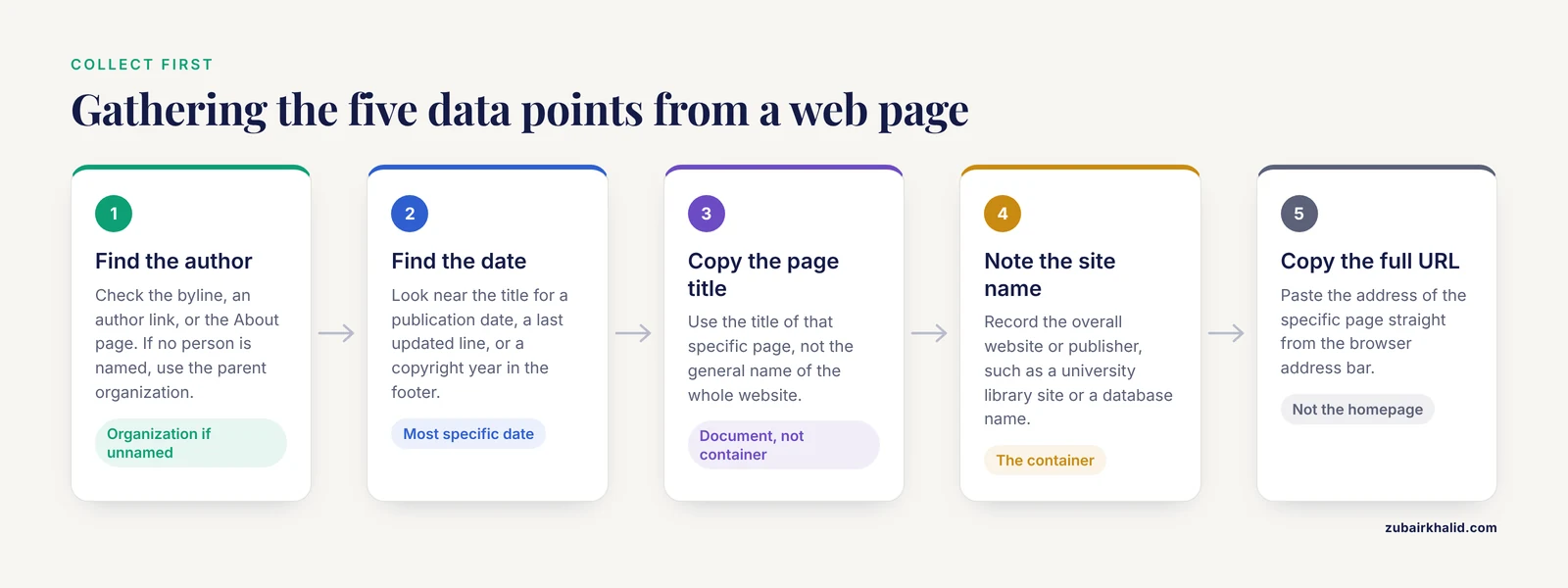
Before touching any style guide, collect this information from the page itself. Open the page and work down this checklist:
- Author. Look for a byline at the top of the article, an author link, or an About or Contact page. If no person is named, the site's parent organization is usually the author (for example, a university department or a government agency).
- Date. Look for a publication date near the title, a "last updated" or "last reviewed" line, or a copyright year in the footer. Record the most specific date available, down to the day if the page gives one.
- Page title. This is the title shown on the page itself for that specific page, not the general name of the entire website.
- Site name. The overall website or publisher, such as a university library site, an organization's main domain, or a database name.
- URL. The full address of the specific page, copied directly from the browser address bar.
A quick way to keep this straight: the page title is the document, and the site name is the container that holds it. If you cannot find a date anywhere on the page, note that now, because all three styles have a specific workaround for undated pages. If you cannot find an author at all, the page title moves into the author slot, and the rules for that differ by style, as shown in the step-by-step section below.
How to Cite a Website in a Lab Report Step by Step
The walkthrough below covers the three styles in the order most lab courses request them. Each step builds on the same sample page so you can see how the identical source transforms across styles.
Step 1: Confirm Which Style Your Course Requires
Open your syllabus, lab manual, or assignment prompt and find the citation requirement. If the document says "APA," use the Publication Manual of the American Psychological Association, 7th edition. If it says "CSE," use the Scientific Style and Format manual published by the Council of Science Editors, 8th edition. If it says "Chicago," use The Chicago Manual of Style, 17th edition. When nothing is specified, CSE name-year style is the most common convention in the laboratory sciences because it keeps the reference list in alphabetical order and matches the citation habits of most scientific journals.
Step 2: Fill In a Citation Data Sheet
Write the five data points into a plain list before formatting anything. Here is the data sheet for the sample page used throughout this walkthrough, written in plain text exactly as you would jot it down:
Author:        Sarah Whitfield
Date:          March 14, 2022
Page title:    Sterile technique guide
Site name:     Example University Libraries
URL:           https://www.example.com/protocols/sterile-technique
Content type:  static instructional page (not expected to change daily)
Because this sample page is dated and stable, none of the three styles will require a retrieval date. Later steps show what changes when a page is undated or frequently updated.
Step 3: Build the APA 7th Edition Entry
APA formats a web page reference as: author, date in parentheses, page title in sentence case and italics, site name, and URL. Sentence case means you capitalize only the first word of the title and any proper nouns. Follow this sequence:
- Write the last name, a comma, then initials. For our sample author:
Whitfield, S. - Add the date in parentheses with the full year, month, and day:
(2022, March 14). - Add the page title in italics with sentence case capitalization:
Sterile technique guide. - Add the site name in plain text:
Example University Libraries. - End with the full URL. Do not add a period after the URL, because a period can break the link.
The complete reference entry looks like this:
Whitfield, S. (2022, March 14). Sterile technique guide. Example
University Libraries. https://www.example.com/protocols/sterile-technique
The expected in-text forms are (Whitfield, 2022) for a parenthetical citation and Whitfield (2022) for a narrative citation, for example "Sterile technique followed the three-step handwashing sequence (Whitfield, 2022)."
Two variations matter for lab work. When the author is an organization, the organization name goes in the author slot: Centers for Disease Control and Prevention. (2024, May 2). Title of page. URL. When the page has no date, write (n.d.) in the date position. A retrieval date appears only when the content is designed to change over time and is not archived, such as a live dashboard or a database count, and it takes this form:
Example University Libraries. (n.d.). Media preparation calculator.
Retrieved November 5, 2026, from
https://www.example.com/tools/media-calculator
Step 4: Build the CSE 8th Edition Entry
CSE has two systems: name-year, where the reference list is alphabetical and in-text citations look like APA, and citation-sequence, where references are numbered in order of first appearance. Most lab courses use the name-year system, so that is what this walkthrough uses. CSE marks websites with the label [Internet] and requires a cited date for online sources, which is the date you consulted the page. Follow this sequence:
- Write the author: last name, a space, then initials with no periods or commas:
Whitfield S - Add the page title in sentence case, followed by
[Internet]. - Add the place of publication and publisher in parentheses, then the publication date.
- Add the cited date in brackets, using the three-letter month abbreviation with no period:
[cited 2026 Nov 5]. - Add
Available from:and the URL, ending with a period.
The complete entry looks like this:
Whitfield S. Sterile technique guide [Internet]. Example City (ST):
Example University Libraries, 2022 Mar 14 [cited 2026 Nov 5].
Available from: https://www.example.com/protocols/sterile-technique
The expected in-text form is (Whitfield 2022) with no comma between the name and the year. This missing comma is the single most common CSE formatting error, because APA training makes the comma feel automatic. When the author is an organization, the organization name starts the entry. When no date is given, CSE uses [date unknown] in the publication date position. CSE also abbreviates single-word months to their first three letters (Jan, Mar, Sep, Nov) and never adds periods to those abbreviations.
Step 5: Build the Chicago 17th Edition Entry
Chicago offers two systems. Author-date, with parenthetical citations and a reference list, matches the way lab reports work. Notes-bibliography, with footnotes, fits humanities writing and is rare in science courses, though Step 6 shows a footnote example in case your instructor wants it. For author-date, follow this sequence:
- Write the author as last name, comma, full first name:
Whitfield, Sarah. - Add the year followed by a period:
2022. - Add the page title in quotation marks with headline capitalization (capitalize major words):
"Sterile Technique Guide." - Add the site name in italics:
Example University Libraries. - Add the publication date, then the URL.
The complete entry looks like this:
Whitfield, Sarah. 2022. "Sterile Technique Guide." Example University
Libraries, March 14, 2022. https://www.example.com/protocols/sterile-technique.
The expected in-text form is (Whitfield 2022). Chicago asks for an access date when the page lacks a publication date or when the content is likely to be revised, written as accessed November 5, 2026 before the URL. For the notes-bibliography system, the same source becomes a footnote in this form:
1. Sarah Whitfield, "Sterile Technique Guide," Example University
Libraries, accessed November 5, 2026,
https://www.example.com/protocols/sterile-technique.
Notice two reversals between the systems: the author-date reference begins with the last name and ends with the date, while the footnote begins with the first name and ends with the access date.
Step 6: Place the Citations Inside the Lab Report
Citation placement follows the section structure of a standard lab report. This is where knowing how to write lab report prose and knowing citation rules meet each other. Use these worked sentences as templates:
Introduction (background):
Sterile technique reduces contamination of transfer surfaces through a
defined handwashing and flame-sterilization sequence (Whitfield 2022).

Materials and methods (protocol source):
Cultures were transferred using a three-step aseptic handwashing and
flame-sterilization sequence (Whitfield 2022).

Discussion (interpretation):
The contamination rate observed here falls within the range expected
for standard aseptic transfers (Whitfield 2022).
Three placement rules keep citations where graders expect them. First, cite the source immediately after the claim, method, or figure it supports, not in a lump at the end of a paragraph. Second, any protocol detail that came from an external page, such as a reagent concentration, an incubation temperature, or an instrument setting, needs a citation in the methods section, because a reader must be able to repeat your procedure from your description plus the cited protocol. Third, figures and tables adapted from a web source carry a note beneath the item, for example "Figure adapted from Whitfield (2022)," in addition to the in-text citation in the caption.
Step 7: Verify the Finished Entries
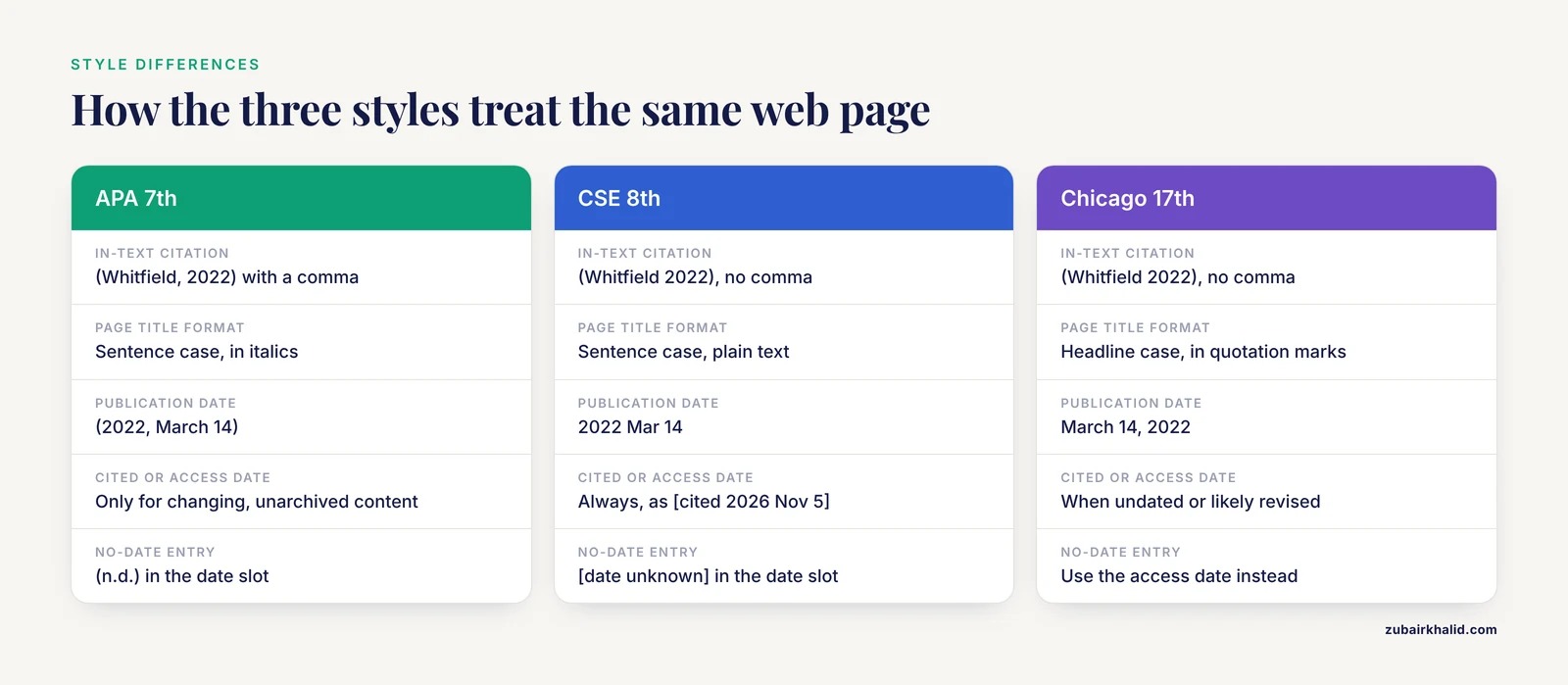
Run this four-point check before submitting. The table below is the fastest way to confirm you used the right convention for each style:
| Feature | APA 7th (name-year) | CSE 8th (name-year) | Chicago 17th (author-date) |
|---|---|---|---|
| In-text citation | (Whitfield, 2022) | (Whitfield 2022) | (Whitfield 2022) |
| Page title capitalization | Sentence case, italics | Sentence case, plain | Headline case, quoted |
| Publication date format | (2022, March 14) | 2022 Mar 14 | March 14, 2022 |
| Cited or retrieval date | Only for changing, unarchived content | Always, as [cited 2026 Nov 5] | When undated or likely revised |
| No-author entry | Starts with the page title | Starts with the page title | Starts with the page title |
| No-date entry | (n.d.) | [date unknown] | Use access date |
| Reference list order | Alphabetical by author | Alphabetical by author | Alphabetical by author |
After the table, apply this checklist to each entry: confirm the URL points to the specific page and not the site homepage, confirm the date in the entry matches the date on the page, confirm the in-text name matches the first element of the reference entry exactly, and confirm the entry appears in the reference list (or that every reference list entry has at least one in-text citation, which APA requires and which is good practice in CSE and Chicago author-date as well).
How to Cite a Website in a Lab Report: Tips That Save Time
These are the working habits that experienced writers rely on, collected as practical tips you can apply to your next report.
- Build the reference list as you read, not at the end. Whenever a page influences a sentence in your report, paste its URL and the five data points into a running document that same day. Reconstructing sources the night before the deadline is where citation errors multiply.
- Use a reference manager for anything beyond two or three sources. Zotero and Mendeley both capture author, date, title, and URL automatically when you save a page, and they generate formatted entries in all three styles covered here. Every generated entry still needs a human check, because metadata pulled from web pages is frequently incomplete or wrong.
- Archive pages that are central to your argument. Save a copy of each cited page as a PDF the day you read it. If the link breaks before grading, you can produce the archived copy, and the content you cited is verifiable.
- Match the name in the text to the name in the list. If the reference entry begins with
Whitfield S, the in-text citation must sayWhitfield, not the site name. A mismatched name breaks the reader's only path from the claim to the source. - Keep one style throughout the report. Mixing an APA entry into a CSE list is a deduction in most rubrics. If you switch styles mid-project, reformat every earlier entry before submission.
- Check the hanging indent and spacing against your department's template. Most reference lists use a hanging indent, where the first line sits at the margin and every later line is indented, plus alphabetical ordering by the first element of each entry.
Common Mistakes and Limitations
These are the errors graders actually mark down, ordered from most to least frequent, followed by the honest limits of this guide.
Citing the homepage instead of the specific page. If your evidence lives at https://www.example.com/protocols/sterile-technique, citing https://www.example.com sends your reader to a landing page where the information cannot be found. Always cite the URL of the page itself.
Using MLA out of habit. Students who wrote English papers with MLA sometimes import that format into lab reports. MLA has no place in a lab report unless the instructor explicitly requests it, and its webpage format differs from all three styles covered here.
Skipping the cited date in CSE. Because APA rarely needs a retrieval date, writers assume no style wants one. CSE name-year style does want one, every time, for every online source, formatted as [cited 2026 Nov 5]. Leaving it out is one of the most common CSE deductions.
Citing a PDF or database record as a plain website. A journal article you read through a website is cited as a journal article. A government or organizational report hosted as a PDF is cited as a report. The URL does not determine the source type, the document does. Reserve the website format for pages that exist only as web pages.
Citing search results or aggregated snippets. The source is always the page that contains the information, never a search engine results page and never a page that quotes another page secondhand. Follow the trail to the original before citing.
Generator output pasted without review. Automatic citation tools frequently miss publication dates, mislabel organizations as individuals, and truncate URLs. Every generated entry needs the four-point verification check from Step 7.
Citing in the wrong section. Background claims belong in the introduction, protocol details in the methods, and interpretive support in the discussion. A citation pasted into an unrelated section reads as padding to an experienced grader.
On limitations: the formats shown here follow the current published manuals, APA 7th edition, CSE 8th edition, and Chicago 17th edition, but individual instructors and journals can and do override any detail of any style manual. A course rubric that demands an access date in APA entries, for example, overrides the manual's narrower rule. When the syllabus and the manual conflict, follow the syllabus. Individual assignments can also carry specific expectations, so when a requirement is unclear, ask your instructor before the due date rather than guessing after grading.
Frequently Asked Questions
Can I cite a website in a lab report?
Yes, websites are acceptable sources in a lab report when they come from credible organizations such as universities, government agencies, or professional societies, and they are cited with the same formality as print sources. Use them for protocols, safety information, and background facts, and pair them with peer-reviewed literature wherever the argument depends on published evidence.
Which citation style should I use for a lab report?
Use whichever style your instructor or lab manual specifies, and check the syllabus first. When no style is specified, CSE name-year is the usual default in the laboratory sciences, with APA common in biology and psychology courses and Chicago author-date appearing in some interdisciplinary courses.
How do I cite a website with no author or no date?
For a page with no author, all three styles move the page title into the author slot of the reference entry. For a page with no date, APA uses (n.d.), CSE uses [date unknown], and Chicago relies on the access date. In the text, APA uses a shortened title in place of the author name, such as ("Sterile Technique," 2022).
Do I need an access date or retrieval date for a website citation?
CSE requires a cited date for every online source, Chicago asks for an access date when the page is undated or likely to be revised, and APA requires a retrieval date only for content designed to change over time and not archived, such as a live database or dashboard. When in doubt, recording the date you consulted the page never hurts.
How do I cite a website in the materials and methods section?
Cite the protocol source immediately after the sentence describing the borrowed method, using your course's in-text format, for example "(Whitfield 2022)" in CSE. Every externally sourced procedure detail, including reagent amounts, temperatures, and timing, must trace to a citation so a reader can reproduce the experiment.
What is the difference between citing a website and citing a journal article found online?
A journal article found online is cited as a journal article, with authors, article title, journal name, volume, issue, pages, and DOI, even though you reached it through a website. The website format applies only to pages that exist solely on the web, such as institutional guides, dashboards, and organizational pages.
How do I write the in-text citation for a website in each style?
APA uses a comma between name and year, as in (Whitfield, 2022). CSE name-year and Chicago author-date both omit the comma, as in (Whitfield 2022). If a page has no author, APA substitutes a shortened version of the title in quotation marks, while CSE and Chicago substitute the title itself.
How many citations does a lab report need?
Most undergraduate lab reports need enough citations to cover every background claim in the introduction, every external method detail in the materials and methods, and every published comparison in the discussion. There is no fixed count, and the correct number is determined by how many distinct sources your argument actually rests on, which for a typical report falls in the range of a handful to a dozen.