How to Choose a Communication Platform for Your Research Lab
By Dr. Zubair Khalid, DVM, MS, PhD ·

A communication platform is any system your lab uses to move information between people, whether that is a quick question about a reagent order, a scheduled team meeting, a shared dataset, or a public announcement about a new paper. The one-sentence difference between your options is this: internal chat tools optimize speed, secure research environments optimize confidentiality and reproducibility, and public channels optimize reach, and no single tool does all three well. The rule of thumb for choosing is simple: match the platform to the sensitivity of the information and the rhythm of the work. Fast, low-stakes coordination belongs in chat. Decisions that need a permanent record belong in email or a documented meeting. Confidential data belongs in a governed environment. Public outreach belongs on channels you can moderate.
If you are working out how to choose a communication platform for your research lab, the mistake most labs make is starting with brand names. The better starting point is a short list of requirements, because a structured requirements-first approach is what separates tools that get adopted from tools that get abandoned. In one health-app project, researchers first ran focus groups and participatory design sessions to define nine functional requirements, and only then compared existing apps against those specifications [1]. That same sequence works for lab communication tools, and this article walks you through it.
Why This Decision Deserves More Thought Than It Usually Gets
Most labs never choose a communication platform. They accumulate one. A mailing list from five years ago, a chat workspace someone set up during the pandemic, a shared drive with unclear permissions, and whatever video tool the university licenses. This drift has real costs.
A survey of 408 interdisciplinary healthcare professionals caring for children with prolonged hospitalizations found that the most common complaints were inconsistent team meetings and few platforms for reaching clinical consensus, alongside continuity gaps when rotating staff lost track of decisions [2]. Research labs are smaller than hospital teams, but the failure mode is identical. When there is no agreed place where decisions live, the person who missed the meeting also missed the decision, and experiments get repeated or dropped.
The choice also matters because platforms shape behavior, not just logistics. A controlled experiment comparing video conferencing with face-to-face teams found that disparities in member influence were significantly greater in virtual teams, and that this inequality in turn reduced task performance [3]. In plain terms, the same lab meeting can produce worse decisions over video because senior voices dominate more easily on screen. A platform choice that ignores this dynamic will quietly bias who gets heard in your group.
How to Choose a Communication Platform for Your Research Lab: The Decision Criteria
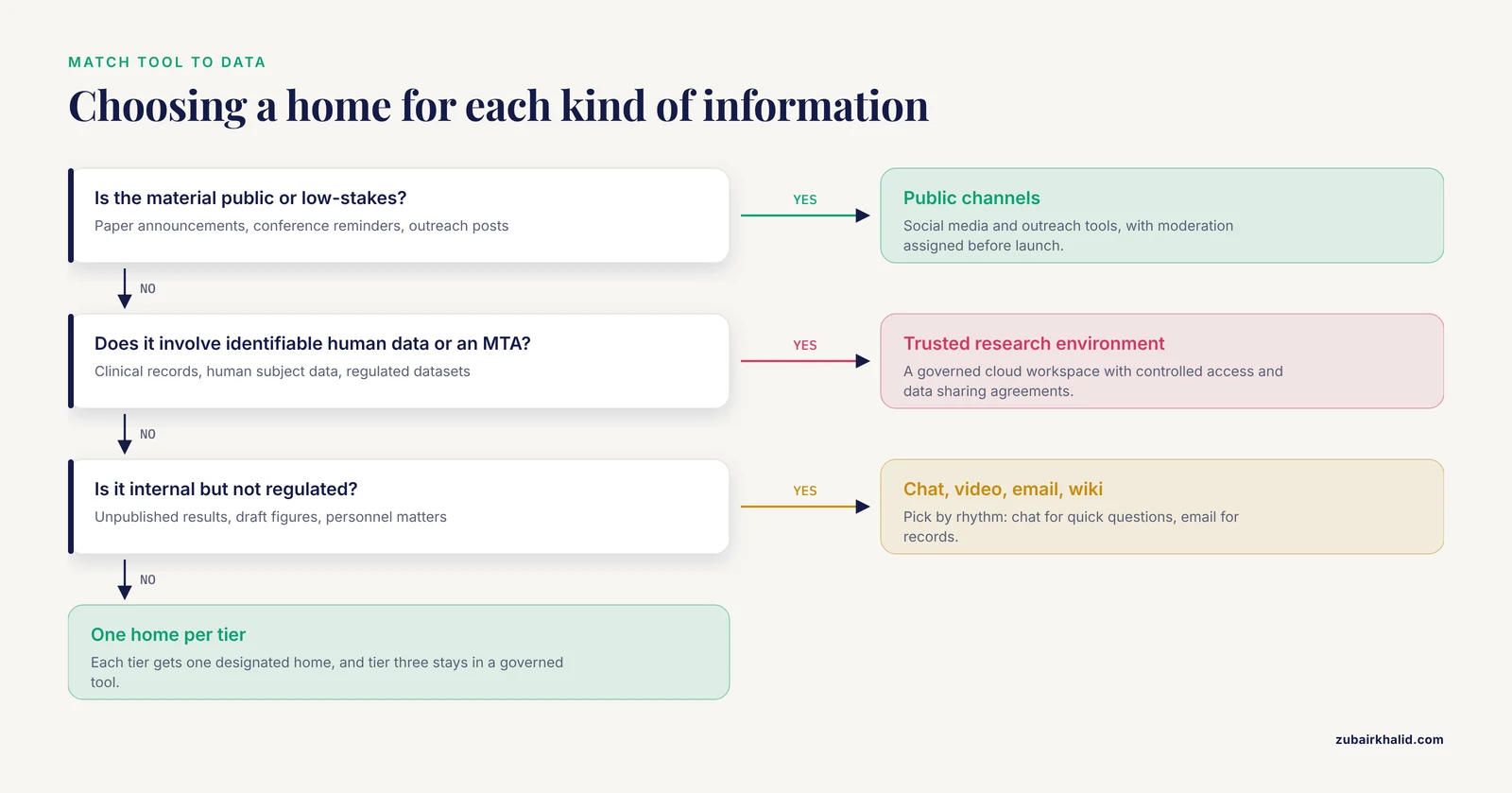
Define these six criteria before you look at a single product page. They apply whether you are evaluating chat apps, video tools, or a full research software comparison across collaboration suites.
1. Data sensitivity. Sort your lab's communication into three tiers. Tier one is public or low-stakes material, such as a paper announcement or a conference reminder. Tier two is internal material, such as unpublished results, draft figures, and personnel matters. Tier three is regulated or high-sensitivity material, such as identifiable human subject data, clinical records, or data covered by a material transfer agreement. Each tier should have one designated home, and the tools for tier three should be ones your institution can govern.
2. Rhythm of the work. Synchronous communication (everyone present at the same time, like a video call) suits feedback, mentoring, and debate. Asynchronous communication (people respond on their own schedule, like email or chat threads) suits status updates, data handoffs, and record keeping. Most labs need both, and the split should be explicit.
3. Size and distribution. A five-person lab in one building can coordinate in a single chat workspace. A multi-institution consortium needs governance, access controls, and standardized data organization, which is a different class of tool entirely.
4. Record keeping and continuity. Who can find last month's decision about the sequencing run? If the answer is "whoever was in the meeting," your platform stack has a continuity gap of the same kind documented in clinical teams, where time-limited rotations and missing shared records undermined shared decision making [2].
5. Workload on the communicator. Every channel generates messages that someone must read and answer. A telemedicine study of a communication support system found that continuous streams of incoming messages imposed substantial workload on clinical teams, and that a human-in-the-loop design, where every automated suggestion was reviewed by staff before sending, was needed to manage it. That system generated more than 22,000 message suggestions over its deployment period, of which about 76 percent resulted in patient communication after human review [4]. The lesson for labs is that high-volume channels need a designated owner and, where possible, filters or triage.
6. Equity of participation. Junior members, shy members, and remote members participate differently on different platforms. Because virtual settings can amplify hierarchy and reduce task performance [3], platforms that support written, asynchronous input (document comments, anonymous polls, structured chat threads) can balance out the meeting-room dynamics that favor senior voices.
Side-by-Side Comparison of the Main Options
The table below is the core of this article. It compares the six platform categories a lab realistically chooses among. Product names change, but these categories have been stable for years, so a research software comparison across brands matters less than choosing the right category for each job.
| Platform category | Best for | Rhythm | Sensitivity fit | Main strengths | Main drawbacks |
|---|---|---|---|---|---|
| Team chat (Slack, Microsoft Teams channels, Discord-style servers) | Quick questions, daily coordination, informal sharing | Asynchronous with bursts of synchrony | Tiers one and two | Fast, searchable, reduces email volume, supports channels per project | Threads decay, decisions get buried, easy to lose important messages in noise |
| Video conferencing (Zoom, Teams meetings, similar tools) | Lab meetings, one-on-one mentoring, external collaborator calls | Synchronous | Tiers one and two, if institutionally licensed | Non-verbal cues, live discussion, screen sharing | Hierarchy effects [3], scheduling cost across time zones, fatigue |
| Email and mailing lists | External communication, formal decisions, records that must persist | Asynchronous | Tiers one and two | Universal, permanent, works across institutions | Overload, slow consensus, attachments scattered across inboxes |
| Shared documents and project boards (shared drives, wikis, trackers) | Protocols, decision logs, project status, onboarding | Asynchronous | Tiers one and two, with permission controls | Single source of truth, version history | Needs maintenance discipline, nobody visits unless required |
| Cloud-based trusted research environment (TRE) | Tier three data, multi-institution collaboration on sensitive datasets | Asynchronous, analysis-focused | Tier three only | Secure access, governance, standardization, FAIR alignment [5] | Setup cost, institutional agreements required, not a casual chat tool |
| Public social media and outreach channels | Recruitment, science communication, dissemination | Asynchronous, broadcast | Public material only | Reach, visibility, community building | Misinformation risk, moderation burden, attribution is hard to measure [6], [7] |
The Options Explained on Their Own Terms
Team chat workspaces
Chat is the default heartbeat of most modern labs. Channels organized by project (for example, #grant-r01-renewal or #mouse-colony) keep topics separable, and search makes old decisions retrievable. Chat works best when the lab agrees on what belongs there. Announcements, quick technical questions, and instrument status belong in chat. Data files, experimental decisions with long-term consequences, and anything involving sensitive records belong elsewhere.
The pros are speed, low ceremony, and visibility of who is working on what. The cons are fragmentation and impermanence. Long technical discussions in chat are hard for a new student to reconstruct six months later, which is why chat should always be paired with a document or wiki where durable conclusions are copied.
A practical onboarding lesson comes from education research on online engagement. A revised version of the ARCS motivational model (Attention, Relevance, Confidence, Satisfaction), extended with professional competency skills such as digital literacy and time management, was used to structure online courses, and it relied on digital quizzes, assignments, and interactive ICT tools to keep learners actively engaged [8]. A lab chat workspace behaves the same way. Passive channels go quiet. Channels with regular rituals, such as a Friday wins thread or a weekly figure-share, stay alive.
Video conferencing
Video meetings carry information that text cannot. A study of synchronous online feedback sessions run over Microsoft Teams with 100 first-year medical students and 10 lecturers documented consistent non-verbal communication patterns: lecturers leaned toward the camera, maintained direct eye contact, used dynamic voice intonation, and paused deliberately while formulating thoughts [9]. Those cues carry mentorship. A student can tell the difference between "this figure needs work, let's talk" delivered warmly and the same words delivered flatly, and that difference changes how feedback lands.
The pros are immediacy, non-verbal bandwidth, and rapport. The cons are scheduling cost, fatigue, and the influence-disparity problem described above, in which virtual settings amplify hierarchical gaps and measurably reduce team task performance [3]. Two countermeasures follow directly from that finding. First, use structured turn-taking so every person speaks in turn rather than competing for airtime. Second, collect written input before the meeting so that the quietest member's analysis arrives with the same weight as the loudest member's.
Email and mailing lists
Email survives because it is universal, permanent, and works across institutional boundaries. Grant officers, collaborators at other universities, and journal editors all use it. The pros are a persistent record and formal tone. The cons are overload and the tendency of decisions to scatter across hundreds of messages.
The healthiest pattern is to treat email as the archive of record and chat as the workshop. When a chat thread produces a real decision, one person summarizes it and sends it by email with a clear subject line. This costs two minutes and converts ephemeral conversation into retrievable documentation.
Shared documents, wikis, and project boards
These are not conversation tools, but they are the memory that every conversation tool lacks. A lab wiki holding protocols, a decision log, and a project tracker answers the questions that otherwise get asked repeatedly in chat. The pros are single-source-of-truth clarity and version history. The cons are that wikis rot without maintenance, so assign ownership. One lab member, or the lab manager, should be responsible for structure even if everyone contributes content.
Cloud-based trusted research environments
When your work involves sensitive human data, ordinary collaboration tools are the wrong category. A trusted research environment (TRE) is a secure, cloud-based workspace where data are analyzed without leaving the controlled environment. The Human Intracerebral EEG Platform, developed within the framework of the Human Brain Project and EBRAINS for collaborative research on intracranial EEG in epilepsy, illustrates the full specification: secure access to sensitive datasets, standardized data organization following the BIDS-iEEG convention for interoperability, controlled access through a secure web interface, preinstalled analysis software, a formal governance model with data sharing agreements, and alignment with FAIR principles (Findable, Accessible, Interoperable, Reusable). By its first years of operation it hosted 34 institutions and 10 ongoing projects, with private spaces per institution and shared collaborative spaces [5].
The pros are real: reproducibility, security, and the ability to collaborate internationally without copying raw data onto laptops. The cons are institutional overhead. Setting up or joining a TRE requires formal agreements, and it will never feel as convenient as a chat message. That friction is the feature, not the flaw.
Public channels and social media
Labs increasingly communicate with the public, with study participants, and with potential trainees on social platforms. Evidence from a youth HIV prevention campaign in Ghana shows what multi-platform outreach looks like in practice. The campaign combined paid Facebook advertising, LinkedIn dissemination, and peer-to-peer WhatsApp sharing. Facebook produced 55,437 impressions and an estimated reach of 48,596 users, while LinkedIn produced 650 impressions, 209 engagements, and 171 link clicks. WhatsApp was the dominant self-reported awareness pathway, though individual-level WhatsApp metrics could not be measured, and the campaign drew 103 eligible entries from adolescents and young adults [7].
Three lessons transfer directly to lab outreach. First, broad-reach platforms and peer networks do different jobs and often work best combined. Second, mobile-first materials and multiple submission formats widen participation. Third, and most important, track where people say they heard about you prospectively, because platform analytics and self-reported sources disagree, and exposures across channels overlap so much that attributing a result to one platform is unreliable [7].
The corresponding risk is misinformation. A scoping review of COVID-19 social media research from 2020 to 2022 found that the same platforms that enabled public health communication also enabled rapid circulation of rumors, false claims, and conspiracy narratives, and it documented a persistent gap between detecting misinformation and acting on it through governance [6]. A lab with a public account inherits a slice of that problem. Plan for moderation time, and designate who responds to corrections and who stays silent.
AI assistants in lab communication
AI chatbots are now part of the communication tooling conversation, and the honest assessment is mixed. A comparison of ChatGPT, Gemini, and Le Chat against certified physicians answering 100 real patient questions about complete blood count results found that the chatbots' interpretations were inferior to the physicians'. The appropriateness of chatbot responses ranged from 51 to 64 percent, with 22 to 33 percent of responses overestimating the seriousness of the patient's condition, although the chatbots did communicate empathetically and consistently included disclaimers recommending professional consultation [10]. For a lab, the takeaway is that AI assistants can help draft plain-language summaries and emails, but domain-specific interpretation of results still needs a qualified human check before anything leaves the lab.
Pros and Cons at a Glance
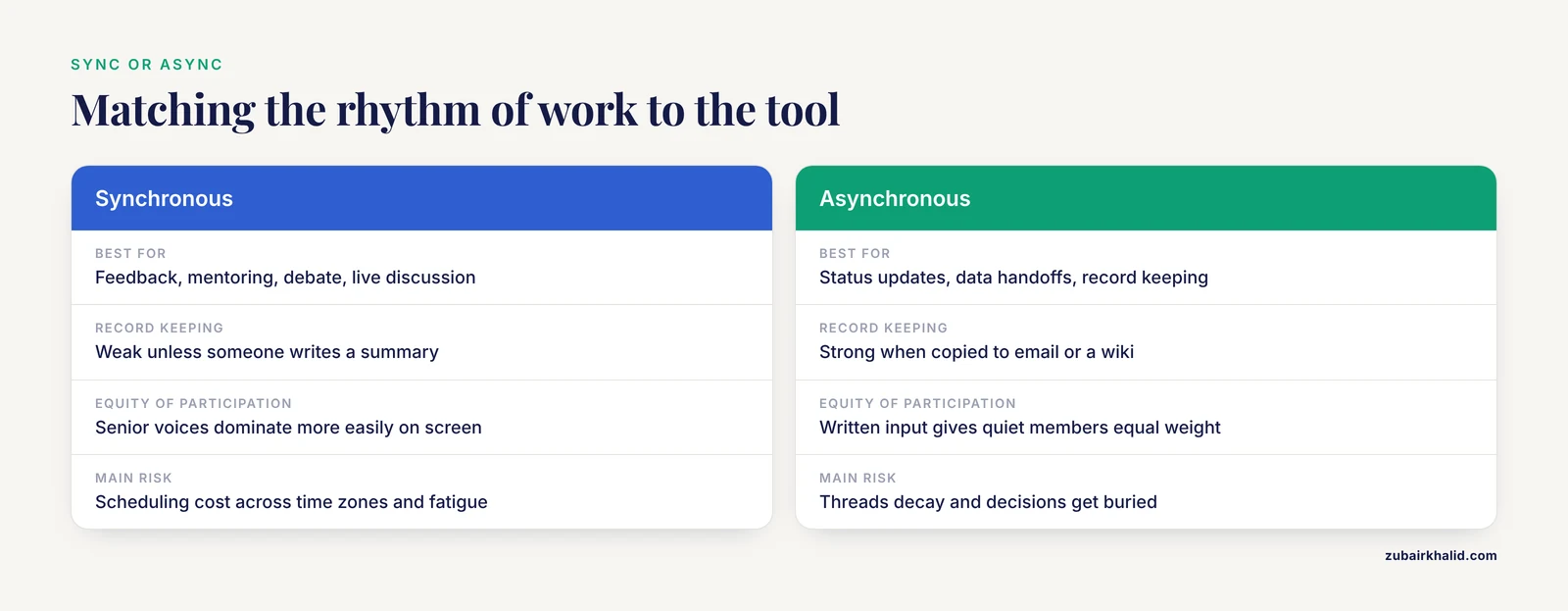
If you want the how to choose communication platform for research lab options and their pros and cons compressed into one view, here it is in prose. Chat is fast and informal but forgettable. Video is rich and personal but hierarchically distorting and expensive to schedule. Email is permanent and universal but overwhelming. Shared documents are authoritative but require upkeep. Trusted research environments are secure and standardized but heavy to set up. Public channels are far-reaching but noisy and hard to measure. The best software for researchers is therefore rarely one product. It is a small stack in which each category has exactly one job.
Worked Scenarios
Scenario one: a five-person molecular biology lab in one building. You need daily coordination, a weekly meeting, and a protocol repository. Choose one chat workspace with channels per project, one recurring video meeting with a standing agenda, and one shared wiki for protocols and a decision log. Email is reserved for external contacts and grant-related correspondence. Total stack: three tools, two of which your institution probably already licenses.
Scenario two: a multi-site consortium working with human intracranial electrophysiology data. Internal chat is fine for scheduling, but the data itself cannot touch it. The consortium joins or builds a cloud-based TRE with secure access, standardized data organization, preinstalled analysis software, and formal data sharing agreements, following the model described for the Human Intracerebral EEG Platform [5]. Meetings happen over institutional video accounts. Decisions about data use are documented in the governance space, not in chat.
Scenario three: a lab recruiting participants and running public engagement for a study. The lab pairs a broad-reach paid channel for reach with peer and institutional networks for trust, designs mobile-first materials, accepts submissions in multiple formats, and asks every respondent where they heard about the study, replicating the elements that made the Ghana campaign measurable despite overlapping channel exposures [7]. A patient and public involvement (PPI) advisory panel meets regularly over a commercial virtual communication platform, with a named link researcher as the panel's point of contact and periodic surveys to assess satisfaction with the process, an approach documented in a sepsis genomics PPI case study [11]. Moderation responsibilities are assigned before the accounts go live, because public science communication inherits the misinformation risks documented across pandemic-era social platforms [6].
Common Mix-Ups
Mix-up one: using chat for decisions. Chat is a workshop, not an archive. If a decision about analysis methods or authorship happens in a chat thread and nowhere else, assume it will be lost.
Mix-up two: assuming video equals in-person. The controlled experiment on video versus face-to-face teams showed larger influence disparities and worse task performance in virtual settings [3], so a video lab meeting needs more structure than an in-person one, not less.
Mix-up three: choosing tools before requirements. The app evaluation study that found 5,606 candidate apps and narrowed them to 112, then excluded 86.6 percent of those, succeeded because the functional requirements were defined first through focus groups and participatory design [1]. Browse app stores after you write your requirements list, and expect to reject most candidates.
Mix-up four: treating public metrics as engagement. Impressions and reach measure exposure, not impact. The Ghana campaign's own analysis noted that channel exposures overlapped and that some channels could not be measured at the individual level, which is why prospective source tracking from participants matters more than platform dashboards [7].
Mix-up five: letting an AI chatbot speak for the lab on domain questions. Chatbot answers to specialized laboratory questions were rated appropriate only 51 to 64 percent of the time in head-to-head comparison with certified professionals [10]. Draft with AI if it helps, but verify every technical claim before it carries the lab's name.
Mix-up six: one platform doing all jobs. Forcing confidential data discussions into the same tool as meme-sharing guarantees that either security or morale suffers.
Common Mistakes and Limitations
Rolling out without a pilot. Run any new platform with two or three volunteers for two weeks before making it mandatory. Adoption problems surface early and cheaply that way.
No named owner. Every channel needs someone responsible for moderation, structure, and archiving. The telemedicine deployment described earlier succeeded because human review was built into routine operation from day one [4], and the same principle applies to any high-traffic lab channel.
Ignoring institutional policy. Your university's information technology and compliance offices determine what tools may hold what data. Check before adopting anything, especially for tier three information. For large collaborative projects, formal communication plans covering participants and stakeholders, including public and patient involvement, are standard recommendations from experienced clinical trials units [12].
Assuming one decision lasts forever. Platforms change pricing, features, and terms of service. Revisit your stack once a year.
A note on the evidence base. Much of the research cited here comes from healthcare teams, medical education, and public health campaigns rather than from basic biology labs specifically. The underlying dynamics, hierarchy in virtual meetings, workload from message volume, requirements-first selection, transfer well, but individual labs differ in size, funding, data types, and institutional rules, so treat these findings as directional guidance and adapt them to your own situation.
Frequently Asked Questions
What is the best communication platform for a research lab?
There is no single best platform, because chat, video, email, shared documents, secure research environments, and public channels each solve a different problem. The best answer for most labs is a small stack of two to four tools in which each tool has exactly one defined job, chosen by matching sensitivity of information and rhythm of work before comparing products.
Should our lab use chat or email for internal communication?
Use both, with a clear division. Chat handles quick questions, daily coordination, and informal sharing, while email carries formal decisions and anything that must persist as a record. When a chat thread produces a real decision, send a one-paragraph email summary so the decision is findable later.
How should a lab communicate about sensitive human data?
Sensitive data should live in a governed, institutionally approved environment such as a cloud-based trusted research environment with controlled access, standardized data organization, and formal data sharing agreements, following the model of platforms built with secure access, interoperability standards, and FAIR alignment [5]. Chat and email should carry only non-sensitive coordination about the data, never the data itself.
How many communication platforms is too many for one lab?
More than four or five distinct tools for internal use usually signals drift rather than design. If members cannot say in one sentence which tool is used for which purpose, consolidate. One chat workspace, one video tool, one document system, and one email list cover the core needs of most labs.
Do we still need video meetings if we have a busy chat workspace?
Yes, for mentoring, feedback, and discussion where tone and non-verbal cues matter, because studies of synchronous online sessions show that cues like eye contact, leaning toward the camera, and voice intonation carry meaningful information [9]. Compensate for the known tendency of virtual meetings to amplify hierarchy by using structured turn-taking and collecting written input beforehand [3].
How can a lab reach the public or study participants effectively?
Combine one broad-reach public channel with peer and institutional networks, use mobile-first materials, allow multiple submission or reply formats, and track participant-reported awareness sources prospectively rather than trusting platform analytics alone [7]. Assign moderation duties before launch, since public science channels carry documented misinformation risks that detection alone does not solve [6].
Sources
- Comparison of a User-Centered Design, Self-Management App to Existing mHealth Apps for Persons Living With HIV.
- Pediatric Chronic Critical Illness: Gaps in Inpatient Intrateam Communication.
- Communicating via Video Conferencing: The Mediating Effect of Member Influence Disparity on Task Performance.
- Real-world deployment and longitudinal evaluation of a human-in-the-loop telemedicine communication support system.
- The Human Intracerebral EEG Platform: A Cloud-Based Trusted Research Environment for Collaborative SEEG Research in Epilepsy and Neuroscience.
- Online COVID-19 Misinformation and Infodemic Governance During the Peak Pandemic Period: Scoping Review of Social Media Research From 2020 to 2022.
- Leveraging social media for youth engagement in HIV prevention: evaluation of the Y-FIT GH open-call campaign in Ghana.
- Design and evaluation of a revised ARCS motivational model for online classes in higher education.
- Beyond words: analyzing non-verbal communication techniques in a medical communication skills course via synchronous online platform.
- Comparison of ChatGPT, Gemini, and Le Chat with physician interpretations of medical laboratory questions from an online health forum.
- A case study of patient and public involvement in sepsis genomics research.
- Practical guidance for running late-phase platform protocols for clinical trials: lessons from experienced UK clinical trials units.