How to Avoid Jargon in Scientific Writing
By Dr. Zubair Khalid, DVM, MS, PhD ·

By the end of this article you will be able to do four things with a real draft. You will define your target reader before you write. You will measure how much specialist vocabulary your draft carries, using a free web tool and a short R script. You will rewrite flagged passages without losing scientific accuracy. And you will apply the same discipline to grant proposal planning, where a funding decision can hinge on whether a non-specialist reviewer understands your aims on the first read.
Here is what you need on hand before you start:
- A sample of your own writing, roughly 200 to 300 words. An abstract or a draft lay summary works well.
- Access to the De-jargonizer, a free web-based jargon identifier described below.
- Optional but useful, a working R installation (R version 4.x from CRAN) if you want to quantify jargon rates yourself across many documents.
- A one-sentence definition of your intended reader, such as "a hospital administrator with no biology training" or "an interdisciplinary review panel."
What Jargon Is and Why It Blocks Communication
Jargon is specialized vocabulary that a professional group uses as shorthand. Terms like "pathogenesis," "orthogonal," and "confounder" compress complex ideas for people who already know the field. The same compression becomes a wall for everyone else. A term that saves an expert five words can cost a non-expert the entire sentence.
The problem is bigger than vocabulary. Scientists are now required to communicate with experts in other fields, with the public, and with policymakers, not only with colleagues in their own subfield [1]. Each of those audiences carries a different working vocabulary, and a draft written for the narrowest audience fails all the others.
Researchers who study this problem point out two difficulties that make it stubborn. First, it is hard for an author to know which terms the general public actually knows, because after years of training your own sense of "common knowledge" is skewed toward your specialty. Second, cutting technical language can threaten accuracy, so the writer must balance accessibility against precision [2]. Both difficulties mean that avoiding jargon is a skill you practice deliberately, not a style you absorb by accident.
The Evidence on Jargon and Reader Loss
Two research programs give this article its empirical backbone.
The first is the De-jargonizer, an automated jargon identifier built for scientists who engage with the public. Its developers trained the tool on a corpus of over 90 million words published on the BBC website between 2012 and 2015, so its frequency judgments reflect general-audience English rather than academic English [1]. The team validated the tool in three ways. They compared its classifications against existing word-frequency lists in the literature. They compared jargon rates in TED transcripts of non-science lectures, TED transcripts of science lectures, and transcripts of academic science lectures, and found the pattern you would predict. They also ran the tool on 5,000 pairs of published research abstracts and lay reader summaries describing the same articles from PLOS Computational Biology and PLOS Genetics [1]. That validation matters for you because it means the tool's flags are grounded in measured reader familiarity, not one editor's opinion.
The second program tackled the reverse question: how do you measure jargon in a way that tells you how much editing is enough? A research team developed an R script that scores the scientific jargon load of any written piece and guides edits based on the target audience [2]. The authors emphasize that "how much is too much" has no universal answer, because the ceiling depends on who will read the piece [2]. That insight drives the first step of the workflow below.
Tools That Measure Jargon in Your Draft
The table summarizes the practical options. Use at least one automated check and one human check on every document that leaves your desk for a broad audience.
| Tool or method | What it does | What you get | Best used for |
|---|---|---|---|
| , - | , - | , - | , - |
| De-jargonizer (free web tool) | Compares each word against a corpus of over 90 million general-audience words [1] | Words sorted into frequency categories, with rare and technical terms highlighted | Abstracts, lay summaries, blog posts, press releases |
| R-based jargon quantification [2] | Scores words by how widely they are known and aggregates the result | A jargon index you can track across revisions | Manuscripts and documents aimed at mixed or public audiences |
| Custom audience-known list (script below) | Flags any word not on a list you define for your reader | Flagged words plus a specialist-word rate | Quick internal passes, teaching, iterative drafts |
| Read-aloud test by a non-expert | Human comprehension check | Sentences where a real reader stumbles | Final check before submission |
How to Avoid Jargon in Scientific Writing Step by Step
This is the core workflow. Run it on a 200 to 300 word sample first so you can complete a full cycle in under an hour.
Step 1: Define Your Audience Before You Write
Write one sentence naming your reader and what they already know. "A district public health officer with a master's in policy" and "a first-year medical resident" need different drafts of the same study. Every later decision, including which terms count as jargon, depends on this sentence. The R-based approach exists precisely because jargon tolerance varies with the target audience [2].
A practical trick is to write two audience cards before drafting:
- What my reader knows for certain (for example, what a vaccine is, what a percentage means).
- What my reader has never encountered (for example, what a confidence interval is, what "seroprevalence" means).
Anything in the second column gets defined, replaced, or deleted.
Step 2: Draft Normally, Then Flag Specialist Words
Do not try to write plain prose on the first pass. Scientists are trained to speak in highly specialized language, and research on the problem confirms that avoiding jargon is genuinely difficult for them [1]. Fighting that habit mid-draft slows you down and produces vague text.
Instead, finish the draft in your normal register, then treat jargon removal as a separate editing pass. This separation is the single most useful habit in the whole workflow.
Step 3: Run an Automated Jargon Check
Paste your text into the De-jargonizer. The tool sorts your words by how common they are in general-audience English and highlights the rare or technical ones [1]. Treat the highlighted words as a candidate list, not a verdict. The tool does not know your audience, so a flagged term that is essential to your argument may deserve a definition rather than deletion.
If you work in R, you can quantify the specialist-word load of any draft yourself. The published approach scores words by how widely they are known and turns the result into an index you can use to guide edits [2]. The short script below is a minimal version of that idea that you can adapt in five minutes.
# A minimal jargon screen for any draft
draft <- "We leveraged a murine model to elucidate the pathogenesis
of cancer-induced cachexia. Body composition was quantified by
longitudinal DXA, and outcomes were analyzed with a mixed model."

# 1. Split the text into lowercase words
tokens <- unlist(strsplit(tolower(draft), "[^a-z']+"))
tokens <- tokens[tokens != ""]

# 2. Words your intended reader already knows (edit this list per project)
audience_known <- c("we", "model", "cancer", "body", "outcomes", "data")

# 3. Function words to ignore
stopwords <- c("a", "an", "the", "to", "of", "and", "with", "by",
               "was", "were", "in", "that")

# 4. Flag everything else, then compute a specialist-word rate
flagged <- setdiff(tokens, c(audience_known, stopwords))
jargon_rate <- length(flagged) / length(tokens)

flagged
jargon_rate
Expected output for the sample sentence above:
 [2] "leveraged"    "murine"       "elucidate"    "pathogenesis" "induced"
 [3] "cachexia"     "composition"  "quantified"   "longitudinal" "dxa"
 "analyzed"     "mixed"
[2] 0.4285714
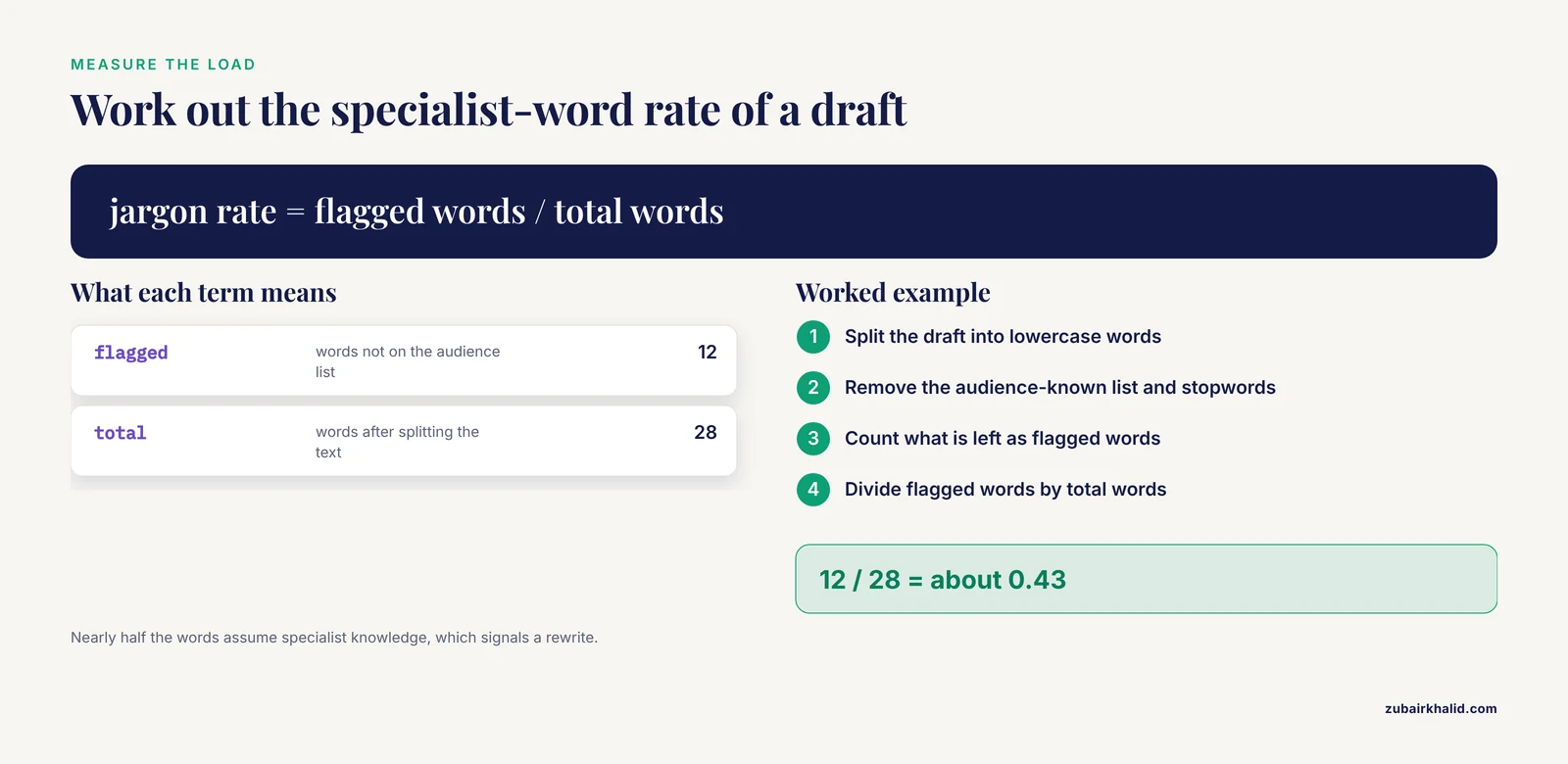
Read the numbers as a worked calculation. The draft has 28 words after splitting. Twelve words survive as specialist vocabulary, so the specialist-word rate is 12 divided by 28, or about 0.43. Nearly half of the content words in this passage assume specialist knowledge. That is the signal to rewrite.
Two cautions when you run this. First, the audience_known list is your model of the reader, and an inaccurate model produces misleading flags. Second, a high rate is not automatically bad. For a methods section read by statisticians, 0.43 may be fine. For a funding-agency lay abstract, it signals a rewrite.
Step 4: Rewrite With Plain Substitutions
Work through the flagged list top down. For each word, choose one of three moves: replace it with a common word, define it in the same sentence, or delete it if it carries no unique meaning. The table shows the sample sentence transformed.
| Draft phrase | The problem | Plain rewrite |
|---|---|---|
| , - | , - | , - |
| utilized | A longer word for a common idea | used |
| murine model | Latin adjective plus jargon | mice |
| elucidate | Formal inflation of a simple verb | show, explain |
| pathogenesis | Disease-process jargon | how the disease develops |
| cachexia | Specialist clinical term | severe weight and muscle loss |
| quantified by longitudinal DXA | Stacked nominalizations and an acronym | measured body fat repeatedly with a body-composition scan |
| analyzed with a mixed model | Statistical shorthand | compared the groups with a standard statistical method that handles repeated measurements |
After substitution, the draft reads: "We used mice to study how cancer causes severe weight and muscle loss. We measured body fat over time with a body-composition scan and compared the groups with a standard statistical method that handles repeated measurements." The meaning survives. The reader barrier is gone.
Notice what the rewrite did not do. It did not round 0.43 down to zero by stripping every technical word. "Statistical method that handles repeated measurements" is longer than "mixed model," and that trade is deliberate. Length buys comprehension when the alternative is a term the reader cannot decode.
Step 5: Test the Rewrite on a Real Reader
Hand the rewritten passage to one person who matches your audience definition and ask two questions. What is this passage about, and what would you do with this information? If the answer to either question drifts from your intent, the failure is usually in a sentence, not a word. Sentences that stack three or four noun phrases ("care delivery microsystem integration outcomes") hide the verb. Break them apart and restore an actor doing something.
Step 6: Verify the Science Survived the Edit
Compare the rewrite against the original term by term. "Severe weight and muscle loss" must still exclude simple weight loss from dieting, so keep the qualifier "muscle." "Standard statistical method that handles repeated measurements" must not claim something the original "mixed model" did not claim. This check closes the loop that jargon-reduction efforts most often leave open, because the hardest part of the task is preserving accuracy while removing esoteric terminology [2].
What Lay Summary Research Recommends
If your document is a lay summary, a short plain-language description of research findings for non-specialists, you can lean on a recent synthesis rather than guesswork. A co-created scoping review with a consultation exercise screened peer-reviewed databases and grey literature and identified 80 resources on writing lay summaries of healthcare evidence [4]. Nearly all of them, 99 percent, described the characteristics a good lay summary should have. Far fewer, 13 percent, described the process of actually writing one [4]. Most of the identified resources had appeared in the previous two years, which tells you this is a fast-developing area of practice [4].
The consensus characteristics that recur across those resources are concrete and testable. Write in plain language and avoid unexplained acronyms. Define necessary technical terms in the sentence where they first appear. Explain why the research matters to the reader, not only what was done. Keep sentences short and structure the summary with headers so readers can navigate it. The review also modeled a practice worth copying: it was co-led by a patient and public partner working alongside researchers, and the consultation sessions brought nine patient and public partners and researchers together to interpret the findings [4]. A reader from your target audience, involved early, is the highest-value editor you can hire for free.
Jargon Control in Grant Proposal Planning
Grant documents fail on jargon in a specific and expensive way. Review panels and institutional decision-makers are rarely homogeneous specialists. A panel may include a clinician, a methodologist, and an administrator, and each brings a different vocabulary. Your proposal must survive all of them on the first read.
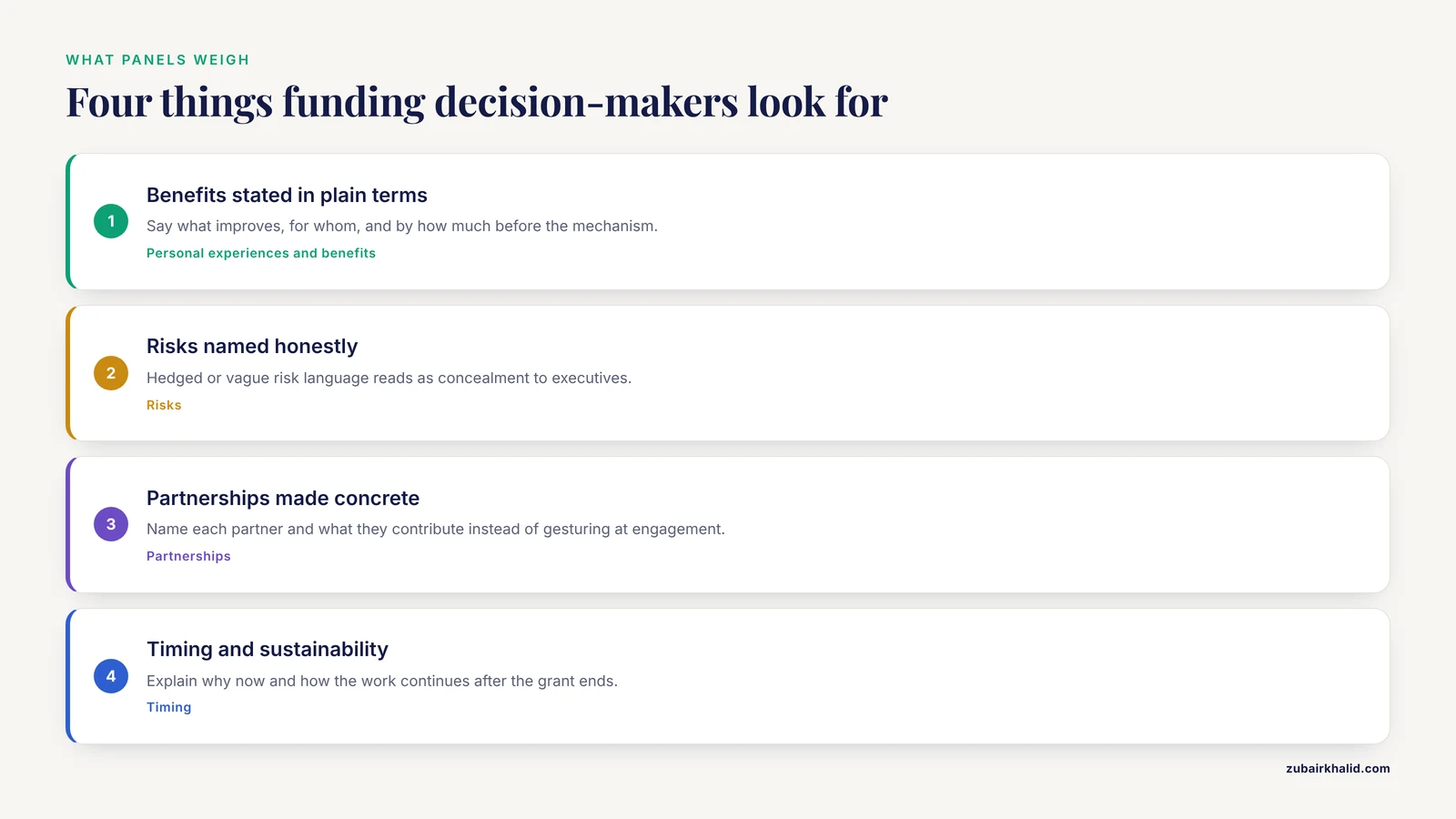
Interview-based research on a funded integrated-care pilot in Queensland shows what actually drives the people who say yes. Researchers studied how healthcare executives decided to commit organizational funding to a Project ECHO telementoring pilot, and the thematic analysis identified five influences on their decisions: personal experiences, benefits, risks, partnerships, and timing [5]. The executives also read the project team itself, treating the intrapreneurial team's drive toward financial sustainability and scalability as an indicator that the investment would hold up [5].
Map those themes directly onto grant proposal planning:
- Benefits in plain terms. State what improves, for whom, and by how much, before you state the mechanism.
- Risks named honestly. Executives weight credibility, and hedged or vague risk language reads as concealment.
- Partnerships made concrete. Name the partners and what each contributes instead of gesturing at "stakeholder engagement."
- Timing and sustainability. Explain why now and how the work continues after the grant, in sentences a non-specialist can repeat.
A structured research grant writing course reinforces this by sequencing the work. A common exercise asks you to write a non-specialist abstract of your project first, then build the technical aims from it, which forces the plain-language core to exist before the jargon grows around it. The same discipline pays off in lay-required components, which many funders now mandate and which reviewers read as evidence that you can communicate beyond your subfield.
Common Mistakes and Limitations
These are the errors that show up repeatedly when writers apply this workflow, followed by the honest limits of the approach.
- Expanding an acronym once and leaning on it forever. Introducing "randomized controlled trial (RCT)" in paragraph one and writing "RCT" thereafter does not help a reader who encounters the acronym five paragraphs later. Lay summary guidance repeatedly recommends limiting acronyms, so prefer the full term or a plain phrase throughout [4].
- Sliding into weasel words when jargon leaves. A weasel word is vague or ambiguous language that creates an impression of meaning or certainty without committing to specific facts. Researchers in ethology document how such phrases, often vague behavioral claims or implied mental states, cause misunderstandings among scientists and prolong unproductive debates, and they argue that describing behavior functionally produces more precise measurement and better terminology agreement [6]. When you cut a technical term, replace it with a specific description, not with a fuzzier one.
- Confusing simplification with inaccuracy. The pull toward plain language can distort the science. The researchers who built jargon quantification flagged this directly, noting that it is difficult to ensure scientific accuracy while avoiding esoteric terminology [2]. Every substitution in Step 4 needs a verification pass in Step 6.
- Assuming a defined term travels. A term your whole field treats as settled can stay opaque to everyone else for years. The clinical nurse leader role, introduced in 2003 by the American Association of Colleges of Nursing, accumulated positive evidence across dozens of implementation reports and studies, yet the literature shows the role still struggled to define itself both internally and to the wider health care system [3]. Naming something is not the same as making it understood.
- Burying the plain version under the technical version. Writers sometimes write the jargon-heavy sentence first and tack a plain paraphrase on at the end. Lead with the plain sentence. The technical detail belongs in methods or a footnote, where specialists can verify it.
- Trusting the automated score alone. Frequency-based tools judge words, not logic, and they cannot know your specific audience. The De-jargonizer's own validation showed its classifications track reader familiarity [1], but a clean score on a logically tangled paragraph is a false pass. Always pair the tool with a human reader.
- Saving plain language for the lay summary and jargon-loading the abstract. Abstracts reach interdisciplinary readers first [1]. An abstract a neighboring-field scientist cannot parse costs you citations and collaborations, which is the same audience-loss problem in an academic costume.
Limitations. Automated jargon measurement is built on general-audience corpora, so it will flag legitimate terms your field requires and miss jargon you have defined away. No single threshold tells you a document is done, because the acceptable jargon load depends on the target audience, as the researchers who formalized this measurement emphasize [2]. Finally, the tools and studies described here address word choice and structure. They cannot fix a muddled argument, and no editing pass substitutes for knowing what your results actually mean.
Frequently Asked Questions
What counts as jargon in scientific writing?
Jargon is any specialized term, acronym, or compressed phrase that your intended reader does not reliably know. The definition is audience-relative, which is why the first step of the workflow is defining the reader, not listing forbidden words.
How much jargon is too much?
There is no universal threshold, because the acceptable jargon load depends on who reads the document. Researchers who built a jargon-quantification approach frame the score as an editing guide keyed to a target audience [2], so set your ceiling when you set your audience definition.
Is all jargon bad?
No. Jargon is efficient and often more precise than its plain-language substitute among readers who share the vocabulary. The mistake is deploying it without checking whether the audience shares the vocabulary or without defining the term where it first appears.
What tools can identify jargon in my draft?
The De-jargonizer is a validated free web tool that classifies words against a corpus of over 90 million general-audience words [1]. An R-based scoring approach lets you quantify jargon load and track it across revisions [2]. A custom list check like the script above works for quick passes.
How do I write a good lay summary?
Define your reader, lead with why the research matters, use plain language with terms defined at first use, keep sentences and structure simple, and have someone from the target audience review it. These recommendations recur across a scoping review of 80 resources on lay summary writing [4].
Does avoiding jargon matter in grant proposals?
Yes, because panels and institutional decision-makers span disciplines, and interviews with healthcare executives who funded a pilot showed their decisions turned on clearly conveyed benefits, risks, partnerships, and timing [5]. Plain language in the specific aims is a strategic asset, not a style preference.
What are weasel words and why avoid them?
Weasel words are vague or ambiguous phrases that suggest meaning or certainty without committing to specific facts. Researchers warn they cause misunderstandings and prolonged debates even among scientists, and recommend precise, functionally descriptive terminology instead [6].
How can I practice plain-language writing?
Run the six-step workflow on one abstract per week, keep a running substitution table from each pass, and rewrite the same paragraph for two different audiences to feel how the audience definition changes the vocabulary. A research grant writing course can add structure, since many build plain-language drafting exercises directly into the planning phase.
Sources
- Automatic jargon identifier for scientists engaging with the public and science communication educators.
- Quantifying scientific jargon.
- The current evidence base for the clinical nurse leader: a narrative review of the literature.
- Recommended characteristics and processes for writing lay summaries of healthcare evidence: a co-created scoping review and consultation exercise.
- Executive Decision-Making: Piloting Project ECHO® to Integrate Care in Queensland.
- Reasons to avoid using weasel words in ethology: establishing a more technical terminology may facilitate synthesis in the behavioural sciences.