How to Assess Grant Fit
By Dr. Zubair Khalid, DVM, MS, PhD ·

Grant fit is the match between your research question, your team, and your stage of evidence on one side, and what a specific funding mechanism is actually designed to support on the other, which is a separate judgment from whether your science is good. A well-designed study submitted to the wrong mechanism loses to a weaker study submitted to the right one. The rule of thumb is simple: if you cannot name several projects a program has funded in the past three years that resemble yours in topic, scale, and career stage, you have not yet assessed fit. You have only noticed the program exists.
This guide walks through how to assess grant fit options in the life sciences, compares the major funding mechanisms side by side, works through realistic project scenarios, and closes with the mistakes that sink otherwise strong applications.
What Grant Fit Actually Means
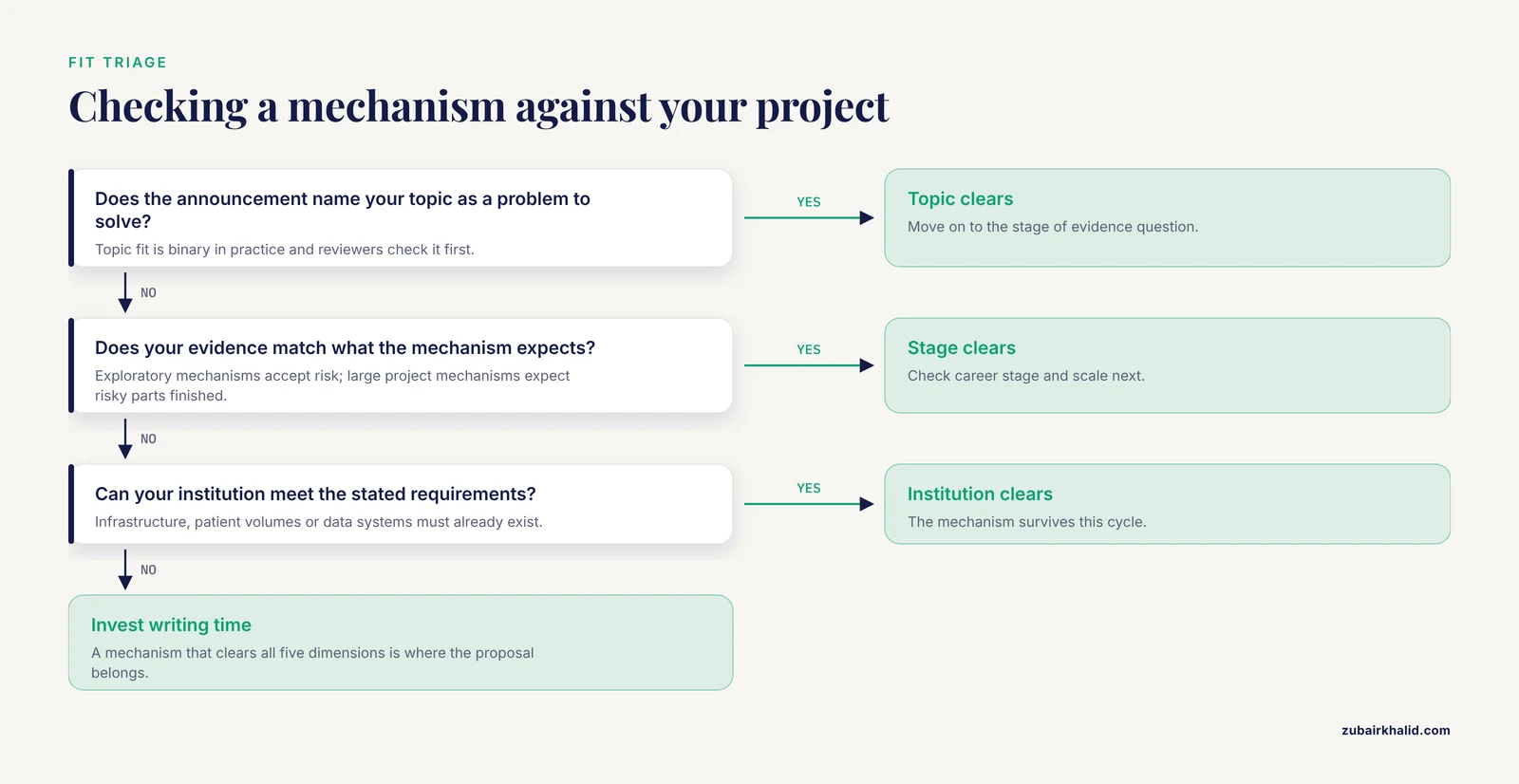
Reviewers judge proposals on several axes at once, and fit is the axis that decides whether the other axes even get read carefully. Fit has five dimensions, and each one can fail independently.
Scientific topic fit. The funding announcement names the problems the funder wants solved. A mechanism supporting clinical measurement science will not fund a basic receptor biology project, no matter how elegant the receptor work is. Topic fit is binary in practice. Reviewers check it in the first minute.
Stage-of-evidence fit. Every mechanism implicitly expects a certain maturity of the work. Exploratory mechanisms accept risk. Large project mechanisms expect the risky parts to be finished. Submitting a first-proof-of-concept idea to a mechanism that funds definitive trials wastes a review cycle, and review cycles are scarce.
Career-stage fit. Training mechanisms exist to buy protected time for people, not to buy results. Project mechanisms buy results and expect the person to already have the track record. The same idea can be a strong application at one career stage and a weak one at another, submitted to the same agency.
Scale fit. Budget size, personnel, and timeline must match what the mechanism is built to support. A single-site study with two personnel does not belong in a mechanism designed for multi-center consortia, and a five-year, multi-lab program does not fit a one-year seed mechanism.
Institutional fit. Some mechanisms require specific infrastructure, patient volumes, or data systems. If your institution cannot meet a stated requirement, no amount of proposal quality fixes it.
When researchers ask about the best how to assess grant fit process, the honest answer is that you assess these five dimensions against each candidate mechanism in turn, and the mechanism that clears all five is where you invest your writing time.
How to Assess Grant Fit Options
The funding landscape in the life sciences sorts into six broad mechanisms. Each one is described here on its own terms, then compared in a table and against decision criteria.
Federal Project Grants
Federal project grants, such as the R01-equivalent mechanisms at the National Institutes of Health, fund discrete hypothesis-driven research projects over multiple years. The review emphasis falls on significance, approach, investigator, environment, and feasibility. A funded project in this category typically has a defined primary outcome, a powered or otherwise justified sample, and a plan that reads as executable rather than aspirational.
A published cohort study comparing two area-based deprivation indices illustrates the shape of this work. The investigators identified 67,386 individuals with hypertension and 30,435 with diabetes in a 19-county region, tested agreement between indices with the weighted kappa statistic, and modeled associations with clinical control outcomes using modified Poisson regression [1]. Nothing about that design is exploratory. The cohorts existed, the analysis plan was specific, and the outcomes were measurable. Project-grant fit means your proposal reads like that: the questions are settled enough that the plan describes execution, not discovery of whether execution is possible.
The trade-off is review rigor and competition. Federal project mechanisms reject the majority of applications, and a proposal that is excellent but misaligned with the study section's remit dies in triage.
Career Development and Training Awards
Career development awards (K-equivalent mechanisms) and fellowships fund the scientist. The application centers on a mentored research plan that builds a new skill or independent direction, plus a sponsor and institution committed to the applicant's development. Reviewers evaluate the candidate, the mentorship team, the environment, and whether the proposed research is appropriately scoped as a training vehicle.
Fit here means the project teaches you something you need for your independent career, not that it produces the maximal result. A small, well-bounded validation study can be a perfect training project. For example, a methodological study validating the Persian version of a school-to-work transition anxiety scale recruited 342 final-year nursing students and split them into two independent samples, one for exploratory factor analysis and one for confirmatory factor analysis, following the standard psychometric sequence of convergent validity assessment after factor structure is established [2]. That is a complete, publishable, bounded project. It is exactly the size of work a career development award or small foundation award is built to carry.
The trade-off is that these mechanisms buy time and development, not large-scale data generation. Aims that require major equipment or multi-site recruitment signal a mismatch.
Pilot and Seed Funding
Pilot mechanisms, often run by institutional centers or as bridge funding by foundations, fund feasibility work. The expected output is preliminary data, a demonstrated workflow, or a validated measurement that makes a later large application competitive. Reviewers accept uncertainty about the outcome and judge instead whether the pilot, either way it turns out, produces information.
Laboratory method-comparison work often starts exactly here. A published laboratory study of three intraoral scanners fabricated models of three tooth preparation types, scanned each model five times with each of three scanners for 45 scans across nine groups, and used a desktop laser scanner as the reference standard, analyzing trueness and precision with 3D inspection software [3]. That structure, a small number of groups, a reference method, and defined agreement metrics, is a textbook pilot design. It generates the methods and the preliminary accuracy figures that a later, larger application can cite.
The trade-off is small budgets and short timelines, usually one to two years, with no renewal. A pilot grant that funds a project needing five years has failed on fit before review even begins.
Foundation and Disease-Specific Grants
Professional societies and disease-focused foundations fund work aligned with their missions, often at pilot or mid-project scale, and they weigh relevance to their community heavily. The American Heart Association, disease-specific foundations, and specialty societies all run mechanisms where a lay or clinician audience shapes the review.
A clinical measurement study in orthopedics shows the kind of bounded, practice-relevant question these funders like. One published study compared the accuracy of arthroscopic assessment of glenoid bone loss against three-dimensional computed tomography and 3D-printed model measurements, found that assessment accuracy varied with surgeons' annual surgical volumes (p = 0.029), and evaluated three measurement methods, with the manual caliper method showing the highest consistency across time and observers (intraclass correlation coefficients of 0.998 and 0.995) [4]. The question, can surgeons judge this accurately and which measurement should we trust, is exactly the type of practice-facing question a specialty society wants answered.
The trade-off is narrower scope and, often, smaller awards. A foundation will not fund work outside its disease area even when the work is superb, and applications need explicit language connecting the findings to the funder's patient or practitioner community.
Internal and Institutional Funding
Universities, core facilities, and intramural programs run internal competitions. These mechanisms are fast, low-bureaucracy, and designed to seed work that will attract external funding or generate publications. Review committees judge fit largely on whether the project advances the institution's strategic areas and whether it plausibly leads to an external application.
Psychometric instrument development is a frequent internal-funding target because it is bounded, low-equipment, and produces a citable tool. One research group developed a 29-item digital competence scale for kindergarten teachers, administered it to 764 teachers, and reported total Cronbach's alpha of 0.980 and split-half reliability of 0.990 across five hypothesized domains [5]. Another validated a Turkish psychiatric inpatient care quality scale with 280 patients, arriving at a 22-item, four-dimension structure with an alpha of 0.86 and fit indices supporting the four-factor model [6]. Projects of this shape, instrument development and validation in an accessible population, fit internal mechanisms well because the budget is dominated by personnel time and the deliverable is clear.
The trade-off is small scale and the expectation of a return, usually a subsequent external application. Internal funds are a stepping stone, not a destination.
Industry-Sponsored Research
Industry sponsorship funds work connected to a product, often late-stage trials, device evaluations, or comparative studies with regulatory or marketing relevance. Fit depends on the sponsor's pipeline, and the agreement terms, including publication rights and data ownership, deserve as much attention as the science.
The EFZO-FIT trial shows what mature industry-sponsored work looks like. It was a multicenter, randomized, double-blind, placebo-controlled phase 3 trial of efzofitimod in pulmonary sarcoidosis, conducted at 85 study centers across nine countries, randomizing participants 1:1:1 to monthly intravenous infusions of two drug doses or placebo over 48 weeks with a registered identifier, NCT05415137, and a primary endpoint of change in mean daily oral corticosteroid dose at week 48 [7]. Every element, the phase, the registration, the pre-specified endpoint, the multicenter infrastructure, signals a mechanism and a sponsor built for definitive evidence, not exploration.
The trade-off is that the sponsor defines the questions. Academic latitude narrows, and the funded question must genuinely overlap with your independent program for the work to advance your career.
Side-by-Side Comparison
| Mechanism | What It Funds | Review Emphasis | Strong Fit Looks Like | Main Trade-Off |
|---|---|---|---|---|
| Federal project grant | Discrete multi-year hypothesis-driven projects | Significance, rigor of approach, investigator track record | Settled preliminaries, executable plan, defined outcomes | Intense competition, misfit dies in triage |
| Career development award | The scientist and protected time | Candidate potential, mentors, environment | Bounded project that builds a new skill | Small research scope, not built for big data generation |
| Pilot or seed grant | Feasibility work and preliminary data | Whether either outcome informs a next step | Small design, reference method, clear deliverable | Short timeline, no renewal |
| Foundation or society grant | Mission-aligned work, often practice-facing | Relevance to the funder's community | Explicit link to patient or practitioner benefit | Narrow scope, smaller awards |
| Internal institutional funds | Early work that seeds external applications | Strategic alignment and next-step potential | Bounded, low-equipment, publishable output | Small scale, stepping-stone expectation |
| Industry sponsorship | Product-connected late-stage research | Regulatory and commercial relevance | Phase-appropriate design, registration, multicenter capacity | Sponsor-defined questions, negotiated terms |
The Criteria That Decide Real Choices
Explaining each mechanism is the easy half. When you hold two or three real possibilities and must pick, five criteria do the deciding.
Mission Alignment
Read the funding announcement's stated priorities, then read the abstracts of the last several funded awards, which most agencies and foundations publish. Your one-sentence project description should sit inside that set without contortion. If you have to explain why your work is relevant, it is not relevant by their definition.
Stage of Evidence
Match your current evidence to the mechanism's expectations. A validation project with the factor-analysis design already sketched out and the population accessible, as in the nursing students study split 171 and 171 for exploratory and confirmatory analysis [2], fits a pilot or training mechanism. A five-year comparative trial of restorative materials, like the published zirconia study that placed 65 restorations in 38 patients and examined them at 12, 24, 36, 48, and 60 months [8], fits a project grant, where follow-up commitments of that length are expected and reviewers look for them.
Budget Scale and Timeline
List the personnel, the equipment, the recruitment burden, and the calendar. Then check the mechanism's typical award shape, which announcements usually describe qualitatively. The deprivation-index cohort analysis required access to tens of thousands of records through an existing research network [1], which implies institutional infrastructure that a seed mechanism does not fund. The intraoral scanner study required fabrication equipment, three commercial scanners, and inspection software [3], a modest but specific equipment footprint that fits a small laboratory or pilot budget.
Review Process and Study Section
Learn who reviews the mechanism and what they reward. Methods-focused panels reward explicit measurement properties, agreement statistics, and pre-specified analysis. Clinical panels reward patient-centered endpoints and follow-up plans. A radiomics study comparing breast cancer risk models across imaging modalities, reported with C statistics and compared via likelihood ratio tests across 924 patients [9], would land differently in an imaging-focused panel than in a population-science panel, even though the paper itself is the same. Fit includes picking the room where your methods read as strengths.
Regulatory and Reporting Load
Phase 3 trials carry registration, safety monitoring, and predefined analysis populations, as the efzofitimod trial's structure shows, with safety and efficacy analyses done in participants who received at least one dose and had at least one post-baseline assessment [7]. If your team cannot carry that load, a lighter mechanism is the better fit now.
Worked Scenarios
Scenario 1: A Methods-Comparison Study
You want to compare three ways of measuring a structure on medical images and establish which is most reliable. This mirrors the glenoid bone loss study, where ten residents measured 3D-printed models three times using three methods and the investigators computed agreement with intraclass correlation coefficients [4]. Fit assessment: the project is small, single-site, equipment-light, and produces a definitive methodological answer. It fits a pilot grant, an internal competition, or a foundation award in the relevant specialty. It does not fit a large project mechanism, where a measurement-method comparison would appear as one aim inside a larger application, not the whole thing.
Scenario 2: An Instrument Validation Project
You have a scale or questionnaire to adapt and validate for a new language or population. The published examples show the expected design, translation and back-translation with expert review following an established adaptation framework, factor analysis in split samples, and convergent validity testing [2] [6]. Fit assessment: validation projects suit training awards, internal funds, and society grants. Budget is personnel and participant recruitment. Timeline is one to two years. A career development applicant can present it as developing measurement expertise, which is a legitimate skill-building argument.
Scenario 3: A Definitive Comparative Trial
You want to test whether a new intervention spares patients a toxic standard therapy. The efzofitimod trial shows the mechanism-level demands: multicenter recruitment, blinded randomization, a taper protocol for the standard therapy, and a hard primary endpoint at a fixed week [7]. Fit assessment: this belongs with large federal project mechanisms, industry sponsorship, or foundation large-award programs. It requires trial registration before enrollment, infrastructure for multicenter coordination, and a team that includes trialists. A first-time principal investigator proposing this scale, without a consortium, has a fit failure regardless of idea quality.
Scenario 4: A Secondary Data Cohort Study
You want to compare two existing risk indices against clinical outcomes in a regional health database. The deprivation-index comparison did this with 67,386 hypertension patients and 30,435 diabetes patients, weighted kappa agreement analysis, modified Poisson regression, and receiver operating characteristic comparison of model fit [1]. Fit assessment: the work is analysis-heavy and recruitment-free, which suits a career development award building data-science skills or a federal project grant if the questions are consequential enough. The gating fit question is data access. If the dataset is not already secured through an agreement, reviewers will flag feasibility.
Grant Proposal Planning: A Working Sequence
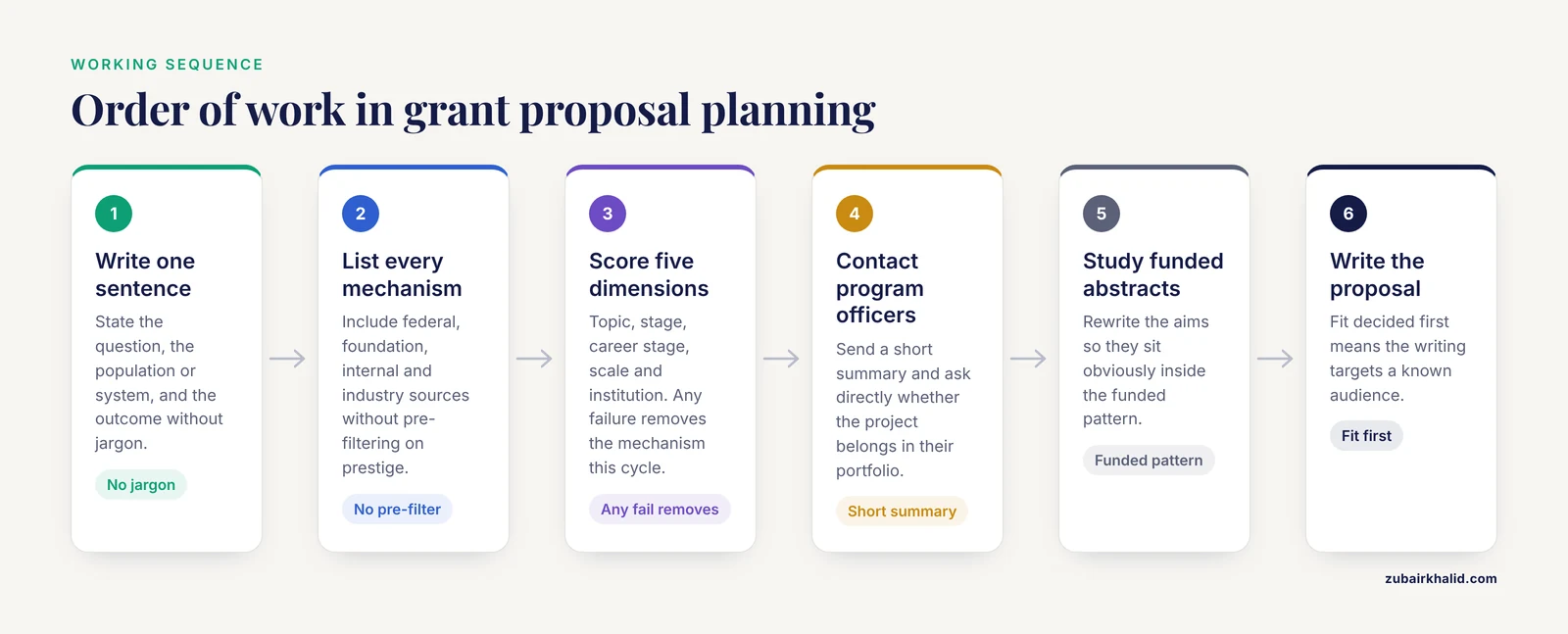
Fit assessment comes first in grant proposal planning, and the sequence that works is short.
- Write your one-sentence project statement. One sentence, no jargon, stating the question, the population or system, and the outcome.
- List every candidate mechanism. Include federal, foundation, internal, and industry sources. Do not pre-filter on prestige.
- Score each mechanism on the five fit dimensions. Topic, stage, career stage, scale, institution. Any dimension that fails removes the mechanism from this cycle.
- Contact the program officer for the survivors. Program officers exist to prevent misfit applications. Send a short summary and ask directly whether the project belongs in their portfolio.
- Study funded abstracts. Rewrite your aims so they sit obviously inside the funded pattern.
- Then write the proposal. Fit decided first means the writing targets a known audience.
Researchers who reverse this order, writing the full proposal first and shopping it to funders afterward, spend effort on applications that could never succeed and miss mechanisms whose announcements would have reshaped their aims productively.
What a Research Grant Writing Course Should Cover
A research grant writing course is worth the time when it teaches the fit judgment, not just sentence craft. Look for five components. First, training in reading funding announcements as documents with binding expectations rather than advertisements. Second, analysis of real funded and unfunded applications, ideally with reviewer commentary, so you can see the difference in how fit and approach are argued. Third, instruction in the specific structure your target agencies use, such as the specific aims page convention used across NIH mechanisms. Fourth, practice writing aims and getting structured critique, because the aims page is where fit and significance are actually judged. Fifth, guidance on the non-writing parts of the process, including program officer contact, budget justification, and the revision and resubmission cycle. Courses taught by faculty who hold current funding, or run through research development offices, generally deliver these better than generic academic-writing seminars.
Common Mistakes and Limitations
Confusing quality with fit. A rigorous proposal to the wrong mechanism loses to a modest proposal to the right one. Reviewers do not reallocate their portfolio to accommodate your topic.
Reading only the announcement headline. The eligibility fine print, on institutional type, career stage, citizenship, and cost sharing, eliminates more applications than the science does.
Stretching a small project to look big. Inflating a measurement-comparison study into a multi-aim program signals inexperience. Reviewers reward honestly sized projects with strong logic over padded ones.
Ignoring the funder's portfolio. Funded abstracts are public. Skipping them means assessing fit against your imagination of the program instead of its record.
Assuming pilot data guarantees the next award. Pilot results help, but the next mechanism judges a different set of criteria at a different scale. Treat the pilot as one input to the next fit assessment, not as a promise.
Overlooking agreement terms in industry deals. Publication rights, data ownership, and intellectual property terms vary widely. A sponsorship that restricts publication may not advance a research career even when the money arrives.
Miscalculating the timeline. Review cycles, pre-award processing, and startup periods add many months between submission and first spending. Planning a project start against an optimistic award date breaks recruitment and personnel plans.
One general limitation applies to all of the above. Individual situations differ in ways no general guide captures, and the specific requirements of any mechanism always override general advice, so confirm current details in the funding announcement itself and with your institution's research office before committing to a plan.
Frequently Asked Questions
What does grant fit mean in practical terms?
It means your question, your evidence, your team, and your budget match what a specific mechanism was designed to fund. In practice you test five dimensions, topic, stage of evidence, career stage, scale, and institution, and any dimension that fails disqualifies the mechanism for that cycle.
How do I know if my project fits a federal grant or a foundation grant?
Check whether your question serves the funder's stated mission and funded history. Federal project mechanisms fund general scientific merit across broad remits, while foundations and societies fund within a defined disease or practice area and weigh community relevance heavily.
Should I apply for a pilot grant before a full project grant?
Usually yes, when your evidence is still forming. Pilot mechanisms are built to fund feasibility work and preliminary data, and reviewers at the project-grant stage expect that groundwork to exist. If your preliminaries are already strong and published, applying directly to a project mechanism is reasonable.
How much preliminary data do I need before applying?
Enough to make your central assumptions unarguable, not enough to have answered the question. A pilot that demonstrates feasibility of the measurement or workflow, with defined metrics such as agreement coefficients or accuracy figures, is typically what reviewers mean by preliminary data.
Can a research grant writing course improve my funding chances?
Yes, when the course teaches fit assessment, aims-page construction, and critique of real applications rather than generic writing advice. Courses led by currently funded faculty or run by research development offices tend to cover those components.
What is the single best first step in assessing grant fit?
Write your one-sentence project statement and read the funded abstracts of the mechanisms you are considering. If your sentence does not sit naturally among them, no amount of proposal polish will fix the mismatch, and if it does, you have found the mechanism where your writing time pays off.
Sources
- Comparison of the Association of Area-Based Deprivation Indices With Hypertension and Diabetes Control Outcomes.
- Psychometric evaluation of the Persian version of the school-to-work transition anxiety scale in senior nursing students.
- Comparison of accuracy of three intraoral scanners for different types of tooth preparations: A laboratory study.
- Surgeon experience and measurement method influence consistency of glenoid bone loss assessment: a three-dimensional printing, computed tomography, and arthroscopy comparison.
- Development and initial psychometric evaluation of a digital competence scale for kindergarten teachers in Western China.
- The Turkish version of the quality in psychiatric care-inpatient scale: translation, cross-cultural adaptation, and psychometric evaluation.
- Efzofitimod versus placebo in patients with pulmonary sarcoidosis (EFZO-FIT): a multicentre, randomised, double-blind, placebo-controlled, phase 3 trial.
- Marginal fit and five-year outcomes of posterior monolithic zirconia restorations: A randomized paired and observational clinical study.
- Comparison of Digital Breast Tomosynthesis and Mammography-based Radiomics for Breast Cancer Risk Assessment: Case-Control Study.