How to Add a Late Entry to Your Lab Notebook
By Dr. Zubair Khalid, DVM, MS, PhD ·

By the end of this article you will be able to correct an error in a lab notebook without invalidating the record, write a late entry that references the original experiment date, and handle the same correction in an electronic lab notebook. You will also get a reusable lab notebook template for corrections and a checklist for reviewing your own entries.
Here is what you need on hand before you start:
- Your bound paper notebook and a permanent, archival ink pen, or
- Login access to your electronic lab notebook (ELN)
- The page number and date of the original entry you are correcting
- A witness or supervisor if your lab requires countersignature (most regulated and patent-focused labs do)
Why Late Entries Matter
A lab notebook is a legal and scientific record, not a personal diary. Patent offices, regulatory auditors, and journal reviewers all treat the notebook as evidence of when an idea or result was first recorded. The United States Patent and Trademark Office relies on dated, contemporaneous records when weighing questions of inventorship and derivation, which is one reason patents courses and technology transfer offices push researchers so hard on notebook discipline. In regulated environments, the Food and Drug Administration frames good documentation through the ALCOA principles: records must be Attributable, Legible, Contemporaneous, Original, and Accurate. A late entry is the sanctioned mechanism for reconciling those principles with reality, because sometimes you only discover an error, a missing result, or an omitted observation days or weeks after the fact.
The tension is obvious. Contemporaneous recording means writing things down as they happen. A late entry is, by definition, not contemporaneous. The solution used across industry and academia is not to pretend the entry was made on time. Instead, you date the correction with today's date, state clearly that it is late, identify the original entry it refers to, and leave the original text visible and unaltered. That approach preserves the audit trail. Anyone reading the notebook can see what was written first, what was changed, when the change happened, and who made it.
Electronic systems enforce the same logic automatically. Under 21 CFR Part 11, the FDA requires that electronic records used in regulated work keep a computer-generated, time-stamped audit trail that does not obscure previous values. Even if your lab is not regulated, the underlying design is the standard you should imitate: never overwrite history, always record who changed what and when.
The Core Rules of Amending a Notebook Entry
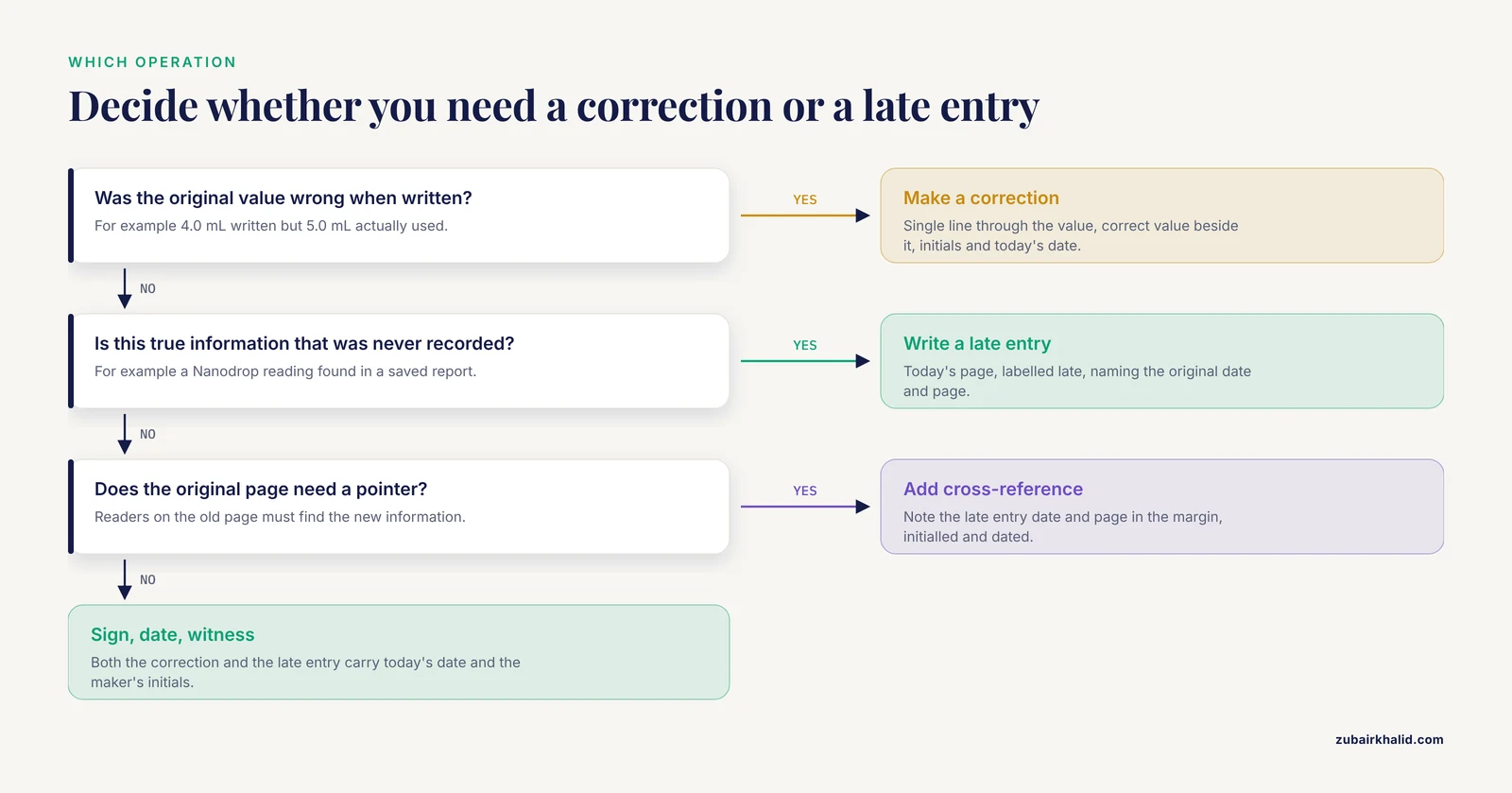
Every legitimate correction, whether in paper or electronic form, follows the same four rules. Internalize these before you touch a pen.
- Never erase, obscure, or overwrite. No white-out, no erasing, no writing over the original text, no ripping out pages. The original entry must stay readable forever. In a bound paper notebook, draw a single thin line through the error so it remains legible underneath.
- Date the correction, not the content. A correction or late entry always carries the date you actually wrote it. The original experiment date lives in the text as a reference, never as the entry date. Backdating, meaning writing an earlier date to make a late note look contemporaneous, is falsification. It has ended careers and invalidated patent claims.
- Sign and initial everything. The person who makes the change initials and dates the change itself, separate from any earlier signatures on the page. If your lab uses witnesses, the witness countersigns the correction too.
- State the reason. A bare correction with no explanation looks suspicious later. One short phrase, such as "transcription error," "sample recount," or "value copied from instrument printout," is enough.
The word "amend" can mean two different operations, and confusing them is the most common conceptual mistake. Correcting an error means fixing something that was wrong when written. Adding a late entry means recording something true that was simply not written at the time. Both use the same mechanics, but the wording differs. A correction says "this value was wrong." A late entry says "this information belongs to the experiment of [original date] and is being recorded now, on today's date."
How to Amend a Lab Notebook with a Late Entry, Step by Step
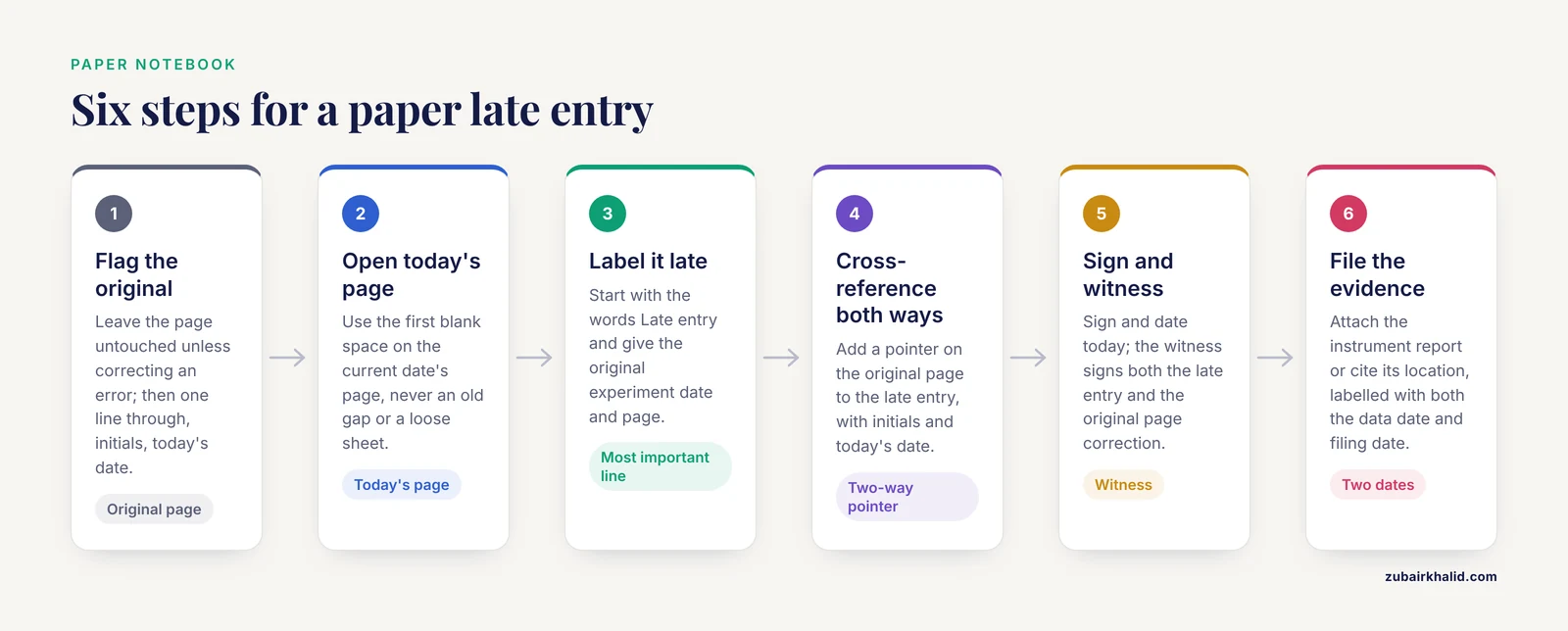
This walkthrough covers the paper notebook case, which is where the mechanics matter most. Follow the steps in order for each late entry.
Step 1. Locate and flag the original entry
Find the page and date of the experiment the late entry belongs to. Do not modify that page unless you are correcting an error on it. If you are only adding missing information, you leave the original page completely untouched and record everything on today's page.
If you do need to correct something on the original page (for example, you wrote 4.0 mL but the actual volume was 5.0 mL), draw one line through the incorrect text, write the correct value immediately nearby, and add your initials and today's date next to it.
Step 2. Turn to today's page
Open the notebook to the first blank space on the current date's page. Late entries go in the chronological flow of the notebook, on the day you write them. Never squeeze a late entry onto older pages in a gap, and never write one on a sticky note or loose sheet that can fall out.
Step 3. Label the entry as late and reference the original
Begin the entry with the words "Late entry" and give the date and page of the original experiment. This is the single most important line. Here is a complete worked example of what a well-formed late entry looks like in writing:
14 Mar 2026

LATE ENTRY for experiment of 09 Mar 2026, page 42, "Plasmid
miniprep, culture B-7".

On 09 Mar 2026 the B-7 miniprep eluate was measured on the
Nanodrop at 213 ng/uL, but this reading was never recorded.
The eluate was stored at -20 C in box 3, position C4, and the
concentration was read from the saved instrument report today.

Reason for late entry: instrument report was exported to the
wrong folder on 09 Mar and found during file cleanup.

Also correcting page 42: the elution volume is 30 uL, not
35 uL. The original figure has a single line through it and
the corrected value is written beside it, initialed and dated
14 Mar 2026.

J. Rivera, 14 Mar 2026
Witness: T. Okafor, 14 Mar 2026
Notice what this entry does. It names the original date and page. It states the fact being added. It explains why the entry is late. It records the related correction made on the old page. It is signed and dated today. A reader who sees only this page can reconstruct the full history without flipping back, and a reader who flips to page 42 can see the correction happened on 14 March.
Step 4. Cross-reference in both directions
On the original page, add a short pointer so a reader there knows more information exists elsewhere. Write something like "See late entry of 14 Mar 2026, page 57" in the margin or below the relevant paragraph, with your initials and today's date. If space is tight, write it as a marginal note. Never write it in pencil and never squeeze it between existing lines where it may be mistaken for part of the original entry.
The two-way pointer is what makes the record self-consistent. Auditors and patent attorneys look for exactly this kind of cross-reference when they evaluate whether a notebook is credible.
Step 5. Sign, date, and witness
Sign and date the late entry with today's date. If your lab requires witnessed pages, have the witness review both the late entry and the correction on the original page, then sign and date both. The witness confirms they saw the original record as it stood and observed the correction being made.
Step 6. File supporting material with the right date
If the late entry is prompted by a document, such as an instrument report, a scanned form, or an email, tape or staple the document into the notebook near the late entry, or file it and cite its location. Label the attachment with the date of the underlying data and the date of filing. A printout from 9 March taped into the notebook on 14 March should say both dates.
What the finished record should look like
After a correct amendment, three things are true. First, the original page still shows the original text, with at most a single-line strikethrough and a nearby correction for genuine errors. Second, today's page contains a signed, dated entry explicitly labeled as late, which references the original date and page. Third, any reader can trace the chain from original entry to correction to late entry without help from the author. If any of those three statements is false, fix it before the ink is cold. Notebook problems compound, and a gap a reviewer would forgive today becomes a red flag next year.
How to Record a Late Entry in an Electronic Lab Notebook
Electronic lab notebooks handle corrections differently because the system enforces the audit trail for you. The principles are identical, but the mechanics change, and knowing the mechanics prevents both under-recording and over-recording.
In most ELNs, you have two options:
- Use the system's amendment or revision feature. Open the original entry, make the change, and save a new revision. The platform keeps the prior version, timestamps the change, and attributes it to your account. Add a comment or change note stating what changed and why, for example "Corrected elution volume from 35 uL to 30 uL after rechecking the pipette calibration log."
- Add a new entry that references the old one. Create a fresh entry dated today, tag or link it to the original experiment, and mark it as a late entry or addendum in the title. This mirrors the paper workflow and is the better choice when you are adding substantial new information rather than fixing a typo.
Never export data, edit it, and re-upload a "corrected" file without explanation, because that severs the link between the record and its history. And never ask an administrator to modify or delete an entry outside the normal workflow. In a validated system, doing so destroys the audit trail and can invalidate the entire dataset for regulatory purposes.
If your lab keeps a plain-file notebook, such as a Markdown journal in a version-controlled repository, the equivalent workflow looks like this:
# Today is 2026-03-14. You are adding a late entry for 2026-03-09.
git pull origin main
nano notebook/2026-03-14.md

# In the file, write:
#   ## Late entry for 2026-03-09 (plasmid miniprep, culture B-7)
#   Recorded 2026-03-14. The B-7 eluate concentration was
#   213 ng/uL, found in the saved Nanodrop report today.
#   Reason: report was exported to the wrong folder on 03-09.

git add notebook/2026-03-14.md
git commit -m "Late entry for 2026-03-09: record B-7 eluate conc (213 ng/uL)"
git push origin main
The expected output of git log, oneline -1 is a commit line like:
a3f9c21 Late entry for 2026-03-09: record B-7 eluate conc (213 ng/uL)The commit timestamp now serves as the automatic, unforgeable record of when the late entry was made, which is exactly what an audit trail requires. Do not rewrite or rebase old commits to "fix" history. Add a new commit, the same way you would add a new page.
Electronic Lab Notebook Comparison for Corrections
Choosing where corrections live is easier when you compare system categories rather than individual products, because correction handling follows from architecture. The table below summarizes the options at a category level.
| System type | How corrections are recorded | Audit trail | Best suited for |
|---|---|---|---|
| Bound paper notebook | Single-line strikethrough, nearby rewrite, initialed and dated, late entries on current page | Manual, via signatures and witnesses | Academic labs focused on patent precedence, field work |
| Loose-leaf or digital scans of paper | Same as paper, then scanned daily or weekly | Weak unless scanning is immediate and indexed | Labs transitioning away from paper |
| General-purpose ELN (notebook-style) | Revision history plus change comments, or linked addendum entries | Automatic, per-user, timestamped | Most academic and industrial research labs |
| Structured ELN or LIMS | Field-level changes with mandatory reason codes, controlled vocabularies | Automatic, often review-and-approve workflows | GxP environments, manufacturing QA, clinical studies |
| Version-controlled plain files | New commit referencing the old entry, never history rewriting | Automatic via version control | Computational biology, bioinformatics, code-adjacent records |
When evaluating a specific ELN product, ask the vendor or your IT group three questions. Does every edit generate an immutable, timestamped, attributed audit entry? Can a user delete or truly overwrite a signed entry, and if so, who controls that permission? Can entries be exported with their full revision history intact? The first question decides whether the tool is acceptable for any work with regulatory or patent implications. The second decides how much trust you place in the platform versus the people. The third decides whether your records survive a lab move or a platform migration.
Lab Notebook Template for Corrections and Late Entries
Copy this template into the front of your notebook or your ELN as a standing page. Fill it out whenever you add a late entry or a correction, and the structure will keep you honest even when you are rushed.
LATE ENTRY / CORRECTION RECORD
------------------------------
Entry type:        [ ] Late entry (new information)
                   [ ] Correction of existing entry
Date of this record: ____________ (always today)
Original experiment date: ____________
Original page / entry ID: ____________
Experiment title: ____________________________

What is being added or corrected:
________________________________________________
________________________________________________

Corrected value (if applicable):
  Original: ____________
  Corrected: ____________

Reason for the late entry or correction:
  [ ] Transcription error    [ ] Instrument report found later
  [ ] Recount / re-read      [ ] Omitted observation
  [ ] Other: ________________

Cross-reference written on original page? [ ] Yes, on page ____
Supporting documents attached? [ ] Yes: ____________  [ ] No

Recorded by: ____________  Date: ____________
Witness:     ____________  Date: ____________
For teams, add one line at the top of every experiment page: "Witnessed by __ on __." A page that is signed when written never needs retroactive witnessing, which is the hardest kind of late entry to legitimize.
How to Verify the Amendment Is Correct
Run this five-point check before you close the notebook.
- Original visible. Every crossed-out value can still be read underneath the single line. Nothing is erased, taped over, or obscured.
- Dates are directional. The correction and the late entry both carry today's date. The original experiment date appears only as a reference inside the text.
- Attribution is complete. The correction and the late entry are initialed, and witnessed if required, by the person who actually made them.
- The chain closes. The late entry names the original page, and the original page carries a pointer to the late entry. Follow the chain in both directions to confirm.
- The reason is stated. Anyone reading the entry cold understands why the record changed when it did.
A quick self-test: hand the two pages to a labmate who was not involved and ask them to explain what happened and when. If they can narrate the sequence without asking you a question, the record passes.
Common Mistakes and Limitations
These are the errors reviewers, auditors, and patent practitioners encounter most often, with the fix for each.
Using white-out or an eraser. This is the classic fatal error. An obscured original destroys the audit trail and, in a patent dispute, casts doubt on the entire notebook. Fix: single line through the text, correction beside it, initials and date. If a whole page is unusable, draw a diagonal line across the page, write "void," initial and date it, and start the entry again on the next page, noting the void on both pages.
Backdating. Writing an earlier date on a late entry, or writing into space left on an old page as if you had written it then, is record falsification. There is no minor version of this. The fix is the procedure in this article, which achieves the same evidentiary goal honestly.
Correcting without dating the correction. A strikethrough with no initials and no date is an unexplained alteration, which auditors treat as worse than the original error. Every change gets its own initials and its own date, even on a page you signed that morning.
Writing the late entry with no reference to the original. "Culture was 213 ng/uL" floating on a March 14 page tells a future reader nothing. Always include the original date, the page or entry identifier, and enough context to identify the experiment unambiguously.
Vague reasons. "Mistake" or "fixed" explains nothing. Choose a specific phrase: transposition error, value read from the wrong column, sample mislabeled and reidentified, instrument report located later.
Losing the original instrument output. A late entry that reports a value with no supporting document is just a claim. Print or attach the report, scan the raw file into the ELN, or cite its archived location by filename and storage path.
Waiting too long. The longer the gap between the event and the record, the weaker the memory and the record. If you notice a gap during a weekly review, close it that week. If you discover months-old gaps, write the late entry with an explicit statement of how the information was recovered, for example "recovered from instrument archive and email of 09 Mar 2026," rather than relying on recollection.
Witnessing problems. A witness who signs a page they never saw in its original state adds little. Witnesses should be people who can genuinely attest to the work, and they should sign on the day, not weeks later. For late entries, the witness confirms the correction process, which is a different and more limited attestation, so say so in the entry if the witness did not observe the original work.
Transcribing corrections onto photocopies only. Some people fix the error on a clean photocopy and paste that in. The pasted copy hides the original. Corrections go on the original page, and copies are supplements, not substitutes.
Assuming electronic systems excuse sloppy habits. An ELN timestamps everything, but it cannot supply your missing context. "Corrected value" with no reason and no reference to the underlying run is just as opaque in an ELN as on paper.
One honest limitation applies to all of this. Specific requirements, such as whether witness signatures are mandatory, what retention period applies, or which ELN features your institution validates, are set by your own institution, sponsor, or quality unit. When your lab's standard operating procedures differ from the general practice described here, the local SOP wins. Individual cases with legal or regulatory weight need review by your technology transfer office or quality assurance group.
Sensible Next Steps
Once your correction workflow is solid, tighten the surrounding system. Adopt a daily sign-off habit so future late entries become rare. Schedule a weekly five-minute review that scans the last week's pages for blanks, unsigned entries, and missing attachments. If you are still on paper and your work touches patents or regulated studies, evaluate an ELN with a genuine audit trail using the three questions in the comparison section above. And build the correction template above into your onboarding documents so every new lab member starts with the same standard.
Frequently Asked Questions
Can I backdate a lab notebook entry?
No. Backdating, meaning writing an earlier date to make a late note appear contemporaneous, is falsification of a research record. The correct method is to date the entry with today's date, label it as a late entry, and reference the original experiment date and page in the text.
What exactly counts as a late entry?
A late entry is any information that belongs to an earlier experiment but is recorded now, on today's dated page, with an explicit statement of the original date and the reason for the delay. It differs from a correction, which fixes something that was wrong when first written.
Do I need a witness for a late entry?
Follow your lab's policy, but witnessing is strongly recommended and often required for patent-related or regulated work. The witness signs and dates the late entry itself, confirming they observed the correction being made. Note in the entry whether the witness also saw the original work.
How do I fix an error in an electronic lab notebook?
Use the platform's revision or amendment feature so the prior version is preserved automatically, and add a change comment stating what changed, the corrected value, and the reason. Alternatively, create a new dated entry linked to the original, titled as a late entry or addendum. Never edit and re-upload exported files outside the system.
Can I use white-out or erase a mistake?
Never. Erasing or obscuring the original entry destroys the audit trail and can invalidate the notebook as evidence. Draw a single line through the incorrect text so it remains legible, write the correct value nearby, and initial and date the change.
What if I cannot remember the exact details anymore?
Do not guess. Write the late entry with only what you can substantiate, and state the source of the information, such as an instrument archive, an email, or a labmate's independent record. If the details cannot be substantiated at all, record that the information is unavailable rather than inventing a value.
How late is too late for a late entry?
There is no fixed cutoff, but record value drops as memory fades and corroboration weakens. Close gaps within days when possible. For older gaps, the entry must state exactly how the information was recovered, because a months-later entry supported only by recollection carries little evidentiary weight.
Do late entries affect patent claims?
They can. Patent proceedings weigh notebook credibility heavily, and a record with honest, well-documented late entries is far stronger than one with suspicious dates or obscured corrections. Honest late entries show the record is maintained carefully, which supports rather than undermines inventorship evidence.