How Often Should You Review Lab Notebooks?
By Dr. Zubair Khalid, DVM, MS, PhD ·

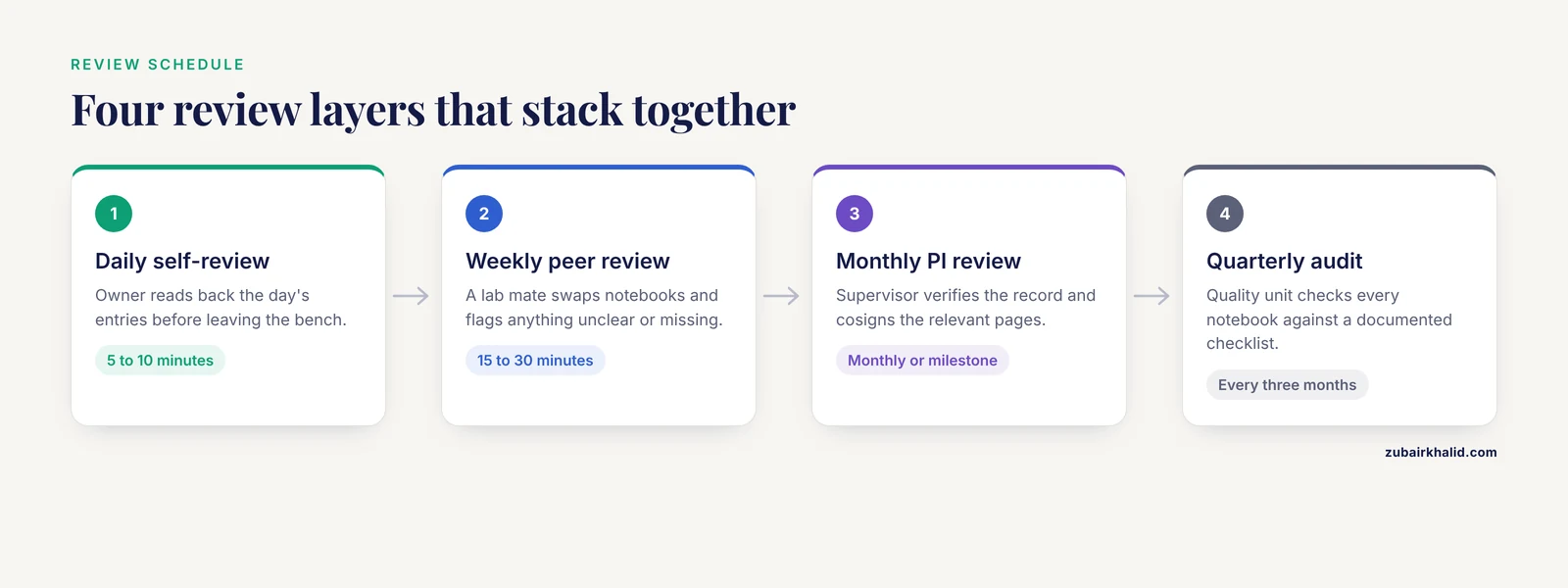
A daily self-review catches errors while the experiment is still fresh, while a formal supervisor review verifies and confirms the record weeks later. These two jobs need different schedules. The rule of thumb is simple: check your own notebook at the end of every working day, have a peer scan it weekly, have your supervisor or PI review and cosign it monthly or at each experiment milestone, and run a deeper periodic audit once per quarter. In regulated or fast-moving settings, electronic lab notebooks shift review toward continuous, near-real-time checking.
This article walks through each review frequency, compares them side by side, shows how electronic lab notebooks change the picture, and gives you a template and worked scenarios so you can pick the schedule that fits your lab.
Why Review Frequency Matters
A lab notebook is the permanent record of what was done, when, and why. Review is what turns a personal logbook into a record that other people can trust. An unreviewed notebook is just one person's memory on paper. A reviewed notebook becomes evidence that an experiment was performed as described, that deviations were caught, and that the data behind a figure or a claim really exists.
The consequences of weak review show up years later. When a group later attempts to synthesize evidence across studies, for example through a systematic review or meta-analysis, the documented methods and raw records from each lab determine whether the data can be extracted and combined at all. Modern methodological guides to systematic review stress pre-registration, documented search and screening steps, and transparent data extraction as the foundation of a trustworthy synthesis [1]. Every one of those steps traces back to a well-maintained, well-reviewed primary record. If the original notebook was never checked, the downstream synthesis inherits the gaps.
Review frequency also protects you personally. In industry settings, an unsigned or unreviewed notebook page can invalidate a data point during an audit. In academia, a notebook reviewed by a second person is the first line of defense against the transcription errors, missing controls, and unrecorded protocol changes that fuel irreproducibility. And in labs that practice open science, review is not an internal formality at all. Open notebook projects share protocols, positive results, and negative results online in near real time, precisely because rapid external visibility acts as a continuous review mechanism [2].
The rest of this article breaks down the practical options for review frequency, with the tradeoffs of each.
How Often Review Lab Notebooks: The Five Main Options
There are five realistic answers to the question of lab notebook review frequency. Most labs combine two or three of them. The comparison table below is the core of this article, and each option is explained in detail afterward.
| Option | Frequency | Who reviews | Best for | Pros | Cons |
|---|---|---|---|---|---|
| Daily self-review | End of each working day | The notebook owner | Everyone, all lab types | Catches errors same day, no scheduling cost | Self-review cannot catch blind spots |
| Weekly peer review | Once per week | A lab mate or colleague | Academic labs, shared equipment groups | Fresh eyes, low burden, builds peer culture | Peers may lack authority or context |
| Monthly or milestone PI review | Monthly, or at each experiment milestone | Supervisor, PI, or designated reviewer | Graduate training, project gatekeeping, IP documentation | Authoritative verification, cosigning, mentoring value | Delays mean errors found late, backlog risk |
| Quarterly periodic audit | Every three months | QC, quality unit, or senior scientist | GLP/GMP-like environments, prior to audits | Systematic, checks completeness across all notebooks | Cannot prevent errors, only detect them |
| Continuous ELN review | As entries are made | Reviewers notified in real time | Labs using electronic systems, collaborative projects | Timestamped, searchable, review integrated into workflow | Requires adoption and training, disruptive rollout |
Daily Self-Review: The End-of-Day Check
The daily self-review takes five to ten minutes. Before you leave the bench, read back the day's entries against what actually happened. Check that every page has a date, that calculations are written out, that raw values are recorded rather than summarized, and that any deviation from the planned protocol is noted with a reason.
This is the highest-value review in the entire system because it happens while memory is reliable. If you wrote 250 mg but weighed 205 mg, you can still check the balance printout or reweigh the vial. Two weeks later, that error is usually unrecoverable. The daily check also confirms that no page was left blank overnight, which matters for record integrity.
The pros are speed and universal applicability. The cons are real but bounded. Self-review cannot catch your own conceptual mistakes, such as a systematically wrong unit conversion that you performed the same wrong way every time. That is why daily self-review is the floor of any review schedule, never the whole schedule.
Weekly Peer Review: Fresh Eyes on a Regular Cycle
Weekly peer review means a lab mate reads your entries for the week and you read theirs, typically in a 15 to 30 minute swap. The reviewer checks that entries are complete, legible, dated, and internally consistent, and flags anything unclear.
The main advantage is that fresh eyes catch what familiarity hides. A peer who did not run the experiment will immediately ask why the control condition is missing on Tuesday, or why the dilution factor changed between days. Regular peer review also normalizes documentation quality across the lab, because everyone learns what a good entry looks like by reading other people's.
The cons are that peers may lack the scientific authority to formally verify the work, and that the review is only as good as the reviewer's engagement. A rushed weekly skim adds little. Weekly review works best when it is scheduled, short, and mutual, so that no one is always the reviewer and no one is always the reviewed.
Monthly or Milestone PI Review and Cosigning
Monthly review, or review at each experiment milestone such as the end of a series, the completion of a construct, or the close of a study phase, is the traditional supervisor check. The PI or a designated senior scientist reads the notebook section covering the completed work, verifies that the record supports the conclusions, and signs or initials the relevant pages. In many industrial settings, a witness signature on each page or each entry is standard practice, and some academic labs adopt a lighter version.
This is the review that carries formal weight. A cosigned notebook section is the version of the record that a funding agency, patent attorney, or audit team will treat as verified. Monthly review also creates a natural mentoring checkpoint, because the reviewer can see not only whether the record is complete but whether the experimental logic is sound.
The cons follow from the delay. Errors introduced in week one may not be caught until week five, by which point the fix may require repeating work. Monthly review also fails predictably when the reviewer falls behind. A PI who reviews four notebooks in one catch-up afternoon at the end of the quarter is not reviewing, they are signing. If your lab uses this frequency, anchor it to milestones rather than calendar months when experiments are short, and treat the milestone signature as non-negotiable before data from that phase is used in any figure, report, or presentation.
Quarterly Periodic Audit: The Systematic Sweep
A quarterly audit is a scheduled, documented review of notebooks across the lab or the quality unit. The auditor checks each notebook against a checklist: Are all pages dated and signed? Are gaps, corrections, and deviations explained? Are raw data files cross-referenced? Are loose inserts taped in and labeled?
This frequency is standard in regulated and quality-driven environments, and it maps onto how quality systems are designed. The audit does not exist to catch yesterday's pipetting error. It exists to verify that the review system itself is functioning, and to produce a dated record that the lab's documentation was checked at a specific point in time. In the classification used to organize the electronic lab notebook market, laboratories with stringent quality requirements form their own distinct category of tools, reflecting how central scheduled, documented review is to their operation [3].
The pros are completeness, objectivity, and audit readiness. The cons are that a quarterly sweep is purely retrospective. By the time an auditor finds a systematic problem, months of data may be affected. That is why audits supplement daily and milestone review rather than replacing them.
Continuous Review in Electronic Lab Notebooks
Electronic lab notebooks, or ELNs, allow review to happen as work is recorded rather than on a fixed calendar. Entries are timestamped at creation, reviewers can be notified when a page or experiment is ready, and a supervisor can verify work from anywhere without handling a physical book. A survey of the ELN market found dozens of competing products and grouped them into five categories by audience, covering quality environments, biology, chemistry, general research and development, and multidiscipline use [3]. In many of these systems, review workflow, electronic signatures, and audit trails are built in.
The practical effect is that lab notebook review frequency stops being a calendar question and becomes a workflow question. Instead of waiting for a weekly or monthly cycle, the reviewer acts when an entry is submitted for approval. Projects that push this logic furthest, such as open notebook initiatives where research is shared online in near real time, treat external visibility as the review mechanism itself [2].
The catch is that ELN adoption is disruptive, particularly in labs that are predominantly paper-based, and the benefits grow only when the ELN is integrated with other systems such as laboratory information management systems, instrument software, and data management platforms [4]. A poorly adopted ELN can produce a reviewed record that is less complete than a well-run paper notebook.
Electronic Lab Notebook Comparison for Review Workflows
Because review frequency depends heavily on whether your notebook is paper or electronic, it is worth comparing the electronic options on their own terms. The market survey of 35 ELN products established the classification most buyers still use, sorting tools into pools suited to quality assurance and quality control environments, specialized biology or chemistry work, and general research and development or multidiscipline use [3]. That classification matters for review because the review features differ by pool. A tool designed for a quality environment will emphasize electronic signatures, audit trails, and formal approval workflows. A tool designed for free-form research may emphasize flexibility, rich media, and sharing, with lighter review structure.
The implementation literature adds a second key point. ELNs offer significant advantages over paper, but their benefits increase when they are integrated with laboratory information management systems, chromatography data systems, analytical instruments, and scientific data management systems, and there is no single well-established path for achieving that integration [4]. For review purposes, integration means the reviewer sees the raw instrument output attached to the notebook entry, not just the scientist's transcription of it. That shrinks the review burden and removes a whole class of transcription errors that paper review exists to catch.
When comparing ELNs for review capability, evaluate three things. First, can a reviewer be assigned and notified, and does the system record who reviewed what and when? Second, is there an immutable audit trail, so that edits after review are visible rather than overwritten? Third, does the tool connect to your instruments and data systems, or will reviewers still be checking transcriptions by hand? These questions do the real work of an electronic lab notebook comparison, more than feature lists or interfaces do.
Building Review Into Your Lab Notebook Template
Review frequency only works if the notebook is reviewable. The cheapest way to guarantee that is a consistent lab notebook template, applied to every entry, whether on paper or in an ELN. A template that supports review contains these elements:
- Header block. Date, experiment title, project or study number, notebook page number, and the experimenter's name.
- Purpose statement. One or two sentences stating the question the experiment answers.
- Materials and conditions. Reagents with lot numbers and concentrations, equipment with identifying numbers, organism or cell line details, and environmental conditions where relevant.
- Protocol reference or in-line protocol. Either a citation to a controlled protocol document with its version, or the full protocol written out, with every deviation noted next to the affected step.
- Raw data section. Measurements as recorded, in real time, in ink on paper or as original instrument files in an ELN. Never transcribe without keeping the original.
- Observations and outcome. What happened, including failures and anomalies, stated factually.
- Signature block. Lines for the experimenter's signature and date, and for a witness or reviewer signature and date.
- Review checkbox. A short list the reviewer ticks, confirming dates present, pages signed, deviations explained, and raw data attached.
The template is also where you make the review schedule visible. A footer line reading "Peer review: initials and date" and "PI review: initials and date" turns your chosen lab notebook review frequency into a physical artifact. In an ELN, the same fields become structured metadata, which is what makes automated review routing possible.
How Review Frequency Changes by Lab Type
The best answer to how often review lab notebooks depends on what kind of lab you run.
Academic wet labs typically run a three-layer schedule. Daily self-review by the notebook owner, weekly or biweekly peer review within the lab, and milestone-based PI review before any result is used in a manuscript, thesis chapter, or grant progress report. New graduate students benefit from more frequent supervisor review in their first months, stepping back to milestone review as their documentation matures.
Regulated and quality-driven labs layer a formal periodic audit on top of entry-level witness verification. Here the review record itself is a compliance artifact, and scheduled audits with documented checklists are the norm. The ELN category built for these environments exists precisely because paper review at this level of formality is slow and error-prone [3].
Computational and data science labs review a different kind of notebook. The modern equivalent is the computational notebook, such as a Jupyter notebook, which interleaves code, output, and narrative analysis. These notebooks are increasingly treated as lab records, shared through repositories so that analyses are transparent and re-runnable. Published analyses delivered as collections of Jupyter Lab Notebooks in a public repository show how the format supports external checking of every computational step [5]. For these records, review frequency aligns with version control practice, meaning review at every meaningful commit or pull request rather than on a paper schedule.
Collaborative and open science projects invert the timeline entirely. In an open notebook model, entries are shared as they are written, so review happens continuously and by people outside the lab. The openlabnotebooks.org initiative, which grew to more than 20 active contributors within its first year, demonstrates that near-real-time sharing is operationally feasible for structured research programs [2].
Worked Scenarios
Scenario 1: A first-year graduate student in an academic molecular biology lab. Maria starts a cloning project. Her lab's schedule asks for a daily self-check, which she does while tidying the bench at 5 pm, and a weekly Thursday peer swap with a senior student. After her first transformation series, her PI reviews the notebook section before agreeing that the construct is ready for sequencing. When the peer reviewer notices in week two that Maria recorded gel concentrations but not electrophoresis voltages, Maria fixes the habit that same day. Total added burden is under one hour per week, and the record survives her thesis examination three years later.
Scenario 2: A quality-controlled analytical lab in industry. A three-person team runs stability studies. Every analyst self-checks at the end of each shift and has a second scientist witness and cosign each analytical run the same day, because the data supports a regulatory filing. A quality unit audits every active notebook quarterly against a checklist, and the audit record is filed. The team adopted an ELN from the quality-oriented category of products, which routes entries for approval automatically and keeps an audit trail of every change [3]. Quarterly audits now take two days instead of two weeks, because the electronic trail answers most checklist questions itself.
Scenario 3: A computational biology group. A postdoc runs pipeline analyses in Jupyter notebooks, committed to a shared repository with each version tagged. Review happens at pull requests, meaning within days of each analysis step, and the final publication ships with the full notebook collection so reviewers of the paper can trace every figure to code and data [5]. When the group later contributes to a meta-analysis, their documented, reviewed records feed directly into data extraction without reconstruction effort, which is exactly the kind of transparency that systematic review methodology depends on [1].
Common Mistakes and Limitations
- Treating the signature as the review. Signing a page you never read is the most common failure mode in milestone review. The signature certifies that you verified the record. If time constraints make real verification impossible, shorten the interval rather than hollow out the review.
- Letting review backlog accumulate. A monthly schedule silently becomes a quarterly catch-up. Set a hard rule that data cannot be used in a figure, report, or presentation until its notebook section is reviewed and cosigned.
- Reviewing only content, not completeness. Reviewers tend to check whether the science makes sense and skip whether every page is dated, every correction is explained, and every raw value is present. Both matter. Use a checklist so the mechanical items are never skipped.
- Switching to an ELN without a rollout plan. Adoption in a paper-based lab is disruptive, and the payoff depends on integration with instruments and data systems that may not exist yet [4]. Pilot with one project before mandating lab-wide use.
- Choosing an ELN by feature list rather than by review needs. The product pools differ in what they are built to verify, and a flexible research tool may lack the approval workflows a quality lab requires [3].
- Assuming self-review is enough. Daily self-review catches clerical errors, not systematic conceptual mistakes. Every schedule needs at least one reviewer who is not the record's author.
- Expecting review to substitute for writing. No frequency of review can reconstruct an entry that was never made. If a day has no record, review can only document that gap, not fill it.
A final limitation applies to all schedules. Review requirements vary between institutions, funding agencies, and regulated environments, and individual situations call for guidance from your own supervisor, quality unit, or institutional policies rather than a general schedule.
Frequently Asked Questions
How often should a PI review lab notebooks?
For most academic labs, monthly or at each experiment milestone is the right interval for formal PI review, layered on top of daily self-checks and weekly peer review. Anchor the review to milestones such as the end of a construct, a completed study phase, or the point where data will be used in a manuscript, so the signature always precedes use of the data.
Do electronic lab notebooks change the review schedule?
Yes, they can replace calendar-based review with workflow-based review. Because ELN entries are timestamped and reviewers can be notified as work is submitted, review becomes continuous or on-demand rather than monthly. The benefit depends on adoption and integration with instruments and data systems, which is where many rollouts fall short.
Who should witness or cosign a notebook entry?
Someone with enough knowledge to understand the entry but who did not perform the work themselves. In industry this is typically a second scientist or a designated reviewer. In academia, a lab mate handles weekly peer review while the PI or a senior designated scientist performs formal cosigning at milestones.
What should a notebook review checklist include?
At minimum, confirm that every page is dated and signed, that corrections and deviations are explained, that raw data is present and attached or cross-referenced, that reagents and conditions are identified fully, and that the reviewer's initials and date are recorded. A one-page checklist applied consistently outperforms an impressionistic read-through.
How does review frequency differ in regulated environments?
Regulated and quality-driven labs rely on review at or near the time of each entry, with witness signatures, plus a documented periodic audit of all notebooks, often quarterly. The audit record itself is a compliance artifact, and electronic systems in this market category are built specifically around signature and audit trail requirements.
Can notebook review help with publications and patents?
Yes. A reviewed and cosigned notebook is the record that establishes when work was done and that the data supports the claims, which matters both for authorship and inventorship disputes and for the documented methods that later synthesis and reproducibility efforts depend on. Review before submission is also the last chance to catch a gap between what the notebook shows and what the manuscript claims.
Further Reading
Sources
- From review to synthesis: A step-by-step methodological guide to systematic reviews and multilevel meta-analyses.
- Open laboratory notebooks: good for science, good for society, good for scientists.
- A review of electronic laboratory notebooks available in the market today.
- Electronic laboratory notebooks progress and challenges in implementation.
- Deception detection with machine learning: A systematic review and statistical analysis.