How Often Should You Meet with Your Thesis Advisor?
By Dr. Zubair Khalid, DVM, MS, PhD ·

Meeting weekly and meeting monthly differ mainly in how much independent work you can finish between check-ins, not in how serious a student you are. The question of how often you should meet with your thesis advisor has no single universal number, but it has a reliable rule of thumb: meet as often as it takes to avoid staying stuck for more than a few days, and no more often than you can prepare for with real work. For most biology graduate students, that lands on a standing meeting every one to two weeks during active research, loosening to monthly during independent writing, with formal committee meetings as fixed anchors on either side.
This guide walks through the realistic cadence options, the pros and cons of each, the criteria that actually decide the choice, how to plan a thesis around your meeting schedule, and worked scenarios for the situations graduate students face most often.
Why Cadence Matters More Than Meeting Length
Cadence means how often a recurring meeting happens. In a thesis, cadence is the heartbeat of the project. A master's or doctoral thesis is a multi-year effort with very few external deadlines, so the regular meeting with your advisor is usually the only force that converts open-ended time into finished chapters.
Two failure modes sit at the extremes. Too little contact produces drift, where weeks pass, an experiment fails quietly, and nobody redirects the plan. Too much contact produces dependence, where every small decision waits for the advisor and the student never develops scientific judgment. Neither extreme reflects how hard anyone is working. Both are scheduling problems with straightforward fixes.
Advisor time is the scarcest resource in most research groups. A focused 30-minute meeting built on a one-page agenda usually beats a rambling hour, and a well-chosen cadence beats a merely frequent one. The rest of this article is about choosing that cadence deliberately instead of inheriting it by accident.
The Main Options for How Often to Meet Your Thesis Advisor
Most students combine two patterns, a working meeting at a fixed interval plus a formal anchor set by the program. Here are the options on their own terms.
Weekly standing meetings
A standing meeting is a recurring appointment at the same time each week, protected from casual cancellation. Weekly meetings work best in the first years of a thesis, during rotation projects (short, supervised research placements used to choose a lab), while learning a demanding technique, and during any period when experiments turn around quickly and plans change fast.
Pros:
- Fast feedback. A mistake in a protocol costs you days rather than weeks.
- Built-in accountability, which matters when nobody else is watching your timeline.
- Steady contact builds the working relationship that later carries you through disagreements and job searches.
Cons:
- Preparation overhead arrives every week. If you scramble for content each time, the cadence is too tight.
- Weekly check-ins can fragment deep work into small slices.
- Some students begin outsourcing decisions they should learn to make themselves.
A weekly cadence fits when your data cycle, meaning the time from starting an experiment to having an interpretable result, is about a week or less.
Meetings every two weeks
Meetings every two weeks are the default for many thesis students in the data collection phase. Two weeks is usually enough time to generate a meaningful chunk of results, yet short enough that a stalled experiment does not eat a month.
Pros:
- Enough material accumulates between meetings to make each one substantive.
- The gap is short enough to catch a failing line of work before it wastes a season.
- Preparation stays manageable, one solid update every two weeks.
Cons:
- A hard technical blocker can sit unresolved for days while you wait for the next session.
- If you travel to field sites or your advisor travels constantly, cancellations break the rhythm.
This cadence works when your experiments take two to four weeks to turn around, or when you have enough experience to troubleshoot routine problems on your own.
Monthly meetings
Monthly meetings suit students running long-cycle projects, such as animal colony expansions, field seasons, long-term cultures, or extended analyses, who have proven they can execute a month-long plan without supervision. Monthly also fits the writing phase, where the unit of progress is a chapter draft rather than a dataset.
Pros:
- Forces consolidation. You must assemble a month of work into a coherent story, which is good rehearsal for thesis writing itself.
- Leaves long uninterrupted blocks for deep work.
- Discussions stay at the level of strategy rather than daily troubleshooting.
Cons:
- Small blockers fester. A back-ordered reagent or a software bug can idle you for weeks.
- Drift risk is real. A month of low output is easy to hide, even from yourself.
- Meetings tend to run long because there is so much to cover.
If you choose monthly, pair it with a lightweight asynchronous update in between so your advisor sees motion, not just monthly summaries.
Asynchronous and on-demand check-ins
Asynchronous communication means updates that do not require both people to be available at the same time, such as email summaries, comments in a shared document, a running electronic lab notebook, or messages in a group chat. On-demand means you request a short meeting when a specific blocker appears.
Pros:
- Creates a written record of decisions, which prevents later disagreements about what was agreed.
- Fits advisors who travel heavily and students in remote field locations.
- No scheduling overhead.
Cons:
- Urgent questions can sit unanswered for days.
- Writing careful updates takes real time.
- You can be quietly deprioritized, since nothing sits on anyone's calendar.
- Rapport is harder to build, and rapport matters when you eventually need strong advocacy and letters.
Asynchronous contact works best as a supplement to a sparse standing meeting, not as the entire relationship.
Milestone and committee anchors
Most graduate programs impose a formal skeleton regardless of what you and your advisor arrange informally. The thesis proposal, sometimes called a prospectus or qualifying exam, is a written plan and oral defense of your intended research, usually completed by the second year. After that, most programs require a committee meeting at set intervals, commonly once or twice per year, where your full committee reviews progress and approves the plan for the next period.
These anchors are not optional and not frequency-tunable. Your graduate school's handbook sets the intervals, the paperwork, and the deadlines. Around those fixed points, you and your advisor adjust the working cadence. A common pattern is to tighten meetings in the two or three weeks before a committee meeting while you assemble the progress report, then relax afterward.
Lab group meetings as a complement
Most labs hold a weekly or biweekly group meeting where students present progress to the whole lab. This is valuable exposure and feedback, and it is not a substitute for one-on-one advisor time. Group meetings optimize for the audience's learning. Individual meetings optimize for your project. Students who rely on lab meeting alone often discover, in their third year, that their advisor knows their project far less well than they had assumed.
Side-by-Side Comparison of Meeting Options
The table below is the decision core of this article. Read it by column when you are choosing. If your bottleneck is feedback speed, move up the table. If your bottleneck is time to think, move down.
| Option | Best fit | Biggest advantage | Biggest drawback | Prep burden | Typical session |
|---|---|---|---|---|---|
| Weekly standing | First years, new techniques, fast-turnaround experiments | Fast feedback and steady accountability | High prep overhead, fragments deep work | High, every week | 30 to 45 minutes |
| Every two weeks | Active data collection, the mid-thesis default | Substantial material per meeting, still a tight loop | Blockers wait days, cancellations break rhythm | Moderate | 45 to 60 minutes |
| Monthly | Long-cycle projects, independent students, writing phase | Forces consolidation, protects deep work | Small problems fester, drift risk | Moderate but deeper | 60 to 90 minutes |
| Asynchronous plus on-demand | Remote students, traveling advisors, computational work | Written record, no scheduling overhead | Slow answers, easy to be deprioritized | Ongoing writing | Minutes to an hour, as needed |
| Committee and milestone anchors | Required by the program | Formal sign-off keeps everyone aligned | Inflexible, dates create crunch periods | High, once or twice a year | 1 to 3 hours |
| Lab group meeting | All students, as a complement | Broad feedback and presentation practice | Not tailored to your project | Moderate | 1 to 3 hours for the group |
How to Choose: The Criteria That Decide Real Schedules
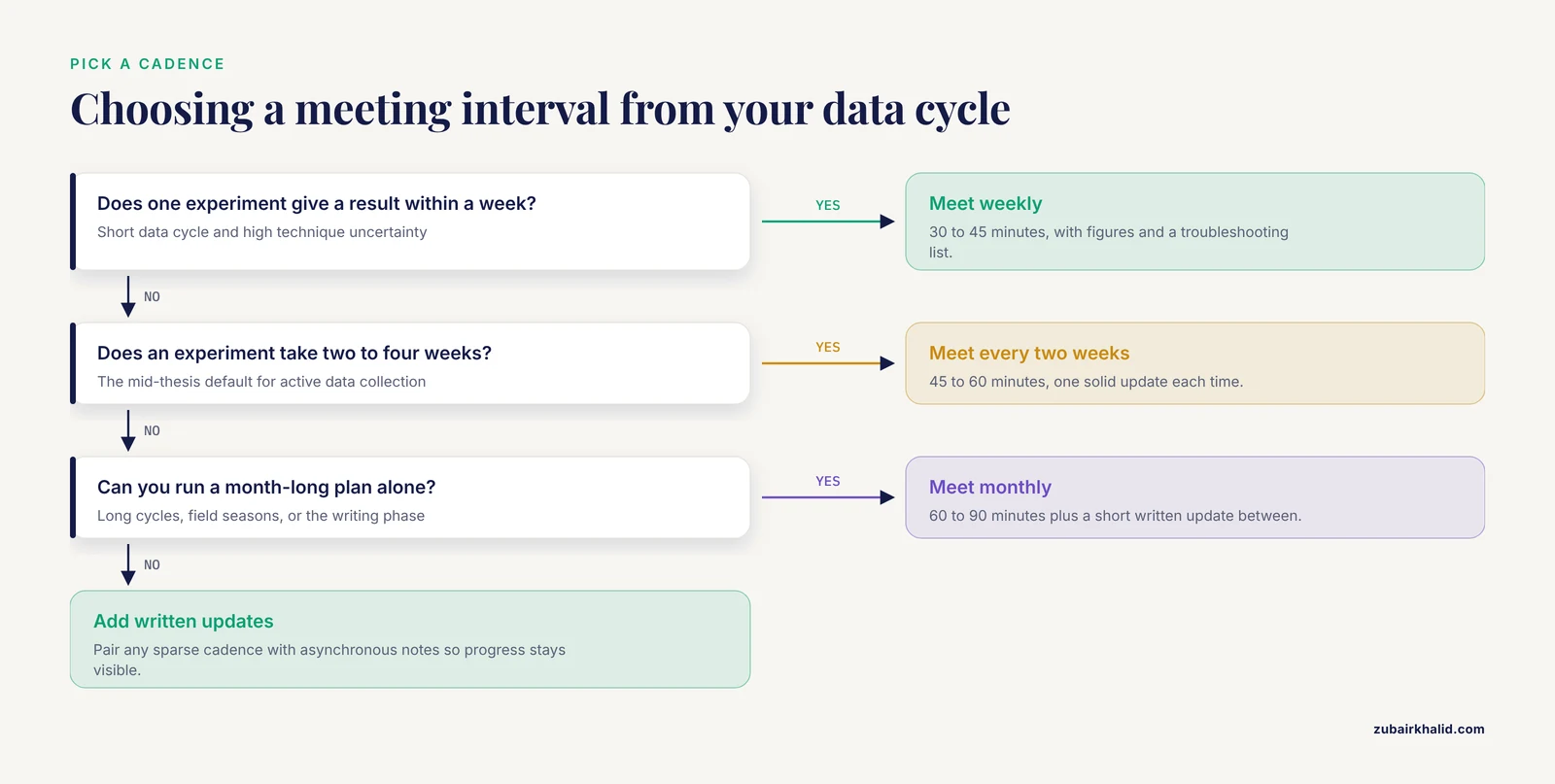
The best meeting cadence is the one that matches your data cycle and your current need for direction. Five criteria separate students who thrive on weekly contact from those who thrive on monthly contact.
- Data cycle time. If your experiment yields an interpretable result within a week, weekly meetings keep pace. If a single experiment takes six weeks, monthly meetings with brief written updates fit better.
- Clarity of the next step. When you know exactly what to do for the coming month, you need less contact. When you are unsure whether the project itself is viable, you need more.
- Your independence. Early students need tighter loops. The right cadence loosens as your judgment grows, and a good advisor expects that to happen.
- Advisor bandwidth and style. Some advisors read every notebook entry and want weekly contact. Others manage ten students and travel constantly. Ask directly in your first month, "What cadence do you expect from your students, and what should I do when you are unreachable?"
- Hard deadlines. Fellowship applications, committee meetings, and the defense date create fixed points. Cadence tightens around them automatically.
Distance and time zones modify all five criteria. A student sampling at a remote field site and an advisor on another continent may run a monthly video call plus weekly written updates, which functions like a biweekly relationship.
How Often Should You Meet with Your Thesis Advisor at Each Stage?
Stage matters more than any universal rule. Here is how the cadence typically evolves through a biology thesis.
Coursework and rotation year
During rotations and early coursework, meet your prospective or new advisor weekly for about 30 minutes. The goal is alignment on expectations, not results. Confirm the basics early, expected cadence, how the advisor prefers to receive updates, how they mark up drafts, and what a good week of work looks like to them.
Proposal period
While shaping your thesis proposal, meet weekly or every two weeks. Proposal writing is where vague ideas become testable questions, and that conversion needs fast iteration. Expect several rounds of written comments on the document between meetings. The period ends with your proposal or qualifying meeting, a formal event in front of your committee.
Data collection years
Every two weeks is the default here, adjusted to your data cycle. Weekly during a troubleshooting stretch, monthly during a long field season or colony expansion, with asynchronous updates filling the gaps. Keep a running results document so any meeting can start from shared context rather than a status recap.
Analysis and writing
As experiments wind down, shift from status meetings to draft meetings. Send a chapter draft several days before each session so the meeting is about feedback rather than reporting. Draft deadlines every two weeks work well for most writers, monthly for the very independent. A thesis with four chapters and a six-month writing window needs roughly a chapter draft every six weeks, which maps naturally onto a biweekly cadence with slack.
Final semester
The committee and the graduate school take over the schedule. Programs commonly require the complete thesis draft to reach the committee a set number of weeks before the defense, often four to six, so work backward from your graduate school's posted deadline. In the final weeks, meetings get short and operational, defense rehearsal, talk slides, and paperwork.
How to Plan a Thesis Around Your Meeting Schedule
Planning a thesis means working backward from the defense date to today, then letting your meeting cadence enforce the plan. A concrete sequence:
- Fix the anchor dates. Write down your target defense month, your graduate school's deadline for delivering the draft to the committee, and your next required committee meeting.
- Set the data freeze. A data freeze is the date after which no new data enter the thesis. Everything after it is analysis, figures, and writing. Choose it so at least half of your remaining time is reserved for writing, the phase students chronically underestimate.
- Map the biology thesis structure. The standard monograph format runs Introduction (background and specific aims), Methods (or Materials and Methods), Results (figures with supporting text), and Discussion (interpretation, limitations, future directions), framed by an abstract and reference list. Many programs also accept a manuscript-based thesis, a compilation of your published or submitted papers with bridging chapters, so check which formats your program allows.
- Assign each chapter a draft deadline and attach it to a meeting. For example, Methods drafted early from your lab notebook while experiments run, Introduction after the proposal, Results as figures finalize, Discussion last.
- Build figures first. Final figures define the Results chapter. Sketching the five or six figures you intend to defend with, before writing any prose, tells you which data are actually missing and therefore which experiments still need meeting time.
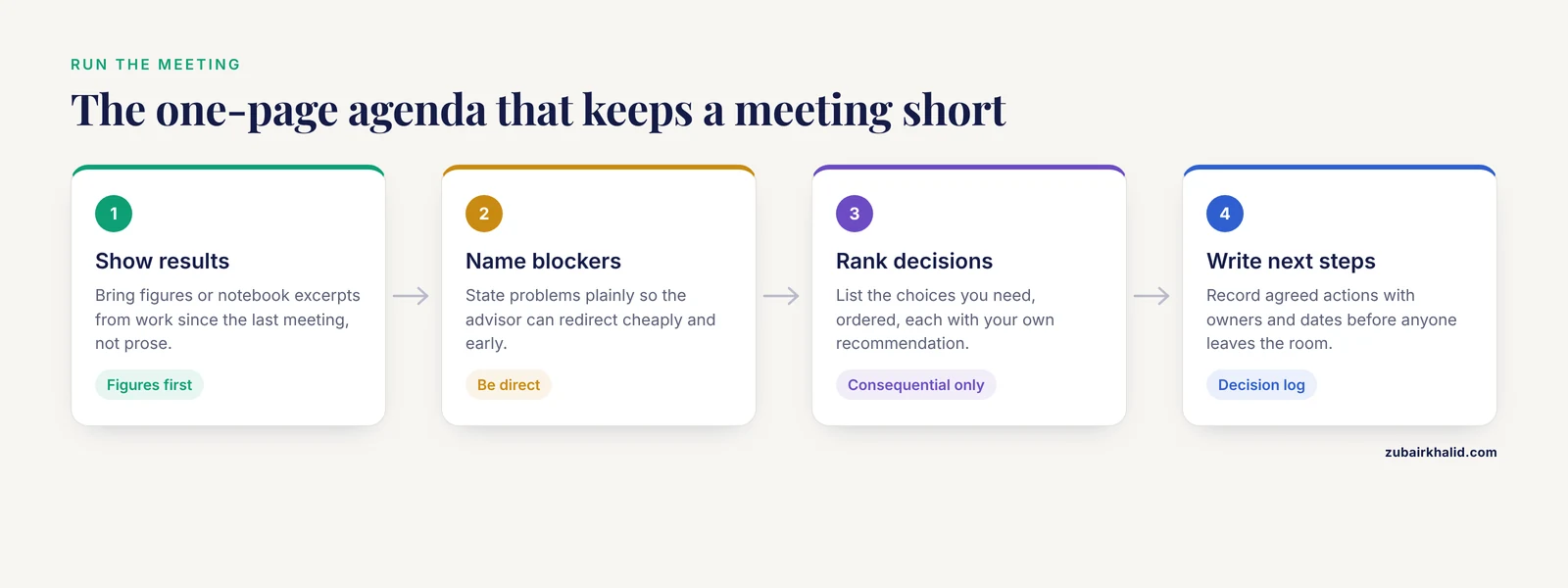
Then run every meeting the same way. A one-page agenda with four parts is enough:
- Results since last time, shown as figures or notebook excerpts rather than prose.
- Problems and blockers, stated plainly.
- Decisions needed, ranked, with your own recommendation for each.
- Agreed next steps, written down before you leave, with owners and dates.
Keep a decision log, a simple dated list of every consequential choice and its rationale. It settles disagreements, drafts your Methods chapter for you, and lets a new committee member understand the project's history in ten minutes.
Worked Scenarios
Four common situations, resolved with the criteria above.
First-year student learning molecular cloning
A student in a molecular lab is learning cloning and cell culture, where a failed construct costs a week. Data cycle time is short and technique uncertainty is high, so a weekly 30-minute meeting fits, supplemented by bench-side questions. The student brings gel images and a written troubleshooting list. After a year, once routine constructs work on the first attempt, the cadence loosens to every two weeks.
Field ecology student during a field season
A student spends ten weeks at a remote field site while the advisor stays on campus. A weekly video call is unrealistic given connectivity and sampling schedules. They agree on a monthly one-hour call plus a weekly asynchronous update, a short email with photos, counts, and any protocol deviations. The committee anchor before the season approved the sampling design, and a committee meeting after the season reviews the data. The written updates double as field notes for the Methods chapter.
Computational biology student with fast iteration cycles
A student modeling protein structures can rerun an analysis in hours, so the risk is not slow feedback but endless tinkering. Meetings every two weeks, built on a shared code repository, work well. Between sessions, the advisor leaves line-by-line comments on code and manuscript text asynchronously. The standing meeting is reserved for decisions the student cannot make alone, such as which model assumptions to defend.
Writing-up student six months from defense
A student has finished data collection and faces a six-month writing window. The cadence shifts to draft deadlines every two weeks, one chapter section per meeting, with the advisor returning comments within a week. Monthly longer sessions handle the Discussion and the overall narrative. The pre-defense draft deadline, set by the graduate school, sits at the center of the plan, and the last committee meeting is scheduled for the day the draft goes out.
Common Mix-Ups
Several misconceptions push students toward the wrong cadence.
- Equating meeting frequency with progress. Meetings transfer information. Bench work, code, and writing make progress. A student who meets weekly and produces little has a work problem, not a scheduling solution.
- Waiting for clean data before meeting. Messy preliminary results are exactly what an advisor can redirect cheaply. Polished results presented too late are expensive to change.
- Reading silence as approval. If your advisor has not explicitly agreed to a plan, it is not agreed. Ask for a one-line written confirmation on consequential decisions.
- Treating lab meeting as sufficient. Group feedback is broad, individual guidance is deep, and a thesis needs both.
- Over-consulting and under-consulting at once. Some students bring every trivial choice to meetings, then quietly make the big choices alone. Rank your questions. Bring the consequential ones, decide the trivial ones yourself and report them.
- Assuming the cadence is permanent. A schedule that fit your first year should not survive unchanged into your fifth. Renegotiate it at least once a year, and after every committee meeting.
Common Mistakes and Limitations
Execution errors are more common than wrong choices, and each has a simple fix.
- Arriving with no agenda. This converts your advisor from a scientist helping you into a project manager interrogating you. Send the agenda the day before.
- Not writing down decisions. Memory is not a record. Send a three-line follow-up email after every meeting summarizing what was decided.
- Letting cancellations accumulate. One canceled meeting is life. Three in a row is a scheduling problem you should name and fix, either by moving to asynchronous updates or by proposing a different standing time.
- Hiding stalled work. Advisors have seen every possible failure. A stalled project reported early is a planning question. Reported late, it is a crisis.
- Scheduling only around the advisor's calendar. Protect your own preparation time too. A meeting you had no time to prepare for is worse than a short delay.
One honest limitation: program rules and advisor styles vary widely, and no general cadence overrides them. Your graduate handbook, your committee, and your written agreement with your advisor are the binding documents. When contact breaks down for months despite your efforts, the graduate program director is the standard first stop, and that conversation goes far better when you can show a dated record of agendas, updates, and unanswered requests.
Frequently Asked Questions
How often should you meet with your thesis advisor?
Most graduate students do well with a standing meeting every one to two weeks during active research, loosening to monthly during independent writing. Match the interval to your data cycle and your need for direction, and keep formal committee meetings as fixed anchors.
Is a weekly meeting with your thesis advisor too much?
No. Weekly is the right cadence for many students in their first years, during troubleshooting, or when experiments turn around in about a week. It becomes too much only when you cannot prepare honestly each week or when deep work keeps getting fragmented.
What should you bring to a thesis advisor meeting?
Bring a one-page agenda with results since last time, your blockers, ranked decisions with your own recommendations, and proposed next steps. Figures and notebook excerpts beat prose, and a written record of agreed actions should exist before you leave the room.
What do you do when your advisor keeps canceling or never replies?
Propose a specific standing time, send agendas in advance, and keep a dated running update document so progress stays visible without meetings. If months pass with no contact despite written requests, raise it with your graduate program director and bring your record.
Should meeting frequency change while you write the thesis?
Yes. Shift from data-focused status meetings to draft-deadline meetings, sending each chapter section several days ahead so the session is spent on feedback. Draft deadlines every two weeks suit most writers, monthly suits the very independent.
How are committee meetings different from advisor meetings?
Committee meetings are formal program requirements, commonly once or twice a year after your proposal, where the full committee reviews progress and approves your plan. Advisor meetings are informal working sessions whose frequency you and your advisor set yourselves.