How Often Should You Meet with Your Dissertation Advisor?
By Dr. Zubair Khalid, DVM, MS, PhD ·

Most dissertation students meet with their advisor every one to two weeks during active research and writing, and less often during long stretches of independent work. The right answer for you depends on one question: do you need direction right now, or do you need time to execute?
That question is the rule of thumb for every scheduling decision in this article. When you are stuck, confused, or about to make an expensive or time-consuming choice, meet soon and meet often. When you know exactly what to do next and just need time to do it, a lighter schedule protects both your progress and your advisor's patience. This guide walks through the standard cadence options, their pros and cons, how the right frequency changes across the stages of a dissertation, and how to make each meeting worth the time it costs.
There is no university-wide rule for meeting frequency at most institutions. Expectations are usually set by your advisor, your department's norms, and your stage of work. That said, the patterns below cover the large majority of successful arrangements across laboratory sciences, social sciences, and humanities.
A reasonable default for a full-time doctoral student is a one-on-one meeting every one to two weeks, supplemented by a weekly research group meeting where your lab or cohort exists. Students in the writing phase often shift to every two to four weeks with chapter drafts exchanged in between. Students in the earliest planning phase, or students at a crisis point, may benefit from shorter but more frequent contact, even fifteen minutes a week.
Frequency is not a status symbol. Meeting three times a week does not mean you are three times as serious, and meeting once a month does not mean you are drifting. What matters is whether the schedule matches the actual decision load in front of you. A student running a three-month experiment with a clear protocol may need almost no meetings until the data arrive. A student with three conflicting ideas for chapter two may need two conversations in one week to break the deadlock.
The rest of this article gives you the options, the criteria for choosing among them, and worked examples so you can set a schedule deliberately instead of by default.
Why Meeting Cadence Is a Dissertation Planning Decision
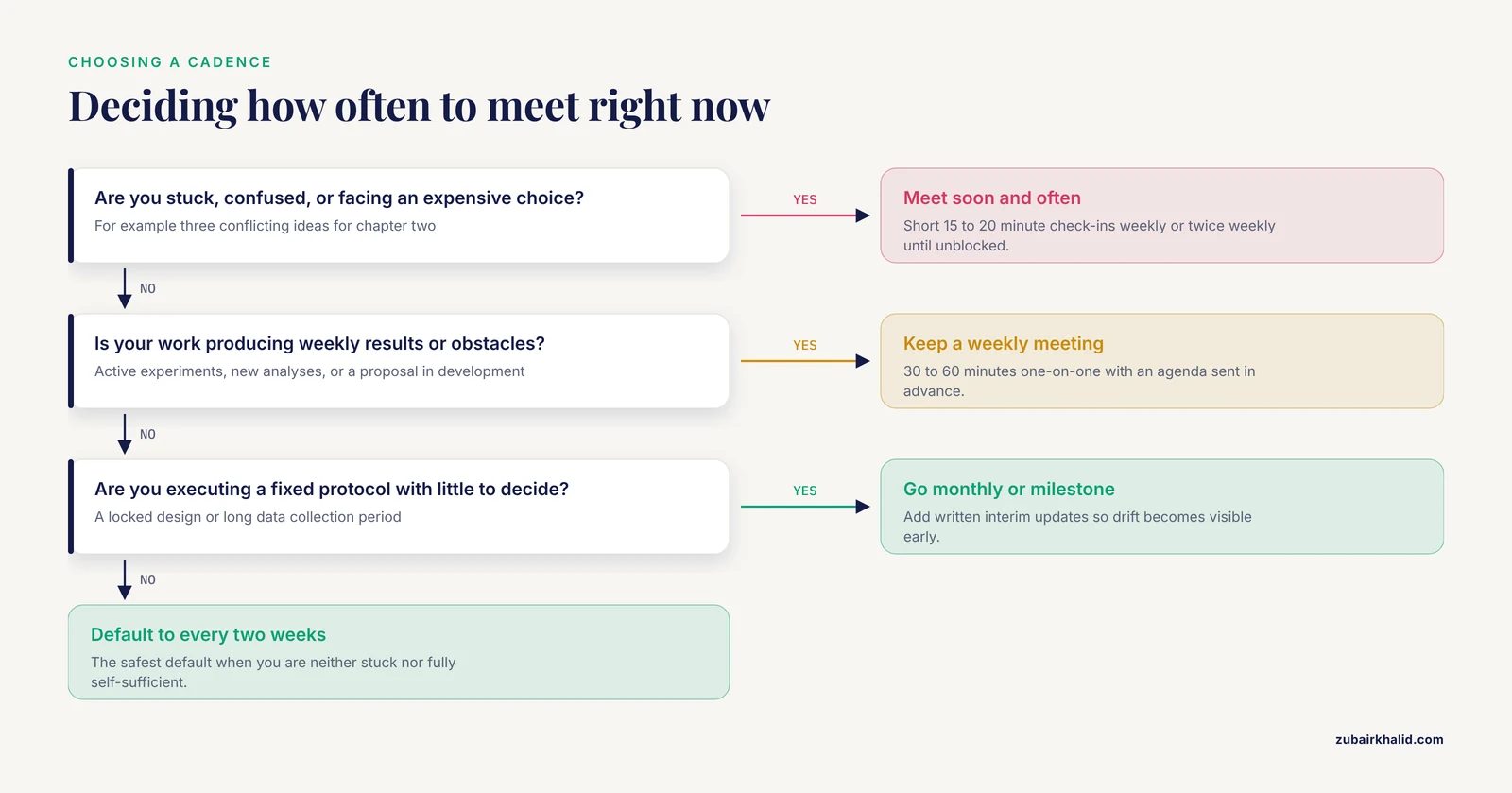
Dissertation planning is mostly a problem of managing long feedback loops. Every piece of work you submit for comment, from a two-paragraph aim statement to a full methods chapter, takes time to review. Every correction you receive sends you back to work that may need reworking. If your meetings are too infrequent, you can spend six weeks producing something your advisor would have redirected in six minutes. If they are too frequent, you generate meetings that have nothing new to discuss, and both of you start arriving unprepared.
The cost of an unproductive meeting is real even when the meeting is short. You spend the day before it preparing, the hour in it talking, and often a day after it recovering morale if the conversation went badly. Multiply that by forty meetings a year and you can see why the question of how often to meet deserves a deliberate answer rather than an inherited one.
There is also a hidden variable: your own work style. Some students use meetings as deadlines and produce nothing between them. Others find frequent meetings disrupt deep work. Neither style is wrong, but each points toward a different cadence, and recognizing your pattern early saves months of friction.
Your Options for Meeting Frequency
Most advisor relationships settle into one of six cadences. Each has genuine advantages, and each fails in a predictable way when applied to the wrong student or the wrong stage. The table below gives a side-by-side comparison, and the sections after it explain each option in detail.
| Cadence | Typical format | Best suited for | Main advantage | Main risk |
|---|---|---|---|---|
| Weekly | 30 to 60 minutes, one-on-one | Early stages, active experiments, students who need deadlines | Fast feedback prevents wasted effort | Meetings with nothing new to discuss |
| Every two weeks | 45 to 60 minutes, one-on-one | Steady progress with drafts or data flowing | Balances feedback speed with work time | Two weeks of drift if momentum stalls |
| Monthly | 60 to 90 minutes, one-on-one | Independent writers, long data collection, final formatting | Maximum autonomy, substantial deliverables each time | A month of work can go in the wrong direction |
| Milestone-based | Scheduled at defined checkpoints | Proposal defense, committee milestones, chapter completion | Aligned with structural deadlines | Long silent gaps between checkpoints |
| Short and frequent | 15 to 20 minutes, weekly or more | Stuck students, crisis management, new students | Low preparation cost, fast unblocking | Not enough time for substantive review |
| Asynchronous plus periodic | Written updates with occasional calls | Remote students, advisors with heavy travel | Written record of decisions | Slow resolution of urgent questions |
Weekly meetings
A weekly one-on-one of 30 to 60 minutes is the standard rhythm in many laboratory-based sciences, and many advisors in these fields hold it as a standing appointment for every student. The meeting usually covers what you did, what you plan to do, and any obstacle that emerged.
The advantage is speed. If an analysis goes wrong on Monday, you find out on Tuesday rather than in a month, when the error may have propagated through three downstream experiments. Weekly contact also creates external deadlines. Students who struggle with self-directed work often find that a standing weekly meeting is the single most effective structure for finishing a dissertation, because it converts an open-ended project into a series of one-week commitments.
The cost is preparation. A good weekly meeting requires an agenda and an honest accounting of the week, which takes an hour or more to assemble if your week was messy. Weekly meetings also fail when there is nothing to discuss. If you spend three weeks reading background literature with no decisions pending, the second and third meetings may be empty, and repeated empty meetings quietly teach both of you to arrive unprepared.
Weekly works best when your work produces weekly results, weekly decisions, or weekly obstacles. It works poorly during long uneventful stretches.
Every two weeks
A biweekly meeting of 45 to 60 minutes is the most common compromise and the safest default for a student who is neither stuck nor fully self-sufficient. Two weeks is long enough to produce something worth reviewing, a draft section, a figure, a set of coded interviews, and short enough that a wrong turn costs you at most two weeks of work.
The advantage is efficiency. You get substantive feedback at a rate that matches most people's realistic output, without the overhead of forty-plus meetings a year. The risk is that two weeks is also long enough to hide a stall. If you have a bad week, then another, you can arrive at the meeting having made no progress and feeling defensive about it. The fix is a written interim update halfway between meetings, even three sentences long, which keeps accountability continuous without adding a meeting.
Biweekly works best for students producing steady output. It works poorly for students who generate questions faster than they can bank them, since smaller questions get lost between sessions.
Monthly meetings
A monthly meeting of 60 to 90 minutes suits students who work autonomously and produce large deliverables. In the humanities especially, where a dissertation chapter may take eight weeks of writing to reach a reviewable state, monthly contact with a full chapter exchanged in advance is a normal and healthy rhythm.
The advantage is depth and autonomy. You bring a complete, polished artifact and get a thorough review rather than incremental comments. You also keep large blocks of uninterrupted time for the actual work, which many writers need.
The risks are the largest of any option here. A month is enough time to write fifty pages in the wrong direction, or to quietly stop working altogether. Monthly students need written progress updates between meetings, ideally a one-page summary at the middle and end of each month, so that drift becomes visible before the next session. Monthly also puts heavy weight on each meeting. If one goes badly, you have four weeks to sit with it, so students who find feedback demoralizing should think twice about this cadence.
Milestone-based meetings
Some advisors, particularly those with large labs or many students, schedule meetings around milestones instead of a fixed rhythm. You meet when your proposal draft is ready, when your qualifying exams approach, when a chapter is complete, or when a data set is fully collected.
The advantage is that meetings always have a concrete object. There is rarely an empty agenda, because the meeting exists precisely because something is finished. This cadence also respects the reality that some phases of a dissertation, such as a six-month data collection period with a locked protocol, genuinely need little oversight.
The risk is silence. Between milestones there may be no contact at all, and milestones themselves can quietly slip when no standing meeting enforces a deadline. Students on this cadence should propose their own interim check-ins when a milestone slips or when a decision point appears, and should treat the milestone schedule as a floor for contact, not a ceiling.
Short and frequent contact
Fifteen to twenty minute check-ins, weekly or even twice weekly, are an underused tool. They are not a substitute for a full meeting because there is no time to review written work. Their purpose is unblocking and accountability: you state what you will do this week, report on last week's commitment, and name the single obstacle if one exists.
This cadence is most useful in three situations. First, a student who is stuck or avoiding work, for whom the low cost of a short meeting removes the barrier to contact. Second, a new student in the first semester, who generates small questions daily and benefits from fast answers. Third, a period of crisis, such as a failed experiment series or a committee conflict, where decisions cannot wait two weeks.
The limitation is obvious: substantive feedback requires substantive time. Use short meetings as a supplement during rough patches, then return to a fuller cadence.
Asynchronous communication plus periodic meetings
Many advisor relationships now run primarily on written updates, shared documents, and occasional scheduled calls. The student sends a structured email every week or two covering progress, plans, and questions. The advisor comments asynchronously and calls when a live discussion is needed.
The advantage is that everything is written down. Decisions about scope, methods, and authorship exist in a searchable record, which prevents the small disputes that arise from remembered conversations. This model also accommodates advisors who travel frequently or students at a distance.
The risk is that asynchronous channels favor the articulate and the patient. Ambiguous questions get answered slowly or not at all, and complex disagreements can fester in email threads. If you adopt this model, keep a scheduled live meeting, even monthly, so that major issues always have a guaranteed forum.
Comparing the Options on the Criteria That Actually Decide
When students ask how often they should meet their dissertation advisor, they usually want a comparison across a small set of practical criteria. Here is how the main cadences differ on each.
Feedback speed. Weekly and short-frequent contact win decisively. Biweekly is adequate for most work. Monthly and milestone-based schedules accept slow feedback in exchange for autonomy, which is a reasonable trade only when your direction is already settled.
Depth of feedback. Monthly and milestone meetings allow the most thorough review, because the artifact is complete and the time block is long. Weekly meetings review fragments, which is ideal for catching errors but weaker for commenting on structure and argument.
Autonomy and uninterrupted work time. Monthly and milestone-based schedules protect deep work best. Weekly meetings fragment the week around preparation. If you are a writer who needs multi-day blocks, forcing a weekly cadence can reduce your actual output.
Accountability. Weekly meetings provide the strongest external structure. Biweekly is close behind. Monthly and milestone schedules provide the weakest, and require written interim updates to compensate.
Relationship maintenance. Regular contact, even brief, keeps the relationship warm. This matters more than students expect, because advisors advocate for students in grant letters, job references, and committee negotiations, and advocacy flows more naturally to students they have spoken with recently. Students on monthly or milestone schedules should add small non-demand touches of contact, such as sharing a relevant paper you read, to keep the relationship active.
Cost to your advisor. Advisors have finite hours spread across many students. A weekly hour for each of eight students is a substantial commitment. If your advisor offers weekly meetings, use them well, because students who arrive repeatedly unprepared train their advisors to deprioritize them. If your advisor offers monthly meetings, accepting that cadence and excelling within it serves you better than demanding more.
Matching Cadence to Your Stage of Work
The best how-often-to-meet answer changes as you move through the dissertation. A schedule that fit your second year will actively harm you in your fifth if you never revisit it.
Coursework and early planning
During coursework years and the first months of topic development, contact can be light but should be regular. A short monthly or biweekly conversation keeps your developing interests on your advisor's radar and prevents you from reading in isolation for a year on a topic nobody would support. Bring questions about direction rather than drafts. Ask what your advisor considers a viable scope, what literature they consider essential, and what pitfalls they have watched other students hit.
Proposal and research design
The proposal phase has the highest decision density of the entire dissertation. Every choice about population, sample, design, instruments, or theoretical frame gets locked in here, and errors made here are expensive to fix later. Meet every one to two weeks during active proposal development. Short iterations, a revised aim page or a revised methods section each cycle, catch problems while they are still cheap to fix. Students who draft a full proposal in isolation and present it at the end routinely face revisions that a weekly cycle would have prevented.
Data collection and analysis
This stage splits cleanly. If your protocol is fixed and you are executing, for example running participants through an approved design or collecting samples on a locked schedule, monthly or milestone-based contact is fine. Meet sooner only if results diverge from expectations in ways that might justify protocol changes. If instead you are in exploratory analysis, coding, or iterative modeling, return to biweekly or weekly contact, because each analysis cycle generates interpretive decisions that benefit from an advisor's perspective before you build on them.
Writing and revision
During drafting, most students do well with biweekly to monthly meetings tied to deliverables. Send a chapter section in advance, receive written comments, and use the meeting for the structural disagreements that written comments cannot resolve. Near the end, when you are assembling the full document and preparing for the defense, increase frequency again. Final-semester students often benefit from weekly short contact simply because deadlines compress and questions multiply.
Post-defense or leave periods
If you are finishing a revision or writing after your committee has approved a timeline, light contact is fine, but never go fully silent. An advisor who has not heard from you in four months cannot write you a strong letter and may not remember your project's details well enough to help when you return.
Worked Scenarios
Three examples show how these principles resolve into concrete schedules.
Scenario one: a second-year student with a new topic. Priya has passed her qualifying exams and has three candidate research questions. Her advisor suggested they talk "when she has a proposal." Following that literally would leave her alone with the hardest decision of her dissertation. Instead she proposes three 30-minute conversations over six weeks, one per candidate question, to eliminate two options. After choosing, she shifts to biweekly proposal iterations. Total contact: frequent at the decision point, moderate during drafting.
Scenario two: a lab-based student mid-project. Marcus runs a data collection protocol that his advisor approved months ago. Weekly lab meetings cover logistics. He and his advisor agree to a formal one-on-one once a month to review aggregate results and plan the analysis phase. Halfway through collection, two conditions produce unexpected results. He emails his advisor the figures the same day, and they add a meeting that week to decide whether to adjust the design. The monthly baseline flexed upward exactly when the decision load demanded it.
Scenario three: a writing-phase student drifting. Elena has monthly meetings scheduled. She arrives at the second one having written nothing in a month. Instead of skipping the next meeting out of embarrassment, she asks her advisor to switch to biweekly for two months, with a 500-word written update due in the off weeks. The shorter loop breaks the stall, and after two productive months she returns to monthly chapter reviews. The lesson: cadence is adjustable, and the student is allowed to propose the adjustment.
How to Make Any Cadence Work
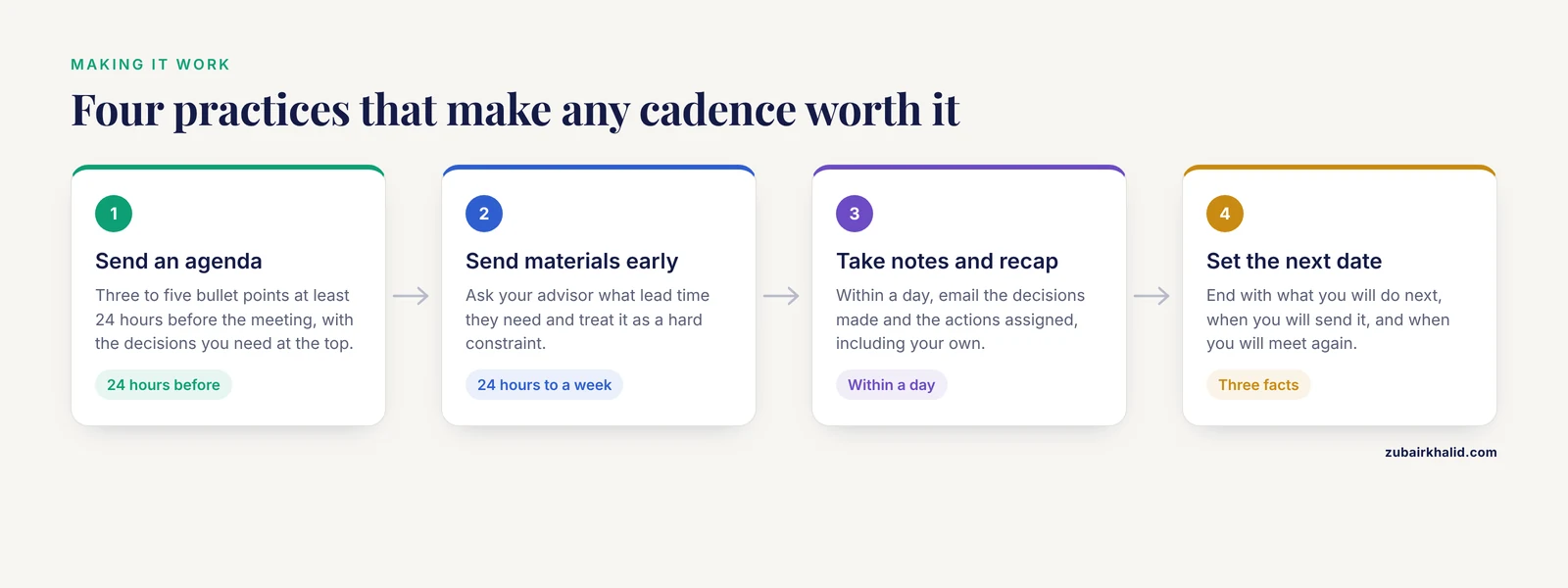
Whatever frequency you choose, four practices determine whether the meetings are worth it.
Send an agenda in advance. Three to five bullet points, sent at least 24 hours before the meeting, with the decisions you need made at the top. An agenda transforms a vague conversation into a decision-making session.
Send materials early enough to be read. A draft sent two hours before a meeting will not be read. Ask your advisor what lead time they need, and treat it as a hard constraint. Common expectations range from 24 hours for short sections to a week for full chapters.
Take notes during the meeting and send a follow-up summary. Within a day, email a short recap of the decisions made and the actions assigned, including your own. This written record prevents the most common advisor-student dispute, which is two people leaving the same meeting with different understandings of what was agreed.
Close every meeting with the next step and the next date. End with three facts: what you will do next, when you will send it, and when you will meet again. If the cadence is milestone-based or monthly, set the next date now, because scheduling by mutual availability later reliably adds weeks.
Common Mistakes and Limitations
Treating the advisor's stated cadence as permanent. Many students accept whatever rhythm the first month established and never revisit it, even as their needs change completely. Review your schedule at every major stage transition and propose changes explicitly. Advisors generally respond well to a student who says "I need more contact while I design my study and less once it is running."
Using meetings as your only accountability. If you produce nothing between meetings, more meetings will not fix the underlying problem, and the meetings will become status conversations about why nothing happened. If you cannot generate output between sessions, the honest move is to name that pattern to your advisor and ask for structure, such as weekly written goals, rather than simply increasing meeting frequency and hoping.
Saving questions for the meeting. Students sometimes bank small questions for weeks to avoid bothering their advisor, then present a list of fifteen accumulated items. Most questions that have a one-sentence answer should be asked by email when they arise. Reserve meeting time for questions that need discussion.
Assuming silence means disapproval. Advisors with large labs often respond slowly to drafts. A slow response is not a verdict on your work. If a review has not arrived within the agreed lead time, a polite follow-up email is normal and expected, not an imposition.
Letting one bad meeting derail a month. Critical feedback can sting, and students on monthly cadences are especially vulnerable to losing weeks to discouragement. Build a personal recovery routine: write down the specific action items the same day, separate the work criticisms from conclusions about your ability, and resume work within 48 hours even if the first hour is unpleasant.
Confusing meeting frequency with progress. The dissertation advances through drafts submitted, data collected, and chapters revised, not through hours logged in conversation. A student who meets monthly and produces steadily is ahead of a student who meets weekly and produces occasionally.
Finally, a note of limitation. Norms vary by discipline, institution, and individual advisor, and some advisors have explicit expectations they have never stated aloud. If you are unsure what your advisor expects, ask directly in your next meeting. A single question, "How often would you like us to meet, and what do you expect from me between meetings," resolves more scheduling problems than any general guidance can. Where a conflict over expectations or responsiveness persists, your program's graduate director or dissertation ombudsperson is the appropriate person to consult.
Frequently Asked Questions
How often should you meet with your dissertation advisor?
Once every one to two weeks is the most common and broadly useful schedule during active research or writing, with lighter monthly or milestone-based contact during long stretches of independent execution. Match the frequency to your current decision load, and adjust it at every major stage of the dissertation.
Is weekly contact with my advisor too much?
Weekly contact is appropriate, and standard in many fields, when your work produces weekly results or obstacles. It becomes wasteful only when meetings repeatedly have nothing new to discuss, which is a signal to lengthen the interval or shorten the format, not a signal that anything is wrong with you.
What should I do if my advisor is unresponsive?
Send a structured written update every one to two weeks regardless, so a record of your progress and questions exists. Follow up politely after the agreed review window passes, propose a specific meeting time rather than an open-ended request, and if unresponsiveness persists, consult your program's graduate director about expectations and options.
Should I meet more often during any particular stage of the dissertation?
Yes, two stages call for increased frequency. The proposal phase has the highest density of consequential decisions and rewards one to two week iterations. The final semester, with its compressed deadlines and assembly of the full document, also benefits from weekly contact even if the meetings are short.
What should I bring to a meeting with my advisor?
An agenda sent in advance, listing the decisions you need and the materials your advisor should have already read, plus your own notes on progress since last time. Close by confirming your next action, the date you will deliver it, and the date of the next meeting.
Can I change my meeting schedule partway through the dissertation?
Yes, and you should. Cadence is a working arrangement, not a contract. Raise the topic directly, explain what you need and why, for example more contact while designing your study or less once data collection is running, and propose a specific trial period such as two months at the new interval before reassessing.