Data Management Plan Template for Horizon Europe
By Dr. Zubair Khalid, DVM, MS, PhD ·

A Horizon Europe data management plan template is a structured form built around the European Commission's funding rules, while a generic research template only organizes whatever you personally decide to record. The rule of thumb for choosing: start from the official annotated questions the Commission asks, then borrow discipline-specific sections from domain frameworks instead of inventing your own structure.
This article explains what Horizon Europe expects from a data management plan (DMP), lays out the realistic template options with their pros and cons, compares them on the criteria that actually decide choices, and walks through worked scenarios for three very different consortia.
Why Horizon Europe Cares About Data Management Plans
Horizon Europe is one of the largest public funders of health and life science research in Europe. In one mapping of European Commission funded work on personalized prevention, Horizon Europe financed 51 percent of the 67 ongoing projects identified, with a total allocation of 253.8 million euros, and 44 percent of those Horizon Europe projects addressed cancer [1]. Every one of those projects had to describe how its data would be handled.
The core expectation is FAIR data. FAIR stands for Findable, Accessible, Interoperable, and Reusable, and it describes the qualities that make research data usable by others rather than trapped on one laptop [2]. In a Horizon 2020 nanotechnology project called ASINA, the project team described how these FAIRification requirements had to be conceptualized and visualized systematically at the start, using a generic questionnaire to capture primary data and metadata descriptions from consortium partners before refining the plan into case-specific templates [3]. That experience generalizes well to Horizon Europe projects: the template you choose determines how early those conversations happen.
A DMP also serves an internal governance function. One published plan for a European observational study framed the DMP as the document that explains how clinical, biochemical, laboratory, and molecular data are governed under the regulations of all relevant stakeholders, and how participants' personal information is protected [4]. In Horizon Europe, that document is a deliverable, a management tool, and a reproducibility safeguard at the same time. Reproducibility itself is a formal priority for the Commission, and a recent Horizon Europe consensus project (iRISE) used a Delphi panel of 73 experts from 34 countries to prioritize the measures that strengthen reproducibility across research systems [5]. A good DMP is one of those measures in practice.
What a Horizon Europe Data Management Plan Must Cover
Whatever template you use, the content areas are fixed. Established Horizon Europe practice requires the DMP to address, in the Commission's own structure:
- Data description. What data will be generated or reused, their origin, nature, and size, and whether existing datasets are involved.
- FAIR compliance. How the data are made findable (persistent identifiers, rich metadata), accessible (open licenses, repositories), interoperable (community standards, vocabularies), and reusable (licensing, provenance).
- Allocation of resources. Who is responsible, how much time and money data management costs, and how it is budgeted.
- Data security. Backup, recovery, and protection measures.
- Other issues. Anything else relevant, including ethical and legal constraints.
Two features of the Horizon Europe regime shape template choice. First, the DMP is a living document. You submit an initial version early in the project and update it at reporting milestones as the data reality becomes clear. Second, the plan is evaluated against FAIR, not against formatting. A template that prompts you for repository names, metadata standards, and access conditions is worth more than a pretty layout.
Personal data adds a hard layer. Any consortium working with human participants must explain how personal information is protected, which is exactly why the NESHIE observational study constructed its plan around the governance of participant data moving nationally and internationally, with particular attention to vulnerable populations [4]. In biobanking, the interplay between the General Data Protection Regulation (GDPR, the European Union's data protection law) and consent management is a persistent challenge that infrastructure networks such as BBMRI-ERIC work to harmonize across the European Research Area [6]. Your template must have a place for these answers, not just a box for "open data: yes".
Horizon Europe Data Management Plan Template Options at a Glance
There is no single mandated form. In practice, consortia choose among five options. Here is the side-by-side comparison:
| Template option | Where it comes from | Best for | Key strengths | Key trade-offs |
|---|---|---|---|---|
| European Commission annotated template | Horizon Europe guidance and grant documentation | Any consortium, especially first-time coordinators | Matches the exact evaluation structure, prompts for every mandatory content area, built for living updates | Generic by design, gives no discipline-specific metadata help |
| Institutional template with data steward support | University or research organization adapted forms | Teams whose host institution has research data services | Local legal review, GDPR expertise, human support | Quality varies between institutions, may drift from Commission wording |
| Cross-funder tool templates (for example DMPTool) | Template platforms that host funder-specific forms | Researchers needing a fast structured draft | Curated guidance at each question, proven adoption, low barrier | Strongest templates target NIH requirements, not Horizon Europe wording |
| FAIR-driven project-specific questionnaires | Developed inside the project, often with external FAIR experts | Multidisciplinary consortia with heterogeneous data | Captures the real data flows of the project, builds FAIRification in from design stage | High setup effort, needs coordination infrastructure |
| Domain-specific DMP frameworks | Field infrastructures and published study plans | Biobanks, clinical trials, cohorts, observational studies | Handles consent, sensitive data, and standards the generic forms miss | Narrow, must still be mapped back to Commission questions |
No option wins on every row. The best horizon europe data management plan template for your project is usually a hybrid, and the next sections explain why.
Option 1: The European Commission Annotated Template
The Commission's annotated template is the reference document. It restates each required element with explanations and examples, so that whatever you produce maps cleanly onto what reviewers and project officers look for. For a first-time coordinator, this is the correct starting point because it removes guesswork about scope.
The pros are direct. Coverage is complete, the living-document principle is built in, and reviewers see familiar structure. The cons are just as real. The template is deliberately domain neutral, so it will not tell a genomics consortium which file formats and vocabularies count as interoperable, and it will not tell a behavioral study team how to describe wearable sensor data. It prompts the questions but does not answer them.
A practical workflow: draft your answers in the annotated template, then paste discipline-specific detail underneath each prompt from the domain frameworks in the sections below. You keep the Commission's skeleton and gain the domain muscle.
Option 2: Institutional Templates Supported by Data Stewards
Many universities and research organizations maintain their own DMP forms and staff who help fill them in. A national survey in Italy, run through the Italian Computing and Data Infrastructure and the Horizon Europe Skills4EOSC project, found that most institutions employ staff performing data steward functions, although these professionals are seldom formally recognized as data stewards, and the variety of job titles reflects the absence of standardized professional profiles [7]. The practical translation for you: the help exists, but you may need to ask around to find it.
The evidence on template support is revealing. In a survey of 155 researchers at an academic medical center about the 2023 NIH Data Management and Sharing Policy, 67 percent understood the policy but only 47 percent felt comfortable developing a plan, only 29 percent had used DMPTool.org, and 87 percent requested tailored templates, while 68 percent perceived plan execution as burdensome [8]. Those numbers come from an American policy context, but the lesson transfers: researchers want tailored templates and centralized consultation, and confidence gaps concentrate in two tasks, choosing repositories and budgeting for data activities. An institutional template with a data steward attached addresses both gaps better than a downloadable form alone.
The pros are expert review, local GDPR and ethics knowledge, and often repository guidance. The cons are uneven quality between institutions and wording that may not track the Commission structure exactly, so you should map institutional sections back to the Horizon Europe headings before submission.
Option 3: Cross-Funder Template Platforms
Template platforms host funder-specific forms with embedded guidance. DMPTool, the most studied example, launched dedicated NIH Data Management and Sharing Plan templates in response to the 2023 policy, with curated guidance and examples at each section and subsection so researchers did not have to navigate the underlying policies themselves. As of October 2023, more than 5,000 plans had been written using the main NIH-Default template and the NIH-NIMH alternative [9].
The pros and cons for a Horizon Europe context deserve honesty. The pros: these platforms demonstrate what good template design looks like, guidance delivered at the point of need rather than in a separate manual, and they produce a structured draft quickly. The cons: the flagship templates are built for NIH requirements, which differ from Horizon Europe's FAIR evaluation and living-document structure, so an NIH form used verbatim will omit Horizon Europe specific content. If your institution subscribes to a platform, use it for drafting discipline sections and repository selection, then remap the output into the Commission's headings.
Option 4: FAIR-Driven, Project-Specific Questionnaires
The ASINA project offers a fully worked alternative model, sometimes called data shepherding. The team began with a generic questionnaire to capture primary data and metadata descriptions from experimentalists and modelers, then ran an interactive process with external FAIR data initiatives, data curators, and quality assessors for guidance on metadata capture and future repository integration. Once a preliminary FAIRification template formed, internal communication between partners produced case-specific templates [3]. The published roadmap explicitly targets future data creators, analysts, stewards, and shepherds in any project.
The pros: this approach fits messy, multidisciplinary consortia where no off-the-shelf form describes the actual data flows, and it builds FAIR compliance into experimental design rather than bolting it on. The cons: it consumes coordinator time, needs a named person who owns the process, and produces documents that still need translation into Commission headings for reporting.
Metadata is where this approach pays off most. Rich, machine-readable metadata is what makes a dataset findable and reusable, and researchers at the Center for Expanded Data Annotation and Retrieval have worked on using community-based standard templates for describing biomedical datasets, with computational techniques that help investigators assemble templates and fill in values, including predictive data entry driven by patterns found in a metadata repository [10]. A project-specific questionnaire is the consortium-level version of that idea: ask the metadata questions once, consistently, of every partner.
Option 5: Domain-Specific DMP Frameworks
Three life science situations have mature, published domain frameworks worth borrowing from directly.
Biobanks and sample-associated data. Cancer biobanks in Europe have expanded over three decades into coordinated networks embedded in international initiatives, and the governing documents now revolve around GDPR, consent management, and interoperability standards, with persistent challenges in each area [6]. If your Horizon Europe project collects biospecimens, borrow the governance sections of biobank data plans: sample linked data, consent scope, and cross-border transfer rules.
Observational human studies. The NESHIE plan shows the full architecture a study with vulnerable participants needs, covering collection, organization, use, storage, contextualization, preservation, sharing, and access of data and samples, plus identification of responsible parties and highlighting of potential problems before they occur [4]. That structure, especially the named responsible parties, is directly reusable in any Horizon Europe DMP.
Clinical trials. A survey of the top 20 public and top 20 private clinical trial sponsors in the European Union mapped the presence and content of their data sharing policies, data management and sharing plans, and data use agreements, finding recurring policy elements alongside areas of heterogeneity [11]. If your consortium includes a trial, a data use agreement and a defined sharing policy are expected artifacts, and the sponsor's own documents are the first place to look.
How the Options Compare on the Criteria That Decide Real Choices
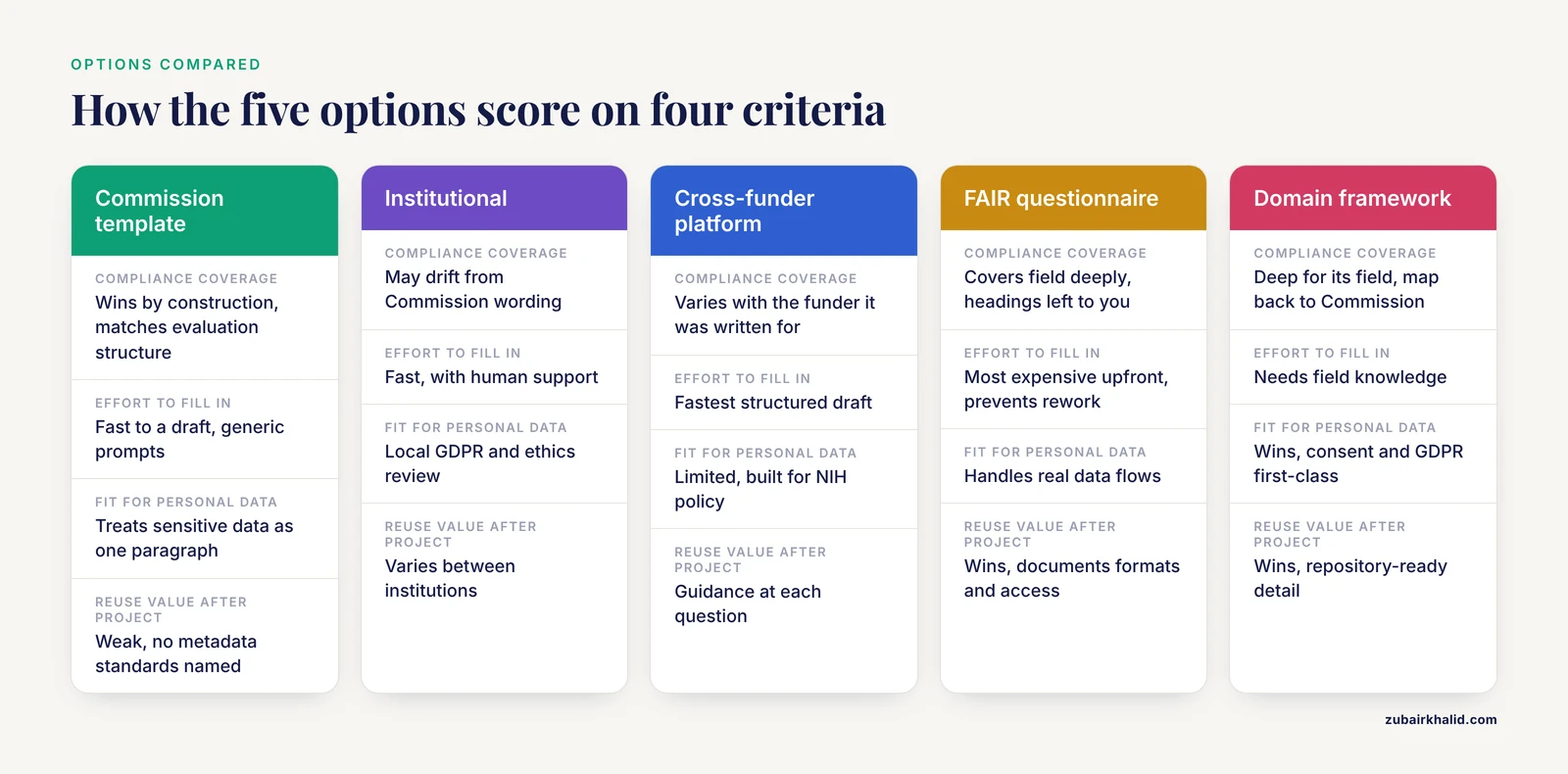
Four criteria separate the options in practice.
Compliance coverage. The Commission template wins, by construction. Domain frameworks cover compliance for their own field deeply but leave Commission headings to you. Cross-funder platform templates vary with the funder they were written for.
Effort to fill in. Platform and institutional templates are fastest to a draft. FAIR-driven questionnaires are the most expensive upfront but shift effort to where it prevents rework, at the design stage, which is exactly the lesson the ASINA team drew when they insisted the first FAIRification steps be conceptualized and visualized systematically [3].
Fit for personal data. Domain frameworks win. Generic templates treat sensitive data as one paragraph, while study-level plans such as NESHIE build protection of participant information, including vulnerable populations, into the core framework [4], and biobank governance documents treat GDPR and consent as first-class sections [6].
Reuse value after the project. FAIR-driven and domain-specific plans win. They document metadata standards, file formats, and access conditions in a form repositories can use, which is what makes a dataset genuinely reusable rather than merely downloadable.
Worked Scenarios
Scenario A: a nine-country cohort study with app-based data. Suppose your consortium recruits more than 2,500 schoolchildren across nine European countries and monitors them for six months through a smartphone application measuring internet use habits and wellbeing, in the pattern of the BootStRaP study [12]. Data are longitudinal, multilingual, and partly personal. Recommended combination: the Commission template as the skeleton, an institutional data steward for GDPR review [7], and the observational-study framework's responsible-party and participant-protection sections [4]. The DMP must specify how app data streams are pseudonymized, where raw and derived data live, and how country-level legal differences are reconciled.
Scenario B: a multidisciplinary materials or nanotechnology project. Partners generate heterogeneous experimental and modeling data with no shared repository. Recommended combination: the FAIR-driven questionnaire approach from ASINA [3], supported by community standard metadata templates and, where available, computational assistance for filling them in [10]. Budget coordinator time for the internal communication loop that converts the generic questionnaire into per-partner templates, and map the final result back into the Commission's five headings for reporting.
Scenario C: a nutrition or food-systems consortium harmonizing national data. The Horizon Europe PLAN'EAT project compared dietary assessment across 11 European countries and found that inconsistencies in survey protocols, portion size assessment, software tools, and food composition database structures hinder cross-country comparability [13]. For a consortium like this, the DMP is a harmonization instrument. Recommended combination: the Commission template, with an interoperability section that names the harmonized protocols and database structures explicitly, borrowing the domain framework habit of documenting standards rather than assuming them. An obesity-focused project in the same funding family took a similar route, defining a concise, structured set of 36 behavioral and 9 living environment indicators with a high-level plan for their verification, so that raw sensor data could be transformed into structured, interpretable measures [14]. A defined indicator set belongs in your DMP's data description section.
Beyond the DMP: Related Research Templates You Will Actually Use
A data management plan template for Horizon Europe does not stand alone, and confusing it with neighboring documents is a common source of wasted effort.
Lab notebook templates. A lab notebook template PDF captures day-to-day experimental records, reagents, and observations. It is a research template at the bench level, while the DMP operates at the dataset level. The connection is metadata: what your notebook records about sample provenance, instrument settings, and file naming is precisely what your DMP promises about findability and provenance. Teams that align the two find that FAIRification becomes bookkeeping instead of archaeology. Keep the PDF notebook for daily capture, and let the DMP define the structure that notebook entries feed into.
Consortium management templates. Individual participant data meta-analysis projects, which are resource-intensive and need careful budgeting of contributor time, dedicated management teams, and clearly documented data sharing and authorship agreements, have published a toolkit containing budget and email templates, agreements, project management spreadsheets, and standard operating procedures refined over 13 years of multinational projects [15]. Those artifacts are the operational siblings of your DMP, and the sharing agreements it references should be consistent with the plan you submit.
Metadata templates. Community standard templates for describing biomedical datasets, such as those studied by the Center for Expanded Data Annotation and Retrieval, reduce the authoring burden and improve downstream discovery and reuse [10]. Cite the standard you adopted inside the DMP rather than describing your format from scratch.
Choosing the Best Horizon Europe Data Management Plan Template for Your Project
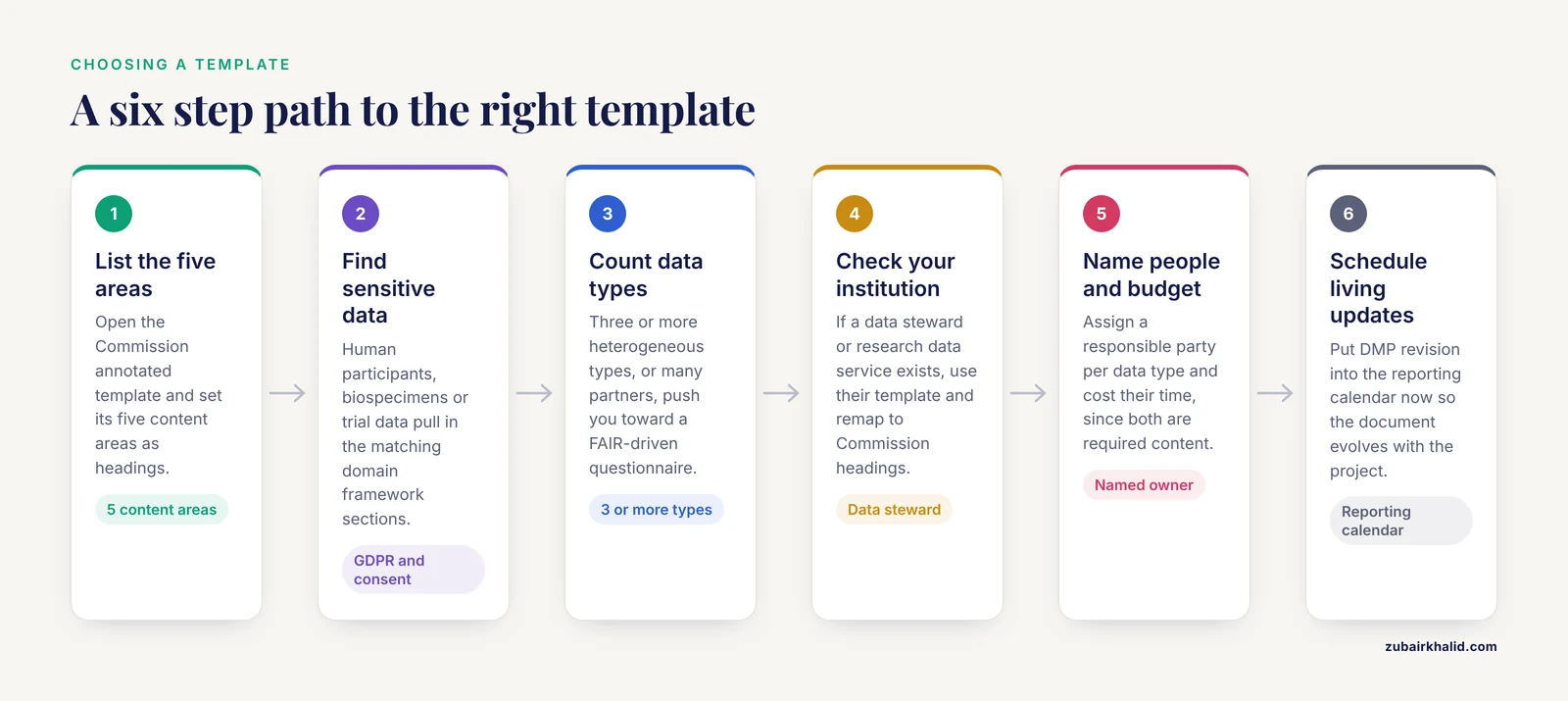
Synthesizing the options and criteria, here is a decision path you can apply in one meeting:
- Open the Commission's annotated template and list its five content areas as headings.
- Identify your sensitive data. Human participants, biospecimens, or trial data pull in the corresponding domain framework sections [4][11].
- Count your data types. Three or more heterogeneous types, or many partners, push you toward a FAIR-driven questionnaire to capture the real data flows before writing prose [3].
- Check your institution. If a data steward or research data service exists, use their template and support, then remap to Commission headings [7].
- Name people and budget. Assign a responsible party per data type and cost their time, since responsibility and resourcing are required content, not decoration [4].
- Schedule the living updates. Put DMP revision into the reporting calendar now, so the document evolves with the project instead of being rebuilt at the final review.
Consortia that follow this path end up with a document that serves reviewers, project officers, and the researchers themselves. Consortia that treat the DMP as a form to satisfy spend the project retrofitting FAIR principles onto decisions that were already made badly.
Common Mistakes and Limitations
- Treating the DMP as a one-time deliverable. Horizon Europe expects a living document. Plans written once at kickoff go stale when repositories change policies or data types expand, and the update burden at project end is then enormous.
- Leaving GDPR and consent to the ethics work package. Consent scope determines what you may share, and cross-border transfers of participant information are a governed activity requiring explicit planning [4]. Retrofitting consent is far costlier than designing it.
- Skipping metadata specifics. Saying "standard metadata will be used" without naming the standard fails the interoperability test. Name the community template, vocabulary, or implementation guide [10][16].
- Omitting the budget line. Data curation, repository deposition, and steward time cost money. Confidence in budgeting for these activities is a documented weakness among researchers, and surveys show budget guidance is one of the most requested forms of institutional support [8].
- Assuming a template guarantees FAIR. The template structures the questions. Someone still has to answer them with real decisions about identifiers, licenses, and repositories.
- Using a foreign-funder template verbatim. Well-designed NIH templates reflect NIH policy structure and six-element plans, not the Commission's five content areas [9]. Borrow their guidance, not their headings.
- No named owner. Plans without responsible parties are plans nobody executes [4].
- Assuming heterogeneity is fine because everyone shares openly. Cross-country data collected with inconsistent methods cannot be meaningfully compared later, which defeats the point of the sharing [13].
One limitation governs all of this: each project's binding requirements come from its own grant agreement and work plan, so when your case is unclear, confirm with your European Commission project officer and your institution's data support staff rather than relying on general guidance alone.
Frequently Asked Questions
Do I need to submit a complete DMP before the grant is signed?
No. Horizon Europe treats the data management plan as a living document that matures with the project. You are expected to provide an initial version early and keep it updated at reporting milestones as your data reality becomes clearer [3].
Can I use a generic DMP template instead of the European Commission's?
Yes, as long as your document covers every required content area. The safest approach is to draft in the Commission's annotated structure and enrich it with domain-specific sections, so nothing mandatory is missing.
How detailed should the data description section be?
Detailed enough that a reviewer can tell what will exist, in what format, under which standards. The ASINA project showed that capturing primary data and metadata descriptions systematically at the design stage prevents later FAIRification problems [3].
How does the plan handle personal data under GDPR?
Personal data are shared only under defined governance. Study-level plans describe the collection, storage, use, and transfer of participant information, protection measures for vulnerable groups, and the parties responsible for each step [4], and biobank frameworks treat consent management and GDPR compliance as core sections [6].
Is a lab notebook template PDF the same thing as a DMP template?
No. A lab notebook template PDF records daily experimental activity at the bench, while the DMP plans how datasets will be described, stored, shared, and preserved at the project level. They connect because notebook metadata feeds the structure the DMP promises.
Who should write and maintain the DMP in a consortium?
A named person per data type, coordinated by the work package leader. Survey evidence shows most research institutions have staff performing data steward functions, so involve them early even if their job title does not say data steward [7].
Sources
- Scanning the horizon of personalized prevention research: an overview of ongoing European funded initiatives.
- Navigating the new NIH Data Management Sharing plan: the NIH HEAL Initiative Data2Action DMPTool template.
- Data Shepherding in Nanotechnology. The Initiation.
- A data management plan for the NESHIE observational study.
- Prioritising measures and interventions to strengthen research reproducibility: a Delphi consultation study.
- Cancer Biobanks and International Collaboration in the European Research Area.
- Data stewardship in Italy: Findings from the first national survey.
- Supporting researcher compliance: assessing institutional readiness for the 2023 NIH Data Management and Sharing Policy.
- The DMPTool NIH DMSP Templates Project.
- The center for expanded data annotation and retrieval.
- Data sharing policies, requirements, and support from public and private clinical trial sponsors: a survey on top sponsors of clinical trials in Europe.
- Research protocol for BootStRaP assessment phase: A nine-nation study on boosting societal adaptation and mental health in a rapidly digitalising, post-pandemic Europe.
- Dietary assessment and dietary guidelines across 11 European Union countries: a review from the PLAN'EAT project.
- Assessing Behavioral and Environmental Facets of Obesity Unobtrusively Utilizing Digital Tools: Introducing the BETTER4U Indicators.
- How to plan and manage an individual participant data meta-analysis. An illustrative toolkit.
- Development, implementation, and initial evaluation of a foundational open interoperability standard for oncology treatment planning and summarization.