Data Sharing in International Consortia
By Dr. Zubair Khalid, DVM, MS, PhD ·

Centralized data sharing moves copies of every partner's records into one pooled repository under a single agreement, while federated data sharing leaves each dataset at its home institution and moves only queries, summary counts, or trained models across institutional borders. The rule of thumb: harmonize the data use agreement before you choose any technology, and go federated whenever privacy law, export restrictions, or institutional policy make pooling impossible.
Consortia now span every corner of the life sciences because scale decides what science can answer. Genomics collaborations link investigators in affluent and developing countries, where growing government and charitable investment has fueled joint projects [1]. Hospital networks share records to run learning health systems, in which data from routine care continuously inform research and practice [2]. Pediatric surgery divisions pool patients across regions [3], and zoos and aquariums share behavior recordings to answer population-level welfare questions that no single institution could address [4]. Research data sharing is the mechanism that turns these partnerships into science.
Sharing across borders also multiplies problems. Partners answer to different privacy laws, keep records in incompatible formats, and start with different expectations about ownership and credit. This guide lays out the agreement options, the repository options, and the criteria that decide real choices, using documented consortium experience as the evidence base. Students, research staff, and early-career scientists planning consortium work will find the decision points here.
Why Data Sharing in International Consortia Stalls
Three forces stall well-intentioned collaborations, and each has a documented remedy.
The first force is silence in the guidance literature. Singh and Daar examined multi-national, multi-institutional genomic collaborations and found that international guidelines say little about data sharing between collaborators inside the same consortium, a gap that is sharpest between investigators in affluent and developing countries and that threatens the success of crucial research ventures [1]. Their central recommendation anchors everything else in this article: a data sharing policy should be prospectively negotiated and concluded between collaborators as early as possible.
The second force is technical heterogeneity. Information models, terminologies, and data definitions differ across healthcare institutions and research systems, and this heterogeneity is a recognized barrier to combining data and to building scalable, standards-based tools [5]. Two sites that both record disease stage can mean different things by it, and every such mismatch propagates into pooled analyses.
The third force is administrative drag. Before scientific work begins, multi-institutional projects must clear a maze of institutional review board (IRB) approvals, data sharing paperwork, and subawards, and delays at this stage stall entire projects [6]. Research, regulatory, and administrative staff are essential contributors to consortium success rather than overhead to be minimized.
Harmonizing Data Use Agreements in International Consortia
A data use agreement (DUA) is the contract that governs a dataset: who may use it, for which purposes, how it must be protected, who owns aggregate results, and what happens when the collaboration ends. Harmonizing DUAs means giving every partner a consistent core of these terms instead of letting each bilateral exchange invent its own. Harmonization matters because inconsistent terms block pooling later. If site A's agreement permits redistribution and site B's forbids it, the consortium cannot build a shared resource without renegotiating one side's terms.
Four options cover most consortia. Each is explained on its own terms, then compared in the table that follows.
Option 1: One Master Agreement for Every Partner
All partners sign a single document with uniform terms for data use, ownership, publication, and security.
Advantages: one negotiation, identical rules for everyone, and a simple path for new sites, which join by signing the existing document. Drawbacks: negotiation is slow when partners span many legal systems, terms must be written to satisfy the most restrictive partner, and any change requires another round of signatures from everyone.
Option 2: A Consortium Charter With Site-Level Addenda
A short charter fixes the non-negotiable core: ownership of aggregate data, publication rights, and a security baseline. Each site then signs a brief addendum covering its local legal requirements.
The Eastern Pediatric Surgery Network shows the charter approach in practice. Its founders organized governance around four pillars: legal ownership of aggregate data, a horizontal leadership structure, mandatory participation in adopted studies, and a broad research portfolio. Within five years the network grew from thirteen academic pediatric surgery divisions to 24 participating medical centers and produced 28 conference abstracts and 12 peer-reviewed manuscripts, most without dedicated extramural funding [3].
Advantages: fast onboarding, respect for local law, and a stable core that survives membership turnover. Drawbacks: more documents to track, and inconsistencies creep in when addenda are drafted carelessly.
Option 3: Bilateral Pairwise Agreements
Every exchanging pair signs its own agreement.
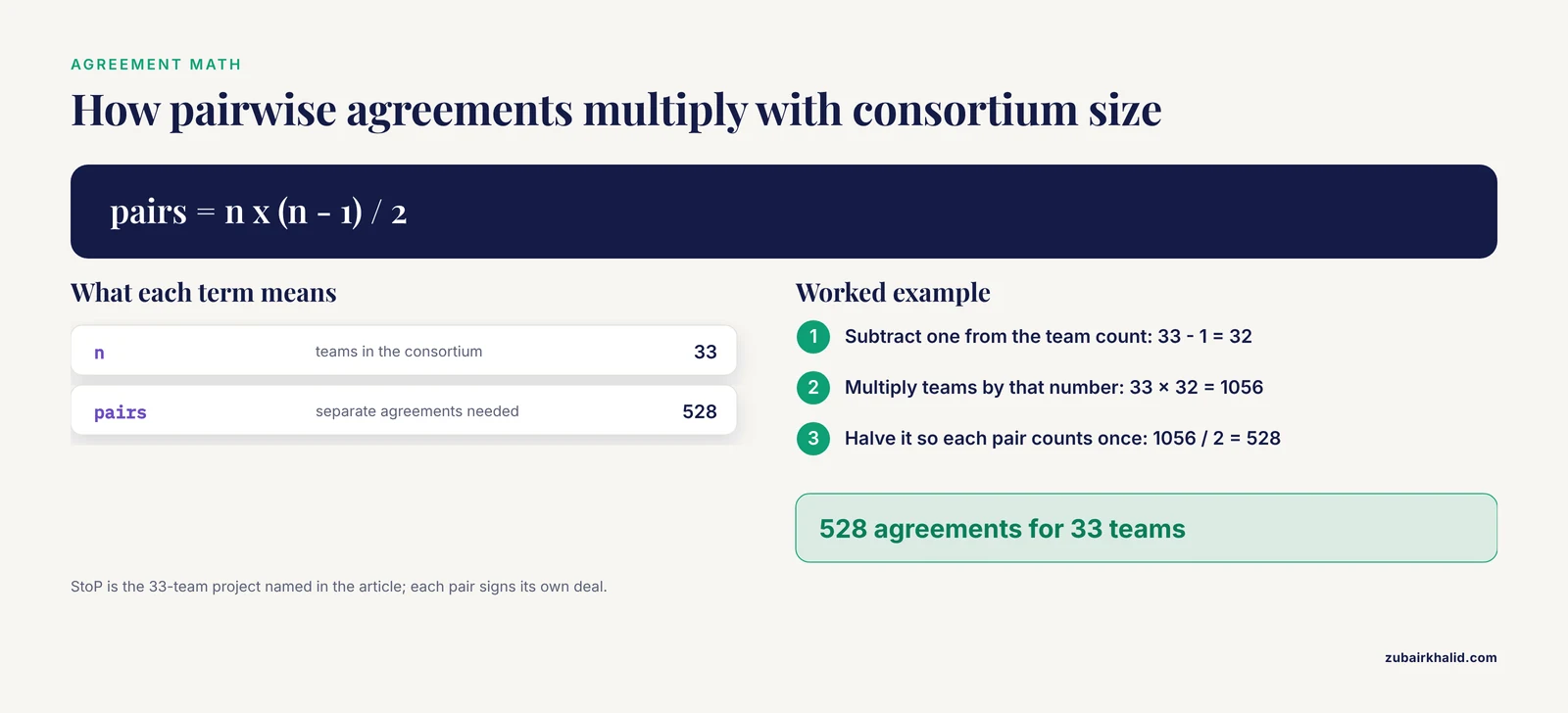
Advantages: maximum tailoring, and entirely appropriate when only two groups share data. Drawbacks: combinatorial growth. A consortium with 33 teams, the size of the Stomach Cancer Pooling (StoP) project, would need 528 separate agreements to cover every pair. Terms drift apart across documents, and pooling data later requires renegotiating most of them.
Option 4: Federated Terms Where Data Never Move
When record-level data cannot leave a site, the agreement changes shape. It governs which algorithms may run on local data, which outputs may cross the border, and who may reuse those outputs. The FLAME platform, developed in the German PrivateAIM project, pairs a hub-and-node architecture, in which a central hub coordinates analysis that executes at each local node, with a dynamic policy framework that specifies permissions and conditions for data access and algorithm execution, enforced across institutions with fine-grained access control and audit logging [8].
Advantages: sidesteps transfer restrictions under privacy frameworks such as the General Data Protection Regulation (GDPR) and the Health Insurance Portability and Accountability Act (HIPAA), and every execution is auditable. Drawbacks: technical overhead, limited support for analyses that need joint record-level data, and the agreement must be precise about outputs, because a model trained on private records can itself leak information.
Table 1. Harmonization options for data use agreements in international consortia
| Option | How terms stay consistent | Pros | Cons | Fits best when |
|---|---|---|---|---|
| Single master agreement | One document, one signature round | Uniform rules, simple onboarding | Slow across many jurisdictions, rigid to change | Few partners with similar legal environments |
| Charter plus addenda | Fixed core charter, short local addenda | Fast onboarding, respects local law | More documents to track | Many partners with mixed legal systems |
| Pairwise agreements | Separate deals for each pair | Maximum tailoring | Combinatorial growth, term drift | Two-party exchanges and small networks |
| Federated terms | Shared policy layer over common infrastructure | No data transfer, auditable execution | Technical overhead, limited analyses | Privacy or export rules block pooling |
Choosing a Sharing Architecture: A Data Repository Comparison
Once the agreement direction is set, the consortium chooses where data live and what crosses institutional borders. Five architectures cover most real projects, and each has published precedents.
Pooled Repositories
All partners contribute record-level data to one validated resource. The Oncoshare project built an integrated multi-institutional database for breast cancer comparative effectiveness research, which compares real-world outcomes of competing treatments, by extracting, standardizing, and integrating data from multiple electronic medical records and registries [9]. The ALL ALS consortium, established by the National Institutes of Health (NIH), applies the pooled model prospectively, with a centralized and readily accessible infrastructure for longitudinal clinical data and biofluids from people living with amyotrophic lateral sclerosis (ALS) and from asymptomatic gene carriers [10]. The rationale for shared outcome databases is well established in pediatric cardiology as well, where European and North American initiatives such as the Central Cardiac Audit Database of the United Kingdom and the IMPACT registry pool procedure outcomes across hospitals [11].
The pooled model offers full analytical flexibility and a single quality-control pass, but it carries the heaviest legal lift and the longest build. The Oncoshare team reported that despite immediately available electronic data, constructing and validating the resource took as long as two years [9].
Federated Aggregate Queries
Only counts cross borders. The Federated Aggregate Cohort Estimator (FACE) federated diverse database sources and an i2b2 instance, an open clinical research data warehouse platform, across three institutions to estimate combined research subject availability, using easily deployed virtual machines designed to meet security and confidentiality requirements [12]. Cohort discovery, meaning finding out how many eligible patients exist across sites before a study launches, is the classic use case, and each site learns its answer without exposing any individual record.
Advantages: minimal legal exposure and fast deployment once agreements exist. Drawbacks: counts alone cannot answer questions that require joint record-level analysis.
Federated Learning and Federated Analytics
Models travel instead of data. The clinical motivation is concrete: rare diseases collectively affect about 5 percent of the population, yet fewer than half of rare disease patients receive a molecular diagnosis after whole genome sequencing, and large variant collections at hospitals remain inaccessible to machine learning because of privacy and legal constraints [13]. Federated learning addresses that constraint. In a proof-of-concept study of variant pathogenicity annotation, meaning scoring whether genetic variants are likely to cause disease, federated models generally achieved comparable or superior performance to centralized training and generalized robustly to independent test sets even at smaller data fractions [13]. FLAME adds the governance layer for clinical settings, with initial deployments at German university hospitals demonstrating federated analyses on clinical and genomic data at model performance comparable to centralized approaches [8]. Federated service architectures also predate modern machine learning: ImageMiner, a federated system of grid-enabled services for analyzing tissue microarrays, which are grids of tiny tissue samples on a single slide, allowed multiple instances at different institutions to be accessed remotely and federated [14].
Advantages: no record-level data transfer, natural alignment with GDPR and HIPAA constraints. Drawbacks: infrastructure and workflow overhead, and not every analysis federates cleanly.
Hub-and-Node Platforms With Local Edge Nodes
A middle path keeps source data on a small local server, called an edge node, at each site and shares only structured metadata. A cloud-native radiology research platform hosts each institution's imaging on a local edge-node Orthanc DICOM server, where DICOM is the Digital Imaging and Communications in Medicine standard for medical images, and reverse-proxies critical metadata to a cloud database through standard web APIs, removing the need for virtual private network setups or hardware shipments [15]. The Ouest Data Hub in France applies a related logic to hospital records: clinical data warehouses and clinical data centers at each hospital support local analytics while shared resources enable single-center and multi-center research, with access to data from over 9.3 million patient records in 2023 [2].
Advantages: sites retain custody of source data while collaboration feels centralized. Drawbacks: the model lives or dies on data quality and interoperability, which the Ouest Data Hub team identifies as ongoing challenges requiring continuous harmonization and standard adherence [2].
Prospective Registries With Controlled Access
When no legacy data exist, consortia can collect to a common protocol from day one. The Merkel Cell Carcinoma Patient Registry is a national multi-institutional effort built on a REDCap database, a widely used research electronic data capture platform, with Project Data Sphere providing a secure, open-access data sharing platform and a task force spanning academic centers, industry, NIH, and the US Food and Drug Administration (FDA) [16]. Its design goal is patient-level data robust enough to serve as a comparator arm for single-arm phase I and II trials in a rare tumor [16].
Advantages: harmonized by construction, with governance built in from the first record. Drawbacks: accrual is slow and the model depends on sustained funding.
Table 2. Data repository comparison across the five architectures
| Architecture | Where data live | What crosses borders | Main advantage | Main trade-off | Published example |
|---|---|---|---|---|---|
| Pooled repository | One shared resource | Record-level data | Full analytical flexibility | Heaviest legal lift, multi-year validation | Oncoshare [9], ALL ALS [10] |
| Federated aggregate query | Each site | Counts only | Minimal legal exposure | Cannot support record-level analyses | FACE [12] |
| Federated learning | Each site | Model updates | No data transfer, GDPR and HIPAA aligned | Infrastructure overhead | FLAME [8], variant annotation study [13] |
| Hub-and-node with edge nodes | Local edge servers | Metadata to shared workspace | Site custody with shared workflow | Demands continuous harmonization | Radiology platform [15], Ouest Data Hub [2] |
| Prospective registry | Common protocol, controlled access | Record-level data under tiered access | Harmonized by construction | Slow accrual, funding dependent | MCC registry [16] |
The Criteria That Decide Real Choices
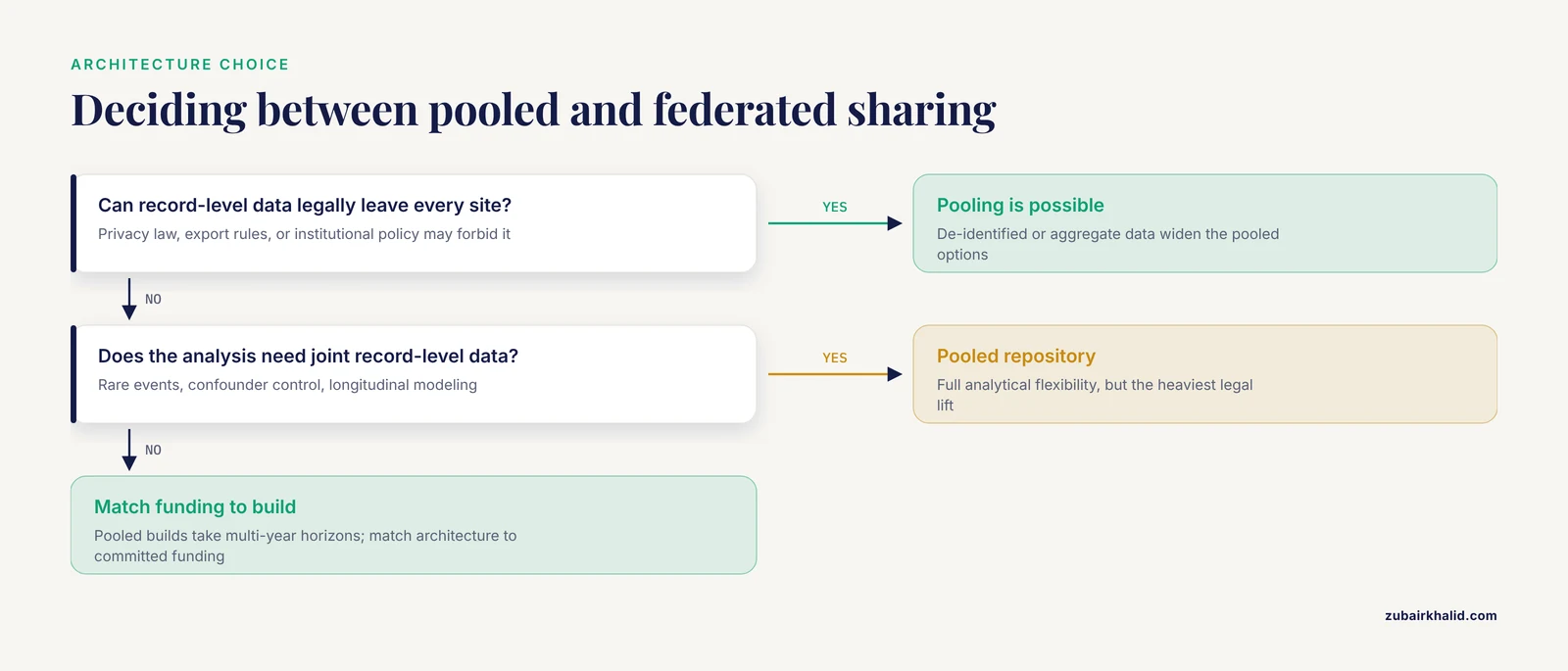
There is no single best way to harmonize data use agreements in international consortia. The best choice depends on six criteria, and working through them in order settles most debates before they start.
- Data sensitivity and legal spread. Identifiable genomic or clinical records spread across jurisdictions push the consortium toward federated terms, because privacy frameworks such as GDPR and HIPAA constrain both transfer and use [8]. De-identified or aggregate data widen the pooled options.
- Analytical requirement. Rare event detection, confounder control, and longitudinal modeling need record-level pooling [9]. Feasibility checks and cohort discovery need only counts, which federated queries supply with minimal legal exposure [12].
- Timeline. Pooled databases and prospective registries deliver full value on multi-year horizons [9]. Federated query deployments on virtual machines can run soon after agreements are signed [12].
- Technical capacity. Hub-and-node platforms and federated learning assume informatics staff at the hub and cooperative nodes [15]. Registry models built on established capture platforms need less specialized support [16].
- Funding horizon. Long-running international projects repeatedly identify funding and sustainability as binding constraints [7]. Match the architecture to committed funding rather than aspirational funding.
- Participation equity. Charters with horizontal leadership and mandatory participation distribute workload fairly across sites [3], and enrollment priorities that span geography and socioeconomic status determine whose data the consortium ultimately holds [10].
Harmonizing the Data Themselves
Agreements decide whether data may move. Standards decide whether combined data mean the same thing everywhere. Four practices recur in successful consortia.
Start from existing standards rather than inventing a dictionary. The Oncoshare team determined that the data dictionary should be based on existing registry standards such as the Surveillance, Epidemiology and End Results (SEER) program when applicable, that a state or regional cancer registry is the most efficient starting point for identifying subjects, and that the Social Security Administration Death Master File provides standardized ascertainment of mortality outcomes where clinical resources do not [9].
Define the shared element set together, early. The Health Level 7 (HL7) Virtual Medical Record project, an open international standards effort for clinical decision support, analyzed systems at 20 institutions across 4 nations and identified 131 data elements in current use, a consensus list that keeps each site from inventing its own vocabulary [5].
Harmonize measures without crushing local flexibility. The Clinical Sequencing Evidence-Generating Research (CSER) consortium balanced site-specific measures against a consensus core, seeking to minimize participant burden, accommodate project-specific choices, and use validated measures that allow data sharing, all supported by platforms for swift communication between teams [17].
Treat harmonization as continuous maintenance. The Ouest Data Hub reports ongoing harmonization as a standing requirement rather than a one-time task [2], and the StoP project found that harmonizing retrospective datasets strengthened local biobanking infrastructure while exposing persistent challenges in data collection, storage, funding, and sustainability [7].
Governance That Makes Agreements Work
Three governance structures determine whether harmonized agreements hold in practice.
A coordinating center turns a consortium into an operation. The Asia Cohort Consortium focused its coordinating center on four activity areas: collaboration development, operations management, statistical and data management, and communications infrastructure and tool development [18]. Published guidance on what makes a coordinating center succeed is scarce, which makes documented experiences like this one the primary reference for new consortia [18].
Administrative and regulatory staff accelerate the start. In three multi-institutional collaborations within the HMO Research Network, staff from research, regulatory, and administrative teams developed novel approaches to secure and maintain IRB approvals, enable data sharing, and expedite subawards for data-only minimal risk studies, accelerating required processes while maintaining regulatory and human subjects protections [6].
Ownership rules set at founding prevent later disputes. The Eastern Pediatric Surgery Network made legal ownership of aggregate data its first governance pillar, so participating divisions could contribute patients and effort without reopening the ownership question project by project [3]. Stakeholder partnership extends governance beyond the consortium itself: ALL ALS operates with partners to operationalize the recommendations of the ACT for ALS Public Private Partnership and prioritizes enrollment of geographically, ethnoculturally, and socioeconomically diverse participants [10].
Worked Scenarios
Scenario 1: Genomics Across Jurisdictions
A consortium of sequencing centers in high-income and middle-income countries wants to combine whole genomes to improve variant interpretation. Two sites cannot export identifiable genomic data under national law.
Sequence the decisions. First, negotiate a master agreement before any transfer, defining ownership of aggregate results and publication credit, because early prospective negotiation is the documented safeguard against intra-consortium disputes [1]. Second, run variant pathogenicity annotation under a federated learning design so the restricted sites contribute model updates rather than genomes [13]. Third, let sites without export restrictions contribute de-identified record-level data to a pooled tier for analyses that need joint records.
Scenario 2: A Rare Disease Registry on a Budget
Twelve hospitals want a shared rare disease registry. No shared warehouse exists, and no consortium-wide informatics staff is funded.
Borrow the registry pattern. Collect prospectively into a common REDCap database with tiered access through an open-access platform, following the Merkel Cell Carcinoma registry model [16]. Base the data dictionary on existing registry standards so the definitions are validated rather than invented [9]. Set ownership of aggregate data in a short charter at founding, so every later project inherits the answer [3].
Scenario 3: Multicenter Imaging Without VPNs
Radiology groups in several countries want to build a shared diagnostic study, but institutional firewalls block data export and no site can ship hardware.
Keep images local and share the workflow. Deploy a local edge-node DICOM server at each site and proxy structured metadata to a shared cloud workspace, the architecture demonstrated by the cloud-native radiology research platform [15]. Write the agreement in federated terms: specify which metadata leave each site, who may query the shared workspace, and how consensus reads are recorded [8].
Common Mistakes and Limitations
- Negotiating the agreement after collection starts. This is the most damaging and most common error, and the documented guidance is unambiguous that the data sharing policy should be concluded as early as possible [1].
- Assuming published guidelines cover intra-consortium sharing. International guidelines are largely silent on data sharing between collaborators inside the same consortium, so the consortium must write its own rules [1].
- Choosing pairwise agreements for a large consortium. Document count grows with the square of membership, and terms drift until pooling requires renegotiation.
- Treating harmonization as a one-time technical task. Measure harmonization in the CSER consortium was a sustained negotiation between local flexibility and consensus core measures, supported by communication platforms [17].
- Underestimating the build calendar. Pooling legacy data into a validated resource is a multi-year project even when electronic data already exist [9].
- Leaving regulatory and administrative staff out of early planning. IRB approvals, subawards, and sharing paperwork stall projects when treated as afterthoughts [6].
- Assuming federated means agreement-free. Federated designs still need a policy layer that specifies permissions, conditions of execution, and audit trails [8].
- Assuming a consortium runs on enthusiasm. Funding and sustainability are recurring challenges in long-running international projects [7].
Limitations: every institution operates under its own contracts, privacy laws, and review boards, and the patterns above inform but do not replace review by your sponsor and contracting office. Consent language, data security plans, and export control determinations depend on the actual datasets and jurisdictions involved, and those decisions belong with your institution's compliance professionals.
Frequently Asked Questions
What does it mean to harmonize data use agreements in international consortia?
It means giving every partner the same core terms covering who may use shared data, for what purposes, who owns aggregate results, and how findings are published, rather than negotiating each data exchange separately. Harmonization keeps one site's rules from blocking pooled analyses later.
When should a consortium choose federated sharing instead of a pooled repository?
Choose federated sharing when privacy law, export restrictions, or institutional policy prevent record-level data from leaving a site, or when the consortium needs only counts, feasibility estimates, or trained models rather than joint record-level analysis.
How early should data use agreements be negotiated?
Before any data are collected or transferred, ideally during study design. Published guidance identifies prospective negotiation, concluded as early as possible, as the key safeguard for multi-institutional collaborations [1].
What is the difference between a data use agreement and a material transfer agreement?
A data use agreement governs data, while a material transfer agreement governs physical materials such as biospecimens. Consortia that share both, such as biobank networks, typically need both instruments with matching ownership and publication terms.
What does a coordinating center do in a consortium?
It runs the collaboration as an operation, covering collaboration development, operations management, statistical and data management, and communications infrastructure. Documented consortium experience identifies the coordinating center as essential to multi-site success [18].
Do federated models perform as well as pooled-data models?
In published multi-institutional tests, federated approaches matched or exceeded centralized performance for variant annotation and hospital-based analytics [13] [8]. The practical answer depends on whether your specific analysis can be expressed as a federated computation.
Sources
- Intra-consortium data sharing in multi-national, multi-institutional genomic studies: gaps and guidance.
- The Ouest Data Hub: An Interregional Health Data Sharing Ecosystem for Research.
- The Eastern Pediatric Surgery Network: Creation and implementation of a comprehensive clinical research collaborative in pediatric surgery.
- ZooMonitor Community: A Tool for Evaluating Population-Level Behavior Questions.
- Multi-National, Multi-Institutional Analysis of Clinical Decision Support Data Needs to Inform Development of the HL7 Virtual Medical Record Standard.
- Accelerating regulatory progress in multi-institutional research.
- Strengthening biobank networks: A Latvian case study within the StoP project.
- Enabling Privacy-Preserving Federated Learning in Healthcare: The FLAME Architecture and Policy Framework.
- Oncoshare: lessons learned from building an integrated multi-institutional database for comparative effectiveness research.
- Access for ALL in ALS: A large-scale, inclusive, collaborative consortium to unlock the molecular and genetic mechanisms of amyotrophic lateral sclerosis.
- Databases for assessing the outcomes of the treatment of patients with congenital and paediatric cardiac disease--the perspective of cardiology.
- Federated Aggregate Cohort Estimator (FACE): an easy to deploy, vendor neutral, multi-institutional cohort query architecture.
- Federated learning for the pathogenicity annotation of genetic variants in multi-site clinical settings.
- ImageMiner: a software system for comparative analysis of tissue microarrays using content-based image retrieval, high-performance computing, and grid technology.
- Radiology research platform: automating multicenter radiological research workflows using a cloud-native platform.
- The Merkel Cell Carcinoma Patient Registry: From Promise to Prototype to Patient.
- Lessons learned about harmonizing survey measures for the CSER consortium.
- Coordinating centers in cancer epidemiology research: the Asia Cohort Consortium coordinating center.