How to Choose an Online Grant Writing Course
By Dr. Zubair Khalid, DVM, MS, PhD ·

An online grant writing course is a structured program that takes you through grant proposal planning, drafting, and revision with deadlines and feedback, while a webinar, recorded lecture, or blog post explains funding rules without asking you to produce a full proposal and act on reviewer comments. The rule of thumb for choosing between them is simple: pick the format by the kind of feedback you need, not by the topic in the course title. Every option on this page teaches roughly the same body of material. What separates them is how much structured practice you get, how quickly you get feedback, and how well the schedule fits the proposal you actually have to write.
This guide is written for students, early-career researchers, clinicians, and research staff in the life sciences who are deciding whether and how to take a grant writing course online. It describes the main course formats on their own terms, compares them on the criteria that decide real choices, walks through worked scenarios, and lists the mistakes people make most often when enrolling.
What a Grant Writing Course Online Actually Teaches
Most courses in this space converge on a recognizable core, regardless of who runs them. That core is grant proposal planning, which means the deliberate sequence of decisions you make before and while drafting a proposal: identifying the right funding mechanism, framing a research question that fits the funder's priorities, designing an aims page, planning a realistic timeline, budgeting, and anticipating reviewer concerns.
A well-designed research grant writing course covers four blocks of content:
- Funder literacy. How agencies and foundations structure their announcements, what review criteria they publish, and how scoring works. In the United States, this typically means understanding the structure of a specific funding opportunity rather than generic "good science."
- Proposal architecture. The standard sections of a life sciences proposal, especially the specific aims page, significance, innovation, and approach sections, plus budgets, biosketches, and letters of support.
- Writing and revision technique. How to write for a panel of tired reviewers, how to signal feasibility, and how to revise after critique.
- The review experience. Either through mock review, peer critique inside the course, or instructor feedback on your actual draft.
That last block is the one that separates a genuine course from a content library. A published study of a clinical research course for academic anesthesiologists, the Introduction to Clinical Research for Academic Anesthesiologists (ICRAA) Course, illustrates what a serious curriculum treats as essential. Over a 9-month program running from July 2024 through April 2025, delivered through online interactive lectures, participants learned biostatistics, how to communicate with data analysts, research ethics, how to write a grant, and how to write and analyze scientific articles [1]. Notice the placement: grant writing sits inside a broader research-design curriculum, not as an isolated writing exercise. That is a useful signal when you evaluate any course, because proposal quality depends heavily on study design, and a course that teaches writing while ignoring design will leave you with polished prose around a weak project plan.
Grant Writing Course Online Options at a Glance
There are five realistic options for most life scientists. The table below compares them on the dimensions that matter in practice.
| Option | Typical format | Feedback you get | Best fit | Main limitation |
|---|---|---|---|---|
| Multi-month university or society cohort course | Weekly or biweekly live online lectures over several months, often with assignments | Instructor feedback on your developing proposal, plus peer discussion | Early-career faculty, fellows, and clinicians preparing a first major proposal | Large time commitment over many months |
| Self-paced MOOC or modular platform | Recorded videos, podcasts, quizzes, and case-based exercises you complete on your own schedule | Automated quizzes, little or no individual review of your draft | Learners building general skills before they have a specific proposal due | No one reads your actual proposal |
| AI-enabled interactive course | Platform where you work through structured exercises and receive automated, individualized feedback | Formative feedback at scale, generated automatically, often per exercise | Learners who want iterative practice between live sessions or instead of them | Feedback is generated by software, so domain-expert review still matters |
| Short workshop or bootcamp | A day to a few weeks of concentrated sessions, often hosted by a professional society or writing center | Live critique during the session, sometimes one round of written comments | People with a near-term deadline who need structure quickly | Too brief to carry a full proposal from idea to submission |
| Self-directed learning with mentor review | Reading funder guidance and examples, then cycling drafts through your mentor or colleagues | Feedback only as good as your reviewer, on your schedule | Trainees with an engaged, experienced mentor | No curriculum, so gaps in your knowledge go unnoticed |
The sections below explain each option in more depth, because the table hides important trade-offs.
Option 1: Multi-Month University and Society Cohort Courses
This is the traditional gold standard delivered through a new channel. A cohort course enrolls a defined group, runs on a fixed calendar, and moves through a curriculum together. The ICRAA course described above is a concrete example of the model: a 9-month program of online interactive lectures covering proposal design, biostatistics, grant writing, and scientific writing as an integrated whole [1].
The strengths of this format follow directly from its structure:
- Duration creates iteration. Nine months gives you time to draft, get feedback, revise, and get feedback again. Grant writing improves through revision cycles, and short formats rarely allow more than one.
- Live interaction forces engagement. Interactive lectures, where you can ask questions and hear how instructors respond to peers, surface the questions you did not know to ask.
- Integration with research design. Because these courses are usually run by academic centers for their own trainees and faculty, grant writing is taught alongside statistics and study design, which is how reviewers will actually judge your proposal [1].
The costs are real, though. A multi-month commitment assumes you can protect hours every week for that long, which is difficult for clinical staff with heavy service loads and for researchers in the middle of a paper submission. Cohort courses also run on academic calendars, so if your funder deadline falls between cohorts, you may wait. And because they are often institution-specific, access can depend on where you train or work rather than on open enrollment.
When you evaluate a course in this category, look for three things: a stated curriculum that includes proposal planning and design, not only writing mechanics. A described mechanism for feedback on drafts, not just lectures. And a schedule you can genuinely sustain, because the reported value of these programs comes from participants completing the full arc.
Option 2: Self-Paced MOOCs and Modular Digital Platforms
A MOOC, or massive open online course, is a course delivered over the internet to a large, open enrollment, typically with recorded content, automated assessments, and discussion forums instead of live instruction. Modular platforms are similar but often organized as discrete units you can mix and match.
The practical question with self-paced formats is not whether the content is good. It often is. The question is whether the course design supports the kind of learning grant writing requires, and you can judge that with specific criteria drawn from research on digital course design.
A design evaluation of the Nordic Digital Health Education (NorDigHE) program, a self-managed digital learning platform for healthcare professionals and students, examined usability and learner reactions to specific tools: educational podcasts, case-based videos, simulations, learning games, and online quizzes. Among 125 participants who had completed at least two of the five course modules, usability scores exceeded the established cut-off value, indicating acceptable to good usability, and podcasts and case-based videos were perceived as relevant and supportive of learning [2]. Two lessons transfer directly to choosing a grant writing course online.
First, usability is measurable and matters. If a platform is clumsy, learners disengage before reaching the material. Course providers that have evaluated their own usability, or that at least let you sample the interface before paying, are easier to trust than ones that hide behind a sales page. Second, the specific learning tools predict what the course can actually do for you. Podcasts and videos deliver information efficiently [2], which is exactly what you need for funder literacy and proposal structure. Simulations and case-based exercises let you practice decisions, which is what you need for the approach section. Quizzes check recall. A self-paced course built mostly from videos and quizzes will inform you. A course built around cases and simulated decisions will train you, which is a different outcome.
A second useful signal comes from how the course was designed in the first place. The Love Your Brain project in Australia co-designed a digital stroke prevention platform, including a MOOC and a text messaging system, through seven online focus groups with community members and health knowledge experts, followed by testing and a final round of focus groups with each cohort in March 2024 [3]. The method is the point: the designers gathered input from both the intended audience and domain experts before and after building the platform, then revised based on what they heard. When a course provider describes how their materials were developed, co-design with learners and experts is a stronger signal of quality than production polish. A grant writing course built with input from actual reviewers and funded investigators will reflect how funding decisions are really made, not just how applications are formatted.
The pros of self-paced options are flexibility, open enrollment, and a low barrier to starting. The cons are equally clear. Completion rates in open online formats are notoriously low because nothing external holds you to a schedule, and the individualized review of your own proposal draft, which is where most of the improvement happens, is usually absent. Treat a self-paced course as the content layer of your training and plan to supply the feedback layer yourself through a mentor, a writing group, or institutional resources.
Option 3: AI-Enabled Interactive Courses
The newest category uses large language models, software systems trained on text that can generate responses and evaluate inputs, to deliver interactive practice and automated feedback at a scale no human instructor corps can match.
A prospective pre-post observational study at Harvard Medical School tested this model directly. Researchers developed seven interactive cases for a preclinical neurosciences course, delivered through an online AI-enabled learning platform. Second-year students completed weekly cases in which they queried an LLM-simulated patient to obtain a history, examination findings, and investigation results, then answered short-answer questions on clinical reasoning. Responses were automatically scored, and students received AI-generated feedback [4]. The design targeted a problem that will feel familiar to anyone who has sat in a large course: traditional approaches provide limited opportunities for iterative, interactive practice and individualized feedback among large cohorts [4].
Grant writing has the same structural problem. The feedback bottleneck, not the content, is what limits most writers. One mentor can read a draft a few times a year. An AI-enabled platform can score and comment on a draft every night. When you evaluate a course in this category, the same logic from the medical education study applies, with one addition:
- Structured practice beats passive consumption. The value in the Harvard model came from forcing learners to act, answer, and then read feedback [4]. Look for AI courses that make you produce text and respond to critique, not ones that simply generate text for you.
- Automatic scoring enables iteration. Fast, repeatable feedback is what turns one draft into five drafts.
- Domain validation is the open question. The neuroscience study reported feasibility with high accuracy and minimal hallucinations in its tested context, and its authors noted that few studies have examined real-world integration of these tools in actual courses [4]. For grant writing, where judgments about feasibility and significance are contested even among human experts, treat AI feedback as a fast first pass that flags structural and clarity problems, and route substantive scientific judgment to experienced humans.
A sensible hybrid is emerging: take the cohort course for the human feedback and the network, use AI-enabled exercises for the weekly reps in between, and use a self-paced MOOC to fill specific gaps. Each layer covers a weakness of the others.
Option 4: Short Workshops and Bootcamps
Professional societies, research offices, and writing centers commonly run grant writing workshops lasting from a single day to a few weeks. These are legitimate options and often the right one, but only for a specific situation: you already understand the funder's requirements, you have a draft or a clear plan, and you need concentrated critique and accountability before a near-term deadline.
What a workshop can do well is compress the review experience. A day spent having your specific aims page torn apart by a room of people who have served on study sections is worth more than a month of recorded lectures. What a workshop cannot do is teach grant proposal planning from scratch, because planning is a process that unfolds over weeks as you refine a question, check feasibility, and talk to collaborators. If you enroll in a two-day workshop expecting to learn the whole craft, you will leave with notes instead of a proposal. Match the format to the stage you are actually at.
Option 5: Self-Directed Learning With Mentor Review
The no-course option deserves honest treatment, because for some trainees it is the right one. If your laboratory has a mentor who has held continuous funding, the single highest-value feedback you can get on a proposal is that person reading your draft. Funder guidelines, previously funded applications, and agency reviewer materials are public, so the raw content of any course is largely available for free.
What self-directed learning lacks is sequence and coverage. A curriculum, whether delivered by humans or software, guarantees that you encounter topics you did not know existed, such as how review panels assign individual reviewers versus discussants, or how a budget justification differs from a budget. Self-directed learners reliably miss some of these. If you choose this route, compensate by adopting a written curriculum from a published course syllabus and checking yourself against it, and by scheduling draft reviews on a calendar rather than when the draft feels ready.
Grant Writing Course Online Pros and Cons
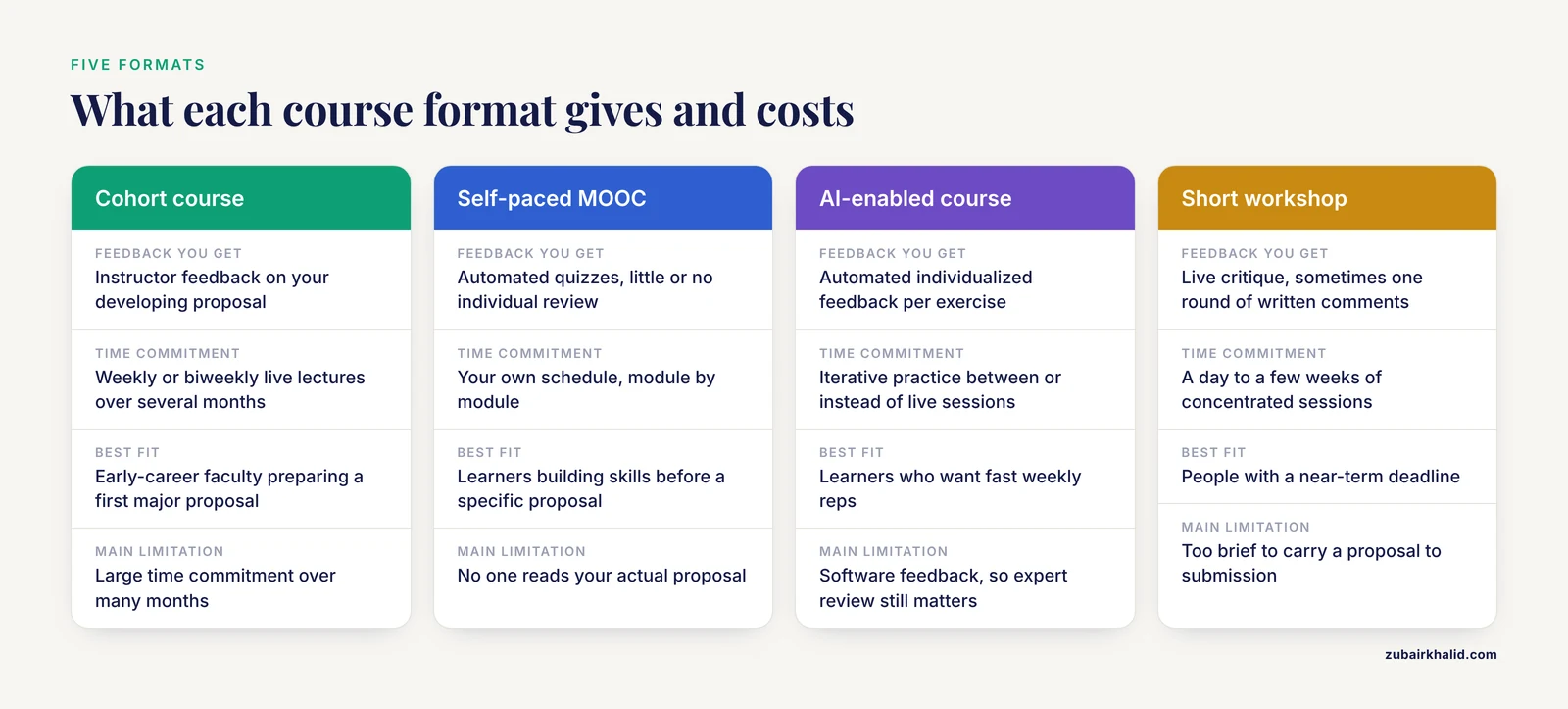
Summarizing the trade-offs across all five options gives you a decision aid.
Multi-month cohort courses. Pros include sustained iteration, live interaction, integration with research design training, and demonstrated value in preparing participants to design proposals ethically and competently [1]. Cons are the time commitment, fixed calendars, and sometimes restricted access.
Self-paced MOOCs and modules. Pros include flexibility, open access, and well-designed tools such as podcasts, case-based videos, and quizzes that learners rate as relevant and supportive [2]. Cons are weak completion without external accountability and the absence of individualized review of your draft.
AI-enabled interactive courses. Pros include iterative practice and individualized formative feedback at scale, addressing the core bottleneck of large cohorts [4]. Cons are the novelty of the model, limited real-world evidence of integration, and the need for human expert review of scientific judgments [4].
Short workshops. Pros are speed and concentrated critique. Cons are insufficient depth for a first proposal and no follow-through between sessions.
Self-directed learning. Pros are zero cost and total flexibility, plus the highest-quality single reviewer if your mentor is strong. Cons are the missing curriculum and your own blind spots.
Notice that no option wins on every row. The best grant writing course online for you is the one whose strengths align with your weakest link, which leads to the comparison criteria below.
How to Compare Courses: The Criteria That Decide Real Choices
Ignore course titles and marketing pages. Evaluate any grant writing course online against these six criteria.
1. Feedback mechanism and frequency. This is the decisive criterion. Ask exactly who or what reads your draft, how often, and with what turnaround. A course with weekly automated scoring gives you more reps than a course with two human reviews, but human review catches different problems. The Harvard AI study succeeded precisely because it built a feedback loop into every weekly case [4], and the 9-month ICRAA course succeeded because its length allowed repeated cycles [1]. A course with neither loop nor length will not improve your writing much.
2. Production versus practice. Does the course make you write, or only watch and read? Case-based and simulated exercises, which learners in the NorDigHE evaluation perceived as supportive of learning [2], are a marker of a practice-oriented design. A syllabus that lists only lecture topics is a marker of a content-oriented design.
3. Curriculum completeness. Look for grant proposal planning in the syllabus, meaning topic selection, funder fit, aims logic, study design, budget, and timeline, rather than only prose style. The ICRAA curriculum placed grant writing among design and analysis topics [1], and that placement reflects how proposals are judged.
4. Evidence of evaluation. Serious providers evaluate their own courses. The NorDigHE evaluation used validated questionnaires and analyzed results against the Kirkpatrick framework, a widely used model for evaluating educational programs, at level 1, which measures learner reactions and perceptions [2]. You do not need every provider to run a formal study, but a provider who can describe how they know the course works, with anything beyond testimonials, is ahead of most of the market.
5. Design provenance. Ask who shaped the content. Courses co-designed with the people they serve, in the way the Love Your Brain platform gathered input from community members and experts across multiple rounds of focus groups before and after testing [3], tend to fit learner needs better than courses written once and shipped. For a research grant writing course, look for named involvement of funded investigators or reviewers.
6. Schedule fit and completeness requirements. Check the minimum completion requirement before you commit. In the NorDigHE evaluation, participants completed surveys after finishing at least two of five modules [2], and modularity allowed that. In a cohort course, the value comes from the full arc, so falling behind mid-course wastes your effort. Match the course calendar against your actual proposal deadline and your other obligations before enrolling, not after.
Worked Scenarios
Scenario 1: A second-year PhD student with no proposal due. You have two years before you need a fellowship application and no current deadline. A cohort course would consume time you need for coursework and experiments. The right choice is a self-paced MOOC built around case-based exercises and quizzes, started now at a leisurely pace, paired with a lab meeting practice talk each semester. The modular structure means you can complete a couple of modules per term and still make progress [2]. When the real deadline approaches, add a workshop or mentor review cycle for the draft itself.
Scenario 2: A clinical fellow with a foundation grant deadline in five months. You have a defined project and a hard date. A multi-month cohort course is attractive but check whether the calendar closes before your deadline. If a course in the ICRAA style is available to you, its integrated treatment of proposal design, statistics, and grant writing matches what a foundation panel will scrutinize [1]. If access is limited, combine a short workshop aimed at your draft with AI-enabled exercises for weekly iteration, and reserve mentor review for the final two revisions. Whatever you choose, confirm the feedback mechanism in writing before you pay or enroll.
Scenario 3: A research staff scientist returning to writing after a decade. Your scientific judgment is current but the funding landscape, format requirements, and review conventions have changed. Your constraint is time, not knowledge of science. An AI-enabled interactive course is a strong fit here, because automated scoring and individualized feedback let you rebuild writing fluency on your own schedule with fast iteration [4]. Pair it with a self-paced module on current funder requirements to close the knowledge gap, and ask a funded colleague to sanity-check your aims page once.
Scenario 4: A course director choosing training for a whole department. If you must train a large cohort, the bottleneck analysis from the medical education literature applies directly. Traditional approaches provide limited opportunities for iterative, interactive practice and individualized feedback in large groups [4], so a lecture-only program will underperform. A layered design works: a shared core of recorded content and quizzes, scheduled live sessions, AI-enabled practice between sessions with automatic feedback, and human review of each participant's actual proposal at defined milestones. Evaluate the result with at least a level 1 Kirkpatrick assessment using validated questions on usability and perceived relevance, as the NorDigHE evaluation did [2], so you can improve the next iteration with data rather than anecdotes.
Common Mistakes and Limitations
Choosing by topic instead of by feedback. Nearly every course promises to teach grant writing. Few tell you how your draft gets reviewed. The feedback mechanism, not the topic list, is what differentiates outcomes, so ask about it first.
Enrolling without a proposal in hand, or the reverse. Cohort courses and workshops assume different starting points. Taking a proposal-focused cohort course with nothing to write produces abstract learning you will forget. Taking a two-day workshop with no background knowledge produces critique you cannot act on. Match the format to your stage.
Confusing content quality with course quality. A beautifully produced video series can be educationally inert if it never makes you produce or revise anything. Conversely, a plainly recorded course with rigorous draft review cycles will improve your writing. Judge the learning activities, not the production values. Learner perception studies support this distinction, rating case-based and interactive tools as the supportive elements of digital learning rather than passive formats [2].
Trusting AI feedback as a final reviewer. AI-enabled platforms can scale practice and formative feedback impressively, and feasibility studies report high accuracy with minimal hallucinations in their tested contexts [4]. But grant review hinges on contested scientific judgments about significance and feasibility, and evidence on real-world integration of these tools in actual courses is still limited [4]. Use AI feedback for structure, clarity, and iteration. Route scientific substance to experienced humans.
Ignoring usability until after payment. A poorly designed platform measurably degrades the learning experience, which is why usability was a designed-in and evaluated property of the NorDigHE program, with scores exceeding the accepted cut-off for acceptable to good usability [2]. Sample the interface, watch a demo lesson, and check the platform on the device you will actually use before committing.
Skipping the completion math. Estimate your realistic weekly hours and compare them against the course's demands over its full duration. A 9-month course is a nine-month commitment in practice [1]. Starting a course you cannot finish is worse than choosing a shorter one you can.
One limitation applies to this entire article. Course quality varies more within each category than between categories, so the options described here are formats, not endorsements, and the right choice depends on your specific deadline, institution, and feedback needs. For advice specific to your situation, your institution's research development office or a funded mentor can tell you which local resources pair well with any course you take.
Frequently Asked Questions
What is the best grant writing course online for a first-time applicant?
The best course is one with scheduled deadlines and individualized feedback on your actual draft, usually a multi-month cohort format. Content quality varies little across providers, so prioritize the feedback mechanism and a curriculum that covers grant proposal planning, including study design, rather than writing mechanics alone.
How long does an online grant writing course take?
It ranges from one or two days for a workshop to nine months for a comprehensive cohort course, with self-paced options in between depending on your pace. Match duration to your deadline, because the improvement in your proposal comes from full revision cycles, which require elapsed time.
Can an online course replace feedback from my mentor?
No, and no course claims to. Online courses supply structure, curriculum, and often more frequent feedback than a mentor can give, while a mentor supplies scientific judgment about your specific project. The strongest preparation uses both, with the course handling the reps and the mentor handling the final substantive review.
Do I need a research grant writing course before writing my first proposal?
You do not strictly need one, since funder guidelines and successful examples are public, but self-directed learning reliably leaves gaps in topics you did not know to look for. A course guarantees coverage and forces practice, which is why most first-time applicants benefit from at least a short structured program.
What should grant proposal planning content actually cover?
Look for funder literacy, aims page construction, study design and feasibility, budgeting, timeline planning, and reviewer anticipation. A course that covers only prose style while ignoring design will leave you with polished writing around a weak project plan, which is the most common reason proposals fail.
Are AI-enabled grant writing courses worth trying?
Yes, as a complement rather than a replacement. They solve the feedback bottleneck by providing iterative practice and individualized formative feedback at scale, which human instructors cannot match for large groups. Treat their feedback as a fast first pass on structure and clarity, and reserve final scientific judgments for experienced human reviewers.
Further Reading
- Cache-efficient and vectorized parallel dynamic programming for RNA folding.
- Patients with vasculitis present a poor oral health: results of the online cross-sectional survey from Canada (VASC-TOOTH Survey).
Sources
- Meeting Report: Inaugural Introduction to Clinical Research for Academic Anesthesiologists Course.
- Digital Competence Development for Hospital-At-Home Care - A Design Evaluation Study Among Healthcare Professionals and Students.
- Co-Designing a Digital Stroke Prevention Platform: Leveraging Lived Experience and Expert Advice.
- Education Research: Integrating AI-Enabled Interactive Case-Based Learning in a Preclinical Neurosciences Course.