Grant Writing Checklist: A Comprehensive Pre-Submission Audit
By Dr. Zubair Khalid, DVM, MS, PhD ·
By the end of this article you will be able to audit a grant proposal the way an experienced reviewer would, catch the technical and stylistic errors that sink otherwise strong applications, and build a realistic submission timeline. You will need the funder's call for proposals, the submission portal requirements, your draft narrative, your budget, your collaborators' biosketches and letters, and a colleague willing to read your draft cold. None of these need to be perfect when you start the audit. The checklist exists precisely because they will not be.
Grant writing has become more competitive and more complex over the past few decades, which means proposals must be innovative, compelling, and cleanly written to survive review [1]. A structured pre-submission audit is the cheapest competitive advantage available to an applicant. This article gives you that audit in a form you can run on any proposal, for any funder.
Why a Pre-Submission Audit Matters
Peer-reviewed project funding distributes a large share of governmental research money, and reviewers judge proposals against explicit criteria under severe time pressure [2]. A proposal that forces a reviewer to hunt for the hypothesis, recalculate the budget, or guess at the timeline loses credibility on every page afterward. The audit is not about polish for its own sake. It is about removing every avoidable obstacle between your idea and a reviewer's understanding.
Institutional studies of grant writing practice point to the same lesson. A mixed-methods study of researchers at Ukrainian universities identified internal grant review processes, institutional support, and evaluation after submission as recurring themes behind higher success rates [3]. Translated into individual practice, that means you should subject your own draft to an internal review before any external one, and you should treat every rejection as data for the next cycle.
Grant Writing Checklist Step by Step
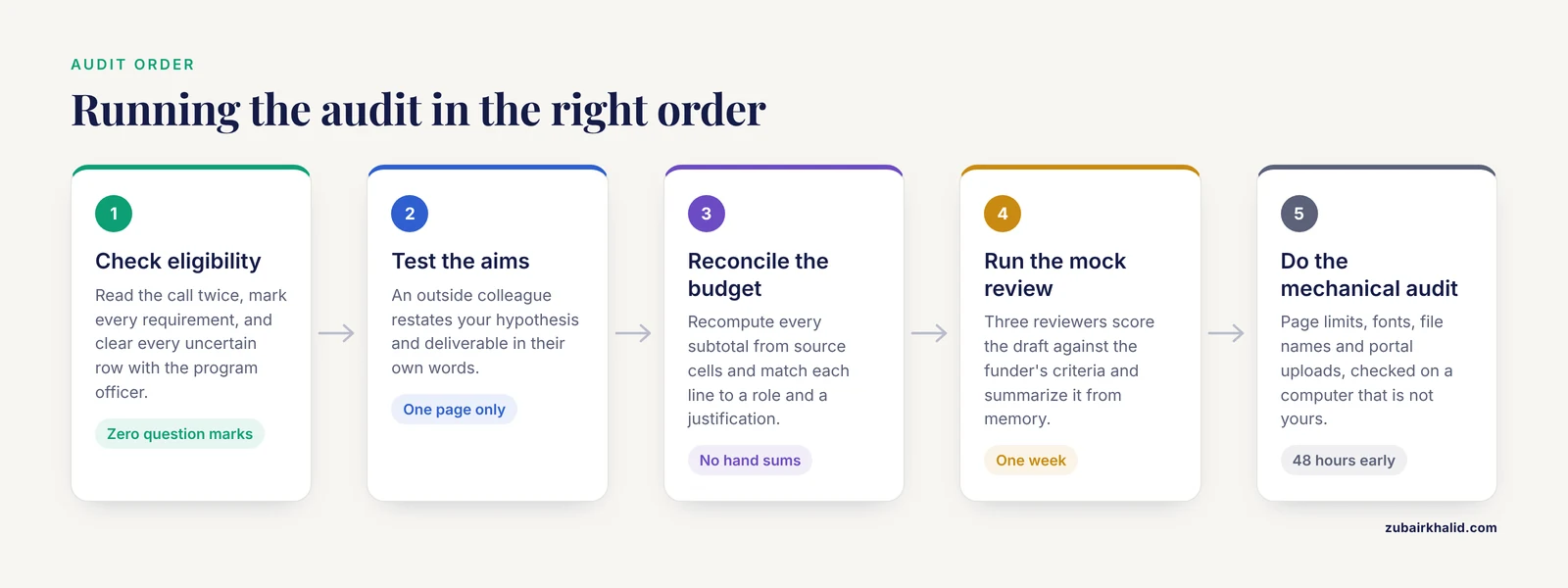
This walkthrough treats the audit as a sequence you run in order. Later steps assume earlier ones are clean. Run the full sequence once early, then again the week before submission.
Step 1. Verify eligibility and fit against the call
Read the funding announcement twice, marking every requirement with a number. Then build a two-column ledger in a plain text file.
eligibility_audit.txt
---------------------------------------
REQUIREMENT                         STATUS
---------------------------------------
Career stage eligible              [YES]
PI eligibility (citizenship/etc)   [YES]
Institutional types allowed        [YES]
Topic within call scope            [?  ]  <- confirm on p.4, para 2
Budget cap respected               [YES]
Cost-sharing required?             [NO ]
Deadlines: LOI 01 Mar / full 05 May [OK]
---------------------------------------
The expected output of this step is zero question marks. Any row marked uncertain becomes a phone call or email to the program officer before drafting continues. Program officers exist to answer exactly these questions, and asking early costs nothing.
Step 2. Audit the specific aims or core narrative
Most funders judge a proposal first on whether the central idea is clear, significant, and innovative. In NIH-style applications this lives in the Specific Aims page. A practical audit: hand the aims page to a colleague outside your subfield and ask them to restate your hypothesis and your deliverable in their own words. If they cannot, the page fails, regardless of how elegant the prose sounds to you.
Structured grant writing programs teach this as a discrete skill. The R Club program at the University of Cincinnati runs a dedicated workshop on crafting a specific aims page, using successful proposals and review criteria as models, and it pairs that workshop with expert feedback on participants' drafts [4]. The pattern to copy is simple: model against funded examples, then get outside eyes on one page before writing twenty-five more.
Step 3. Audit the budget and justification
Work through the numbers line by line.
- Every personnel line matches a named or explicitly described role, with effort percentages that sum to no more than 100 percent per person per period.
- Equipment, supplies, travel, and other direct costs each have a justification sentence that a non-specialist can follow.
- Indirect costs use the funder's stated rate or your institution's negotiated rate, not a guess.
- The budget periods align with the project timeline, so nothing is requested in a year when it cannot be spent.
- If the funder caps direct costs, confirm the uncapped figure separately so a program officer's question does not stall the review.
A frequent arithmetic failure looks like this:
FAIL: Year 2 personnel
  Co-I (0.25 FTE)      $ 31,500
  Postdoc (1.00 FTE)   $ 61,200
  Tech (0.50 FTE)      $ 28,400
  Sum listed           $ 118,100
  Recomputed           $ 121,100   <- [transcription error](/knowledge/molecular-biology/transcription-error)
FIX: recompute every subtotal from source cells, never by hand
Recompute every total independently. Spreadsheet transcription errors are among the most common and most embarrassing findings in a pre-submission audit.
Step 4. Audit the biosketches and compliance items
Check every co-investigator's biosketch against the funder's current template and page limits. Templates change between cycles, and an outdated format can trigger administrative rejection before scientific review begins. Confirm current-and-pending support documents list every active award for every senior person, including pending submissions where the funder requires them.
Step 5. Audit letters, resources, and collaborations
Every letter of support should name your project, state a concrete contribution, and be signed by someone with authority to make that commitment. A generic letter that could describe any proposal in your field weakens rather than strengthens the application. Confirm that facilities and equipment described in the resources section actually exist, are accessible to the project team, and are described in terms matching the letters that reference them.
Step 6. Run a mock review before submission
This is the step most applicants skip and the one with the best evidence behind it. A mock review committee, in which colleagues review a draft against the funder's published criteria and discuss it as a panel, is an established teaching and refinement tool in grant writing instruction [5]. A five-year surgical residency curriculum built around drafting a grant and holding a mock review committee found that 91 percent of surveyed participants found the workshops useful, and grant submission and funding numbers rose in the four years after the program began compared with the four years before [6]. NSF-style peer review exercises have been used the same way in undergraduate teaching, precisely because they mirror how real panels behave [7].
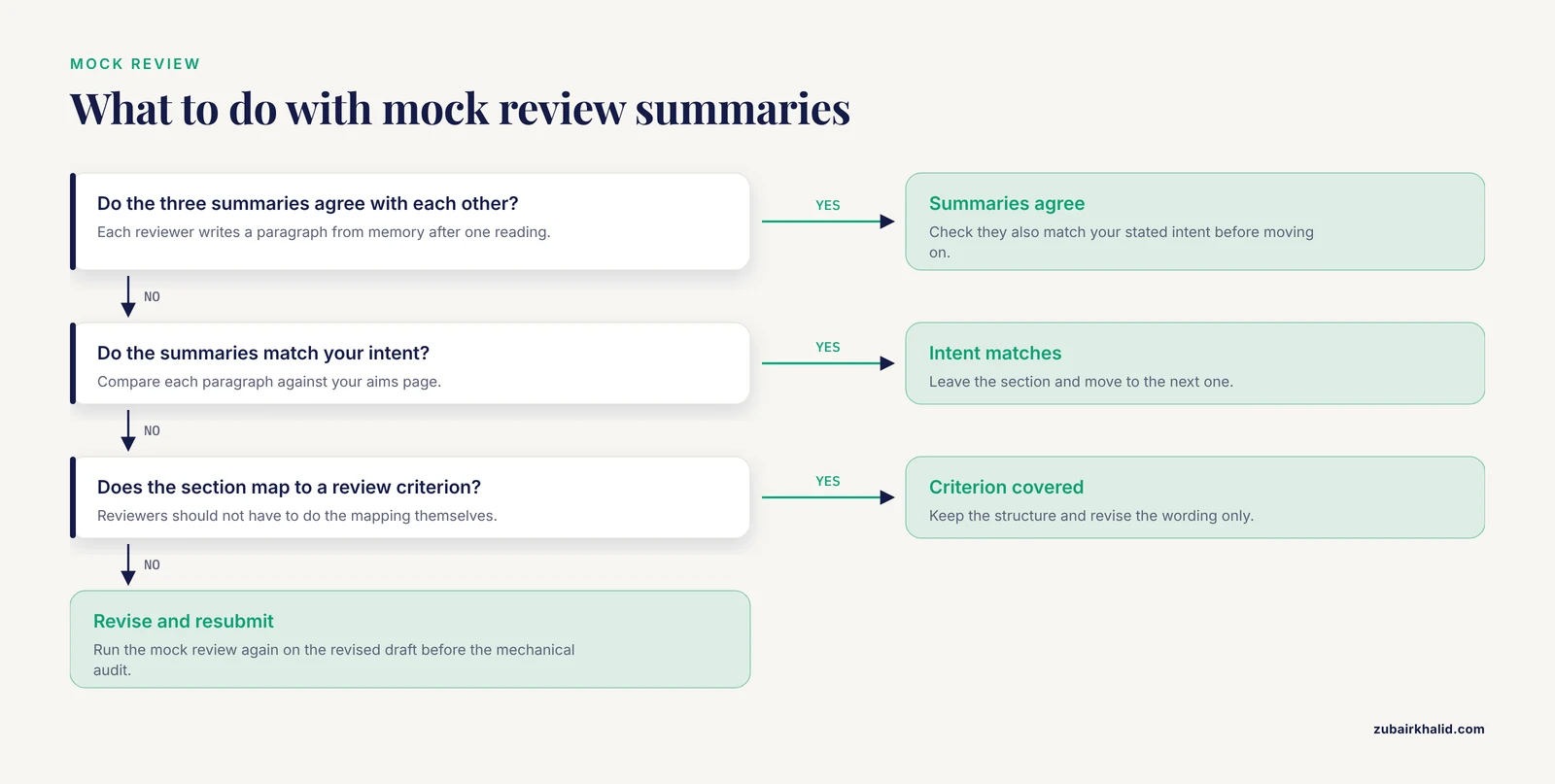
To run one yourself, give three reviewers the funder's scoring criteria, your full draft, and one week. Ask each to write a one-paragraph summary of your proposal from memory after a single reading. Where the three summaries disagree with each other or with your intent, that section of the proposal is ambiguous and needs rewriting.
Step 7. Perform the mechanical audit last
Formatting is unglamorous but mechanical failures are entirely preventable. Confirm page limits, font size and type, margin requirements, reference style, file formats, file naming rules, and portal submission deadlines. Then confirm the actual uploaded files open correctly on a computer other than yours. Submit at least 48 hours before the deadline, because portal traffic and last-minute compliance flags are predictable risks you can eliminate for free.
Grant Proposal Planning: The Timeline Behind the Checklist
A checklist audits a finished draft. Grant proposal planning determines whether a finished draft exists with time to spare. The two fail together, so plan backward from the deadline.
| Phase | Typical lead time before deadline | Focus |
|---|---|---|
| Idea and fit assessment | 6 to 12 months | Match idea to call, contact program officer, assemble team |
| Outline and aims page | 4 to 6 months | Draft and stress-test the one-page core |
| Full first draft | 3 to 4 months | Narrative, budget, biosketches, letters requested |
| Internal review round | 2 to 3 months | Mock review, revise, second round of letters |
| Compliance and formatting | 3 to 4 weeks | Figures, appendices, portal accounts, final budget |
| Submission buffer | Final week | Upload, confirm, archive confirmation receipts |
Shorter timelines are possible for experienced teams on renewal applications. For a first application to a major funder, compressing the internal review phase below two months is the step that costs the most quality per day saved. Structured support programs consistently build long runways into their design. The University of Cincinnati's R Club spread its support across multiple NIH grant cycles, combining workshops, one-on-one mentoring, and pre-review, and investigators participating in that comprehensive support went on to successful funding across mechanisms including K23, R01, R03, R21, R35, and R56 [8]. The lesson for an individual applicant is not to replicate the program but to replicate its sequencing: feedback early, revision in the middle, mechanical checks at the end.
Grant Writing Checklist Tips That Change Outcomes
The mechanical checklist gets you to submission. These habits get you to a competitive score.
Write for a tired reviewer. Reviewers read many proposals in a short window. Front-load your significance and approach, use informative section headers, and make figures self-explanatory. If a reviewer must flip back pages to reconstruct your logic, tighten the structure.
Use review criteria as your outline. Most funders publish the criteria reviewers score. Organizing your narrative so each criterion has an obvious home means reviewers find what they are looking for without effort, which is precisely the point.
Get hierarchical feedback. Not all comments are equal. Experienced grant writers, mentors, and program directors catch different problems than peers do. Multi-level feedback, in which a draft moves from peer comments to expert review to comprehensive editing, is the design used in formal programs precisely because each level catches a different class of error [4].
Treat grantsmanship as a learnable craft. The skills required to write successful grants, often called grantsmanship, include critical thinking, problem solving, and communication, and they develop through structured practice rather than talent [1]. This matters because applicants who treat a failed proposal as a verdict on their ideas tend to stop applying, while those who treat it as a draft in a longer process tend to improve.
Build the team before the proposal. Collaborative grants in particular require established roles, data-sharing plans, and letters that reflect real working relationships. Institution-level studies of grant writing capacity identify promoting collaboration and leveraging international partnerships as themes that raise competitiveness [3]. For you, that means conversations with potential co-investigators should precede the writing, not accompany it.
Mine the hidden curriculum deliberately. In many fields, grant writing skills are part of the hidden curriculum, taught informally while working alongside a principal investigator rather than in formal coursework [9]. If you are a trainee, ask to read your mentor's funded and unfunded proposals, including reviewer comments on both. The comparison teaches more per hour than almost any other exercise available to you.
The Role of a Research Grant Writing Course
Formal instruction shortens the learning curve, and the evidence for structured programs is now substantial. A descriptive review of grant writing courses in the United States examined course syllabi and the factors shaping instructors' choices of course texts, reflecting how widely these courses have spread across institutions [10]. Surveys of participants in structured programs report strong perceived value. In the surgical residency curriculum described earlier, the large majority of past participants rated the workshops useful, and many used their draft grants in real applications [6]. Faculty-level programs report that workshop participants number over a hundred and that comprehensive support contributed to successful funding across multiple NIH mechanisms [8].
What a good research grant writing course gives you that self-teaching does not:
- Deconstruction of funded proposals, so you see what a competitive aims page and research strategy actually look like rather than imagining them.
- Iterative feedback on your own draft, which converts passive knowledge into revision.
- Exposure to review criteria and reviewer behavior, often through a mock review exercise.
- Accountability, in the form of deadlines and cohort expectations, which is the difference between a plan and a finished draft.
If a formal course is unavailable, replicate its skeleton: find two funded proposals in your field, one unfunded one if you can, the funder's review criteria, and two colleagues willing to trade critiques on a fixed schedule.
AI Tools in the Audit Process
AI tools now appear at two points in the grant workflow. In grant discovery, algorithmic matching of researchers to funding calls has been reported to raise award hit rates in institutional case studies, with one synthesis of African higher education sources reporting hit rates rising from 12 percent to 19 percent where matching tools filtered calls [11]. As a pre-submission aid, AI tools can compress feedback cycles, with the same synthesis estimating supervisor feedback time reduced by around 45 percent in case studies [11].
The risks are equally concrete. Reviews of AI use in academic writing document plagiarism, data-provenance, and authorship-blur problems, including instances where AI-generated text has appeared in grant applications, and they recommend plagiarism detection, transparency about AI use, and training on ethical usage as countermeasures [12]. For the audit checklist, this translates into three items: verify every citation an AI tool produced against the original source, never allow generated text to describe results or data that do not yet exist, and follow your funder's and institution's disclosure policies on AI assistance. AI can accelerate drafting and matching. It cannot substitute for a human mock review, and treating its output as review-ready is one of the newer grant writing checklist common mistakes.
Common Mistakes and Limitations
These are the errors reviewers and program officers see most often, phrased so you can check for each one.
- Writing to the science, not to the criteria. A brilliant description of an experiment is not the same as a competitive proposal. If your sections do not map onto the funder's published review criteria, reviewers must do that mapping for you, and many will not.
- The vague hypothesis. If the central question can be restated three different ways by three readers, the proposal will be scored on the weakest reading.
- Budget arithmetic that does not reconcile. Recompute every total from source cells. Transcription errors in budgets signal carelessness to reviewers and can trigger administrative holds.
- Letters that commit to nothing. A support letter without a named contribution, a named project, and a signatory with authority is filler, and experienced reviewers recognize filler instantly.
- Skipping the mock review. The single highest-yield step in this checklist is also the most commonly skipped. Evidence from structured programs shows mock review panels change outcomes, not just confidence, [6].
- Formatting complacency. Page limits, fonts, and portal quirks cause administrative rejections that no scientific quality can rescue. Check them twice, on a different computer.
- Submitting at the deadline. Portal congestion and upload failures are routine. The 48-hour buffer is not optional if the award matters to you.
- Treating rejection as terminal. Peer-reviewed project funding is a system with known criticisms, including arguments that it incentivizes questionable research practices and that reform proposals are mounting [2]. Review outcomes are noisy. Resubmission with reviewer comments addressed is a normal and expected part of most funding careers.
One limitation of any checklist deserves stating plainly. A checklist verifies what can be verified. It cannot make an uninteresting idea interesting, and it cannot guarantee funding in a system where excellent proposals routinely go unfunded. What it does is make sure that when reviewers judge your idea, they are judging only the idea.
Frequently Asked Questions
What is a grant writing checklist?
A grant writing checklist is a structured list of items you verify before submitting a proposal, covering fit with the call, narrative quality, budget accuracy, compliance documents, and formatting. Its purpose is to catch preventable errors before reviewers do.
How far in advance should grant proposal planning start?
Start grant proposal planning six to twelve months before the deadline for a first application to a major funder, which allows time for team assembly, aims testing, mock review, and revision. Experienced teams on renewals can compress this considerably.
What are the most common grant writing checklist failures?
The most common failures are skipping the mock review, budget subtotals that do not reconcile, outdated biosketch templates, vague hypotheses, and last-minute submission that leaves no buffer for portal problems. All five are fully preventable.
Do I need a research grant writing course before applying?
You do not need one, but structured courses demonstrably shorten the learning curve by teaching proposal deconstruction, review criteria, and revision through feedback. If no course is available, replicate its structure with funded examples, published criteria, and scheduled peer critique.
How does a mock review improve my proposal?
A mock review exposes ambiguity that you can no longer see in your own draft. When multiple reviewers summarize your proposal from a single reading and their summaries disagree, the disagreeing sections are precisely where a real reviewer will also stumble.
What is grantsmanship?
Grantsmanship is the set of skills required to write successful grant proposals, including critical thinking, problem solving, and communication. It is a learnable craft that develops through practice and structured feedback, not an innate talent.
Can I use AI tools when writing a grant proposal?
You can use AI tools for drafting support and funding-call discovery, provided you verify every citation against the original source, never let generated text describe nonexistent data, and follow your funder's disclosure rules. Untreated AI text carries plagiarism and integrity risks.
What should I do after a rejection?
Read the reviewer comments, categorize each as scientific, structural, or administrative, and revise the proposal with those categories in mind before resubmission. Treat the rejection as feedback on a draft rather than a verdict on the idea, and contact the program officer if comments are unclear.
Sources
- Grant writing
- Grant writing and grant peer review as questionable research practices
- Building Research Capacity and Promoting Collaboration Through Grant Writing: Lessons From Ukrainian Universities
- 99 Grant Writing Program to Enhance Junior Faculty Research Funding Success
- A Review Committee as a Way to Teach Grant Writing Skills
- Training Surgeon Scholars: Grant Writing Workshops During Residency
- NSF-Style Peer Review for Teaching Undergraduate Grant-Writing
- 172 Evaluating grant writing support programs to enhance faculty research funding success
- Grant Writing and the Hidden Curriculum: Mentoring and Collaborating Across Disciplines
- Grant-Writing Courses in the United States: A Descriptive Review of Syllabi and Factors That Influence Instructor Choice of Course Texts
- Ethical AI Integration in African Higher Education: Enhancing Research Supervision, Grant Discovery, and Proposal Writing Without Compromising Academic Integrity
- Ethical Dilemmas in Using AI for Academic Writing and an Example Framework for Peer Review in Nephrology Academia: A Narrative Review