Grant Triage: What It Means and Your Options
By Dr. Zubair Khalid, DVM, MS, PhD ·

A grant triage decision means reviewers sorted your proposal out of the full competition before it received a complete scientific review, so it will not be scored or discussed this cycle. It is a routing call about fit, framing, and priority, not a verdict delivered after every aim was debated in detail. The rule of thumb for your next move is simple. If the triage feedback points to a mismatch between your proposal and the funder, fix the match and redirect. If the feedback exposes a real weakness in the science, rebuild the science before you send the proposal anywhere.
This article explains the grant triage meaning in plain terms, walks through how the process works at major funding agencies, and lays out the five practical options you hold after a triage decision, with the pros and cons of each.
Grant Triage Meaning: The Word Before the Process
Triage is a sorting system, not a judgment system. The word comes from medicine, where scarce resources such as surgeon time, imaging slots, and hospital beds force clinicians to sort a large queue of patients quickly so that limited expert time goes where it changes outcomes. That same mathematics governs grant review, which is why funding agencies borrowed the term.
What Triage Looks Like in Other Fields
The clearest way to understand what happens to your proposal is to see what triage does elsewhere. In an Irish hospital service evaluation, a specialist physiotherapist-led musculoskeletal triage clinic saw 714 patients over seven months, and 76 percent of them were managed by the physiotherapists without ever needing an orthopaedic consultation [1]. The triage clinician absorbed the bulk of the queue so that the scarcest resource, the orthopaedic surgeon, saw only the patients whose problems genuinely required that level of expertise.
Triage also adapts to new formats. During the COVID-19 pandemic, telemedicine became a standard way to evaluate and triage hand and wrist complaints remotely, though reviewers of the practice noted that outcomes depend heavily on having disciplined, step-by-step protocols for collecting clinical information through a virtual interface [2]. The lesson for grants is direct. A triage process is only as good as the structured criteria behind it.
Sorting is increasingly automated as well. A convolutional neural network trained on nearly 10,000 head CT studies triaged them as normal or abnormal with a mean AUROC of 0.84, which is strong performance but still leaves a meaningful error rate in both directions [3]. Every triage system, human or algorithmic, makes fast judgments that trade some accuracy for speed.
Finally, triage often uses a second measurement to stratify risk rather than a single verdict. In cervical cancer screening, HPV testing of equivocal cytology results separates patients into sharply different risk groups, with HPV-positive cases showing markedly higher five-year risk of high-grade lesions than cytology-negative cases [4]. Grant triage works the same way. The score a reviewer assigns is a second measurement layered on top of your written proposal to separate applications into risk categories, and the category determines what happens next.
Translating the Logic to Funding
A funding agency faces a queue far longer than its reviewers can possibly discuss in depth. Panel time is the scarce resource. Triage exists so that the time is spent on applications that have a real chance of being funded, while applications with weak fit, thin preliminary data, or framing problems are moved out early with a short explanation rather than a full critique.
So when you see the word triaged on your application, the accurate reading is this. One or more reviewers looked at your proposal briefly, compared it against the pile, and judged that a full panel discussion would not change its outcome this cycle. That is a serious signal, and it deserves a serious response. But it is a different kind of signal than a rejection that follows a line-by-line scientific debate.
How Grant Triage Actually Works
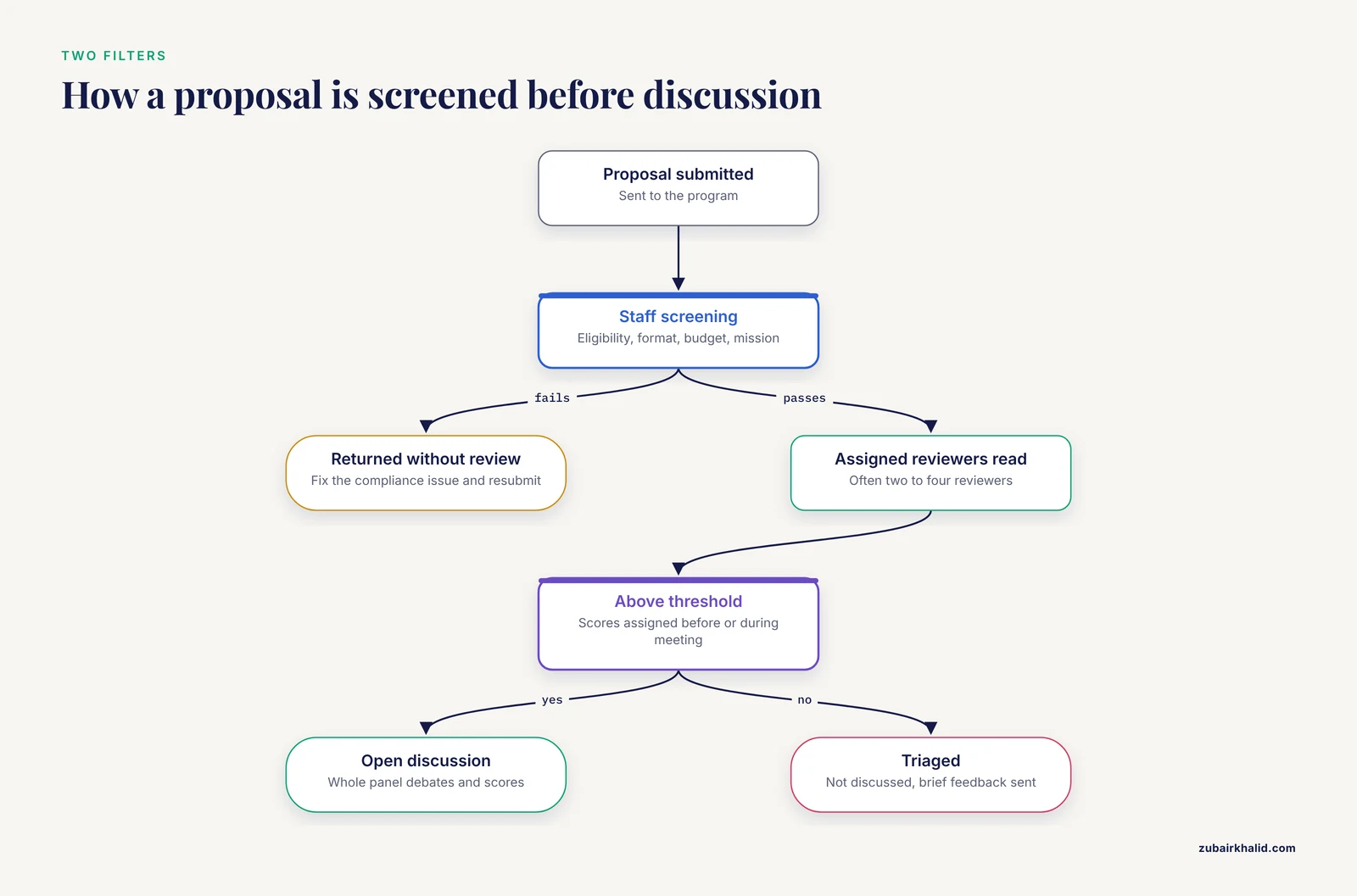
Most agencies run two filters in sequence, and knowing which one caught your proposal changes what you should do.
Stage 1: Administrative and Mission Fit Screening
Before any scientist reads your proposal, agency staff check eligibility, formatting, page limits, budget rules, human subjects protections, and whether the topic falls inside the program's stated mission. Applications that fail here are returned without scientific review. If your proposal was stopped at this stage, the fix is usually mechanical and quick. Read the funding announcement line by line, correct the compliance issue, and resubmit.
Stage 2: Scientific Triage at the Review Panel
At agencies that use study sections or review panels, the process typically works like this. Each assigned application is read in advance by a small number of reviewers, often two to four. Reviewers assign scores before or during the meeting. Proposals that land above a threshold move into open discussion, where the whole panel debates and scores them. Proposals below the threshold are not discussed, and the application is recorded as triaged, unscored, or not recommended for further consideration, depending on the agency's vocabulary.
At busy panels, a large share of assigned applications never reach open discussion. Those applications still receive some written feedback, usually a summary statement or a brief notification with reviewer comments, though the depth of that feedback varies widely by agency and program. A triaged application can be revised and submitted again in a later cycle. Nothing about the decision is permanent.
The distinction that matters is between triage and post-review rejection. Rejection after full review means your peers examined the science closely and found it wanting. Triage means the science was judged quickly, before the debate happened, by the few people assigned to read it. Fast judgments carry more error than slow ones, which cuts both ways. Some proposals are triaged that would have survived discussion, and some are discussed that would not have survived it.
Your Options After a Triage Decision
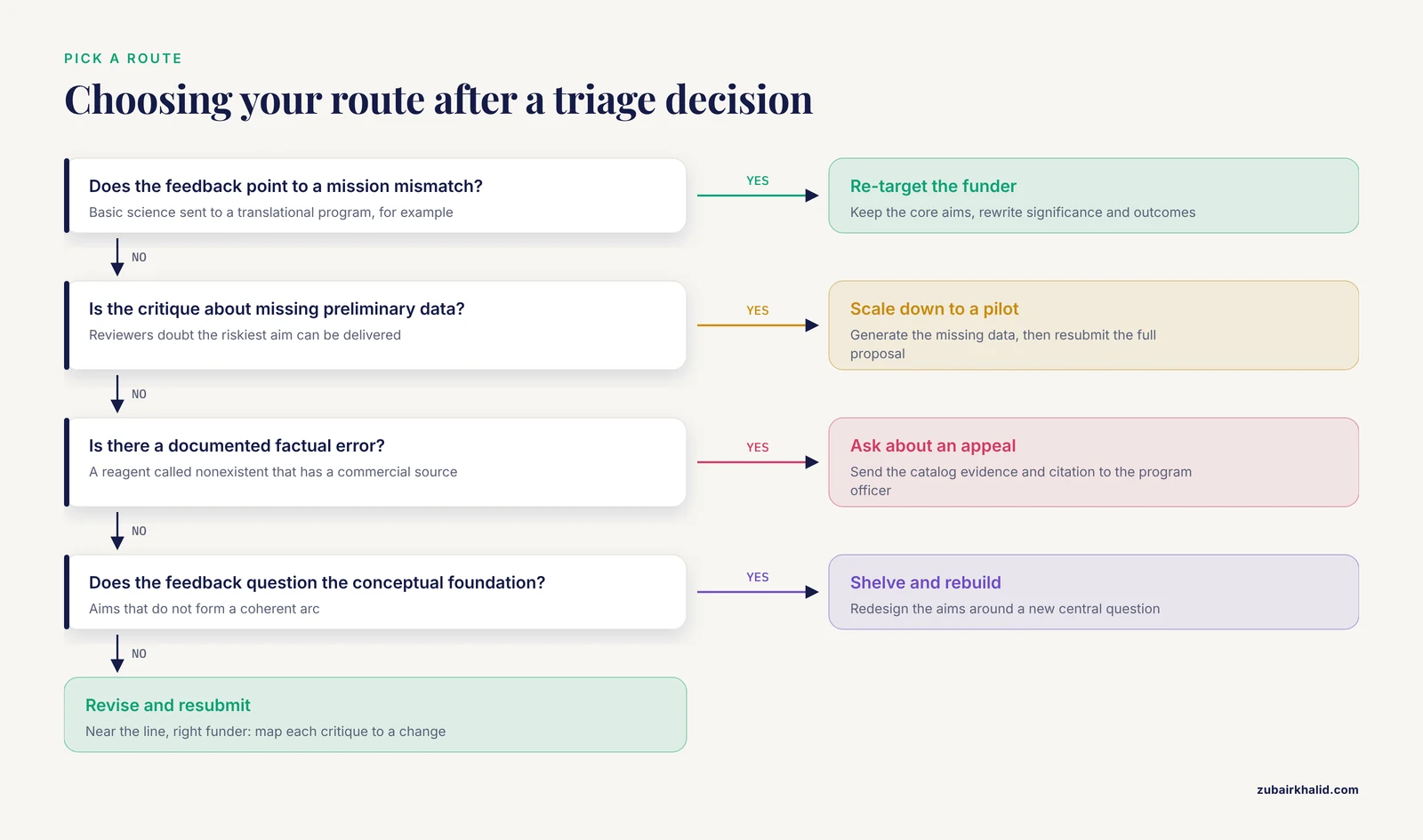
You hold five realistic options. Each one fits a different diagnosis, so the first job is always to figure out why the proposal left the queue.
Option 1: Revise and Resubmit to the Same Program
Choose this route when the feedback suggests your proposal was close but not close enough, for example marginal fit, an aims page that buried the significance, or missing preliminary data that reviewers wanted.
The advantage is continuity. The program knows your name, your topic is clearly within their mission, and a revised application builds on reviewer comments rather than starting from zero. The trade-off is timing. The next cycle may be months away, and triage feedback is sometimes too brief to act on, which makes it easy to revise the wrong things.
Approach the revision the way experienced academics approach any peer review response. Treat the outcome as one step in a longer scholarly process rather than a final judgment, map every reviewer comment to a specific change in the revised document, and rebuild the submission around that feedback systematically [5]. A cosmetic resubmission that only changes a few sentences is the most common way applicants get triaged twice.
Option 2: Re-Target the Proposal to a Different Funder
Choose this route when the triage reason points to fit. If your proposal is basic mechanistic biology and the program explicitly funds translational work, no amount of polishing will change the mismatch. The most efficient fix is often a different funding announcement with a mission that actually matches your question.
The advantage is that your core science may need almost no change while your framing, aims structure, and significance paragraph change substantially. The trade-off is real work. Every funder has its own priorities, page formats, review criteria, and review culture, and proposals recycled without adaptation tend to get triaged again. Tailoring the submission to the specific target, rather than sending one generic document everywhere, is one of the established principles of surviving peer review [5].
Option 3: Scale Down to a Pilot, Internal, or Career-Development Award
Choose this route when the recurring critique is feasibility, meaning reviewers doubt you can deliver the preliminary data the full proposal needs. A pilot grant, an institutional seed award, or a career-development mechanism can generate exactly the data that would have made your full proposal discussable.
The advantage is that this option attacks the root cause instead of the symptom. Small awards also tend to have faster decisions and lighter review requirements. The trade-offs are scope and time. A pilot budget cannot answer the full question, the administrative overhead of a new submission is nontrivial, and you need to design the pilot so its results genuinely strengthen the larger application rather than becoming a separate orphan project.
Option 4: Ask the Program Officer for Feedback, and Appeal if the Facts Are Wrong
Choose this route when you need information more than you need another submission. Program officers know how their panels behave, which criteria drive triage at their agency, and whether your proposal landed near the discussion line or far below it.
Write a short, specific message. State that your application was triaged, name the application or cycle, and ask two or three concrete questions, such as which review criterion drove the outcome and whether the panel flagged anything specific. Where the agency allows it, you can also pursue a formal appeal. Keep expectations calibrated. Appeals generally succeed only when there is a documented factual error in the critique or a reviewer conflict of interest, not when you simply disagree with the priority call.
The advantage of this option is that it is cheap, fast, and produces information that shapes every other option. The trade-off is that it does not move your proposal by itself, and a vague or combative approach wastes the one conversation that could help you most.
Option 5: Shelve the Proposal and Rebuild the Science
Choose this route when the feedback, however brief, suggests the conceptual foundation itself has problems, for example aims that do not form a coherent arc, a hypothesis the field no longer finds plausible, or an approach reviewers consider outdated.
The advantage is honest triage. A proposal that gets sorted out repeatedly at multiple funders is telling you something about the science, not just the packaging. Taking a cycle off to rethink the aims, gather new preliminary data, or bring in a needed collaborator often produces an application that clears the discussion bar instead of hovering near it. The trade-off is opportunity cost. The field moves, co-investigators take on other commitments, and your timeline for the project line extends.
Side-by-Side Comparison of Your Options
| Option | Best when | Main advantage | Main trade-off | Typical first step |
|---|---|---|---|---|
| Revise and resubmit to same program | Feedback suggests you were near the line | Builds on existing reviewer comments and program familiarity | Long wait to the next cycle, vague feedback | Map each critique to a specific revision |
| Re-target to a different funder | The problem is mission fit | Core science stays intact, framing gets fixed | Full reformatting and new review culture | Shortlist funders whose announcements match your question |
| Pilot or internal award | Feasibility and preliminary data drove the triage | Produces the missing data and keeps momentum | Budget too small for the real question | Identify a mechanism with a near-term deadline |
| Program officer contact or appeal | You need to know the real reason | Free, fast, decision-shaping information | Rarely reverses the decision by itself | Send specific written questions within days |
| Shelve and rebuild | The conceptual foundation is weak | Protects your time and produces a stronger application | Opportunity cost and timeline drift | Redesign the aims around the new central question |
Notice that the options are not mutually exclusive. The strongest responses usually combine them. You might call the program officer this week, start a pilot application for the next internal deadline, and begin the full resubmission once pilot data arrive.
How to Handle a Triage Decision Step by Step
Knowing the options is one thing. Executing a decision under the sting of bad news is another. This sequence keeps you from acting on emotion.
- Read the full written feedback before reacting to any of it. Read it twice, once the day it arrives and once two days later. Your first read captures the emotional hit, the second captures the substance.
- Sort the critique into three buckets: fit, framing, and feasibility. Fit problems mean the wrong funder. Framing problems mean the right funder but the wrong packaging. Feasibility problems mean the science needs more support. Most triage decisions trace to one dominant bucket, and knowing which one determines your route.
- Contact the program officer within a week. Prepare your questions in writing before the call or email. Ask what drove the outcome and whether the reviewers flagged anything specific. Record the answers.
- Give yourself a fixed decision deadline. A practical deadline is about two weeks from receiving the summary statement. Beyond that, momentum dies and the proposal sits in a drawer.
- Build a point-by-point revision map. Every critique sentence gets either a change in the revised document or a deliberate, documented reason why no change is warranted. This is the same discipline that separates productive from unproductive responses to peer review in publishing, where structured engagement with reviewer comments is one of the core strategies for long-term scholarly success [5].
- Manage the psychological load deliberately. Research on hope under uncertain conditions describes three components that keep people functioning when outcomes cannot be controlled: existential trust, meaning, and agency, where agency is the commitment to act in ways that improve the situation even when results are not guaranteed [6]. A triage decision is precisely that kind of uncertainty. The practical translation is to anchor the project's meaning in the question itself rather than in any single funding decision, and to convert frustration into the next concrete action, which is always one of the five options above.
Grant Proposal Planning That Keeps You Out of the Triage Pile
The better long-term strategy is to reduce the odds of triage before you submit. Grant proposal planning has several high-leverage habits.
Start from the announcement, not from your idea. Read the funding announcement's review criteria first, then shape your aims to satisfy them. Reviewers score against those criteria, and a proposal that answers them point by point is easier to keep in the discussion pile.
Test the fit with a colleague who knows the funder. Before writing, ask someone who has served on that panel whether your question belongs there. Ten minutes of that conversation can save you a full cycle.
Write the aims page for a tired reader. Triage reviewers read many applications in limited time. Put the question, the central hypothesis, the approach, and the payoff in the first paragraph. If a reviewer cannot state your significance after reading one page, the proposal is at triage risk regardless of how good the science is.
Secure the preliminary data before you need it. The single most common feasibility critique at triage is missing pilot data for the riskiest aim. Plan which data the proposal requires and generate them, or partner with a collaborator who already has them.
Invest in formal training. Many early-career researchers receive little structured instruction in how peer review works, how to interpret critique, and how to rebuild after a negative decision, which is why educators in academic medicine now push explicit training that reframes rejection as part of scholarly growth [5]. A structured research grant writing course serves the same function for grants. It teaches you the reviewer's side of the table, which is the side that decides your fate, and it forces the revision discipline that separates funded from unfunded applicants.
Plan a submission calendar, not a submission event. Map two or three plausible funders, their deadlines, and their review cycles before you write anything. Then draft once and adapt deliberately for each target, rather than submitting one document to three agencies in the same month with no changes.
Why Funders Triage: The Pros and Cons
It helps to understand why agencies run triage at all, because the strengths and weaknesses of the system shape how you should respond to it.
Pros of triage. Triage protects the panel's scarcest resource, discussion time, and concentrates it on applications where debate can actually change the outcome. It also gives applicants faster closure on proposals with poor fit, which means less time wasted in a queue that would never produce funding. The economic logic is well documented in clinical triage, where a computed tomography angiography pathway for triaging chest pain patients cost 2.5 times less on the initial visit and 1.98 times less over 30 days than the local standard of care pathway [7]. Sorting early is cheaper than evaluating everything fully. Triage also sharpens targeting, the way HPV-based stratification concentrates follow-up on the patients with genuinely elevated risk [4].
Cons of triage. Speed costs accuracy. Automated triage systems illustrate the point concretely, since even a well-performing head CT triage network at AUROC 0.84 misclassifies a meaningful fraction of studies [3]. Human triage panels make similar errors at the cut line, and the applications near that line rise or fall on thin margins. Triage also tends to disadvantage early-career applicants, because reviewers lean on track record and reputation signals when judging quickly, and those signals favor established laboratories. Finally, triage feedback is often thin, which leaves applicants guessing at the real reason and sometimes revising the wrong thing.
Worked Scenarios
Scenario 1. The mechanistic proposal at a translational program. A junior investigator submits a basic receptor-biology proposal to an institute whose announced priority is clinical translation. The application is triaged with a one-paragraph summary statement. Diagnosis: fit. Route: contact the program officer to confirm the fit problem, then re-target to a basic-science program at another agency, rewriting the significance paragraph and outcomes around that program's mission while leaving the core aims intact.
Scenario 2. The three-aim proposal with no data for aim three. A proposal is triaged and the brief critique notes that aims one and two rest on solid preliminary work but aim three depends on an unvalidated technique. Diagnosis: feasibility. Route: apply for an institutional pilot award to validate the technique, resubmit the full proposal to the same program once the pilot data exist, and restructure aim three so it no longer carries the whole application.
Scenario 3. The factual error. A proposal is triaged, and the summary statement asserts that a key reagent does not exist, when a commercial source and published characterization both exist. Diagnosis: reviewer error. Route: contact the program officer with the catalog evidence and the citation, ask about the agency's appeal process, and submit a documented appeal. Absent a correction, the proposal would be retriaged against the same mistaken premise.
Common Mistakes and Limitations
Mistake 1: Treating triage as a full scientific rejection. Applicants sometimes overhaul the entire research plan in response to two sentences of rapid review. If the critique is thin, the diagnosis is usually fit or framing, not a deep flaw in the science. Match the scale of your revision to the depth of the feedback.
Mistake 2: Treating triage as meaningless and resubmitting unchanged. The opposite error is equally common. A triage decision that repeats across cycles at the same program is a consistent signal, and ignoring it wastes cycles you cannot get back.
Mistake 3: Arguing in the appeal. Appeals decided on emotion, sarcasm, or a point-by-point attack on reviewer intelligence almost never succeed. Appeals decided on documented factual errors and conflicts of interest sometimes do. Write the second kind.
Mistake 4: Calling the program officer unprepared. A rambling call produces vague sympathy. Two or three written, specific questions produce usable intelligence.
Mistake 5: Submitting the same document everywhere at once. A single proposal sent to several funders in the same month, unadapted, gets triaged at all of them for the same fit reasons, and you burn the goodwill that fresh, tailored submissions would have earned.
Limitations. Triage vocabulary, appeal rights, feedback depth, and cut-line behavior differ across agencies and even across panels within the same agency, and much of the process is not publicly documented. Individual decisions require input from your program officer, your mentors, and colleagues who know the specific funder, so treat every route described here as a starting framework rather than a guarantee for your specific case. The principles of responding to peer critique transfer well between manuscripts and grants, but the procedural details always belong to the individual funder [5].
Frequently Asked Questions
What does "triaged" mean on a grant application?
It means your application was sorted out before full panel discussion, usually after a rapid review by a small number of assigned readers, and it will not receive a scored review in this cycle. You will typically still receive brief written feedback or a summary statement.
Is triage the same as rejection?
No. Rejection after full review means peers examined your science in detail and judged it insufficient. Triage is a fast priority call made before that detailed examination happens, which makes it more reversible and also more error-prone at the margins.
Can I appeal a triage decision?
You can ask your program officer about the agency's appeal process, but appeals generally succeed only when you can document a factual error in the critique or a reviewer conflict of interest. Disagreement with the priority call alone is rarely enough.
Should I resubmit the same proposal to a different funder?
Only after you reframe it for that funder's mission, review criteria, and format. An unadapted resubmission tends to be triaged again for the same fit problems that affected it the first time.
How long should I wait before resubmitting?
Wait until every critique point has a concrete, substantive change behind it, which usually means at least one full review cycle and often longer if you need new preliminary data. A fast, cosmetic resubmission is the most common path to a second triage.
How do I find out why my proposal was triaged?
Read the written feedback in full first, then contact the program officer with two or three specific questions about which review criterion drove the outcome and whether the panel flagged anything particular. Program officers can often tell you whether you were near the discussion line or far below it.
Sources
- Orthopaedic triage at a physiotherapist-led 'Musculoskeletal Assessment Clinic': a seven-month service evaluation of outcomes.
- Evaluation of the Hand and Wrist via Telephone and Video Visit.
- Impact of Upstream Medical Image Processing on Downstream Performance of a Head CT Triage Neural Network.
- Population-based e-records to evaluate HPV triage of screen-detected atypical squamous cervical lesions in Catalonia, Spain, 2010-15.
- Educator's Blueprint: Seven Strategies for Turning Peer Review Into Scholarly Growth.
- Toward an integrative psychological framework of existential hope: navigating uncertain futures.
- Advanced Imaging Reduces Cost Compared to Standard of Care in Emergency Department of Triage of Acute Chest Pain.