How to Prepare a Grant Submission Checklist: A Template
By Dr. Zubair Khalid, DVM, MS, PhD ·

By the end of this article you will be able to build a complete grant submission checklist template for any funding application, work backward from the sponsor deadline to set internal milestones, and reuse the same template format for federal agencies, foundations, professional societies, and institutional programs. You need three things on hand: the funding opportunity announcement you plan to answer, a shared document or spreadsheet tool such as Word, Google Docs, Excel, or Notion, and the name of your institutional grants or sponsored programs office.
A checklist matters because most rejected applications fail on fixable problems. Reviewers reject proposals for unclear aims, weak fit with the funding program, and administrative errors long before they question the science itself. A checklist turns those recurring failure points into a repeatable routine you complete before every submission.
Why a Checklist Beats Memory in Grant Proposal Planning
Grant proposal planning is a long process with many independent parts. You must read the funding opportunity, confirm eligibility, assemble a budget, collect letters, route forms through your institution, and upload files to a portal, often with co-investigators on separate schedules. Each part has its own deadline and its own owner. When you track all of that in your head, you lose items.
A written checklist does three things memory cannot. First, it externalizes the plan so a co-investigator or grants officer can see exactly what remains. Second, it creates a fixed review point where someone checks each item rather than assuming it is done. Third, it survives between cycles, so the checklist you build for this application becomes the starting point for the next one.
The habit also compounds. In a national randomized trial of grant writing coaching groups involving 367 faculty and postdoctoral fellows across 76 groups, 69 percent of participants submitted at least one national application and 32 percent received at least one award within the study window [1]. Participants who succeeded treated proposal preparation as a structured process with mentors and deadlines built in, which is exactly what a checklist encodes.
Step 1: Learn the Funding Landscape Before You Write Anything
The first checklist item is not a form. It is a decision about which grant to pursue. Early-career researchers can draw on several distinct sources of funding, including federal agencies, foundations, professional societies, institutional programs, and commercial sponsors [2]. Each source supports different award types, and each award type carries different expectations.
Common award types include pilot or seed grants, travel grants, career development awards, engagement or community partnership grants, and independent research grants [2]. A pilot grant may require only a short proposal and preliminary data. A career development award typically demands a mentorship plan and a career goals statement. An independent research grant asks for a full project narrative with detailed methods.
Add these items to your checklist under a section called "Fit and Eligibility":
- Sponsor name and funding mechanism
- Funding opportunity number and announcement link
- Eligibility requirements, checked against your position, degree, and institutional status
- Award ceiling, project period, and allowed costs
- Review criteria published in the announcement
- Number of submissions allowed per investigator per cycle
Do not move to writing until every box in this section is checked. Applying to a poorly matched program wastes weeks and produces a rejection you could have predicted. Guidance written for early-career hospitalist researchers makes this point directly: deciding whether a specific grant is the right fit is a distinct step that comes before deciding how to apply [2].
Step 2: Work Backward From the Deadline With a Real Calculation
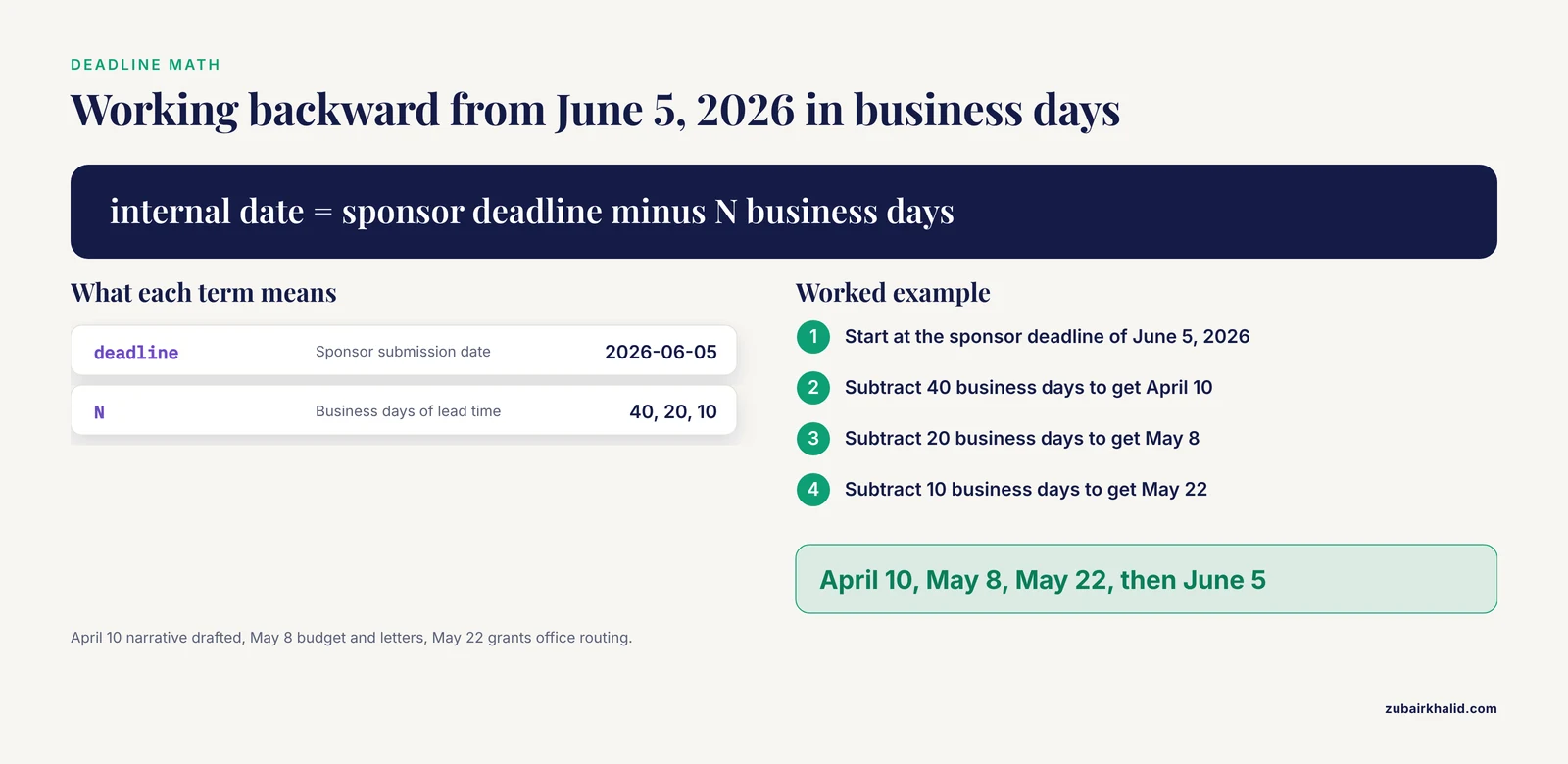
Every usable grant submission checklist template format starts with two dates: the sponsor deadline and your internal deadline. Your internal deadline exists because routing a proposal through an institutional grants office takes time for review, signatures, and compliance checks. Set the internal deadline well before the sponsor deadline so late letters and formatting problems can still be fixed.
Here is a worked example using a Python script to compute business-day offsets from a sponsor deadline of June 5, 2026:
from datetime import date, timedelta

def subtract_business_days(start, days):
    d = start
    while days > 0:
        d -= timedelta(days=1)
        if d.weekday() < 5:
            days -= 1
    return d

deadline = date(2026, 6, 5)
print("Sponsor deadline:       ", deadline)
print("10 business days before:", subtract_business_days(deadline, 10))
print("20 business days before:", subtract_business_days(deadline, 20))
print("40 business days before:", subtract_business_days(deadline, 40))
Expected output:
Sponsor deadline:        2026-06-05
10 business days before: 2026-05-22
20 business days before: 2026-05-08
40 business days before: 2026-04-10
Read this output as a schedule. By April 10 you should have the project narrative drafted. By May 8 the budget, biosketches, and letters should be collected. By May 22 the package goes to your grants office for routing. The sponsor deadline of June 5 is reserved for portal submission only, never for first drafts.
Adjust the offsets to your institution's rules. Some grants offices require two weeks of lead time, others require a month. Ask your sponsored programs office once, write the required lead time into your template, and reuse it.
Step 3: Copy This Grant Submission Checklist Template Example
The template below is the core deliverable of this article. Copy it into your document tool and fill in every field for each new application. This grant submission checklist template example uses plain markdown so it works in Word, Google Docs, Notion, GitHub, and most wiki tools without conversion.
# Grant Submission Checklist

## 1. Application Snapshot
- [ ] Principal investigator name and credentials
- [ ] Funding opportunity number and link
- [ ] Sponsor and mechanism
- [ ] Sponsor deadline (date and time, with time zone)
- [ ] Internal deadline to grants office
- [ ] Submission portal name and URL
- [ ] Grants officer contact

## 2. Fit and Eligibility
- [ ] Eligibility requirements reviewed against PI status
- [ ] Award ceiling and project period confirmed
- [ ] Review criteria copied from announcement
- [ ] Submission limit per investigator confirmed

## 3. Science and Narrative
- [ ] Specific aims drafted on one page
- [ ] Significance addresses the program's stated priorities
- [ ] Innovation section states what is genuinely new
- [ ] Approach includes alternatives for high-risk steps
- [ ] Preliminary data organized and cited
- [ ] Timeline and milestones included
- [ ] Full draft reviewed by one non-expert and one expert

## 4. People
- [ ] Co-investigators confirmed in writing
- [ ] Biosketches current for every key person
- [ ] Letters of support requested with deadline dates
- [ ] Mentors and consultants committed
- [ ] Conflict-of-interest disclosures collected

## 5. Budget and Justification
- [ ] Budget aligned to award ceiling
- [ ] Justification matches every budget line
- [ ] Facilities and administrative costs applied at institutional rate
- [ ] Subaward contacts informed of budget roles

## 6. Compliance and Forms
- [ ] Human subjects, animal, or biosecurity sections completed as applicable
- [ ] Data management plan drafted if required
- [ ] All required sponsor forms current versions
- [ ] Institutional routing and signatures obtained

## 7. Final Package
- [ ] Every file named per sponsor instructions
- [ ] Page limits verified file by file
- [ ] Fonts, margins, and figures checked against rules
- [ ] References formatted consistently
- [ ] PDF compiled and read end to end after compilation
- [ ] Portal submission completed with confirmation number saved
- [ ] Copy of full submission archived

## 8. After Submission
- [ ] Confirmation saved with date and time
- [ ] Calendar reminder set for reviewer feedback window
- [ ] Plan noted for responding to critiques or resubmitting
Sections 1, 2, 7, and 8 apply to nearly every application. Sections 3 through 6 scale with award type. A travel grant may need only sections 1, 2, 3 in shortened form, and 7. An independent research grant needs all eight sections filled completely.
Step 4: Convert the Template Into Other Formats
Different teams keep checklists in different tools. The same grant submission checklist template format converts cleanly into a spreadsheet, which adds an owner column and a status column. Here is the same checklist as comma-separated values you can paste directly into Excel or Google Sheets and then split by delimiter:
Section,Item,Owner,Status,Due date
1 Snapshot,Funding opportunity number entered,PI,Not started,
1 Snapshot,Sponsor deadline and time zone recorded,PI,Not started,
2 Fit,Eligibility confirmed,PI,Not started,
3 Narrative,Specific aims one-pager drafted,PI,Not started,
3 Narrative,Non-expert review completed,Co-I,Not started,
4 People,Biosketches current for all key persons,Coordinator,Not started,
4 People,Support letters requested,PI,Not started,
5 Budget,Budget matches award ceiling,Grants office,Not started,
6 Compliance,Data management plan drafted,PI,Not started,
7 Final,Page limits verified file by file,PI,Not started,
7 Final,Portal confirmation number saved,Coordinator,Not started,
8 After,Feedback window reminder set,PI,Not started,
If you prefer a script, generate the skeleton with a small Python function so you never start from a blank file:
sections = ["Snapshot", "Fit", "Narrative", "People", "Budget",
            "Compliance", "Final", "After"]

with open("checklist.md", "w") as f:
    f.write("# Grant Submission Checklist\n\n")
    for i, s in enumerate(sections, 1):
        f.write(f"## {i}. {s}\n")
        f.write("- [ ] (add item)\n\n")
Expected output is a file named checklist.md containing eight empty section headers, each with one unchecked item waiting to be filled in. This takes less than a minute to run and removes the friction of starting a new application.
Step 5: Fill the Narrative Section With Reviewer-Focused Writing
The narrative section of your checklist is where most of the writing effort lives. Two principles from peer review research transfer directly to grants. Reviewers respond to submissions tailored to the target audience, and they respond to a compelling opening that frames why the work matters now [3]. For a grant, the "target journal" is the funding program and its review panel. Read the announcement's review criteria and mirror their exact language in your aims page and significance section.
Practical items to complete under this principle:
- Write the specific aims page first and circulate it alone for feedback before drafting anything else.
- Ask one colleague outside your subfield to read the aims page. If they cannot restate your central question, revise it.
- Ask one colleague inside your subfield to check methods and preliminary data.
- Draft the summary or abstract last, once the narrative is stable.
Budget one full revision cycle between expert review and internal deadline. A draft that has never been read by anyone except the writer is not a draft, it is a risk.
Step 6: Handle Compliance and Administrative Items Early
Administrative items have hard gates. A missing institutional signature or an outdated form version can block submission regardless of how strong the science is. Your grants office is the authority on institutional requirements, so route the package through them at your internal deadline rather than the day before the sponsor deadline.
Check these gates in section 6 of the template:
- Human subjects protections, if your project involves people
- Animal care and use approvals, if your project involves animals
- Biosecurity or dual-use review, if applicable to your materials
- Data management and sharing plan, if the sponsor requires one
- Current versions of every required form
Confirm form versions directly in the application package. Sponsors update forms between cycles, and uploading a retired version is a common, entirely avoidable desk-reject trigger.
Step 7: Plan for What Happens After You Press Submit
The checklist does not end at submission. Section 8 exists because the post-submission period determines what you learn from the effort. Guidance on the grant process for early-career researchers treats interpreting reviewer feedback, choosing between resubmission and alternative approaches, and deciding where to apply next as standard steps that follow every outcome, funded or not [2].
Two evidence-backed habits belong in this section. First, treat critique as usable information rather than a verdict. Strategies developed for peer review in scholarly publishing, including responding point by point to reviewer comments and turning rejection into progress on the next version, apply with little modification to grant critiques [3]. Second, protect your persistence. Psychological work on hope under uncertain futures describes agency, the commitment to act in ways that improve outcomes, as a stance people sustain even when results are uncertain or threatening [4]. Grant cycles are exactly such an environment. Success rates are low for everyone, and the applicants who resubmit revised proposals are acting on feedback rather than absorbing it as a final judgment.
Concretely, when reviews arrive:
- Read the summary statement or critique once, then wait a day before acting on it.
- Sort every comment into three groups: must fix, should address, and disagree with justification.
- Write a point-by-point response document even if the sponsor does not require one. The exercise clarifies your revision plan.
- Decide within two weeks whether to resubmit to the same program, apply elsewhere, or revise the project design.
Step 8: Invest in Skills That Outlast Any Single Application
A checklist improves one submission. Skills improve every future one. Formal training options include a research grant writing course offered through your institution, a professional society, or an online provider. Structured coaching programs show measurable results. In the randomized trial described earlier, faculty participants whose scientific mentors engaged with the coaching program in a structured way had significantly higher odds of receiving any award, with an adjusted odds ratio of 1.87, and much higher odds of receiving a mentored career development award, with an adjusted odds ratio of 3.32, compared with participants whose mentors were engaged less formally [1].
If a formal course is not available, replicate the core structure yourself:
- Form a small writing group of three to five peers at similar career stages.
- Meet every two weeks with circulated drafts.
- Invite a funded senior colleague to sit in on at least one meeting per cycle.
- Track submissions and outcomes in a shared sheet so the group can see patterns over time.
The coaching trial ran over months, not days, and participants who stayed engaged benefited most [1]. Build that duration into your planning. A checklist prepared the week a proposal is due captures none of this value.
Summary Table: Checklist Phases, Key Items, and Timing
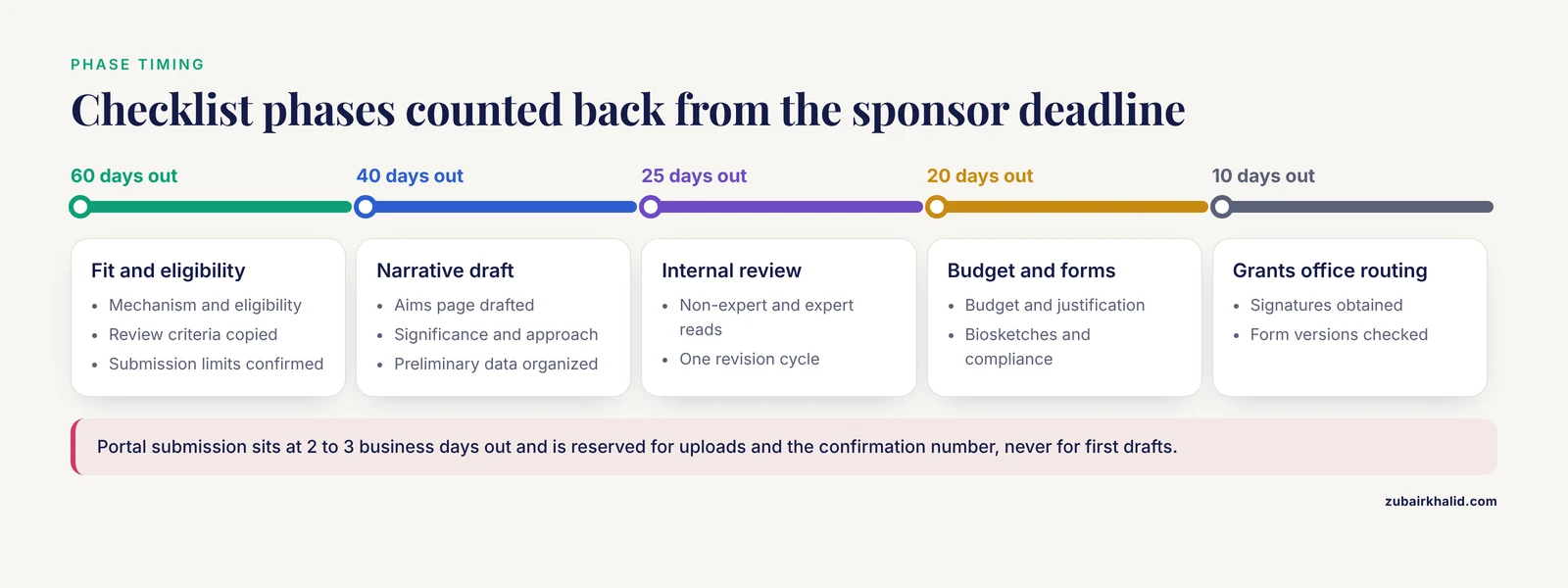
| Phase | Key items | Typical timing before sponsor deadline |
|---|---|---|
| Fit and eligibility | Mechanism, eligibility, review criteria, submission limits | 60 business days |
| Narrative draft | Aims page, significance, approach, preliminary data | 40 business days |
| Internal review | Non-expert and expert reads, revision cycle | 25 business days |
| Budget and forms | Budget, justification, biosketches, compliance sections | 20 business days |
| Grants office routing | Signatures, form versions, package review | 10 business days |
| Portal submission | Uploads, verification, confirmation number | 2 to 3 business days |
| Post-submission | Confirmation archived, feedback reminder, response plan | Day 0 and beyond |
Treat the business-day numbers in the table as a starting pattern to calibrate against your institution's actual requirements, not as universal rules.
Common Mistakes and Limitations
Starting the checklist at the deadline. A checklist created the week before submission only documents panic. Build it at the moment you decide to apply, while the announcement is fresh.
Setting the internal deadline equal to the sponsor deadline. Grants offices review, sign, and reject incomplete packages on their own schedule. If your office asks for ten business days, give it ten.
Treating the checklist as one person's job. Every line needs an owner. Items marked "someone" get done by no one.
Writing the narrative before confirming fit. Reviewers can tell when a proposal was written for a different program. Confirm the mechanism matches your aims before the first drafting session [2].
Ignoring the reviewer's stated criteria. Review panels score against the criteria published in the announcement. Proposals that never address those criteria explicitly score poorly even when the science is sound.
Reusing stale biosketches and outdated forms. Check dates on every personnel document and version number on every form during the final package review.
Assuming one rejection ends the program. Feedback interpretation and resubmission are normal parts of the process, not signs of failure [2]. Build the resubmission decision into your calendar rather than leaving it to morale.
Overloading the template. A checklist with 200 lines stops being used. Keep it to the items that have actually caused problems for you, and add a line only after something goes wrong once.
One limitation applies to this article. Every institution and sponsor maintains its own routing rules, lead times, and form requirements, and individual circumstances vary. Your grants office and the specific funding announcement are the controlling documents for any application you actually submit.
Frequently Asked Questions
What is a grant submission checklist template?
A grant submission checklist template is a reusable list of every task required to submit a funding application, organized into sections such as fit, narrative, budget, compliance, final package, and post-submission follow-up. You copy it once, fill it in for each application, and reuse it across your career.
How far in advance should I begin grant proposal planning?
Start grant proposal planning at least two to three months before the sponsor deadline for a standard research grant, and longer for complex mechanisms like career development awards. Work backward from the deadline in business days so drafts, internal review, and institutional routing each get protected time.
What does a good grant submission checklist template format look like?
A good grant submission checklist template format has numbered sections, checkbox items, an owner for each item, and due dates tied to business-day offsets from the sponsor deadline. Markdown works well for individual researchers and spreadsheets work well for teams because you can filter and sort by owner and status.
Are free grant submission checklist template options reliable?
A free grant submission checklist template is reliable when you adapt it to your sponsor and institution. Treat any downloaded template as a starting skeleton, then add your grants office's lead times, your sponsor's form versions, and the specific review criteria from your funding announcement before you use it.
How do I prepare a grant submission checklist for my first application?
To prepare a grant submission checklist for your first application, read the funding announcement fully, list every document and form it requires, group those items into the eight sections shown in this article, assign business-day deadlines, and ask your grants office to confirm institutional lead times. Then fill the template in as you work rather than at the end.
Do checklists help after a rejection?
Yes. The post-submission section of the checklist schedules when you will read the critiques, sort comments into fixable and disputable groups, and decide on resubmission or an alternative route. Reviewer feedback functions as revision guidance when you respond to it systematically rather than treating it as a final judgment.
Should I take a research grant writing course?
A research grant writing course or coaching group is worth the time if you are early in your career. Evidence from a large randomized trial shows structured programs raise submission and award rates, and faculty whose mentors engaged in a structured way had substantially higher odds of winning awards, especially mentored career development awards.
What should I do in the final 48 hours before the deadline?
In the final 48 hours, verify page limits and formatting file by file, compile the final PDF and read it end to end, upload everything to the portal, confirm every section shows as complete, submit, and save the confirmation number. Do not plan to write any new content in this window.
Sources
- Grant writing coaching groups: A randomized trial to discern the influences of coaching duration and engagement of scientific mentors on participants' proposal submission and success rates.
- Introduction to Grant Funding: A Primer for Early Career Researchers.
- Educator's Blueprint: Seven Strategies for Turning Peer Review Into Scholarly Growth.
- Toward an integrative psychological framework of existential hope: navigating uncertain futures.