How to Conduct a Risk Assessment for a Grant-Funded Research Project
By Dr. Zubair Khalid, DVM, MS, PhD ·

By the end of this guide you will be able to build a scored risk register for a funded research project, calculate likelihood and impact scores for each risk, assign a mitigation plan and a contingency plan with named owners, and fold the whole thing into a research project plan template you can update every quarter. You will need the funded proposal and its budget, the project timeline, a spreadsheet program such as Excel, Google Sheets or LibreOffice Calc, and optionally Python 3 if you want to automate the scoring. Set aside one or two team meetings for the initial workshop and about 30 minutes per quarter for updates after that.
Grant risk assessment research is the habit of asking, before and during a funded project, what could go wrong, how likely it is, how much damage it would do, and who will do what about it. Funders rarely fail a project because a risk came true. They notice when a risk came true and the team had no plan, no owner, and no documentation.
What a Grant Risk Assessment Actually Covers
A risk for a funded project is any event that threatens the specific aims, budget, timeline, personnel, data, or compliance obligations described in your award. That is broader than laboratory safety. It includes the departure of a co-investigator, slower participant recruitment than projected, a freezer failure that destroys irreplaceable samples, a supplier that discontinues a critical reagent, or a data breach.
Most fields already have mature risk frameworks you can borrow from. Water safety planners use a risk-based approach, meaning hazards are identified, scored, and then managed with control measures and contingency planning rather than handled ad hoc after an incident [1]. Disaster risk reduction programs organize their work into three domains: preparedness, response, and recovery, and begin with an assessment of needs, risks, and vulnerabilities [2]. Those three domains map cleanly onto a grant lifecycle. Preparedness is your pre-award and early-phase planning. Response is what you do in the first days after a risk event occurs. Recovery is how you restore the project to its planned trajectory and document what happened.
Two properties separate a useful assessment from a decorative one. First, it must be specific to your project and context, in the same way that disaster preparedness protocols are meant to be context-specific rather than generic checklists [2]. Second, it must be integrated into how the project already runs. A review of small water supplies found that climate risks received limited attention when they were treated as a separate exercise, and concluded that new risks are best addressed by integrating them into the existing risk-based framework rather than adding another standalone process [1]. Your risk register should live inside your research project management routine, not in a folder nobody opens.
Grant Risk Assessment Research Step by Step
The following walkthrough takes you from an empty page to a living risk register with worked numbers at each stage. The running example is a three-year federally funded project with a human subjects component, a wet laboratory component, and two co-investigators at a separate institution.
Step 1: Convene a structured risk workshop
Do not write the risk register alone in your office. Participatory, expert-based assessment consistently surfaces risk factors that a single assessor misses. A One Health risk assessment for zoonotic disease emergence in Cameroon used expert semi-structured interviews and a semi-quantitative scoring approach to identify perceived high-risk periods and key risk factors, precisely because local experts held knowledge that epidemiological databases lacked [3]. Your postdocs, lab manager, study coordinator, and data manager each see failure modes the principal investigator does not.
Run a 60 to 90 minute session with this agenda:
- Review the project aims, timeline, and budget for five minutes so everyone shares context.
- Collect candidate risks by category. Use at least six categories: personnel, participants or subjects, technical and equipment, data and computing, budget and procurement, and external dependencies such as collaborator institutions or suppliers.
- For each candidate risk, write one sentence in cause-event-consequence form.
- Do not debate scores yet. Collection and scoring should be separated to keep quieter team members in the conversation.
If your team disagrees sharply about which risks matter, use a modified Delphi process. A clinician consensus panel in Singapore and Malaysia developed risk assessment recommendations by combining a literature review with structured discussion and anonymous voting until consensus was achieved, then tailoring protocols to each risk category [4]. Two anonymous voting rounds by email usually resolve most disagreements without a second meeting.
Step 2: Write risk statements that name a cause, event, and consequence
A risk statement has three parts. Compare these two versions:
- Weak: "Recruitment might be a problem."
- Strong: "Because competing trials at the same clinic are enrolling the same population, participant recruitment may reach only 60 percent of target, which would reduce statistical power below the planned threshold and require a no-cost extension."
The strong version tells you where to aim your mitigation (the clinic pipeline) and what the consequence actually costs you (power and timeline). Write every row of your register this way. A risk register full of vague one-liners cannot be scored meaningfully, because different readers will imagine different magnitudes of the same event.
Step 3: Score likelihood and impact on defined scales
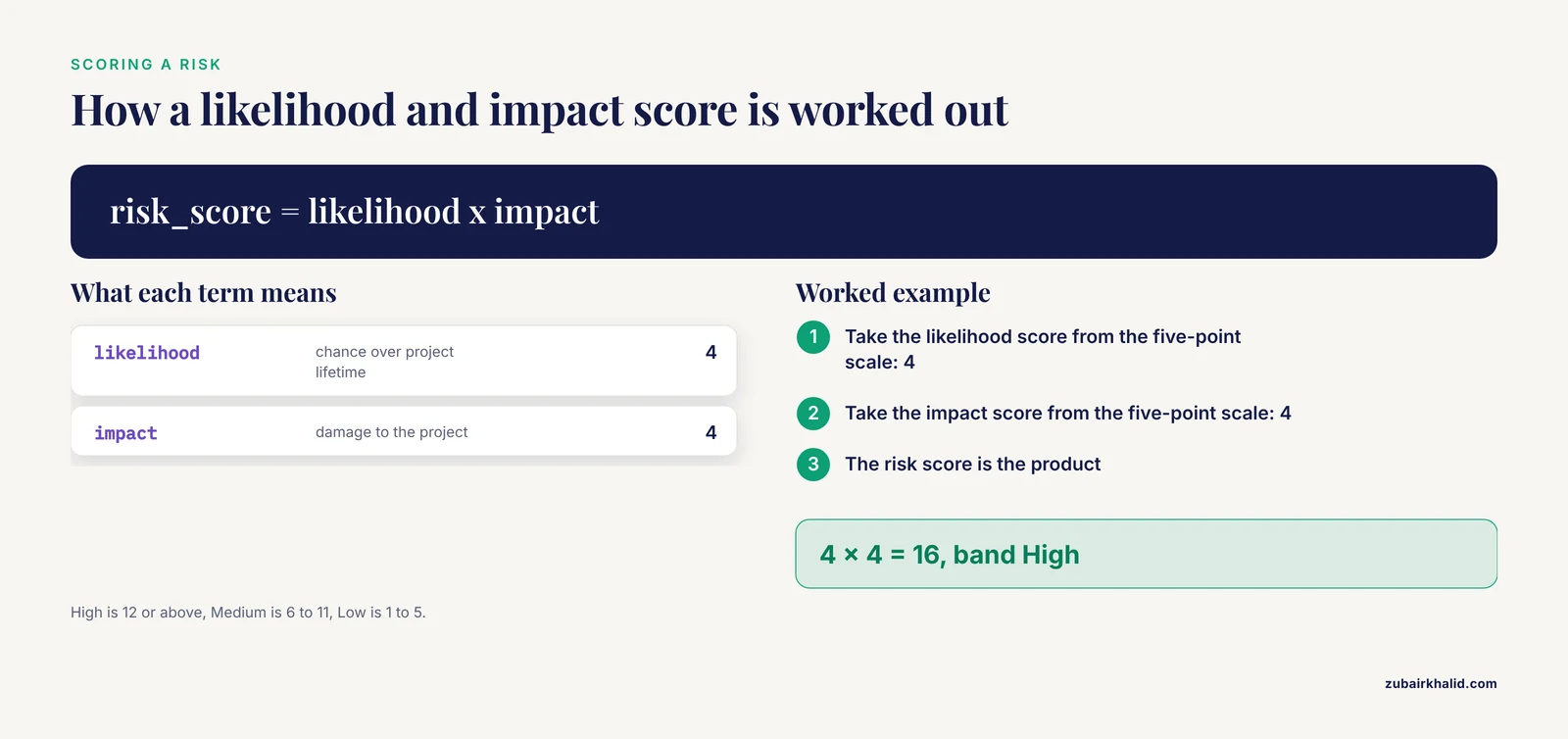
Score each risk on two five-point scales. Publish the scale definitions with the register so two people scoring the same risk independently get similar numbers. This mirrors the approach used in smart waste management risk assessment, where stakeholders rated risks using intensity and probability scores through questionnaires, followed by interviews and focus groups to interpret the results [5].
| Score | Likelihood over project lifetime | Impact on project |
|---|---|---|
| 1 | Rare, under 5 percent chance | Negligible, absorbed within normal operations |
| 2 | Unlikely, 5 to 25 percent | Minor, days of delay or a small budget line shift |
| 3 | Possible, 25 to 50 percent | Moderate, weeks of delay or one aim at risk |
| 4 | Likely, 50 to 75 percent | Major, an aim or milestone missed without intervention |
| 5 | Almost certain, above 75 percent | Severe, project viability or compliance threatened |
The risk score is the product:
risk_score = likelihood x impactA worked example: participant recruitment shortfall, likelihood 4, impact 4.
4 x 4 = 16The arithmetic is trivial. The value is in the two independent judgments the scale forces you to make, because a likely-but-mild risk and a rare-but-catastrophic risk need completely different responses even when a naive ranking treats them as similar.
Step 4: Prioritize with thresholds and a matrix
Bin the products into three bands:
High     : score 12 or above
Medium   : score 6 to 11
Low      : score 1 to 5
High risks get written mitigation plans, written contingency plans, named owners, and quarterly review. Medium risks get a named owner and a mitigation sketch. Low risks get logged and left alone.
Resist the urge to treat every high score as an emergency. A review of preoperative airway screening reframed the problem as individualized risk stratification, matching the intensity of assessment to pre-test probability, because universal screening thresholds generate false alarms that drive resource-intensive contingency plans for patients who were never truly high risk [6]. If your scoring pushes eight risks into the high band, your thresholds or your impact definitions are too generous, and every plan will compete for the same limited attention.
Step 5: Choose a response and write both plans
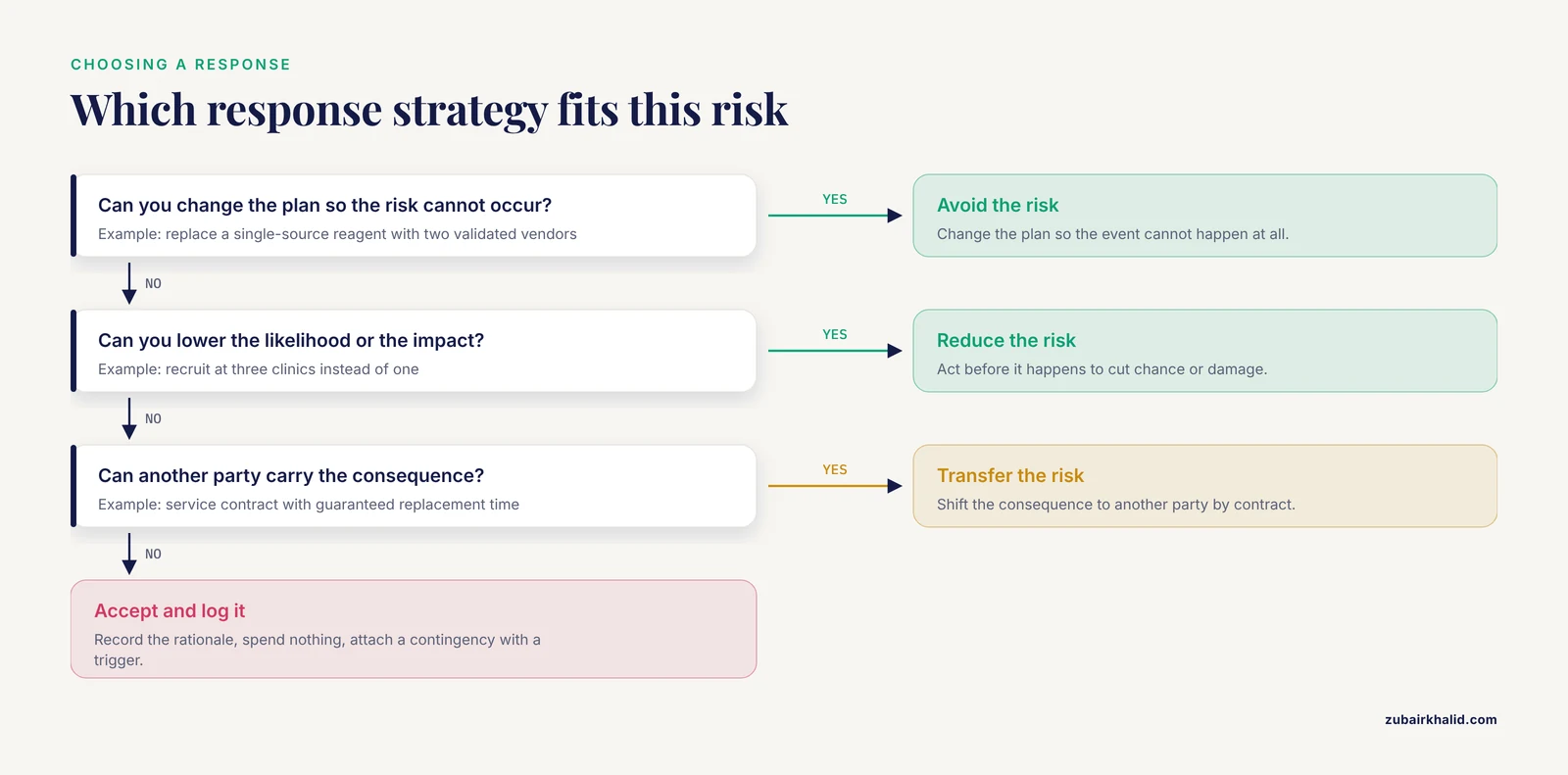
Every medium and high risk needs two plans, and confusing them is the most common structural error in new registers.
A mitigation plan lowers the likelihood or impact of the risk before anything happens. A contingency plan executes after the risk has already materialized, and it must have a trigger condition and a named decision maker. The distinction appears across domains. School safety research on an emergency during a school event found that preparedness had been assumed to transfer from routine classroom plans, and identified planning gaps, undefined roles, and missing contingency planning as the core failures, recommending event-specific protocols with clearly defined roles and coordinated supervision [7]. In anesthesia decision support, contingency planning is scored as its own dimension of decision quality, separate from the initial plan [8], which is a useful reminder that a contingency is a distinct artifact, not a footnote.
| Response strategy | What it means | Grant example |
|---|---|---|
| Avoid | Change the plan so the risk cannot occur | Replace a single-source reagent with a validated alternative from two vendors |
| Reduce | Lower likelihood or impact | Recruit participants at three clinics instead of one |
| Transfer | Shift the consequence to another party | Service contract with guaranteed replacement time on a shared cryostorage unit |
| Accept | Log the risk and its rationale, spend nothing | Minor risk of a one-week instrument service delay, buffer already in the timeline |
Every contingency needs a trigger you can observe. "If enrollment is below 50 percent of the month 12 target, the PI convenes the recruitment task force within five business days and activates the amended site list." A trigger without a number is a wish.
Step 6: Quantify what your mitigation actually buys
Where you can, attach numbers to the effect of a mitigation. In an occupational heat risk study across World Cup host cities, researchers quantified exceedance of recommended exposure limits across cities and work schedules, then showed that a concrete intervention, shading, lowered peak wet-bulb globe temperatures by roughly 2 to 3 degrees Celsius and substantially reduced the frequency of threshold exceedances [9]. The structure transfers directly to grants. If your baseline estimate is a 25 percent chance of falling short on enrollment, and adding a second recruitment site cuts that to 10 percent, write both numbers in the register. That turns the mitigation from an aspiration into a testable claim, and it tells you whether the mitigation is worth its cost in personnel time or budget.
Be honest about precision. Without baseline data, qualitative language such as "reduces likelihood from likely to possible" is more credible than a decimal point you invented.
Step 7: Assign owners, triggers, and a review cadence
Every risk above the low band gets exactly one named owner. Shared ownership is unowned. The owner maintains the mitigation, watches for the trigger, and reports at the review meeting. Review cadence for a typical three to five year award:
- Quarterly for all medium and high risks, 30 minutes appended to an existing lab or project meeting.
- Immediately, by email, whenever a trigger fires.
- Annually, a full re-scoring of the entire register, because likelihoods drift as the project matures. A recruitment risk that scored 4 in year one may score 2 by year three.
At each annual review, hold a short retrospective on any risk that actually occurred. A case study of an emergency at a special education school found that even after a serious event, the organization showed limited learning and did not translate the experience into structural change [7]. The cheap fix is a standing agenda item: what happened, did the plan work, and does this change any score in the register.
Step 8: Fold the register into your project plan and automate the scoring
The register earns its keep only if it lives inside your research project management workflow. Store it in the same repository as your timeline and milestones, link each high risk to the milestone it threatens, and review both together. If your project involves public contributors, include contingency and risk planning for that involvement as part of the planning itself, and assess the resource requirements realistically, as recommended in a reflective analysis of public involvement in a large NIHR research programme [10].
Here is a minimal risk register template as a CSV header you can paste into any spreadsheet:
risk_id,risk_statement,category,likelihood_1to5,impact_1to5,score,band,owner,mitigation,mitigation_effect,contingency,trigger,responsible_for_trigger,review_date,statusAnd here is a small Python 3 script that scores and sorts a register automatically:
import csv

risks = [
    ("R01", "Key personnel departure mid-project", 3, 4),
    ("R02", "Participant recruitment shortfall", 4, 4),
    ("R03", "Freezer failure destroys samples", 2, 5),
    ("R04", "Reagent supply disruption", 3, 3),
    ("R05", "Data breach or loss", 2, 5),
    ("R06", "Collaborator site delays data sharing", 3, 3),
]

def band(score):
    if score >= 12:
        return "High"
    if score >= 6:
        return "Medium"
    return "Low"

rows = sorted(
    [(r, r[2], r[11], r[1], r[11] * r[1], band(r[11] * r[1])) for r in risks],
    key=lambda row: row[4],
    reverse=True,
)

header = ("ID", "Risk", "L", "I", "Score", "Band")
print("{:<5}{:<38}{:>3}{:>3}{:>7}{:>8}".format(*header))
for row in rows:
    print("{:<5}{:<38}{:>3}{:>3}{:>7}{:>8}".format(*row))
Expected output:
ID   Risk                                   L  I  Score    Band
R02  Participant recruitment shortfall      4  4     16    High
R03  Freezer failure destroys samples       2  5     10   Medium
R01  Key personnel departure mid-project    3  4     12    High
R04  Reagent supply disruption              3  3      9   Medium
R05  Data breach or loss                    2  5     10   Medium
R06  Collaborator site delays data sharing  3  3      9   Medium
Wait, check the sort order in the output above against your own run. The script sorts strictly by score, so R01 at 12 prints above the 10s. A correct run prints R02 (16), R01 (12), then R03 and R05 at 10, then R04 and R06 at 9. If your output differs, the most common cause is a typo in the tuple order, where impact was entered before likelihood. Verify a single row by hand before trusting the whole table. For example, R01: likelihood 3 times impact 4 equals 12, band High.
A Research Project Plan Template With Risk Built In
A research project plan template that ignores risk is a schedule, not a plan. When you adapt any template to your funded project, add four columns to the milestone table: linked risk ID, the trigger condition, the contingency plan ID, and the owner. Then each milestone inherits its protection automatically.
A minimal template structure:
- Aims and milestones, with dates and responsible personnel.
- Milestone table with the four risk columns described above.
- The risk register, sorted by score, current as of the last quarterly review.
- A change log, one line per risk status change, trigger firing, or score revision, with dates.
The change log matters more than it looks. It is what converts a one-time document into organizational memory, and it is the evidence you can show a program officer or a renewal panel that the team managed the project rather than merely survived it.
Targeted prioritization also helps here. In geographic risk modeling of an invasive pathogen in Costa Rica, the authors did not just map national risk, they narrowed the output to the eight protected areas at greatest concern so monitoring resources could be concentrated [11]. Do the same with milestones. Attach your high risks to the specific aims and quarters they threaten, so quarterly reviews open on the two or three cells of the timeline where attention actually changes outcomes.
Grant Risk Assessment Research Tips
These are the habits that separate registers that get used from registers that get filed.
- Score independently, then reconcile. Have two people score the top ten risks separately before the workshop discussion. Large divergences usually mean the risk statement is ambiguous, not that one person is wrong.
- Separate collection from scoring in the workshop, as described above, so that scoring pressure does not suppress dissenting expert judgment [3].
- Vote anonymously when consensus stalls. The modified Delphi approach exists because open discussion lets senior voices dominate [4].
- Write contingencies for your highest risks even when they feel awkward. "If the co-investigator at the partner institution departs, the trigger is a signed resignation letter, and the contingency is activating the memorandum with the identified alternate site within 30 days."
- Integrate rather than multiply. If your institution already requires annual biosafety, data security, or conflict-of-interest reviews, fold those findings into the same register instead of maintaining a parallel process. Suppliers and operators interviewed in the Nordic water study reported concern about being overburdened with multiple overlapping guidelines and tools, which is exactly the failure mode of a standalone risk document [1].
- Give every plan a number you can check. A trigger like "recruitment is clearly behind" cannot fire. "Below 50 percent of the month 12 target" can.
- Re-score annually and after any major event. Scores are estimates of a moving target.
Common Mistakes and Limitations
These are the errors that show up repeatedly in first-time registers, and each one has a specific fix.
Scoring once and never again. A register written at the start of year one and reviewed at closeout documents nothing. The quarterly 30 minute review exists to prevent exactly this.
Every risk lands in the high band. If more than a third of your scored risks are high, recalibrate the impact definitions. Over-inclusive high bands generate the same problem seen in universal screening, where false alarms trigger resource-intensive contingency plans and erode attention for genuinely high-risk items [6].
Vague risk statements. "Data issues" cannot be scored, owned, or triggered. Rewrite in cause-event-consequence form or delete the row.
Contingencies without triggers or owners. A contingency plan with no observable trigger and no named decision maker is a paragraph, not a plan [7].
Assuming preparedness transfers. Teams often assume that because the lab has a general data backup policy, a specific dataset is protected, or because the clinic has general safety procedures, a specific off-site recruitment event is covered. Event-specific and setting-specific protocols are a repeated recommendation across safety planning reviews for exactly this reason [7].
Ignoring recruitment and involvement risks. Human subjects projects routinely treat enrollment as a certainty. Plan it as a risk with a scored likelihood, and include contingency and risk planning for public contributor involvement as well [10].
False precision. Reporting a mitigation effect as "reduces risk by 37 percent" without any baseline data is decoration. Use ordinal language until you have data, and quantify only what you can defend, the way the heat risk study quantified the measured temperature reduction from shading rather than estimating an abstract benefit [9].
No post-event learning. When a risk materializes, the retrospective agenda item is the whole payoff. Skipping it repeats the pattern of limited organizational learning documented after a real school emergency [7].
One final limitation applies to everything above. This article describes process, not outcomes for any specific project, and decisions about human subjects, biosafety, and data security on your award must also comply with your institution's own policies and your funder's terms and conditions, which take precedence over any general template.
Frequently Asked Questions
When should I conduct a risk assessment for a grant-funded project?
Run the first workshop during the pre-award or first 60 days of the award, then re-score annually. Early assessment lets mitigation choices shape the project plan, and embedding risk planning from the start is a recommended practice in large funded programs [10].
What is the difference between mitigation and contingency?
Mitigation reduces the likelihood or impact of a risk before it happens. Contingency is the pre-agreed action you take after the risk materializes, activated by an observable trigger and executed by a named owner.
How many risks should a grant risk register contain?
Most three to five year projects hold 10 to 25 rows. Fewer than 10 usually means categories were skipped, and more than 40 usually means the statement quality is too low, producing duplicate and fragmented rows.
What scoring scale should I use for likelihood and impact?
A five-point scale for each, with written definitions, multiplied to produce a score from 1 to 25. The specific numbers matter less than publishing the definitions so scores are reproducible across team members, consistent with the intensity and probability scoring used in structured stakeholder assessments [5].
How often should the risk register be reviewed?
Quarterly for medium and high risks, immediately when any trigger fires, and fully once per year. A review that only happens at renewal is a filing exercise.
Who should own each risk?
One named person per risk, chosen because they control the mitigation, not because they are senior. The principal investigator owns the register as a whole, not every individual row.
Should I share the risk register with my funder?
Share the summary of high risks and their plans when the funder requests a management plan or at reporting milestones, and keep the working register internal. Check your specific award terms, since requirements differ by agency and program.
What do I do about a high risk I cannot mitigate?
Score it honestly, choose the accept or transfer strategy, document the rationale, and attach a contingency plan with a trigger so the team responds fast if it fires. An accepted risk with a working contingency is managed, whereas an unexamined risk is not.
Sources
- Small water supplies in Nordic countries: climate change effects, risks and contingency planning.
- A Roadmap for Disaster Risk Reduction and Management in Kidney Care: A Scoping Review and Content Analysis.
- A participatory expert-based risk assessment to inform zoonotic disease surveillance in Cameroon: the case of Ebola virus disease and Rift Valley fever.
- Management of cardiometabolic risk in prostate cancer: expert consensus from Singapore and Malaysia.
- An AI-powered smart municipal waste management from the viewpoints of environmental, social, and governance.
- Beyond Mallampati: From Universal Bedside Tests to Precision Airway Risk Stratification.
- Why Safety Planning Matters in School Social Events: Lessons From a Special Education Case.
- Performance of Large Language Models in Complex Anesthesia Decision-Making: A Comparative Study of Four LLMs in High-Risk Patients.
- Occupational heat risk at the 2026 FIFA World Cup: implications for worker safety.
- Involvement of underserved 18-40 year olds living with early-onset type 2 diabetes in the M3 NIHR programme grant.
- Geographic risk assessment of Batrachochytrium salamandrivorans invasion in Costa Rica as a means of informing emergence management and mitigation.