Understanding Grant Review Criteria
By Dr. Zubair Khalid, DVM, MS, PhD ·

Reviewers score grant proposals against a published set of criteria, and the fastest way to improve your odds is to write to those criteria rather than to your own sense of what makes good science. The single biggest difference between funding systems is how many criteria they score and how explicitly they weight them. The NIH asks reviewers to grade five distinct criteria plus an overall impression. NSF asks for judgment on two broad criteria. Foundations and internal programs often use flexible, mission-driven rubrics. The rule of thumb for choosing where to invest your writing effort is simple. Read the funder's review instructions first, then allocate your word count, figures, and preliminary data to the criteria that reviewers are actually required to score.
This article walks through the major review frameworks side by side, explains each on its own terms, and shows how the criteria play out in real decisions. It also draws on published examples of structured evaluation in the life sciences, because grant review shares a core logic with peer review, evidence grading, and diagnostic test appraisal. When you understand how experts score anything with a rubric, you understand how your grant will be scored.
What Review Criteria Are and Why They Exist
Review criteria are the explicit questions a funding agency instructs its reviewers to answer about every proposal. They exist to make a messy process more consistent. A study section or review panel may contain fifteen to thirty scientists, most of whom have never met you, reading your application in a compressed window, often in the evening after their own lab work. Criteria give those strangers a shared checklist. They also give you a defense. If your significance is questioned during a panel discussion, you can point to the paragraph that addresses it directly.
Two features of real review systems matter for planning. First, scored criteria are usually rated individually before any overall impression is formed. A weak score on one criterion can drag an otherwise strong application down. Second, agencies publish not only the criteria but also the scale and the descriptors reviewers use. The NIH enhanced scoring scale, for example, runs from 1 to 9 for each criterion, where 1 is exceptional and 9 is poor. Knowing that scale changes how you write, because the difference between a 2 and a 3 on Approach is usually the difference between a design with clear controls and one with plausible-sounding but unspecified methods.
The logic of explicit scoring is not unique to grants. Across the life sciences, evaluators rely on structured instruments precisely because unstructured judgment varies. Systematic reviews of diagnostic artificial intelligence tools, for example, assess each included study with the QUADAS-2 checklist, a standardized tool for judging risk of bias in diagnostic accuracy research [1]. Reviews of prediction models use PROBAST for the same purpose [2]. Grant review criteria are the funding-world equivalent of these checklists, applied to a research plan instead of a published paper.
The Core Comparison: How Major Funders Score Proposals
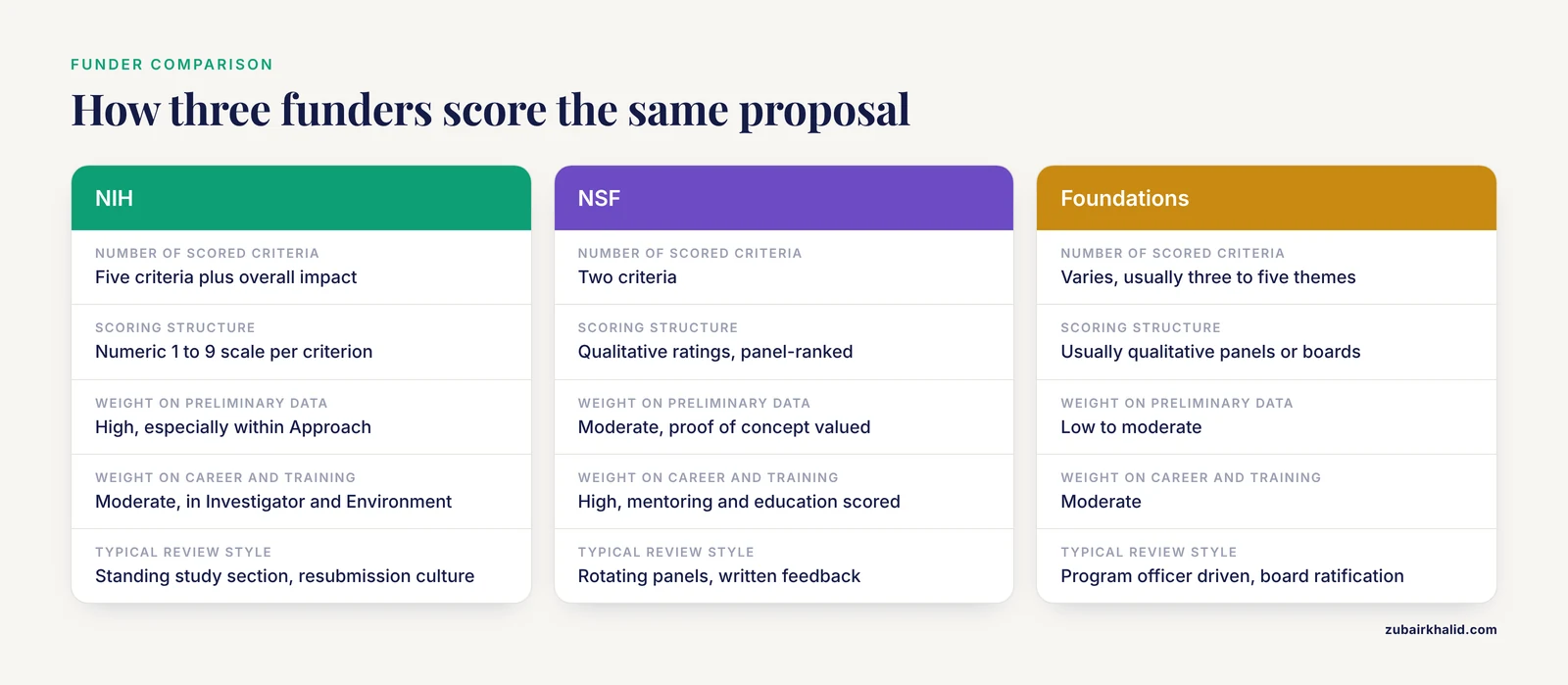
The table below summarizes the review criteria comparison that matters most for early-career life scientists in the United States. Treat the right-hand columns as planning targets. If your funder is not listed, look for its published review instructions, because nearly every agency and foundation posts them.
| Feature | NIH (R01-style project grants) | NSF (research directorate programs) | Private foundations | Internal / seed awards |
|---|---|---|---|---|
| Number of scored criteria | Five criteria plus overall impact | Two criteria | Varies, usually three to five mission-driven themes | Varies, often two to four institutional themes |
| Criteria names | Significance, Investigator(s), Innovation, Approach, Environment | Intellectual Merit, Broader Impacts | Mission alignment, scientific merit, feasibility, expected impact | Fit to seed program, feasibility, faculty development value |
| Scoring structure | Numeric 1 to 9 scale per criterion, then an overall impact score | Qualitative ratings with written comments, panel-ranked | Usually qualitative review panels or advisory boards | Departmental or internal committee review |
| Weight on preliminary data | High, especially within Approach | Moderate, proof of concept valued but not mandatory | Low to moderate, mission fit often outweighs data | Low, emphasis on enabling new directions |
| Weight on career and training | Moderate, embedded in Investigator(s) and Environment | High, mentoring plans and integration with education scored | Moderate | Very high, often the primary purpose of the award |
| Typical review style | Standing study section, scored discussion, resubmission culture | Rotating panels, unscored proposals receive written feedback | Program officer driven, board ratification | Local committee, fast turnaround |
No single column is the best grant review criteria comparison target for every applicant. The best framework is the one your chosen funder actually uses, and the pros and cons of each model describe how your effort gets spent.
NIH: Five Scored Criteria Plus Overall Impact
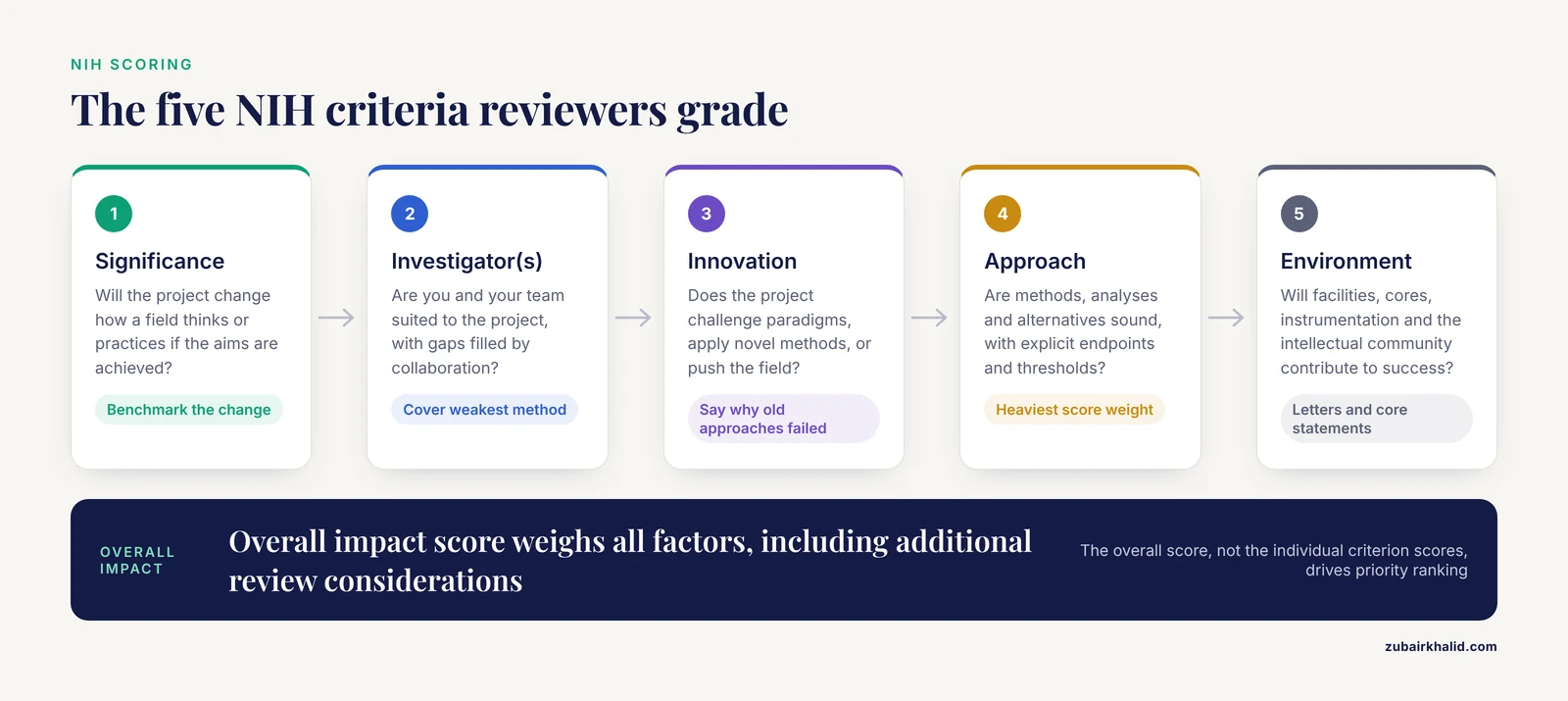
The NIH model is the most explicit of the major systems, which makes it the most instructive to study even if you never apply to NIH. Reviewers grade five criteria.
Significance. Will this project change how a field thinks or practices if the aims are achieved? Reviewers look for a problem stated in terms of its consequences, not just its description. A useful test from clinical research applies here. When the IMMPACT initiative set out to define what counts as a clinically meaningful treatment effect in pain trials, it concluded that between-group results must be interpreted case by case, in the context of existing treatments, rather than against a single universal threshold [3]. Strong significance sections do the same work. They benchmark the expected change against what the current standard achieves and explain why the increment matters.
Investigator(s). Are you and your team suited to the project? Reviewers weigh your publication record in the relevant area, your demonstrated command of the methods, and any gaps you fill through collaboration. Early-career applicants compensate for a short track record by showing targeted preliminary work and naming co-investigators who cover the weakest method in the plan.
Innovation. Does the project challenge existing paradigms, apply novel concepts or methods, or push the field in a new direction? Innovation is the criterion applicants most often misread. It does not require a brand-new technology. Applying an established method to a stalled problem counts, if you say plainly why the old approaches failed.
Approach. Are the methods, analyses, and alternative strategies sound? This criterion carries the heaviest score weight in most study sections and generates the most reviewer comments. Reviewers expect explicit endpoints, defined success thresholds, and preplanned alternatives. The cost of vague thresholds is well documented in the clinical literature. A review of fusion assessment after cervical spine surgery found that studies used either a 1 mm or a 2 mm interspinous motion threshold on flexion-extension radiographs, and this lack of standardization complicated cross-study comparison and influenced reported outcomes [4]. A reviewer who sees an endpoint with no stated threshold asks the same question about your aims. What number counts as success, and why that number?
Comparators deserve the same explicitness. A scoping review of single-arm trials that used objective performance criteria or performance goals as external comparators found that the comparability of design characteristics between the trials and their cited benchmark sources was often unclear, prompting the authors to call for careful justification of comparator selection [5]. In grant terms, if you promise to benchmark your results against an external standard or historical control, the reviewers will ask whether the populations, outcome definitions, and measurement time points actually match. Address that question in the Research Strategy before it is asked out loud.
Environment. Will the scientific and institutional setting contribute to success? Reviewers consider facilities, core services, instrumentation, and the intellectual community. This is where letters from collaborators, descriptions of core facilities, and statements about institutional support earn their space.
After the five criteria, reviewers assign an overall impact score that weighs all factors, including additional review considerations such as vertebrate animal use, biohazards, and resource sharing plans. The overall score, not the individual criterion scores, drives the priority ranking.
NSF: Two Criteria, Many Subquestions
NSF review compresses the logic into two criteria. Intellectual Merit asks whether the project advances knowledge within and across fields. Broader Impacts asks about societal benefits, education and training of researchers, broadening participation of underrepresented groups, and infrastructure or dissemination. Proposals are reviewed qualitatively, panels rank them in relative order, and unscored proposals typically receive a summary of written comments.
The practical difference from NIH is where you put your effort. An NSF proposal cannot outsource broader impacts to one paragraph at the end. Reviewers evaluate integration, meaning how training, outreach, and research aims reinforce each other. A graduate student designing a NSF-style plan should map every major activity to at least one of the two criteria and be able to say which one during a mock panel.
Foundations and Internal Awards
Private foundations and institutional seed programs score fewer criteria, but their criteria are usually non-negotiable in a way federal criteria are not. A foundation exists to advance a specific mission, and a proposal that does not map onto that mission will not advance regardless of scientific quality. Expect themes such as mission alignment, potential for the work to attract follow-on funding, feasibility within the award period, and benefit to the populations the foundation serves. Internal seed awards emphasize enabling new directions and generating the preliminary data needed for a federal application. For these programs, a crisp one-page aims page with a realistic timeline often matters more than a dense research narrative.
Criteria That Cut Across Every System
Whichever column of the table fits your situation, four cross-cutting expectations appear in nearly every review rubric. Master these once and you can adapt to any funder.
Explicit Inclusion and Exclusion Logic
Reviewers reward research plans that state exactly what will be studied and why. The clearest illustrations come from systematic review practice, where eligibility criteria are declared in advance and every screening decision traces back to them. A review of digital reminder systems for anti-rabies vaccination adherence registered its protocol in PROSPERO before searching, then screened 733 identified records down to twelve full-text assessments and three included studies using pre-specified criteria and validated quality tools [6]. A review of artificial intelligence for mesenchymal stromal cell quality assessment similarly registered its protocol prospectively, screened 3,872 records, and applied defined inclusion rules to arrive at 18 studies [2]. You do not need those numbers in your grant. You need the underlying habit. If your Aim 1 involves patient samples, state the inclusion and exclusion criteria, the recruitment source, and how many participants you expect to screen versus enroll. Reviewers read unspecified cohorts as unfunded risk.
Named, Validated Methods of Assessment
When your project involves evaluating anything, including itself, reviewers want to know which instrument or framework you will use. The vocabulary of quality assessment is standard in the life sciences and borrowing it strengthens an Approach section. Diagnostic accuracy studies are appraised with QUADAS-2 [1]. Prediction model studies are appraised with PROBAST [2]. Evidence quality across intervention studies can be graded with GRADE, as done in a recent consensus-driven review of preoperative imaging for uterovaginal prolapse repair, where GRADE ratings supported the development of formal guideline recommendations [7]. Writing that you will "assess study quality" earns a mediocre score. Writing that you will assess it with a named tool, applied by two independent reviewers, earns a better one, because it shows you know that assessment procedures themselves need criteria.
Structured Frameworks for Defining Success
Every funding agency wants to know what result would count as a win. Frameworks help you answer. The Population-Concept-Context framework used to structure a scoping review of vector flow imaging for carotid stenosis is a compact example, defining in one sentence who the population is, what concept the technology addresses, and in what contexts it applies [8]. The same three-part discipline applied to a specific aim produces an endpoint reviewers can score. Similarly, when a review needed to compare published 1 mm and 2 mm fusion thresholds, it pre-specified exactly which outcome measures, which radiographic criteria, and which patient-reported scales it would extract from each study [4]. That level of pre-specification is what reviewers mean when they ask for rigorous study design.
Honest Handling of Uncertainty and Citation Integrity
Reviewers are trained skeptics, and two behaviors reliably damage scores. The first is hiding limitations. Strong applications name the most likely failure points and give a contingency for each. The second is careless citation. Citation integrity is not a cosmetic issue. In a controlled evaluation of large language models used for academic writing in medicine, both tested models produced citations in every output, yet a substantial share of those citations were fabricated or inaccurate, and the open-source model fabricated far more than the proprietary one [9]. Whether you draft alone or with assistance, verify every reference before submission. A reviewer who checks one citation and finds it invented will distrust every other claim in the application.
Worked Scenarios
The abstract frameworks become concrete in three planning scenarios.
Scenario 1. A postdoctoral fellow preparing an NIH-style fellowship or first R01. The fellow has strong preliminary data from the host lab but no independent publications. Criteria weighting suggests this order of effort. Approach first, with a detailed experimental design, defined endpoints with numeric success thresholds, and a clearly labeled pitfalls-and-alternatives section. Significance second, benchmarked against the current state of practice rather than described in general terms. Investigator third, strengthened by preliminary data generated personally and by a co-mentor who covers the least familiar method. Innovation and Environment receive brief but sharp paragraphs. The overall impact paragraph at the start of the project narrative should preview, in one or two sentences each, how the application satisfies each scored criterion, because reviewers read that paragraph first and use it to organize their scores.
Scenario 2. An assistant professor preparing an NSF proposal. The professor works at the interface of materials chemistry and microbiology, an interdisciplinary space that NIH study sections sometimes struggle to place. NSF's two-criteria structure rewards integration. The research narrative should demonstrate command of methods on both sides of the interface, since reviewers on interdisciplinary panels probe whether the applicant truly owns each technique. Broader impacts should be designed as a program with named partners and measurable participation, not a list of good intentions. Because NSF panels rank proposals relatively, the aims page should make the intellectual contribution memorable enough to survive a long discussion of many proposals.
Scenario 3. A clinician-scientist approaching a disease-focused foundation. The applicant has a rigorous trial design but the foundation funds a specific condition the project only partially addresses. The mission-alignment criterion dominates. The winning move is to reframe the specific aims so the foundation's population sits at the center, and to demonstrate awareness of how that population's outcomes are meaningfully measured, drawing on established frameworks for clinical meaningfulness [3] rather than generic language about improving patient lives. Feasibility within the award period comes second. The foundation's program officer can tell you in one email which criterion carries the most weight, and applicants who ask that question consistently outperform those who guess.
Common Mistakes and Limitations
Writing one proposal and adapting it everywhere. The grant review criteria comparison in this article exists because funders differ. Copying an NIH-shaped Research Strategy into an NSF submission leaves Broader Impacts underdeveloped, and copying it into a foundation submission leaves mission alignment absent. Budget time to restructure, not just reformat.
Leaving success thresholds unstated. "We expect improved outcomes" is unscoreable. Define the metric, the direction, the magnitude, and the time point. The cross-study confusion caused by unstated or inconsistent thresholds in the spinal fusion literature [4] is a live demonstration of what reviewers worry about when aims lack numbers.
Confusing preliminary data with significance. Pages of pilot results do not substitute for a clear argument about why the expected result matters. Significance is judged against the external context of the field, not against the effort you invested. IMMPACT's framework makes this explicit by requiring contextual comparison against existing therapeutic options before any treatment effect can be judged meaningful [3].
Overloading the design. Reviewers consistently penalize plans with more aims than the timeline can support. Three tightly designed aims with realistic sample sizes outscore five sprawling ones. Every added aim dilutes reviewer attention and multiplies the methods you must defend.
Ignoring the "additional considerations." Vertebrate animal justification, biohazard plans, resource sharing, and data management are often scored or at minimum trigger comments. An otherwise strong application can acquire a damaging note when reviewers find these sections missing or generic.
Assuming criteria guarantee outcomes. Published criteria are necessary but not sufficient. Panel dynamics, the composition of the study section, the strength of the competing portfolio that cycle, and even the order of discussion influence results. Reviewer assignment, the choice of which scientists evaluate your proposal, is itself a source of variance no amount of writing fully controls. A fair reading of the evidence on expert evaluation, across grant panels, diagnostic appraisal, and manuscript review, is that structured criteria reduce but do not eliminate variability in judgment.
Treating review criteria as a mystery. Nearly every funder publishes its criteria, scale, and reviewer forms. The most common self-inflicted disadvantage in grant proposal planning is submitting before reading those documents. Set aside an hour per funder to annotate the instructions against your outline.
Frequently Asked Questions
Are all review criteria weighted equally?
No. Agencies tell you the criteria but rarely publish exact weights, and in practice weights shift by mechanism and panel. Within NIH review, Approach and Significance usually dominate the discussion for project grants, while Investigator(s) carries more weight for career development awards. Check the specific funding opportunity announcement, because program priorities can shift emphasis between cycles.
Can I see the exact questions reviewers will ask about my proposal?
Yes, in most public systems. NIH and NSF publish reviewer guidelines, scoring descriptors, and sample review forms on their websites. Foundations often share evaluation rubrics on request. Reading a sample critique of a funded application, which NIH makes available through its public examples, teaches the reviewer vocabulary faster than any secondary guide.
Do review criteria change between an original submission and a resubmission?
The criteria themselves stay the same, but reviewer attention changes. Resubmissions are judged in part on the response to prior criticism, so the introduction to the revised application should map each major reviewer concern to the specific change made. Unaddressed critiques are treated as unresolved risks rather than disagreements.
How do panels review interdisciplinary proposals?
Panels assign interdisciplinary proposals to reviewers whose expertise covers different slices of the work, and each reviewer scores the criteria through their own lens. This makes explicit writing your best defense. Define specialized terms in plain language, justify methods from adjacent fields rather than assuming shared knowledge, and name a consultant or co-investigator for any technique you do not perform in your own lab.
Is a research grant writing course worth taking?
For most early-career scientists, yes, if the course uses real review materials. The highest-value courses have you write an aims page, exchange it with peers, and score each other with the actual funder rubric. That exercise simulates the reviewer experience better than lectures do. Before enrolling, confirm the course covers your target funder's criteria, since a generic curriculum will not teach the NIH five-criteria structure or the NSF two-criteria structure specifically.
How far in advance should grant proposal planning start relative to the deadline?
Plan around the criteria, not just the calendar. A realistic minimum for a federal project grant is roughly three months from outline to submission, with the first third spent on the aims page and the funder's review instructions rather than the methods. The aims page drives everything downstream. Applications written method-first tend to sprawl, while applications written aims-first stay aligned with what reviewers are instructed to score.
Sources
- Diagnostic Performance of Artificial Intelligence in Detecting Periodontal Diseases Using Cone-Beam Computed Tomography: A Systematic Review.
- Artificial intelligence for stromal cell quality assessment: A systematic review of human mesenchymal stromal cell properties and viability.
- Evaluating IMMPACT Criteria for the Clinical Meaningfulness of Between-Group Differences: Interpreting Randomized Trial Results within a Context of Existing Chronic Pain Analgesics.
- Varying fusion criteria for anterior cervical discectomy and fusion: Is a 1-mm or 2-mm interspinous motion threshold associated with more favorable patient-reported outcomes?
- Are study design characteristics in single-arm trials comparable with those of their objective performance criteria or performance goals? A scoping review.
- Digital reminder systems for improving adherence to anti-rabies vaccination among animal bite victims: A systematic review.
- The Use of Preoperative Defecography and Magnetic Resonance Imaging in Patients Undergoing Surgery for Primary Uterovaginal Prolapse: A Systematic Review.
- Vector Flow Imaging for Carotid Artery Stenosis Assessment: A Scoping Review.
- Open-source versus proprietary large language models for academic writing in medicine: A controlled evaluation of DeepSeek-R1 and ChatGPT-o1 in neuroradiology.